| (19) |
 |
|
(11) |
EP 1 325 488 B1 |
| (12) |
EUROPEAN PATENT SPECIFICATION |
| (45) |
Mention of the grant of the patent: |
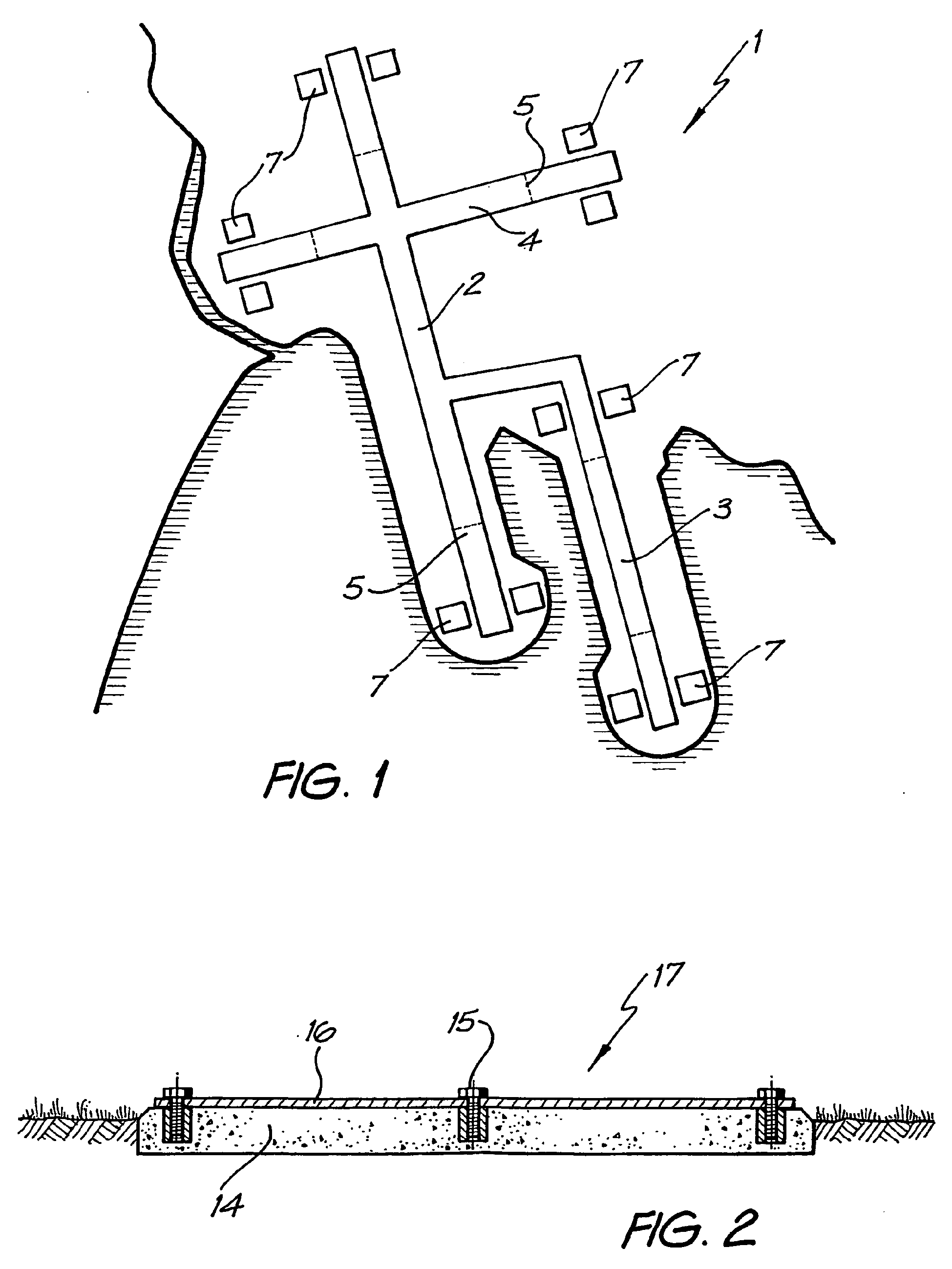
|
18.02.2009 Bulletin 2009/08 |
| (22) |
Date of filing: 16.08.2001 |
|
| (51) |
International Patent Classification (IPC):
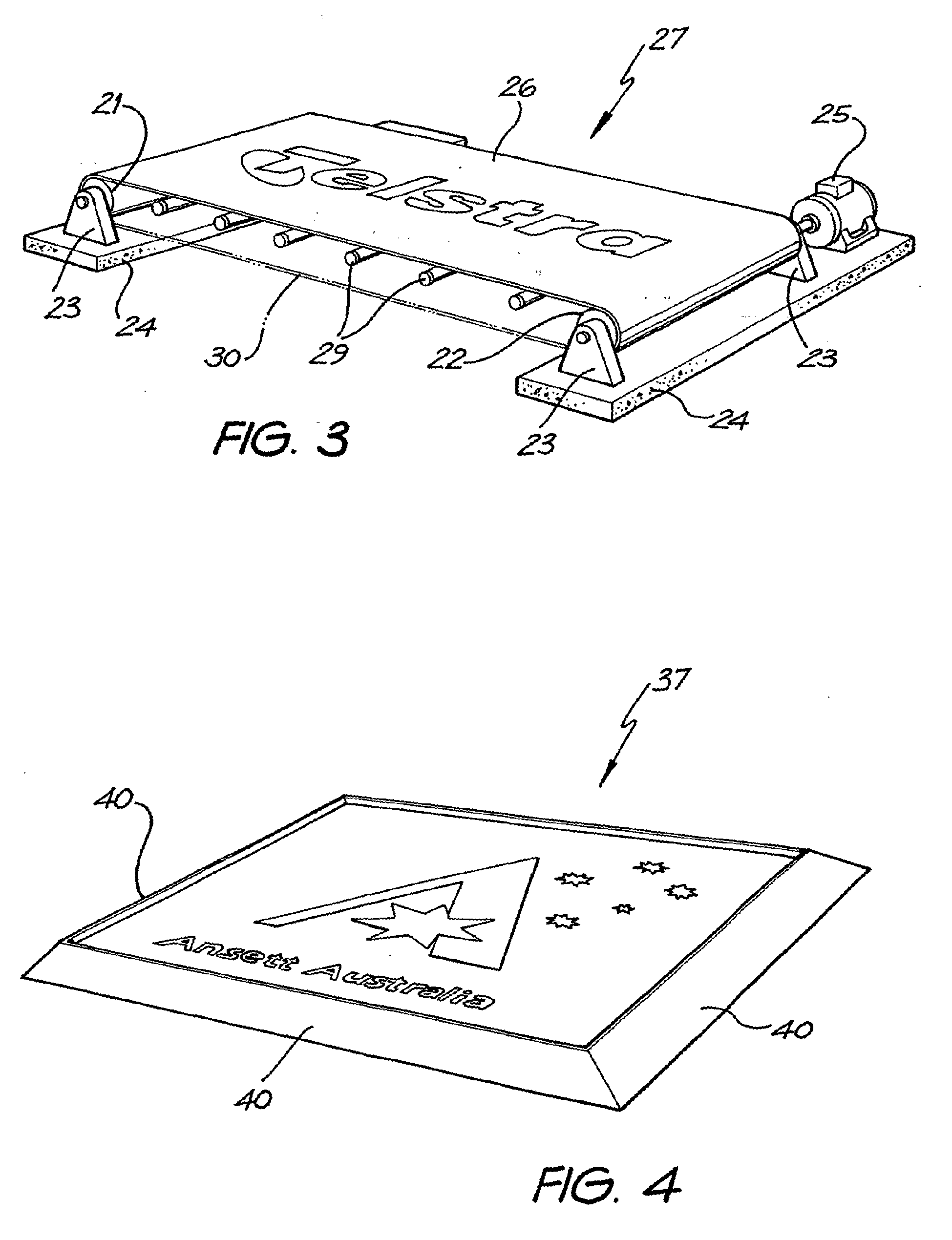
|
| (86) |
International application number: |
|
PCT/AU2001/001015 |
| (87) |
International publication number: |
|
WO 2002/015161 (21.02.2002 Gazette 2002/08) |
|
| (54) |
AN AIRPORT ADVERTISING SYSTEM
FLUGHAFEN-WERBESYSTEM
SYSTEME PUBLICITAIRE POUR AEROPORT
|
| (84) |
Designated Contracting States: |
|
AT BE CH CY DE DK ES FI FR GB GR IE IT LI LU MC NL PT SE TR |
| (30) |
Priority: |
16.08.2000 AU PQ945900
|
| (43) |
Date of publication of application: |
|
09.07.2003 Bulletin 2003/28 |
| (73) |
Proprietor: Denann Consultant Services Pty Ltd |
|
New South Wales 2517 (AU) |
|
| (72) |
Inventors: |
|
- WEBSTER, Warren, James
Harbord, NSW 2096 (AU)
- ROGAN, Denis
Bulli, NSW 2516 (AU)
|
| (74) |
Representative: Asquith, Julian Peter |
|
Marks & Clerk
4220 Nash Court
Oxford Business Park South
Oxford
Oxfordshire OX4 2RU
Oxford Business Park South
Oxford
Oxfordshire OX4 2RU (GB) |
| (56) |
References cited: :
EP-A- 0 479 697
WO-A-99/44840
CH-A- 689 320
US-A- 4 424 449
|
WO-A-98/14930
AU-A- 7 868 687
FR-A- 2 590 060
US-A- 5 815 966
|
|
| |
|
|
- DATABASE WPI Week 199926, Derwent Publications Ltd., London, GB; Class A93, AN 1999-308348,
XP002992848 & JP 11 106 685 A (NEMOTO TOKUSHU KAGAKU KK) 20 April 1999
|
|
| |
|
| Note: Within nine months from the publication of the mention of the grant of the European
patent, any person may give notice to the European Patent Office of opposition to
the European patent
granted. Notice of opposition shall be filed in a written reasoned statement. It shall
not be deemed to
have been filed until the opposition fee has been paid. (Art. 99(1) European Patent
Convention).
|
FIELD OF THE INVENTION
[0001] The present invention relates to airports and, in particular, to a system of displaying
advertising to aircraft passengers during take-off and/or landing of the aircraft
from the airport.
BACKGROUND ART
[0002] Airports are by definition divided into two zones, namely the "airside" and the "landside".
The airside is the area from which members of the public are excluded and includes
the runways, taxiing areas and apron. The "landside" is the remainder of the airport
to which the general public is permitted free access and egress. This includes the
terminals, car parks, taxi rank, etc.
[0003] It is well known that aircraft passengers represent a lucrative market and the provision
of advertising to aircraft passengers in aircraft terminals is a well established
business which enjoys a large turnover. Normally such display advertising takes the
form of large vertical billboards positioned on the walls of the interior of the airport
terminal. However, this advertising is restricted to the landside. As a consequence,
this advertising is only able to be seen by the aircraft passengers prior to embarkation
and after disembarkation and is unable to be seen during flight.
[0004] US Patent No. 5,815,966 (Vestevich) discloses a portable rooftop sign to be disposed in a horizontal position on the
roof of a multi-storey building. It is stated in this citation that the building is
preferably within five miles of an airport. In this way, passengers on aircraft approaching
or departing from an airport about five miles away can view the rooftop sign.
[0005] French Patent No.
2,590,060 (Lamarre) discloses a ground advertising display in the form of a laminate or sheet metal
having an indicia bearing surface. It is expressly noted that this type of display
has an application in parking areas, shopping arcades, airports, shops, stations,
etc.
OBJECT OF THE INVENTION
[0006] The object of the present invention is to extend the availability of advertising
to enable advertising to be displayed to aircraft passengers during take-offs and/or
landing and/or taxiing and thereby create a new advertising market. In particular,
the invention enables advertising to be displayed at locations in the airside.
SUMMARY OF THE INVENTION
[0007] In accordance with the invention there is provided a billboard and method as set
out in the accompanying claims.
BRIEF DESCRIPTION OF THE DRAWINGS
[0008] Several embodiments of the present invention will now be described with reference
to the drawings in which:
Fig. 1 is a plan view of Sydney's Kingsford-Smith Airport showing the locations of
the three runways,
Fig. 2 is a transverse vertical cross-section through a horizontal billboard in accordance
with one embodiment of the present invention,
Fig. 3 is a perspective view of a horizontal billboard in accordance with another
embodiment of the present invention, and
Fig. 4 is a view similar to Fig. 3 but showing a further embodiment of the present
invention having a peripheral skirt.
DETAILED DESCRIPTION
[0009] As seen in Fig. 1, Sydney's Kingsford-Smith Airport 1 has two north-south runways
2, 3 and an east-west runway 4 within the airside. Each runway has a central zone
intermediate two opposite distal ends. Intermediate the central portion and the distal
ends is a take-off/touch-down zone 5 indicated by dotted lines in Fig. 1. That is
to say, aircraft taking off approach the distal end of the runway and are airborne
at or about the zone 5 whilst aircraft coming in to land approach the central zone
of the runway and have landed by the time they reach the zone 5.
[0010] In accordance with a first embodiment, positioned alongside each of the runways 2,
3, 4 and between the distal end of the runway and the adjacent zone 5 is a large,
substantially horizontal billboard 7. In the embodiment illustrated in Fig.1 each
of the three runways has four billboards 7 so there are twelve billboards 7 in total.
[0011] Each of the billboards 7 has a dimension of approximately fifty metres by fifty metres
and is therefore approximately ¼ hectare in surface area. Such a size billboard is
easily able to be seen by aircraft passengers immediately prior to landing or immediately
after taking off.
[0012] In general the area alongside runways is grassed and must be generally free of obstructions
in order that there not be a collision with an obstruction should the aircraft happen
to leave the runway in an unintended direction. Most such grassed areas are regularly
mowed, however, sometimes they are fenced off and grazed. In all cases the general
public is denied access to the grassed areas. In order not to constitute an obstruction,
the billboards 7 should preferably be both substantially horizontal and also be mounted
close to the ground. In its simplest form, the billboard 7 could simply be formed
from the grass alongside the runway and the indicium or indicia which go to make up
the advertising can simply be painted on to the grass or the grass be dyed. However,
it is thought that this is generally unsatisfactory since the grassed areas alongside
airport runways are generally not very smooth and substantial upkeep is required for
such a site.
[0013] Therefore a second embodiment is to form the indicia on a low level prepared surface
other than grass. Examples of such prepared surfaces include spray sealed rolled profiles,
light construction asphalt, or concrete. The indicia are painted onto the prepared
surface. Such prepared surfaces incur a capital cost but reduce the maintenance costs
such as grass mowing.
[0014] A third, and more preferred embodiment is that illustrated in Fig. 2 where a billboard
17 is formed from a rigid sheet 16 which is anchored by bolts 15 into a cementitious
pad 14 formed from concrete or asphalt. In this way the sheet 16 is able to be provided
with bright colouring of a durable nature and therefore the upkeep of the billboard
17 is minimal.
[0015] It is apparent that the land surface in Fig. 2 is substantially level and therefore
so to is the sheet 16. However, if the land surface slopes then so too will the sheet
16. Thus the sheet 16 may be regarded as being substantially flush with the land surface.
[0016] In a still further embodiment as illustrated in Fig. 3, the billboard 27 is formed
from a flexible sheet 26 which extends between two rollers 21 and 22 which are mounted
in journals 23 which are in turn supported by a cementitious pad 24. A motor 25 enables
the roller 21 to be rotated in either direction.
[0017] The flexible sheet 26 carries an advertising sign. If desired, the advertising sign
can be back illuminated by means of elongate light fittings 29 positioned under the
sheet 26 at spaced apart locations.
[0018] As indicated by dotted lines in Fig. 3, if desired the flexible sheet 26 can take
the form of an endless loop 30 which enables two advertising signs to be alternatively
displayed in a regular automated fashion. Alternatively, the flexible sheet 26 can
consist of only a single sign in which case the sheet 26 is wrapped around each of
the rollers 21, 22 only by a small number of turns or even a fraction of a turn. In
a further possible arrangement, the flexible sheet 26 can be very long and can be
rolled from one roller 21 to the other roller 22, and then reversed. Such an arrangement
enables a long sequence of advertisements to be displayed in turn, and the sequence
then reversed.
[0019] Fig. 4 illustrates a still further embodiment of a billboard 37 which is essentially
the same as in Fig. 3 but is provided with a peripheral skirt which prevents wind
entering under the tensioned flexible sheet which forms the display surface of the
billboard 37.
[0020] The height of the billboards 17, 27, 37 above the ground is typically less than one
metre so there are several orders of magnitude difference between the height of the
billboard above the ground and the length of an edge of the billboard.
[0021] The foregoing describes only some embodiments of the present invention and modifications,
obvious to those skilled in the art, can be made thereto without departing from the
scope of the present invention. For example, the rigid sheet 16 can be formed from
a number of individual flush and abutting smaller sheets. Furthermore, the sheet 16
can be mounted at an inclined angle, preferably falling towards the adjacent runway,
in order to both enhance its visibility from the air and permit run-off of rainwater
from the sheet 16. In some instances the airside can include sloping surfaces, or
even man made hills, on which the billboard(s) can be located generally substantially
flush with the sloping surface. Generally such slopes would have a slope angle of
approximately 60° or less - being the slump angle of soil or the scree angle of weathered
debris.
[0022] In addition to being located as indicated in Fig. 1, the billboards 7 can also be
located adjacent taxiways (taxiing runways which inter-connect the airport terminal(s)
with the take off and landing runways 2, 3, and 4). In this way passengers can see
advertising whilst taxiing and, in particular, whilst delayed on taxiways waiting
for the take off runway to be cleared for take off.
[0023] The term "comprising" has used herein is used in the inclusive sense of "including"
or "having" and not in the exclusive sense of "consisting only of".
1. A substantially horizontal billboard (7) being substantially flush with a ground surface
and being dimensioned to be visible to aircraft passengers during take-off, landing
or taxiing of the aircraft, characterised in that the billboard is located within the airside of an airport adjacent to said runway
(2,3,4) or taxiway where said airside comprises at least one runway (2,3,4) and at
least one taxiway, and wherein said billboard (7) is positioned away from a straight
line of sight of a pilot of the aircraft during taxiing, landing or take-off.
2. The billboard as defined in claim 1 and located alongside the airport runway (2,3,4)
and adjacent a distal end of said runway beyond a touchdown/lift-off zone (5) of said
runway.
3. The billboard as defined in claim 1 and located adjacent a taxiway of the airport.
4. The billboard as defined in claim 2 and comprising at least one indicium formed on,
or adhered to, grass alongside said runway.
5. The billboard as defined in claim 4 wherein said indicium is formed by painting and
dyeing said grass.
6. The billboard as defined in claim 1 and comprising at least one indicium formed on,
or adhered to, a prepared surface of said airside.
7. The billboard as defined in claim 6 wherein said prepared surface is selected from
the group consisting of spray sealed and rolled profiles, light construction asphalt
and light construction concrete.
8. The billboard as defined in claim 1 comprising a layer of sheet material (16) mounted
closely adjacent the ground and anchoring means (15) interconnecting said sheet material
being dislodged from its mounted position.
9. The billboard as defined in claim 8 wherein said sheet material (16) is directly anchored
to said, ground.
10. The billboard as defined in claim 8 wherein said sheet material (16) is substantially
rigid and is bolted to a pad of hardened cementitious material (14) formed substantially
flush with said ground.
11. The billboard as defined in claim 1 comprising a pair of substantially parallel rollers
(21,22), means (23) to mount said rollers closely adjacent the ground, a pliant sheet
(30) extending around and between said rollers, and means to rotate at least one of
said rollers (21,22) and thereby tension said sheet (30).
12. The billboard as defined in claim 11 wherein said sheet (30) extends in an endless
loop between said rollers.
13. The billboard as defined in claim 11 and having a peripheral skirt (40) which substantially
excludes wind from beneath said pliant sheets.
14. The billboard as defined in claim 11 and having lighting means positioned below said
sheet.
15. A method of displaying advertising to aircraft passengers within an aircraft whilst
the aircraft is within an airport airside, said method characterised by comprising the step of locating a substantially horizontal billboard (7) at a location
within the airside adjacent a runway (2,3,4) or taxiway where said airside comprises
at least one runway (2,3,4) and at least one taxiway, said billboard (7) being positioned
substantially flush with a ground surface and being dimensioned to be visible to aircraft
passengers during at least one event selected from the group consisting of take-off,
landing and taxiing of the aircraft, wherein the billboard (7) is positioned away
from a straight line of sight of a pilot of the aircraft during taxiing, landing or
take-off.
16. The method as defined in claim 15 wherein wherein said location is alongside an airport
runway (2,3,4) adjacent a distal end of said runway beyond a touchdown/liftoff zone
(5) of said runway.
17. The method as claimed in claim 15 wherein said location is adjacent a taxiing route
of said aircraft.
18. The method as defined in claim 15 including the further step of repeatedly changing
the advertising displayed.
19. The method as defined in claim 15 including the further step of illuminating the billboard.
1. Eine im Wesentlichen waagerechte Werbetafel (7), die im Wesentlichen eben mit einer
Bodenfläche ist und die dimensioniert ist, um für Flugpassagiere beim Abheben, bei
der Landung oder beim Rangieren des Flugzeugs sichtbar zu sein, dadurch gekennzeichnet, dass sich die Werbetafel innerhalb der Airside eines Flughafens neben der Start- und Landebahn
(2, 3, 4) oder der Rollbahn befindet, wobei die Airside mindestens eine Start- und
Landebahn (2, 3, 4) und mindestens eine Rollbahn umfasst, und wobei die Werbetafel
(7) außerhalb einer direkten Sichtlinie eines Piloten des Flugzeugs während des Rangierens,
des Landens oder des Abhebens positioniert ist.
2. Werbetafel nach Anspruch 1, die sich entlang der Start- und Landebahn (2, 3, 4) des
Flughafens und neben einem distalen Ende der Start- und Landebahn jenseits einer Aufsetz-/Abhebzone
(5) der Start- und Landebahn befindet.
3. Werbetafel nach Anspruch 1, die sich neben einer Rollbahn des Flughafens befindet.
4. Werbetafel nach Anspruch 2, die mindestens ein Merkmal umfasst, das auf dem Gras entlang
der Start- und Landebahn gebildet ist oder daraufgeklebt ist.
5. Werbetafel nach Anspruch 4, wobei das Merkmal durch Färben und Tönen des Grases gebildet
ist.
6. Werbetafel nach Anspruch 1, die mindestens ein Merkmal umfasst, das auf einer vorbereiteten
Fläche der Airside gebildet ist oder daraufgeklebt ist.
7. Werbetafel nach Anspruch 6, wobei die vorbereitete Fläche ausgewählt ist aus der Gruppe
bestehend aus spritzgedichteten Walzprofilen, Leichtbauasphalt und Leichtbaubeton.
8. Werbetafel nach Anspruch 1, umfassend eine Schicht aus Blechmaterial (16), die dicht
am Boden angebracht ist und Verankerungsmittel (15), die das Blechmaterial, das aus
seiner angebrachten Position gelöst ist, verbindet.
9. Werbetafel nach Anspruch 8, wobei das Blechmaterial (16) direkt am Boden verankert
ist.
10. Werbetafel nach Anspruch 8, wobei das Blechmaterial (16) im Wesentlichen steif ist
und an eine Platte aus gehärtetem zementartigen Material (14), das im Wesentlichen
eben mit dem Boden gebildet ist, angeschraubt ist.
11. Werbetafel nach Anspruch 1, umfassend ein Paar im Wesentlichen paralleler Rollen (21,
22), Mittel (23), um die Rollen dicht am Boden anzubringen, eine biegsame Folie (30),
die sich um die Rollen herum und zwischen Letzteren erstreckt, und Mittel, um mindestens
eine der Rollen (21, 22) zu drehen und so die Folie (30) zu spannen.
12. Werbetafel nach Anspruch 11, wobei sich die Folie (30) in einer endlosen Schleife
zwischen den Rollen erstreckt.
13. Werbetafel nach Anspruch 11, wobei diese eine periphere Ummantelung (40) hat, die
im Wesentlichen Wind von unter den biegsamen Folien fernhält.
14. Werbetafel nach Anspruch 11, wobei diese Belichtungsmittel hat, die unter der Folie
positioniert sind.
15. Verfahren zum Anzeigen von Werbungen für Flugpassagiere im Flugzeug während sich das
Flugzeug in einer Flughafen-Airside befindet, wobei das Verfahren dadurch gekennzeichnet ist, dass es den Schritt des Anordnens einer im Wesentlichen waagerechten Werbetafel (7) an
einem Ort in der Airside neben einer Start- und Landebahn (2, 3, 4) oder Rollbahn
umfasst, wobei die Airside mindestens eine Start- und Landebahn (2, 3, 4) und mindestens
eine Rollbahn umfasst, wobei die Werbetafel (7) im Wesentlichen eben mit einer Bodenfläche
positioniert ist und dimensioniert ist, um für Flugpassagiere während mindestens eines
Vorgangs ausgewählt aus der Gruppe bestehend aus Abheben, Landung oder Rangieren des
Flugzeugs sichtbar zu sein, wobei die Werbetafel (7) außerhalb einer direkten Sichtlinie
eines Piloten des Flugzeugs während des Rangierens, des Landens oder des Abhebens
positioniert ist.
16. Verfahren nach Anspruch 15, wobei sich der Ort entlang einer Start- und Landebahn
(2, 3, 4) eines Flughafens neben einem distalen Ende der Start- und Landebahn jenseits
einer Aufsetz-/Abhebzone (5) der Start- und Landebahn befindet.
17. Verfahren nach Anspruch 15, wobei sich der Ort neben einer Rollbahn des Flugzeugs
befindet.
18. Verfahren nach Anspruch 15, einschließend den weiteren Schritt des ständigen Wechselns
der angezeigten Werbung.
19. Verfahren nach Anspruch 15, einschließend des weiteren Schritts des Beleuchtens der
Werbetafel.
1. Panneau publicitaire (7) substantiellement horizontal, substantiellement de niveau
avec une surface du sol et étant dimensionné pour être visible pour des passagers
dans un avion durant le décollage, l'atterrissage ou le roulage de l'avion, caractérisé en ce que le panneau publicitaire est situé du côté piste d'un aéroport à proximité de ladite
piste (2, 3, 4) ou aire de roulement où ledit côté piste comprend au moins une piste
(2, 3, 4) et au moins une voie de roulage, ledit panneau publicitaire (7) étant positionné
à l'écart d'une ligne droite de visée d'un pilote de l'avion durant le roulage, l'atterrissage
ou le décollage.
2. Panneau publicitaire selon la revendication 1 situé le long d'une piste d'aéroport
(2, 3, 4) et à proximité d'une extrémité distale de ladite piste au-delà d'une zone
de poser/décollage (5) de ladite piste.
3. Panneau publicitaire selon la revendication 1 et situé à proximité d'une zone de roulage
de l'aéroport.
4. Panneau publicitaire selon la revendication 2 et comprenant au moins une indication
formée sur ou adhérant à l'herbe longeant ladite piste.
5. Panneau publicitaire selon la revendication 4, dans lequel ladite indication est formée
par peinture et teinture de ladite herbe.
6. Panneau publicitaire selon la revendication 1, et comprenant au moins une indication
formée sur, ou adhérant à une surface préparée dudit côté piste.
7. Panneau publicitaire selon le revendication 6, dans lequel ladite surface préparée
est sélectionnée dans le groupe consistant en sections laminées et étanchéifiées par
pulvérisation, asphalte ou béton pour constructions à ossature légère.
8. Panneau publicitaire selon la revendication 1 comprenant une couche de matériau en
feuille (16) monté à proximité du sol et des moyens d'ancrage (15) interconnectant
ledit matériel en feuille délogé de sa position montée.
9. Panneau publicitaire selon la revendication 8 dans lequel ledit matériau en feuille
(16) est directement ancré audit sol.
10. Panneau publicitaire selon la revendication 8, dans lequel ledit matériau en feuille
(16) est substantiellement rigide et est boulonné sur un massif de matériau de ciment
durci (14) formé substantiellement de niveau avec ledit sol.
11. Panneau publicitaire selon la revendication 1, comprenant une paire de roulettes substantiellement
parallèles (21, 22), des moyens (23) pour monter lesdites roulettes à proximité du
sol, une feuille pliable (30) s'étendant autour et entre lesdites roulettes, et des
moyens pour faire tourner au moins une desdites roulettes (21, 22) et ainsi mettre
sous tension ladite feuille (30).
12. Panneau publicitaire selon la revendication 11, dans lequel ladite feuille (30) s'étend
en une boucle infinie entre lesdites roulettes.
13. Panneau publicitaire selon la revendication 11, comportant une jupe périphérique (40)
empêchant le vent de s'infiltrer sous lesdites feuilles pliables.
14. Panneau publicitaire selon la revendication 11, comportant des moyens d'illumination
positionnés au-dessous de ladite feuille.
15. Procédé pour afficher des publicités pour les passagers d'un avion se trouvant dans
l'avion lorsque l'avion est sur le côté piste d'un aéroport, ladite méthode étant
caractérisée par l'étape de mise en place d'un panneau publicitaire substantiellement horizontal (7)
dans un endroit du côté piste à proximité d'une piste (2, 3, 4) ou d'une piste de
roulage, ledit côté piste comprenant au moins une piste (2, 3, 4) et au moins une
piste de roulage, ledit panneau publicitaire (7) étant positionné substantiellement
de niveau avec une surface du sol et étant dimensionné de façon à être visible pour
les passagers d'un avion durant au moins un événement sélectionné dans le groupe constitué
du décollage, de l'atterrissage et du roulage de l'avion, le panneau publicitaire
(7) étant positionné à l'écart d'une ligne droite de visée d'un pilote de l'avion
durant le roulage, l'atterrissage ou le décollage.
16. Procédé selon la revendication 15, dans lequel ledit endroit est le long d'une piste
d'aéroport (2, 3, 4) à proximité d'une extrémité distale de ladite piste au-delà d'une
zone de poser/décollage (5) de ladite piste.
17. Procédé selon la revendication 15, dans lequel ledit endroit est à proximité d'une
voie de roulage dudit avion.
18. Procédé selon la revendication 15, incluant l'étape supplémentaire de changement répétitif
de la publicité affichée.
19. Procédé selon la revendication 15 incluant l'étape supplémentaire consistant en l'illumination
du panneau publicitaire.
REFERENCES CITED IN THE DESCRIPTION
This list of references cited by the applicant is for the reader's convenience only.
It does not form part of the European patent document. Even though great care has
been taken in compiling the references, errors or omissions cannot be excluded and
the EPO disclaims all liability in this regard.
Patent documents cited in the description