| (19) |
 |
|
(11) |
EP 1 338 722 B1 |
| (12) |
EUROPEAN PATENT SPECIFICATION |
| (45) |
Mention of the grant of the patent: |
|
26.07.2006 Bulletin 2006/30 |
| (22) |
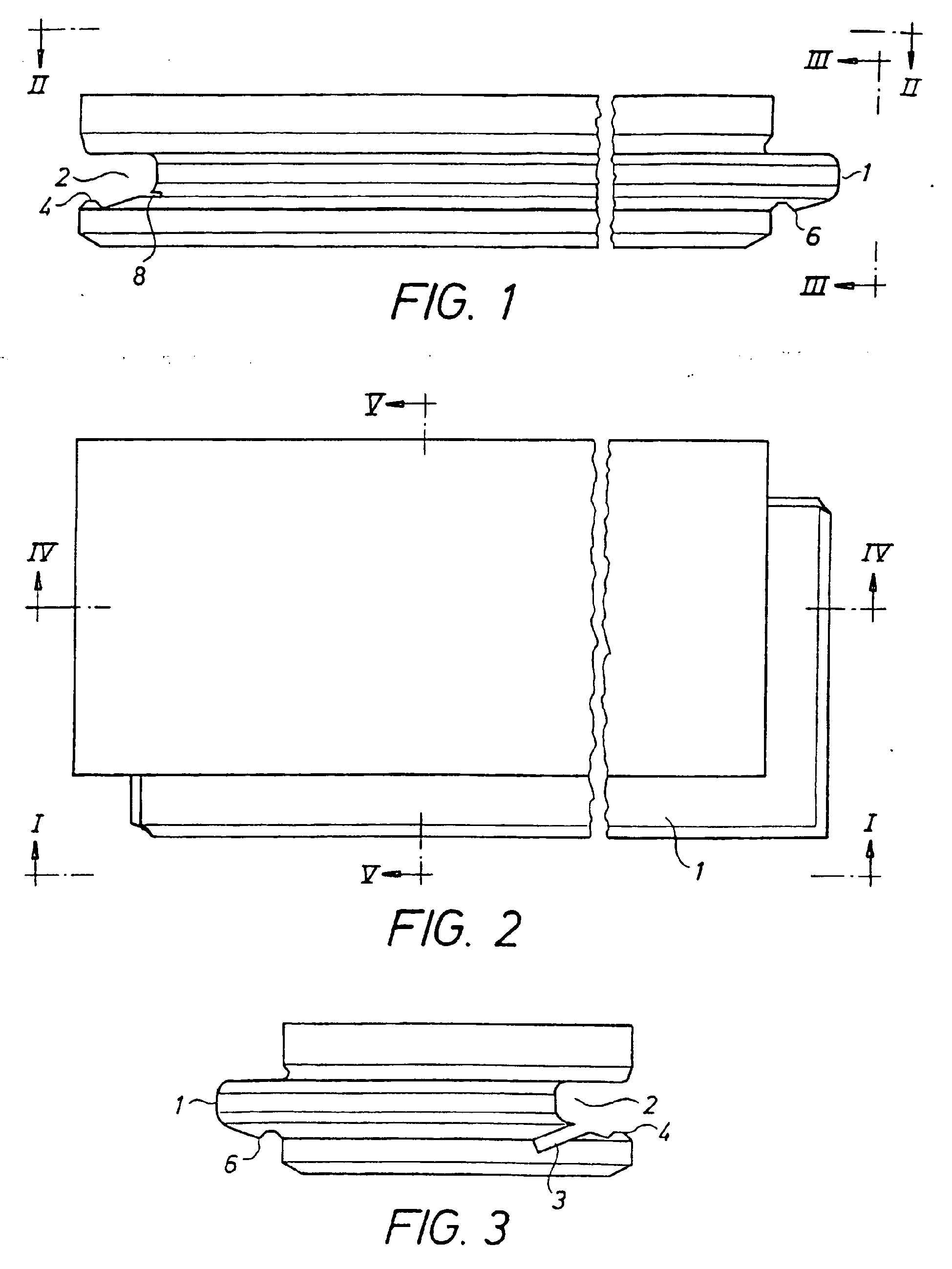
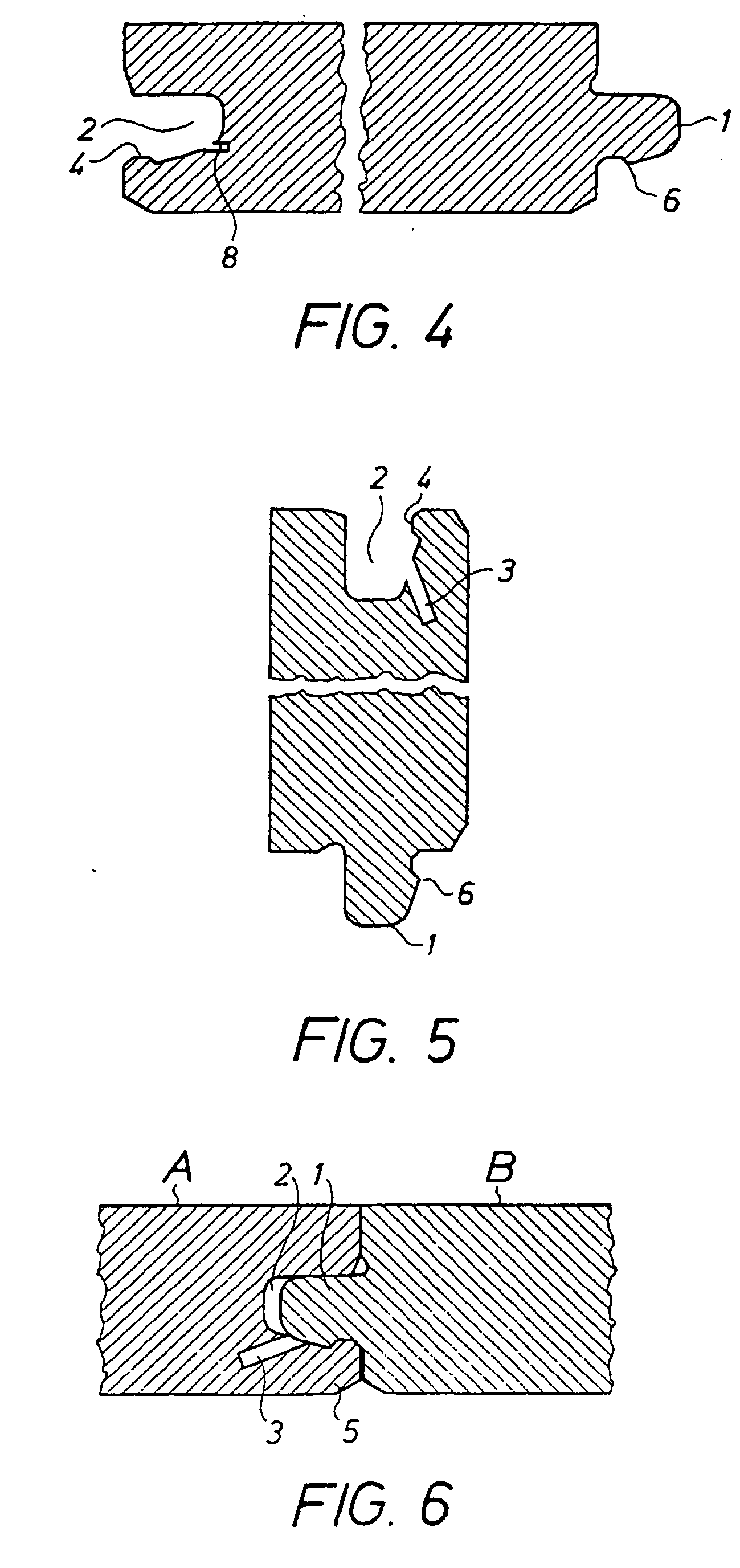
Date of filing: 02.10.2002 |
|
| (51) |
International Patent Classification (IPC):
|
|
| (54) |
A flooring system comprising floorboards and a method fo joining such floorboards
Fussbodensystem mit Fussbodenplatten und Verfahren zur Verbindung derartiger Platten
Système de revêtement de sol comprenant des planches de plancher et procédé d'assemblage
de telles planches
|
| (84) |
Designated Contracting States: |
|
AT BE BG CH CY CZ DE DK EE ES FI FR GB GR IE IT LI LU MC NL PT SE SK TR |
| (30) |
Priority: |
03.05.2002 DE 20207021 U
|
| (43) |
Date of publication of application: |
|
27.08.2003 Bulletin 2003/35 |
| (73) |
Proprietor: AB Berg & Berg |
|
372 52 Kallinge (SE) |
|
| (72) |
Inventor: |
|
- AB Berg & Berg
372 52 Kallinge (SE)
|
| (74) |
Representative: Akerman, Marten Lennart |
|
Albihns Malmö AB
Box 4289
203 14 Malmö
203 14 Malmö (SE) |
| (56) |
References cited: :
EP-A- 1 195 477
DE-A- 4 434 057
DE-U- 20 120 704
|
DE-A- 4 222 999
DE-C- 426 251
JP-A- 3 169 967
|
|
| |
|
|
|
|
| |
|
|
|
Remarks: |
|
The file contains technical information submitted after the application was filed
and not included in this specification |
|
| Note: Within nine months from the publication of the mention of the grant of the European
patent, any person may give notice to the European Patent Office of opposition to
the European patent
granted. Notice of opposition shall be filed in a written reasoned statement. It shall
not be deemed to
have been filed until the opposition fee has been paid. (Art. 99(1) European Patent
Convention).
|
FIEL OF THE INVENTION
[0001] The present invention relates to a joining system and method for floorboards, panels
and sheaves, but foremost for parquetry. The invention is an improvement of the traditional
groove and tenon technique. Through this, the joining will be very simple to perform,
whilst at the same time providing a strong joint.
STATE OF THE ART
[0002] The traditional groove and tenon technique for floorboards has been known in the
art for a long time. Furthermore, there are a number of alternative technical solutions
available with various shapes of protrusions and recesses.
[0003] DE A 44 34 057 discloses a heat insulation element with an insulation layer, preferably
of plastics, having a tongue and a groove allowing identical such boards to be joined
with each other. During assembly, a lip on one board is deformed and located in an
overlapping relationship with an adjoining board.
[0004] EP A 1 195 477 discloses a floorboard having on one side a tongue with a protrusion,
and on the other side a groove provided with a cavity having a shape complementary
to the protrusion allowing identical such boards to be joined with each other. During
assembly, the edges on both sides of the groove are deformed. The cavity is adjoining
a centrally located slot adapted to prevent the floorboard from cracking during use.
[0005] DE-U-20120704 discloses panel elements for floor laying, having various shapes of
mating grooves and tenons. The document shows two embodiments in figs. 10 and 12 where
cuts are provided in a recess. This recess is not intended for horizontal but vertical
floor laying, as it is directed upward and one panel element has to be placed on top
of another. The system described is intended for glueless laying, even though a glue
channel is mentioned in connection with the embodiment shown in fig. 1. This glue
channel is located on the top side of the tenon.
[0006] DE-U-20207021 is regarded as the closest prior art and the preambles of the independent
claims are based on this document. As stated therein, and is normal practice in the
art, it is customary to apply glue on top of the tenon or on the underside of the
groove (by turning the board and applying glue on the underside of the groove, now
directed upwards). If glue is applied in this manner, it might not reach the cut.
[0007] The aim of the invention is to allow for simple floor-laying that can easily be performed
by one person and to provide a stronger joint. At the same time, the board manufacturing
process shall not be made notably more complicated.
SUMMARY OF THE INVENTION
[0008] The invention thus relates to a flooring system, comprising boards intended to be
joined together. The first board has a groove fitting with a tenon in the second board.
[0009] Also, the first board has a groove provided with a rib on the top side of a lower
edge, and a second board has a tenon provided with a ridge on the underside. A cut
is provided in the inner, lower corner of the groove. With the glue application as
prescribed by the invention, the glue is allowed to collect in the cut, resulting
in a stronger joint.
[0010] The invention also relates to a corresponding board and a joining method for joining
such floor boards.
[0011] The invention is defined in the appended claims 1, 10 and 19, whereas preferred embodiments
are described in the dependent claims.
BRIEF DESCRIPTION OF THE DRAWINGS
[0012] The invention will be described in further detail below, with reference to the enclosed
drawings, of which:
- Fig. 1
- is a side view of a long side of a board according to one embodiment of the present
invention,
- Fig. 2
- is a top view of the board in Fig. 1,
- Fig. 3
- is a side view of a short side of the board in Fig. 1,
- Fig. 4
- is a partial cross-sectional view of the board along the line IV-IV in Fig. 2,
- Fig. 5
- is a partial cross-sectional view of the board along the line V-V in Fig. 2,
- Fig. 6
- a partial cross section view of two boards, taken from the short side thereof, joined
together, according to one embodiment of the present invention.
DETAILED DESCRIPTION OF EMBODIMENTS OF THE INVENTION
[0013] The invention will be illustrated by means of embodiments where the floorboards are
made of wood. It should be understood that other materials, such as laminates, plastic,
etc. could be used just as well.
[0014] The terms horizontal and vertical are used for describing directions in relation
to a board that is lying on a horizontal surface as in a typical floor. However, as
a matter of course, the invention is equally applicable to boards for wall and ceiling
panels in any direction.
[0015] In Figs 1 to 5, a board is shown in various views. The board may have an upper wear
layer of hardwood and a carrier layer of simpler wood, as is conventional.
[0016] Instead of a traditional tenon, the board exhibits a tenon 1 provided with a ridge
6 on the underside. The remainder of the shape is not critical and can for instance
be more rounded than shown. The board has a groove 2 provided with a rib 4. The groove
and the tenon are dimensioned to fit together as shown in figure 6. In the lower corner
of the groove, a cut 3 (Figs 3, 5, 6) is provided. The cut 3 is preferably angled
so that the inner end is lower than the opening. The angle from the horizontal is
in the range of 0-45°, preferably 5-25°, more preferred 5-15°, and most preferred
about 10°. The length of the cut is in the range of 1-15 mm, preferably 2-10 mm, more
preferred 2-7 mm, and most preferred about 7 mm. The cut is formed by sawing or milling.
The cut 3 enables the lower edge 5 of the groove 2 to spring down a small distance
when joning two boards together.
[0017] With reference to figure 6, the joining is performed as follows:
[0018] It should be understood that the boards A and B are identical, but Fig 6 shows only
the joint between a right hand long side of board A and a left hand long side of board
B.
[0019] Board A is laid in place and is to be joined with the next board B.
[0020] Board B is laid on the existing ground next to board A in such a way that the tenon
1 is located straight in front of the groove 2 of board A. It is now easy to push
or knock the boards together e.g. by means of a mallet and a block, similar to the
case with the traditional groove and tenon. Thereby the ridge 6 on the tenon 1 will
pass over the rib 4 pressing the lower edge 5 of the groove downward. When the tenon
has passed into the groove 2 the lower edge 5 will spring back locking the ridge 6
behind the rib 4.
[0021] A joint having sufficient strength may be obtained without glue but an even stronger
joint is achieved by applying glue before the boards are knocked together. The glue
may be applied e.g. on top of the tenon 1 or on the underside of the the top edge
of the groove 2, or both, an is applied, according to the invention, in the cut 3
in a liberal amount. The glue will then be located between the top side of the tenon
1 and the underside of the the top edge of the groove 2. Embodiments without glue
in the cut are not claimed, but are described for a better understanding of the invention.
[0022] Thanks to the cut 3 (and cut 8, see below), the amount of glue is not critical. In
the prior art, if too much glue was applied, the excess amount would be pressed out
from the joint and spread on top of the floor which could leave stains even if wiped
off immediately. More importantly, there is a risk of a hydraulic action from the
excess glue, resulting in a force in the bottom of the groove that prevents the boards
from being knocked together properly. On the other hand, if too little glue was applied,
the joint would be weaker.
[0023] In the present invention, a liberal amount of glue can be applied without risk. A
fairly large excessive amount of glue (up to 100% more than the effective amount)
will collect in the cut 3. Thus, the hydraulic action is avoided and the glue does
not exit the joint. In fact, when the glue is cured, the excess glue located in the
cut will make the cut less resilient resulting in a joint having greater strength.
[0024] As is shown in the figures, the short sides of the boards may be provided with a
similar profile as defined above. However, the cut 8 in the short sides (Figs 1, 4)
is preferably not angled. The length of the cut is in the range of 0-3 mm, and most
preferred about 2 mm. Alternatively, the short sides of the boards may be provided
with conventional groove-and-tenon joints (or another well known system).
[0025] The illustrated embodiments may be varied e.g. through modification of the thickness
of the wear and carrier layers, the angles and configuration of the groove and tenon,
the width and the length of the boards, etc., all of which should be obvious to a
person skilled in the art. The scope of the invention will only be limited by the
appended claims.
1. A flooring system, comprising boards (A, B) intended to be joined with each other,
wherein a first board (A) has a groove (2) provided with a rib (4) on the top side
of a lower edge (5), and a second board (B) has a tenon (1) provided with a ridge
(6) on the underside, said first board (A) and second board (B) being adapted to be
joined with each other by being forced together, thereby letting the ridge (6) on
the tenon (1) pass over the rib (4) pressing the lower edge (5) of the groove (2)
downward, and, when the tenon (1) has passed into the groove (2), letting the lower
edge (5) spring back locking the ridge (6) behind the rib (4), and wherein the groove
(2) and the tenon (1) are parallel with a top flat side of the boards, a cut (3) being
provided in the inner, lower corner of the groove (2) characterised in that glue is applied so that uncured glue is collected in the cut (3) and thus carried
by the first board (A).
2. A flooring system according to claim 1, wherein the cut (3) is angled so that the
inner end of the cut is lower than the opening of the cut.
3. A flooring system according to claim 2, wherein the cut (3) is angled about 5-15°.
4. A flooring system according to claim 2, wherein the cut (3) is angled about 10°.
5. A flooring system according to any one of claims 1 to 4, wherein the length of the
cut is in the range of 1-15 mm.
6. A flooring system according to any one of claims 1 to 4, wherein the length of the
cut is in the range of 2-7 mm.
7. A flooring system according to any one of claims 1 to 4, wherein the length of the
cut is about 7 mm.
8. A flooring system according to any one of claims 1 to 7, wherein the short sides of
the boards are provided with grooves and tenons fitting into each other.
9. A flooring system according to claim 8, wherein the grooves on the shorts sides are
provided with ribs (4) on the top side of a lower edge and the tenons on the shorts
sides are provided with ridges (6) on the underside, and cuts (8) are provided in
the inner, lower corner of the grooves (2).
10. A floorboard for a joining system, having a groove (2) on a first long side of the
board, and a tenon (1) on a second long side of the board, wherein the groove (2)
is provided with a rib (4) on the top side of a lower edge and the tenon (1) is provided
with a ridge (6) on the underside, identical such boards being adapted to be joined
with each other by being forced together, thereby letting the ridge (6) on the tenon
(1) pass over the rib (4) pressing the lower edge (5) of the groove (2) downward,
and, when the tenon (1) has passed into the groove (2), letting the lower edge (5)
spring back locking the ridge (6) behind the rib (4), and wherein the groove (2) and
the tenon (1) are parallel with a top flat side of the board, a cut (3) being provided
in the inner, lower corner of the groove (2) characterised in that glue is applied so that uncured glue is collected in the cut (3) and thus carried
by the board.
11. A floorboard according to claim 10, wherein the cut (3) is angled so that the inner
end of the cut is lower than the opening of the cut.
12. A floorboard according to claim 11, wherein the cut (3) is angled about 5-15°.
13. A floorboard according to claim 11, wherein the cut (3) is angled about 10°.
14. A floorboard according to any one of claims 10 to 13, wherein the length of the cut
is in the range of 1-15 mm.
15. A floorboard according to any one of claims 10 to 13, wherein the length of the cut
is in the range of 2-7 mm.
16. A floorboard according to any one of claims 10 to 13, wherein the length of the cut
is about 7 mm.
17. A floorboard according to any one of claims 10 to 16, wherein one short side of the
board is provided with a groove and the other short side of the board is provided
with a tenon, allowing identical such boards to be joined with each other.
18. A floorboard according to claim 17, wherein the groove on the short side is provided
with a rib (4) on the top side of a lower edge and the tenon on the short side is
provided with a ridge (6) on the underside, and a cut (8) is provided in the lower,
inner corner of the groove (2).
19. A method of joining floor boards, using boards (A, B) intended to be joined with each
other, wherein a first board (A) has a groove (2) provided with a rib (4) on the top
side of a lower edge, and a second board (B) has a tenon (1) provided with a ridge
(6) on the underside, wherein the groove (2) and the tenon (1) are parallel with a
top flat side of the boards, a cut (3) being provided in the inner, lower corner of
the groove (2), characterised in that it comprises the steps of: laying a first board (A) in place;
laying a second board (B) next to board (A) in such a way that the tenon (1) is located
straight in front of the groove (2) of board (A);
applying glue so that uncured glue is collected in the cut (3);
forcing the boards together, thereby letting the ridge (6) on the tenon (1) pass over
the rib (4) pressing the lower edge (5) of the groove downward;
and, when the tenon has passed into the groove (2), letting the lower edge (5) spring
back locking the ridge (6) behind the rib (4).
20. A method of joining floor boards according to claim 19, wherein the glue is applied
on top of the tenon (1).
1. Fußbodensystem, das Dielen (A, B) umfasst, die bestimmungsgemäß miteinander verbunden
werden, wobei eine erste Diele (A) eine Nut (2), die mit einer Rippe (4) an der Oberseite
einer unteren Kante versehen ist, aufweist und eine zweite Diele (B) einen Zapfen
(1), der mit einem Steg (6) an der Unterseite versehen ist, aufweist, wobei die erste
Diele (A) und die zweite Diele (B) dafür ausgelegt sind, durch Zusammendrücken miteinander
verbunden zu werden, so dass der Steg (6) am Zapfen (1) über die Rippe (4), die die
untere Kante (5) der Nut (2) nach unten drückt, gleiten lässt, und dann, wenn der
Zapfen (1) in die Nut (2) gelangt ist, die unter Kante (5) zurückspringen lässt, wodurch
der Steg (6) hinter der Rippe (4) einrastet, und wobei die Nut (2) und der Zapfen
(1) parallel mit einer oberen flachen Seite der Dielen sind, und ein Schlitz (3) in
der inneren unteren Ecke der Nut (2) vorgesehen ist, dadurch gekennzeichnet, dass Klebstoff so aufgetragen wird, dass ungehärteter Klebstoff im Schlitz (3) gesammelt
wird und somit von der ersten Diele (A) getragen wird.
2. Fußbodensystem nach Anspruch 1, wobei der Schlitz (3) so angewinkelt ist, dass das
innere Ende des Schlitzes tiefer liegt als die Öffnung des Schlitzes.
3. Fußbodensystem nach Anspruch 2, wobei der Schlitz (3) etwa 5 bis 15° angewinkelt ist.
4. Fußbodensystem nach Anspruch 2, wobei der Schlitz (3) etwa 10° angewinkelt ist.
5. Fußbodensystem nach irgendeinem der Ansprüche 1 bis 4, wobei die Länge des Schlitzes
im Bereich von 1―15 mm liegt.
6. Fußbodensystem nach irgendeinem der Ansprüche 1 bis 4, wobei die Länge des Schlitzes
im Bereich von 2-7 mm liegt.
7. Fußbodensystem nach irgendeinem der Ansprüche 1 bis 4, wobei die Länge des Schlitzes
etwa gleich 7 mm ist.
8. Fußbodensystem nach irgendeinem der Ansprüche 1 bis 7, wobei die kurzen Seiten der
Dielen mit Nuten und Zapfen versehen sind, die ineinander passen.
9. Fußbodensystem nach Anspruch 8, wobei die Nuten an den kurzen Seiten mit Rippen (4)
an der Oberseite einer unteren Kante versehen sind und die Zapfen an den kurzen Seiten
mit Stegen (6) an der Unterseite versehen sind, und Schlitze (8) in der inneren unteren
Ecke der Nuten (2) vorgesehen sind.
10. Fußbodendiele für ein Verbindungssystem, die eine Nut (2) an einer ersten langen Seite
der Diele und einen Zapfen (1) an einer zweiten langen Seite der Diele aufweist, wobei
die Nut (2) mit einer Rippe (4) an der Oberseite einer unteren Kante versehen ist
und der Zapfen (1) mit einem Steg (6) an der Unterseite versehen ist, wobei derartige
identische Dielen dafür ausgelegt sind, durch Zusammendrücken miteinander verbunden
zu werden, so dass der Steg (6) am Zapfen (1) über die Rippe (4), die die untere Kante
(5) der Nut (2) nach unten drückt, gleiten lässt, und dann, wenn der Zapfen (1) in
die Nut (2) gelangt ist, die unter Kante (5) zurückspringen lässt, wodurch der Steg
(6) hinter der Rippe (4) einrastet, und wobei die Nut (2) und der Zapfen (1) parallel
mit einer oberen flachen Seite der Dielen sind, und ein Schlitz (3) in der inneren
unteren Ecke der Nut (2) vorgesehen ist, dadurch gekennzeichnet, dass Klebstoff so aufgetragen wird, dass ungehärteter Klebstoff im Schlitz (3) gesammelt
wird und somit von der Diele getragen wird.
11. Fußbodendiele nach Anspruch 10, wobei der Schlitz (3) so angewinkelt ist, dass das
innere Ende des Schlitzes tiefer liegt als die Öffnung des Schlitzes.
12. Fußbodendiele nach Anspruch 11, wobei der Schlitz (3) etwa 5 bis 15° angewinkelt ist.
13. Fußbodendiele nach Anspruch 11, wobei der Schlitz (3) etwa 10° angewinkelt ist.
14. Fußbodendiele nach irgendeinem der Ansprüche 10 bis 13, wobei die Länge des Schlitzes
im Bereich von 1―15 mm liegt.
15. Fußbodendiele nach irgendeinem der Ansprüche 10 bis 13, wobei die Länge des Schlitzes
im Bereich von 2―7 mm liegt.
16. Fußbodendiele nach irgendeinem der Ansprüche 10 bis 13, wobei die Länge des Schlitzes
etwa gleich 7 mm ist.
17. Fußbodendiele nach irgendeinem der Ansprüche 10 bis 16, wobei eine kurze Seite der
Diele mit einer Nut versehen ist und die andere kurze Seite der Diele mit einem Zapfen
versehen ist, was erlaubt, dass derartige identische Dielen miteinander verbunden
werden.
18. Fußbodendiele nach Anspruch 17, wobei die Nut an der kurzen Seite mit einer Rippe
(4) an der Oberseite einer unteren Kante versehen ist und der Zapfen an der kurzen
Seite mit einem Steg (6) an der Unterseite versehen ist, und wobei ein Schlitz (8)
in der unteren, inneren Ecke der Nut (2) vorgesehen ist.
19. Verfahren zum Verbindung von Fußbodendielen, das Dielen (A, B) verwendet, die bestimmungsgemäß
miteinander verbunden werden, wobei eine erste Diele (A) eine Nut (2) aufweist, die
mit einer Rippe (4) an der oberen Seite einer unteren Kante versehen ist, und eine
zweite Diele (B) einen Zapfen (1) aufweist, der mit einem Steg (6) an der Unterseite
versehen ist, wobei die Nut (2) und der Zapfen (1) parallel zu einer oberen flachen
Seite der Dielen sind, und wobei ein Schlitz (3) in der inneren, unteren Ecke der
Nut (2) vorgesehen ist,
dadurch gekennzeichnet, dass es die Schritte umfasst:
Verlegen einer ersten Diele (A);
Verlegen einer zweiten Diele (B) neben der Diele (A), derart, dass der Zapfen (1)
unmittelbar vor der Nut (2) der Diele (A) angeordnet ist;
Auftragen von Klebstoff, so dass ungehärteter Klebstoff im Schlitz (3) gesammelt wird;
Zusammendrücken der Dielen, um somit den Steg (6) am Zapfen (1) über die Rippe (4),
die die untere Kante (5) der Nut nach unten drückt, gleiten zu lassen;
und dann, wenn der Zapfen in die Nut (2) gelangt ist, Zurückfedernlassen der unteren
Kante (5), wodurch der Steg (6) hinter der Rippe (4) einrastet.
20. Verfahren zum Verbinden von Fußbodendielen nach Anspruch 19, wobei der Klebstoff auf
der Oberseite des Zapfens (1) aufgetragen wird.
1. Système de revêtement de sol, comprenant des planches (A, B), prévues pour être jointes
les unes aux autres, dans lequel une première planche (A) comporte une rainure (2)
présentant une nervure (4) sur la face supérieure d'un bord inférieur (5), et une
deuxième planche (B) comporte un tenon (1) présentant un relief (6) sur la face inférieure,
la dite première planche (A) et la dite deuxième planche (B) pouvant être jointes
l'une à l'autre par rapprochement forcé, de manière à ce que le relief (6) du tenon
(1) franchisse la nervure (4) en pressant le bord inférieur (5) de la rainure (2)
vers le bas et, lorsque le tenon (1) a pénétré dans la rainure (2), le bord inférieur
(5) revient élastiquement et bloque le relief (6) derrière la nervure (4), et dans
lequel la rainure (2) et le tenon (1) sont parallèles à une face supérieure plane
des planches, une entaille (3) étant prévue dans l'angle intérieur inférieur de la
rainure (2), caractérisé en ce que de la colle est appliquée de sorte que la colle non durcie est collectée dans l'entaille
(3) et ainsi portée par la première planche (A).
2. Système de revêtement de sol selon la revendication 1, dans lequel l'entaille (3)
est inclinée de sorte que l'extrémité intérieure de l'entaille soit plus basse que
l'ouverture de l'entaille.
3. Système de revêtement de sol selon la revendication 1, dans lequel l'entaille (3)
est inclinée de 5 à 15 degrés environ.
4. Système de revêtement de sol selon la revendication 1, dans lequel l'entaille (3)
est inclinée de 10 degrés environ.
5. Système de revêtement de sol selon une quelconque des revendications 1 à 4, dans lequel
la longueur de l'entaille est dans la plage de 1 à 15 mm.
6. Système de revêtement de sol selon une quelconque des revendications 1 à 4, dans lequel
la longueur de l'entaille est dans la plage de 2 à 7 mm.
7. Système de revêtement de sol selon une quelconque des revendications 1 à 4, dans lequel
la longueur de l'entaille est de 7 mm environ.
8. Système de revêtement de sol selon une quelconque des revendications 1 à 7, dans lequel
les petits côtés des planches comportent des rainures et des tenons s'ajustant les
uns dans les autres.
9. Système de revêtement de sol selon la revendication 8, dans lequel les rainures sur
les petits côtés comportent des nervures (4) sur le côté supérieur d'un bord inférieur,
et les tenons sur les petits côtés comportent des reliefs (6) sur le côté inférieur,
et des entailles (8) sont prévues dans l'angle intérieur inférieur des rainures (2).
10. Planche de sol pour un système de jonction, comprenant une rainure (2) sur un premier
grand côté de la planche, et un tenon (1) sur un deuxième grand côté de la planche,
dans lequel la rainure (2) comporte une nervure sur la face supérieure d'un bord inférieur
et le tenon (1) comporte un relief (6) sur la face inférieure, ces planches identiques
étant prévues pour être jointes les unes aux autres par rapprochement forcé, de sorte
que le relief (6) sur le tenon (1) franchit la nervure (4) et presse le bord inférieur
(5) de la rainure (2) vers le bas et, lorsque le tenon (1) a pénétré dans la rainure
(2), on laisse le bord inférieur (5) revenir élastiquement pour bloquer le relief
(6) derrière la nervure (4), et dans lequel la rainure (2) et le tenon (1) sont parallèles
à une face supérieure plane de la planche, une entaille (3) étant prévue dans l'angle
intérieur inférieur de la rainure (2), caractérisée en ce que de la colle est appliquée de sorte que la colle non durcie est collectée dans l'entaille
(3) et ainsi transportée par la planche.
11. Planche selon la revendication 10, dans laquelle l'entaille (3) est inclinée de sorte
que l'extrémité intérieure de l'entaille soit plus basse que l'ouverture de l'entaille.
12. Planche selon la revendication 11, dans laquelle l'entaille (3) est inclinée de 5
à 15 degrés environ.
13. Planche selon la revendication 11, dans laquelle l'entaille (3) est inclinée de 10
degrés environ.
14. Planche selon une quelconque des revendications 10 à 13, dans laquelle la longueur
de l'entaille est dans la plage de 1 à 15 mm.
15. Planche selon une quelconque des revendications 10 à 13, dans laquelle la longueur
de l'entaille est dans la plage de 2 à 7 mm.
16. Planche selon une quelconque des revendications 10 à 13, dans laquelle la longueur
de l'entaille est de 7 mm environ.
17. Planche selon une quelconque des revendications 10 à 16, dans laquelle un petit côté
de la planche comporte une rainure et l'autre petit côté de la planche comporte un
tenon, ce qui permet de joindre ces planches identiques les unes aux autres.
18. Planche selon la revendication 17, dans laquelle la rainure sur le petit côté comporte
une nervure (4) sur la face supérieure d'un bord inférieur et le tenon sur le petit
côté comporte un relief (6) sur la face inférieure, et une entaille (8) est prévue
dans l'angle inférieur intérieur de la rainure (2).
19. Procédé de jonction de planches de plancher, utilisant les planches (A, B) prévues
pour une jonction mutuelle, dans lequel une première planche (A) comporte une rainure
(2) pourvue d'une nervure (4) sur la face supérieure d'un bord inférieur, et une deuxième
planche (B) comporte un tenon (1) pourvu d'un relief (6) sur la face inférieure, dans
lequel la rainure (2) et le tenon (1) sont parallèles à une face supérieure plate
des planches, une entaille (3) étant prévue dans l'angle intérieur inférieur de la
rainure (2),
caractérisé en ce qu'il comprend les étapes de :
mise en place d'une première planche (A) ;
pose d'une deuxième planche (B) près de la planche (A) d'une manière telle que le
tenon (1) se trouve directement en face de la rainure (2) de la planche (A) ;
application de colle de sorte que la colle non durcie soit collectée dans l'entaille
(3) ;
rapprochement forcé des planches, afin que le relief (6) sur le tenon (1) franchisse
la nervure (4) en pressant le bord inférieur (5) de la rainure vers le bas ; et
lorsque le tenon a pénétré dans la rainure (2), retour élastique du bord inférieur
(5) de façon à verrouiller le relief (6) derrière la nervure (4).
20. Procédé de jonction de planches selon la revendication 19, dans lequel la colle est
appliquée sur le dessus du tenon (1).