|
(11) | EP 1 344 320 B1 |

| (12) | EUROPEAN PATENT SPECIFICATION |
|
|
| (54) |
A LINE CODING SCHEME FOR DIGITAL COMMUNICATIONS, TRANSMISSION METHOD AND APPARATUS LEITUNGSKODIERUNG ZUR DIGITALEN KOMMUNIKATION, DATENÜBERTRAGUNGSVERFAHREN UND -VORRICHTUNG SYSTEME DE CODAGE DE LIGNE POUR COMMUNICATIONS NUMERIQUES, PROCEDE ET DISPOSITIF DE TRANSMISSION |
|
|
|||||||||||||||||||||||||||||||
| Note: Within nine months from the publication of the mention of the grant of the European patent, any person may give notice to the European Patent Office of opposition to the European patent granted. Notice of opposition shall be filed in a written reasoned statement. It shall not be deemed to have been filed until the opposition fee has been paid. (Art. 99(1) European Patent Convention). |
[0001] The present invention relates to the field of encoding data for serial transmission in a transmission means, and is particularly applicable, but not limited, to the field of the optical communication systems.
[0002] Optical communications systems are a substantial and fast-growing constituent of communication networks. The expression "optical communication system", as used herein, relates to any system which uses optical signals to convey information. Such optical systems include, but are not limited to, telecommunications systems, cable television systems, and local area networks (LANs). Optical communication systems are configured to carry information in modulated beams of light carried over optical fibres. However, the optical fibres in use today have characteristics that limit the speed and distance of data transmission.
[0003] A dispersive fibre broadens an input pulse causing intersymbol interference at the receiver and limiting, for a prefixed data rate, the maximum connection distance. As this effect is due to the non-linear shape of the fibre phase response around the optical carrier frequency, a signal with a narrower bandwidth should suffer less from chromatic dispersion. A way to reduce the signal bandwidth is line coding, and one proposed candidate is the duobinary code.
[0004] Duobinary is a widely used code scheme in which a "0" ("zero") bit is represented by a zero-level electric current or voltage and a "1" ("one") bit is represented by a positive-level current or voltage if the quantity of "0" bits since the last "1" bit is even, and by a negative-level current or voltage if the quantity of "0" bits since the last "1" bit is odd. This logic can be reversed, exchanging the words "bits 0" and "bits 1" in the above discussion.
[0005] Recently other line coding schemes, called Phased Amplitude-Shift Signalling (PASS) codes and based on a modification of the duobinary one, have been proposed by Stark et al. in "Line coding for dispersion tolerance and spectral efficiency: duobinary and beyond" Proc. OFC'99, 1999, vol. WM46-1, pp. 331--333.
[0006] An alternative coding scheme referred to as Phase-Shaped Binary Transmission (PSBT) has been described by Penninckx et al. in "The phase-shared binary transmission (PSBT): a new technique to transmit far beyond the chromatic dispersion limit," IEEE Photon. Technol. Lett., vol. 9, no. 2, pp. 259--261, Feb. 1997.
[0007] The performance of such coding techniques may be accurately evaluated and compared via an analytical method recently proposed by one of the present inventors in E. Forestieri, "Evaluating the error probability in lightwave systems with chromatic dispersion, arbitrary pulse shape and pre- and post-detection filtering", submitted to J. Lightwave Technol., vol. 18, n.11, Nov.2000.
[0009] The general purpose of the present invention is to obviate the above mentioned shortcomings by making available a line coding scheme, a method and an apparatus which would permit better performances then the prior art.
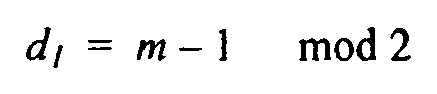
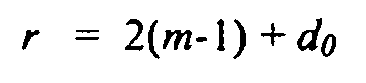
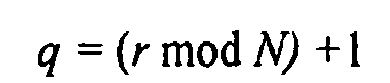
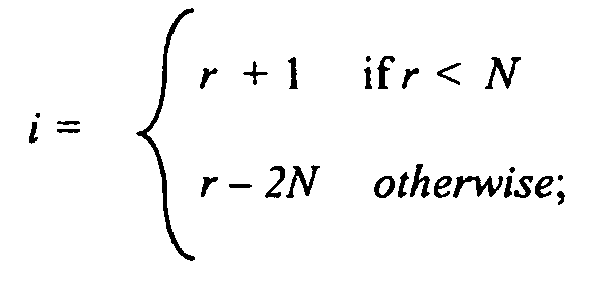
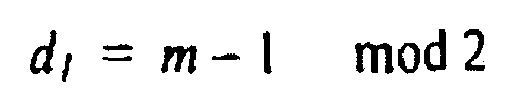
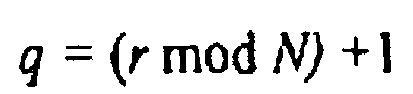
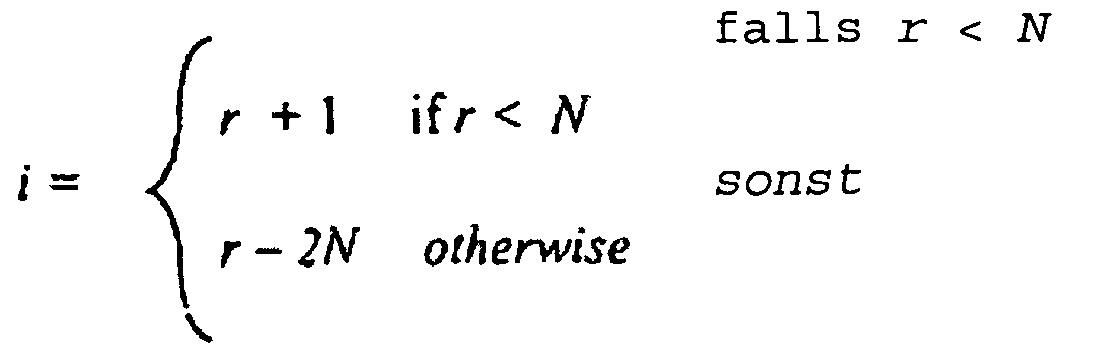
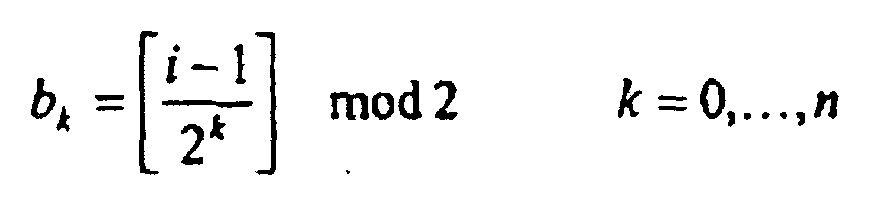
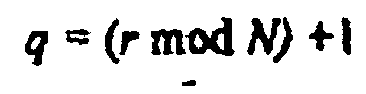
[0010] In view of this purpose it was sought to provide in accordance with the present invention a transmission method for coded digital communications in which the digital data are coded using a code of order n, where n ≥ 1, to obtain a coded signal x(t) which represents binary data which are constituted by sequences of information hits {uk} with rate T, the scheme having N = 2n states, named Σj, j = 1,...,N, and comprising predetermined elementary signals si(t) which are combined in the signal x(t), wherein if at the time t = kT the coding is in a state Σm of the N states, the arrival of the information bit uk of the sequence {u} forces a transition to the state Σq of the N states and the selection of the elementary signal si(t) as x(t), where q and i are given by the following equations:
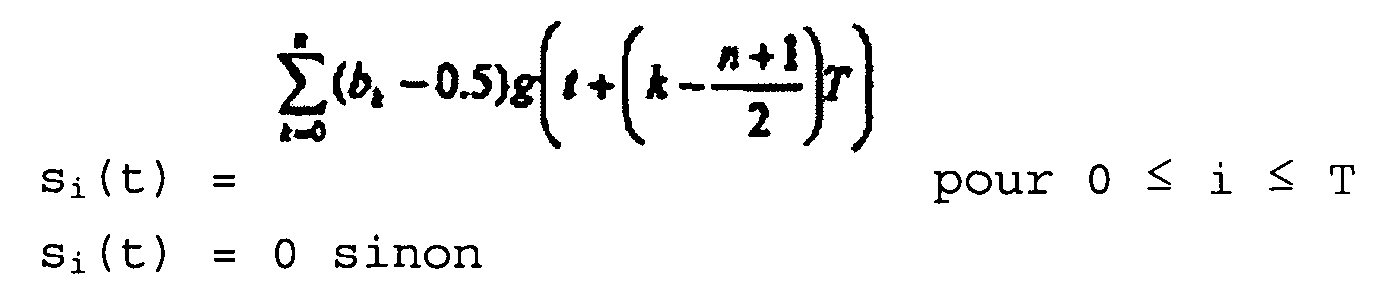
in which the elementary signal si(t), i = ±1,...,± N, are such that s-i (t) = -si(t) and, for i ≥ 1, in that:
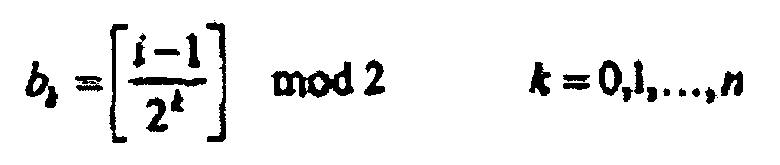
where
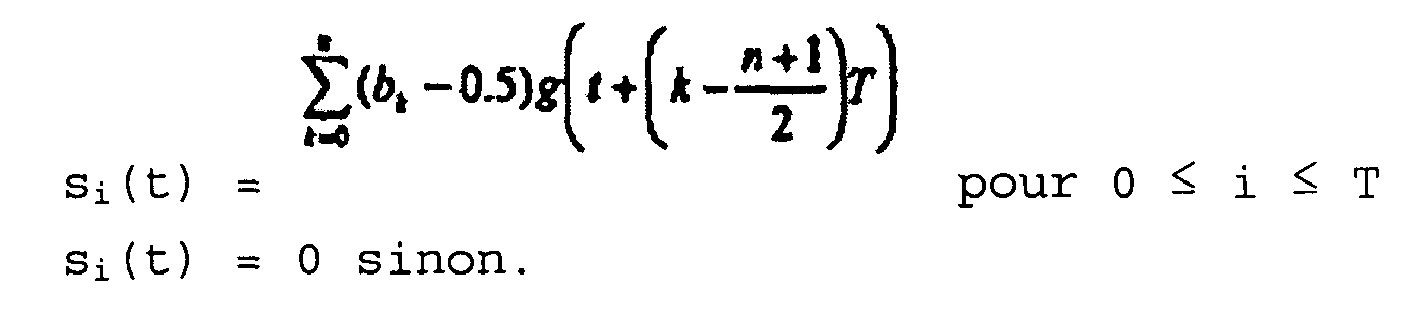
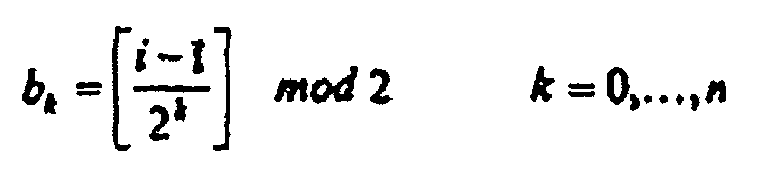
wherein the division in the above equation is an integer division and g(t) is a pulse of time length D = (n + 1)T centered in the origin such that g(t) = g(-t) and having constant values over time intervals of length T/2 and characterized in that the elementary signals si(t), i = ±1, ...,± N, constitute couples of signals s-i(t) = -si(t), have levels not zero in a time interval of length T, and have levels zero elsewhere and wherein each couple of signals has level different from the level of the other couples of signals. Also, in accordance with the present invention, it was sought to provide a transmission method for coded digital communications, characterized in that the digital date are coded by the above mentioned coding scheme, and the coded signal is transmitted in a transmission means.
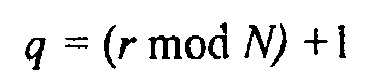
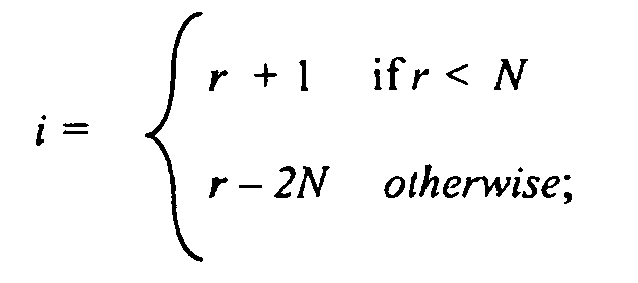
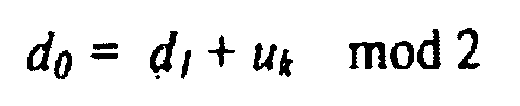
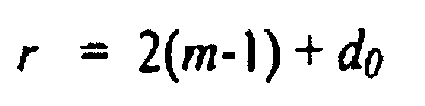
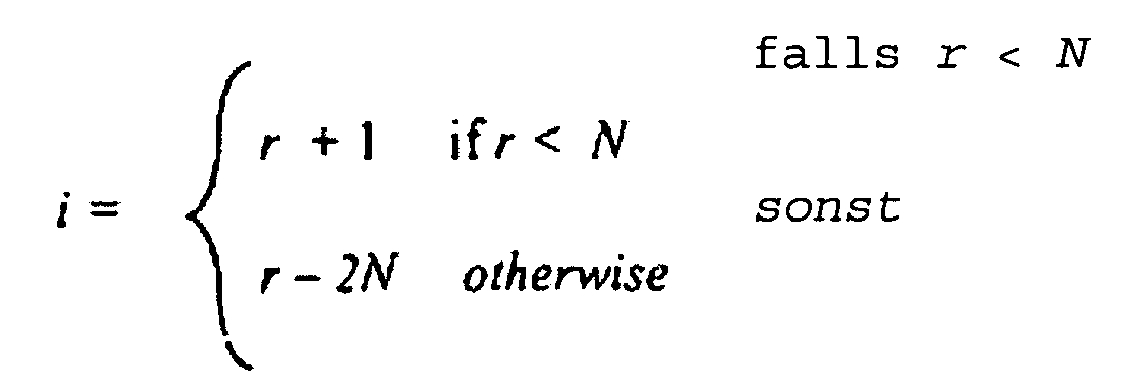
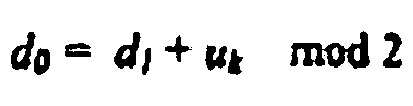
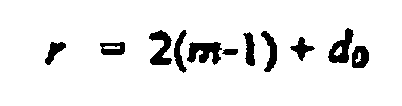
[0011] In accordance with the present invention, also it was sought to provide an apparatus for coded digital communications comprising a coder for coding the digital data according to a code of order n, where n ≥ 1, for obtaining a coded signal x(t) comprising predetermined elementary signals si(t) and representing binary data in which the binary data are constituted by sequences of information bits {uk} with rate T, the code having N = 2" states named Σj, j = 1,..., N wherein the coder is arranged to force, upon the arrival of the information bit uk of the sequence of information bits {uk}, a transition to the state Σq of the N states and the selection of the elementary signal si(t) as x(t), where at the time t = kT the coding is in a state Σm of the N states and where q and i are given by the following equations:
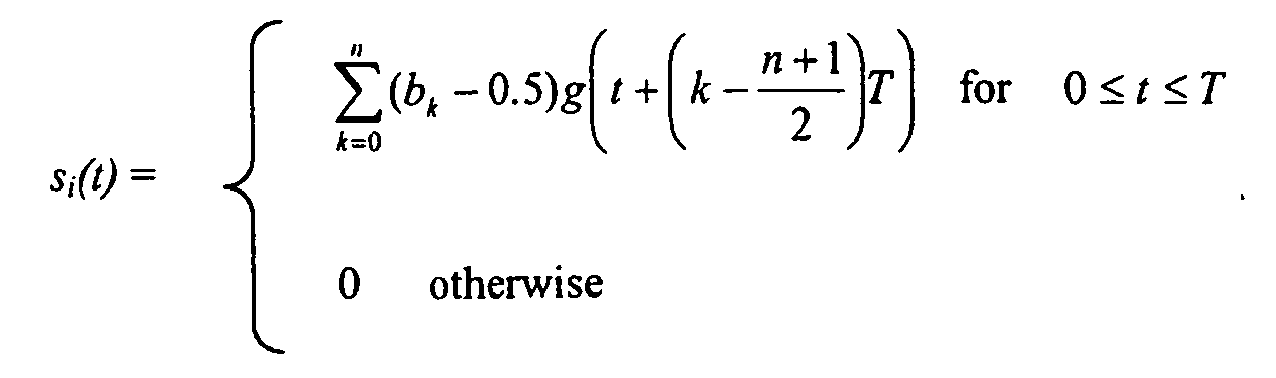
in which the elementary signal si(t), i = ±1,...,± N , are such that s-i(t) = -si(t) and, for i ≥ 1, in that:
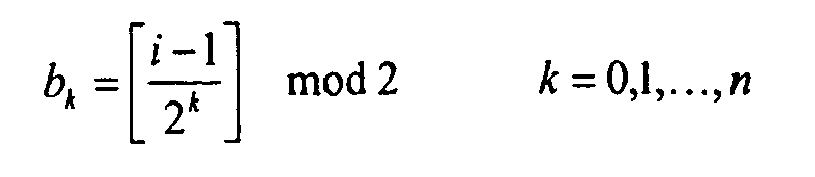
where
wherein the division in the above equation is an integer division and g(t) is a pulse of time length D = (n + 1)T centered in the origin such that g(t) = g(-t) and having constant values over time intervals of length T/2 characterized in that the elementary signals si(t), i =±1,...,±N, constitute couples of signals s-i(t) =-si (t), have levels not zero in a time interval of length T, and have levels zero elsewhere and each couple of signals has level different from the level of the other couples of signals.
[0012] To clarify the explanation of the innovative principles of the present invention and its advantages compared with the prior art there are described below with the aid of the annexed drawings possible embodiments thereof by way of non-limiting example applying said principles. In the drawing:
- Figure 1 shows a state diagram and elementary signals according to a first embodiment of the present invention (order-1 code);
- Figure 2 shows a transmitter model configuration according to the present invention;
- Figure 3 shows a block diagram for a pre-amplified direct-detection optical system;
- Figura 4 shows example waveforms of prior art and novel line codes;
- Figure 5 shows the novel order-1 line code power spectrum at the encoder output for two values of the parameter α;
- Figure 6 shows an eye diagram for the known duobinary code;
- Figure 7 shows an eye diagram for the novel line code according to the invention in the case of order 1;
- Figure 8 shows a state diagram and elementary signals according to a second embodiment of the present invention (order-2 code);
- Figure 9 shows a state diagram according to a third embodiment (order-3 code).
[0013] With reference to the figures, figure 1 shows a state diagram and a set of elementary signals relating to a first embodiment of the invention in the case of order 1 code.
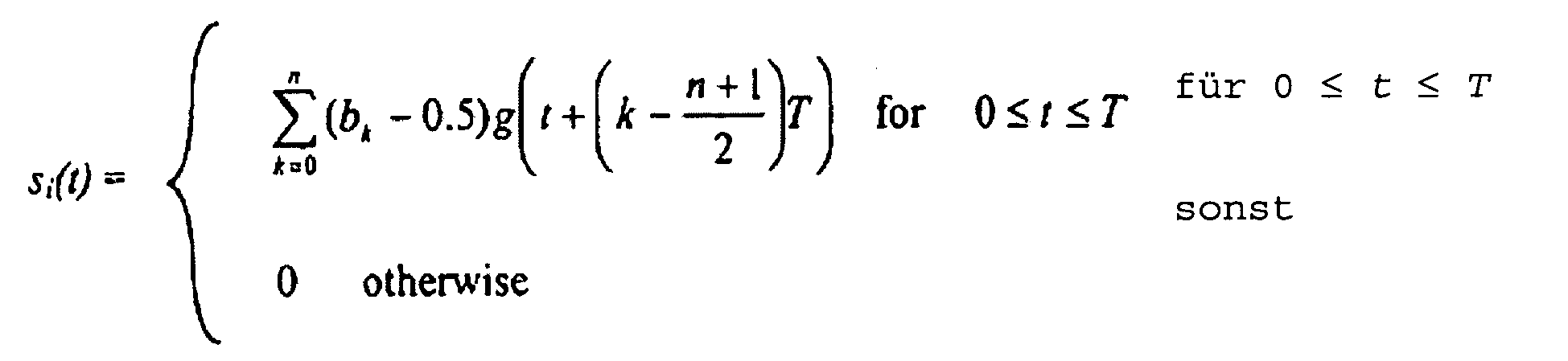
[0014] As illustrated, the new line code uses four waveforms or elementary signals si(t), as shown in Figure 1(a). It will be noted that the elementary signals form two pairs with one pair (e.g. s1(t) and s2(t)) being the negative of the second pair (i.e. s4(t) and s3(t) respectively). In addition two of the elementary signals (s2(t) and s3(t)), i.e. one form each pair are scaled by a factor α. The factor α will be chosen such as to produce the best spectral shape. The state diagram relating to this first line code according to the invention has two states, as shown in Fig. 1 (b). The code states are denoted Σ1, Σ2 and the elementary signals are denoted si(t), i =1, 2, 3, 4.
[0015] Figure 2 shows a transmitter apparatus according to the invention in which a source of information SOURCE feeding an encoder according to the present invention. The output xe(t) of the encoder passes through low pass filter LPF to modulator MOD.
[0016] Figure 3 shows the entire apparatus making use of the transmission method according to the invention to send the digital information in a transmission means, in particular a means formed by optical fibers. The system comprises the transmitter of figure 2 (block TRANS), the optical fibre (singlemode type fibre) and the receiver. The receiver comprises, in sequence, an optical preamplifier with power gain G, an optical bandpass filter BPF, a detector (DETECTOR), a lowpass filter LPF and the sampler. The decoded transmitted information sequence {uk} exits from the sampler output (SAMPLE). It will be noted that the code according to the invention don't need decoding because the elementary signals si(t) (signals that represent "zero's" and "one's" of the transmitted sequence) have quite different power at the moment of the fotodetection. Since the DETECTOR detects the power of the input signal, a simple threshold circuit is sufficient for distinguishing "zero's" and "one's".
[0017] The information sequence{uk} with rate T is encoded as shown in Fig. 3 to form the signal:
where σk denotes the generic encoder state and g1(σk) is a coefficient which is defined by the following rule:
where Σ1 and Σ2 indicate the states allowed to the encoder, and se(t;uk) is one of the two elementary signals s1(t) or s2(t) selected in accordance with the following rule:
[0018] Hence the elementary signal output from the encoder will be one of s1(t) or s2(t) or their negative (i..e. s4(t) or s3(t) respectively) depending on the value of g1(σk), as shown in figure 1.
[0019] The sequence of states of the encoder is defined in the invention by the following rule:
where the value of the function g2 to be used in the embodiment is described by the following map:
| uk\σk | Σ1 | Σ2 |
| 0 | Σ1 | Σ2 |
| 1 | Σ2 | Σ1 |
[0020] An example of a waveform xe(t) generated by the novel line code (with α=0.5) is shown in figure 4a togheter with, for comparison, signals generated with duobinary (figure 4b), PASS (figure 4c) and PSBT (figure 4d) codes of the prior art.
[0021] The power spectral density of the signal xe (t) in (1) coded according to the state diagram of Figure 1 turns out to be:
where S1(f) and S2(f) are the Fourier transforms of the elementary signals si(t) and s2(t), respectively.
[0022] The state diagram in figure 1(b) may be used in combination with any selection of elementary signals
and the power spectral density in (5) holds as long as
[0024] The choice of different elementary signal sets for si(t), i =1, 2, 3, 4 does not significantly affect the performance as long as a post-coder filter is adopted. For this reason we limit ourselves here to the set of elementary signals shown in Fig. 1(a).
[0025] A better understanding of the structure and characteristics of the order-1 code can be gained by expressing the form of the four elementary signals in Fig. 1 mathematically as linear combinations of rectangular pulses of duration T/2:
[0026] In this case we get for the elementary signals si(t), i=1,2,3,4 the following expressions:
which will lead to an useful generalization in the case of the order-n code, as described below. When using (6a) we may also write Ge(f) in terms of P(f), the Fourier transform ofp(t), as follows
[0027] The power sprectrum is shown in fig.5 for two values of the parameter α. As can be seen, when increasing α the main lobe gets broader, but there is a stronger attenuation at the frequencies around 1/T and more energy is pushed in the Nyquist bandwidth. This behaviour has important consequence in selecting the best value of α Notice that espression (7a) per Ge(f) holds as long as si(t) are given by (6b) irrespectively of the actual shape of p(t), which may also be different from (6a), as already stated.
[0028] As described above with reference to Figure 2, the signal xe(t) in (1) is then lowpass filtered prior to driving the modulator. It will be seen later on that this low-pass filter has important effects on the overall performance.
[0029] In order to introduce the new order-n codes, we notice that, although the order-1 code is fully described by its diagram in figure 1, we may also envision its output signal xe(t) in (1) as an equivalent PAM (Pulse Amplitude Modulated) signal, as follows
where (see fig. 1c for a graph of g(t))
and
where the precoded symbols bk are obtained from the information symbols uk by
[0030] The encoder acts as if "large" output signals g(t) weighted by the coefficients wk were generated every T seconds, therefore overlapping each other to introduce a controlled amount of intersymbol interference. This interpretation is very useful because it allows to recognize that when the PAM pulse g(t) in (9a) is filtered by a Gaussian filter of bandwidth equal to 1/2T, the filter output fits very well a "prolate spheroidal wave function", which, for a given time spread, has the most concentrated spectrum in frequency. This means that the filtered xe(t) has a power spectral density the most concentrated in frequency and therefore is more robust to the chromatic dispersion. Indeed, it can be shown that a sufficiently dispersive fiber turns an input pulse sin (t) with Fourier transform Sin(f) and bandwidth Bin, into the output pulse envelope approximately given by
where γ is the chromatic dispersion index of the fibre, defined as
where c is the light speed, λ is the optical wavelength corresponding to the optical carrier frequency, D is the fibre chromatic dispersion parameter at λ (usually provided in ps/nm/km), Rb is the bit rate and L is the fibre length. The above formula (12) turns out to be an exact relation instead that an approximation when the input pulse is properly chirped.
[0031] So, the most concentrated in frequency the pulse, the less the effect of the intersymbol interference due to the chromatic dispersion in the output signal.
[0032] The signal y(t), corresponding to (1) or (8), at the output of the post-detection lowpass filter is of binary type and an example eye diagram corresponding to a 32-bit pattern with
[0033] Rb=10 Gb/s, dispersive fibre of length L≈10 km and chromatic dispersion D=17 ps/nm/km at λ=1550 nm.
[0034] A corresponding eye diagram for duobinary/PSBT is shown in Fig. 7. Comparing the figures, it is evident the effectiveness of the novel line code according to the invention.
[0035] It is evident that when γ increases, so does the time spread of sout(t) in (12) and we reach a point where the intersymbol interference cannot be avoided any longer by the code of order 1. But observing that for γ'=2γ to the input pulse
having the same energy of sin(t), would correspond the same output pulse corresponding to sin(t) at γ, we conclude that when the dispersion doubles we can still avoid intersymbol interference by using an equivalent PAM pulse of double duration (in this case, however, chirping may be required). The signal xe(t) corresponding to an equivalent PAM pulse of length (n+1)T may be obtained by a coder of order n, as described below.
[0036] We now describe the general rule, embodiment of the coder of order n according to the present invention. As above disclose, a coder is described by its states, the transitions between states and the elementary signals correspondingly generated.
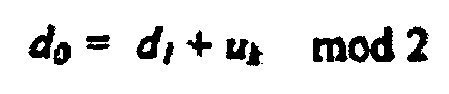
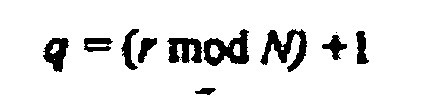
[0037] The order-n coder has N = 2n states, denoted by Σj, j = 1,...,N, and the transitions and signal generations are specified by the following rule. If at the time t = kT the coder is in the state Σm, the arrival of the information bit uk forces a transition to the state Σq and the transmission of the elementary signal si(t), where q and i are given by the following equations:
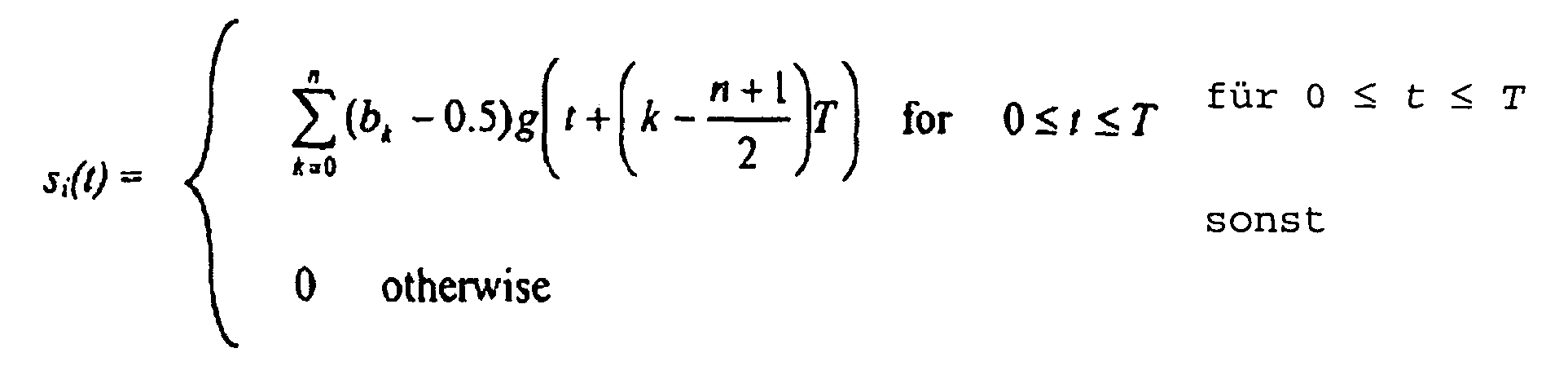
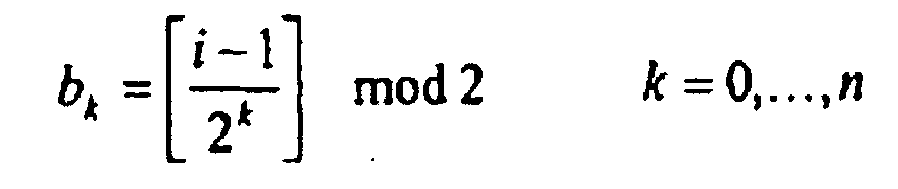
[0038] The elementary signals st(t), i = ±1,...,±N are such to form couples in which s-i(t) = -si(t) and for i ≥ 1
where
and now g(t) is a pulse of time length D=(n+1)T centered in the origin such that g(t) = g(-t) and assuming piecewise constant values (chosen to produce the best spectral configuration) over time intervals of length T/2. To obtain the k-th information symbol the post-detection lowpass filter output signal y(t) is to be sampled at the time
[0040] Depending on the n-order used, the elementary signals si(t) obtained by the (13b) have characteristic independent from their particular shape. For example, in the above mentioned case of order-1, the signals named s2(t) and s3(t) in figure 1a (which form the couple s-i(t)=-si(t) in the general notation) must be shaped for having at least a change of elementary signals si(t) can be used in accordance with the principles of the present invention, that is following the coding scheme given by (13a), or any shape that can be obtaining with any type of filtering of the elementary signals si(t) obtained by (13b). In other words, si(t) obtained by (13b) can be filtered before coding.
[0041] Any couple of the elementary signals si(t) has level different than level of the other couples of the elementary signals si(t).
[0042] As another example of embodiment, a state diagram (figure 8b) and elementary signals (figure 8a: for simplicity, the four signals -si(t) are not shown) for a 4-state coder (order n = 2) are shown in Fig. 8. Equivalent PAM pulse g(t) is shown in Fig. 8c.
[0043] Another example state diagram for a 8-state coder (order n = 3) is shown in Fig. 9 (for simplicity, elementary signals and equivalent PAM pulse are not shown).
[0044] In order to evaluate the performance of the line-coded pre-amplified direct-detection system shown in Fig. 2 and Fig. 3, we apply here the analysis presented in the paper by E.
[0045] Forestieri referred to above as it poses no restrictions on the signal types and on the kind of the pre- and post-detection filters. In this manner, we have found that the best choice for the parameter α in (6b), according to invention, is α=0.5.
[0046] For highly dispersive fibres (γ > 0.35), the most effective transmitter lowpass filter LPF in Fig.2, is ideal of bandwidth equal to half the bit rate in the uncoded, duobinary and PASS case, while for the novel optical line code according to the invention the best filter turns out to be a Gaussian one with the same bandwidth. In this case, numerical results show that the novel line code performs better than all other coding schemes (among which the best are the narrow filtered duobinary and PSBT, whose performances are the same) as, given the same transmitted power (e.g. about 4 dBs more than that necessary for an uncoded transmission over a non-dispersive fibre), it allows to span a distance 1.5 times greater than that allowed by duobinary before the probability of bit error exceeds Pb=10-12.
[0047] At this point, it is clear that the objectives of the present invention have been achieved by making a coding scheme having better performance than prior art schemes by means of a innovative state diagram and a particular selection of elementary signals. Naturally the above description of embodiments applying the innovative principles of the present invention is given by way of non-limiting example of said principles within the scope of the exclusive right claimed here. For example it is clear for an expert in the art that the "bit 0" and "bit 1" indications used here can be exchanged to each other and the indexes used in the elementary waveform notation can be changed (for example, in figure 1a the indexes 1,2,3,4 can be 1,2,-1, 2, as obvious by the general case of order n).
1. Transmission method for coded digital communications in which the digital data are
coded using a code of order n, where n ≥ 1, to obtain a coded signal x(t) which represents binary data which are constituted by sequences of information bits
{uk} with rate T, the code having N = 2n states, named Σj, j = 1,..., N, in which predetermined elementary signals si(t) are combined in the coded signal x(t), wherein if at the time t = kT the coding is in a state Σm of the N states, the arrival of the information bit uk of the sequence of information bits {uk} forces a transition to the state Σq of the N states and the selection of the elementary signal si(t) as x(t), where q and i are given by the following equations:

in which the elementary signal si(t), i = ±1,...,± N, are such that s-i(t) =-si(t) and, for i ≥ 1, in that:
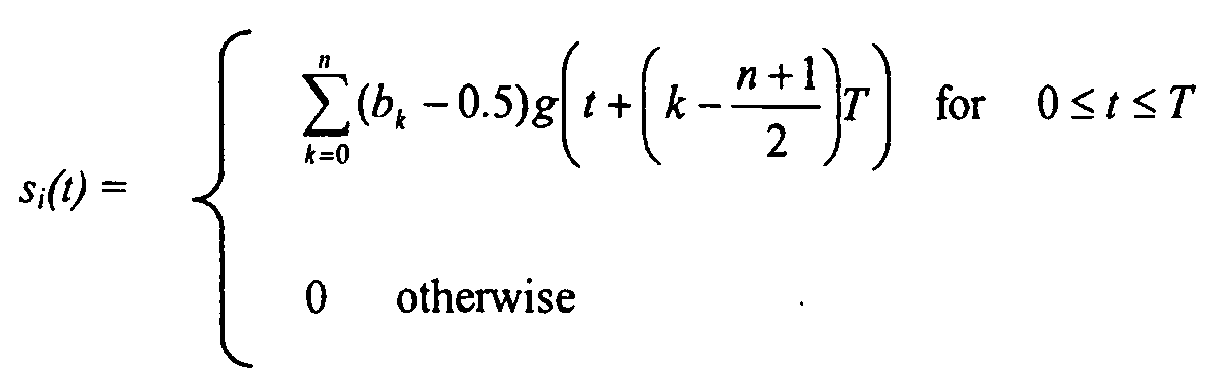
where
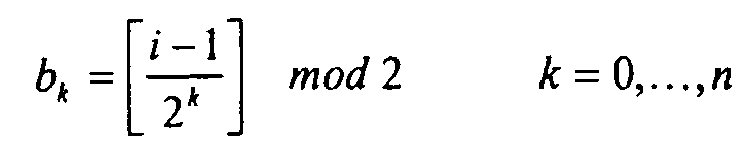
wherein the division in the above equation is an integer division and g(t) is a pulse of time length D = (n + 1 )T centered in the origin such that g(t) = g(-t) and having constant values over time intervals of length T/2, characterized in that the elementary signals si(t), i = ±1, ...,± N, constitute couples of signals s-i (t) = -si (t), have levels not zero in a time interval of length T, and have levels zero elsewhere and wherein each couple of signals has level different from the level of the other couples of signals.
in which the elementary signal si(t), i = ±1,...,± N, are such that s-i(t) =-si(t) and, for i ≥ 1, in that:
where
wherein the division in the above equation is an integer division and g(t) is a pulse of time length D = (n + 1 )T centered in the origin such that g(t) = g(-t) and having constant values over time intervals of length T/2, characterized in that the elementary signals si(t), i = ±1, ...,± N, constitute couples of signals s-i (t) = -si (t), have levels not zero in a time interval of length T, and have levels zero elsewhere and wherein each couple of signals has level different from the level of the other couples of signals.
2. Transmission method as claimed in claim 1, characterized in that the level differences are chosen for improving the spectral configuration.
3. Transmission method as claimed in claim 1, characterized in that the signals of one of the couples of the signals have a sign inversion in T/2.
4. Transmission method as claimed in claim 3, characterized in that the signals of said one of the couples of the signals have constant level over time
intervals of length T/2.
5. Transmission method as claimed in claim 3, characterized in that when the order is n=1, another of the couples of signals is constituted of a constant level pulse of
length T.
6. Transmission method as claimed in claims 4 and 5, characterized in that the constant level of said one of the couples of signals is less than the constant
level of the other of the couples of signals.
7. Transmission method as claimed in claim 6, characterized in that the constant level of said one of the couples of signals is equal to half of the
constant level of the other of the couples of signals.
8. Transmission method as claimed in claim 1 characterised in that signals si(t) given by the equation (1) are filtered for resulting in elementary signal si(t) forming the x(t) in which the filter bandwidth is not greater than half the bit rate.
9. Transmission method as claimed in any above claim including transmitting the coded
signal in a transmission means.
10. Transmission method as claimed in claim 9, characterized in that the transmission means are dispersive optical fibres.
11. Apparatus for coded digital communications comprising a coder for coding the digital
data according to a code of order n, where n≥1, for obtaining a coded signal x(t) comprising predetermined elementary signals si(t) and representing binary data in which the binary data are constituted by sequences
of information bits {uk} with rate T, the code having N = 2n states named Σj, j = 1,..., N wherein the coder is arranged to force, upon the arrival of the information bit uk of the sequence of information bits {uk}, a transition to the state Σq of the N states and the selection of the elementary signal si(t) as x(t), where at the time t = kT the coding is in a state Σm of the N states and where q and i are given by the following equations:
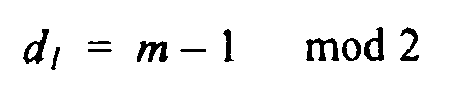

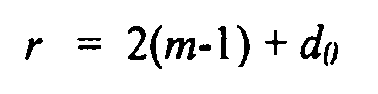
in which the elementary signal si(t), i = ±1,...,± N, are such that s-i (t) = -si (t) and, for i ≥ 1, in that:
where
wherein the division in the above equation is an integer division and g(t) is a pulse of time length D = (n + 1)T centered in the origin such that g(t) = g(-t) and having constant values over time intervals of length T/2 characterized in that the elementary signals si(t), i = ±1,...,± N, constitute couples of signals s-i (t)= -si(t), have levels not zero in a time interval of length T, and have levels zero elsewhere and each couple of signals has level different from the level of the other couples of signals.
in which the elementary signal si(t), i = ±1,...,± N, are such that s-i (t) = -si (t) and, for i ≥ 1, in that:
where
wherein the division in the above equation is an integer division and g(t) is a pulse of time length D = (n + 1)T centered in the origin such that g(t) = g(-t) and having constant values over time intervals of length T/2 characterized in that the elementary signals si(t), i = ±1,...,± N, constitute couples of signals s-i (t)= -si(t), have levels not zero in a time interval of length T, and have levels zero elsewhere and each couple of signals has level different from the level of the other couples of signals.
12. Apparatus as claimed in claim 11, characterized in that the level differences are chosen for improving the spectral configuration.
13. Apparatus as claimed in claim 11, characterized in that the signals of one of the couples of the signals have a sign inversion in T/2.
14. Apparatus as claimed in claim 13, characterized in that the signals of said one of the couples of the signals have constant level over time
intervals of length T/2.
15. Apparatus as claimed in claim 13, characterized in that when the order is n=1, another of said couples of signals is constituted of a constant level pulse of
length T.
16. Apparatus as claimed in claims 14 and 15, characterized in that the constant level of said one of couples of signals is less than the constant level
of the other of said couples of signals.
17. Apparatus as claimed in claim 16, characterized in that the constant level of said one of couples of signals is equal to half of the constant
level of the other of said couples of signals.
18. Apparatus as claimed in claim 11, characterized in that signals si(t) given by the equation (1) are filtered for resulting in elementary signal si(t) forming the x(t).
19. Apparatus as claimed in claim 11 for transmitting the coded signal in a transmission
means.
20. Apparatus as claimed in claim 19, characterized in that the transmission means are dispersive optical fibres.
21. Apparatus as claimed in claim 19 or 20, characterized in that it comprises a lowpass filter between coder and transmission means in which the filter
bandwidth is not greater than half the bit rate.
1. Übertragungsverfahren für codierte digitale Nachrichten, bei welchem die digitalen
Daten unter Verwendung eines Codes der Ordnung n codiert werden, wobei n ≥ 1 ist, um ein codiertes Signal x(t) zu erhalten, welches binäre Daten repräsentiert, welche von Folgen von Informationsbits
{uk} mit Rate T gebildet werden, wobei der Code N = 2n Zustände aufweist, die Σj, j = 1, ..., N, genannt werden, und bei welchem vorgegebene Elementarsignale si(t) in dem codierten Signal x(t) kombiniert werden, wobei, falls zum Zeitpunkt t = kT die Codierung sich in einem Zustand Σm von den N Zuständen befindet, das Eintreffen des Informationsbits uk der Folge von Informationsbits {uk} einen Übergang in den Zustand Σq von den N Zuständen und die Wahl des Elementarsignals si(t) als x(t) erzwingt, wobei q und i durch die folgenden Gleichungen gegeben sind:


in welchen die Elementarsignale si(t), i = ±1, ..., ±N, so beschaffen sind, dass s-i(t) = -si(t) ist und dass für i ≥ 1 gilt:
wobei
wobei die Division in der obigen Gleichung eine ganzzahlige Division ist und g(t) ein Impuls mit der Zeitdauer D = (n+1)T ist, der im Ursprung zentriert ist, so dass g(t) = g(-t) ist, und konstante Werte in Zeitintervallen der Länge T/2 aufweist, dadurch gekennzeichnet, dass die Elementarsignale si(t), i = ±1, ..., ±N, Paare von Signalen s-i (t) = -si (t) bilden, die in einem Zeitintervall der Länge T Pegel aufweisen, die von null verschieden sind, und die außerhalb desselben einen Pegel null aufweisen, und wobei jedes Paar von Signalen einen Pegel aufweist, der von dem Pegel der anderen Paare von Signalen verschieden ist.
in welchen die Elementarsignale si(t), i = ±1, ..., ±N, so beschaffen sind, dass s-i(t) = -si(t) ist und dass für i ≥ 1 gilt:
wobei
wobei die Division in der obigen Gleichung eine ganzzahlige Division ist und g(t) ein Impuls mit der Zeitdauer D = (n+1)T ist, der im Ursprung zentriert ist, so dass g(t) = g(-t) ist, und konstante Werte in Zeitintervallen der Länge T/2 aufweist, dadurch gekennzeichnet, dass die Elementarsignale si(t), i = ±1, ..., ±N, Paare von Signalen s-i (t) = -si (t) bilden, die in einem Zeitintervall der Länge T Pegel aufweisen, die von null verschieden sind, und die außerhalb desselben einen Pegel null aufweisen, und wobei jedes Paar von Signalen einen Pegel aufweist, der von dem Pegel der anderen Paare von Signalen verschieden ist.
2. Übertragungsverfahren nach Anspruch 1, dadurch gekennzeichnet, dass die Pegeldifferenzen so gewählt sind, dass die spektrale Konfiguration verbessert
wird.
3. Übertragungsverfahren nach Anspruch 1, dadurch gekennzeichnet, dass die Signale eines der Paare der Signale eine Vorzeichenumkehr in T/2 aufweisen.
4. Übertragungsverfahren nach Anspruch 3, dadurch gekennzeichnet, dass die Signale des besagten einen der Paare der Signale einen konstanten Pegel in Zeitintervallen
der Länge T/2 aufweisen.
5. Übertragungsverfahren nach Anspruch 3, dadurch gekennzeichnet, dass, wenn die Ordnung n = 1 ist, ein anderes der Paare von Signalen von einem Impuls der Länge T mit einem konstanten Pegel gebildet wird.
6. Übertragungsverfahren nach Anspruch 4 und 5, dadurch gekennzeichnet, dass der konstante Pegel des besagten einen der Paare von Signalen kleiner als der konstante
Pegel des anderen der Paare von Signalen ist.
7. Übertragungsverfahren nach Anspruch 6, dadurch gekennzeichnet, dass der konstante Pegel des besagten einen der Paare von Signalen gleich der Hälfte des
konstanten Pegels des anderen der Paare von Signalen ist.
8. Übertragungsverfahren nach Anspruch 1, dadurch gekennzeichnet, dass Signale si(t), die durch die Gleichung (1) gegeben sind, gefiltert werden, so dass Elementarsignale
si(t) resultieren, die das x(t) bilden, in welchen die Filterbandbreite nicht größer ist als die halbe Bitrate.
9. Übertragungsverfahren nach einem der vorhergehenden Ansprüche, welches das Übertragen
des codierten Signals in einem Übertragungsmittel umfasst.
10. Übertragungsverfahren nach Anspruch 9, dadurch gekennzeichnet, dass das Übertragungsmittel dispersive optische Fasern sind.
11. Vorrichtung für codierte digitale Nachrichten, die einen Codierer zum Codieren der
digitalen Daten gemäß einem Code der Ordnung n, wobei n ≥ 1 ist, umfasst, um ein codiertes Signal x(t) zu erhalten, das vorgegebene Elementarsignale si(t) umfasst und binäre Daten repräsentiert, wobei die binären Daten von Folgen von Informationsbits
{uk} mit Rate T gebildet werden, wobei der Code N = 2n Zustände aufweist, die Σj, j = 1, ..., N, genannt werden, wobei der Codierer so beschaffen ist, dass er beim Eintreffen des
Informationsbits uk aus der Folge von Informationsbits {uk} einen Übergang in den Zustand Σq von den N Zuständen und die Wahl des Elementarsignals si(t) als x(t) erzwingt, wobei zum Zeitpunkt t = kT die Codierung sich in einem Zustand Σm von den N Zuständen befindet und wobei q und i durch die folgenden Gleichungen gegeben sind:


in welchen die Elementarsignale si(t), i = ±1, ..., ±N, so beschaffen sind, dass s-i (t) = -si (t) ist und dass für i ≥ 1 gilt:
wobei
wobei die Division in der obigen Gleichung eine ganzzahlige Division ist und g(t) ein Impuls mit der Zeitdauer D = (n+1)T ist, der im Ursprung zentriert ist, so dass g(t) = g(-t) ist, und konstante Werte in Zeitintervallen der Länge T/2 aufweist, dadurch gekennzeichnet, dass die Elementarsignale si(t), i = ±1, ..., ±N, Paare von Signalen s-i(t) = -si(t) bilden, die in einem Zeitintervall der Länge T Pegel aufweisen, die von null verschieden sind, und die außerhalb desselben einen Pegel null aufweisen, und wobei jedes Paar von Signalen einen Pegel aufweist, der von dem Pegel der anderen Paare von Signalen verschieden ist.
in welchen die Elementarsignale si(t), i = ±1, ..., ±N, so beschaffen sind, dass s-i (t) = -si (t) ist und dass für i ≥ 1 gilt:
wobei
wobei die Division in der obigen Gleichung eine ganzzahlige Division ist und g(t) ein Impuls mit der Zeitdauer D = (n+1)T ist, der im Ursprung zentriert ist, so dass g(t) = g(-t) ist, und konstante Werte in Zeitintervallen der Länge T/2 aufweist, dadurch gekennzeichnet, dass die Elementarsignale si(t), i = ±1, ..., ±N, Paare von Signalen s-i(t) = -si(t) bilden, die in einem Zeitintervall der Länge T Pegel aufweisen, die von null verschieden sind, und die außerhalb desselben einen Pegel null aufweisen, und wobei jedes Paar von Signalen einen Pegel aufweist, der von dem Pegel der anderen Paare von Signalen verschieden ist.
12. Vorrichtung nach Anspruch 11, dadurch gekennzeichnet, dass die Pegeldifferenzen so gewählt sind, dass die spektrale Konfiguration verbessert
wird.
13. Vorrichtung nach Anspruch 11, dadurch gekennzeichnet, dass die Signale eines der Paare der Signale eine Vorzeichenumkehr in T/2 aufweisen.
14. Vorrichtung nach Anspruch 13, dadurch gekennzeichnet, dass die Signale des besagten einen der Paare der Signale einen konstanten Pegel in Zeitintervallen
der Länge T/2 aufweisen.
15. Vorrichtung nach Anspruch 13, dadurch gekennzeichnet, dass, wenn die Ordnung n = 1 ist, ein anderes der Paare von Signalen von einem Impuls der Länge T mit einem konstanten Pegel gebildet wird.
16. Vorrichtung nach Anspruch 14 und 15, dadurch gekennzeichnet, dass der konstante Pegel des besagten einen der Paare von Signalen kleiner als der konstante
Pegel des anderen der Paare von Signalen ist.
17. Vorrichtung nach Anspruch 16, dadurch gekennzeichnet, dass der konstante Pegel des besagten einen der Paare von Signalen gleich der Hälfte des
konstanten Pegels des anderen der Paare von Signalen ist.
18. Vorrichtung nach Anspruch 11, dadurch gekennzeichnet, dass Signale si(t), die durch die Gleichung (1) gegeben sind, gefiltert werden, so dass Elementarsignale
si(t) resultieren, die das x(t) bilden.
19. Vorrichtung nach Anspruch 11 zum Übertragen des codierten Signals in einem Übertragungsmittel.
20. Vorrichtung nach Anspruch 19, dadurch gekennzeichnet, dass das Übertragungsmittel dispersive optische Fasern sind.
21. Vorrichtung nach Anspruch 19 oder 20, dadurch gekennzeichnet, dass sie ein Tiefpassfilter zwischen Codierer und Übertragungsmittel umfasst, in welchem
die Filterbandbreite nicht größer als die halbe Bitrate ist.
1. Procédé de transmission pour communications numériques codées dans lequel les données
numériques sont codées en utilisant un code d'ordre n, où n≥1, afin d'obtenir un signal
codé x(t) qui représente des données binaires qui sont constituées par des séquences
de bits d'information {uk} au débit T, le code ayant N = 2n états, c'est-à-dire Σj, j = 1,...,N, dans lesquels des signaux élémentaires prédéterminés si(t) sont combinés en le signal codé x(t), moyennant quoi si au moment t = kT le codage
est dans un état Σm des N états, l'arrivée du bit d'information uk de la séquence de bits d'information {uk} force une transition à l'état Σq des N états et la sélection des signaux élémentaires si(t) en tant que x(t), où q et i sont donnés par les équations suivantes :




dans lequel le signal élémentaire sl(t), i=l±1,...,±N, est tel que s-l(t)=-sl(t) et pour i ≥ 1, en ce que :
où
moyennant quoi la division dans l'équation ci-dessus est une division de nombre entier et g(t) est une impulsion de longueur temporelle D = (n+1)T centrée dans l'origine de telle sorte que g(t) = g(-t) et ayant des valeurs constantes sur les intervalles de temps de longueur T/2, caractérisé en ce que les signaux élémentaires sl(t), i=±1,...,±N,constituent des couples de signaux s-l(t)=-sl(t) ont des niveaux non zéro dans un intervalle de temps de longueur T et ont des niveaux zéro sinon et moyennant quoi chaque couple de signaux a un niveau différent du niveau des autres couples de signaux.
dans lequel le signal élémentaire sl(t), i=l±1,...,±N, est tel que s-l(t)=-sl(t) et pour i ≥ 1, en ce que :
où
moyennant quoi la division dans l'équation ci-dessus est une division de nombre entier et g(t) est une impulsion de longueur temporelle D = (n+1)T centrée dans l'origine de telle sorte que g(t) = g(-t) et ayant des valeurs constantes sur les intervalles de temps de longueur T/2, caractérisé en ce que les signaux élémentaires sl(t), i=±1,...,±N,constituent des couples de signaux s-l(t)=-sl(t) ont des niveaux non zéro dans un intervalle de temps de longueur T et ont des niveaux zéro sinon et moyennant quoi chaque couple de signaux a un niveau différent du niveau des autres couples de signaux.
2. Procédé de transmission selon la revendication 1,
caractérisé en ce que les différences de niveau sont choisies afin d'améliorer la configuration spectrale.
caractérisé en ce que les différences de niveau sont choisies afin d'améliorer la configuration spectrale.
3. Procédé de transmission selon la revendication 1, caractérisé en ce que les signaux d'un des couples de signaux ont une inversion de signe à T/2.
4. Procédé de transmission selon la revendication 3,
caractérisé en ce que les signaux dudit un des couples de signaux ont des niveaux constants sur des intervalles de temps de longueur T/2.
caractérisé en ce que les signaux dudit un des couples de signaux ont des niveaux constants sur des intervalles de temps de longueur T/2.
5. Procédé de transmission selon la revendication 3,
caractérisé en ce que quand l'ordre est n=1, un autre des couples de signaux est constitué d'une impulsion de niveau constant de longueur T.
caractérisé en ce que quand l'ordre est n=1, un autre des couples de signaux est constitué d'une impulsion de niveau constant de longueur T.
6. Procédé de transmission selon les revendications 4 et 5, caractérisé en ce que le niveau constant dudit un des couples de signaux est inférieur au niveau constant
de l'autre des couples de signaux.
7. Procédé de transmission selon la revendication 6,
caractérisé en ce que le niveau constant dudit un des couples de signaux est égal à la moitié du niveau constant de l'autre des couples de signaux.
caractérisé en ce que le niveau constant dudit un des couples de signaux est égal à la moitié du niveau constant de l'autre des couples de signaux.
8. Procédé de transmission selon la revendication 1, caractérisé en ce que les signaux si(t) donnés par l'équation (1) sont filtrés afin de donner en résultat un signal élémentaire
si(t) formant le x(t) dans lequel la bande passante de filtre n'est pas supérieure à
la moitié du débit.
9. Procédé de transmission selon l'une quelconque des revendications ci-dessus incluant
la transmission du signal codé dans un moyen de transmission.
10. Procédé de transmission selon la revendication 9, caractérisé en ce que les moyens de transmission sont des fibres optiques dispersives.
11. Appareil de communication numérique codée comprenant un codeur pour coder les données
numériques en fonction d'un code d'ordre n, où n≥1, pour obtenir un signal codé x(t)
comprenant des signaux élémentaires prédéterminés si(t) et représentant des données binaires, dans lequel les données binaires sont constituées
de séquences de bits d'information {uk} au débit T, le code ayant N = 2n états, c'est-à-dire Σj, j = 1, ..., N, dans lequel le codeur est agencé afin de forcer, à l'arrivée du bit
d'information uk de la séquence de bits d'information {uk}, une transition à l'état Σq des N états et la sélection du signal élémentaire si(t) en tant que x(t), où au moment t = kT le codage est dans un état Σm des N états et où q et i sont donnés par les équations suivantes :



dans lequel le signal élémentaire sl(t), i=l±1,...,±N, est tel que s-l(t)=-sl(t) et pour i ≥ 1, en ce que :
où
moyennant quoi la division dans l'équation ci-dessus est une division de nombre entier et g(t) est une impulsion de longueur temporelle D = (n+1)T centrée dans l'origine de telle sorte que g(t) = g(-t) et ayant des valeurs constantes sur les intervalles de temps de longueur T/2, caractérisé en ce que les signaux élémentaires sl(t), i=l±1,...,±N, constituent des couples de signaux s-l(t)=-sl(t), ont des niveaux non zéro dans un intervalle de temps de longueur T et ont des niveaux zéro sinon et moyennant quoi chaque couple de signaux a un niveau différent du niveau des autres couples de signaux.
dans lequel le signal élémentaire sl(t), i=l±1,...,±N, est tel que s-l(t)=-sl(t) et pour i ≥ 1, en ce que :
où
moyennant quoi la division dans l'équation ci-dessus est une division de nombre entier et g(t) est une impulsion de longueur temporelle D = (n+1)T centrée dans l'origine de telle sorte que g(t) = g(-t) et ayant des valeurs constantes sur les intervalles de temps de longueur T/2, caractérisé en ce que les signaux élémentaires sl(t), i=l±1,...,±N, constituent des couples de signaux s-l(t)=-sl(t), ont des niveaux non zéro dans un intervalle de temps de longueur T et ont des niveaux zéro sinon et moyennant quoi chaque couple de signaux a un niveau différent du niveau des autres couples de signaux.
12. Appareil selon la revendication 11, caractérisé en ce que les différences de niveau sont choisies afin d'améliorer la configuration spectrale.
13. Appareil selon la revendication 11, caractérisé en ce que les signaux d'un des couples de signaux ont une inversion de signe à T/2.
14. Appareil selon la revendication 13, caractérisé en ce que les signaux dudit un des couples de signaux ont des nivaux constants sur des intervalles
de temps de longueur T/2.
15. Appareil selon la revendication 13, caractérisé en ce que quand l'ordre est n=1, un autre desdits couples de signaux est constitué d'une impulsion
de niveau constant de longueur T.
16. Appareil selon les revendications 14 et 15, caractérisé en ce que le niveau constant dudit un des couples de signaux est inférieur au niveau constant
de l'autre desdits couples de signaux.
17. Appareil selon la revendication 16, caractérisé en ce que le niveau constant dudit un des couples de signaux est égal à la moitié du niveau
constant de l'autre desdits couples de signaux.
18. Appareil selon la revendication 11, caractérisé en ce que les signaux si(t) donnés par l'équation (1) sont filtrés afin de donner en résultat un signal élémentaire
si(t) formant le x(t).
19. Appareil selon la revendication 11 pour transmettre le signal codé dans un moyen de
transmission.
20. Appareil selon la revendication 19, caractérisé en ce que les moyens de transmission sont des fibres optiques dispersives.
21. Appareil selon les revendications 19 ou 20,
caractérisé en ce que il comprend un filtre passe bas entre le codeur et le moyen de transmission, dans lequel la bande passante de filtre n'est pas supérieure à la moitié du débit.
caractérisé en ce que il comprend un filtre passe bas entre le codeur et le moyen de transmission, dans lequel la bande passante de filtre n'est pas supérieure à la moitié du débit.