|
(11) | EP 1 344 768 B1 |

| (12) | EUROPEAN PATENT SPECIFICATION |
|
|
| (54) |
Synthesis of substituted pyrazolopyrimidines Synthese substituierter Pyrazolopyrimidine Synthèse de pyrazolopyrimidines substituées |
|
|
|||||||||||||||||||||||||||||||||||
| Note: Within nine months from the publication of the mention of the grant of the European patent, any person may give notice to the European Patent Office of opposition to the European patent granted. Notice of opposition shall be filed in a written reasoned statement. It shall not be deemed to have been filed until the opposition fee has been paid. (Art. 99(1) European Patent Convention). |
TECHNICAL FIELD
[0001] This invention is directed to the synthesis of a substituted pyrazolopyrimidine, which compound has utility over a wide range of indications including treatment of insomnia.
BACKGROUND OF THE INVENTION
[0002] U.S. Patent No. 4,521,422 to American Cyanamid Company is directed to certain aryl and heteroaryl[7-(aryl and heteroaryl)-pyrazolo[1,5-a]pyrimidin-3-yl]methanones which are active as anxiolytic, anticonvulsant, sedative-hypnotic and skeletal muscle relaxant agents. Such compounds may generally be classified as "substituted pyrazolopyrimidines" having the following structure (I):
wherein R2, R3, R5, R6 and R7 are as defined in U.S. Patent No. 4,521,422 (but under a different numbering scheme for the various R groups).
[0003] Compounds of structure (I) are made according to U.S. Patent No. 4,521,422 by reacting an appropriately substituted pyrazole (a) with an appropriately substituted 3-dimethylamino-2-propen-1-one (b) as represented by the following Reaction Scheme A:
[0004] U.S. Patent No. 4,900,836, also to American Cyanamid Company, discloses novel pyrazoles (a) for use in Reaction Scheme A. More specifically, in this patent pyrazoles (a) are made, as represented below in Reaction Scheme B, by reacting appropriately substituted acetonitrile (c) with a dimethylamide dimethyl acetal (d) to yield the corresponding propanenitrile (e), which is then reacted with aminoguanidine nitrile (f) to give the correspondingly substituted pyrazole (a).
[0005] U.S. Patent No. 4,521,422 also discloses the synthesis of substituted pyrazolopyrimidines of structure (I) using starting intermediates other than substituted 3-dimethylamino-2-propen-1-ones (b). For example, as represented by Reaction Scheme C, U.S. Patent No. 4,521,422 teaches that the intermediate alkali metal salts of hydroxymethyleneketones (g) can be acylated by reacting with acid chlorides or anhydrides to give O-acyl derivatives (h), and that neutralization of (g) with certain acids affords hydroxymethylene ketones (i), all of which may be reacted with pyrazole (a) to give compounds of structure (I).
[0006] Further, U.S. Patent No. 4,521,422 discloses that hydroxymethyleneketones (i) may be converted to other aldehyde equivalents, such as alkoxymethyleneketones (j), alkylthiomethyleneketones (k) and aminomethyleneketones (1) - as represented by Reaction Scheme D - and reacted with pyrazole (a) to give compounds of structure (I). Other hydroxymethleneketone and derivatives which are chemical equivalents of the same may also be used, such as 2-(dialkylamino)-1-aryl or (heteroatyl)-2 propen-1-ones.
[0007] In addition, other United States patents have issued directed to the synthesis of substituted pyrazolopyrimidines. For example, U.S. Patent Nos. 4,654,347 and 4,626,538, both to American Cyanamide, disclose substituted pyrazolopynmidines of structure (I) made by the techniques discussed above, but having different substituents than those of U.S. Patent No. 4,521,422.
[0008] While U.S. Patent Nos. 4,521,422 and 4,900,836, among others, teach techniques for the synthesis of compounds of structure (I), such procedures are relatively time consuming, involve numerous steps, and are not particularly economical or efficient for large-scale synthesis. Accordingly, there is a need in the art for improved synthetic techniques which overcome these shortcomings. The present invention fulfills these needs, and provides further related advantages.
SUMMARY OF THE INVENTION
[0009] In brief, the present invention is directed to the synthesis of a substituted pytazolopyrimidine having the following structure (1), which compound has utility over a wide range of indications, including treatment of insomnia.
DETAILED DESCRIPTION OF THE INVENTION
[0010] As mentioned above, the present invention is directed to an improved synthetic route for the synthesis of a substituted pyrazolopyrimidine which is active as anxiolytic, anticonvulsant, sedative-hypnotic and skeletal muscle relaxant agents. This compound is covered by structure (I) above previously disclosed in U.S. Patent No. 4,521,422.
[0011] More specifically, the pyrazolopyrimidine of structure (I) is N-methyl-N-(3-{3-[2-thienylcarbonyl]-pyrazolo-[1,5-a]-pyrimidin-7-yl}phenyl)acetamide, which compound has the following structure (hereinafter referred to as "Compound 1" or "1"):
[0012] In one aspect of the invention, compound 1 is prepared by the following
Reagents: (c) HOAc, reflux
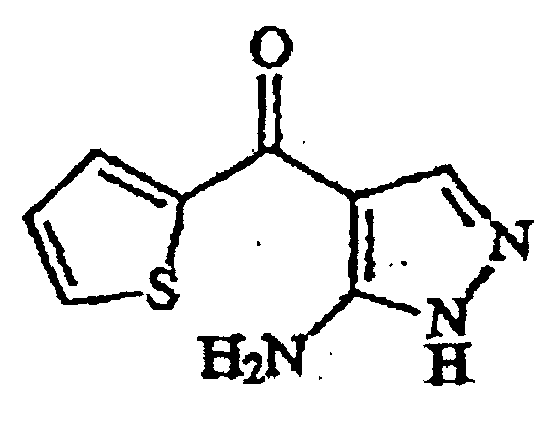
[0013] In Reaction Scheme 1, pyrazole 5 is cyclized with the known enaminone 8 under the standard conditions providing the desired product, Compound 1.
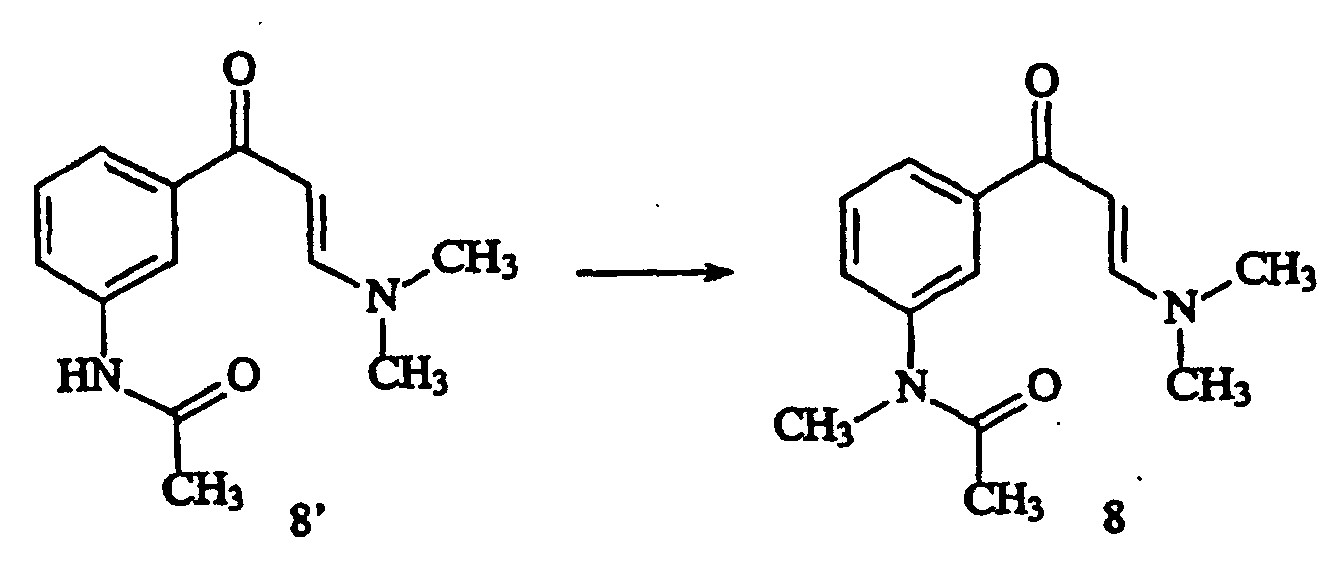
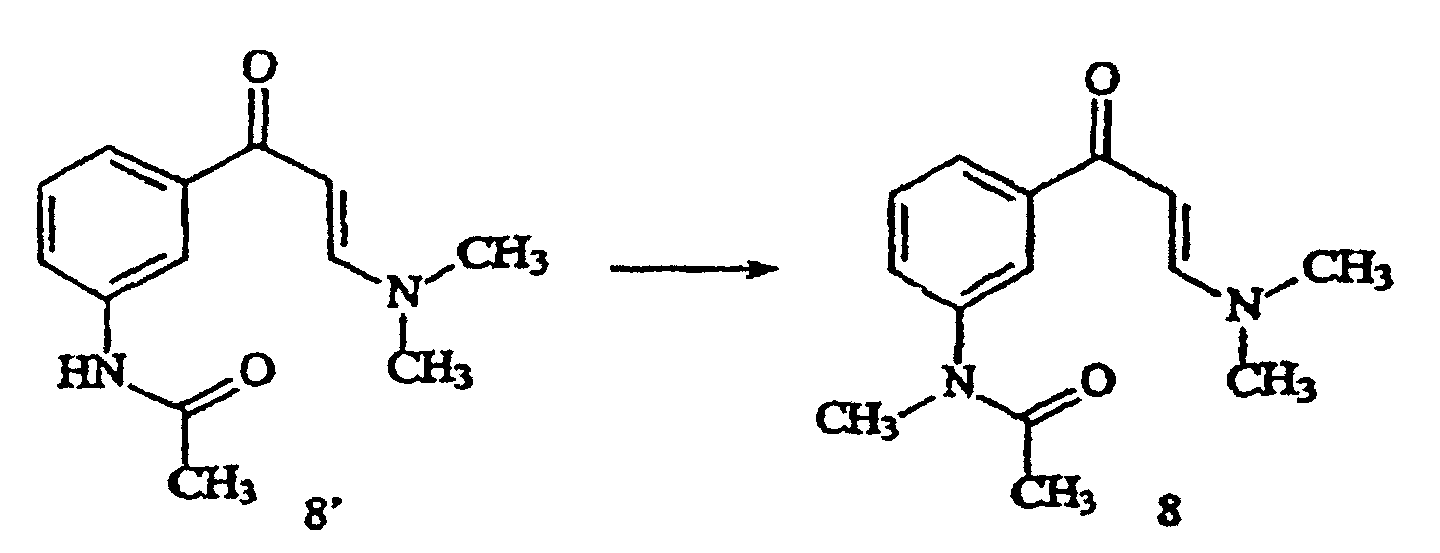
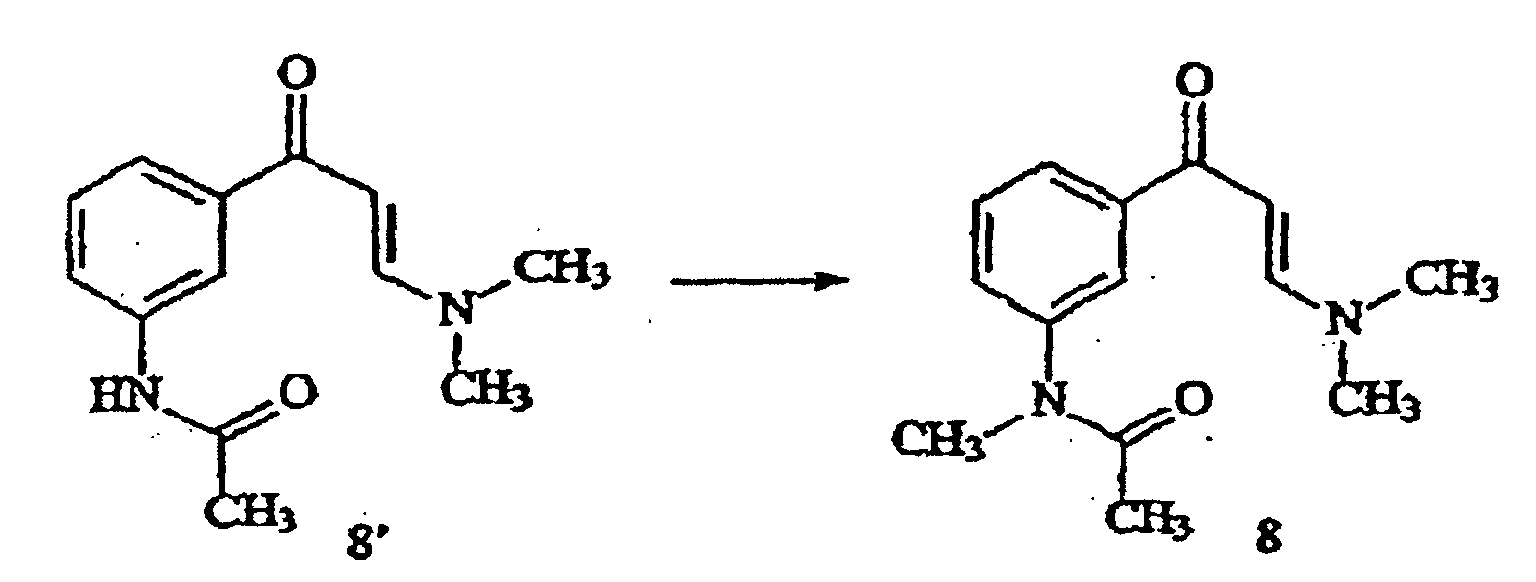
[0014] More particularly, the invention concerns a method for making alkylated enaminone 8, composing the step of alkylating enaminone 8' under phase transfer conditions.
[0015] As used herein, "phase transfer conditions" means an organic substrate is dissolved in an organic solvent and the nucleophilic reagent is dissolved in an aqueous phase, a phase transfer catalyst is used to carry the nucleophile from the aqueous phase into the organic phase to react with the substrate. More specifically, phase transfer conditions in the context of this invention may be obtained by utilizing, for example, a phase transfer catalyst (such as quaternary ammonium or phosphonium salts, crown ethers and polyethylene glycol ethers) in a polar organic solvent (such as methylene chloride, benzotrifluoride, or toluene) with an aqueous phase containing a base (such as sodium or potassium hydroxide).
EXAMPLE
FORMATION OF ENAMINONE 8 UNDER PHASE TRANSFER CONDITIONS
[0018] To enaminone 8' (25 g, 107.6 mmol) in benzotrifluoride (92 mL) and dichloromethane (160 mL) was added tetrabutytammonium sulfate (2 g, 5.9 mmol). To the mixture was added of dimethyl sulfate (16 g, 126.7 mmol). To the mixture was added 200 g of 50% aqueous sodium hydroxide solution and the mixture vigorously stirred for 6 hours, keeping the reaction temperature less than 40°C. Upon consumption of starting material, 200 mL of water was carefully added keeping the reaction temperature less than 40°C. The aqueous phase was separated and the organic phase was washed three times with water and dried over magnesium sulfate. The dichloromethane was removed in vacuo affording a yellow solid. The solid was filtered, washed with benzotrifluoride and dried in vacuo affording alkylated enaminone 8 (19 g, 72% yield).
1. A method for making alkylated enaminone. 8, comprising the step of alkylating enaminone
8' under phase transfer conditions
2. The method of claim 1 wherein the phase transfer conditions comprise a phase transfer
catalyst in a polar organic solvent with an aqueous phase containing a base.
3. The method of claim 2 wherein the phase transfer catalyst is a quaternary ammonium
or phosphonium salt, a crown ether or a polyethylene glycol ether.
4. The method of claim 2 wherein the organic solvent is methylene chloride, benzotrifluoride
or toluene.
5. The method of claim 2 wherein the base of aqueous phase is sodium or potassium hydroxide.
6. The method of claim 1, further comprising the step of utilizing enaminone 8 as an
intermediate in the synthesis of N-methyl-N-(3-{3-[2-thienylcarbonyl]-pyrazolo-[1,5-a]pyrimidin-7-yl}phenyl)acetamide
(Compound 1), wherein the step of utilizing enaminone 8 as an intermediate comprises
reacting enaminone 8 with a pyrazole having the structure:
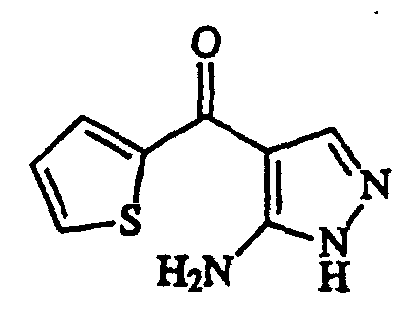
to form Compound 1.
to form Compound 1.
1. Verfahren zum Herstellen von alkyliertem Enaminon 8, umfassend den Schritt des Alkylierens
von Enaminon 8' unter Phasentransferbedingungen
2. Verfahren nach Anspruch 1, wobei die Phasentransferbedingungen einen Phasentransferkatalysator
in einem polaren organischen Lösungsmittel mit einer wässrigen Phase, die eine Base
enthält, umfassen.
3. Verfahren nach Anspruch 2, wobei der Phasentransferkatalysator ein quaternäres Ammonium-
oder Phosphoniumsalz, ein Kronenether oder ein Polyethylenglycolether ist.
4. Verfahren nach Anspruch 2, wobei das organische Lösungsmittel Methylenchlorid, Benzotrifluorid
oder Toluol ist.
5. Verfahren nach Anspruch 2, wobei die Base der wässrigen Phase Natrium- oder Kaliumhydroxid
ist.
6. Verfahren nach Anspruch 1, außerdem umfassend den Schritt des Verwendens von Enaminon
8 als ein Zwischenprodukt bei der Synthese von N-Methyl-N-(3-{3-[2-thienylcarbonyl]-pyrazolo-[1,5-a]-pyrimidin-7-yl}phenyl)acetamid
(Verbindung 1), wobei der Schritt des Verwendens von Enaminon 8 als ein Zwischenprodukt
das Umsetzen von Enaminon 8 mit einem Pyrazol mit der Struktur:
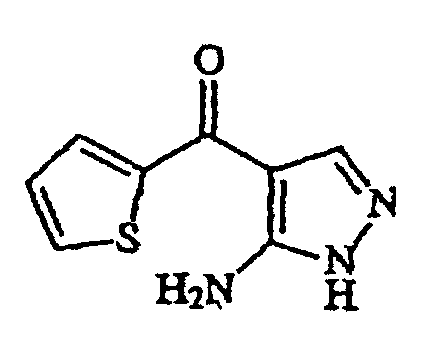
zum Bilden der Verbindung 1 umfasst.
zum Bilden der Verbindung 1 umfasst.
1. Une méthode de formation de l'énaminone 8 alkylée, comprenant l'étape d'alkylation
en conditions de transfert de phase de l'énaminone 8'.
2. La méthode de la revendication 1 dans laquelle la condition de transfert de phase
se compose d'une phase de catalyse dans un solvant organique polaire avec une phase
aqueuse contenant une base.
3. La méthode de la revendication 2 dans laquelle le transfert de phase de catalyse est
un ammonium quaternaire ou un sel de phosphonium, un éther couronne ou un éther de
polyéthylène glycol.
4. La méthode de la revendication 2 dans laquelle le solvant organique est du chloride
de méthylène, du benzotrifluoride ou du toluène.
5. La méthode de la revendication 2 dans laquelle la base de la phase aqueuse est de
l'hydroxide de sodium ou de potassium.
6. la méthode de la revendication 1, qui de plus se compose de l'étape d'utilisation
de l'énaminone 8 comme un intermédiaire de la synthèse du N-méthyl-N-(3-{3-[2-thienylcarbonyl]-pyrazolo-[1,5-a]-pyrimidine-7-yl}phényl)
acétamide (Composant 1), dans laquelle l'étape d'utilisation de l'énaminone 8, comme
un intermédiaire, comprend l'émanione réagissant avec un pyrazole ayant la structure
ci-dessous afin de former le composant 1.