|
(11) | EP 1 351 914 B1 |

| (12) | EUROPEAN PATENT SPECIFICATION |
|
|
| (54) |
DEHYDROGENATION OF ALKYLENE GLYCOL ETHERS TO ETHER KETONES AND ALDEHYDES DEHYDRIERUNG VON ALKYLENGLYKOLETHERN ZU ETHERKETONEN UND -ALDEHYDEN DESHYDROGENATION D'ETHERS D'ALKYLENEGLYCOL EN ETHERS CETONIQUES OU EN ALDEHYDIQUES |
|
|
|||||||||||||||||||||||||||||||
| Note: Within nine months from the publication of the mention of the grant of the European patent, any person may give notice to the European Patent Office of opposition to the European patent granted. Notice of opposition shall be filed in a written reasoned statement. It shall not be deemed to have been filed until the opposition fee has been paid. (Art. 99(1) European Patent Convention). |
FIELD OF THE INVENTION
[0001] The invention relates to the preparation of ether ketones and ether aldehydes. In particular, the invention relates to a catalytic dehydrogenation of alkylene glycol ethers to produce ether ketones and ether aldehydes.
BACKGROUND OF THE INVENTION
[0002] Primary alcohols can be converted to aldehydes and secondary alcohols to ketones by dehydrogenation. Similarly, glycol ethers can be converted to ether aldehydes or ether ketones. Catalytic dehydrogenation is more often used industrially because it gives relatively high selectivity to aldehydes or ketones.
[0003] U.S. Pat. No. 3,462,495 teaches dehydrogenation of glycol ethers with "calcium nickel phosphate" catalysts. The dehydrogenation is performed by feeding a mixture of glycol ether with from 1 to 25% of water at 425°C. It gives 55 % of conversion of glycol ether and 72.5% selectivity to ether ketone.
[0004] U.S. Pat. No. 4,233,246 teaches oxidation of glycol ethers to ether ketones with silver/copper metal catalysts in the presence of air. The reaction is carried out in vapor phase by passing glycol ether through multiple layers of catalyst at 450-700°C. While this complicated process gives a high conversion of glycol ether (>99%), it has low selectivity to ether ketone (less than 70 %).
[0005] U.S. Pat. No. 4,141,919 teaches dehydrogenation of propylene glycol methyl ether in the presence of copper oxide catalyst. The catalyst is treated with hydrogen. A mixture of propylene glycol methyl ether with about 5% of water is passed over the catalyst at about 280°C. It gives less than 50% selectivity to methoxyacetone.
[0006] U.S. Pat. No. 4,431,493 teaches electrochemical preparation of ether ketones and ether aldehydes from alkylene glycol ethers. However, the conversion and selectivity are still very low.
[0007] A Czech and Slovak patent, C.S. Pat. No. 275,182, also teaches dehydrogenation of propylene glycol methyl ether to methoxyacetone with copper-zinc oxides. The patent discloses that using an aniline derivative in the dehydrogenation can enhance the selectivity to methoxyacetone.
[0008] Copending Appl. Ser. No. 09/519,398, filed on March 3, 2000 (US 6,232,505), discloses liquid phase oxidation of propylene glycol methyl ether to methoxyacetone using hydrogen peroxide in the presence of a transition metal catalyst. It has achieved a higher conversion and higher selectivity. However, using hydrogen peroxide is inconvenient in a commercial process.
[0009] There is an increasing interest in ketones and aldehydes. They are used for making dyes and herbicidal compositions (see, e.g., U.S. Pat. Nos. 4,666,502 and 5,576,188). Ether ketones have found potential uses as co-solvents in water-borne coatings (see, e.g., U.S. Pat. No. 4,202,808). An improved process for making ether ketones and ether aldehydes is thus needed. Ideally, the process would have high selectivity and could be easily commercialized.
SUMMARY OF THE INVENTION
[0010] The invention is a process for dehydrogenation of an alkylene glycol ether to an ether ketone or an aldehyde. The process is performed in the presence of a copper chromite catalyst and at least 5 wt % of water based on the amount of alkylene glycol ether. The process gives high selectivity to ketones and aldehydes.
DETAILED DESCRIPTION OF THE INVENTION
[0011] The invention is a process for dehydrogenation of alkylene glycol ethers to ether ketones and aldehydes. The process is performed in the presence of a copper chromite catalyst. Suitable copper chromite catalysts can be made by any method known in the art. For example, U.S. Pat No. 3,374,184 teaches making copper chromite by reacting cupric nitrate and chromic oxide. In another example, U.S. Pat, No. 4,251,396 teaches making copper chromite from copper sulfate and sodium dichromate. Copper chromite catalysts are commercially available, e.g., from Engehard Company. Preferably, the copper chromite for use in the process of the invention contains at least 50 wt % of CuCr2O4.
[0012] The catalyst is preferably treated with hydrogen. Methods for hydrogenation of metal oxides are known. For example, U.S. Pat. No. 4,141,919 teaches how to hydrogenate copper oxide. The hydrogenation of copper chromite is exothermic, so hydrogen is added slowly in the beginning and gradually increased when the reaction continues. The hydrogenation is preferably carried out at a temperature from about 125°C to about 225°C, more preferably from about 150°C to about 200°C.
[0013] The catalyst preferably has a total pore volume within the range of about 0.05 to about 2 cc/g, more preferably from 0.05 to 0.5 cc/g. It preferably has a surface area within the range from about 1 to about 50 m2/g, more preferably from about 5 to about 15 m2/g.
[0014] The process of the invention is performed in the presence of at least 5 wt % of water based on alkylene glycol ether. Preferably, the dehydrogenation is performed in the presence of at least 20 wt % of water. More preferably, the process is performed in the presence of at least 40 wt % of water. As shown in the examples, the selectivity to ether ketones increases with increasing water concentration. When about 40 wt % of water is used, the selectivity reaches almost 100%.
[0015] Suitable alkylene glycol ethers for use in the dehydrogenation include those having the general structure:
in which R1 is a C1 to C10 alkyl group, or a C6 to C10 aryl or alkylaryl group, R2 is hydrogen, a C1 to C10 alkyl group, or a C6 to C10 aryl or alkylaryl group, and n, which is an average number of oxyalkylene units, is within the range of 1 to about 10. Preferably, n is within the range of 1 to about 5. More preferably, n is within the range of 1 to about 3. Preferably, R1 is a C1 to C10 alkyl group. More preferably, R1 is a C1 to C6 alkyl group. Preferably, R2 is hydrogen or a C1 to C10 alkyl group. More preferably, R2 is hydrogen or methyl group.
[0016] Examples of suitable alkylene glycol ethers are propylene glycol methyl ether, propylene glycol n-butyl ether, propylene glycol t-butyl ether, propylene glycol n-propyl ether, dipropylene glycol methyl ether, dipropylene glycol n-butyl ether, dipropylene glycol t-butyl ether, dipropylene glycol n-propyl ether, tripropylene glycol methyl ether, ethylene glycol methyl ether, ethylene glycol n-butyl ether, diethylene glycol methyl ether, diethylene glycol n-propyl ether, and the like, and mixtures thereof.
[0017] The dehydrogenation converts primary hydroxyl group of alkylene glycol ether to aldehyde and secondary hydroxyl group to ketone. For example, dehydrogenation of propylene glycol methyl ether gives methoxyacetone, while the dehydrogenation of ethylene glycol methyl ether gives methoxyformaldehyde. Ether ketones and aldehydes prepared by the hydrogenation of the invention include those represented by the formula:
R1, R2 and n are defined above.
[0018] The process is preferably performed at a temperature within the range of about 150°C to about 350°C. More preferably, the process is performed at a temperature within the range of about 220°C to about 280°C.
[0019] The following examples merely illustrate the invention. Those skilled in the art will recognize many variations that are within the spirit of the invention and scope of the claims.
EXAMPLE 1
[0020] The hydrogenation is carried out in a stainless steel fixed bed reactor. Copper chromite catalyst (4.1 kg, Cu-0203-T, product of Engelhard Company) is loaded into the reactor. The catalyst is activated using a mixture of hydrogen and nitrogen. To drive out moisture and air, the catalyst bed is heated to 150°C and remains at this temperature for 5-8 hours under nitrogen flow in a rate of 500 1/hr. Hydrogen is then added into the reactor. The reaction is exothermic, so hydrogen is added slowly in the beginning in a rate that is 1.0-1.5% of the nitrogen flow rate. As the reaction continues, hydrogen concentration is gradually increased so as to control the temperature not to exceed 170°C. At the end of the reaction, hydrogen concentration reaches 100%.
[0021] A mixture of 40 wt % water and 60 wt % of propylene glycol methyl ether is fed into the reactor at a weight-hourly space-velocity (WHSV) of 1.1. Reactor temperature is maintained at 250°C. In the steady state, the conversion of propylene glycol methyl ether is 43.5% and selectivity to methoxyacetone is 95.2 mole %.
EXAMPLE 2
[0022] Example 1 is repeated, but a mixture of 20 wt % water and 80 wt % propylene glycol methyl ether is used. In the steady state, the conversion of propylene glycol methyl ether is 37.5% and selectivity to methoxyacetone is 85.4 mole %.
EXAMPLE 3
[0023] Example 1 is repeated, but a mixture of 10 wt % water and 90 wt % propylene glycol methyl ether is used. In the steady state, the conversion of propylene glycol methyl ether is 34% and selectivity to methoxyacetone is 75.2 mole %.
EXAMPLE 4
[0024] Example 1 is repeated but a mixture of 5 wt % water and 95 wt % propylene glycol methyl ether is used. In the steady state, the conversion of propylene glycol methyl ether is 39.0% and selectivity to methoxyacetone is 64 mole %.
COMPARATIVE EXAMPLE 5
[0025] Example 1 is repeated, but pure propylene glycol methyl ether is used. In the steady state, the conversion of propylene glycol methyl ether is 56 % and selectivity to methoxyacetone is 37%.
EXAMPLE 6
[0026] Example 1 is repeated, but the dehydrogenation is conducted at 280°C. In the steady state, the conversion of propylene glycol methyl ether is 76 % and selectivity to methoxyacetone is 99%.
COMPARATIVE EXAMPLE 7
1. A process which comprises dehydrogenating an alkylene glycol ether to an ether ketone
or an ether aldehyde, wherein the process is performed in the presence of a copper
chromite catalyst and at least 5 wt % of water, based on the amount of alkylene glycol
ether.
2. The process of claim 1 wherein the copper chromite catalyst contains at least 50 wt % of CuCr2O4.
3. The process of claim 1 wherein the copper chromite catalyst is hydrogenated.
4. The process of claim 1 wherein the alkylene glycol ether has the structure:
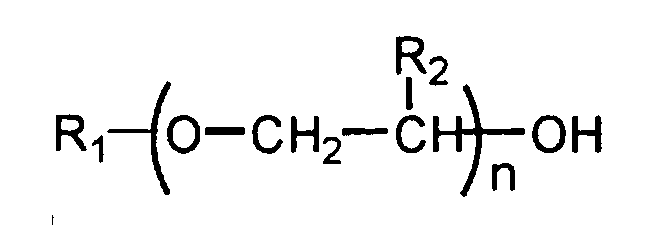
in which R1 is a C1 to C10 alkyl group, or a C6 to C10 aryl or alkylaryl group, R2 is hydrogen, a C1 to C10 alkyl group, or a C6 to C10 aryl or alkylaryl group, and n, which is an average number of oxyalkylene units, is within the range of 1 to about 10.
in which R1 is a C1 to C10 alkyl group, or a C6 to C10 aryl or alkylaryl group, R2 is hydrogen, a C1 to C10 alkyl group, or a C6 to C10 aryl or alkylaryl group, and n, which is an average number of oxyalkylene units, is within the range of 1 to about 10.
5. The process of claim 1 performed at a temperature within the range of about 150°C to about 350°C.
6. The process of claim 1 performed at a temperature within the range of about 220°C to about 280°C.
7. The process of claim 1 wherein the alkylene glycol ether is selected from the group consisting of propylene
glycol alkyl ethers, ethylene glycol alkyl ethers, butylene glycol alkyl ethers, and
mixtures thereof.
8. The process of claim 1 wherein the alkylene glycol ether is a propylene glycol methyl ether.
9. The process of claim 1 performed in the presence of at least 20 wt % of water based on the amount of alkylene
glycol ether.
10. The process of claim 1 performed in the presence of at least 40 wt % of water based on the amount of alkylene
glycol ether.
11. A process comprising dehydrogenating propylene glycol methyl ether to produce methoxyacetone,
wherein the process is performed in the presence of a copper chromite catalyst that
contains at least 50 wt % of CuCr2O4 and in the presence of at least 40 wt % of water based on the amount of propylene
glycol methyl ether.
1. Verfahren umfassend Dehydrierung eines Alkylenglykolethers zu einem Etherketon oder
einem Etheraldehyd, wobei das Verfahren in der Anwesenheit eines Kupferchromitkatalysators
und von zumindest 5 Gewichtsprozent Wasser, auf der Menge von Alkylenglykolether basiert,
durchgeführt wird.
2. Verfahren nach Anspruch 1, wobei der Kupferchromitkatalysator zumindest 50 Gewichtsprozent
CuCr2O4 enthält.
3. Verfahren nach Anspruch 1, wobei der Kupferchromitkatalysator hydriert wird.
4. Verfahren nach Anspruch 1, wobei der Alkylenglykolether die Struktur:
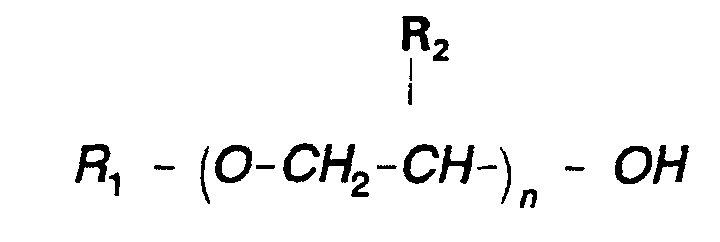
hat, wobei R1 eine C1 bis C10 Alkylgruppe, oder eine C6 bis C10 Aryl- oder Alkylarylgruppe ist, R2 Wasserstoff, eine C1 bis C10 Alkylgruppe, oder eine C6 bis C10 Aryl- oder Alkylarylgruppe ist, und n, welcher eine Durchschnittszahl von Oxyalkyleneinheiten ist, in dem Bereich von 1 bis ungefähr 10 ist.
hat, wobei R1 eine C1 bis C10 Alkylgruppe, oder eine C6 bis C10 Aryl- oder Alkylarylgruppe ist, R2 Wasserstoff, eine C1 bis C10 Alkylgruppe, oder eine C6 bis C10 Aryl- oder Alkylarylgruppe ist, und n, welcher eine Durchschnittszahl von Oxyalkyleneinheiten ist, in dem Bereich von 1 bis ungefähr 10 ist.
5. Verfahren nach Anspruch 1, bei einer Temperatur in dem Bereich von ungefähr 150°C
bis ungefähr 350°C durchgeführt.
6. Verfahren nach Anspruch 1, bei einer Temperatur in dem Bereich von ungefähr 220°C
bis ungefähr 280°C durchgeführt.
7. Verfahren nach Anspruch 1, wobei der Alkylenglykolether aus der Gruppe bestehend aus
Propylenglykolalkylethern, Ethylenglykolalkylethern, Butylenglykolalkylethern und
deren Mischungen ausgewählt wird.
8. Verfahren nach Anspruch 1, wobei der Alkylenglykolether ein Propylenglykolmethylether
ist.
9. Verfahren nach Anspruch 1, in der Anwesenheit von zumindest 20 Gewichtsprozent Wasser
auf der Menge von Alkylenglykolether basiert, durchgeführt.
10. Verfahren nach Anspruch 1, in der Anwesenheit von zumindest 40 Gewichtsprozent Wasser
auf der Menge von Alkylenglykolether basiert, durchgeführt.
11. Verfahren umfassend Dehydrierung von Propylenglykolmethylether um Methoxyaceton zu
produzieren, wobei das Verfahren in der Anwesenheit eines Kupferchromitkatalysators,
der zumindest 50 Gewichtsprozent CuCr2O4 enthält, und in der Anwesenheit von zumindest 40 Gewichtsprozent Wasser auf der Menge
von Propylenglykolmethylether basiert, durchgeführt wird.
1. Procédé qui comprend la déshydrogénation d'un éther d'alkylèneglycol en une éther
cétone ou un éther aldéhyde, où le procédé est mis en oeuvre en présence d'un catalyseur
au chromite de cuivre et d'au moins 5 % en masse d'eau, sur la base de la quantité
d'éther d'alkylèneglycol.
2. Procédé selon la revendication 1 où le catalyseur au chromite de cuivre contient au
moins 50 % en masse de CuCr2O4.
3. Procédé selon la revendication 1 où le catalyseur au chromite de cuivre est hydrogéné.
4. Procédé selon la revendication 1 où l'éther d'alkylèneglycol à la structure :
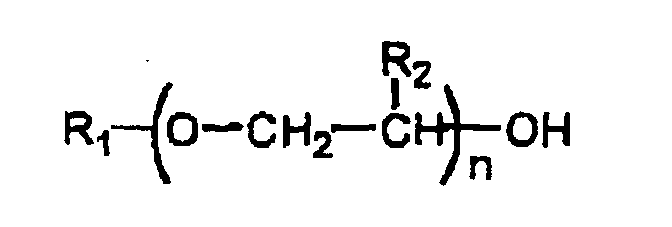
où R1 est un groupe C1 à C10 alkyle, ou un groupe C6 à C10 aryle ou alkylaryle, R2 est l'hydrogène, un groupe C1 à C10 alkyle, ou un groupe C6 à C10 aryle ou alkylaryle, et n, qui est un nombre moyen d'unités d'oxyalkylène, est dans la plage de 1 à environ 10.
où R1 est un groupe C1 à C10 alkyle, ou un groupe C6 à C10 aryle ou alkylaryle, R2 est l'hydrogène, un groupe C1 à C10 alkyle, ou un groupe C6 à C10 aryle ou alkylaryle, et n, qui est un nombre moyen d'unités d'oxyalkylène, est dans la plage de 1 à environ 10.
5. Procédé selon la revendication 1 mis en oeuvre à une température dans la plage d'environ
150°C à environ 350°C.
6. Procédé selon la revendication 1 mis en oeuvre à une température dans la plage d'environ
220°C à environ 280°C.
7. Procédé selon la revendication 1 où l'éther d'alkylèneglycol est choisi dans le groupe
consistant en les alkyléthers de propylèneglycol, les alkyléthers d'éthylèneglycol,
les alkyléthers de butylèneglycol et leurs mélanges.
8. Procédé selon la revendication 1 où l'éther d'alkylèneglycol est un méthyléther de
propylèneglycol.
9. Procédé selon la revendication 1 mis en oeuvre en présence d'au moins 20 % en masse
d'eau sur la base de la quantité d'éther d'alkylèneglycol.
10. Procédé selon la revendication 1 mis en oeuvre en présence d'au moins 40 % en masse
d'eau sur la base de la quantité d'éther d'alkylèneglycol.
11. Procédé comprenant la déshydrogénation de méthyléther de propylèneglycol pour produire
la méthoxyacétone, où le procédé est mis en oeuvre en présence d'un catalysateur au
chromite de cuivre qui contient au moins 50 % en masse de CuCr2O4 et en présence d'au moins 40 % en masse d'eau, sur la base de la quantité de méthyléther
de propylèneglycol.