| (19) |
 |
|
(11) |
EP 1 380 721 B1 |
| (12) |
EUROPEAN PATENT SPECIFICATION |
| (45) |
Mention of the grant of the patent: |
|
25.10.2006 Bulletin 2006/43 |
| (22) |
Date of filing: 23.09.1999 |
|
| (51) |
International Patent Classification (IPC):
|
|
| (54) |
Method of wiping the inner surface of a tubular member, and a plug for use in said
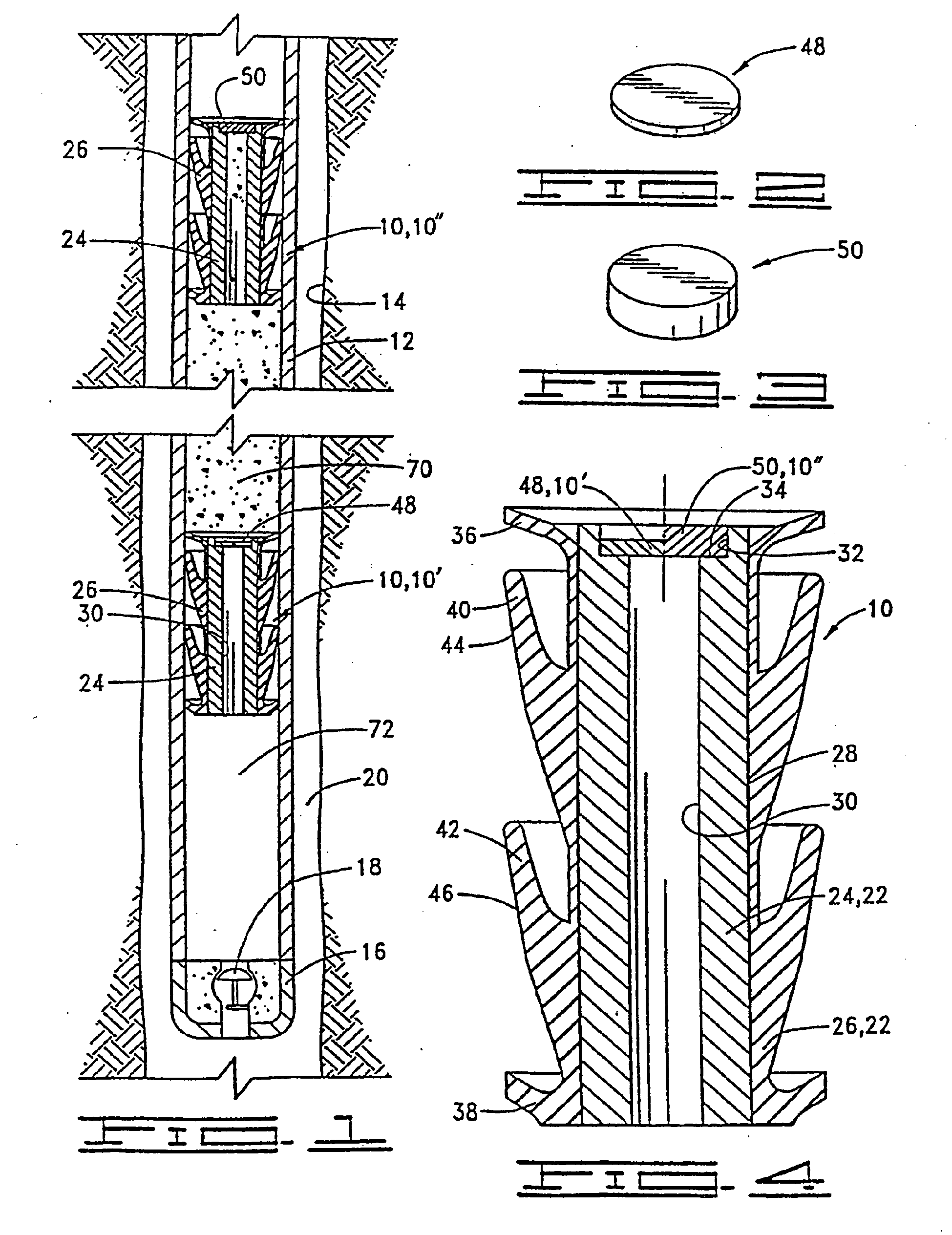
method
Verfahren zum Wischen der Innenfläche eines rohrförmigen Elementes und ein Stopfen
zur Anwendung im genannten Verfahren
Méthode d'essuyage de la surface intérieure d'un élément tubulaire et un bouchon à
utiliser dans ladite méthode
|
| (84) |
Designated Contracting States: |
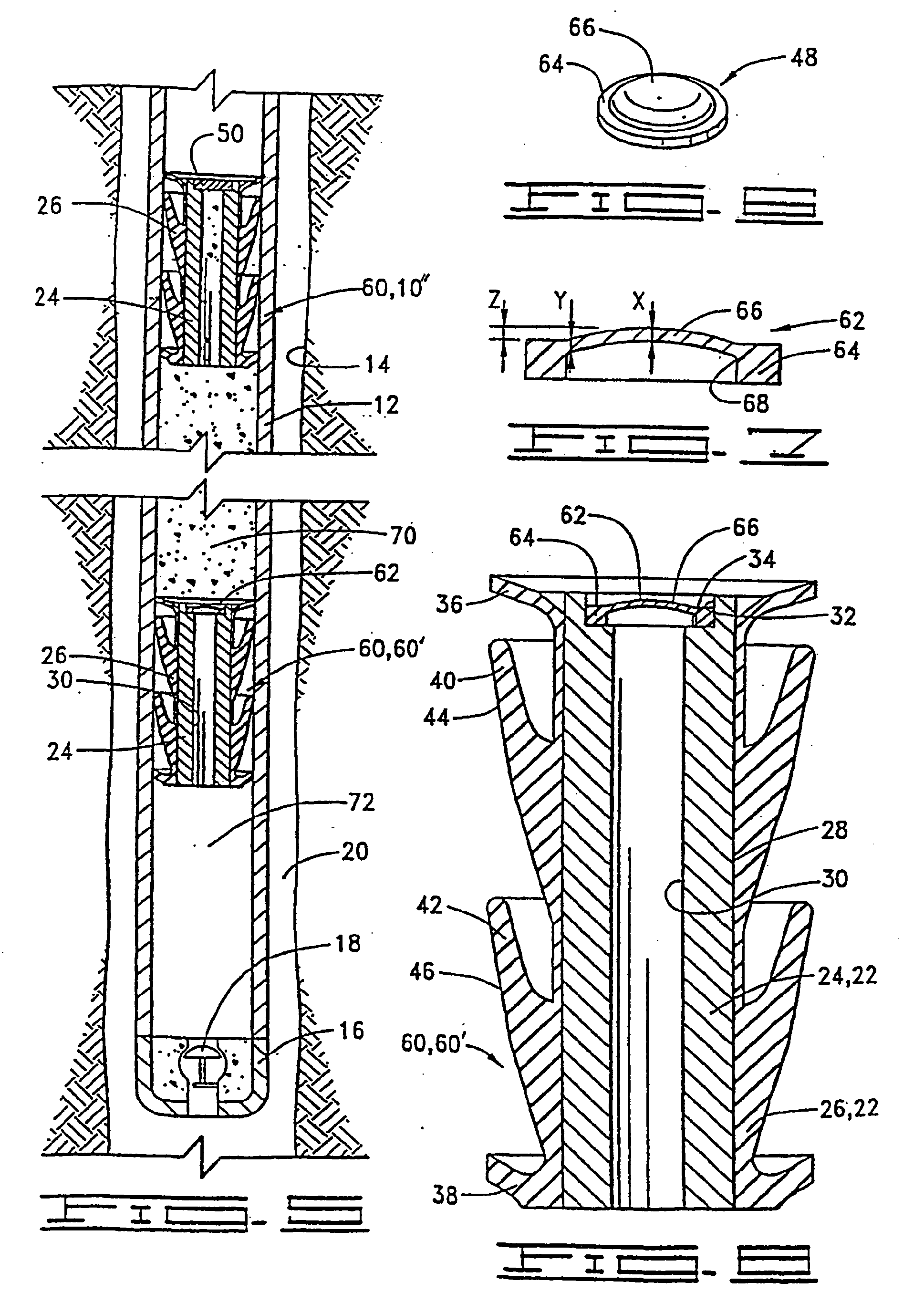
|
DE FR GB IT NL |
| (30) |
Priority: |
20.10.1998 US 175664
|
| (43) |
Date of publication of application: |
|
14.01.2004 Bulletin 2004/03 |
| (60) |
Divisional application: |
|
04078181.7 / 1519004 |
| (62) |
Application number of the earlier application in accordance with Art. 76 EPC: |
|
99947665.8 / 1127211 |
| (73) |
Proprietor: HALLIBURTON ENERGY SERVICES, INC. |
|
Duncan,
Oklahoma 73536 (US) |
|
| (72) |
Inventor: |
|
- Treece, Harold O.
Duncan, Oklahoma 73533 (US)
|
| (74) |
Representative: Wain, Christopher Paul et al |
|
A.A. Thornton & Co.
235 High Holborn
London WC1V 7LE
London WC1V 7LE (GB) |
| (56) |
References cited: :
EP-A- 0 498 990
US-A- 3 616 850
US-A- 5 533 570
US-A- 5 813 457
|
EP-A- 0 869 257
US-A- 4 934 452
US-A- 5 722 491
|
|
| |
|
|
|
|
| |
|
| Note: Within nine months from the publication of the mention of the grant of the European
patent, any person may give notice to the European Patent Office of opposition to
the European patent
granted. Notice of opposition shall be filed in a written reasoned statement. It shall
not be deemed to
have been filed until the opposition fee has been paid. (Art. 99(1) European Patent
Convention).
|
[0001] This invention relates to cementing plugs for use in cementing casing in a well,
and more particularly, to a universal cementing plug having improved wiping and extended
wear and which includes a plurality of interchangeable inserts so that the plug may
be selectively used as a top or a bottom plug.
[0002] In the process of preparing a well for testing and/or production, a casing is positioned
in the well and cemented in place. Typically, at the beginning of the cementing job
in rotary-drilled wells, the casing and the wellbore are usually filled with drilling
mud. In many areas, to reduce contamination on the interface between the mud and cement
a bottom plug is released from a plug container and pumped ahead of the cement slurry.
Such plugs have wipers of an elastomeric material thereon to wipe the casing of any
accumulated mud film so that the mud is pushed ahead of the bottom plug.
[0003] When the bottom plug reaches floating equipment such as a float collar or float shoe
at the bottom of the casing string, a fluid pressure differential created across the
plug ruptures a rubber diaphragm at the top of the plug and allows the cement slurry
to proceed down the casing through the plug and floating equipment and then up an
annulus space defined between the casing and the wellbore.
[0004] When all of the cement has been mixed and pumped into the casing string, a top cementing
plug is released from the plug container. The top plug also has wipers of elastomeric
material thereon. The function of the top plug is to follow the cement and wipe any
accumulated cement film from the inside of the casing. The top plug is also designed
to reduce the possibility of any contamination or channeling of the cement slurry
with the drilling mud that is used to displace the cement column down the casing and
into the annular space between the casing and the wellbore. The top cementing plug
is typically solid in construction, and the design is such that when it reaches the
bottom cementing plug at the float collar or float shoe, the top cementing plug causes
a shutoff of fluids being pumped into the casing. This causes a normal pressure rise
at the surface and notifies the operator that the cementing job is complete.
[0005] The landing of the top plug lessens the possibility of any further displacement of
the cement slurry and provides a better quality of cement slurry around the bottom
of the casing where a good cement bond to the casing is required.
[0006] Currently, two different cementing plugs are used in this cementing operation, one
for the top and one for the bottom. The bottom plug has a shearable member, such as
the rubber diaphragm previously mentioned, which shears when a specific fluid pressure
differential is applied thereto. The top plug is substantially solid. Because each
plug requires different construction, separate molds must be used for each of the
plugs which increase the costs of manufacturing, and also, the two separate plugs
must be kept in inventory. The present invention solves this problem by using a single
plug subassembly design which has the same general construction whether it is used
as a top plug or a bottom plug. A shearable insert is positioned in one plug so that
it may be used as a bottom plug. This shearable member is designed to shear at a predetermined
differential pressure thereacross. In one embodiment, the shearable member is a flat
disc, and in another embodiment, the shearable member has a relatively thin domed
portion. Another insert, which is essentially non-shearable at the pressures in which
the plugs are utilized, is positioned in another plug so that it can be used as a
top plug. By the use of a single plug subassembly, with separate inserts, the cost
of molds of the plugs is decreased, and only one plug must be maintained in inventory
along with the different inserts.
[0007] Another advantage of the present invention is that the shearable member may be interchanged
with a plurality of shearable members, including, but not limited to, the two embodiments
previously described, designed to shear at any one of a selected number of differential
pressures as necessary for different well conditions. This is an improvement over
the previous design which had essentially one shear pressure.
[0008] With prior art cementing plugs, the wiping efficiency of the wipers on the plugs
is affected by pumping rate and wear along the casing surface. The cementing plug
of the present invention provides an improved wiper design which offers more surface
contact, and as the plug is pumped down the casing, wiping efficiency is increased.
As a top cup on the plug wears, the pressure is transferred to a bottom cup which
prolongs the surface engagement maintaining the wiping, resulting in extended wear.
[0009] The prior art discloses cementing plugs of various constructions in US 5813457, EP0869257A,
US 5722491, US 5533570, US 3616850 and EP 0498990A
[0010] The present invention is a universal cementing plug which may be configured as either
a bottom cementing plug or a top cementing plug. The plug may also be described as
an improved wiping and/or extended wear plug.
[0011] According to one aspect of the invention there is provided a method for wiping the
inner surface of a tubular member as claimed in claim 1.
[0012] According to another aspect of the invention there is provided a cementing plug for
use in a cementing casing in a well as claimed in claim 19.
[0013] In an embodiment, said shearable member is made of a rupturable material.
[0014] In an embodiment, said shearable member is a substantially flat disk having a substantially
uniform thickness.
[0015] In an embodiment, said shearable member comprises: a ring portion; and a domed portion
extending from said ring portion.
[0016] In an embodiment, said insert is a substantially non-shearable disk adapted for substantially
permanent closure of said central opening.
[0017] In an embodiment, said body member defines a shoulder in said central opening; and
said insert is disposed on said shoulder.
[0018] In an embodiment, there is an outer jacket disposed around the body member, and said
jacket may be made of an elastomeric material.
[0019] Reference is now made to the accompanying drawings, in which:
FIG. 1 shows a first embodiment of the universal cementing plug and system of the
present invention in use in a wellbore.
FIG. 2 is a perspective illustrating a first embodiment of a shearable insert used
in the cementing plug as a bottom plug.
FIG. 3 illustrates in perspective a substantially non-shearable insert for use in
the cementing plug as a top plug.
FIG. 4 illustrates a longitudinal cross section of the cementing plug of FIGS. 1-3.
FIG. 5 shows a second embodiment of the universal cementing plug and system of the
present invention in use in a wellbore.
FIG. 6 is a perspective illustrating a second embodiment of a shearable insert used
in the cementing plug as a bottom plug.
FIG. 7 is a longitudinal cross section of the second embodiment shearable insert.
FIG. 8 illustrates a longitudinal cross section of the cementing plug as a bottom
plug including the second embodiment shearable insert of FIGS. 6 and 7.
[0020] Referring now to the drawings, and more particularly to FIG. 1, a first embodiment
of the universal cementing plug of the present invention is shown and generally designated
by the numeral 10. Universal cementing plug 10 may also be referred to as an improved
wiping and/or extended wear cementing plug. As will be further discussed herein, cementing
plug 10 can be configured as a first embodiment bottom plug 10' or a top plug 10".
Bottom plug 10' and top plug 10" may be referred to together as a first embodiment
cementing plug system.
[0021] Cementing plug 10 is designed for use in a casing 12 disposed in a wellbore 14. At
the lower end of casing 12 is floating equipment, such as a casing float collar or
float shoe 16, of a kind known in the art, having a valve 18 therein designed to allow
cement to be pumped into an annulus 20 between casing 12 and wellbore 14 while preventing
backflow.
[0022] Referring now to FIGS. 2-3, the details of first embodiment cementing plug 10 will
be discussed. Cementing plug 10 includes a plug subassembly 22 which comprises a body
member 24 and a jacket 26 disposed around the body member. Body member 24 is made
of any one of a number of drillable materials known in the art, such as aluminum,
plastic, wood, etc. Jacket 26 is made of an elastomeric material and is molded onto
the outer surface of body member 24.
[0023] Body member 24 has a substantially cylindrical configuration with an outer surface
28 and a central opening, such as a first bore 30, defined longitudinally therethrough.
A larger second bore 32 is defined in the upper end of body member 24 such that an
upwardly facing annular shoulder 34 is defined between first bore 30 and second bore
32. Thus, a recess is formed in the upper end of the central opening.
[0024] Jacket 26 has an upper radially outwardly extending lip 36 and a lower radially outwardly
extending lip 38. Between upper lip 36 and lower lip 38 are a pair of upwardly opening
cup portions 40 and 42. Cup portion 40 may be referred to as upper cup 40, and cup
portion 42 may be referred to as lower cup 42. It will be seen that upper cup 40 and
lower cup 42 extend upwardly and radially outwardly. As seen in FIG. 4, cups 40 and
42 extend at an acute angle with respect to a longitudinal axis of cementing plug
10, and thus are angled much more sharply with respect to body member 24 than are
upper lip 36 and lower lip 38. Upper cup 40 has an acutely angled conical outer surface
44 which is deflected into substantial wiping engagement with the inner surface of
casing 12 as seen in FIG. 1, and lower cup 42 has a similar acutely angled conical
surface 46.
[0025] FIG. 2 illustrates a first embodiment of a shearable insert or disk 48 which is substantially
flat and of uniform thickness. FIG. 3 illustrates a substantially solid, non-shearable
insert or disk 50 which is also substantially flat. Either of inserts 48 and 50 may
be positioned on shoulder 34 in body member 24 of first embodiment cementing plug
10. Referring to the right side of FIG. 4, non-shearable insert 50 is shown thus forming
a top plug 10". In the left side of FIG. 4, first embodiment shearable insert 48 is
shown, thus illustrating a first embodiment bottom plug 10'.
[0026] First embodiment shearable insert 48 is made of a material which is easily sheared
or ruptured when a predetermined differential pressure is applied thereacross. One
typical material is rubber, but the invention is not intended to be so limited. The
thickness of shearable insert 48 may be one of a plurality of available thicknesses
so that the shear pressure may be predetermined as conditions dictate.
[0027] Non-shearable insert 50 is substantially thicker than shearable insert 48 and is
designed to be substantially non-shearable when normal pressures are applied thereacross.
Thus, non-shearable insert 50 provides substantially permanent closure of the central
opening in the corresponding body member 24.
[0028] Referring now to FIG. 5, a second embodiment of the uniform cementing plug of the
present invention is shown and generally designated by the numeral 60. Universal cementing
plug 60 may also be referred to as an improved wiping and/or extended-wear cementing
plug. As will be further discussed herein, cementing plug 60 can be configured as
a second embodiment bottom plug 60' or the same top plug 10" as in first embodiment
cementing plug 10. Second embodiment bottom plug 60' and top plug 10" may be referred
together as a second embodiment cementing plug system.
[0029] As with the first embodiment, second embodiment cementing plug 60 is designed for
use in casing 12 disposed in wellbore 14. Again, at the lower end of casing 12 is
floating equipment, such as casing float collar or float shoe 16 having valve 18 therein.
An annulus 20 is formed between casing 12 and wellbore 14.
[0030] Referring now to FIGS. 6-8, the details of second embodiment cementing plug 60 will
be discussed. Cementing plug 60 includes the same plug subassembly 22 used in first
embodiment cementing plug 10. Therefore, the same reference numerals are used for
the components of plug subassembly 22 in FIG. 8 as were used in FIG. 4 for the first
embodiment. As with the first embodiment, in the second embodiment, upper lip 40 on
jacket 26 has an acutely angled conical outer surface 44 which is deflected into substantial
wiping engagement with the inner surface of casing 12 as seen in FIG. 5, and lower
cup 42 has a similar acutely angled conical surface 46.
[0031] FIGS. 6 and 7 illustrate a second embodiment of a shearable insert or member 62.
Shearable insert 62 has an outer ring portion 64 and a relatively thin inner portion
66 which acts as a rupture disk portion. In the preferred embodiment, but not by way
of limitation, inner portion 66 has an outwardly convex, curvilinear configuration.
Thus, inner portion 66 may also be referred to as a domed portion 66.
[0032] Domed portion 66 is integrally formed with outer ring portion 64 and extends upwardly
and inwardly from the ring portion.
[0033] Domed portion 66 preferably has a variable thickness including a first thickness
X at or near its center and a second thickness Y adjacent to an internal corner 68
formed on the inside between ring portion 64 and domed portion 66. In the illustrated
embodiment, first thickness X is less than second thickness Y. Corner 68 is preferably
radiused.
EXAMPLES
[0034] Although various materials may be used for shearable insert 62, a preferred material
is 23570 glass-filled plastic from Barlow-Hunt, Inc., of Tulsa, Oklahoma. This material
has a working temperature range of room temperature to about 41 0E F.
[0035] The following table illustrates the pressure at which domed portion 66 shears based
on different values of X and Y using this material:
| X |
Y |
Shear Pressure |
| 0.100" |
0.125" |
370 psi |
| 0.125" |
0.150" |
700 psi |
| 0.131" - 0.135" |
0.175" |
1200 psi |
[0036] In a preferred embodiment, but not by way of limitation, the height Z of domed portion
66 above ring portion 64 is approximately equal to center thickness X of domed portion
66.
[0037] Second embodiment shearable insert 62 may be positioned on shoulder 34 in body member
24 of plug subassembly 22 to form second embodiment bottom plug 60', as seen in FIGS.
5 and 8.
[0038] In second embodiment cementing plug 60, top plug 10" used with bottom plug 60' is
identical to that in first embodiment cementing plug 10.
OPERATION OF THE INVENTION
[0039] Referring again to FIGS. 1 and 5, the operation of cementing plug systems 10 and
60 are shown, respectively. First, a bottom plug 10' or 60' is prepared by positioning
a shearable insert 48 or 62, respectively, in body member 24 of a plug subassembly
22, and a top plug 10" is similarly formed by positioning a non-shearable insert 50
in body member 24 of another plug subassembly 22. Bottom plug 10' or 60' is dropped
into casing 12 in a manner known in the art. Cement 70 is pumped into casing 12 above
bottom plug 10' or 60', thus forcing the bottom plug downwardly to displace mud and
other fluid in casing volume 72 below bottom plug 10' or 60'. This mud is forced outwardly
into well annulus 20 after opening of valve 18 in float shoe 16.
[0040] Once the desired amount of cement 70 is pumped into casing 12, top plug 10" is dropped
into the well, and additional fluid pumped into casing 12 to force top plug 10" downwardly.
The downward movement of top plug 10", forces cement 70 downwardly, and thus, bottom
plug 10' or 60' is also forced downwardly until it lands on top of float shoe 16.
Additional pressure applied above upper plug 10" will create a pressure differential
across shearable insert 48 in bottom plug 10' or shearable insert 62 in bottom plug
60' until the insert shears. At this point, further pumping of fluid above top plug
10" will force cement downwardly through first bore 30 in body member 24 of lower
plug 10' or 60' and past valve 18 in float shoe 16 so that the cement is pumped into
well annulus 20. Pumping is stopped when top plug 10" lands on top of bottom plug
10' or 60', at which point all of the cement has been forced into well annulus 20.
Once the cement cures, top plug 10", bottom plug 10' or 60' and float shoe 16 may
be drilled out of casing 12 as desired in a manner known in the art.
[0041] The sharply angled configuration of conical surfaces 44 and 46, respectively, of
upper cup 40 and lower cup 42 on jacket 26 of bottom plug 10' or 60' and top plug
10" offers more surface contact with the inside of casing 12 than previous cementing
plugs. When bottom plug 10' or 60' and top plug 10" are positioned in casing 12, conical
surfaces 44 and 46 are compressed such that they are in flat, substantially cylindrical
contact with the inner surface of the casing. As any of plugs 10', 60' or 10" move
downwardly through casing 12, the pressure above the plug is first mostly applied
to upper cup 40. As conical surface 44 wears and fluid pressure leaks therepast, the
pressure is then applied to lower cup 42 and conical surface 46 thereof. Cementing
plug 10 or 60 can be designed with any number of cup portions as well conditions dictate.
[0042] Because of the design of new cementing plug 10 or 60, the operator of the well only
has to maintain one plug subassembly 22 in inventory, along with the necessary corresponding
number of shearable inserts 48 or 62 and non-shearable inserts 50. Thus, inventory
control is simpler than with prior art plugs. Further, by having a plurality of different
shearable plugs 48 or 62, the operator has the opportunity to select a shear pressure
rather than use the single pressure previously available.
[0043] It will be seen, therefore, that the cementing plug of the present invention is well
adapted to carry out the ends and advantages mentioned, as well as those inherent
therein. While a preferred embodiment of the invention has been shown for the purposes
of this disclosure, numerous changes in the arrangement and construction of parts
may be made by those skilled in the art. All such changes are encompassed within the
scope of the appended claims.
1. A method for wiping the inner surface of a tubular member (12) using a first plug
(10) having at least two conical wipers (40, 42) one (42) of which overlaps the other
(40) in an axial direction, the method comprising applying pressure from a first end
of the tubular member to move the first plug within the tubular member, to engage
and wipe the inner surface, the wipers engaging the inner surface in such a manner
that each wiper is deflected into a substantially cylindrical shape in engagement
with the inner surface.
2. A method according to claim 1, further comprising: and applying pressure from the
first end of the casing to move a second plug within the casing, wherein the second
plug has at least two conical wipers one of which overlaps the other in an axial direction,
to engage and wipe the inner surface, the wipers of the second plug engaging the inner
surface in such a manner that each wiper is deflected into a substantially cylindrical
shape in engagement with the inner surface.
3. A method according to claim 2, wherein the first and second plugs are identical.
4. A method according to claim 1, 2 or 3, wherein the wipers of the or each plug are
axially spaced on the plug.
5. A method according to any preceding claim, wherein the wiper on the first plug closest
to the first end of the tubular member is overlapped by the other wiper on the first
plug and/or the wiper on the second plug closest to the first end of the tubular member
is overlapped by the other wiper on the second plug .
6. A method according to any preceding claim, wherein the wipers on the or each plug
are acutely angled with respect to a longitudinal axis of their respective plug.
7. A method according to any preceding claim, wherein as the wiper closest to the first
end of the tubular member wears, the pressure is applied to the other wiper.
8. A method according to any preceding claim, wherein an insert (48) is provided across
a central opening in the first plug for closure thereof, wherein the insert is a shearable
member adapted for shearing and opening the central opening when a predetermined pressure
is applied across the shearable member or a substantially non-shearable member adapted
for substantially permanent closure of the central opening.
9. A method according to claim 8, when dependent on claim 2, wherein the shearable member
is provided across the central opening of one of the first and second plugs, and the
substantially non-shearable insert is provided across the central opening of the other
of the first and second plugs
10. A method according to claim 2, or any of claims 3 to 9 when dependent on claim 2,
wherein the tubular member contains fluid and further comprising: introducing the
first plug into the first end of the tubular member; introducing a fluid into the
first end of the tubular member to force the first plug downwardly in the tubular
member to displace the fluid from the tubular member; whereby, as the plug passes
downwardly in the tubular member, it wipes the inner surface of the tubular member
of any accumulated fluid, wherein each wiper of the first plug is sized to engage
the inner surface in a manner so that it is deflected into a substantially cylindrical
wiping engagement with the inner surface; terminating the step of introducing the
fluid into the tubular member; introducing the second plug into the tubular member
first end; forcing the second plug downwardly through the tubular member so that it
forces the fluid and the first plug downwardly in the tubular member, and so that
as the second plug passes downwardly in the tubular member, it wipes the inner surface
of the tubular member of any accumulated fluid; establishing a differential pressure
across the first plug to open the first plug and allow the fluid to pass through the
first plug and exit the other end of the tubular member; and wherein wherein each
wiper of the second plug is sized to engage the inner surface in a manner so that
it is deflected into a substantially cylindrical wiping engagement with the inner
surface.
11. A method according to claim 10, wherein the second plug is forced downwardly in the
tubular member by introducing a fluid into the tubular member.
12. A method according to claim 10 or 11, wherein the second plug forces the fluid from
the tubular member into an annulus formed between the tubular member and the well.
13. A method according to claim 10, 11 or 12, further comprising providing a float shoe
(16) in the tubular member which stops the downward movement of the first plug and
causes the differential pressure.
14. A method according to any preceding claim, wherein the tubular member is a casing.
15. A method according to any one of claim 1 to 9, for cementing a casing containing drilling
mud in a well comprising: introducing the first plug into a first end of the casing;
introducing a cement into the first end of the casing to force the first plug downwardly
in the casing to displace the mud from the casing, wherein as the plug passes downwardly
in the casing, it wipes the inner surface of the casing of any accumulated mud; terminating
the step of introducing the cement into the casing; introducing the second plug into
the casing first end; forcing the second plug downwardly through the casing so that
it forces the cement and the first plug downhwardly in the casing; establishing a
differential pressure across the first plug to open the first plug and allow the cement
to pass through the first plug and exit the other end of the casing; wherein as the
second plug passes downwardly in the casing, it wipes the inner surface of the casing
of any accumulated cement.
16. A method according to claim 15, wherein the second plug is forced downwardly in the
casing by introducing a fluid into the casing.
17. A method according to claim 15 or 16, wherein the second plug forces the cement from
the casing into an annulus formed between the casing and the well.
18. A method according to any one of claims 15 to 17, wherein a float shoe is provided
in the casing which stops the downward movement of the first plug and causes the differential
pressure.
19. A cementing plug (10) for use in a cementing casing in a well, comprising a plughaving
a longitudinal axis; a first wiper (40) extending radially outwardly from the plug
at an acute angle with respect to the longitudinal axis of the plug; a second wiper
(42) extending radially outwardly from the plug at an acute angle with respect to
the longitudinal axis of the plug and disposed in an axially spaced relation to the
first wiper; and wherein the wipers deflect into substantially cylindrical, wiping
engagement with an inner surface of the casing (12) when the plug is inserted in the
casing; characterised in that the second wiper overlaps the first wiper in an axial direction so that the outer
surfaces of the wipers portions together extend continuously along the axial length
of the plug before the plug is inserted in the casing;
20. A plug according to claim 19, further comprising an insert (48) disposed across a
central opening in the plug for closure thereof, wherein said insert is a shearable
member adapted for shearing and opening the central opening when a predetermined pressure
is applied across the shearable member or a substantially non-shearable member adapted
for substantially permanent closure of the central opening.
21. A device according to claim 19 or 20, wherein the plug comprises a body member (24)
having an elastomeric jacket (26) disposed therearound and wherein the first and second
wipers are integrally formed with the jacket.
22. A device according to any one of claims 19 to 21, wherein the jacket comprises a cylindrical
portion surrounding the body member and is integrally formed with the wipers.
23. A device of according to any one of claims 19 to 22, wherein the body member is cylindrical
and wherein the jacket has a through bore for receiving the body member.
1. Ein Verfahren zum Auswischen der Innenseite eines rohrförmigen Glieds (12), wobei
ein erster Stopfen (10) verwendet wird, der wenigstens zwei konische Wischer (40,
42) aufweist, von denen einer (42) den andern (40) in axialer Richtung überlappt,
wobei das Verfahren umfasst: Ausüben eines Drucks von einem ersten Ende des rohrförmigen
Glieds, wodurch der erste Stopfen innerhalb des rohrförmigen Glieds bewegt wird, damit
es an der Innenseite anliegt und diese abwischt, wobei die Wischer an der Innenseite
derart anliegen, daß jeder Wischer in eine an der Innenseite anliegende, im wesentlichen
zylindrische Form gebogen wird.
2. Ein Verfahren nach Anspruch 1, weiterhin umfassend: und Ausüben eines Druck vom ersten
Ende des Gehäuses, wodurch ein zweiter Stopfen innerhalb des Gehäuses bewegt wird,
wobei der zweite Stopfen wenigstens zwei konische Wischer aufweist, von denen einer
den anderen in einer axialen Richtung überlappt, damit er an der Innenseite derart
anliegt, daß jeder Wischer in eine an der Innenseite anliegende, im wesentlichen zylindrische
Form gebogen wird.
3. Ein Verfahren nach Anspruch 2, wobei der erste und zweite Stopfen identisch sind.
4. Ein Verfahren nach Anspruch 1, 2 oder 3, wobei die Wischer jedes Stopfens auf dem
Stopfen axial beabstandet sind.
5. Ein Verfahren nach einem der vorgehenden Ansprüche, wobei der Wischer auf dem ersten
Stopfen, der dem ersten Ende des rohrförmigen Glieds am nächsten ist, von dem anderen
Wischer auf dem ersten Stopfen überlappt wird und/oder der Wischer auf dem zweiten
Stopfen, der dem ersten Ende des rohrförmigen Glieds am nächsten ist, von dem anderen
Wischer des zweiten Stopfens überlappt wird.
6. Ein Verfahren nach einem der vorgehenden Ansprüche, wobei die Wischer auf dem oder
jedem Stopfen spitzwinklig bezüglich einer longitudinalen Achse der jeweiligen Stopfen
angeordnet sind.
7. Ein Verfahren nach einem der vorgehenden Ansprüche, wobei der Druck auf den anderen
Wischer ausgeübt wird, wenn sich der Wischer, der dem ersten Ende des rohrförmigen
Glieds am nächsten ist, abnutzt.
8. Ein Verfahren nach einem der vorgehenden Ansprüche, wobei ein Einsatz (48) in einer
Mittenöffnung in dem ersten Stopfen zum Verschließen vorgesehen ist, wobei der Einsatz
ein Scherglied ist, das derart ausgebildet ist, dass es die Mittenöffnung schert und
öffnet, wenn ein vorbestimmter Druck auf das Scherglied ausgeübt wird oder ein im
wesentlichen nicht-scherbares Glied, dass für das im wesentlichen dauerhafte Verschließen
der Mittenöffnung ausgebildet ist.
9. Ein Verfahren nach Anspruch 8, sofern er auf Anspruch 2 zurückbezogen ist, wobei das
Scherglied über der Mittenöffnung einer der ersten und zweiten Stopfen vorgesehen
ist und der im wesentlichen nicht-scherbare Einsatz über der Mittenöffnung des anderen
der ersten und zweiten Stopfen vorgesehen ist.
10. Ein Verfahren nach Anspruch 2 oder einem der Ansprüche 3 bis 9, sofern sie auf Anspruch
2 zurückbezogen sind, wobei das rohrförmige Glied ein Fluid enthält und weiterhin
enthaltend: Einführen des ersten Stopfens in das erste Ende des rohrförmigen Glieds;
Einführen eines Fluids in das erste Ende des rohrförmigen Glieds wodurch der erste
Stopfen in dem rohrförmigen Glied nach unten gedrückt wird, damit das Fluid von dem
rohrförmigen Glied verschoben wird; wodurch, während der Stopfen sich nach unten in
dem rohrförmigen Glied bewegt, er alles sich ansammelnde Fluid von der Innenseite
des rohrförmigen Glieds wischt, wobei jeder Wischer des ersten Stopfens so dimensioniert
ist, daß er an der Innenseite auf eine Weise anliegt, so daß er in eine im wesentlichen
zylindrische, wischende Verbindung mit der Innenseite gebogen wird; Beenden des Schritts
des Einführens des Fluids in das rohrförmige Glied; Einführen des zweiten Stopfens
in das erste Ende des rohrförmigen Glieds; Drücken des zweiten Stopfens nach unten
durch das rohrförmige Glied, so daß es das Fluid und den ersten Stopfen in dem rohrförmigen
Glied nach unten drückt, und so daß, während sich der zweite Stopfen in dem rohrförmigen
Glied nach unten bewegt, es alles angesammelte Fluid von der Innenseite des rohrförmigen
Glieds wischt.
11. Ein Verfahren nach Anspruch 10, wobei der zweite Stopfen in dem rohrförmigen Glied
nach unten gedrückt wird, indem ein Fluid in das rohrförmige Glied eingeführt wird.
12. Ein Verfahren nach Anspruch 10 oder 11, wobei der zweite Stopfen das Fluid von dem
rohrförmigen Glied in einen Ringraum drückt, der zwischen dem rohrförmigen Glied und
dem Bohrloch gebildet ist.
13. Ein Verfahren nach Anspruch 10, 11 oder 12, weiterhin umfassend: Vorsehen eines Gleitschuhs
(16) in dem rohrförmigen Glied, das die Bewegung des ersten Stopfens nach unten stoppt
und einen Differenzdruck verursacht.
14. Ein Verfahren nach einem der vorgehenden Ansprüche, wobei das rohrförmige Glied ein
Gehäuse ist.
15. Ein Verfahren nach einem der Ansprüche 1 bis 9, zum Einzementieren eines Gehäuses,
das Bohrschlamm enthält, in einem Bohrloch umfassend: Einführen des ersten Stopfens
in ein erstes Ende des Gehäuses; Einführen eines Zements in das erste Ende des Gehäuses,
wodurch der erste Stopfen in dem Gehäuse nach unten gedrückt wird, damit der Schlamm
aus dem Gehäuse entfernt wird, wobei er, während sich der Stopfen in dem Gehäuse nach
unten bewegt, jeden angesammelten Schlamm von der Innenseite des Gehäuses wischt;
Beenden des Schritts des Einführens von Zement in das Gehäuse; Einführen des zweiten
Stopfens in das erste Ende des Gehäuses; Drücken des zweiten Stopfens nach unten durch
das Gehäuse, so daß er den Zement und den ersten Stopfen in dem Gehäuse nach unten
drückt; Herstellen eines Differenzdrucks über den ersten Stopfen damit der erste Stopfen
öffnet und es ermöglicht, daß der Zement durch den ersten Stopfen geleitet wird und
am anderen Ende des Gehäuses austritt; wobei, während sich der zweite Stopfen in dem
Gehäuse nach unten bewegt, er jeden angesammelten Zement von der Innenseite des Gehäuses
wischt.
16. Ein Verfahren nach Anspruch 15, wobei der zweite Stopfen in dem Gehäuse nach unten
gedrückt wird, indem ein Fluid in das Gehäuse eingeführt wird.
17. Ein Verfahren nach Anspruch 15 oder 16, wobei der zweite Stopfen den Zement aus dem
Gehäuse in einen Ringraum drückt, der zwischen dem Gehäuse und dem Bohrloch gebildet
ist.
18. Ein Verfahren nach einem der Ansprüche 15 bis 17, wobei ein Gleitschuh in dem Gehäuse
vorgesehen ist, der die Abwärtsbewegung des ersten Stopfens aufhält und einen Differenzdruck
bewirkt.
19. Ein Zementierstopfen (10) zur Verwendung in einem Zementiergehäuse in einem Bohrloch,
enthaltend einen Stopfen, der eine Longitudinalachse hat; einen ersten Wischer (40),
der sich unter einem spitzen Winkel bezüglich der Longitudinalachse des Stopfens radial
nach außen von dem Stopfen erstreckt; einen zweiten Wischer (42) der sich unter einem
spitzen Winkel bezüglich der Longitudinalachse des Stopfens radial nach außen von
dem Stopfen erstreckt und axial beabstandet zu dem ersten Wischer angeordnet ist;
und wobei die Wischer sich in eine im wesentlichen zylindrische, wischende Anlage
mit einer Innenseite des Gehäuses (12) verbiegen, wenn der Stopfen in das Gehäuse
eingeführt wird; dadurch gekennzeichnet, daß der zweite Wischer den ersten Wischer in axialer Richtung überlappt, so daß die Außenflächen
der Wischerteile sich zusammen kontinuierlich über die axiale Länge des Stopfens erstrecken,
bevor der Stopfen in das Gehäuse eingeführt wird.
20. Ein Stopfen nach Anspruch 19, weiterhin enthaltend einen Einsatz (48), der als dessen
Verschluß über einer Mittenöffnung in dem Stopfen angeordnet ist, wobei besagter Einsatz
ein Scherglied ist, das zum Scheren und Öffnen der Mittenöffnung ausgebildet ist,
wenn ein vorbestimmter Druck auf das Scherglied ausgeübt wird oder ein im wesentlichen
nicht-scherendes Glied, dass zum im wesentlichen dauerhaften Verschließen der Mittenöffnung
ausgebildet ist.
21. Eine Vorrichtung nach Anspruch 19 oder 20, wobei der Stopfen ein Körperglied (24)
enthält, das einen elastomeren Mantel (26) aufweist, der darum herum angeordnet ist,
und wobei die ersten und zweiten Wischer integral an den Mantel angeformt sind.
22. Eine Vorrichtung nach einem der Ansprüche 19 oder 21, wobei der Mantel einen zylindrischen
Teil aufweist, der das Körperglied umschließt und einstückig mit den Wischern ausgebildet
ist.
23. Eine Vorrichtung nach einem der Ansprüche 19 bis 22, wobei das Körperglied zylindrisch
ist und wobei der Mantel eine durchgängige Bohrung zur Aufnahme des Körperglieds aufweist.
1. Procédé de raclage de la surface interne d'un élément tubulaire (12) utilisant un
premier bouchon (10) présentant au moins deux racleurs cylindriques (40, 42) dont
un (42) chevauche l'autre (40) dans une direction axiale, le procédé comprenant l'étape
consistant à appliquer une pression depuis une première extrémité de l'élément tubulaire
pour déplacer le premier bouchon à l'intérieur de l'élément tubulaire, afin d'engager
et de racler la surface interne, les racleurs entrant en prise avec la surface interné
de manière à ce que chaque racleur soit fléchi en une forme sensiblement cylindrique
en prise avec la surface interne.
2. Procédé selon la revendication 1, comprenant en outre l'étape consistant à : appliquer
une pression depuis la première extrémité du cuvelage pour déplacer un second bouchon
à l'intérieur du cuvelage, dans lequel le second bouchon présente au moins deux racleurs
cylindriques dont un chevauche l'autre dans une direction axiale, afin d'engager et
de racler la surface interne, les racleurs du second bouchon entrant en prise avec
la surface interne de manière à ce que chaque racleur soit fléchi en une forme sensiblement
cylindrique en prise avec la surface interne.
3. Procédé selon la revendication 2, dans lequel le premier et le second bouchon sont
identiques.
4. Procédé selon la revendication 1, 2 ou 3, dans lequel les racleurs du ou de chaque
bouchon sont espacés axialement sur le bouchon.
5. Procédé selon l'une quelconque des revendications précédentes, dans lequel le racleur
sur le premier bouchon le plus proche de la première extrémité de l'élément tubulaire
est chevauché par l'autre racleur sur le premier bouchon et/ou le racleur sur le second
bouchon le plus proche de la première extrémité de l'élément tubulaire est chevauché
par l'autre racleur sur le second bouchon.
6. Procédé selon l'une quelconque des revendications précédentes, dans lequel les racleurs
sur le ou sur chaque bouchon forment un angle aigu avec l'axe longitudinal de leur
bouchon respectif.
7. Procédé selon l'une des revendications précédentes, dans lequel à mesure que le racleur
le plus proche de la première extrémité de l'élément tubulaire s'use, la pression
est appliquée à l'autre racleur.
8. Procédé selon l'une quelconque des revendications précédentes, dans lequel un insert
(48) est positionné à travers une ouverture centrale dans le premier bouchon pour
la fermeture de celui-ci, dans lequel l'insert est soit un organe cisaillable adapter
pour cisailler et ouvrir ladite ouverture centrale lorsqu'une pression prédéterminée
est appliquée à travers ledit organe cisaillable, soit un organe sensiblement non
cisaillable adapté pour la fermeture sensiblement permanente de l'ouverture centrale.
9. Procédé selon la revendication 8, lorsqu'elle dépend de la revendication 2, dans lequel
l'organe cisaillable est positionné à travers l'ouverture centrale de l'un d'entre
le premier et le second bouchon, et l'insert sensiblement non cisaillable est positionné
à travers l'ouverture centrale de l'autre d'entre le premier et le second bouchon.
10. Procédé selon la revendication 2, ou l'une quelconque des revendications 3 à 9 en
ce qu'elles dépendent de la revendication 2, dans lequel l'élément tubulaire contient
du fluide et comprend en outre les étapes consistant à : introduire le premier bouchon
dans la première extrémité de l'élément tubulaire ; introduire un fluide dans la première
extrémité de l'élément tubulaire pour forcer le premier bouchon vers le bas dans l'élément
tubulaire afin de déplacer le fluide depuis l'élément tubulaire ; moyennant quoi,
à mesure que le bouchon passe vers le bas dans l'élément tubulaire, il racle la surface
interne de l'élément tubulaire de tout fluide accumulé, dans lequel chaque racleur
du premier bouchon est dimensionné pour entrer en prise avec la surface interne de
manière à être fléchi en un engagement de raclage sensiblement cylindrique avec la
surface interne ; terminer l'étape consistant à introduire le fluide dans l'élément
tubulaire ; introduire le second bouchon dans la première extrémité de l'élément tubulaire
; forcer le second bouchon vers le bas à travers l'élément tubulaire et de manière
à ce que cela force vers le bas le fluide et le premier bouchon dans l'élément tubulaire
et de manière à ce qu'à mesure que le second bouchon passe vers le bas dans l'élément
tubulaire, il racle la surface interne de l'élément tubulaire de tout fluide accumulé
; établir une pression différentielle à travers le premier bouchon pour ouvrir le
premier bouchon et permettre au fluide de passer à travers le premier bouchon et de
sortir par l'autre extrémité de l'élément tubulaire ; et dans lequel chaque racleur
du second bouchon est dimensionné pour entrer en prise avec la surface interne de
manière à être fléchi en un engagement de raclage sensiblement cylindrique avec la
surface interne.
11. Procédé selon la revendication 10, dans lequel le second bouchon est forcé vers le
bas dans l'élément tubulaire par introduction d'un fluide dans l'élément tubulaire.
12. Procédé selon la revendication 10 ou 11, dans lequel le second bouchon force le fluide
depuis l'élément tubulaire jusqu'à un espace annulaire formé entre l'élément tubulaire
et le puits.
13. Procédé selon la revendication 10, 11 ou 12, comprenant en outre l'étape consistant
à positionner un sabot à soupape (16) dans l'élément tubulaire, qui arrête le mouvement
descendant du premier bouchon et provoque la pression différentielle.
14. Procédé selon l'une quelconque des revendications précédentes, dans lequel l'élément
tubulaire est un cuvelage.
15. Procédé selon l'une quelconque des revendications 1 à 9, pour la cimentation d'un
cuvelage dans un puits, comprenant les étapes consistant à : introduire le premier
bouchon dans une première extrémité du cuvelage ; introduire un ciment dans la première
extrémité du cuvelage pour forcer le premier bouchon vers le bas dans le cuvelage
afin de déplacer la boue du cuvelage, dans lequel à mesure que le bouchon passe vers
le bas dans le cuvelage, il racle la surface interne du cuvelage de toute boue accumulée
; terminer l'étape consistant à introduire le ciment dans le cuvelage ; introduire
le second bouchon dans la première extrémité du cuvelage ; forcer le second bouchon
vers le bas à travers le cuvelage de manière à ce qu'il force le ciment ainsi que
le premier bouchon vers le bas dans le cuvelage ; établir une pression différentielle
à travers le premier bouchon pour ouvrir le premier bouchon et permettre au ciment
de passer à travers le premier bouchon et de sortir par l'autre extrémité de du cuvelage
; dans lequel à mesure que le second bouchon passe vers le bas dans le cuvelage, il
racle la surface interne du cuvelage de tout ciment accumulé.
16. Procédé selon la revendication 15, dans lequel le second bouchon est forcé vers le
bas dans le cuvelage par introduction d'un fluide dans le cuvelage.
17. Procédé selon la revendication 15 ou 16, dans lequel le second bouchon force le ciment
depuis le cuvelage vers un espace annulaire formé entre le cuvelage et le puits.
18. Procédé selon l'une quelconque des revendications 15 à 17, dans lequel un sabot à
soupape est positionné dans le cuvelage, qui arrête le mouvement descendant du premier
bouchon et provoque la pression différentielle.
19. Bouchon de cimentation (10) à utiliser dans un cuvelage de cimentation dans un puits,
comprenant un bouchon ayant un axe longitudinal un premier racleur (40) s'étendant
radialement vers l'extérieur depuis le bouchon à un angle aigu par rapport à l'axe
longitudinal du bouchon ; un second racleur (42) s'étendant radialement vers l'extérieur
depuis le bouchon à un angle aigu par rapport à l'axe longitudinal du bouchon et disposé
en un rapport espacé dans un sens axial par rapport au premier racleur ; et dans lequel
les racleurs fléchissent en un engagement de raclage sensiblement cylindrique avec
une surface interne du cuvelage (12) lorsque le bouchon est inséré dans le cuvelage
; caractérisé en ce que le second racleur chevauche le premier racleur dans une direction axiale de sorte
à ce que les surfaces externes des parties des racleurs s'étendent ensemble de manière
continue le long de la longueur axiale du bouchon avant l'introduction du bouchon
dans le cuvelage.
20. Bouchon selon la revendication 19, comprenant en outre un insert (48) disposé à travers
une ouverture centrale dans le bouchon pour fermer celui-ci, dans lequel ledit insert
est soit un organe cisaillable adapté pour cisailler et ouvrir l'ouverture centrale
lorsqu'une pression prédéterminée est appliquée à travers l'organe cisaillable soit
un organe sensiblement non cisaillable adapté pour une fermeture sensiblement permanente
de l'ouverture centrale.
21. Dispositif selon la revendication 19 ou 20, dans lequel le bouchon comprend un organe
de corps (24) ayant une chemise élastomère (26) disposée autour de celui-ci et dans
lequel le premier et le second racleur sont formés d'un seul tenant avec la chemise.
22. Dispositif selon l'une quelconque des revendications 19 à 21, dans lequel la chemise
comprend une partie cylindrique entourant l'élément de corps et est formée d'un seul
tenant avec les racleurs.
23. Dispositif selon l'une quelconque des revendications 19 à 22, dans lequel l'organe
de corps est cylindrique et dans lequel la chemise comporte un alésage traversant
pour recevoir l'élément de corps.