|
(11) | EP 1 386 918 B1 |

| (12) | EUROPEAN PATENT SPECIFICATION |
|
|
| (54) |
METHOD FOR OBTAINING OPTICALLY ACTIVE EPOXIDE VERFAHREN ZUR HERSTELLUNG OPTISCH AKTIVER EPOXIDE PROCEDE RELATIF A L'ELABORATION D'EPOXYDE OPTIQUEMENT ACTIF |
|
|
|||||||||||||||||||||||||||||||
| Note: Within nine months from the publication of the mention of the grant of the European patent, any person may give notice to the European Patent Office of opposition to the European patent granted. Notice of opposition shall be filed in a written reasoned statement. It shall not be deemed to have been filed until the opposition fee has been paid. (Art. 99(1) European Patent Convention). |
[0001] The present invention relates to a method for stably obtaining an optically active epoxide. More specifically, the present invention relates to a method for stably obtaining an optically active epoxide by distillation.
[0002] An optically active epoxide which is useful for medical products, agricultural chemicals and synthetic intermediates thereof is known to cause a decrease in optical purity due to heating (Can. J. Chem. (1976), 54, 3364-76 and J. Chem. Soc., Perkin Trans. 1(1983), 3, 595-9, etc). In obtaining an optically active epoxide by distillation, the optical purity is decreased by heating for distillation. Particularly, in production on an industrial scale, the decrease in the optical purity causes significant adverse effects on yield, quality, and the like. Therefore, an obtaining method using a general-purpose distiller or rectifier accompanied with excessive heating is unsuitable for obtaining an optically active epoxide by industrial distillation or rectification, and the obtaining method is limited to thin-film distillation or the like, thereby limiting an improvement in quality of the optically active epoxide. A means for solving this problem has not yet been known.
[0003] In consideration of the above-described actual situation, an object of the present invention is to provide a simple method for preventing a decrease in the optical purity of an optically active epoxide when the optically active epoxide is obtained by distillation in production on an industrial scale.
[0004] As a result of intensive studies for solving the problem, the inventors found that a decrease in optical purity of an optically active epoxide can be suppressed by distillation in the presence of a base to obtain an optically active epoxide of high quality, leading to the achievement of the present invention.
[0005] The present invention relates to a method for obtaining an optically active epoxide comprising distilling an optically active epoxide in the presence of a base.
[0006] In the obtaining method of the present invention, the optically active epoxide is represented by formula (1):
(wherein R1 is an aryl group R2, R3 and R4 are independently a hydrogen atom, a halogen atom, an alkyl group having 1 to 20 carbon atoms, an alkenyl group having 2 to 20 carbon atoms, an alkynyl group having 2 to 20 carbon atoms, an aryl group having 6 to 20 carbon atoms, an aralkyl group having 7 to 20 carbon atoms, an alkoxy group having 1 to 20 carbon atoms, an aryloxy group having 6 to 20 carbon atoms, an aralkyloxy group having 7 to 20 carbon atoms, an alkoxycarbonyl group having 2 to 20 carbon atoms, an aryloxycarbonyl group having 7 to 20 carbon atoms, an aralkyloxycarbonyl group having 8 to 20 carbon atoms, an acyl group having 1 to 20 carbon atoms, or a cyano group; two of these groups R2, R3 and R4 may be combined to form a ring; R1 and R2 are different groups; and * represents an asymmetric carbon atom).
[0007] Furthermore, in the obtaining method of the present invention, R1 is an aryl group, and each of R2, R3 and R4 is a hydrogen atom; an aryl group is a substituted or unsubstituted phenyl group; an aryl group is a phenyl group substituted by 1 to 5 halogen atoms; a halogen atom is a chlorine atom; and an aryl group is a m-chlorophenyl group.
[0008] In the obtaining method of the present invention, a nonvolatile base is used as the base; the nonvolatile base is an inorganic base; the inorganic base is at least one of alkali metal carbonates, alkali earth metal carbonates and alkali metal hydrogen carbonates; and the inorganic base is at least one of sodium carbonate, potassium carbonate, sodium hydrogen carbonate and potassium hydrogen carbonate.
[0009] In the obtaining method of the present invention, the distillation temperature is 50°C to 250°C or 100° C to 250° C.
[0011] A method for obtaining an optically active epoxide of the present invention comprises distilling an optically active epoxide in the presence of a base.
[0012] The optically active epoxide used in the present invention is not limited as long as it can be obtained by distillation. More specifically, the optically active epoxide is a compound represented by, for example, formula (1):
In formula (1), R1 is an aryl group, R2, R3 and R4 are each independently a hydrogen atom, a halogen atom, an alkyl group having 1 to 20 carbon atoms, an alkenyl group having 2 to 20 carbon atoms, an alkynyl group having 2 to 20 carbon atoms, an aryl group having 6 to 20 carbon atoms, an aralkyl group having 7 to 20 carbon atoms, an alkoxy group having 1 to 20 carbon atoms, an aryloxy group having 6 to 20 carbon atoms, an aralkyloxy group having 7 to 20 carbon atoms, an alkoxycarbonyl group having 2 to 20 carbon atoms, an aryloxycarbonyl group having 7 to 20 carbon atoms, an aralkyloxycarbonyl group having 8 to 20 carbon atoms, an acyl group having 1 to 20 carbon atoms, or a cyano group; two of these groups, R2, R3 and R4 may be combined to form a ring; R1 and R2 are different groups; and * represents an asymmetric carbon atom.
[0014] Examples of a halogen atom include a chlorine atom, a bromine atom, an iodine atom, and the like. A chlorine atom and bromine atom are preferred.
[0015] Although an alkyl group having 1 to 20 carbon atoms is not limited, an alkyl group having 1 to 8 carbon atoms is preferred. Examples of such an alkyl group include a methyl group, an ethyl group, a n-propyl group, an i-propyl group, a n-butyl group, a t-butyl group, a n-pentyl group, a hexyl group, a cyclohexyl group, a heptyl group, an octyl group, and the like.
[0016] Although an alkenyl group having 2 to 20 carbon atoms is not limited, an alkenyl group having 2 to 8 carbon atoms is preferred. Examples of such an alkenyl group include a vinyl group, an allyl group, a propenyl group, a butenyl group, a pentenyl group, a cyclopentenyl group, a hexenyl group, a heptenyl group, an octenyl group, and the like.
[0017] Although an alkynyl group having 2 to 20 carbon atoms is not limited, an alkynyl group having 2 to 8 carbon atoms is preferred. Examples of such an alkynyl group include an ethynyl group, a propynyl group, a butynyl group, a pentynyl group, a hexynyl group, a heptynyl group, an octynyl group, and the like.
[0018] Although an aryl group having 6 to 20 carbon atoms is not limited, an aryl group having 6 to 12 carbon atoms is preferred. Examples of such an aryl group include a phenyl group, a naphthyl group, a p-tolyl group, a xylyl group and the like.
[0019] Although an aralkyl group having 7 to 20 carbon atoms is not limited, an aralkyl group having 7 to 15 carbon atoms is preferred. Examples of such an aralkyl group include a benzyl group, a phenethyl group, a phenylpropyl group, a phenylbutyl group, and the like.
[0020] Although an alkoxy group having 1 to 20 carbon atoms is not limited, an alkoxy group having 1 to 12 carbon atoms is preferred. Examples of such an alkoxy group include a methoxy group, an ethoxy group, a n-propoxy group, an i-propoxy group, a n-butoxy group, a t-butoxy group, a pentyloxy group, a hexyloxy group, and the like.
[0021] Although an aryloxy group having 6 to 20 carbon atoms is not limited, an aryloxy group having 6 to 15 carbon atoms is preferred. Examples of such an aryloxy group include a phenoxy group, a naphthyloxy group, a p-tolyloxy group, a xylyloxy group, and the like.
[0022] Although an aralkyloxy group having 7 to 20 carbon atoms is not limited, an aralkyloxy group having 7 to 15 carbon atoms is preferred. Examples of such an aralkyloxy group include a benzyloxy group, a phenethyloxy group, a phenylpropoxy group, a phenylbutoxy group, and the like.
[0023] Although an alkoxycarbonyl group having 2 to 20 carbon atoms is not limited, an alkoxycarbonyl group having 2 to 10 carbon atoms is preferred. Examples of such an alkoxycarbonyl group include a methoxycarbonyl group, an ethoxycarbonyl group, an i-propoxycarbonyl group, a t-butoxycarbonyl group, a pentyloxycarbonyl group, a hexyloxycarbonyl group, and the like.
[0024] Although an aryloxycarbonyl group having 7 to 20 carbon atoms is not limited, an aryloxycarbonyl group having 7 to 15 carbon atoms is preferred. Examples of such an aryloxycarbonyl group include a phenoxycarbonyl group, a naphthyloxycarbonyl group, a p-tolyloxycarbonyl group, a xylyloxycarbonyl group, and the like.
[0025] Although an aralkyloxycarbonyl group having 8 to 20 carbon atoms is not limited, an aralkyloxycarbonyl group having 8 to 15 carbon atoms is preferred. Examples of such an aralkyloxycarbonyl group include a benzyloxycarbonyl group, a phenethyloxycarbonyl group, a phenylpropoxycarbonyl group, a phenylbutoxycarbonyl group, and the like.
[0026] Although an acyl group having 1 to 20 carbon atoms is not limited, an acyl group having 1 to 12 carbon atoms is preferred. Examples of such an acyl group include a formyl group, an acetyl group, a propanoyl group, a butyryl group, a valeryl group, a pivaloyl group, a hexanoyl group, a benzoyl group, and the like.
[0028] Examples of other atoms include an oxygen atom, a nitrogen atom, a sulfur atom, and the like. A carbon atom of each group may be substituted by any of these atoms.
[0029] Examples of substituents include a hydroxyl group, an alkoxy group having 1 to 6 carbon atoms, an amino group, a halogen atom, and the like. Each of the above-described groups may be substituted by any of these substituents.
[0030] Each of the groups represented by R1, R2, R3 and R4 and substituents thereof may be a straight chain, a branched form, a cyclic form or a noncyclic form.
[0031] Two groups of R1, R2, R3 and R4 may be combined together to form a ring. Although the formed ring is not limited, for example, 7-oxabicyclo[4.1.0]heptane-2-one, 9-oxabicyclo[6,1,0]none-4-ene, or the like can be formed.
[0032] In the optically active epoxide (1), R1 is preferably an aryl group. Preferably, R1 is an aryl group, and at least one of R2, R3 and R4 is a hydrogen atom, and more preferably, R1 is an aryl group, and at least two of R2, R3 and R4 are hydrogen atoms. Most preferably, R1 is an aryl group, and all of R2, R3 and R4 are hydrogen atoms.
[0033] Furthermore, an aryl group is preferably a substituted or unsubstituted phenyl group, more preferably a phenyl group substituted by 1 to 5 halogen atoms, and most preferably a phenyl group substituted by a chlorine atom. Particularly, a m-chlorophenyl group is preferred.
[0034] As the base used in the present invention, an inorganic base such as an alkali or alkali earth metal carbonate or hydroxide, an alkali metal hydrogen carbonate, or the like, or an organic base such as a tertiary amine, a quaternary ammonium hydroxide, or the like may be used.
[0035] Examples of such bases include alkali metal carbonates such as sodium carbonate, potassium carbonate, lithium carbonate, and the like; alkali earth metal carbonates such as calcium carbonate, magnesium carbonate, and the like; alkali metal hydrogen carbonates such as sodium hydrogen carbonate, potassium hydrogen carbonate, lithium hydrogen carbonate, and the like; alkali metal hydroxides such as sodium hydroxide, potassium hydroxide, lithium hydroxide, and the like; alkali earth metal hydroxides such as calcium hydroxide, magnesium hydroxide, and the like; tertiary amines such as triethylamine, tripropylamine, tributylamine, triamylamine, pyridine, N-methylmorpholine, and the like; tetramethyl, tetraethyl, tetrapropyl, tetraamyl and benzyltrimethyl quaternary ammonium hydroxides, and the like. However, the base is not limited to these compounds.
[0036] Of these bases, a nonvolatile base is preferred. The term "nonvolatile" means that substantially no distillate occurs under distillation conditions, without an essentially adverse effect on product quality. As the nonvolatile base, for example, the inorganic base and the organic base such as a quaternary ammonium hydroxide are preferred, and the inorganic base is more preferred. As the inorganic base, an alkali metal carbonate, an alkali earth metal carbonate, and an alkali metal hydrogen carbonate are more preferred from the viewpoint of low price, low reactivity with the optically active epoxide and ease of waste water treatment. Particularly, sodium carbonate, potassium carbonate, sodium hydrogen carbonate and potassium hydrogen carbonate are preferred. These bases may be used singly or in combination of at least two compounds.
[0037] The amount of the base used is not limited, and the use of a large amount of the base has no problem. However, in consideration of economy and operationality, the amount of the base used is generally 0.1 to 30 percent by weight, preferably 0.1 to 10 percent by weight, more preferably 0.1 to 5 percent by weight, and most preferably 0.1 to 2 percent by weight, based on the amount of the distilled substance.
[0038] Generally, these bases may be used without any treatment, but the bases may be mixed with other components according to demand. Examples of other components include water, high molecular polymers, a surfactant, and the like.
[0039] Although the system of distillation (including rectification) is not limited, batch-system distillation can be generally performed. The distillation conditions depend upon the boiling point of the optically active epoxide used, the ability of the distiller used, etc., and are not limited. However, the distillation temperature is about 50°C to 250°C, preferably about 70°C to 220°C, and more preferably about 100°C to 200°C. Particularly, the effect of the present invention can be exhibited to the maximum extent in distillation at about 100°C or more, i.e., about 100°C to about 250°C, preferably about 100°C to 220°C, and more preferably about 100°C to 200°C, which causes a significant decrease in the optical purity of an optically active epoxide.
[0040] Although the distillation time is not limited, the distillation time is preferably 1 to 200 hours, and more preferably 1 to 150 hours.
(EXAMPLE 1)
[0041] Each of a mixture containing 100 g of m-chlorostyrene oxide (99.3% ee) and 2 g of Na2CO3, and 100 g of m-chlorostyrene oxide (99.3% ee) only was distilled at an internal temperature of 150°C under a reduced pressure. The optical purity of the resultant m-chlorostyrene oxide was measured. The results are shown in Table 1.
Table 1
| Base type | Optical purity of m-chlorostyrene oxide (% ee) |
| No addition | 98.4 |
| Na2CO3 | 99.3 |
(REFERENCE EXAMPLE 1)
[0042] On the assumption of large-scale distillation requiring a long time and significant heating, the experiments below were carried out. 1.4 g each of Na2CO3, CaCO3, NaHCO3, and MgCO3·Mg(OH)2 (combination of two compounds) was added to 70 g of m-chlorostyrene oxide (99.3% ee), and the resultant mixture was heated to 150°C and stirred. 24 hours after, a change in optical purity of m-chlorostyrene oxide was measured in each of a case in which the base was not added and a case in which the base was added. The results are shown in Table 2. When the base was added, m-chlorostyrene oxide (corresponding to m-chlorostyrene oxide remaining in a reactor in actual distillation) was little racemized after heating. Therefore, it is thought that a target material having high optical purity can be obtained by distillation on a large scale.
Table 2
| Base type | Optical purity of m-chlorostyrene oxide (% ee) |
| No addition | 95.4 |
| Na2CO3 | 99.3 |
| CaCO3 | 99.3 |
| NaHCO3 | 99.3 |
| MgCO3·Mg(OH)2 | 99.2 |
Industrial Applicability
[0043] According to the present invention, an optically active epoxide useful for medical products, agricultural chemicals and synthetic intermediates thereof is distilled in the presence of a base to permit the suppression of a decrease in optical purity and the acquisition of an optically active epoxide of high purity on an industrial scale.
1. A method for obtaining an optically active epoxide comprising distilling an optically
active epoxide represented by formula (1):
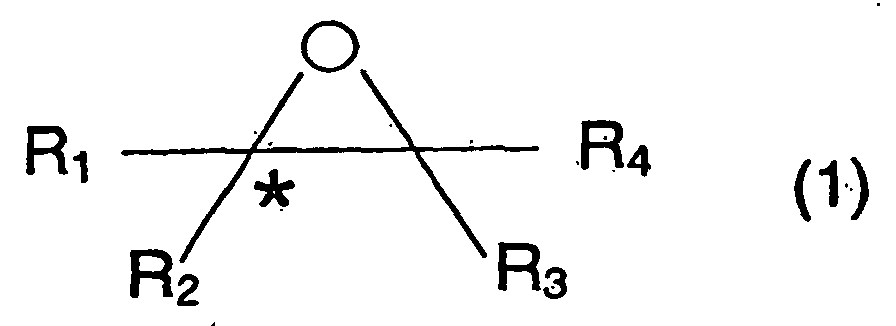
wherein R1 is an aryl group; R2, R3 and R4 are each independently a hydrogen atom, a halogen atom, an alkyl group having 1 to 20 carbon atoms, an alkenyl group having 2 to 20 carbon atoms, an alkynyl group having 2 to 20 carbon atoms, an aryl group having 6 to 20 carbon atoms, an aralkyl group having 7 to 20 carbon atoms, an alkoxy group having 1 to 20 carbon atoms, an aryloxy group having 6 to 20 carbon atoms, an aralkyloxy group having 7 to 20 carbon atoms, an alkoxycarbonyl group having 2 to 20 carbon atoms, an aryloxycarbonyl group having 7 to 20 carbon atoms, an aralkyloxycarbonyl group having 8 to 20 carbon atoms, an acyl group having 1 to 20 carbon atoms, or a cyano group; two of these groups R2, R3 and R4 may be combined together to form a ring, R1 and R2 are different groups, and * represents an asymmetric carbon atom, in the presence of a base.
wherein R1 is an aryl group; R2, R3 and R4 are each independently a hydrogen atom, a halogen atom, an alkyl group having 1 to 20 carbon atoms, an alkenyl group having 2 to 20 carbon atoms, an alkynyl group having 2 to 20 carbon atoms, an aryl group having 6 to 20 carbon atoms, an aralkyl group having 7 to 20 carbon atoms, an alkoxy group having 1 to 20 carbon atoms, an aryloxy group having 6 to 20 carbon atoms, an aralkyloxy group having 7 to 20 carbon atoms, an alkoxycarbonyl group having 2 to 20 carbon atoms, an aryloxycarbonyl group having 7 to 20 carbon atoms, an aralkyloxycarbonyl group having 8 to 20 carbon atoms, an acyl group having 1 to 20 carbon atoms, or a cyano group; two of these groups R2, R3 and R4 may be combined together to form a ring, R1 and R2 are different groups, and * represents an asymmetric carbon atom, in the presence of a base.
2. The obtaining method according to claim 1, wherein R1 is an aryl group, and each of R2, R3 and R4 is a hydrogen atom.
3. The obtaining method according to claim 2, wherein the aryl group is a substituted
or unsubstituted phenyl group.
4. The obtaining method according to claim 3, wherein the aryl group is a phenyl group
substituted by 1 to 5 halogen atoms.
5. The obtaining method according to claim 4, wherein the halogen atom is a chlorine
atom.
6. The obtaining method according to claim 2, wherein the aryl group is a m-chlorophenyl
group
7. The obtaining method according to any one of claims 1 to 6, wherein the base is a
nonvolatile base.
8. The obtaining method according to claim 7, wherein the nonvolatile base is an inorganic
base.
9. The obtaining method according to claim 8, wherein the inorganic base is at least
one of alkali metal carbonates, alkali earth metal carbonates, and alkali metal hydrogen
carbonates.
10. The obtaining method according to claim 9, wherein the inorganic base is at least
one of sodium carbonate, potassium carbonate, sodium hydrogen carbonate, and potassium
hydrogen carbonate.
11. The obtaining method according to any one of claims 1 to 10, wherein the distillation
temperature is 50°C to 250°C.
12. The obtaining method according to claim 11, wherein the distillation temperature is
100°C to 250°C.
1. Verfahren zur Herstellung eines optisch aktiven Epoxids, umfassend Destillieren eines
optisch aktiven Epoxids der Formel (1):

wobei R1 ein Arylrest ist; R2, R3 und R4 jeweils unabhängig ein Wasserstoffatom, ein Halogenatom, ein Alkylrest mit 1 bis 20 Kohlenstoffatomen, ein Alkenylrest mit 2 bis 20 Kohlenstoffatomen, ein Alkinylrest mit 2 bis 20 Kohlenstoffatomen, ein Arylrest mit 6 bis 20 Kohlenstoffatomen, ein Aralkylrest mit 7 bis 20 Kohlenstoffatomen, ein Alkoxyrest mit 1 bis 20 Kohlenstoffatomen, ein Aryloxyrest mit 6 bis 20 Kohlenstoffatomen, ein Aralkyloxyrest mit 7 bis 20 Kohlenstoffatomen, ein Alkoxycarbonylrest mit 2 bis 20 Kohlenstoffatomen, ein Aryloxycarbonylrest mit 7 bis 20 Kohlenstoffatomen, ein Aralkyloxycarbonylrest mit 8 bis 20 Kohlenstoffatomen, ein Acylrest mit 1 bis 20 Kohlenstoffatomen oder eine Cyanogruppe sind; zwei dieser Reste R2, R3 und R4 zusammengenommen werden können, um einen Ring zu bilden; R1 und R2 verschiedene Reste sind; und * ein asymmetrisches Kohlenstoffatom bedeutet, in Gegenwart einer Base.
wobei R1 ein Arylrest ist; R2, R3 und R4 jeweils unabhängig ein Wasserstoffatom, ein Halogenatom, ein Alkylrest mit 1 bis 20 Kohlenstoffatomen, ein Alkenylrest mit 2 bis 20 Kohlenstoffatomen, ein Alkinylrest mit 2 bis 20 Kohlenstoffatomen, ein Arylrest mit 6 bis 20 Kohlenstoffatomen, ein Aralkylrest mit 7 bis 20 Kohlenstoffatomen, ein Alkoxyrest mit 1 bis 20 Kohlenstoffatomen, ein Aryloxyrest mit 6 bis 20 Kohlenstoffatomen, ein Aralkyloxyrest mit 7 bis 20 Kohlenstoffatomen, ein Alkoxycarbonylrest mit 2 bis 20 Kohlenstoffatomen, ein Aryloxycarbonylrest mit 7 bis 20 Kohlenstoffatomen, ein Aralkyloxycarbonylrest mit 8 bis 20 Kohlenstoffatomen, ein Acylrest mit 1 bis 20 Kohlenstoffatomen oder eine Cyanogruppe sind; zwei dieser Reste R2, R3 und R4 zusammengenommen werden können, um einen Ring zu bilden; R1 und R2 verschiedene Reste sind; und * ein asymmetrisches Kohlenstoffatom bedeutet, in Gegenwart einer Base.
2. Herstellungsverfahren nach Anspruch 1, wobei R1 ein Arylrest ist und jeder der Reste R2, R3 und R4 ein Wasserstoffatom ist.
3. Herstellungsverfahren nach Anspruch 2, wobei der Arylrest eine substituierte oder
unsubstituierte Phenylgruppe ist.
4. Herstellungsverfahren nach Anspruch 3, wobei der Arylrest eine mit 1 bis 5 Halogenatomen
substituierte Phenylgruppe ist.
5. Herstellungsverfahren nach Anspruch 4, wobei das Halogenatom ein Chloratorn ist.
6. Herstellungsverfahren nach Anspruch 2, wobei der Arylrest eine m-Chlorphenylgruppe
ist.
7. Herstellungsverfahren nach einem der Ansprüche 1 bis 6, wobei die Base eine nicht
flüchtige Base ist.
8. Herstellungsverfahren nach Anspruch 7, wobei die nicht flüchtige Base eine anorganische
Base ist.
9. Herstellungsverfahren nach Anspruch 8, wobei die anorganische Base mindestens eine
von Alkalimetallcarbonaten, Erdalkalimetallcarbonaten und Alkalimetallhydrogencarbonaten
ist.
10. Herstellungsverfahren nach Anspruch 9, wobei die anorganische Base mindestens eine
von Natriumcarbonat, Kaliumcarbonat, Natriumhydrogencarbonat und Kaliumhydrogencarbonat
ist.
11. Herstellungsverfahren nach einem der Ansprüche 1 bis 10, wobei die Destillationstemperatur
50°C bis 250°C beträgt.
12. Herstellungsverfahren nach Anspruch 11, wobei die Destillationstemperatur 100°C bis
250°C beträgt.
1. Procédé pour l'obtention d'un époxyde optiquement actif comprenant la distillation
d'un époxyde optiquement actif représenté par la formule (1) :
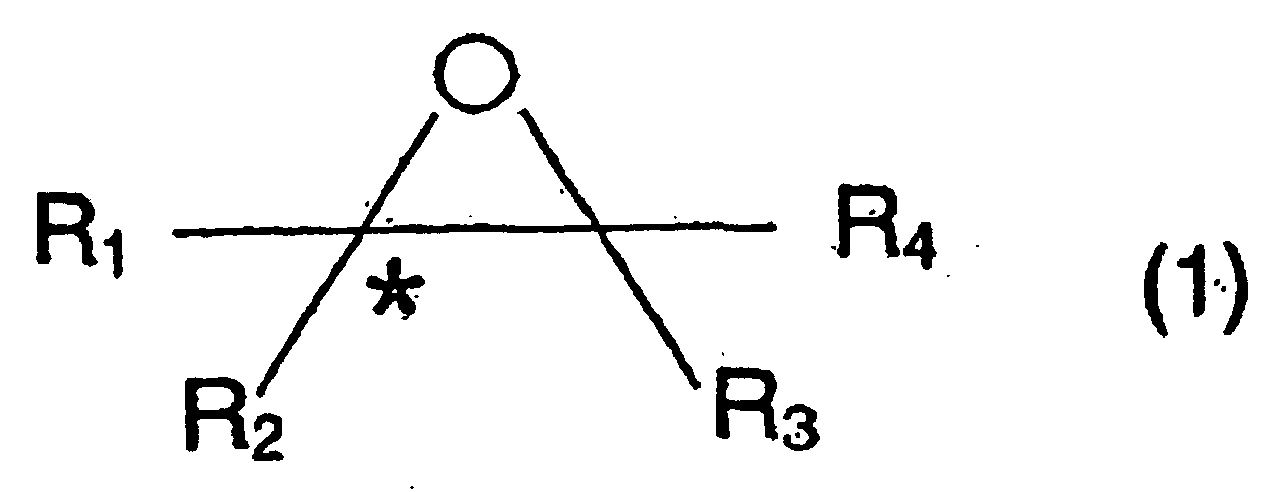
dans laquelle R1 est un groupe aryle ; R2, R3 et R4 sont chacun indépendamment un atome d'hydrogène, un atome d'halogène, un groupe alkyle ayant de 1 à 20 atomes de carbone, une groupe alcényle ayant de 2 à 20 atomes de carbone, un groupe alcynyle ayant de 2 à 20 atomes de carbone, un groupe aryle ayant de 6 à 20 atomes de carbone, un groupe aralkyle ayant de 7 à 20 atomes de carbone, un groupe alkoxy ayant de 1 à 20 atomes de carbone, un groupe aryloxy ayant de 6 à 20 atomes de carbone, un groupe aralkyloxy ayant de 7 à 20 atomes de carbone, un groupe alkoxycarbonyle ayant de 2 à 20 atomes de carbone, un groupe aryloxycarbonyle ayant de 7 à 20 atomes de carbone, un groupe aralkyloxycarbonyle ayant de 8 à 20 atomes de carbone, un groupe acyle ayant de 1 à 20 atomes de carbone, ou un groupe cyano ; deux de ces groupes R2, R3 et R4 peuvent être combinés ensemble afin de former un cycle ; R1 et R2 sont des groupes différents ; et * représente un atome de carbone asymétrique en présence d'une base.
dans laquelle R1 est un groupe aryle ; R2, R3 et R4 sont chacun indépendamment un atome d'hydrogène, un atome d'halogène, un groupe alkyle ayant de 1 à 20 atomes de carbone, une groupe alcényle ayant de 2 à 20 atomes de carbone, un groupe alcynyle ayant de 2 à 20 atomes de carbone, un groupe aryle ayant de 6 à 20 atomes de carbone, un groupe aralkyle ayant de 7 à 20 atomes de carbone, un groupe alkoxy ayant de 1 à 20 atomes de carbone, un groupe aryloxy ayant de 6 à 20 atomes de carbone, un groupe aralkyloxy ayant de 7 à 20 atomes de carbone, un groupe alkoxycarbonyle ayant de 2 à 20 atomes de carbone, un groupe aryloxycarbonyle ayant de 7 à 20 atomes de carbone, un groupe aralkyloxycarbonyle ayant de 8 à 20 atomes de carbone, un groupe acyle ayant de 1 à 20 atomes de carbone, ou un groupe cyano ; deux de ces groupes R2, R3 et R4 peuvent être combinés ensemble afin de former un cycle ; R1 et R2 sont des groupes différents ; et * représente un atome de carbone asymétrique en présence d'une base.
2. Procédé d'obtention selon la revendication 1, dans lequel R1 est un groupe aryle, et chacun des R2, R3 et R4 est un atome d'hydrogène.
3. Procédé d'obtention selon la revendication 2, dans lequel le groupe aryle est un groupe
phényle substitué ou non substitué.
4. Procédé d'obtention selon la revendication 3, dans lequel le groupe aryle est un groupe
phényle substitué par 1 à 5 atomes d'halogène.
5. Procédé d'obtention selon la revendication 4, dans lequel l'atome d'halogène est un
atome de chlore.
6. Procédé d'obtention selon la revendication 2, dans lequel le groupe aryle est un groupe
m-chlorophényle.
7. Procédé d'obtention selon l'une quelconque des revendications 1 à 6, dans lequel la
base est une base non volatile.
8. Procédé d'obtention selon la revendication 7, dans lequel la base non volatile est
une base inorganique.
9. Procédé d'obtention selon la revendication 8, dans lequel la base inorganique est
au moins une base parmi des carbonates de métal alcalin, des carbonates de métal alcalino-terreux,
et des hydrogénocarbonates de métal alcalin.
10. Procédé d'obtention selon la revendication 9, dans lequel la base inorganique est
au moins une base parmi le carbonate de sodium, le carbonate de potassium, l'hydrogénocarbonate
de sodium, et l'hydrogénocarbonate de potassium.
11. Procédé d'obtention selon l'une quelconque des revendications 1 à 10, dans lequel
la température de distillation est de 50°C à 250°C.
12. Procédé d'obtention selon la revendication 11, dans lequel la température de distillation
est de 100°C à 250°C.