|
(11) | EP 1 398 167 A1 |

| (12) | EUROPEAN PATENT APPLICATION |
|
|
|
|
|||||||||||||||||||||||
| (54) | Anti-ozonants bonded to silicia for use in printing media |
| (57) A method of protecting dyes printed on print media against ozonolysis is provided.
The method comprises: (a) providing a first reaction product comprising the reaction
of a phenylenediamine or derivative thereof (an anti-ozonant) with a silica or silicate;
and (b) reacting the first reaction product in the presence of a water-free solvent
with silica groups on the print media to form a second reaction product. Also provided
is the reaction product resulting from the reaction of (1) the anti-ozonant-silica
(or silicate) and (2) silica groups on a substrate. The anti-ozonant-silica (or silicate)
is covalently attached to the particles of silica in the media and cannot escape or
evaporate away. The use of phenylenediamines as anti-ozonants solves the problem of
the fading of dyes on porous media by ozone pollution. |
TECHNICAL FIELD
[0001] The present invention relates generally to ink jet printing, and, more particularly, to protection of ink jet images printed on print media against oxidation by ozone.
BACKGROUND ART
[0002] Oxidation of ink jet images printed on print media by ozonation is becoming more recognized as a problem, now that more pressing issues, such as water fastness and smear fastness, have been largely resolved. The problem of ozonation is particularly significant in urban areas where there are large concentrations of ozone from pollution, e.g., Los Angeles and Denver (during the summer months). That dyes and pigments react and thus decompose from ozone is a well-established fact.
[0003] Preventing oxidation by ozonation has not, however, been the subject of much investigation to date. Thus, there have been no prior solutions to this problem, to the best knowledge of the present inventor.
[0004] Thus, there is a need for preventing oxidation by ozonation of ink jet images printed on print media.
DISCLOSURE OF INVENTION
[0005] In accordance with embodiments disclosed herein, a method of protecting colorants printed on print media against ozonolysis is provided. The method comprises:
[0006] (a) providing a first reaction product comprising the reaction of a phenylenediamine or derivative thereof with a silica or silicate; and
[0007] (b) reacting the first reaction product in the presence of a water-free solvent with silica groups to form a second reaction product.
[0008] Further in accordance with other embodiments disclosed herein, a reaction product is provided resulting from the reaction of (1) the first reaction product comprising the reaction of a phenylenediamine or derivative thereof with the silica or silicate and (2) silica groups on a substrate.
[0009] Additionally, in accordance with yet other embodiments disclosed herein a method of printing an ink on a print media is provided, where the ink contains at least one colorant susceptible to ozonolysis. The method comprises:
[0010] (a) providing a first reaction product comprising the reaction of a phenylenediamine or derivative thereof with a silica or silicate;
[0011] (b) reacting the first reaction product in the presence of a water-free solvent with silica groups to form a second reaction product; and
[0013] The anti-ozonant employed in accordance with the teachings herein is covalently attached to the particles of silica in the media and cannot escape or evaporate away.
[0014] The use of phenylenediamines, or derivatives thereof, solves the problem of the fading of dyes on porous media by ozone pollution.
BEST MODES FOR CARRYING OUT THE INVENTION
[0015] It is well known in the plastics and rubber technologies fields that phenylenediamines (PDAs) and like amines are excellent ozonolysis inhibitors. They react with ozone and other oxidants at a much faster rate than the unsaturated links in the polymer and afford protection to the polymer from these oxidants. They have the following structure:
[0016] where R1, R2, R3, and R4 are independently alkyl, aryl, alkene, or arene groups, branched chain or straight chain or any combination thereof, comprising 30 carbon atoms or less, with the proviso that while any two R groups can be aryl, there are no more than two aryl groups. Of the alkyl groups, the secondary alkyls (2-alkyls or iso-alkyls) are most effective in preventing ozone degradation.
[0017] The rates of reaction of a variety of compounds, including three derivatives of phenylenediamine (PDA), with ozone are summarized in the Table below:
Table.
| Rates of Reaction for Various Compounds with Ozone | |
| Compound | Rate of Reaction, 105k· M-1 · s-1 |
| N,N'-diisopentyl-p-PDA | 80 |
| N,N'-di-n-octyl-p-PDA | 70 |
| N-phenyl-N'-isopropyl-p-PDA | 70 |
| N-butyl-N,N'-dibutylthiourea | 20 |
| cis-polyisoprene | 4.4 |
| cis-polybutadiene | 0.6 |
[0018] It is seen that the PDA derivatives react with ozone considerably faster than other compounds.
[0019] Attaching PDA derivatives to print media used for ink jet printing renders the inks printed thereon substantially immune to ozonation; that is, the printing media that contains colorants printed thereon is rendered non-ozone fugitive. Thus, PDA derivatives when incorporated in an alkyl backbone attached to a silica gel, a silicate, or other such derived particles would afford such protection against colorant fugitivity.
[0020] The embodiments disclosed herein are directed to the synthesis, dispersal, and printing use of these PDA-silica or PDA-silicate derivatives present in the print media.
[0021] A two-step reaction is involved. In the first step, silica gel (or a silicate) is prepared with the anti-ozonant molecule covalently attached to it to form a PDA-silica derivative (or PDA-silicate derivative in the case of silicates prepared with the anti-ozonant molecule attached to it). The preparation of such PDA-silica (or PDA-silicate) derivatives is known in the prior art. Specifically, the reaction is a simple one to carry out. The coupling occurs at room temperature over a few hours in an alcohol-based solvent, usually methanol. Stoichiometric quantities of reagent are sometimes used, and sometimes they are not - it depends on the application. Separation occurs readily, since the silica gel is insoluble in the solvent. Purification is easily performed by washing the silica particles with excess, clean methanol. (These methods are well appreciated in chromatography, such as silating a column to change its properties, for example.)
[0022] When ozone encounters such PDA-silica/PDA-silicate derivatives in the presence of dye molecules, the ozone reacts with the derivative rather than with the dye molecule, thus saving the dye molecule from ozonolysis. The same reaction occurs with pigments, but to a lesser extent. It appears that, due to the number of pigment molecules in a pigment crystal, a large number of pigment chromophore molecules may be lost before there is a significant decrease in optical density. Nevertheless, the benefits of the embodiments disclosed herein are applicable to both dyes and pigments, which generically fall within the term ''colorant".
[0023] Examples of PDA-silicate derivatives that may be employed in the practice of the embodiments disclosed herein include, but are not limited to, the following compounds:
where R1, R2, R3, and R4 are independently any alkyl, alkene, arene, or aromatic group and where n is from 1 to 10. Essentially, the same requirements obtain for the R groups as listed above.
[0024] In the second step, the PDA-silica (or PDA-silicate) compound is attached to silica or silicate on the surface of the print media via a silicon oxide coupling that is well-known in the prior art. Simply selecting one of the PDA compounds from the list herein and reacting it with the silicate (on the print media) in the absence of water, e.g., employing absolute methanol as the reaction solvent yields the desired silica derivative.
[0027] The print media employed in conjunction with the teachings herein is essentially plain paper provided with one or more coatings of silica to provide a glossy print medium. Such print media are used in color ink jet printing to provide the equivalent of photographic prints.
[0028] It is possible to react the silica first and then coat the paper with the reaction product. However, it is preferable to complete the reagent first and then perform the silicate coupling on the print media. That ensures that the silica is where the attachment is, as opposed to being only on the other components of the print media. It is desirable to maximize the amount on the surface of the print media for the maximal effect.
[0029] Silica coatings on print media are disclosed elsewhere; see, e.g., U.S. Patents 5,275,867; 5,463,178; 5,576,088; 5,605,750; 5,989,378; and 6,187,430, the contents of which are incorporated herein by reference. Typically, plain paper (the substrate) or a lower layer is coated with a proprietary mixture of silica, binder, such as poly(vinyl alcohol), and other components.
INDUSTRIAL APPLICABILITY
1. A reaction product resulting from the reaction of (1) a first reaction product comprising
the reaction of a phenylenediamine or derivative thereof with a silica or silicate
and (2) silica groups on a substrate.
2. The reaction product of Claim 1 wherein said phenylenediamine comprises:
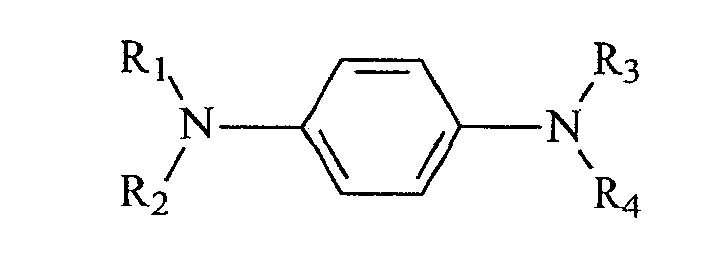
where R1, R2, R3, and R4 are independently selected from the group consisting of alkyl, aryl, alkene, and arene groups, whether branched chain or straight chain or any combination thereof, comprising 30 carbon atoms or less, with the proviso that while any two R groups can be aryl, there are no more than two aryl groups.
where R1, R2, R3, and R4 are independently selected from the group consisting of alkyl, aryl, alkene, and arene groups, whether branched chain or straight chain or any combination thereof, comprising 30 carbon atoms or less, with the proviso that while any two R groups can be aryl, there are no more than two aryl groups.
3. The reaction product of Claim 1 wherein said first reaction product is selected from
the group consisting of
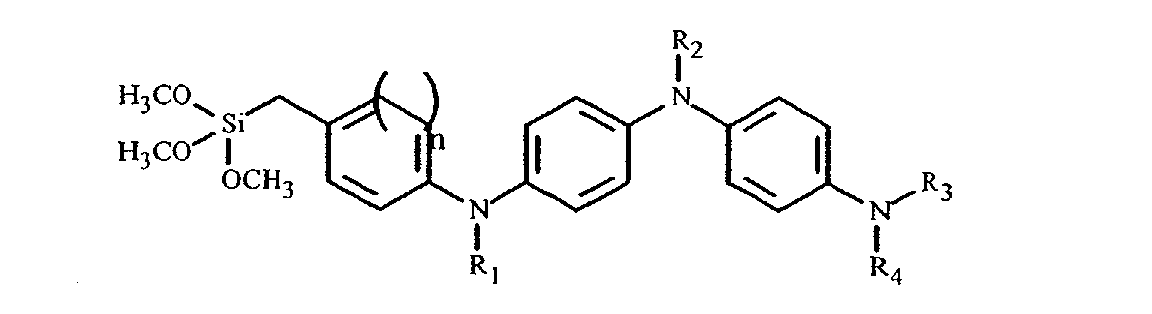
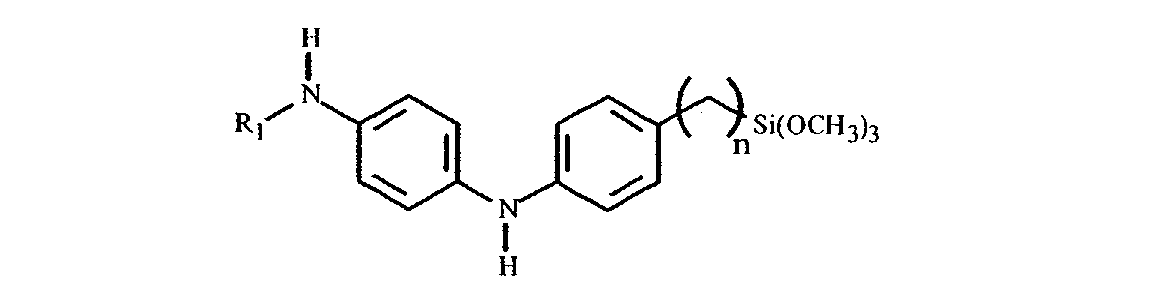
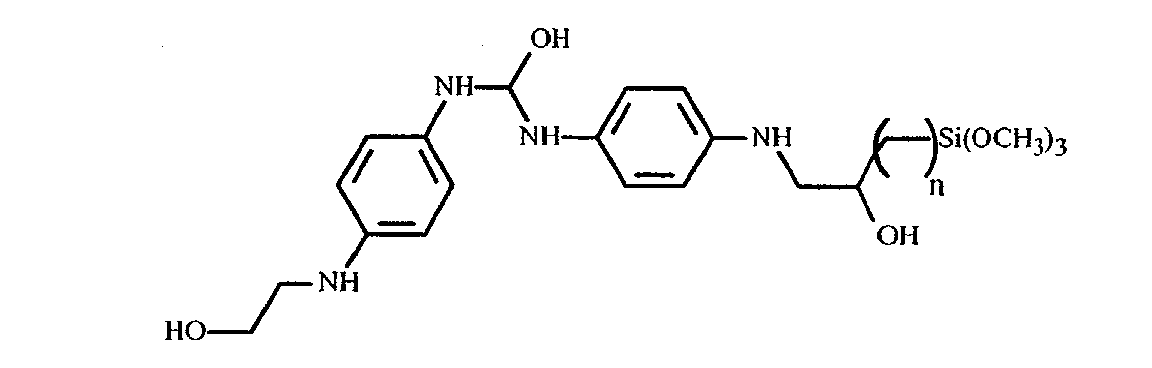
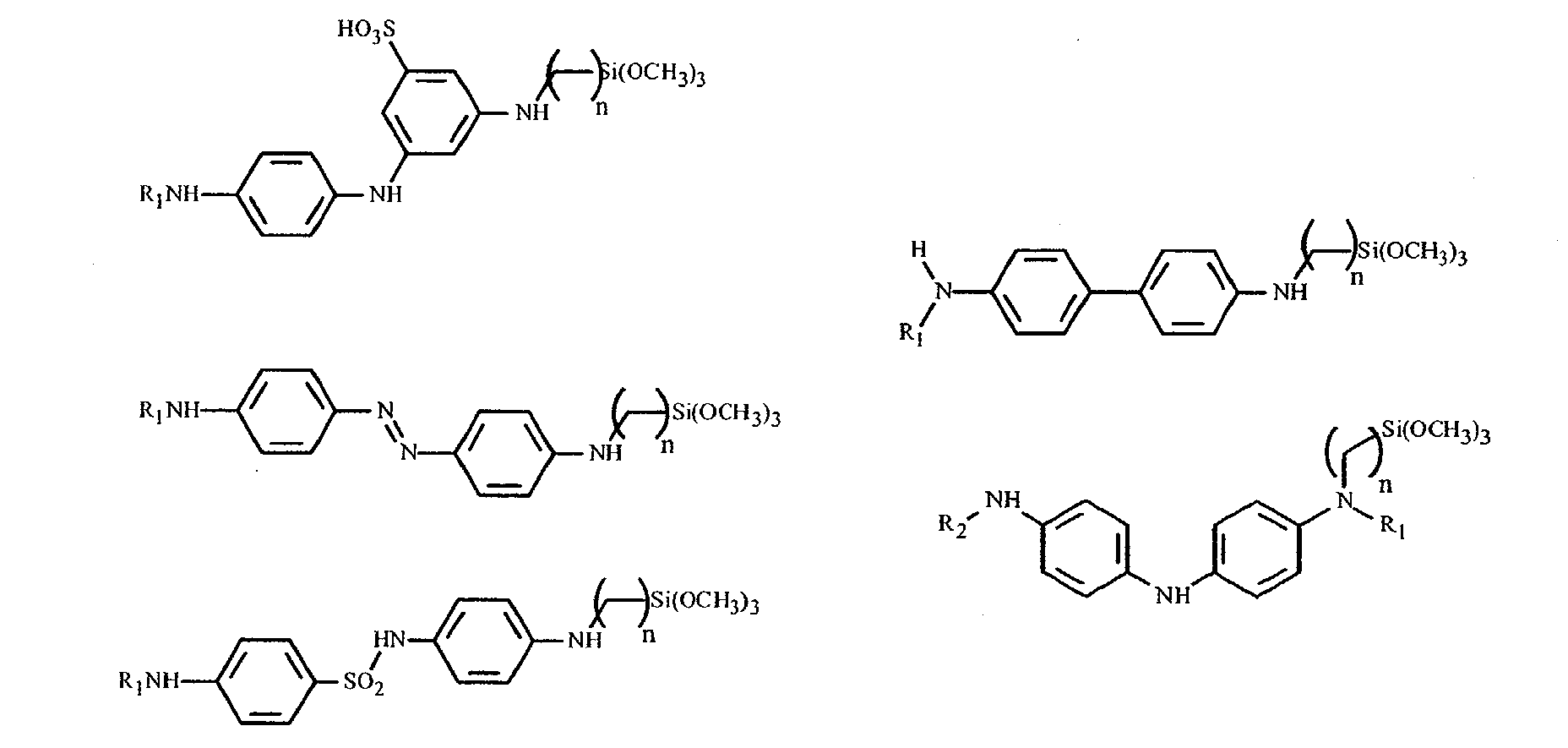
where R1, R2, R3, and R4 are independently an alkyl, alkene, arene, or aromatic group.
where R1, R2, R3, and R4 are independently an alkyl, alkene, arene, or aromatic group.
4. A method of protecting colorants printed on print media against ozonolysis comprising:
(a) providing said first reaction product of Claim 1; and
(b) reacting said first reaction product in the presence of a water-free solvent with silica groups on said print media to form a second reaction product.
5. The method of Claim 4 further comprising printing an ink on said print media, said
ink including at least one colorant.
6. The method of Claims 4 or 5 wherein said colorant is a dye or a pigment.
7. The method of Claims 4 or 5 wherein said print media comprises plain paper provided
with at least one coating layer containing silica.