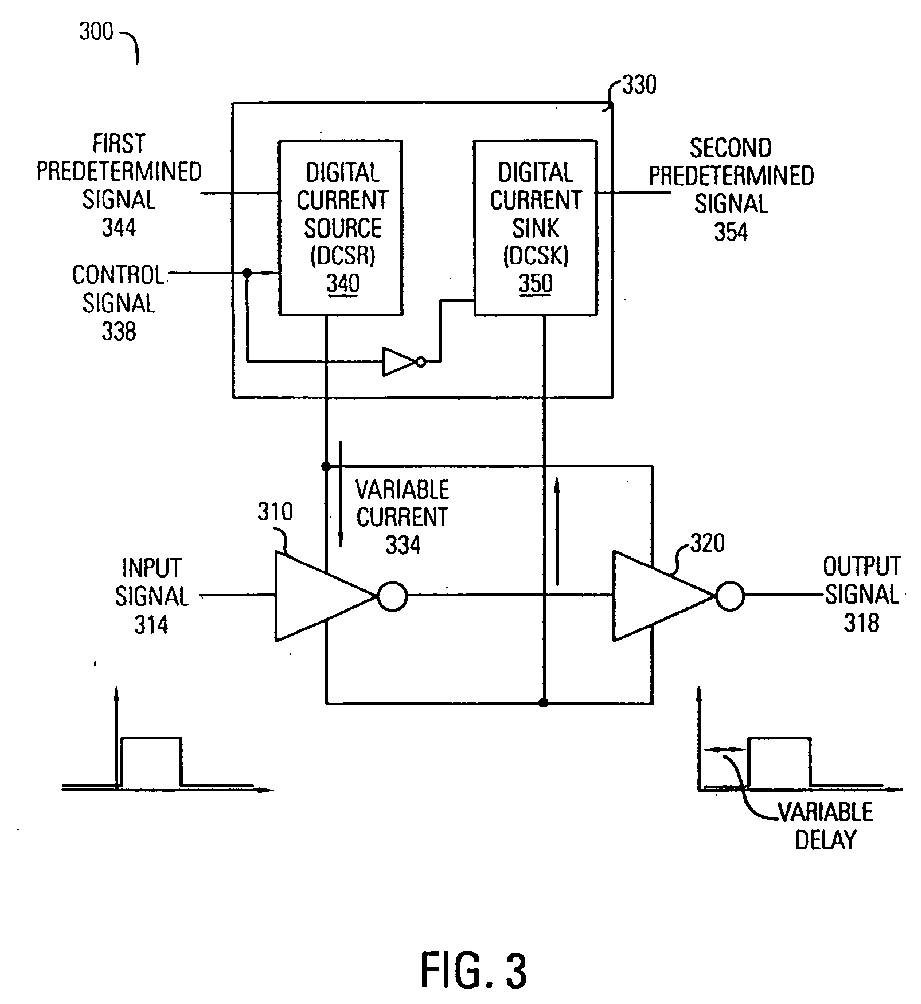
(57) A balanced programmable delay element (300) that has a variable incremental delay.
A first inverter (310) is provided that has a first electrode for receiving an input
signal, a second electrode, a third electrode, and a fourth electrode for providing
an output signal. The second electrode and the third electrode form a first current
path, and the first inverter has a propagation delay that is dependent on the current
through the first current path. A second inverter (320) is provided that has a first
electrode coupled to the fourth electrode of the first inverter for receiving the
output signal of the first inverter, a second electrode, a third electrode, and a
fourth electrode for providing an output signal. The second electrode and the third
electrode form a second current path, and the second inverter has a propagation delay
that is dependent on the current through the second current path. A current switch
(330) is coupled to the second electrode of the first inverter, the second electrode
of the second inverter, the third electrode of the first inverter, and the third electrode
of the second inverter. The current switch (330) receives at least two control signals,
and responsive thereto, controls the amount of current through the first current path
and the second current path, thereby selectively varying the incremental delay of
the delay element.
|
|
