| (19) |
 |
|
(11) |
EP 1 411 690 B1 |
| (12) |
EUROPEAN PATENT SPECIFICATION |
| (45) |
Mention of the grant of the patent: |
|
12.12.2007 Bulletin 2007/50 |
| (22) |
Date of filing: 17.10.2003 |
|
| (51) |
International Patent Classification (IPC):
|
|
| (54) |
Method for transferring GPRS data packets from different PDP contexts according to
their relative priority
Verfahren zum Übertragen von GPRS Datenpaketen aus unterschiedlichen PDP Kontexten
gemäss ihrer relativen Priorität
Procédé pour transférer des paquets de données GPRS de différents contextes PDP selon
leur priorités relatives
|
| (84) |
Designated Contracting States: |
|
AT BE BG CH CY CZ DE DK EE ES FI FR GB GR HU IE IT LI LU MC NL PT RO SE SI SK TR |
| (30) |
Priority: |
18.10.2002 FI 20021869
|
| (43) |
Date of publication of application: |
|
21.04.2004 Bulletin 2004/17 |
| (73) |
Proprietor: Nokia Corporation |
|
02150 Espoo (FI) |
|
| (72) |
Inventor: |
|
- Forssell, Mika
02300 Espoo (FI)
|
| (74) |
Representative: Tanhua, Pekka Vilhelm |
|
Berggren Oy Ab,
P.O. Box 16
00101 Helsinki
00101 Helsinki (FI) |
| (56) |
References cited: :
WO-A-01/58095
|
WO-A-99/48310
|
|
| |
|
|
|
|
| |
|
| Note: Within nine months from the publication of the mention of the grant of the European
patent, any person may give notice to the European Patent Office of opposition to
the European patent
granted. Notice of opposition shall be filed in a written reasoned statement. It shall
not be deemed to
have been filed until the opposition fee has been paid. (Art. 99(1) European Patent
Convention).
|
TECHNICAL FIELD OF THE INVENTION
[0001] The present invention relates to transferring data over a radio interface in General
Packet Radio System (GPRS) networks.
BACKGROUND OF THE INVENTION
[0002] In wireless telecommunication systems information is transferred over the radio interface
between a transmitting and/or receiving communication device and a communication network.
In General Packet Radio System (GPRS) networks, such as GPRS, Enhanced GRPS (EGPRS)
and GSM Enhanced Data rate for Global Evolution (EDGE) Radio Access Network (GERAN)
efforts has been made to improve the quality of the data transfer and thus the quality
of service (QoS). The term GPRS also relates to EGPRS, GERAN and other enhancements
of the GPRS in the present application.
[0003] A mobile station (MS), a base station sub-system (BSS) comprising a base transceiver
station (BTS) and a base station controller (BSC) including a Packet Control Unit
(PCU), and a serving GPRS support node (SGSN) are the main components of the GPRS
architecture for communicating between a terminal device and the GPRS network. A gateway
GPRS support node (GGSN) enables data transfer between the GPRS network and external
data networks, such as an Internet. One or more GGSNs are connected to a SGSN via
Internet Protocol (IP) based GPRS backbone network. When the MS communicates with
external data networks, the GGSN operates as an IP router between a MS and the external
network. Packet data channels (PDCH) are used as physical channels for the packet
data transfer in the GPRS. To transfer user data, i.e. other data not produced by
the GPRS protocols, a Packet Data Protocol (PDP) context is generated. All messages
including PDP context messages are transferred using a Temporary Block Flow (TBF)
between a MS and GPRS network.
[0004] The Logical Link Control (LLC) protocol is used to transfer data between a MS and
a SGSN in the GPRS network. The technical specifications of the LLC layer protocol
to be used for Packet Data Transfer (PDT) between a MS and SGSN are defined in the
document 3GPP TS 44 064 V 4.3.0 (2002-03) [1]. The LLC layer is independent of the
underlying radio interface protocol. The LLC protocol layer consists of Logical Link
Management Entities (LLME), Logical Link Entities (LLE) and a multiplex procedure.
A LLE is the LLC layer protocol state machine controlling one logical link connection.
[0005] The LLC layer operates above a Radio Link Control (RLC) layer on the MS side and
above a Base Station Sub-system GPRS Protocol (BSSGP) layer on the SGSN side. Above
the LLC layer is a SubNetwork Dependent Convergence (SNDC) protocol layer, that controls
the transfer of user data Network layer Packet Data Units (N-PDU) between a MS and
SGSN. Also above the LLC layer locates a GPRS Mobility Management (GMM) protocol layer,
that uses the services of the LLC layer to transfer messages between a MS and a SGSN.
[0006] A MAC (Media Access Control) protocol layer locates under a RLC layer on the MS side.
It defines the procedures that enable multiple MSs to share a common radio interface
and it allows a MS to use several physical channels in parallel on the MS side of
the GPRS network. The MAC also provides the arbitration between multiple MSs simultaneously
attempting to access a radio interface.
[0007] A RLC/MAC layer protocol of the GPRS is described in the document 3GPP TS 44 060
V4.5.0 (2002-02) [2]. A RLC/MAC block is a protocol data unit exchanged between RLC/MAC
entities, and a RLC/MAC control block is a part of a RLC/MAC block carrying a control
message between RLC/MAC entities or RLC data block is a part of a RLC/MAC block carrying
user data or signalling data of upper layers. The RLC layer defines the procedures
for segmentation and reassembly of LLC PDUs into RLC/MAC blocks and the RLC layer
provides also link adapatation. The RLC/MAC is responsible for transmitting LLC PDUs
over the radio interface using a Temporary Block Flow (TBF), which is a physical radio
connection supporting the unidirectional transfer of LLC PDUs between a MS and the
network. A LLC PDU contains user data or GPRS protocol related signalling messages,
such as a GMM signalling message (GMM/SM). A MS may have an uplink TBF (UL TBF), a
downlink TBF (DL TBF) or an uplink and downlink TBF established at any time. When
a transfer mode of LLC PDUs terminates, in either uplink or downlink direction, the
corresponding TBF is released and the MS returns to packet idle mode. When a transfer
mode of LLC PDUs terminates but there exists an on-going LLC PDU transfer to the other
direction, the MS stays in transfer mode.
[0008] One TBF may carry RLC data blocks only in one RLC mode at a time. This means that
when transferring in-sequence LLC PDUs utilizing different RLC modes (ACK or UNACK),
a previous TBF has to be released and a new TBF has to be established for a new RLC
mode. The LLC is intended for use with both acknowledged (LLC ACK) and unacknowledged
(LLC UNACK) data transfer and the RLC/MAC supports both the RLC ACK mode and RLC UNACK
mode. The LLC modes and the RLC modes are independent from each other. In the LLC
ACK mode the LLC provides a reliable service with in-order delivery but in the LLC
UNACK mode the LLC does not guarantee in-order delivery. In RLC ACK mode RLC uses
retransmissions to guarantee error-free transmission and in RLC UNACK mode retransmissions
are not used. In both modes RLC/MAC specification says that upper layer PDUs shall
be delivered in the order they are received from upper layers. In RLC UNACK mode one
lost RLC data block may result in discarding of the whole LLC PDU at the receiving
side. In the RLC ACK mode Backward Error Correction (BEC) procedures enable the selective
retransmission of unsuccessfully delivered RLC/MAC blocks.
[0009] According to the Technical Specifications 3GPP TS 44 064 V 4.3.0 [1] the RLC shall
deliver LLC PDUs received from the upper layers in the same order as they were received
from the upper layers. This means that LLC PDUs are delivered in the same order as
received from the upper layers (i.e. LLC layer), regardless of the fact that some
LLC PDUs may have e.g. higher priority than other LLC PDUs. This is a big problem
when transferring e.g. real-time or other delay sensitive data over the radio interface,
because also this data, despite of its high priority, have to hold on the transmitting
queue of in-order delivery. This may impair the QoS of the application.
[0010] The LLC allows data transfer with different service criteria, such that high-priority
data transfers may take precedence over lower-priority data transfers to the same
MS. A LLC PDU has certain QoS characteristics concerning the RLC mode, priority, throughput,
etc. When streaming data or otherwise delay sensitive data, such as speech, is transferred
over the GPRS network, it should be delivered before e.g. best effort data, such as
FTP (File Transfer Protocol) data or web surfing, to ensure the QoS. Otherwise the
service suffers bad quality. Recently an interest towards transferring delay sensitive
data over the GPRS network is rising.
[0011] Document
WO 99/48310 discloses that in a mobile communication system each data packet is arranged to carry
a QoS parameter, and the scheduding and policing of the transmission of the data packets
is made according to this QoS information in the packets within the limits set by
the PDP context. The QoS information includes priority information and traffic type
information, and priority information defines the order in which data packets should
be handled or discarded. Also reliability can be directly associated with the QoS
information. Data packets are multiplexed in the mobile network based on the reliability
and QoS information. QoS information in data packets could be relevant only within
the PDP context in question and is taken into account only in relation with the QoS
profile of the PDP context.
[0012] According to document
WO 99/48310 at a GPRS protocol layer data packets are received from an upper protocol layer,
and each data packet carries QoS information and belongs to a PDP context. Each data
packet is delivered further from the GPRS protocol layer in order of its arrival from
the upper protocol layer or is discarded in case of network congestion.
[0013] An example is now provided to describe the current state of the prior art. Assume
that the RLC/MAC of the MS first receives three short LLC PDUs from a delay sensitive
application that needs to be transmitted using the RLC UNACK mode. After this the
RLC/MAC receives two long ,e.g. 1500 octet each, LLC PDUs containing FTP data that
needs to be transmitted using the RLC ACK mode. Then after this the RLC/MAC again
receives three short LLC PDUs from the delay sensitive application that needs to be
transmitted using the RLC UNACK mode. When changing a transfer mode from the RLC UNACK
mode to the RLC ACK mode, first an existing TBF is released, then a new TBF is established
and then FTP traffic LLC PDUs are transferred in RLC data blocks. After this a transfer
mode is changed from the RLC ACK mode to the RLC UNACK mode again by releasing existing
TBF and establishing new TBF, and then a transfer of data packets of the delay sensitive
application may continue. A time needed to transfer FTP traffic LLC PDUs in the RLC
data block depends on the number of assigned uplink PDCHs. The elapsed time also depends
on a channel coding scheme used to transfer RLC data blocks over the radio interface
and how frequently the TBF is assigned sending permissions. In this example, a transfer
of two 1500 octet long LLC PDUs in the RLC ACK mode between the delay sensitive data
packets may take several seconds. The gap of several seconds will result in that delay
sensitive applications will substantially suffer from the FTP transfer.
[0014] The gap of several seconds will result in that a transfer of real time LLC PDUs of
applications using streaming or otherwise delay sensitive data will be blocked by
a transfer of non-real time LLC PDUs of applications using FTP or other best effort
data according to the current specifications. In case of a speech application the
quality of the conversation becomes unacceptable. From the foregoing it follows that
the current GPRS network is unable to transfer delay sensitive data over the radio
interface.
[0015] There are significant problems related to prior art to transfer delay sensitive data
over the GPRS network. Grounds for the problems in prior art is the fact that a RLC/MAC
does not interpret contents of a LLC PDU at all, and it only transfers a LLC PDU,
such as received from a LLC, over a radio interface.
SUMMARY OF THE INVENTION
[0016] An objective of the present invention is to provide a method and system for transferring
user data over a network ensuring the best quality of service characteristics.
[0017] The objective of the present invention is fulfilled by prioritising a packed user
data message delivery according to a data content of a message and by associating
the Packet Data Protocol (PDP) context to the radio interface access points via which
the packed data message is transferred over the network.
[0018] In accordance with the present invention there is provided a method for transferring
user data in a wireless packet data network according to claim 1.
[0019] In accordance with the present invention there is provided a mobile station (MS)
for transferring user data in a wireless packet data network according to claim 20.
[0020] In accordance with the present invention there is provided a network element of a
wireless network for transferring user data between a mobile station (MS) and a wireless
packet data network according to claim 38.
[0021] Some embodiments of the invention are described in the dependent claims.
BRIEF DESCRIPTION OF THE DRAWINGS
[0022] Next the present invention will be described in greater detail with reference to
exemplary embodiments in accordance with the accompanying drawings, in which:
Figure 1 illustrates a block diagram of a mobile station (MS) according to an embodiment
of the present invention.
Figure 2 illustrates a flow diagram of a method according to the present invention.
DETAILED DESCRIPTION
[0023] A preferred embodiment of the present invention is prioritising of Logical Link Control
(LLC) Packet Data Units (PDUs) when user data is transferred over the radio interface
between the Mobile Station (MS) and the GPRS network. According to the invention LLC
PDUs are reordered based on their requirements.
[0024] According to one embodiment of the invention a Radio Link Control/Media Access Control
(RLC/MAC) is able to reorder LLC PDUs inside a RLC/MAC and a LLC associates a Packet
Data Protocol (PDP) context to a LLC Service Access Point Indicator (SAPI) intelligently.
The present invention enables a LLC PDU to be prioritised in RLC/MAC and thus it enables
applications to receive the quality of service (QoS) they need. Based on the additional
QoS information received along the LLC PDU, RLC/MAC unit is able to prioritise LLC
PDUs according to their urgency of transmission in relation to other LLC PDUs.
[0025] Figure 1 shows a block diagram of an embodiment of wireless communication system
3 comprising at least one mobile station (MS) 10, a network 50 and a radio link connection
40 according to the present invention. On the network side of the wireless communication
system 3 there is also illustrated in figure 1 a Serving General Packet Radio Service
(GPRS) Support Node (SGSN) 55 provided by a wireless network operator, at least one
base station controller (BSC) 54 including a Packet Control Unit PCU and at least
one base transceiver station (BTS) 51 including antenna 53 to wirelessly communicate
with the MS 10 over the radio interface in accordance with a predetermined radio interface
specifications. A BTS 51 and BSC 54 are included to a Base Station Sub-system (BSS)
52. The radio interface 40 enables to transfer both voice and data traffic, including
an Internet access and web browsing. At least one gateway GPRS support node (GGSN)
58, connected to a SGSN 55 via IP-based GPRS backbone, provides a connection to external
data networks 61. According to the present invention the radio interface supports,
but is not limited to, General Packet Radio System (GPRS) networks, such as GPRS,
Enhanced GRPS (EGPRS), GSM (Global System for Mobile communications) Enhanced Data
rate for Global Evolution (EDGE) Radio Access Network (GERAN) and any other enhancements
of the GPRS or GSM or combinations thereof. The term GPRS relates to all those in
this present application.
[0026] In figure 1 a MS 10 may be a handheld radiotelephone, such as a cellular phone, a
personal communicator or alike. The MS 10 typically includes a microcontroller unit
(MCU) 11 coupled to a display unit 12 and a keyboard unit 13 for a user interface
(as well as a microphone and speaker). The MS 10 also contains a digital signal processor
(DSP) 17 or equivalent, and a wireless transceiver unit 18 including transmitter,
receiver and antenna 19 functions. The MCU 11 is connected to a memory 14 for storing
an operation program, received packet data, packet data to be transmitted, and the
like. In association with the memory 14 is a buffer unit 15 for storing packet data
messages into a transfer queue and for delivering packet data messages from the buffer
to provide an in-order delivery of packet data messages according to the present invention.
[0027] The memory 14 also includes a Read-Only Memory (ROM) which in association with the
MCU 11 provides a Radio Link Control/Medium Access Control (RLC/MAC) unit 11 a, a
SubNetwork Dependent Convergence Protocol (SNDCP) unit 11 c for user data transfer,
a GPRS Mobility Management (GMM) unit 11 d and a Logical Link Control (LCC) unit 11
b to store a program enabling the MCU 11 to execute software routines, layers and
protocols required to implement the methods according to the present invention. The
SNDCP unit 11 c and GMM unit 11 c are locating on the same protocol layer. On the
network 50 side in association with the BSC 54 are a RLC/MAC unit 54a and a BSSGP
unit 54b, and in association with the SGSN 55 are a BSSGP unit 55a, a LLC unit 55b,
a SNDCP unit 55c, and GMM unit 55d. Functional operation of these units is also controlled
by software instructions from the network operator's premises. The SNDCP unit 55c
and GMM unit 55d are locating on the same protocol layer.
[0028] In the GPRS network a packet data message is always transferred via a LLC layer which
operates above RLC and BSSGP layers to provide logical links between a MS and its
SGSN. Messages transferred via a LLC layer are called LLC packet data unit (LLC PDU)
messages. Above a LLC layer is e.g. a SNDC protocol layer which controls the transfer
of user data between a MS and SGSN. A data link connection of a LLC layer to provide
services e.g. to the GMM and SNDC protocol layers is identified by a Service Access
Point Identifier (SAPI) both on the SGSN and MS side. The SAPI is carried in the address
field of the frame header of each LLC frame. LLC PDUs are segmented and reassembled
into RLC/MAC blocks defined by a RLC layer. A TBF allocated on one or more PDCHs comprises
a number of RLC/MAC blocks carrying one or more LLC PDUs. A TBF is temporary and is
maintained only for a duration of the data transfer.
[0029] When LLC Packet Data Units (LLC PDU) are transferred between a MS 10 and BSS 52 and
between a BSS 52 and SGSN 55 a LLC Relay provides services to the RLC layer protocol.
An LLC layer connection is identified via Service Access Points (SAP) in the LLC layer.
In case the RLC/MAC unit 54a of the network is located in the BSS 52, the LLC relay
operates above the RLC/MAC. In case RLC/MAC unit is located in the SGSN, the LLC operates
directly above the RLC/MAC. According to specifications [1] the RLC/MAC may be located
in the network in the BTS, BSC or SGSN.
[0030] A SAP Identifier (SAPI) is used to identify a SAP on the SGSN side of the LLC interface
and on the MS side of the LLC interface. In a LLC frame a SAPI includes an address
field which is part of a frame header (LLC header). The SAPI identifies upper layer
entity that receives a LLC PDU, e.g. a GMM, SMS, SNDCP. For example, if a SAPI is
equal to 1 (SAPI=1), this LLC PDU goes to the GMM. A SAPI is also used as an internal
LLC information in order to be able to handle PDUs with appropriate QoS characteristics.
For example, when a SNDCP PDU using NSAPI (NSAPI is a PDP context ID) is received
from a SNDCP, the PDU is transferred e.g. using the LLC SAPI=3 and during the PDP
context activation procedure certain QoS characteristics have been associated to the
PDP context.
[0031] Figure 2 shows a flow diagram of an embodiment of a method related to a mobile station
(MS) for transferring user data in a wireless packet data network according to the
present invention. The present invention improves a way to transfer real-time (RT)
and otherwise delay sensitive data over radio interface between the MS and the SGSN
enabling applications to receive service they need.
[0032] In step 201 the MS 10 generates a protocol activation message for informing the network
to activate a packet data protocol (PDP) context for user data transmission. To do
this, the GMM unit 11d generates a GMM/SM message "Activate PDP Context Request" and
moves it to the LLC unit 11 b to pack it to be a LLC PDU message. The LLC unit 11
b associates a LLC PDU message to the LLC GMM SAPI and defines a LLC mode to be used
to transfer the LLC PDU message. The LLC modes are a LLC ACK mode and LLC UNACK mode
which are independent of a RLC mode. Then LLC unit 11 b moves the LLC PDU message
to the RLC/MAC unit 11 a to transfer it over the network.
[0033] Then the MS 10 in step 203 sends to the network "Activate PDP Context Request" message.
The RLC/MAC unit 11 a transfers this LLC PDU message consisting a LLC header including
a SAPI to the RLC/MAC unit 54a locating in the BSC 54 where it is transmitted to the
SGSN 55 according to step 204. LLC unit 55b identifies the SAPI from the LLC header
of the LLC PDU message. Then the LLC unit 55b moves a data content of the LLC PDU
to the GMM/SM unit 55d according to the SAPI. Next, the GMM/SM unit 55d either accepts
or rejects the request by transmitting a message "Activate PDP Context Accept" (step
205) or "Activate PDP Context Reject" (step 207). If the GMM/SM unit 55d accepts the
PDP context activation, all information needed to route a user data is available to
all GPRS network entities. E.g. a GGSN knows the IP address to be used and can route
user data packets to the right SGSN serving the MS (GGSN is unaware of LLC). In association
with activating PDP context QoS characteristics are also defined for the PDP context
(and user data transferred using the PDP context).
[0034] When a PDP context is activated in step 207, the LLC unit 55b associates the PDP
context to a LLC SAPI based on QoS requirements of the PDP context according to the
Technical Specifications 3GPP TS 23.060 V 3.12.0 "General Packet Radio Service (GPRS);
Service description" [3]. It says about multiplexing of N-PDUs from one or several
NSAPIs onto one LLC SAPI that NSAPls which are multiplexed onto the same SAPI shall
use the same radio priority level, QoS traffic handling priority, and traffic class.
This means that if a MS has two active PDP contexts, the PDP context transferring
delay sensitive data and the PDP context transferring best effort data can't be associated
to the same SAPI according to specifications. Thus, different PDP contexts shall use
a different LLC SAPI and similar PDP contexts may use the same LLC SAPI. However in
case of two quite similar PDP contexts, they may also be defined to use a different
LLC SAPI in order to be able to reorder LLC PDUs belonging to different PDP contexts.
An example: two streaming PDP contexts are activated, one carries voice and the other
carries video. Usually if a video gets stuck for a while, it doesn't matter as much
as if there's a break in voice. Therefore by prioritising voice over video in this
case, we obtain better result.
[0035] When transferring user data a SNDCP unit 55c becomes active in stead of a GMM unit
55d. In step 209 a SNDCP unit 55c receives a user data packet. Then it segments a
user data packet and transfers it to the LLC unit 55b. The user data packet carries
a NSAPI identifier of the PDP context. A NSAPI is one way to identify data belonging
to different PDP context. Because a SNDCP and LLC share an internal interface, the
LLC unit knows on the basis of the NSAPI to which LLC SAPI the user data packet must
be connected. After this the LLC unit 55b packs the user data packet to a LLC PDU
message containing the user data, a LLC header and a frame check sequence (FCS). FCS
is used to detect bit errors in the frame header and user data field. In this phase
the LLC unit 55b labels the LLC PDU message with a LLC window number, on the basis
on which a receiving LLC unit 11 b can process the LLC PDU message properly. The LLC
unit 55b then passes the LLC PDU message to the RLC/MAC unit 54a. The LLC PDU message
contains information how the RLC/MAC unit has to process it. This information includes
e.g. a RLC mode, throughput and priority information. According to this information
RLC/MAC unit 54a is able to transfer the LLC PDU over the radio in appropriate way.
A new TBF may not have to be established in case there already exists one.
[0036] Then in step 211 the RLC/MAC unit 54a reads a LLC SAPI from the LLC header of each
LLC PDU message containing user data packets and reorders certain LLC PDU messages
on the basis of the LLC SAPI. Based on LLC PDU a RLC/MAC unit is able to read which
LLC SAPI the LLC PDU uses. Based on the additional QoS information received along
the LLC PDU, RLC/MAC unit is able to prioritise LLC PDUs not utilizing the same LLC
SAPI. The RLC/MAC unit doesn't know what kind of QoS characteristics are used for
a certain LLC SAPI, but the information is received along the LLC PDU. When a PDP
context has been associated to a certain LLC SAPI, all LLC PDUs associated to this
PDP context are routed via LLC layer using this same LLC SAPI.
[0037] When RLC/MAC unit receives LLC PDU, the RLC/MAC checks if it has already buffered
LLC PDUs (steps 211 and 217). In case there are buffered LLC PDUs and the received
and the buffered LLC PDUs utilize different LLC SAPI or the same LLC SAPI but different
LLC mode (ACK/UNACK), RLC/MAC is able to reorder the LLC PDUs according to their QoS
requirements (steps 215). The LLC PDU with higher QoS information is transmitted (steps
213 and 215) before the LLC PDU with lower QoS information (step 219).
[0038] An example:
A RLC/MAC buffer 15 situation in the beginning: (head) SAPI=7, SAPI=7, SAPI=7 (tail)
[0039] A new LLC PDU with LLC SAPI=3 is received. According to QoS received along the LLC
PDUs, if QoS of LLC PDU using SAPI=3 is higher than QoS of LLC PDUs using LLC SAPI=7,
a RLC/MAC buffer looks like:
RLC/MAC buffer 15 situation: (head) SAPI=3, SAPI=7, SAPI=7, SAPI=7 (tail)
Otherwise if QoS of a LLC PDU using SAPI=3 is lower than QoS of LLC PDUs using LLC
SAPI=7, a RLC/MAC buffer looks like:
RLC/MAC buffer 15 situation: (head) SAPI=7, SAPI=7, SAPI=7, SAPI=3 (tail)
[0040] The RLC/MAC unit 54a of the network indicates to the RLC/MAC unit 11 a, and vice
versa, if the RLC ACK mode or the RLC UNACK mode is to be used. When using RLC ACK
mode the MS 10 can be sure that a transferred LLC PDU is received by the network 50.
A transmitting RLC/MAC unit always tells a receiving RLC/MAC unit in association a
TBF establishment which RLC mode is used to transfer LLC PDUs.
[0041] Throughput of RT data should be ensured and NRT data should be buffered in case there
is RT data to be transmitted. An advantage of reordering LLC PDUs compared to the
FTP example described in the background section of prior art is that RT data is transmitted
before NRT data and thus RLC mode doesn't have to be changed in the middle of the
TBF (TBF release and establishments) in case RT data and NRT data use different RLC
mode.
[0042] If during data transfer LLC PDU using different RLC mode than the one used with existing
TBF is received, MS/PCU 10, 54 shall check if the sending of the LLC PDU may be delayed
and possibly if LLC PDUs may be reorganized. Only after transferring LLC PDUs having
higher priority, the LLC PDUs using different RLC mode shall be transmitted.
[0043] In case RLC/MAC unit 54a has reorganized and delayed the transmission of LLC PDU
transmission not carrying high priority data, RLC/MAC unit shall be able to determine
when it may transmit the delayed LLC PDUs not carrying high priority data. There are
three alternative ways to detect an end of a high priority data transfer:
[0044] One alternative is that after sending the last LLC PDU carrying high priority data
RLC/MAC unit 54a starts transmitting LLC PDUs not carrying high priority data. As
soon as new high priority data is received, RLC/MAC unit finishes the ongoing transmission
of LLC PDU not carrying high priority data and after that continues transmission with
LLC PDUs carrying high priority data. This alternative creates some delay between
two subsequent high priority data packets, depending on the length and RLC mode of
the LLC PDU not carrying high priority data.
[0045] Another solution to the problem is that after sending the last LLC PDU carrying high
priority data RLC/MAC unit 54a starts a timer with short timeout value (e.g. 100-200ms).
If the timer expires and RLC/MAC unit hasn't received new high priority data, RLC/MAC
is allowed to start transmission of LLC PDUs not carrying high priority data.
[0046] A third alternative is that the RLC/MAC unit 54a waits until high priority frames
in RLC/MAC buffer 15 have been transmitted. In case RLC/MAC unit runs (temporarily)
out of high priority data, RLC/MAC starts to transmit other LLC PDUs located in RLC
buffer. If RLC receives new high priority data during transmission of low priority
data, RLC/MAC unit could interrupt transmission of the current LLC PDU by generating
LLC PDU border into RLC data block and continue transmitting LLC PDUs carrying high
priority data in order to avoid delays in high priority data transmission. A downside
of this solution is that a fake LLC PDU border might create confusion in LLC (however
most likely LLC PDU CRC (FCS) checking would fail).
[0047] In the receiving end a SNDCP unit 11c receives a LLC PDU containing user data packet.
Then it segments a user data packet and transfers it to the LLC unit 11 b. LLC PDUs
are buffered into the transfer queue 15 in association with the memory 14. When a
LLC unit 55b sends a LLC PDU to peer LLC unit 11 b via RLC/MAC, a LLC unit 11 b receiving
the transmitted LLC PDU checks that it receives LLC PDUs in-sequence order, what is
needed not to break the operation of the LLC layer. This checking is based on a window
number inside a LLC header of the LLC PDU. The window number is also used to check
if received LLC PDU is a duplicate or a new LLC PDU. The window number increments
by one (1) every time when a new LLC PDU is transmitted from LLC unit 11 b to the
RLC/MAC unit 11 a and thus LLC unit 11 b checks that the window number of a received
LLC PDU also increments in-sequence order (1, 2, 3, ...). Each LLC SAPI has its own
series of window numbers, i.e. LLC SAPI 1 has window numbers (1, 2, 3,...), LLC SAPI
2 (1, 2, 3;...), ..., LLC SAPI 5 (1, 2, 3,...), etc. In case the window number of
the received LLC PDU increments in-sequence order, the LLC PDU is transferred to the
transfer queue buffer 15. If the window number of the received LLC PDU (e.g. 1) was
smaller than that of the previous LLC PDU (e.g. 50), i.e. the in-sequence order in
not valid, the received LLC PDU may be discarded. The RLC/MAC unit 11 a only transfers
the LLC PDU message and it doesn't concern the contents of the LLC PDU message.
[0048] The MS 10 may also propose a LLC SAPI to be used with the PDP context but in any
case the SGSN 55 determines a used LLC SAPI eventually.
[0049] A feature according to a method of the present invention may be implemented in a
mobile station (MS) 10, in a Serving General Packet Radio Service (GPRS) Support Node
(SGSN) 55, and in a Packet Control Unit (PCU) containing network RLC/MAC 61 in association
with a Base Station Controller (BSC) 53 or a mobile switching center (MSC).
[0050] The invention is not restricted to the embodiments described above. While a preferred
embodiment of the present invention is disclosed herein for purposes of explanation,
numerous changes, modifications, variations, substitutions and equivalents in whole
or in part should now be apparent to those skilled in art to which the invention pertains.
Accordingly, it is intended that the present invention be limited only the scope of
the hereto appended claims.
1. A method for transferring user data in a wireless packet data network over a radio
interface between a mobile station and a network element, the method comprising the
step of
- generating at least one packet data protocol (PDP) context for transmission of at
least one logical link control packet data unit (LLC PDU) comprising user data, each
packet data protocol (PDP) context defining connection information relating to urgency
of transmission,
characterised in that the method comprises steps of
- at a Radio Link Control/Medium Access Control (RLC/MAC) protocol layer, receiving
at least one LLC PDU from an upper protocol layer, wherein each LLC PDU belongs to
a certain packet data protocol (PDP) context associated to connection information
and wherein quality of service QoS information relating to the connection information
is defined for the certain PDP context,
- reordering each LLC PDU at said RLC/MAC protocol layer according to the relative
urgency of transmission of the LLC PDU with respect to a buffered LLC PDU on a basis
of said connection information and said QoS information, and
- delivering the received and buffered LLC PDUs further from said RLC/MAC protocol
layer in reordered order.
2. A method according to claim 1, wherein after receiving each LLC PDU the method further
comprises checking whether the RLC/MAC protocol layer already comprises at least one
buffered LLC PDU.
3. A method according to claim 1 or 2, wherein the connection information of the LLC
PDU received and the connection information of the LLC PDU buffered is different.
4. A method according to claim 1 or 2, wherein the connection information of the LLC
PDU received and the connection information of the LLC PDU buffered is similar and
the QoS information of the LLC PDU received and the QoS information of the LLC PDU
buffered is different.
5. A method according to claim 1 or 2, wherein the connection information of the LLC
PDU received and the connection information of the LLC PDU buffered is similar and
the QoS information of the LLC PDU received and the QoS information of the LLC PDU
buffered is quite similar, changing the connection information of the LLC PDU received.
6. A method according to claim 5, wherein the LLC PDU received carries voice and the
LLC PDU buffered carries video.
7. A method according to any preceding claim, wherein at the upper protocol layer the
connection information is used as an internal LLC information in order to handle the
LLC PDU with appropriate QoS characteristics.
8. A method according to any preceding claim, wherein the LLC PDU received at said RLC/MAC
protocol layer comprises a LLC header which indicates at least a Service Access Point
Indicator (SAPI) at the upper protocol layer and the RLC/MAC protocol layer reads
the SAPI.
9. A method according to claim 8, wherein the LLC header further indicates a window number
specific for the SAPI at the upper protocol layer and the window number is incremented
by one when the upper protocol layer transmits the LLC PDU to the RLC/MAC protocol
layer.
10. A method according to claim 9, wherein the upper protocol layer receives each LLC
PDU from the RLC/MAC protocol layer in-sequence order according to the window number.
11. A method according to any preceding claim, wherein the connection information is a
Service Access Point Indicator (SAPI).
12. A method according to claim 5, wherein the connection information is changed to be
an unused Service Access Point Indicator (SAPI).
13. A method according to any preceding claim, wherein the step of delivering further
comprises buffering said LLC PDU received into a packet data transfer queue for a
period of time a current LLC PDU delivery is on-going.
14. A method according to any preceding claim, wherein the step of delivering further
comprises after ending transmission of the current LLC PDU carrying higher relative
urgency of transmission the RLC/MAC protocol layer starts a timer with a predetermined
timeout value and after said timeout value, said RLC/MAC protocol layer initiates
transmission of a LLC PDU carrying lower relative urgency of transmission if said
RLC/MAC protocol layer has not received a new LLC PDU message carrying higher relative
urgency of transmission during said predetermined timeout value.
15. A method according to any of claims 1-13, wherein the step of delivering further comprises
during transmission of the current LLC PDU carrying lower relative urgency of transmission
the RLC/MAC protocol layer interrupts said transmission if said RLC/MAC protocol layer
receives a new LLC PDU carrying higher relative urgency of transmission during said
transmission, and said RLC/MAC protocol layer initiates transmission of said new LLC
PDU carrying higher relative urgency of transmission.
16. A method according to claim 15, wherein said LLC PDU carrying lower relative urgency
of transmission profile is buffered by generating a LLC PDU border into a Radio Link
Control (RLC) data block.
17. A method according to any preceding claim, wherein the wireless packet data network
is a General Packet Radio Service (GPRS) network.
18. A method according to any preceding claim, wherein the network element is one of the
following network elements: a Serving General Packet Radio Support Node (SGSN), a
Base Station Controller (BSC), Mobile Switching Center (MSC) and a Packet Control
Unit (PCU) comprising a RLC/MAC unit.
19. A method according to any preceding claim, wherein the QoS information relates to
a LLC mode defined in the upper protocol layer.
20. A mobile station (MS) for transferring user data in a wireless packet data network,
the mobile station (MS) comprising a transceiver for transmit-ting and receiving packet
data messages, the mobile station (MS) further comprising:
- a controller configured to generate packet data protocol (PDP) context activation
messages for informing the network about the activation of packet data protocol (PDP)
contexts for transmission of at least one logical link control packet data unit (LLC
PDU) comprising user data, each packet data protocol (PDP) context defining connection
information relating to urgency of transmission,
characterised in that the MS further comprises
- a layered transmission protocol arrangement comprising a Radio Link Control/Medium
Access Control (RLC/MAC) protocol layer entity as well as higher protocol layer entities,
of which said RLC/MAC protocol layer entity is configured to receive from at least
one upper protocol layer logical link control packet data units (LLC PDUs), wherein
each LLC PDU belongs to a certain packet data protocol (PDP) context associated to
connection information and wherein quality of service (QoS) information relating to
the connection information is defined for the certain PDP context,
- said RLC/MAC protocol entity is arranged to reorder each LLC PDU received from at
least one upper protocol layer according to a relative urgency of transmission of
LLC PDU with respect to a buffered LLC PDU on a basis of said connection information
and said QoS information, and
- said RLC/MAC protocol entity is arranged to deliver the received and buffered LLC
PDUs further from said RLC/MAC protocol layer in reordered order.
21. A mobile station (MS) according to claim 20, wherein after receiving each LLC PDU,
the MS is arranged to check whether the RLC/MAC protocol layer entity already comprises
at least one buffered LLC PDU.
22. A mobile station (MS) according to claim 20 or 21, wherein the connection information
of the LLC PDU received and the connection information of the LLC PDU buffered is
different.
23. A mobile station (MS) according to claim 20 or 21, wherein the connection information
of the LLC PDU received and connection information of the LLC PDU buffered is similar
and the QoS information of the LLC PDU received and the QoS information of the LLC
PDU buffered is different.
24. A mobile station (MS) according to claim 20 or 21, wherein the connection information
of the LLC PDU received and the connection information of the LLC PDU buffered is
similar and the QoS information of the LLC PDU received and the QoS information of
the LLC PDU buffered is quite similar, the MS is arranged to change the connection
information of the LLC PDU received.
25. A mobile station (MS) according to claim 24, wherein the LLC PDU received carries
voice and the LLC PDU buffered carries video.
26. A mobile station (MS) according to any of claims 20-25, wherein at the upper protocol
layer entity the connection information is used as an internal LLC information in
order to handle the LLC PDU with appropriate QoS characteristics.
27. A mobile station (MS) according to any of claims 20-26, wherein the LLC PDU received
at said RLC/MAC protocol layer entity comprises a LLC header which indicates at least
a Service Access Point Indicator (SAPI) at the upper protocol layer entity and the
RLC/MAC protocol layer entity is arranged to read the SAPI.
28. A mobile station (MS) according to claim 27, wherein the LLC header further indicates
a window number specific for the SAPI at the upper protocol layer entity and the window
number is incremented by one when the upper protocol layer entity transmits the LLC
PDU to the RLC/MAC protocol layer entity.
29. A mobile station (MS) according to claim 28, wherein the upper protocol layer entity
receives each LLC PDU from the RLC/MAC protocol layer entity in-sequence order according
to the window number.
30. A mobile station (MS) according to any of claims 20-29, wherein the connection information
is a Service Access Point Indicator (SAPI).
31. A mobile station (MS) according to claim 24, wherein the connection information is
changed to be an unused Service Access Point Indicator (SAPI).
32. A mobile station (MS) according to any of claims 20-31, wherein the MS further comprises
a buffer arranged to buffer said LLC PDU received into a packet data transfer queue
for a period of time a current LLC PDU delivery is on-going.
33. A mobile station (MS) according to any of claims 20-32, wherein the MS further comprises
a timer with a predetermined timeout value arranged to start after ending transmission
of the current LLC PDU carrying higher relative urgency of transmission.
34. A mobile station (MS) according to any of claims 20-32, wherein during transmission
of the current LLC PDU carrying lower relative urgency of transmission the RLC/MAC
protocol layer entity is arranged to interrupt said transmission if said RLC/MAC protocol
layer entity receives a new LLC PDU carrying higher relative urgency of transmission
during said transmission.
35. A mobile station (MS) according to claim 34, wherein said RLC/MAC protocol layer entity
is arranged to buffer said LLC PDU carrying lower relative urgency of transmission
profile by generating a LLC PDU border into a Radio Link Control (RLC) data block.
36. A mobile station (MS) according to any of claims 20-35, wherein the wireless packet
data network is a General Packet Radio Service (GPRS) network.
37. A mobile station (MS) according to any of claims 20-36, wherein the QoS information
relates to LLC mode defined in the upper protocol layer entity.
38. A network element of a wireless network for transferring user data between a mobile
station (MS) and a wireless packet data network, the network element comprising:
- a controller configured to receive information about the activation of packet data
protocol (PDP) contexts for transmission of at least one logical link control packet
data unit (LLC PDU) comprising user data, each packet data protocol (PDP) context
defining connection information relating to urgency of transmission, and
characterised in that the network element further comprises
- a layered transmission protocol arrangement comprising a Radio Link Control/Medium
Access Control (RLC/MAC) protocol layer entity as well as higher protocol layer entities,
of which said RLC/MAC protocol layer entity is configured to receive from at least
one upper protocol layer logical link control packet data units (LLC PDUs), wherein
each LLC PDU belongs to a certain packet data protocol (PDP) context associated to
connection information and wherein quality of service (QoS) information relating to
the connection information is defined for the certain PDP context,
- the RLC/MAC protocol layer entity is arranged to reorder each LLC PDU received from
at least one upper protocol layer according to a relative urgency of transmission
of the LLC PDU with respect to a buffered LLC PDU on a basis of said connection information
and said QoS information, and
- the RLC/MAC protocol layer entity is arranged to deliver the received and buffered
LLC PDUs further from said RLC/MAC protocol layer in reordered order.
39. A network element according to claim 38, wherein the controller receives an uplink
Temporary Block Flow (TBF) for configuring said packet data protocol (PDP) context
activation messages.
40. A network element according to claim 38, wherein the controller, during reception,
is arranged to check that the LLC PDUs are received in-sequence order according the
connection information of The LLC PDUs.
41. A network element according to claim 38, wherein after receiving each LLC PDU, the
network element is arranged to check whether the RLC/MAC protocol layer entity already
comprises at least one buffered LLC PDU.
42. A network element according to any of claims 38-41, wherein the connection information
of the LLC PDU received and the connection information of the LLC PDU buffered is
different.
43. A network element according to any of claims claim 38-41, wherein the connection information
of the LLC PDU received and the connection information of the LLC PDU buffered is
similar and the QoS information of the LLC PDU received and the QoS information of
the LLC PDU buffered is different.
44. A network element according to any of claims 38-41, wherein the connection information
of the LLC PDU received and the connection information of the LLC PDU buffered is
similar and the QoS information of the LLC PDU received and the QoS information of
the LLC PDU buffered is quite similar, the network element is arranged to change the
connection information of the LLC PDU received.
45. A network element according to any of claims 38-44, wherein at the upper protocol
layer entity the connection information is used as an internal LLC information in
order to handle the LLC PDU with appropriate QoS characteristics.
46. A network element according to any of claims 38-45, wherein the LLC PDU received at
said RLC/MAC protocol layer entity comprises a LLC header which indicates at least
a Service Access Point Indicator (SAPI) at the upper protocol layer entity and the
RLC/MAC protocol layer entity is arranged to read the SAPI.
47. A network element according to claim 46, wherein the LLC header further indicates
a window number specific for said SAPI at the upper protocol layer and the window
number is incremented by one when the upper protocol layer entity transmits the LLC
PDU to the RLC/MAC protocol layer entity.
48. A network element according to claim 47, wherein the upper protocol layer entity receives
each LLC PDU from the RLC/MAC layer entity in-sequence order according to the window
number.
49. A network element according to any of claims 38-48, wherein the connection information
is a Service Access Point Indicator (SAPI).
50. A network element according to claim 44, wherein the connection information is changed
to be an unused Service Access Point Indicator (SAPl).
51. A network element according to any of claims 38-50, wherein the network element further
comprises a buffer arranged to buffer said LLC PDU received into a packet data transfer
queue for a period of time a current LLC PDU delivery is on-going.
52. A network element according to any of claims 38-51, wherein the network element further
comprises a timer with a predetermined timeout value arranged to be started after
ending transmission of the current LLC PDU carrying higher relative urgency of transmission.
53. A network element according to any of claims 38-51, wherein during transmission of
the current LLC PDU carrying lower relative urgency of transmission, the RLC/MAC protocol
layer entity is arranged to interrupt said transmission if said RLC/MAC protocol layer
entity receives a new LLC PDU carrying higher relative urgency of transmission during
said transmission.
54. A network element according to claim 53, wherein said RLC/MAC protocol layer entity
is arranged to buffer said LLC PDU carrying lower relative urgency of transmission
profile by generating a LLC PDU border into a Radio Link Control (RLC) data block.
55. A network element according to any of claims 38-54, wherein the wireless packet data
network is a General Packet Radio Service (GPRS) network.
56. A network element according to any of claims 38-55, wherein the network element is
one of the following network elements: a Serving General Packet Radio Support Node
(SGSN), a Base Station Controller (BSC), Mobile Switching Center (MSC) and a Packet
Control Unit (PCU) comprising a RLC/MAC unit.
57. A network element according to any of claims 38-56, wherein the QoS information relates
to a LLC mode defined by the upper protocol entity.
1. Verfahren zur Übertragung von Benutzerdaten in einem drahtlosen Paketdaten-Netzwerk
über eine Funkschnittstelle zwischen einer Mobilstation und einem Netzwerkelement,
wobei das Verfahren die Schritte umfasst
- Erzeugen von mindestens einem Paketdatenprotokoll (PDP) Kontext für die Übertragung
von mindestens einer Logical Link Control Paketdateneinheit (LLC PDU), die Benutzerdaten
umfasst, wobei jeder Paketdatenprotokoll (PDP) Kontext Verbindungsinformationen definiert,
die sich auf die Dringlichkeit der Übertragung beziehen;
dadurch gekennzeichnet, dass das Verfahren die Schritte umfasst
- Empfangen von mindestens einer LLC PDU von einer höheren Protokollschicht auf einer
Radio Link Control / Medium Access Control (RLC/MAC) Protokollschicht, wobei jede
LLC PDU zu einem bestimmten Paketdatenprotokoll (PDP) Kontext gehört, der mit Verbindungsinformationen
verknüpft ist, und wobei Dienstgüte, QoS, Informationen, die sich auf die Verbindungsinformationen
beziehen, für den bestimmten PDP Kontext definiert werden;
- Neuordnen jeder LLC PDU auf der RLC/MAC Protokollschicht gemäß der relativen Dringlichkeit
der Übertragung der LLC PDU in Bezug auf eine gepufferte LLC PDU auf einer Grundlage
der Verbindungsinformationen und der QoS Informationen; und
- Liefern der empfangenen und gepufferten LLC PDUs von der RLC/MAC Protokollschicht
in neu geordneter Reihenfolge.
2. Verfahren nach Anspruch 1, wobei das Verfahren nach dem Empfangen jeder LLC PDU weiter
ein Überprüfen umfasst, ob die RLC/MAC Protokollschicht bereits mindestens eine gepufferte
LLC PDU umfasst.
3. Verfahren nach Anspruch 1 oder 2, wobei die Verbindungsinformationen der empfangenen
LLC PDU und die Verbindungsinformationen der gepufferten LLC PDU verschieden sind.
4. Verfahren nach Anspruch 1 oder 2, wobei die Verbindungsinformationen der empfangenen
LLC PDU und die Verbindungsinformationen der gepufferten LLC PDU ähnlich sind und
die QoS Informationen der empfangenen LLC PDU und die QoS Informationen der gepufferten
LLC PDU verschieden sind.
5. Verfahren nach Anspruch 1 oder 2, wobei die Verbindungsinformationen der empfangenen
LLC PDU und die Verbindungsinformationen der gepufferten LLC PDU ähnlich sind und
die QoS Informationen der empfangenen LLC PDU und die QoS Informationen der gepufferten
LLC PDU ziemlich ähnlich sind, Ändern der Verbindungsinformationen der empfangenen
LLC PDU.
6. Verfahren nach Anspruch 5, wobei die empfangene LLC PDU Sprache und die gepufferte
LLC PDU Video transportiert.
7. Verfahren nach irgendeinem vorhergehenden Anspruch, wobei auf der höheren Protokollschicht
die Verbindungsinformationen als interne LLC Informationen verwendet werden, um die
LLC PDU mit geeigneten QoS Eigenschaften zu handhaben.
8. Verfahren nach irgendeinem vorhergehenden Anspruch, wobei die auf der RLC/MAC Protokollschicht
empfangene LLC PDU einen LLC Datenkopf umfasst, der mindestens einen Service Access
Point Indikator (SAPI) auf der höheren Protokollschicht angibt, und die RLC/MAC Protokollschicht
den SAPI liest.
9. Verfahren nach Anspruch 8, wobei der LLC Datenkopf weiter eine Fensterzahl angibt,
die für den SAPI auf der höheren Protokollschicht spezifisch ist, und die Fensterzahl
um eins erhöht wird, wenn die höhere Protokollschicht die LLC PDU an die RLC/MAC Protokollschicht
überträgt.
10. Verfahren nach Anspruch 9, wobei die höhere Protokollschicht jede LLC PDU von der
RLC/MAC Protokollschicht in Sequenzreihenfolge gemäß der Fensterzahl empfängt.
11. Verfahren nach irgendeinem vorhergehenden Anspruch, wobei die Verbindungsinformation
ein Service Access Point Indikator (SAPI) ist.
12. Verfahren nach Anspruch 5, wobei die Verbindungsinformation zu einem unbenutzten Service
Access Point Indikator (SAPI) geändert wird.
13. Verfahren nach irgendeinem vorhergehenden Anspruch, wobei der Schritt des Lieferns
weiter Puffern der empfangenen LLC PDU in einer Paketdaten-Übertragungswarteschlange
für eine Zeitspanne umfasst, während der eine derzeitige LLC PDU Lieferung abläuft.
14. Verfahren nach irgendeinem vorhergehenden Anspruch, wobei der Schritt des Lieferns
nach dem Beenden der Übertragung der derzeitigen LLC PDU, die eine höhere relative
Übertragungs-Dringlichkeit trägt, weiter umfasst, dass die RLC/MAC Protokollschicht
einen Zeitgeber mit einem vorbestimmten Zeitablaufwert startet und nach dem Zeitablaufwert
die RLC/MAC Protokollschicht eine Übertragung einer LLC PDU einleitet, die eine niedrigere
relative Übertragungs-Dringlichkeit trägt, falls die RLC/MAC Protokollschicht während
dem vorbestimmten Zeitablaufwert keine neue LLC PDU Nachricht empfangen hat, die eine
höhere relative Übertragungs-Dringlichkeit trägt.
15. Verfahren nach irgendeinem der Ansprüche 1 - 13, wobei der Schritt des Lieferns während
der Übertragung der derzeitigen LLC PDU, die eine niedrigere relative Übertragungs-Dringlichkeit
trägt, weiter umfasst, dass die RLC/MAC Protokollschicht die Übertragung unterbricht,
falls die RLC/MAC Protokollschicht während der Übertragung eine neue LLC PDU empfängt,
die eine höhere relative Übertragungs-Dringlichkeit trägt, und die RLC/MAC Protokollschicht
die Übertragung der neuen LLC PDU einleitet, die eine höhere relative Übertragungs-Dringlichkeit
trägt.
16. Verfahren nach Anspruch 15, wobei die LLC PDU, die ein niedrigeres relatives Übertragungs-Dringlichkeitsprofil
trägt, durch Erzeugen einer LLC PDU Grenze in einem Radio Link Control (RLC) Block
gepuffert wird.
17. Verfahren nach irgendeinem vorhergehenden Anspruch, wobei das drahtlose Paketdaten-Netzwerk
ein General Packet Radio Service (GPRS) Netzwerk ist.
18. Verfahren nach irgendeinem vorhergehenden Anspruch, wobei das Netzwerkelement eines
der folgenden Netzwerkelemente ist:
- ein Serving General Packet Radio Support Knoten (SGSN);
- ein Basisstationskontroller (BSC);
- eine Mobilvermittlungsstelle (MSC); und
- ein Paketsteuereinheit (PCU), umfassend eine RLC/MAC Einheit.
19. Verfahren nach irgendeinem vorhergehenden Anspruch, wobei sich die QoS Informationen
auf einen in der höheren Protokollschicht definierten LLC Modus beziehen.
20. Mobilstation (MS) zur Übertragung von Benutzerdaten in einem drahtlosen Paketdaten-Netzwerk,
wobei die Mobilstation (MS) einen Sende/Empfänger zum Übertragen und Empfangen von
Paketdatennachrichten umfasst, wobei die Mobilstation (MS) weiter umfasst:
- einen Kontroller, der konfiguriert ist, Paketdatenprotokoll (PDP) Kontext-Aktivierungsnachrichten
zu erzeugen, um das Netzwerk über die Aktivierung von Paketdatenprotokoll (PDP) Kontexten
zur Übertragung von mindestens einer Logical Link Control Paketdateneinheit (LLC PDU)
zu informieren, die Benutzerdaten umfasst, wobei jeder Paketdatenprotokoll (PDP) Kontext
Verbindungsinformationen definiert, die sich auf die Dringlichkeit der Übertragung
beziehen;
dadurch gekennzeichnet, dass die MS weiter umfasst
- eine geschichtete Übertragungsprotokollanordnung, umfassend eine Radio Link Control
/ Medium Access Control (RLC/MAC) Protokollschichtentität, ebenso wie höhere Protokollschichtentitäten,
von denen die RLC/MAC Protokollschichtentität konfiguriert wird, von mindestens einer
höheren Protokollschicht Logical Link Control Paketdateneinheiten (LLC PDU) zu empfangen,
wobei jede LLC PDU zu einem bestimmten Paketdatenprotokoll (PDP) Kontext gehört, der
mit Verbindungsinformationen verknüpft ist, und wobei Dienstgüte, QoS, Informationen,
die sich auf die Verbindungsinformationen beziehen, für den bestimmten PDP Kontext
definiert werden;
- die RLC/MAC Protokollschichtentität eingerichtet ist, jede LLC PDU, die von einer
höheren Protokollschicht empfangen wurde, gemäß der relativen Dringlichkeit der Übertragung
der LLC PDU in Bezug auf eine gepufferte LLC PDU auf einer Grundlage der Verbindungsinformationen
und der QoS Informationen neu zu ordnen; und
- die RLC/MAC Protokollschichtentität eingerichtet ist, die empfangenen und gepufferten
LLC PDUs von der RLC/MAC Protokollschicht in neu geordneter Reihenfolge weiter zu
liefern.
21. Mobilstation (MS) nach Anspruch 20, wobei die MS eingerichtet ist, nach dem Empfangen
jeder LLC PDU zu überprüfen, ob die RLC/MAC Protokollschichtentität bereits mindestens
eine gepufferte LLC PDU umfasst.
22. Mobilstation (MS) nach Anspruch 20 oder 21, wobei die Verbindungsinformationen der
empfangenen LLC PDU und die Verbindungsinformationen der gepufferten LLC PDU verschieden
sind.
23. Mobilstation (MS) nach Anspruch 20 oder 21, wobei die Verbindungsinformationen der
empfangenen LLC PDU und die Verbindungsinformationen der gepufferten LLC PDU ähnlich
sind und die QoS Informationen der empfangenen LLC PDU und die QoS Informationen der
gepufferten LLC PDU verschieden sind.
24. Mobilstation (MS) nach Anspruch 20 oder 21, wobei die Verbindungsinformationen der
empfangenen LLC PDU und die Verbindungsinformationen der gepufferten LLC PDU ähnlich
sind und die QoS Informationen der empfangenen LLC PDU und die QoS Informationen der
gepufferten LLC PDU ziemlich ähnlich sind, wobei die MS eingerichtet ist, die Verbindungsinformationen
der empfangenen LLC PDU zu ändern.
25. Mobilstation (MS) nach Anspruch 24, wobei die empfangene LLC PDU Sprache und die gepufferte
LLC PDU Video transportiert.
26. Mobilstation (MS) nach irgendeinem der Ansprüche 20 - 25, wobei an der höheren Protokollschichtentität
die Verbindungsinformationen als interne LLC Informationen verwendet werden, um die
LLC PDU mit geeigneten QoS Eigenschaften zu handhaben.
27. Mobilstation (MS) nach irgendeinem der Ansprüche 20 - 26, wobei die an der RLC/MAC
Protokollschichtentität empfangene LLC PDU einen LLC Datenkopf umfasst, der mindestens
einen Service Access Point Indikator (SAPI) auf der höheren Protokollschichtentität
angibt, und die RLC/MAC Protokollschichtentität eingerichtet ist, den SAPI zu lesen.
28. Mobilstation (MS) nach Anspruch 27, wobei der LLC Datenkopf weiter eine Fensterzahl
angibt, die für den SAPI bei der höheren Protokollschichtentität spezifisch ist, und
die Fensterzahl um eins erhöht wird, wenn die höhere Protokollschichtentität die LLC
PDU an die RLC/MAC Protokollschichtentität überträgt.
29. Mobilstation (MS) nach Anspruch 28, wobei die höhere Protokollschichtentität jede
LLC PDU von der RLC/MAC Protokollschichtentität in Sequenzreihenfolge gemäß der Fensterzahl
empfängt.
30. Mobilstation (MS) nach irgendeinem der Ansprüche 20 - 29, wobei die Verbindungsinformation
ein Service Access Point Indikator (SAPI) ist.
31. Mobilstation (MS) nach Anspruch 24, wobei die Verbindungsinformation zu einem unbenutzten
Service Access Point Indikator (SAPI) geändert wird.
32. Mobilstation (MS) nach irgendeinem der Ansprüche 20 - 31, wobei die Mobilstation weiter
einen Puffer umfasst, der eingerichtet ist, die empfangene LLC PDU in einer Paketdaten-Übertragungswarteschlange
für eine Zeitspanne zu puffern, während der eine derzeitige LLC PDU Lieferung abläuft.
33. Mobilstation (MS) nach irgendeinem der Ansprüche 20 - 32, wobei die Mobilstation einen
Zeitgeber mit einem vorbestimmten Zeitablaufwert umfasst, eingerichtet, um zu starten,
nachdem eine Übertragung der derzeitigen LLC PDU beendet wurde, die eine höhere relative
Übertragungs-Dringlichkeit trägt.
34. Mobilstation (MS) nach irgendeinem der Ansprüche 20 - 32, wobei während der Übertragung
der derzeitigen LLC PDU, die eine niedrigere relative Übertragungs-Dringlichkeit trägt,
die RLC/MAC Protokollschichtentität eingerichtet ist, die Übertragung zu unterbrechen,
falls die RLC/MAC Protokollschichtentität während der Übertragung eine neue LLC PDU
empfängt, die eine höhere relative Übertragungs-Dringlichkeit trägt.
35. Mobilstation (MS) nach Anspruch 34, wobei die RLC/MAC Protokollschichtentität eingerichtet
ist, die LLC PDU, die ein Profil niedrigerer relativer Übertragungs-Dringlichkeit
trägt, durch Erzeugen einer LLC PDU Grenze in einem Radio Link Control (RLC) Datenblock
zu puffern.
36. Mobilstation (MS) nach irgendeinem der Ansprüche 20 - 35, wobei das drahtlose Paketdaten-Netzwerk
ein General Packet Radio Service (GPRS) Netzwerk ist.
37. Mobilstation (MS) nach irgendeinem der Ansprüche 20 - 36, wobei sich die QoS Informationen
auf einen in der höheren Protokollschichtentität definierten LLC Modus beziehen.
38. Netzwerkelement eines drahtlosen Netzwerks zur Übertragung von Benutzerdaten zwischen
einer Mobilstation (MS) und einem drahtlosen Paketdaten-Netzwerk, wobei das Netzwerkelement
umfasst:
- einen Kontroller, der konfiguriert ist, Informationen über die Aktivierung eines
Paketdatenprotokoll (PDP) Kontext für die Übertragung von mindestens einer Logical
Link Control Paketdateneinheit (LLC PDU) zu empfangen, die Benutzerdaten umfasst,
wobei jeder Paketdatenprotokoll (PDP) Kontext Verbindungsinformationen definiert,
die sich auf die Dringlichkeit der Übertragung beziehen; und
dadurch gekennzeichnet, dass das Netzwerkelement weiter umfasst
- eine geschichtete Übertragungsprotokollanordnung, umfassend eine Radio Link Control
/ Medium Access Control (RLC/MAC) Protokollschichtentität, ebenso wie höhere Protokollschichtentitäten,
von denen die RLC/MAC Protokollschichtentität konfiguriert wird, von mindestens einer
höheren Protokollschicht Logical Link Control Paketdateneinheiten (LLC PDU) zu empfangen,
wobei jede LLC PDU zu einem bestimmten Paketdatenprotokoll (PDP) Kontext gehört, der
mit Verbindungsinformationen verknüpft ist, und wobei Dienstgüte (QoS) Informationen,
die sich auf die Verbindungsinformationen beziehen, für den bestimmten PDP Kontext
definiert werden;
- die RLC/MAC Protokollschichtentität eingerichtet ist, jede LLC PDU auf der RLC/MAC
Protokollschicht gemäß der relativen Dringlichkeit der Übertragung der LLC PDU in
Bezug auf eine gepufferte LLC PDU auf einer Grundlage der Verbindungsinformationen
und der QoS Informationen neu zu ordnen; und
- die RLC/MAC Protokollschichtentität eingerichtet ist, die empfangenen und gepufferten
LLC PDUs von der RLC/MAC Protokollschicht in neu geordneter Reihenfolge weiter zu
liefern.
39. Netzwerkelement nach Anspruch 38, wobei der Kontroller einen Uplink Temporary Block
Fluss (TBF) zum Konfigurieren der Paketdatenprotokoll (PDP) Kontext-Aktivierungsnachrichten
empfängt.
40. Netzwerkelement nach Anspruch 38, wobei der Kontroller eingerichtet ist, während dem
Empfang zu überprüfen, dass die LLC PDUs in einer Sequenzreihenfolge gemäß der Verbindungsinformationen
der LLC PDUs empfangen werden.
41. Netzwerkelement nach Anspruch 38, wobei das Netzwerkelement eingerichtet ist, nach
dem Empfangen jeder LLC PDU zu überprüfen, ob die RLC/MAC Protokollschichtentität
bereits mindestens eine gepufferte LLC PDU umfasst.
42. Netzwerkelement nach irgendeinem der Ansprüche 38 - 41, wobei die Verbindungsinformationen
der empfangenen LLC PDU und die Verbindungsinformationen der gepufferten LLC PDU verschieden
sind.
43. Netzwerkelement nach irgendeinem der Ansprüche 38 - 41, wobei die Verbindungsinformationen
der empfangenen LLC PDU und die Verbindungsinformationen der gepufferten LLC PDU ähnlich
sind und die QoS Informationen der empfangenen LLC PDU und die QoS Informationen der
gepufferten LLC PDU verschieden sind.
44. Netzwerkelement nach irgendeinem der Ansprüche 38 - 41, wobei die Verbindungsinformationen
der empfangenen LLC PDU und die Verbindungsinformationen der gepufferten LLC PDU ähnlich
sind und die QoS Informationen der empfangenen LLC PDU und die QoS Informationen der
gepufferten LLC PDU ziemlich ähnlich sind, wobei das Netzwerkelement eingerichtet
ist, die Verbindungsinformationen der empfangenen LLC PDU zu ändern.
45. Netzwerkelement nach irgendeinem der Ansprüche 38 - 44, wobei an der höheren Protokollschichtentität
die Verbindungsinformationen als interne LLC Informationen verwendet werden, um die
LLC PDU mit geeigneten QoS Eigenschaften zu handhaben.
46. Netzwerkelement nach irgendeinem der Ansprüche 38 - 45, wobei die an der RLC/MAC Protokollschichtentität
empfangene LLC PDU einen LLC Datenkopf umfasst, der mindestens einen Service Access
Point Indikator (SAPI) auf der höheren Protokollschicht angibt, und die RLC/MAC Protokollschichtentität
eingerichtet ist, den SAPI zu lesen.
47. Netzwerkelement nach Anspruch 46, wobei der LLC Datenkopf weiter eine Fensterzahl
angibt, die für den SAPI bei der höheren Protokollschichtentität spezifisch ist, und
die Fensterzahl um eins erhöht wird, wenn die höhere Protokollschichtentität die LLC
PDU an die RLC/MAC Protokollschichtentität überträgt.
48. Netzwerkelement nach Anspruch 47, wobei die höhere Protokollschichtentität jede LLC
PDU von der RLC/MAC Protokollschichtentität in Sequenzreihenfolge gemäß der Fensterzahl
empfängt.
49. Netzwerkelement nach irgendeinem der Ansprüche 38 - 48, wobei die Verbindungsinformation
ein Service Access Point Indikator (SAPI) ist.
50. Netzwerkelement nach Anspruch 44, wobei die Verbindungsinformation zu einem unbenutzten
Service Access Point Indikator (SAPI) geändert wird.
51. Netzwerkelement nach irgendeinem der Ansprüche 38 - 50, wobei das Netzwerkelement
weiter einen Puffer umfasst, der eingerichtet ist, die empfangene LLC PDU in einer
Paketdaten-Übertragungswarteschlange für eine Zeitspanne zu puffern, während der eine
derzeitige LLC PDU Lieferung abläuft.
52. Netzwerkelement nach irgendeinem der Ansprüche 38 - 51, wobei das Netzwerkelement
weiter einen Zeitgeber mit einem vorbestimmten Zeitablaufwert umfasst, eingerichtet,
um zu starten, nachdem eine Übertragung der derzeitigen LLC PDU beendet wurde, die
eine höhere relative Übertragungs-Dringlichkeit trägt.
53. Netzwerkelement nach irgendeinem der Ansprüche 38 - 51, wobei während der Übertragung
der derzeitigen LLC PDU, die eine niedrigere relative Übertragungs-Dringlichkeit trägt,
die RLC/MAC Protokollschichtentität eingerichtet ist, die Übertragung zu unterbrechen,
falls die RLC/MAC Protokollschichtentität während der Übertragung eine neue LLC PDU
empfängt, die eine höhere relative Übertragungs-Dringlichkeit trägt.
54. Netzwerkelement nach irgendeinem der Ansprüche 53, wobei die RLC/MAC Protokollschichtentität
eingerichtet ist, die LLC PDU, die eine niedrigere relative Übertragungs-Dringlichkeit
trägt, durch Erzeugen einer LLC PDU Grenze in einem Radio Link Control (RLC) Datenblock
zu puffern.
55. Netzwerkelement nach irgendeinem der Ansprüche 38 - 54, wobei das drahtlose Paketdaten-Netzwerk
ein General Packet Radio Service (GPRS) Netzwerk ist.
56. Netzwerkelement nach irgendeinem der Ansprüche 38 - 55, wobei das Netzwerkelement
eines der folgenden Netzwerkelemente ist:
- ein Serving General Packet Radio Support Knoten (SGSN);
- ein Basisstationskontroller (BSC);
- eine Mobilvermittlungsstelle (MSC); und
- ein Paketsteuereinheit (PCU), umfassend eine RLC/MAC Einheit.
57. Netzwerkelement nach irgendeinem der Ansprüche 38 - 56, wobei sich die QoS Informationen
auf einen in der höheren Protokollschichtentität definierten LLC Modus beziehen.
1. Procédé pour transférer des données d'utilisateur dans un réseau de données en paquets
sans fil sur une interface radio entre une station mobile et un élément de réseau,
le procédé comportant l'étape consistant à
- générer au moins un contexte de protocole de données en paquets (PDP) pour la transmission
d'au moins une unité de données en paquets de commande de liaison logique (LLC PDU)
comportant des données d'utilisateur, chaque contexte de protocole de données en paquets
(PDP) définissant des informations de connexion relatives à l'urgence de transmission,
caractérisé en ce que le procédé comporte les étapes consistant à
- au niveau d'une couche de protocole de commande de liaison radio - commande d'accès
au support (RLC/MAC), recevoir au moins une unité LLC PDU d'une couche de protocole
supérieure, dans lequel chaque unité LLC PDU appartient à un certain contexte de protocole
de données en paquets (PDP) associé à des informations de connexion et dans lequel
les informations de qualité de services QoS connexes aux informations de connexion
sont définies pour le certain contexte PDP,
- réorganiser chaque unité de données en paquets de commande de liaison logique (LLC
PDU) au niveau de ladite couche de protocole de commande de liaison radio - commande
d'accès au support (RLC/MAC) selon l'urgence relative de transmission de l'unité LLC
PDU relativement à une unité LLC PDU mise en mémoire tampon sur une base desdites
informations de connexion et desdites informations de qualité de service (QoS), et
- distribuer en outre les unités LLC PDU reçues et mises en mémoire tampon de ladite
couche de protocole de commande de liaison radio - commande d'accès au support (RLC/MAC)
dans un ordre réorganisé.
2. Procédé selon la revendication 1, dans lequel après réception de chaque unité de données
en paquets de commande de liaison logique (LLC PDU) le procédé comporte en outre l'étape
consistant à vérifier si la couche de protocole de commande de liaison radio - commande
d'accès au support (RLC/MAC) comporte déjà au moins une unité LLC PDU mise en mémoire
tampon.
3. Procédé selon la revendication 1 ou 2, dans lequel les informations de connexion de
l'unité LLC PDU reçue et les informations de connexion de l'unité LLC PDU mise en
mémoire tampon sont différentes.
4. Procédé selon la revendication 1 ou 2, dans lequel les informations de connexion de
l'unité de données en paquets de commande de liaison logique (LLC PDU) reçue et les
informations de connexion de l'unité LLC PDU mise en mémoire tampon sont similaires
et les informations de qualité de service (QoS) de l'unité LLC PDU reçue et les informations
de qualité de service (QoS) de l'unité LLC PDU mise en mémoire tampon sont différentes.
5. Procédé selon la revendication 1 ou 2, dans lequel les informations de connexion de
l'unité de données en paquets de commande de liaison logique (LLC PDU) reçue et les
informations de connexion de l'unité LLC PDU mise en mémoire tampon sont similaires
et les informations de qualité de service (QoS) de l'unité LLC PDU reçue et les informations
de qualité de service (QoS) de l'unité LLC PDU mise en mémoire tampon sont tout à
fait similaires, ce qui modifie les informations de connexion de l'unité LLC PDU reçue.
6. Procédé selon la revendication 5, dans lequel l'unité de données en paquets de commande
de liaison logique (LLC PDU) reçue transporte de la parole et l'unité LLC PDU mise
en mémoire tampon transporte de la vidéo.
7. Procédé selon l'une quelconque des revendications précédentes, dans lequel au niveau
de la couche de protocole supérieure les informations de connexion sont utilisées
en tant que des informations de commande de liaison logique (LLC) internes afin de
traiter l'unité de données en paquets de commande de liaison logique (LLC PDU) avec
des caractéristiques de qualité de service (QoS) appropriées.
8. Procédé selon l'une quelconque des revendications précédentes, dans lequel l'unité
de données en paquets de commande de liaison logique (LLC PDU) reçue au niveau de
ladite couche de protocole de commande de liaison radio - commande d'accès au support
(RLC/MAC) comporte un en-tête de commande de liaison logique (LLC) qui indique au
moins un identificateur de point d'accès au service (SAPI) au niveau de la couche
de protocole supérieure et dans lequel la couche de protocole RLC/MAC lit l'identificateur
de point d'accès au service (SAPI).
9. Procédé selon la revendication 8, dans lequel l'en-tête de commande de liaison logique
(LLC) indique en outre un numéro de fenêtre spécifique pour l'identificateur de point
d'accès au service (SAPI) au niveau de la couche de protocole supérieure et le numéro
de fenêtre est incrémenté de un lorsque la couche de protocole supérieure transmet
l'unité de données en paquets de commande de liaison logique (LLC PDU) à la couche
de protocole de commande de liaison radio - commande d'accès au support (RLC/MAC).
10. Procédé selon la revendication 9, dans lequel la couche de protocole supérieure reçoit
chaque unité de données en paquets de commande de liaison logique (LLC PDU) de la
couche de protocole de commande de liaison radio - commande d'accès au support (RLC/MAC)
dans un ordre séquentiel selon le numéro de fenêtre.
11. Procédé selon l'une quelconque des revendications précédentes, dans lequel les informations
de connexion représentent un identificateur de point d'accès au service (SAPI).
12. Procédé selon la revendication 5, dans lequel les informations de connexion sont modifiées
afin de devenir un identificateur de point d'accès au service (SAPI) inutilisé.
13. Procédé selon l'une quelconque des revendications précédentes, dans lequel l'étape
de distribution comporte en outre l'étape consistant à mettre en mémoire tampon ladite
unité de données en paquets de commande de liaison logique (LLC PDU) reçue dans une
file d'attente de transfert de données en paquets sur une période de temps dans laquelle
une distribution d'unité LLC PDU en cours est continue.
14. Procédé selon l'une quelconque des revendications précédentes, dans lequel l'étape
de distribution comporte en outre, après l'arrêt de la transmission de l'unité de
données en paquets de commande de liaison logique (LLC PDU) en cours écoulant une
urgence relative plus élevée de transmission, une étape dans laquelle la couche de
protocole de commande de liaison radio - commande d'accès au support (RLC/MAC) démarre
un compteur avec une valeur de temporisation prédéterminée et après ladite valeur
de temporisation, ladite couche de protocole RLC/MAC initie la transmission d'une
unité LLC PDU écoulant une urgence relative inférieure de transmission si ladite couche
de protocole RLC/MAC n'a pas reçu un nouveau message d'unité LLC PDU écoulant une
urgence relative supérieure de transmission au cours de ladite valeur de temporisation
prédéterminée.
15. Procédé selon l'une quelconque des revendications 1 à 13, dans lequel l'étape de distribution
comporte en outre l'étape dans laquelle, au cours de la transmission de l'unité de
données en paquets de commande de liaison logique (LLC PDU) écoulant une urgence relative
supérieure de transmission, la couche de protocole de commande de liaison radio -
commande d'accès au support (RLC/MAC) interrompt ladite transmission si ladite couche
de protocole RLC/MAC reçoit une nouvelle unité LLC PDU écoulant une urgence relative
supérieure de transmission au cours de ladite transmission, et ladite couche de protocole
RLC/MAC initie la transmission de ladite nouvelle unité LLC PDU écoulant une urgence
relative supérieure de transmission.
16. Procédé selon la revendication 15, dans lequel ladite unité de données en paquets
de commande de liaison logique (LLC PDU) écoulant une urgence relative inférieure
de profil de transmission est mise en mémoire tampon en générant une frontière d'unité
LLC PDU dans un bloc de données de commande de liaison radio (RLC).
17. Procédé selon l'une quelconque des revendications précédentes, dans lequel le réseau
de données en paquets sans fil est un réseau de service général de radiocommunication
par paquets (GPRS).
18. Procédé selon l'une quelconque des revendications précédentes, dans lequel l'élément
de réseau est l'un des éléments de réseau suivants : un noeud de support GPRS de service
(SGSN), un contrôleur de station de base (BSC), un centre de commutation du service
mobile (MSC) et une unité de contrôle de paquets (PCU) comportant une unité RLC/MAC.
19. Procédé selon l'une quelconque des revendications précédentes, dans lequel les informations
de qualité de service (QoS) concernent un mode de commande de liaison logique (LLC)
défini dans la couche de protocole supérieure.
20. Station mobile (MS) pour transférer des données d'utilisateur dans un réseau de données
en paquets sans fil, la station mobile (MS) comportant un émetteur - récepteur en
vue de transmettre et de recevoir des messages de données en paquets, la station mobile
(MS) comportant en outre :
- un contrôleur configuré pour générer des messages d'activation de contexte de protocole
de données en paquets (PDP) pour informer le réseau relativement à l'activation de
contextes de protocole de données en paquets (PDP) en vue de la transmission d'au
moins une unité de données en paquets de commande de liaison logique (LLC PDU) comportant
des données d'utilisateur, chaque contexte de protocole de données en paquets (PDP)
définissant des informations de connexion concernant l'urgence de transmission,
caractérisée en ce que la station mobile (MS) comporte en outre
- un agencement de protocole de transmission en couche comportant une entité de couche
de protocole de commande de liaison radio - commande d'accès au support (RLC/MAC)
ainsi que des entités de couche de protocole plus élevées, dont ladite entité de couche
de protocole de commande de liaison radio - commande d'accès au support (RLC/MAC)
est configurée pour recevoir au moins une des unités de données en paquets de commande
de liaison logique (LLC PDU) de couche de protocole supérieure, où chaque unité de
données en paquets de commande de liaison logique (LLC PDU) appartient à un certain
contexte de protocole de données en paquets (PDP) associé à des informations de connexion
et dans lequel les informations de qualité de services (QoS) connexes aux informations
de connexion sont définies pour ledit certain contexte PDP,
- ladite entité de protocole RLC/MAC est agencée pour réorganiser chaque unité LLC
PDU reçue d'au moins une couche de protocole supérieure selon une urgence relative
de transmission d'unité LLC PDU relativement à une unité LLC PDU mise en mémoire tampon
sur une base desdites informations de connexion et desdites informations de qualité
de service (QoS), et
- ladite entité de protocole RLC/MAC est agencée en vue de continuer à distribuer
les unités LLC PDU reçues et mises en mémoire tampon de ladite couche de protocole
RLC/MAC dans un ordre réorganisé.
21. Station mobile (MS) selon la revendication 20, dans laquelle après réception de chaque
unité de données en paquets de commande de liaison logique (LLC PDU), la station mobile
(MS) est agencée pour vérifier si l'entité de couche de protocole de commande de liaison
radio - commande d'accès au support (RLC/MAC) comporte déjà au moins une unité LLC
PDU mise en mémoire tampon.
22. Station mobile (MS) selon la revendication 20 ou 21, dans laquelle les informations
de connexion de l'unité de données en paquets de commande de liaison logique (LLC
PDU) reçue et les informations de connexion de l'unité LLC PDU mise en mémoire tampon
sont différentes.
23. Station mobile (MS) selon la revendication 20 ou 21, dans laquelle les informations
de connexion de l'unité LLC PDU reçue et les informations de connexion de l'unité
LLC PDU mise en mémoire tampon sont similaires et les informations de qualité de service
(QoS) de l'unité LLC PDU reçue et les informations de qualité de service (QoS) de
l'unité LLC PDU mise en mémoire tampon sont différentes.
24. Station mobile (MS) selon la revendication 20 ou 21, dans laquelle les informations
de connexion de l'unité de données en paquets de commande de liaison logique (LLC
PDU) reçue et les informations de connexion de l'unité LLC PDU mise en mémoire tampon
sont similaires et les informations de qualité de service (QoS) de l'unité LLC PDU
reçue et les informations de qualité de service (QoS) de l'unité LLC PDU mise en mémoire
tampon sont tout à fait similaires, et dans laquelle la station mobile (MS) est agencée
pour modifier les informations de connexion de l'unité LLC PDU reçue.
25. Station mobile (MS) selon la revendication 24, dans laquelle l'unité de données en
paquets de commande de liaison logique (LLC PDU) reçue transporte de la parole et
l'unité LLC PDU mise en mémoire tampon transporte de la vidéo.
26. Station mobile (MS) selon l'une quelconque des revendications 20 à 25, dans laquelle,
au niveau de l'entité de couche de protocole supérieure, des informations de connexion
sont utilisées en tant que des informations de commande de liaison logique (LLC) internes
afin de traiter l'unité de données en paquets de commande de liaison logique (LLC
PDU) avec des caractéristiques de qualité de service (QoS) appropriées.
27. Station mobile (MS) selon l'une quelconque des revendications 20 à 26, dans laquelle
l'unité de données en paquets de commande de liaison logique (LLC PDU) reçue au niveau
de ladite entité de couche de protocole de commande de liaison radio - commande d'accès
au support (RLC/MAC) comporte un en-tête de commande de liaison logique (LLC) qui
indique au moins un identificateur de point d'accès au service (SAPI) au niveau de
l'entité de couche de protocole supérieure et dans laquelle l'entité de couche de
protocole RLC/MAC est agencée pour lire l'identificateur de point d'accès au service
(SAPI).
28. Station mobile (MS) selon la revendication 27, dans laquelle l'en-tête de commande
de liaison logique (LLC) indique en outre un numéro de fenêtre spécifique pour l'identificateur
de point d'accès au service (SAPI) au niveau de l'entité de couche de protocole supérieure
et le numéro de fenêtre est incrémenté de un lorsque l'entité de couche de protocole
supérieure transmet l'unité de données en paquets de commande de liaison logique (LLC
PDU) à l'entité de couche de protocole de commande de liaison radio - commande d'accès
au support (RLC/MAC).
29. Station mobile (MS) selon la revendication 28, dans laquelle l'entité de couche de
protocole supérieure reçoit chaque unité de données en paquets de commande de liaison
logique (LLC PDU) de l'entité de couche de protocole RLC/MAC en ordre séquentiel selon
le numéro de fenêtre.
30. Station mobile (MS) selon l'une quelconque des revendications 20 à 29, dans laquelle
les informations de connexion représentent un identificateur de point d'accès au service
(SAPI).
31. Station mobile (MS) selon la revendication 24, dans laquelle les informations de connexion
sont modifiées afin de devenir un identificateur de point d'accès au service (SAPI)
inutilisé.
32. Station mobile (MS) selon l'une quelconque des revendications 20 à 31, dans laquelle
la station mobile (MS) comporte en outre une mémoire tampon agencée en vue de mettre
en mémoire tampon ladite unité de données en paquets de commande de liaison logique
(LLC PDU) reçue dans une file d'attente de transfert de données en paquets sur une
période de temps dans laquelle une distribution d'unité LLC PDU en cours est continue.
33. Station mobile (MS) selon l'une quelconque des revendications 20 à 32, dans laquelle
la station mobile (MS) comporte en outre un compteur avec une valeur de temporisation
prédéterminée agencé pour démarrer après l'arrêt de la transmission de l'unité de
données en paquets de commande de liaison logique (LLC PDU) en cours écoulant une
urgence relative plus élevée de transmission.
34. Station mobile (MS) selon l'une quelconque des revendications 20 à 32, dans laquelle
au cours de la transmission de l'unité de données en paquets de commande de liaison
logique (LLC PDU) écoulant une urgence relative supérieure de transmission, l'entité
de couche de protocole de commande de liaison radio - commande d'accès au support
(RLC/MAC) est agencée pour interrompre ladite transmission si ladite entité de couche
de protocole RLC/MAC reçoit une nouvelle unité LLC PDU écoulant une urgence relative
supérieure de transmission au cours de ladite transmission.
35. Station mobile (MS) selon la revendication 34, dans laquelle ladite entité de couche
de protocole de commande de liaison radio - commande d'accès au support (RLC/MAC)
est agencée en vue de mettre en mémoire tampon ladite unité de données en paquets
de commande de liaison logique (LLC PDU) écoulant une urgence relative inférieure
de profil de transmission en générant une frontière d'unité LLC PDU dans un bloc de
données de commande de liaison radio (RLC).
36. Station mobile (MS) selon l'une quelconque des revendications 20 à 35, dans laquelle
le réseau de données en paquets sans fil est un réseau de service général de radiocommunication
par paquets (GPRS).
37. Station mobile (MS) selon l'une quelconque des revendications 20 à 36, dans laquelle
les informations de qualité de service (QoS) concernent un mode de commande de liaison
logique (LLC) défini dans l'entité de couche de protocole supérieure.
38. Élément de réseau d'un réseau sans fil pour transférer des données d'utilisateur entre
une station mobile (MS) et un réseau de données en paquets sans fil, l'élément de
réseau comportant :
- un contrôleur configuré pour recevoir des informations concernant l'activation de
contextes de protocole de données en paquets (PDP) en vue de la transmission d'au
moins une unité de données en paquets de commande de liaison logique (LLC PDU) comportant
des données d'utilisateur, chaque contexte de protocole de données en paquets (PDP)
définissant les informations de connexion relatives à une urgence de transmission,
et
caractérisée en ce que l'élément de réseau comporte en outre
- un agencement de protocole de transmission en couche comportant une entité de couche
de protocole de commande de liaison radio - commande d'accès au support (RLC/MAC)
ainsi que des entités de couche de protocole plus élevées, dont ladite entité de couche
de protocole RLC/MAC est configurée pour recevoir au moins une des unités de données
en paquets de commande de liaison logique (LLC PDU) de couche de protocole supérieure,
où chaque unité de données en paquets de commande de liaison logique (LLC PDU) appartient
à un certain contexte de protocole de données en paquets (PDP) associé à des informations
de connexion et où des informations de qualité de services (QoS) connexes aux informations
de connexion sont définies pour ledit certain contexte PDP,
- l'entité de couche de protocole RLC/MAC est agencée en vue de réorganiser chaque
unité LLC PDU reçue d'au moins une couche de protocole supérieure selon une urgence
relative de transmission de l'unité LLC PDU relativement à une unité LLC PDU mise
en mémoire tampon sur une base desdites informations de connexion et desdites informations
de qualité de service (QoS), et
- l'entité de couche de protocole RLC/MAC est agencée en vue de distribuer en outre
les unités LLC PDU reçues et mises en mémoire tampon de ladite couche de protocole
RLC/MAC dans un ordre réorganisé.
39. Élément de réseau selon la revendication 38, dans lequel le contrôleur reçoit un flux
de bloc temporaire (TBF) en liaison montante en vue de configurer lesdits messages
d'activation de contexte de protocole de données en paquets (PDP).
40. Élément de réseau selon la revendication 38, dans lequel le contrôleur, au cours de
la réception, est agencé pour vérifier que les unités LLC PDU sont reçues dans un
ordre séquentiel selon les informations de connexion des unités LLC PDU.
41. Élément de réseau selon la revendication 38, dans lequel après réception de chaque
unité de données en paquets de commande de liaison logique (LLC PDU), l'élément de
réseau est agencé pour vérifier si l'entité de couche de protocole de commande de
liaison radio - commande d'accès au support (RLC/MAC) comporte déjà au moins une unité
LLC PDU mise en mémoire tampon.
42. Élément de réseau selon l'une quelconque des revendications 38 à 41, dans lequel les
informations de connexion de l'unité de données en paquets de commande de liaison
logique (LLC PDU) reçue et les informations de connexion de l'unité LLC PDU mise en
mémoire tampon sont différentes.
43. Élément de réseau selon l'une quelconque des revendications 38 à 41, dans lequel les
informations de connexion de l'unité de données en paquets de commande de liaison
logique (LLC PDU) reçue et les informations de connexion de l'unité LLC PDU mise en
mémoire tampon sont similaires et les informations de qualité de service (QoS) de
l'unité LLC PDU reçue et les informations de qualité de service (QoS) de l'unité LLC
PDU mise en mémoire tampon sont différentes.
44. Élément de réseau selon l'une quelconque des revendications 38 à 41, dans lequel les
informations de connexion de l'unité de données en paquets de commande de liaison
logique (LLC PDU) reçue et les informations de connexion de l'unité LLC PDU mise en
mémoire tampon sont similaires et les informations de qualité de service (QoS) de
l'unité LLC PDU reçue et les informations de qualité de service (QoS) de l'unité LLC
PDU mise en mémoire tampon sont tout à fait similaires, l'élément de réseau est agencé
pour modifier les informations de connexion de l'unité de données en paquets de commande
de liaison logique (LLC PDU) reçue.
45. Élément de réseau selon l'une quelconque des revendications 38 à 44, dans lequel au
niveau de l'entité de couche de protocole supérieure des informations de connexion
sont utilisées en tant que des informations de commande de liaison logique (LLC) internes
afin de traiter l'unité de données en paquets de commande de liaison logique (LLC
PDU) avec des caractéristiques de qualité de service (QoS) appropriées.
46. Élément de réseau selon l'une quelconque des revendications 38 à 45, dans lequel l'unité
de données en paquets de commande de liaison logique (LLC PDU) reçue au niveau de
ladite entité de couche de protocole de commande de liaison radio - commande d'accès
au support (RLC/MAC) comporte un en-tête de commande de liaison logique (LLC) qui
indique au moins un identificateur de point d'accès au service (SAPI) à l'entité de
couche de protocole supérieure et l'entité de couche de protocole RLC/MAC est agencée
pour lire l'identificateur de point d'accès au service (SAPI).
47. Élément de réseau selon la revendication 46, dans lequel l'en-tête de commande de
liaison logique (LLC) indique en outre un numéro de fenêtre spécifique pour ledit
identificateur de point d'accès au service (SAPI) au niveau de la couche de protocole
supérieure et le numéro de fenêtre est incrémenté de un lorsque l'entité de couche
de protocole supérieure transmet l'unité de données en paquets de commande de liaison
logique (LLC PDU) à l'entité de couche de protocole de commande de liaison radio -
commande d'accès au support (RLC/MAC).
48. Élément de réseau selon la revendication 47, dans lequel l'entité de couche de protocole
supérieure reçoit chaque unité de données en paquets de commande de liaison logique
(LLC PDU) de l'entité de couche de protocole de commande de liaison radio - commande
d'accès au support (RLC/MAC) en ordre séquentiel selon le numéro de fenêtre.
49. Élément de réseau selon l'une quelconque des revendications 38 à 48, dans lequel les
informations de connexion représentent un identificateur de point d'accès au service
(SAPI).
50. Élément de réseau selon la revendication 44, dans lequel les informations de connexion
sont modifiées afin de devenir un identificateur de point d'accès au service (SAPI)
inutilisé.
51. Élément de réseau selon l'une quelconque des revendications 38 à 50, dans lequel l'élément
de réseau comporte en outre une mémoire tampon agencée en vue de mettre en mémoire
tampon ladite unité de données en paquets de commande de liaison logique (LLC PDU)
reçue dans une file d'attente de transfert de données en paquets au cours d'une période
de temps pour laquelle une distribution d'unité LLC PDU en cours est continue.
52. Élément de réseau selon l'une quelconque des revendications 38 à 51, dans lequel l'élément
de réseau comporte en outre un compteur avec une valeur de temporisation prédéterminée
agencé pour être démarré après l'arrêt de la transmission de l'unité de données en
paquets de commande de liaison logique (LLC PDU) en cours écoulant une urgence relative
plus élevée de transmission.
53. Élément de réseau selon l'une quelconque des revendications 38 à 51, dans lequel au
cours de la transmission de l'unité de données en paquets de commande de liaison logique
(LLC PDU) écoulant une urgence relative supérieure de transmission, l'entité de couche
de protocole RLC/MAC est agencée pour interrompre ladite transmission si ladite entité
de couche de protocole RLC/MAC reçoit une nouvelle unité LLC PDU écoulant une urgence
relative supérieure de transmission au cours de ladite transmission.
54. Élément de réseau selon la revendication 53, dans lequel ladite entité de couche de
protocole de commande de liaison radio - commande d'accès au support (RLC/MAC) est
agencée en vue de mettre en mémoire tampon ladite unité de données en paquets de commande
de liaison logique (LLC PDU) écoulant une urgence relative inférieure de profil de
transmission en générant une frontière d'unité LLC PDU dans un bloc de données de
commande de liaison radio (RLC).
55. Élément de réseau selon l'une quelconque des revendications 38 à 54, dans lequel le
réseau de données en paquets sans fil est un réseau de service général de radiocommunication
par paquets (GPRS).
56. Élément de réseau selon l'une quelconque des revendications 38 à 55, dans lequel l'élément
de réseau est l'un des éléments de réseau suivants : un noeud de support GPRS de service
(SGSN), un contrôleur de station de base (BSC), un centre de commutation du service
mobile (MSC) et une unité de contrôle de paquets (PCU) comportant une unité RLC/MAC.
57. Élément de réseau selon l'une quelconque des revendications 38 à 56, dans lequel les
informations de qualité de service (QoS) concernent un mode de commande de liaison
logique (LLC) défini par l'entité de protocole supérieure.
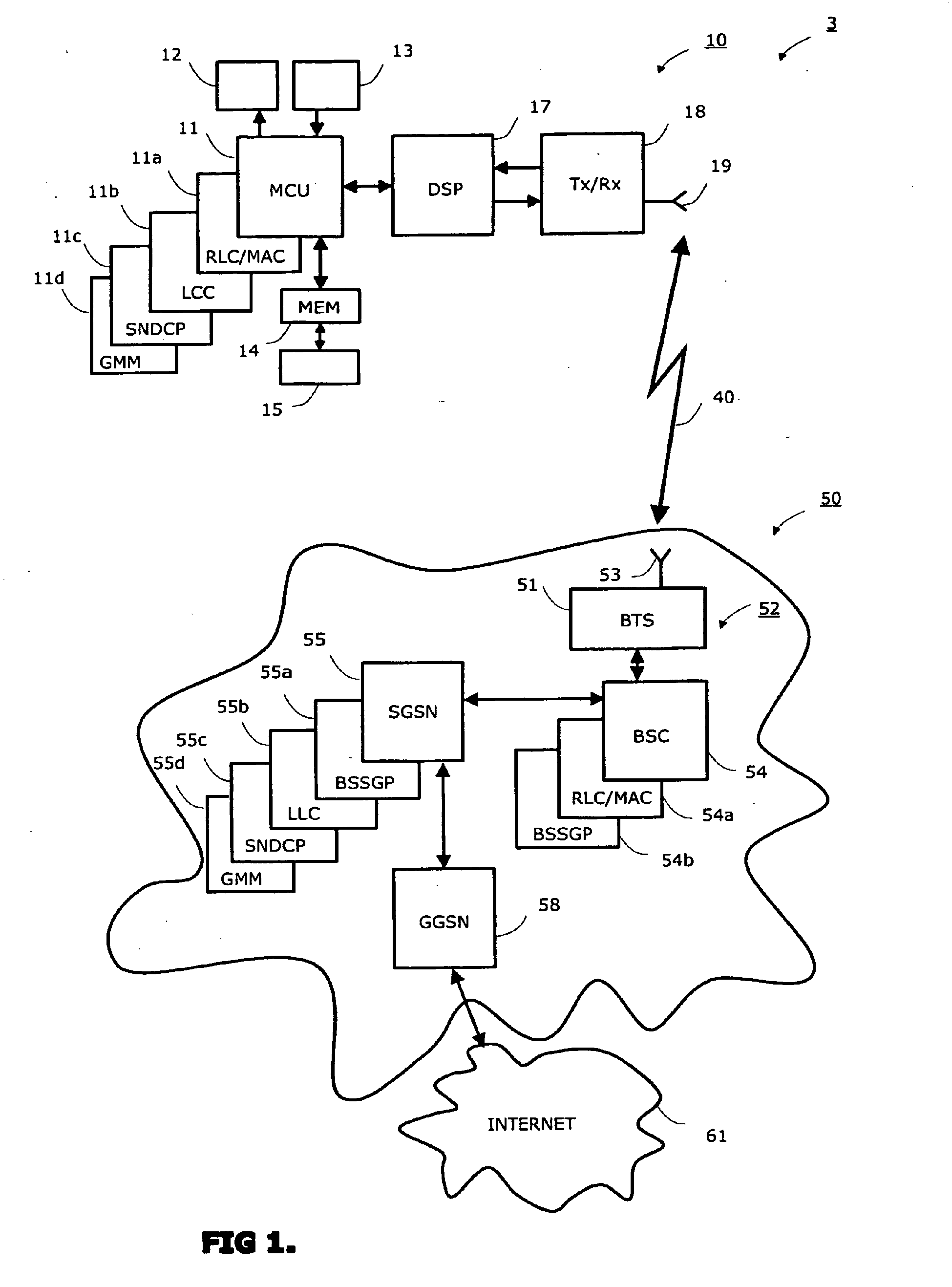
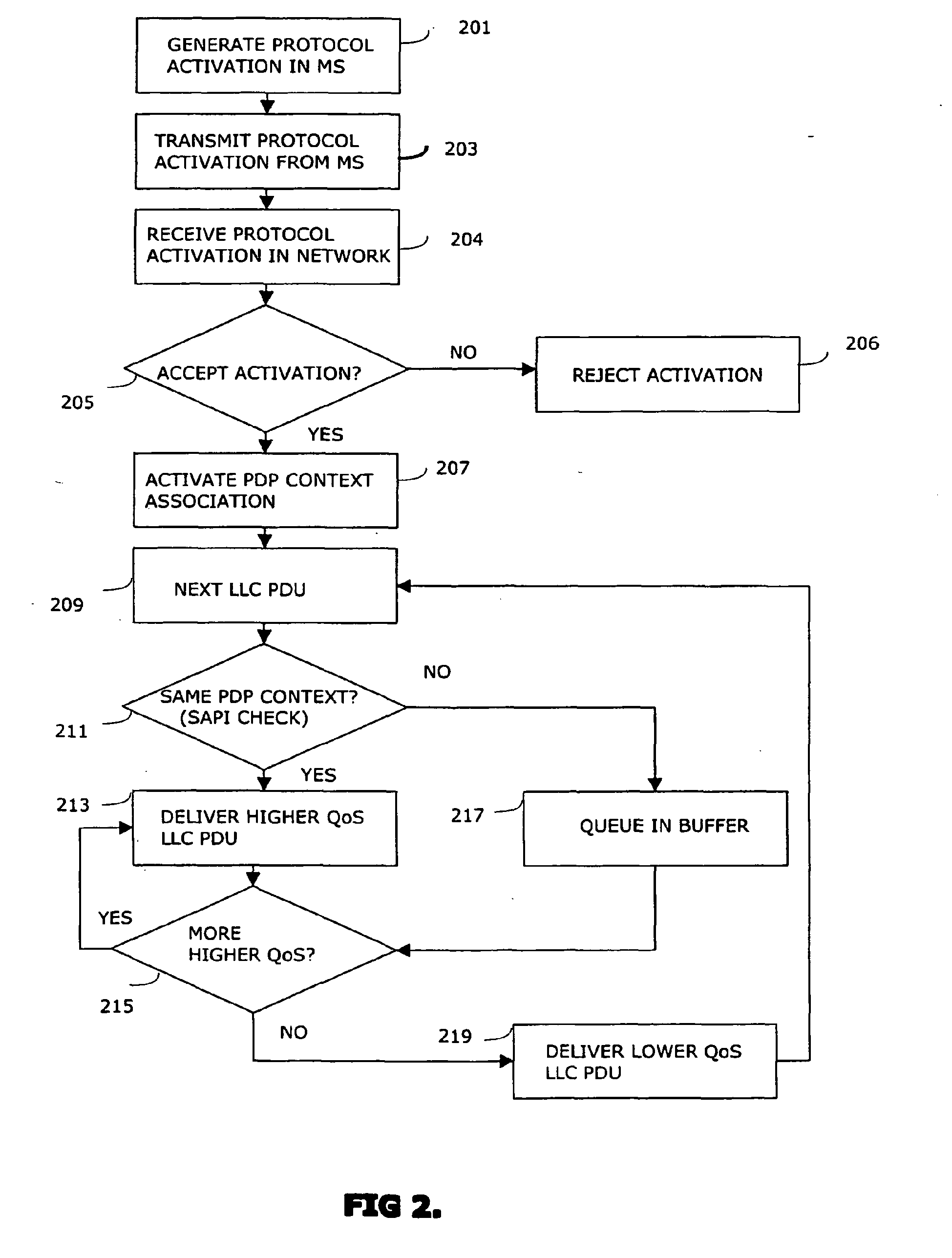
REFERENCES CITED IN THE DESCRIPTION
This list of references cited by the applicant is for the reader's convenience only.
It does not form part of the European patent document. Even though great care has
been taken in compiling the references, errors or omissions cannot be excluded and
the EPO disclaims all liability in this regard.
Patent documents cited in the description