|
(11) | EP 1 422 221 A1 |

| (12) | EUROPEAN PATENT APPLICATION |
|
|
|
|
||||||||||||||||||||
| (54) | Novel process for the preparation of 2-aminomethylpyridine derivative |
| (57) Process for the preparation of 2-aminomethylpyridine derivative of general formula
(I) or a salt thereof :
in which :
|
[0001] The present invention relates to a novel process for the preparation of 2-aminomethylpyridine derivatives which are useful as intermediates for the preparation of pesticides, by catalytic hydrogenation of 2-cyanopyridine derivatives.
[0002] Certain catalytic hydrogenation reactions of cyanopyridines to obtain aminomethylpyridines have been disclosed. An additional difficulty exists when the cyanopyridine is substituted by an halogen atom, due to dehalogenation competitive reaction that can take place, as stated in P. N. Rylander, Hydrogenation Methods (Best Synthetic Series, published by Academic Press), (1985), page 148.
Patent application EP0409716 discloses the use of Raney nickel associated with a catalyst inhibitor in the presence of iodide. This process presents the drawback in that it uses a catalyst inhibitor. Such an inhibitor should be avoided on an industrial scale.
Patent application WO 02/16322 discloses the use of a metal catalyst (especially palladium) in an alcohol solvent to carry out this reaction. Nevertheless, this process suffers from the disadvantage of dehalogenation reaction due to the high activity of palladium. Furthermore, palladium is a catalyst which is very expensive and which is very sensitive to catalysts poisons, such as the sulfur compounds which are formed during the process leading to the production of 2-cyanopyridines. This hydrogenation process can not be used on an industrial scale.
We have now found a process to prepare 2-aminomethylpyridine derivative which does not possess the above mentioned drawbacks and which is applicable to industrial scale process.
[0003] Accordingly, the present invention relates to a process for the preparation of 2-aminomethylpyridine derivative of general formula (I) or a salt thereof :
in which :
- n represents 0, 1, 2 or 3,
- X is halogen atom,
- Y may be the same or different and may be a halogen atom, a halogenoalkyl, an alkoxycarbonyl or an alkylsulphonyl;
in which n, X and Y are as defined above,
in acetic acid using Raney nickel, at a temperature of from 30°C to 70°C, under a hydrogen pressure of from 1 to 50 bar.
[0004] For the purposes of the present invention :
- haloalkyl means C1-C6 alkyl moiety substituted by one or more halogen atoms;
- alkoxycarbonyl means C1-C6 alkoxycarbonyl. Suitable examples of such a moiety may be methoxycarbonyl, ethoxycarbonyl, n-propoxycarbonyl and i-propoxycarbonyl;
- alkylsulphonyl means C1-C6 alkysulphonyl;
- a halogen atom may be a bromine atom, a chlorine atom, a iodine atom or a fluorine atom.
[0006] The product obtained by the process according to the present invention is the acetate of the compound of general formula (I) which is fully soluble in acetic acid. The catalyst may then be recycled by filtration and the solution of the acetate of the compound of general formula (I) is assayed according to methods well-known by the man ordinary skilled in the art. Yield of acetate of the compound of general formula (I) with respect to 2-cyanopyridine derivative of general formula (II) is usually more than 95 %. At 45°C, even with Ni-Ra damp with water, no more than 0.1 % yield of dehalogenation product is generally observed in the absence of dehalogenation inhibitors such as KI or KBr usually used with palladium catalysts.
[0007] The present invention relates to a process for the preparation of compound of general formula (I). Preferably the different characteristics of compound of formula (I) may be chosen independently from each other as being :
- as regards X, X is chlorine;
- as regards n, n is 1;
- as regards Y, Y is haloalkyl; more preferably, Y is trifluoromethyl.
- X is chlorine;
- n is 1;
- Y is trifluoromethyl.
[0008] The process according to the present invention is carried out at a temperature of from 30°C to 70°C, preferably at a temperature of from 35 to 50°C.
The process according to the present invention is carried out under a pressure of hydrogen of from 1 to 50 bar, preferably under a pressure of from 2 to 30 bar, more preferably under a pressure of from 10 to 20 bar.
The process according to the present invention is carried out in the presence of Ni-Ra. Ni-Ra is preferably introduced in a weight ratio of from 1 to 20% with respect to 2-cyanopyridine derivative of general formula (II).
[0009] The process according to the present invention is particularly suitable for the preparation of 2-aminomethyl-3-chloro-5-trifluoromethylpyridine, by hydrogenation of 3-chloro-2-cyano-5-trifluoromethylpyridine in acetic acid using Ni-Ra introduced in a weight ratio of from 1 to 20 % with respect to 2-cyanopyridine derivative of general formula (II), at a temperature of from 40 to 50°C, under a hydrogen pressure of from 15 to 20 bar.
[0010] The catalyst may be recycled according to methods well known by the man ordinary skilled in the art. Particularly, the catalyst may be easily recycled by filtration.
[0011] The process according to the present invention will now be illustrated with reference to the following example.
Example of the preparation of 2-aminomethyl-3-chloro-5-trifluoromethylpyridine
[0012] 400g of acetic acid and 6g of Ni-Ra (previously washed with water until washings were at a pH of 7) were loaded in a 1L stainless steel reactor. The reactor was purged with nitrogen and then hydrogen. Heating was applied to the reactor to raise the temperature up to 40°C and the reactor pressure was raised to 18 bar with hydrogen.
[0013] 120g of 3-chloro-2-cyano-5-trifluoromethylpyridine (0.571 mol) were added by pump over 2 hours. The reaction was exothermic and temperature raised to 45°C. Hydrogen consumption was monitored. After 2 hours, no more hydrogen was consumed and the reaction was complete. The mixture was cooled down to 20°C and then vented off and purged with nitrogen.
[0014] The catalyst was filtered. The solution of 2-aminomethyl-3-chloro-5-trifluoromethylpyridine acetic acid salt was assayed by liquid chromatography. 0.558 moles of 2-aminomethyl-3-chloro-5-trifluoromethylpyridine was formed and a 97% yield of 2-aminomethyl-3-chloro-5-trifluoromethylpyridine over 3-chloro-2-cyano-5-trifluoromethylpyridine was obtained. A yield of only 0.05% yield of the dechlorinated analogue was obtained.
1. Process for the preparation of 2-aminomethylpyridine derivative of general formula
(I)
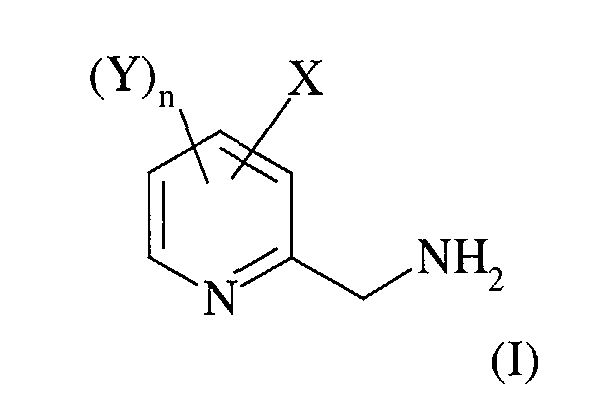
in which :
by hydrogenation of a 2-cyanopyridine derivative of general formula (II) :
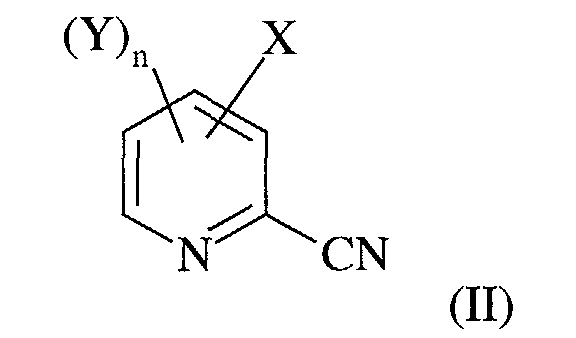
in which n, X and Y are as defined above,
or a salt thereof;
in acetic acid using Raney nickel, at a temperature of from 30°C to 70°C, under a hydrogen pressure of from 1 to 50 bar.
in which :
- n represents 0, 1, 2 or 3,
- X is halogen atom,
- each Y, which may be the same or different, is chosen in the group comprising halogen atom, halogenoalkyl, alkoxycarbonyl and alkylsulphonyl,
or a salt thereof;by hydrogenation of a 2-cyanopyridine derivative of general formula (II) :
in which n, X and Y are as defined above,
or a salt thereof;
in acetic acid using Raney nickel, at a temperature of from 30°C to 70°C, under a hydrogen pressure of from 1 to 50 bar.
2. Process according to claim 1, characterised in that X is chlorine.
3. Process according to claim 1 or 2, characterised in that n is 1.
4. Process according to any of the claims 1 to 3, characterised in that Y is haloalkyl.
5. Process according to claim 4, characterised in that Y is trifluoromethyl.
6. Process according to claim 1, characterised in that X is chlorine, n is 1 and Y is trifluoromethyl.
7. Process according to claim 6, characterised in that compound of general formula (I) is 2-aminomethyl-3-chloro-5-trifluoromethylpyridine.
8. Process according to any of the claims 1 to 7, characterised in that temperature is chosen from 35 to 50°C.
9. Process according to any of the claims 1 to 8, characterised in that the pressure of hydrogen is chosen from 2 to 30 bar.
10. Process according to claim 9, characterised in that the pressure of hydrogen is chosen from 10 to 20 bar.
11. Process according to any of the claims 1 to 10, characterised in that Raney nickel is introduced in a weight ratio of from 1 to 20 % with respect to compound
of general formula (II).
12. Process according to claim 7, characterised in that the temperature is chosen from 35 to 50°C and the pressure of hydrogen is chosen
from 10 to 20 bar and Raney nickel is introduced in a weight ratio of from 1 to 20
% with respect to compound of general formula (II).