|
(11) | EP 1 437 946 B1 |

| (12) | EUROPEAN PATENT SPECIFICATION |
|
|
| (54) |
USE OF A CATIONIC PRESERVATIVE IN FOOD PRODUCTS VERWENDUNG EINES KATIONISCHEN KONSERVIERUNGSMITTELS IN LEBENSMITTELN AGENT CONSERVATEUR CATIONIQUE POUR PRODUITS ALIMENTAIRES |
|
|
||||||||||||||||||||||||||||
|
|||||||||||||||||||||||||||||
| Note: Within nine months from the publication of the mention of the grant of the European patent, any person may give notice to the European Patent Office of opposition to the European patent granted. Notice of opposition shall be filed in a written reasoned statement. It shall not be deemed to have been filed until the opposition fee has been paid. (Art. 99(1) European Patent Convention). |
[0001] This invention relates to a novel use of cationic preservatives and preparations according to this novel use.
[0002] Despite the food industry must avoid the use of preservative products by means of good manufacture practices as it is described in the national and international regulations, it is often necessary to warrant the needed storage capability of the produced food-stuff but never to hide defective effects of a manipulation or manufacture technique.
[0003] A cationic preservative derived from lauric acid and arginine, in particular, the ethyl ester of the lauramide of the arginine monohydrochloride, hereafter named LAE, could be used for the protection against the growth of the microorganisms. The chemical structure is described in the following formula:
[0004] The preparation of this product has been described in Spanish patent application ES-A-512643.
[0005] Biological studies carried out at different research centres under supervision of the present applicant showed LAE to act mainly over the external and cytoplasmatic membrane of the microorganisms and, also, into the cytoplasmatic media, preventing their proliferation. Its action depends on the kind of microorganism and on the exposure time.
[0006] Besides, its metabolism in rats has been studied showing a fast absortion and metabolisation into naturally-occurring amino acids and the fatty acid lauric acid, which are eventually excreted as carbon dioxide and urea. Toxicological studies have demonstrated, that LAE is completely harmless to animals and humans.
[0007] Therefore, LAE and related compounds are particularly suitable to be used in the preservation of all perishable food products.
[0008] This compound is remarkable for its inhibitory action over the proliferation of different microorganisms, such as bacteria, fungi and yeasts. The minimum inhibitory concentrations of LAE are shown in the following table 1.
Table 1
| Kind | Microorganism | M.I.C. (ppm) |
| Arthrobacter oxydans ATCC 8010 | 64 | |
| Bacillus cereus var mycoide ATCC 11778 | 32 | |
| Bacillus subtilis ATCC 6633 | 16 | |
| Clostridium perfringens ATCC 77454 | 16 | |
| Gram + Bacteria | Listeria monocytogenes ATCC 7644 | 10 |
| Staphylococcus aureus ATCC 6538 | 32 | |
| Micrococcus luteus ATCC 9631 | 128 | |
| Lactobacillus delbrueckii ssp lactis CECT 372 | 16 | |
| Leuconostoc mesenteroides CETC 912 | 32 | |
| Alcaligenes faecalis ATCC 8750 | 64 | |
| Bordetella bronchiseptica ATCC 4617 | 128 | |
| Citrobacter freundii ATCC 22636 | 64 | |
| Enterobacter aerogenes CECT 689 | 32 | |
| Escherichia coli ATCC 8739 | 32 | |
| Escherichia coli 0157H7 | 20 | |
| Gram - Bacteria | Klebsiella pneumoniae var pneumoniae CECT 178 | 32 |
| Proteus mirabilis CECT 170 | 32 | |
| Pseudomonas aeruginosa ATCC 9027 | 64 | |
| Salmonella typhimurium ATCC16028 | 32 | |
| Serratia marcenses CECT 274 | 32 | |
| Mycobacterium phlei ATCC 41423 | 2 | |
| Aspergillus nigerATCC14604 | 32 | |
| Aureobasidium pullulans ATCC 9348 | 16 | |
| Gliocadium virens ATCC 4645 | 32 | |
| Fungi | Chaetonium globosum ATCC 6205 | 16 |
| Penicillium chrysogenum CECT 2802 | 128 | |
| Penicillium funiculosum CECT 2914 | 16 | |
| Candida albicans ATCC 10231 | 16 | |
| Yeast | Rhodotorula rubra CECT 1158 | 16 |
| Saccharomyces cerevisiae ATCC 9763 | 32 |
[0010] It is preferred to dissolve the compound directly before use in one of the following preferred solvents of food grade: water, ethanol, propylene glycol, isopropyl alcohol, other glycols, mixtures of glycols and mixtures of glycols and water. If the treatment shall be performed at a specific pH value the use of a corresponding buffer solution may be recommendable.
[0011] The composition optionally comprises auxiliary components and excipients. Such auxiliary components and excipients can be thickening agents (e.g. xanthan gum, guar gum, modified starches), anti-foam agents (e.g. dimethylpolysiloxane, silicon dioxide), products to obtain the optimal pH value (e.g. phosphates, tartrates, citrates, lactates), colouring agents (e.g. curcumin, tartrazine, erythrosine), and aroma products. It is preferred, that the preservative composition comprises LAE in an amount of from 0.0001% to 1% by weight relative to the whole weight of the preservative composition.
[0012] It is particularly preferred to use the inventive composition for the preservation of meat products, like for instance meat, poultry products, fish, crustaceans, vegetables, greens, emulsions, sauces, confectionery, bakery, pre-cooked meals, ready-to-serve meals, dairy products, egg-based products, jams, jellies, beverages, juices, wines and beers.
[0013] Moreover, the intended use relates to: wine-based flavoured drinks including products; non-alcoholic flavoured drinks; liquid tea concentrates and liquid fruit and herbal infusion concentrates; Barley Water; fruit and citric juices; Capilé Groselha; grape juices, unfermented, for sacramental use; wines, alcohol-free wines, fruit wines (including alcohol-free), alcoholic drinks with fruit; made wines, fruit sparkling wines, ciders, beers and perries (including alcohol-free); fermentation vinager; sod, saft; mead; spirits with less than 15% alcohol by volume; fillings of ravioli and similar products; quince, jams, jellies, marmelades and other fruit based spreads, candied, crystallized and glacé fruit and vegetables; sugar, glucose syrup, molasses and other sugars; transformed and dried fruits and vegetables, Frugtgrod and Rote Grütze, fruit and vegetable preparations (including fruit-based sauces); vegetable flesh; shell fruits; mousse, compote; salads, fruits and similar products, canned or bottled; Mostarda Di Fruta; Mascarpone; fruit based cake fillings; fruit gelling extracts and liquid pectine; vegetables and fruits in vinegar, brine or oil; rehydrated dried fruits; dressed dried fruits; sweetcom canned in vacuum; potato dough and pre-fried, sliced, transformed, frozen, deep-frozen and peeled potatoes; dehydrated potato flakes and granulated; gnocchi; polenta; olives and olive-based preparations; jelly coating of meat products (cooked, cured or dried); burger meat; heat-treated meat products, sausages, breakfast sausages, pickled porks, pates, Foie Gras, Foie Gras Entier, Blocs de Foie Gras; Sagu; Mehu and Makeutettu; Ostkaka; Pasha; Semmelknodelteig; Polsebrod and bollery Dansk; canned Flutes; gelatine; collagen based covers with a water activity of more than 0.6; salted meats, cured placenta, dried meat products; semi-preserved fish products including fish roe products, pickling, salted, dried fish, shrimps, cooked, Crangon crangon and Crangon vulgaris cooked; fresh, cooked, frozen and deep-frozen crusteacean; cheese, pre-packed, sliced, unripened and cured cheese, processed cheese, layered cheese and cheese with added foodstuffs; superficial treatment of cheese, fruits and vegetables; cheese substitute, meat substitute, fish substitute, crusteacean substitute; non-heat-treated dairy-based desserts, curdled milk, semolina and tapioca based desserts; liquid egg (white, yolk or whole egg), dehydrated, concentrated, frozen and deep-frozen egg products; pre-packed and sliced bread and rye-bread; partially baked, pre-packed bakery wares intended for retail sale, fine bakery wares with a water activity of more than 0.65; low-energetic bread; dry-biscuits; cereal- or potato-based snacks and coated nuts; batters, confectionery, glucose syrup based confectionery, flour based confectionery with a water activity of more than 0.65, chewing gum; christmas pudding, nougats and marzipans; clotted cream; toppings (syrups for pancakes, flavoured syrups for milkshakes and ice cream, similar products), fat emulsions, dressing salads, emulsified sauces, non-emulsified sauces; prepared salads, mustard, seasonings and condiments; liquid soups and broths; aspic, liquid dietary food supplements; pearl barley; dietetic foods intended for special medical purposes and starches; dietetic formulae for weight control intended to replace total daily food intake or an individual meal; and other food products where the use of preservatives became necessary and allowed by law.
[0014] The cationic preservative may be added to a final stage of the product to be preserved or it may be added to a initial stage which would have the advantage of treating the food product, whereby it may be added as dry product to the product to be preserved, or in the form of a solution or dispersion.
[0015] The food products according to the invention are prepared according to the techniques which are well known to a person skilled in the art.
Procedures to determine the microbiological population and preservative effect
[0016] The determination of the microbiological population is carried out according to the ISO standards.
[0017] The samples are treated by dilution in buffer peptone with the appropriate neutralising agent of the preservative. The culture media used for counting the microorganisms are: Soya triptone agar (32-35°C, 48 hours) for the determination of mesophilic bacteria; Sabouraud agar with chloramfenicol (25°C, 3-5 days) for fungi and yeast; Violet red bile glucose agar (32-35°C, 24 hours) for enterobacteria; Soya triptone agar (17°C, 5 days) for psychrotrophic bacteria.
EXAMPLES
[0018] Different examples of food products and formulations are shown where the product has been assayed. These examples are a part of the preparations and formulations assayed.
■ Example 1:
[0019] This example shows the use of LAE in semi-preserved codfish in oil (table 2). The sample LAE was added to the oil assayed at a concentration of 100 ppm and its microbiological evolution at 4°C was compared against a control.
■ Example 2:
[0020] This example shows the use of LAE in a chicken product (table 3). The sample LAE was added to at a concentration of 150 ppm and the evolution of aerobe and psychrotrophic bacteria at 10°C was compared against a control.
■ Example 3:
[0021] This example shows the use of LAE in a carbonated orange beverage (table 4). The sample LAE was added to at a concentration of 100 ppm and its micobiological evolution at 17°C was compared against a control.
■ Example 4:
[0022] This example shows the use of LAE in a blackberry juice (table 5). The sample LAE was added to at a concentration of 60 ppm and its micobiological evolution at 34°C was compared against a control.
■ Example 5:
[0023] This example shows the use of LAE in custard (table 6). The sample LAE was added to at a concentration of 100 ppm and its micobiological evolution at 25°C was compared against a control.
■ Example 6:
[0024] This example shows the use of LAE in fairy cakes (table 7). The sample LAE was added to at a concentration of 80 ppm and its micobiological evolution at 25°C was compared against a control.
■ Example 7:
[0025] This example shows the use of LAE in veal stew (table 8). The sample LAE was added to at a concentration of 100 ppm and its microbiological evolution at 10°C was compared against a control.
■ Example 8:
1. Use of a cationic preservative derived from the condensation of a fatty acid and an
esterified dibasic amino acid, according to the following formula:
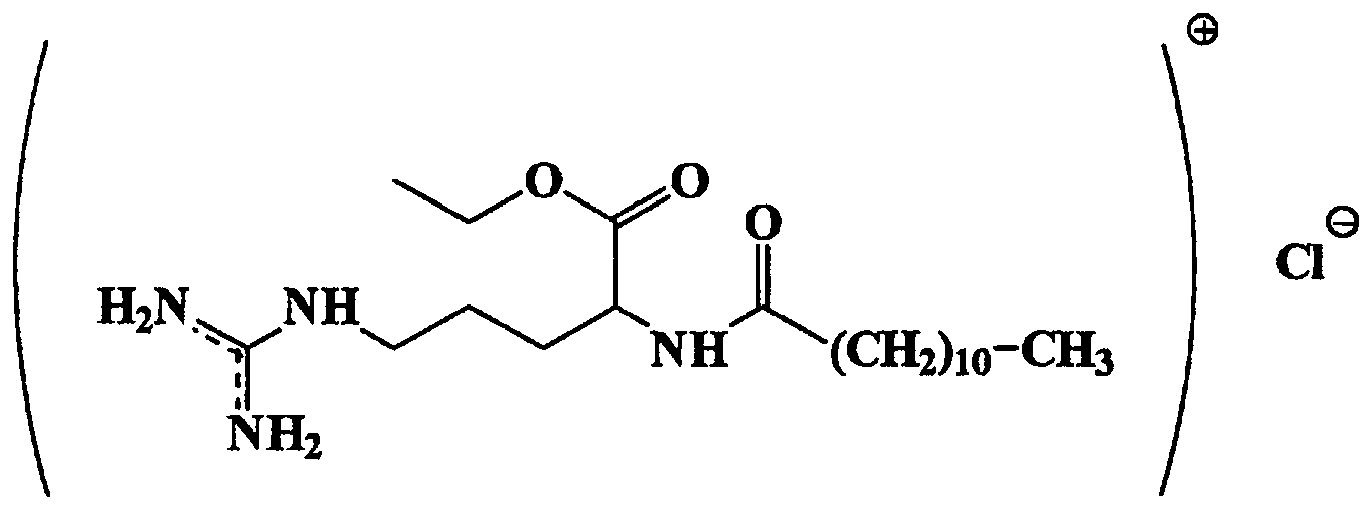
as a preservative in food preparations,
wherein the preservative is added to such food products at a concentration from 0.006% to 0.015%.
as a preservative in food preparations,
wherein the preservative is added to such food products at a concentration from 0.006% to 0.015%.
2. Food products comprising the cationic preservative defined in claim 1 as a preservative,
wherein the cationic preservative is present at a concentration of from 0.006% to
0.015%.
3. Method of preservation of food products wherein the preservative defined in claim
1 is added to such food products at a concentration from 0.006% to 0.015%.
4. The method of claim 3, wherein the food products are fish, crustaceans, fish substitutes
or crustaceans substitutes.
5. The method of claim 3, wherein the food products are meat, meat substitutes or poultry
products.
6. The method of claim 3, wherein the food products are vegetables, greens, sauces and
emulsions.
7. The method of claim 3, wherein the food products are beverages, juices, wines or beers.
8. The method of claim 3, wherein the food products are dairy, egg-based, jam, jelly,
bakery or confectionery products.
9. The method of claim 3, wherein the food products are pre-cooked meal and ready-to-serve
meal products.
10. The method of claim 3, wherein the preservative is added as a solution, dispersion
or solid or is sprayed to a food product before, during and/or after the manufacture
to.
11. The method of claim 3, wherein the preservative is applied by surface treatment or
mixed in the composition.
1. Verwendung eines kationischen Konservierungsstoffes, der aus der Kondensation einer
Fettsaure und einer dibasischen veresterten Aminosäure stammt, entsprechend der folgenden
Formel:
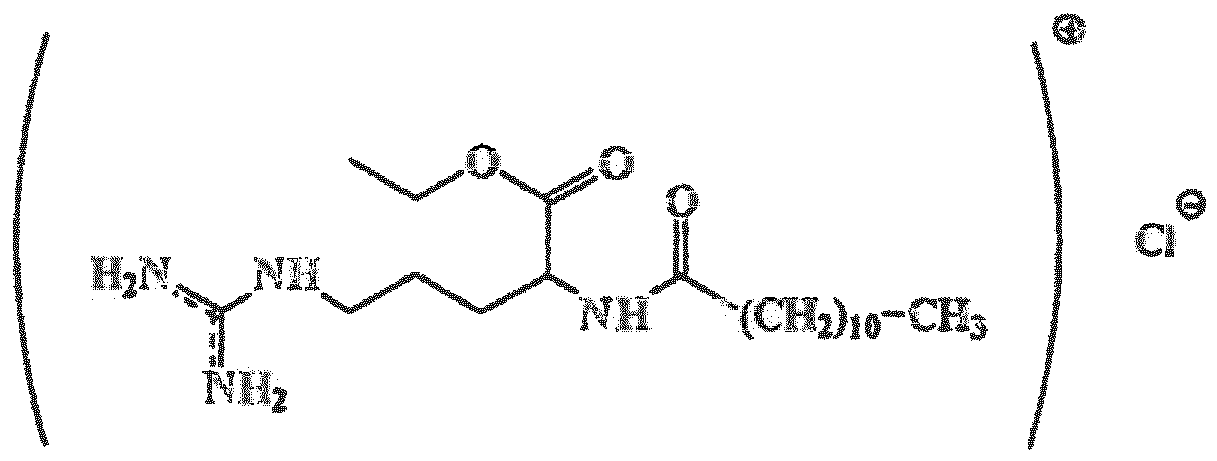
als Konservierungsmittel in Lebensmittelzubereitungen,
wobei das Konservierungsmittel solchen Lebensmittelprodukten in einer Konzentration von 0,006 % bis 0,015 % zugesetzt wird,
als Konservierungsmittel in Lebensmittelzubereitungen,
wobei das Konservierungsmittel solchen Lebensmittelprodukten in einer Konzentration von 0,006 % bis 0,015 % zugesetzt wird,
2. Lebensmittelprodukte, umfassend das in Anspruch 1 definierte kationische Konservierungsmittel
als Koservierungsmittel, wobei das kationische Konservierungsmittel in einer Konzentation
von 0,006 % bis 0,015 % vorliegt.
3. Verfahren zur Konservierung von Lebensmittelprodukten, wobei das in Anspruch 1 definierte
Konservierungsmittel solchen Lebensmittelprodukten in einer Konzentration von 0,006
% bis 0,015 % zugesetzt wird.
4. Verfahren nach Anspruch 3, wobei die Lebensmittelprodukte Fisch, Krustentiere, Fischersatz
oder Krustentierersatz sind.
5. Verfahren nach Anspruch 3, wobei die Lebensmittelprodukte Fleisch, Fleischersatz oder
Geflügelprodukte sind.
6. Verfahren nach Anspruch 3, wobei die Lebensmittelprodukte Gemüse, Kräuter, Soßen und
Emulsionen sind.
7. Verfahren nach Anspruch 3, wobei die Lebensmittelprodukte Getränke, Säfte, Welne oder
Biere sind.
8. Verfahren nach Anspruch 3, wobei die Lebensmittelprodukte Milchprodukte, Produkte
auf El-Basis, Marmeladenprodukte, Geleeprodukte, Gebäckprodukte oder Konfektprodukte
sind.
9. Verfahren nach Anspruch 3, wobei die Lebensmittelprodukte vorgekochte Mahlzeiten und
servierfertige Mahlzeiten sind,
10. Verfahren nach Anspruch 3, wobei das Konservierungsmittel vor, während und/oder nach
der Herstellung als Lösung, Dispersion oder Feststoff zugesetzt wird oder auf ein
Lebensmittelprodukt gesprüht wird.
11. Verfahren nach Anspruch 3, wobei das Konservierungsmittel durch Oberflächenbehandlung
aufgetragen wird oder in die Zusammensetzung gemischt wird.
1. Utilisation d'un agent conservateur cationique dérivé de la condensation d'un acide
gras et un acide aminé dibasique estérifié, selon la formule suivante :
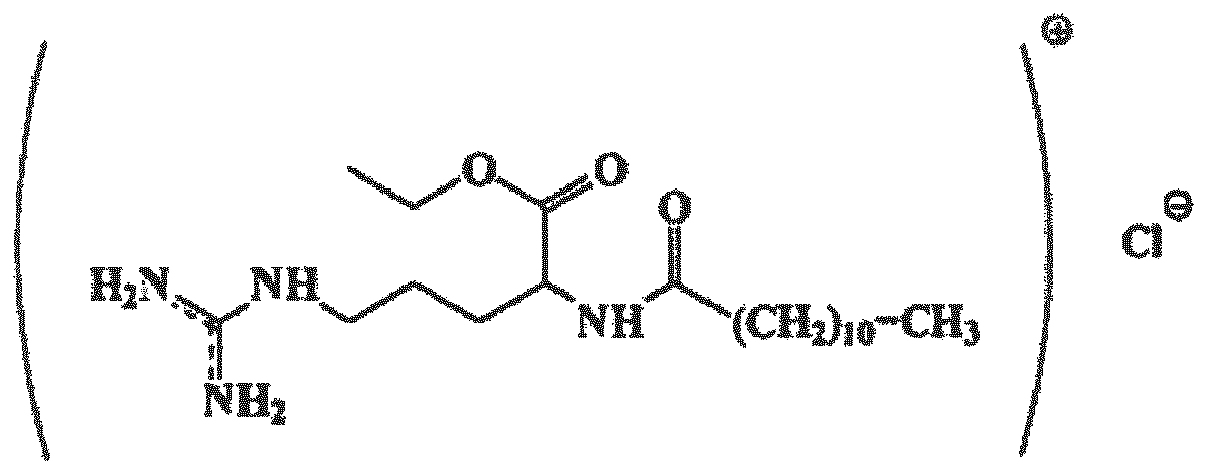
en tant qu'agent conservateur dans des préparations alimentaires,
dans lesquelles l'agent conservateur est ajouté à ces produits alimentaires à une concentration de 0,006 % à 0,015 %.
en tant qu'agent conservateur dans des préparations alimentaires,
dans lesquelles l'agent conservateur est ajouté à ces produits alimentaires à une concentration de 0,006 % à 0,015 %.
2. Produits alimentaires comprenant l'agent conservateur cationique selon la revendication
1 en tant qu'agent conservateur, dans lesquels l'agent conservateur cationique est
présent à une concentration de 0,006 % à 0,015 %.
3. Procédé permettant de conserver des produits alimentaires, dans lequel l'agent conservateur
selon la revendication 1 est ajouté à ces produits alimentaires à une concentration
de 0,006 à 0,015 %.
4. Procédé selon la revendication 3, dans lequel les produits alimentaires sont des poissons,
des crustacés, des substituts de poisson et des substituts de crustacé.
5. Procédé selon la revendication 3, dans lequel les produits alimentaires sont de la
viande, des substituts de viande et des produits de la volaille.
6. Procédé selon la revendication 3, dans lequel les produits alimentaires sont des légumes,
des verdures, des sauces et des émulsions,
7. Procédé selon la revendication 3, dans lequel les produits alimentaires sont des boissons,
des jus, des vins et des bières.
8. Procédé selon la revendication 3, dans lequel les produits alimentaires sont des produits
laitiers, à base d'oeufs, de la confiture, de la gelée, de boulangerie ou des produits
de pâtisserie.
9. Procédé selon la revendication 3, dans lequel les produits alimentaires sont des plats
précuits et des produits des plats prêts à servir.
10. Procédé selon la revendication 3, dans lequel l'agent conservateur est ajouté sous
forme d'une solution, d'une dispersion ou d'un solide ou est pulvérisé sur un produit
alimentaire avant, pendant et/ou après la fabrication.
11. Procédé selon la revendication 3, dans lequel l'agent conservateur est appliqué par
traitement de la surface ou est mélangé dans la composition.
REFERENCES CITED IN THE DESCRIPTION
This list of references cited by the applicant is for the reader's convenience only. It does not form part of the European patent document. Even though great care has been taken in compiling the references, errors or omissions cannot be excluded and the EPO disclaims all liability in this regard.
Patent documents cited in the description