| (19) |
 |
|
(11) |
EP 1 454 010 B1 |
| (12) |
EUROPEAN PATENT SPECIFICATION |
| (45) |
Mention of the grant of the patent: |
|
14.09.2011 Bulletin 2011/37 |
| (22) |
Date of filing: 04.12.2002 |
|
| (51) |
International Patent Classification (IPC):
|
| (86) |
International application number: |
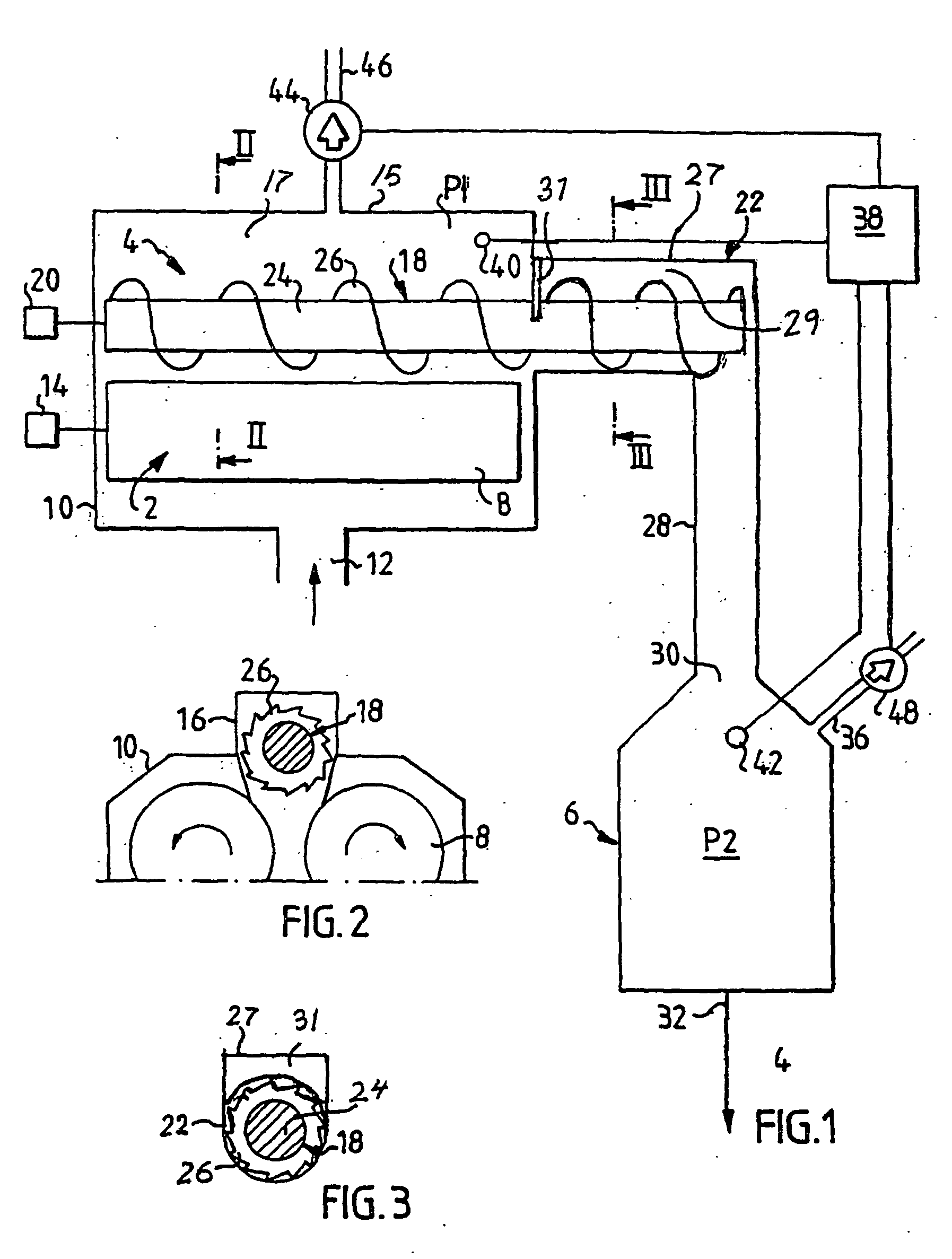
|
PCT/SE2002/002229 |
| (87) |
International publication number: |
|
WO 2003/048448 (12.06.2003 Gazette 2003/24) |
|
| (54) |
METHOD AND SYSTEM FOR THE TREATMENT OF PULP PRIOR TO OZONE BLEACHING
VERFAHREN UND VORRICHTUNG ZUR ZELLSTOFFBEHANDLUNG VOR DER OZONBLEICHE
PROCEDE ET SYSTEME DE TRAITEMENT DE LA PATE A PAPIER AVANT LE BLANCHIMENT A L'OZONE
|
| (84) |
Designated Contracting States: |
|
AT BE BG CH CY CZ DE DK EE ES FI FR GB GR IE IT LI LU MC NL PT SE SI SK TR |
| (30) |
Priority: |
05.12.2001 SE 0104081
|
| (43) |
Date of publication of application: |
|
08.09.2004 Bulletin 2004/37 |
| (73) |
Proprietor: Metso Paper, Inc. |
|
00101 Helsinki (FI) |
|
| (72) |
Inventors: |
|
- BOKSTRÖM, Monica
S-860 25 Kovland (SE)
- STRÖM, Per
S-860 25 Kovland (SE)
|
| (74) |
Representative: Rosenquist, Per Olof |
|
Bergenstråhle & Lindvall AB
P.O. Box 17704
118 93 Stockholm
118 93 Stockholm (SE) |
| (56) |
References cited: :
WO-A1-00/77296
US-A- 4 278 496
|
WO-A1-96/05365
|
|
| |
|
|
|
|
| |
|
| Note: Within nine months from the publication of the mention of the grant of the European
patent, any person may give notice to the European Patent Office of opposition to
the European patent
granted. Notice of opposition shall be filed in a written reasoned statement. It shall
not be deemed to
have been filed until the opposition fee has been paid. (Art. 99(1) European Patent
Convention).
|
[0001] The present invention relates to a method for treatment of pulp, in which the pulp
is dewatered to a fiber concentration of at least 20% dryness, the dewatered pulp
is shredded in a closed pulp-shredding vessel, the shredded pulp is transported from
the pulp-shredding vessel through an outlet pipe by means of a transport screw therein
directly to a reactor vessel via a conduit which is gastight against the environment,
the interior of the conduit communicating with the interior of the outlet pipe and
with the interior of the reactor vessel, and the shredded pulp is bleached in the
reactor vessel through reaction with ozone gas.
[0002] The invention also relates to a system for treatment of pulp, comprising a dewatering
device for dewatering the pulp to a fiber concentration.of at least 20% dryness, a
closed pulp-shredding vessel in which the dewatered pulp is shredded, an outlet pipe
from the pulp-shredding vessel, and a transport screw arranged in the outlet pipe
for transportation of the shredded pulp from the pulp-shredding vessel through the
outlet pipe. The system further comprises a reactor vessel for bleaching the shredded
pulp through reaction with ozone gas, and a conduit which is gastight against the
environment and which connects the outlet pipe of the pulp-shredding vessel gas tightly
to the reactor vessel, so that the interior of the outlet pipe directly communicates
with the interior of the reactor vessel via the interior of the conduit.
[0003] A method and a system of these kinds are known from
SE 514416 C2. In accordance with the known method the shredded pulp is transported, without being
compressed, continuously out of the pulp-shredding vessel via the outlet pipe, so
that the outlet pipe is kept filled with passing pulp. From the outlet pipe the shredded
pulp is directly transported to the reactor vessel through the gastight conduit, and
at the same time the gas pressure in the pulp-shredding vessel is kept higher than
the gas pressure in the reactor vessel. The combination of the two measures - (1)
keeping the outlet pipe filled with passing shredded non-compressed pulp, and - (2)
keeping the gas pressure in the pulp-shredding vessel higher than that in the reactor
vessel, has proved to be sufficient to prevent ozone gas from leaking from the reactor
vessel upstream out to the environment.
[0004] US 4 278 496 A shows another method and another apparatus, said method and apparatus relating to
treatment of finely divided fibrous pulp material.
[0005] Traditionally, the shredded pulp is transported by means of a plug screw from the
pulp-shredding vessel to a fluffer, in which the pulp is fluffed, and then the fluffed
pulp is bleached in the reactor vessel, see for example
WO 9605365 A1. The function of the plug screw is to compress the shredded pulp to a plug forming
a gas lock preventing ozone gas from leaking from the reaction vessel upstream in
the system to the environment. The function of the fluffer is to fluff up the compressed
pulp leaving the pulp screw, so that the pulp gets a large specific surface, which
facilitates the reaction of the ozone gas with the lignin of the pulp. Thus, the pulp
entering the reactor vessel has to be fluffed, in order to obtain high ozone utilization
and a good bleaching selectivity. With the method and system according to
SE 514416 C2 it has been possible to eliminate the need for a plug screw and a fluffer.
[0006] However, when using the method and system according to
SE 514416 C2 the problem has arisen that the transport screw acts as a pump in the outlet pipe
filled with shredded pulp, which results in that a certain amount of air is pumped
from the pulp-shredding vessel to the reactor vessel. Thus, in the reactor vessel
the air is mixed with the ozone gas. Because of the nitrogen content of the air the
surplus of ozone gas will get a smaller oxygen content, which makes the surplus gas
less valuable. For example, the surplus gas could be used for oxygen delignification
if it had a sufficient content of oxygen.
[0007] An object of the present invention is to improve the known method according to
SE 514416 C2, so that the amount of air mixing with the ozone gas is substantially reduced.
[0008] This object is obtained by the method initially stated characterized by transporting
the shredded pulp by a transport screw through the outlet pipe in such a manner that
an upper gas space is formed in the outlet pipe between the pulp-shredding vessel
and the gastight conduit, and restraining the gas flow flowing through the upper gas
space between the pulp-shredding vessel and the gastight conduit. This reduces the
pumping action of the transport screw, which results in that only an insignificant
amount of air can leak to the reactor vessel.
[0009] According to a preferred embodiment of the invention the transport screw extends
in the pulp-shredding vessel and shreds the pulp.therein in such a manner that a further
upper gas space is formed in the pulp-shredding vessel above the transport screw.
This further reduces the pumping action of the transport screw.
[0010] Preferably, a transport screw shreds the pulp in the pulp-shredding vessel by at
least one toothed transport thread.
[0011] The gas pressure in the pulp-shredding vessel is advantageously kept lower than the
gas pressure in the reactor vessel, which further reduces leakage of air to the reactor
vessel. Preferably, the gas pressure in the pulp-shredding vessel and the gas pressure
in the reactor vessel is regulated to predetermined values, so that the difference
between these gas pressures suitably is in the range of 0,1-1,5 kPa. The gas pressures
in the pulp-shredding vessel and the reactor vessel are advantageously kept below
the ambient atmospheric pressure.
[0012] For example, the gas under-pressure in the pulp-shredding vessel may be from 0,1
to 1,5 kPa while the gas under-pressure in the reactor vessel can be between 0,01
to 0,4 kPa.
[0013] The shredded pulp in the gas pipe conduit is suitable transported by gravity.
[0014] A further object of the present invention is to improve the known system according
to
SE 514416 C2, so that the amount of air mixed with the ozone gas is substantially reduced during
operation of the system.
[0015] This object is obtained by the system initially stated characterized in that the
outlet pipe is designed with a heighten roof portion, so that an upper gas space free
from pulp is formed in the outlet pipe between the roof portion and the transport
screw, which gas space extends between the pulp-shredding vessel and the gas pipe
conduit, and a flow restraining member arranged in the upper gas space in the outlet
pipe for restraining the gas flow through the gas space.
[0016] According to a preferred embodiment of the system according to the invention, the
transport screw extends in the pulp-shredding vessel and the pulp-shredding vessel
is designed with a heighten roof portion, so that an additional upper gas space free
from pulp is formed in the pulp-shredding vessel above the transport screw.
[0017] The flow-restraining member preferably comprises a partition wall extending in the
gas space perpendicular to the outlet pipe. The partition wall is suitably situated
at the end of the outlet pipe at which the shredded pulp enters the outlet pipe. Alternatively,
however, the partition wall may be placed in another location in the outlet pipe.
[0018] The system advantageously comprises a pressure regulation device for maintaining
a gas pressure in the pulp-shredding vessel, which is lower than the gas pressure
in the reactor vessel. The pressure regulation device regulates the gas pressure in
the pulp-shredding vessel and the gas pressure in the reactor vessel to predetermine
values. Preferably, the pressure regulation device comprises a first fan with a controllable
capacity arranged in a gas outlet in the pulp-shredding vessel for evacuation of gas
therefrom, a second fan with a controllable capacity arranged in a gas outlet in the
reactor vessel for evacuation of gas therefrom, a first pressure sensor for sensing
the gas pressure in the pulp-shredding vessel, a second pressure sensor for sensing
the gas pressure in the reactor vessel, and a control unit which controls the capacity
of a first and second, respectively, fan in response to the first and second, respectively,
pressure sensor.
[0019] The invention is described in more detail in the following with reference to the
accompanying drawing, in which figure 1 schematically shows an example of the system
according to the present invention, and figure 2 and figure 3, respectively, is a
cross section along the line II-II and III-III, respectively, in figure 1.
[0020] The drawing shows a system for treatment of pulp comprising a dewatering device 2,
a pulp-shredding device 4 and a reactor vessel 6 for bleaching the pulp through reaction
with ozone gas. The dewatering device 2 comprises two pressure rolls 8, which are
arranged to counter rotate in a housing 10, and an inlet 12 for pulp to be dewatered
in the lower part of the housing 10. A motor 14 provides for the rotation of the pressure
rolls 8. An elongated closed pulp-shredding vessel 16 extends along the pressure rolls
8 above these. In the pulp-shredding vessel 16 a transport screw 18 extends in parallel
in the pressure rolls 8. The pulp-shredding vessel 16 is designed with a heighten
roof portion 15, so that an upper gas space 17 free from pulp is formed in the pulp-shredding
vessel 16 above the transport screw 18. Another motor 20 is adapted to rotate the
transport screw 18. The pulp-shredding vessel 16 has a lower elongated inlet for pulp
that has been dewatered by the pressure rolls 8, see figure 2 and an outlet pipe 22,
through which the transport screw 18 extends, for dewatered and shredded pulp.
[0021] The transport screw 18 has a core 24 with a constant diameter and a toothed transport
thread 26 with a constant pitch and diameter. Alternatively, the transport screw 18
may have more than one transport thread 26. The part of the transport thread 26 extending
in the outlet pipe 22.may alternatively not be toothed.
[0022] Also the outlet pipe 22 is designed with a heightened roof portion 27, so that an
upper gas space 29 free from pulp is form in the outlet pipe 22 between the roof portion
27 and the transport screw 18. The lower part of the interior of the outlet pipe 22
has a semi-circular cross-section and fits the transport screw 18. A flow-restraining
member 13 in the form of a partition wall 31 extends in the gas space 29 perpendicular
to the outlet pipe 22 and is situated at the end of the outlet pipe 22 at which the
shredded pulp enters the outlet pipe 22. The partition wall 31 is formed with a lower
semi-circular recess that fits the transport screw 18.
[0023] A vertical gas tight conduit 28 connects the outlet pipe 22 gas tightly to an upper
inlet 30 in the reactor vessel 6, so that the interior of the outlet pipe 22 directly
communicates with the interior of the reactor vessel 6 via the interior of the conduit
28. The reactor vessel 6 has a lower outlet conduit 32 for discharging bleached pulp,
and an upper outlet conduit 36 for evacuation of gas. There is also means, not shown,
for supplying ozone gas to the interior of the reactor vessel 6.
[0024] A control unit 38 is by signal lines connected to a pressure sensor 40 for sensing
the gas pressure P1 in the pulp-shredding vessel 16 and to a pressure sensor 42 for
sensing the gas pressure P2 in the reactor vessel 6. The control unit 38 is by further
signal lines also connected to a fan 44 with a controllable capacity situated in an
upper outlet conduit 46 from the pulp-shredding vessel 16, and to another fan 48 likewise
with controllable capacity situated in the upper outlet conduit 36 of the reactor
vessel 6.
[0025] During operation, a pulp suspension is pumped via the inlet 12 of the dewatering
device 2 to the pressure rolls 8, which are counter rotated by the motor 14, the rotational
direction of the pressure rolls is indicated by arrows in figure 3, so that the pulp
during dewatering is pulled between the pressure rolls 8 up to the inlet of the pulp-shredding
vessel 16. When entering the inlet of the pulp-shredding vessel 16 the dewatered pulp
has a fiber concentration of 20-50% dryness. In the pulp-shredding vessel 16 the toothed
transport thread 26 of the transport screw 18, which is rotated by the motor 20, shreds
the pulp. During the pulp shredding operation, the gas space 17 is free from pulp.
Depending on the desired result the toothing of the transport thread 26 may be designed
so that a relatively coarse or fine shredding of the pulp is obtained.
[0026] The transport screw 18 feeds the shredded pulp through the outlet pipe 22, without
compressing the pulp and without filling the outlet pipe 22 completely (the upper
gas space 29 of the outlet pipe 22 is not filled), whereby the pumping action of the
transport screw is decreased. The partition wall 31 restrains the gas flow between
the pulp-shredding vessel 16 and the reactor vessel 6. From the outlet pipe 22 the
shredded pulp falls through the vertical conduit 28 to the reactor vessel 6, where
the pulp is bleached through reaction with ozone gas. Finally, the bleached pulp is
taken out of the reactor vessel 6 via the lower outlet conduit 32.
[0027] The control unit 38 controls the capacity of the fans 44 and 48, for example through
speed control, in response to the pressure sensors 40 and 42, so that the gas pressure
P1 in the pulp-shredding vessel 16 is kept lower than the gas pressure P2 in the reactor
vessel 6. Hereby, the air in the pulp-shredding vessel 16 is efficiently prevented
from passing to the reactor vessel. The control unit 38 maintains both the gas pressure
P1 and gas pressure P2 below the ambient atmospheric pressure. Suitably, the control
unit 38 maintains the gas pressure P1 in the range of 0,1-1,5 kPa atu and the gas
pressure P2 in the range of 0,01-0,04 kPa atu at the same time as the control unit
38 regulates the pressure difference between the gas pressure P1 and P2 towards a
predetermined value chosen in the range of 0,1-1,3 kPa.
1. A method of treatment of pulpy in which the pulp is dewatered to a fiber concentration
of at least 20% dryness, the dewatered pulp is shredded in a closed pulp-shredding
vessel (16), the shredded pulp is transported from the pulp-shredding vessel through
an outlet pipe (22) by a transport screw (18) therein directly to a reactor vessel
(6) via a conduit (28), which is gastight against the environment, the interior of
the conduit communicating with the interior of the outlet pipe and the interior of
the reactor vessel, and the shredded pulp is bleached in the reactor vessel (6) through
reaction with ozone gas,
characterized by
- transporting the shredded pulp by a transport screw (18) through the outlet pipe
(22) where the outlet pipe (22) is designed with a heightened roof portion (27) so
that an upper gas space (29) free from pulp is formed in the outlet pipe between the
roof portion and the transport screw, which gas space extends between the pulp-shredding
vessel (16) and the gastight conduit (28), and
- restraining by a flow restraining member (131) arranged in the upper gas space (29)
in the outlet pipe (22) the gas flow flowing through the upper gas space between the
pulp-shredding vessel and conduit, and
keeping the gas pressure (P1) in the pulp-shredding vessel (16) lower than the gas
pressure (P2) in the reactor vessel (6).
2. A method according to claim 1, wherein the transport screw (18) extends in the pulp-shredding
vessel (16) and shreds the pulp therein in such a manner that an additional upper
gas space (17) is formed in the pulp-shredding vessel above the transport screw.
3. A method according to claim 2, wherein the gas pressure (P1) in the pulp-shredding
vessel (16) and the gas pressure (P2) in the rector vessel (6) are regulated to predetermined
values.
4. A method according to claim 3, wherein the gas pressures (P1, P2) in the pulp-shredding
vessel (16) and the reactor vessel (6) are kept below the ambient atmospheric pressure.
5. A method according to any one of claims 1-4, wherein the shredded pulp is transported
in the gastight conduit (28) by gravity.
6. A method according to any one of claims 1-5, wherein the transport screw (18) extends
in the pulp-shredding vessel (16) and shreds the pulp therein by at least one toothed
transport thread (26).
7. A system for treatment of pulp, comprising a dewatering device (2) for dewatering
the pulp to a fiber concentration of at least 20% dryness, a closed pulp-shredding
vessel (16) in which the dewatered pulp is shredded, an outlet pipe (22) from the
pulp-shredding vessel, a transport screw (18) arranged in the outlet pipe for transporting
the shredded pulp from the pulp-shredding vessel through the outlet pipe, a reactor
vessel (6) for bleaching the shredded pulp through reaction with ozone gas, and a
conduit (28), which is gastight against the environment and which connects the outlet
pipe of the pulp-shredding vessel gas tightly to the reactor vessel, so that the interior
of the cutlet pipe directly communicates with interior of the reactor vessel via the
interior of the conduit, characterized in that the outlet pipe (22) is designed with a heightened roof portion (27), so that an
upper gas space (29) free from pulp is formed in the outlet pipe between the roof
portion and the transport screw, which gas space extends between the pulp-shredding
vessel (16) and the gastight conduit (28), and a flow restraining member (131) arranged
in the upper gas space in the outlet pipe for restraining the gas flow flowing through
the gas space, and a pressure regulation device (38, 40, 42, 44, 48) for maintaining
a predetermined gas pressure (P1) in the pulp-shredding vessel (16) and a predetermined
gas pressure (P2) in the reactor vessel (6), the gas pressure (P1) in the pulp-shredding
vessel (16) being lower than the gas pressure (P2) in the reactor vessel (6).
8. A system for treating pulp according to claim 7, wherein the transport screw (18)
extends in the pulp-shredding vessel (16), and that the pulp-shredding vessel is designed
with a heightened roof portion (15), so that an additional upper gas space (17) free
from pulp is formed in the pulp-shredding vessel above the transport screw.
9. A system for treating pulp according to claim 7 or 8, wherein the flow restraining
member comprises a partition wall (31) extending in the gas space perpendicular to
the outlet pipe (22).
10. A system for treating pulp according to claim 9, wherein the partition wall (31) is
situated at the end of the outlet pipe (22) at which the shredded pulp enters the
outlet pipe.
11. A system for treating pulp according to any one of claims 7-10, wherein the pressure
regulation device (38, 40, 42, 44, 48) regulates the pressure difference between the
gas pressure (P1) in the pulp-shredding vessel (16) and the gas pressure (P2) in the
reactor vessel (6) to a predetermined value.
12. A system for treating pulp according to claim 11, wherein the pressure regulation
device (38, 40, 42, 44, 48) comprises a first fan (44) with a controllable capacity
arranged in a gas outlet pipe (46) in the pulp-shredding vessel (16) for evacuation
of gas there from, a second fan (48) with a controllable capacity arranged in a gas
outlet (36) in the reactor vessel (6) for evacuation of gas therefrom, a first pressure
sensor (40) for sensing the gas pressure (P1) in the pulp-shredding vessel (16), a
second pressure sensor (42) for sensing the gas pressure (P2) in the reactor vessel
(6), and a control unit (38), which controls the capacity of the first and the second
fan in response to the first and second pressure sensor.
13. A system for treating pulp according to any one of claims 7-12, wherein the transport
screw (18) extends in the pulp-shredding vessel (16) and is provided with at least
one toothed transport thread (26) for shredding the pulp.
1. Verfahren zum Behandeln von Zellstoffbrei, wobei der Zellstoffbrei auf eine Faserkonzentration
von mindestens 20 % Trockengehalt entwässert wird, der entwässerte Zellstoffbrei in
einem geschlossenen Zellstoffzerfaserungsbehälter (16) zerfasert wird, der zerfaserte
Zellstoffbrei durch eine Transportschnecke (18) aus dem Zellstoffzerfaserungsbehälter
durch ein Auslassrohr (22) hindurch über einen Durchlass (28), welcher gegenüber der
Umgebung gasdicht ist, direkt zu einem Reaktorbehälter (6) befördert wird, wobei das
Innere des Durchlasses mit dem Inneren des Auslassrohrs und dem Inneren des Reaktorbehälters
kommuniziert, und der zerfaserte Zellstoffbrei in dem Reaktorbehälter (6) durch Reaktion
mit Ozongas gebleicht wird,
dadurch gekennzeichnet, dass
- der zerfaserte Zellstoffbrei durch eine Transportschnecke (18) durch das Auslassrohr
(22) hindurch befördert wird, wo das Auslassrohr (22) mit einem erhöhten Dachabschnitt
(27) ausgestaltet ist, derart, dass in dem Auslassrohr zwischen dem Dachabschnitt
und der Transportschnecke ein oberer Gasraum (29) frei von Zellstoffbrei gebildet
wird, wobei sich der Gasraum zwischen dem Zellstoffzerfaserungsbehälter (16) und dem
gasdichten Durchlass (28) erstreckt,
- der Gasstrom, welcher durch den oberen Gasraum zwischen dem Zellstoffzerfaserungsbehälter
und dem Durchlass strömt, durch ein Strömungsbeschränkungselement (131) beschränkt
wird, welches in dem oberen Gasraum (29) in dem Auslassrohr (22) angeordnet ist, und
- der Gasdruck (P1) in dem Zellstoffzerfaserungsbehälter (16) niedriger als der Gasdruck
(P2) in dem Reaktorbehälter (6) gehalten wird.
2. Verfahren nach Anspruch 1, wobei sich die Transportschnecke (18) in den Zellstoffzerfaserungsbehälter
(16) erstreckt und den Zellstoffbrei darin derart zerfasert, dass in dem Zellstoffzerfaserungsbehälter
über der Transportschnecke ein weiterer oberer Gasraum (17) gebildet wird.
3. Verfahren nach Anspruch 2, wobei der Gasdruck (P1) in dem Zellstoffzerfaserungsbehälter
(16) und der Gasdruck (P2) in dem Reaktorbehälter (6) auf vorgegebene Werte einreguliert
werden.
4. Verfahren nach Anspruch 3, wobei der Gasdruck (P1, P2) in dem Zellstoffzerfaserungsbehälter
(16) und dem Reaktorbehälter (6) unterhalb des Atmosphärendrucks der Umgebung gehalten
werden.
5. Verfahren nach einem der Ansprüche 1 bis 4, wobei der zerfaserte Zellstoffbrei in
dem gasdichten Durchlass (28) durch die Schwerkraft befördert wird.
6. Verfahren nach einem der Ansprüche 1 bis 5, wobei sich die Transportschnecke (18)
in den Zellstoffzerfaserungsbehälter (16) erstreckt und den Zellstoffbrei darin durch
mindestens ein Transportgewinde (26) mit Zähnen zerfasert.
7. System zur Behandlung von Zellstoffbrei, welches eine Entwässerungsvorrichtung (2)
zum Entwässern des Zellstoffbreis auf eine Faserkonzentration von mindestens 20 %
Trockengehalt, einen geschlossenen Zellstoffzerfaserungsbehälter (16), in welchem
der entwässerte Zellstoffbrei zerfasert wird, ein Auslassrohr (22) aus dem Zellstoffzerfaserungsbehälter,
eine in dem Auslassrohr angeordnete Transportschnecke (18) zum Transportieren des
zerfaserten Zellstoffbreis aus dem Zellstoffzerfaserungsbehälter durch das Auslassrohr,
einen Reaktorbehälter (6) zum Bleichen des zerfaserten Zellstoffbreis durch Reaktion
mit Ozongas und einen Durchlass (28) umfasst, welcher gasdicht gegen die Umgebung
ist und welcher das Auslassrohr des Zellstoffzerfaserungsbehälters gasdicht mit dem
Reaktorbehälter verbindet, derart, dass das Innere des Auslassrohrs über das Innere
des Durchlasses direkt mit dem Inneren des Reaktorbehälters kommuniziert, dadurch gekennzeichnet, dass das Auslassrohr (22) mit einem erhöhten Dachabschnitt (27) ausgestaltet ist, derart,
dass in dem Auslassrohr zwischen dem Dachabschnitt und der Transportschnecke ein oberer
Gasraum (29) frei von Zellstoffbrei gebildet wird, wobei sich der Gasraum zwischen
dem Zellstoffzerfaserungsbehälter (16) und dem gasdichten Durchlass (28) erstreckt,
und mit einem Strömungsbeschränkungselement (131), welches in dem oberen Gasraum in
dem Auslassraum angeordnet ist, zum Beschränken des Gasstroms ausgestaltet ist, welcher
durch den Gasraum strömt, und mit einer Druckregulierungsvorrichtung (38, 40, 42,
44, 48) zum Halten eines vorgegebenen Gasdrucks (P1) in dem Zellstoffzerfaserungsbehälter
(16) und eines vorgegebenen Gasdrucks (P2) in dem Reaktorbehälter (6) ausgestaltet
ist, wobei der Gasdruck (P1) in dem Zellstoffzerfaserungsbehälter (16) niedriger ist
als der Gasdruck (P2) in dem Reaktorbehälter (6).
8. System zur Behandlung von Zellstoffbrei nach Anspruch 7, wobei sich die Transportschnecke
(18) in den Zellstoffzerfaserungsbehälter (16) erstreckt und wobei der Zellstoffzerfaserungsbehälter
mit einem erhöhten Dachabschnitt (15) ausgestaltet ist, derart, dass in dem Zellstoffzerfaserungsbehälter
über der Transportschnecke ein weiterer oberer Gasraum (17) frei von Zellstoffbrei
gebildet wird.
9. System zur Behandlung von Zellstoffbrei nach Anspruch 7 oder 8, wobei das Strömungsbeschränkungselement
eine Trennwand (31) umfasst, welche sich senkrecht zu dem Auslassrohr (22) in den
Gasraum erstreckt.
10. System zur Behandlung von Zellstoffbrei nach Anspruch 9, wobei die Trennwand (31)
an dem Ende des Auslassrohrs (22) angeordnet ist, an welchem der zerfaserte Zellstoffbrei
in das Auslassrohr eintritt.
11. System zur Behandlung von Zellstoffbrei nach einem der Ansprüche 7 bis 10, wobei die
Druckregulierungsvorrichtung (38, 40, 42, 44, 48) die Druckdifferenz zwischen dem
Gasdruck (P1) in dem Zellstoffzerfaserungsbehälter (16) und dem Gasdruck (P2) in dem
Reaktorbehälter (6) auf einen vorgegebenen Wert reguliert.
12. System zur Behandlung von Zellstoffbrei nach Anspruch 11, wobei die Druckregulierungsvorrichtung
(38, 40, 42, 44, 48) ein erstes Gebläse (44) mit regelbarer Leistung, welches in einem
Gasauslassrohr (46) in dem Zellstoffzerfaserungsbehälter (16) angeordnet ist, zum
Evakuieren von Gas aus diesem, ein zweites Gebläse (48) mit regelbarer Leistung, welches
in einem Gasauslass (36) in dem Reaktorbehälter (6) angeordnet ist, zum Evakuieren
von Gas aus diesem, einen ersten Drucksensor (40) zum Erfassen des Gasdrucks (P1)
in dem Zellstoffzerfaserungsbehälter (16), einen zweiten Drucksensor (42) zum Erfassen
des Gasdrucks (P2) in dem Reaktorbehälter (6) und eine Steuereinheit (38) umfasst,
welche die Leistung des ersten und des zweiten Gebläses in Reaktion auf den ersten
und zweiten Drucksensor steuert.
13. System zur Behandlung von Zellstoffbrei nach einem der Ansprüche 7 bis 12, wobei sich
die Transportschnecke (18) in den Zellstoffzerfaserungsbehälter (16) erstreckt und
mit mindestens einem Transportgewinde (26) mit Zähnen zum Zerfasern des Zellstoffbreis
versehen ist.
1. Procédé de traitement de pâte à papier, dans lequel la pâte à papier est égouttée
à une concentration en fibres à au moins 20% de siccité, la pâte à papier égouttée
est déchiquetée dans une cuve de déchiquetage de pâte à papier fermée (16), la pâte
à papier déchiquetée est transportée de la cuve de déchiquetage de pâte à papier,
au moyen d'une vis transporteuse (18) disposée dans un tuyau d'évacuation (22), directement
dans une cuve de réaction (6) par le biais d'un conduit (28) étanche aux gaz vis-à-vis
du milieu ambiant, l'intérieur du conduit communiquant avec l'intérieur du tuyau d'évacuation
et l'intérieur de la cuve de réaction, et la pâte à papier déchiquetée est blanchie
dans la cuve de réaction (6) par réaction avec de l'ozone gaz,
caractérisé en ce que
- la pâte à papier déchiquetée est transportée par une vis transporteuse (18) dans
le tuyau d'évacuation (22), ledit tuyau d'évacuation (22) étant conçu avec une partie
de voûte surélevée (27) de façon à former un espace gazeux supérieur (29) exempt de
pâte à papier dans le tuyau d'évacuation entre la partie de voûte et la vis transporteuse,
lequel espace gazeux s'étend entre la cuve de déchiquetage de pâte à papier (16) et
le conduit étanche aux gaz (28), et
- le débit de gaz qui s'écoule dans l'espace gazeux supérieur entre la cuve de déchiquetage
de pâte à papier et le conduit est restreint par un élément restricteur de débit (131)
disposé dans l'espace gazeux supérieur (29) du tuyau d'évacuation (22), et
- la pression de gaz (P1) dans la cuve de déchiquetage de pâte à papier (16) est maintenue
à une valeur inférieure à la pression de gaz (P2) dans la cuve de réaction (6).
2. Procédé selon la revendication 1, dans lequel la vis transporteuse (18) s'étend dans
la cuve de déchiquetage de pâte à papier (16) et déchiquette la pâte à papier contenue
dans la cuve de manière à former un espace gazeux supérieur (17) supplémentaire dans
la cuve de déchiquetage de pâte à papier au-dessus de la vis transporteuse.
3. Procédé selon la revendication 2, dans lequel la pression de gaz (P1) dans la cuve
de déchiquetage de pâte à papier (16) et la pression de gaz (P2) dans la cuve de réaction
(6) sont régulées à des valeurs prédéterminées.
4. Procédé selon la revendication 3, dans lequel les pressions de gaz (P1, P2) dans la
cuve de déchiquetage de pâte à papier (16) et dans la cuve de réaction (6) sont maintenues
en dessous de la pression atmosphérique ambiante.
5. Procédé selon l'une quelconque des revendications 1 à 4, dans lequel la pâte à papier
déchiquetée est transportée par gravité dans le conduit étanche aux gaz (28).
6. Procédé selon l'une quelconque des revendications 1 à 5, dans lequel la vis transporteuse
(18) s'étend dans la cuve de déchiquetage de pâte à papier (16) et déchiquette la
pâte à papier contenue dans la cuve à l'aide d'au moins une spire de transport dentée
(26).
7. Système de traitement de pâte à papier, comprenant un dispositif d'égouttage (2) pour
égoutter la pâte à papier à une concentration en fibres à au moins 20% de siccité,
une cuve de déchiquetage de pâte à papier fermée (16) dans laquelle la pâte à papier
égouttée est déchiquetée, un tuyau d'évacuation (22) sortant de la cuve de déchiquetage
de pâte à papier, une vis transporteuse (18) disposée dans le tuyau d'évacuation pour
transporter la pâte à papier déchiquetée de la cuve de déchiquetage de pâte à papier
en passant par le tuyau d'évacuation jusqu'à une cuve de réaction (6) pour blanchir
la pâte à papier déchiquetée par réaction avec de l'ozone gaz, et un conduit (28)
étanche aux gaz vis-à-vis du milieu ambiant et reliant le tuyau d'évacuation de la
cuve de déchiquetage de pâte à papier de manière étanche aux gaz à la cuve de réaction
de telle façon que l'intérieur du tuyau d'évacuation communique directement avec l'intérieur
de la cuve de réaction par le biais de l'intérieur du conduit, caractérisé en ce que le tuyau d'évacuation (22) est conçu avec une partie de voûte surélevée (27) de façon
à former un espace gazeux supérieur (29) exempt de pâte à papier dans le tuyau d'évacuation
entre la partie de voûte et la vis transporteuse, ledit espace gazeux s'étendant entre
la cuve de déchiquetage de pâte à papier (16) et le conduit étanche aux gaz (28),
et un élément restricteur de débit (131) disposé dans l'espace gazeux supérieur dans
le tuyau d'évacuation pour restreindre le débit de gaz qui s'écoule dans l'espace
gazeux, et un dispositif régulateur de pression (38, 40, 42, 44, 48) pour maintenir
une pression de gaz (P1) prédéterminée dans la cuve de déchiquetage de pâte à papier
(16) et une pression de gaz (P2) prédéterminée dans la cuve de réaction (6), la pression
de gaz (P1) dans la cuve de déchiquetage de pâte à papier (16) étant inférieure à
la pression de gaz (P2) dans la cuve de réaction (6).
8. Système de traitement de pâte à papier selon la revendication 7, dans lequel la vis
transporteuse (18) s'étend dans la cuve de déchiquetage de pâte à papier (16) et la
cuve de déchiquetage de pâte à papier est conçue avec une partie de voûte surélevée
(15) de façon à former un espace gazeux supérieur (17) supplémentaire exempt de pâte
à papier dans la cuve de déchiquetage de pâte à papier au-dessus de la vis transporteuse.
9. Système de traitement de pâte à papier selon la revendication 7 ou la revendication
8, dans lequel l'élément restricteur de débit comprend une cloison (31) qui s'étend
dans l'espace gazeux perpendiculairement au tuyau d'évacuation (22).
10. Système de traitement de pâte à papier selon la revendication 9, dans lequel la cloison
(31) est située à l'extrémité du tuyau d'évacuation (22) par laquelle la pâte à papier
déchiquetée pénètre dans le tuyau d'évacuation.
11. Système de traitement de pâte à papier selon l'une quelconque des revendications 7
à 10, dans lequel le dispositif régulateur de pression (38, 40, 42, 44, 48) régule
la différence entre la pression de gaz (P1) dans la cuve de déchiquetage de pâte à
papier (16) et la pression de gaz (P2) dans la cuve de réaction (6) à une valeur prédéterminée.
12. Système de traitement de pâte à papier selon la revendication 11, dans lequel le dispositif
régulateur de pression (38, 40, 42, 44, 48) comprend un premier ventilateur (44) à
débit commandable disposé dans un tuyau d'évacuation de gaz (46) de la cuve de déchiquetage
de pâte à papier (16) pour évacuer du gaz à partir de cette dernière, un deuxième
ventilateur (48) à débit commandable disposé dans un tuyau d'évacuation de gaz (36)
de la cuve de réaction (6) pour évacuer du gaz à partir de cette dernière, un premier
capteur de pression (40) pour détecter la pression de gaz (P1) dans la cuve de déchiquetage
de pâte à papier (16), un deuxième capteur de pression (42) pour détecter la pression
de gaz (P2) dans la cuve de réaction (6), et un module de commande (38) qui commande
le débit des premier et deuxième ventilateurs en réponse aux premier et deuxième capteurs
de pression.
13. Système de traitement de pâte à papier selon l'une quelconque des revendications 7
à 12, dans lequel la vis transporteuse (18) s'étend dans la cuve de déchiquetage de
pâte à papier (16) et est munie d'au moins une spire de transport dentée (26) pour
déchiqueter la pâte à papier.
REFERENCES CITED IN THE DESCRIPTION
This list of references cited by the applicant is for the reader's convenience only.
It does not form part of the European patent document. Even though great care has
been taken in compiling the references, errors or omissions cannot be excluded and
the EPO disclaims all liability in this regard.
Patent documents cited in the description