| (19) |
 |
|
(11) |
EP 1 461 383 B2 |
| (12) |
NEW EUROPEAN PATENT SPECIFICATION |
|
After opposition procedure |
| (45) |
Date of publication and mentionof the opposition decision: |
|
06.06.2012 Bulletin 2012/23 |
| (45) |
Mention of the grant of the patent: |
|
11.03.2009 Bulletin 2009/11 |
| (22) |
Date of filing: 04.12.2002 |
|
| (51) |
International Patent Classification (IPC):
|
| (86) |
International application number: |
|
PCT/US2002/038853 |
| (87) |
International publication number: |
|
WO 2003/048249 (12.06.2003 Gazette 2003/24) |
|
| (54) |
THERMOSETTING RESIN COMPOSITION FOR HIGH PERFORMANCE LAMINATES
WÄRMEHÄRTENDE HARZZUSAMMENSETZUNG FÜR HOCHLEISTUNGSLAMINATE
COMPOSITION DE RESINE THERMODURCISSABLE POUR DES LAMINES A HAUTES PERFORMANCES
|
| (84) |
Designated Contracting States: |
|
AT BE BG CH CY CZ DE DK EE ES FI FR GB GR IE IT LI LU MC NL PT SE SI SK TR |
|
Designated Extension States: |
|
AL LT LV MK RO |
| (30) |
Priority: |
05.12.2001 US 337362 P
|
| (43) |
Date of publication of application: |
|
29.09.2004 Bulletin 2004/40 |
| (73) |
Proprietor: Isola Laminate Systems, Corp. |
|
LaCrosse, WI 54602-1448 (US) |
|
| (72) |
Inventors: |
|
- SHARMA,Jyoti
Onalaska, WI 54650 (US)
- CHOATE, Martin
Onalaska, WI 54650 (US)
- PETERS, Steve
Rockland, WI 54653 (US)
- RAFFERTY, Kevin
Winona, MN 55987 (US)
|
| (74) |
Representative: Adam, Holger et al |
|
Kraus & Weisert
Patent- und Rechtsanwälte
Thomas-Wimmer-Ring 15
80539 München
80539 München (DE) |
| (56) |
References cited: :
EP-A- 0 627 463
WO-A-01/00409
GB-A- 1 395 780
JP-A- 02 204 909
US-A- 4 195 014
US-A- 4 820 782
US-A- 5 284 883
US-B1- 6 521 326
|
EP-A- 0 736 571
GB-A- 1 062 598
GB-A- 2 068 385
JP-A- 49 040 350
US-A- 4 298 514
US-A- 4 882 389
US-A- 5 712 336
|
|
| |
|
|
- DATABASE WPI Section Ch, Week 198744 Derwent Publications Ltd., London, GB; Class
A17, AN 1987-311128 XP002352163 & JP 62 220555 A (FUJIKURA CABLE WORKS LTD.) 28 September
1987 (1987-09-28)
- DATABASE WPI Section Ch, Week 199517 Derwent Publications Ltd., London, GB; Class
A17, AN 1995-128506 XP002352164 & JP 07 053796 A (CHISSO CORP.) 28 February 1995 (1995-02-28)
|
|
| |
|
CROSS REFERENCE TO RELATED APPLICATIONS
BACKGROUND OF THE INVENTION
(1) Field of the Invention
[0002] This invention concerns a thermosetting resin system that is useful in the manufacture
of high performance prepreg, laminate and composite materials as well as the prepregs,
laminates and composites made from the thermosetting resin composition.
(2) Description of the Related Art
[0003] Plastics have certain mechanical and structural limitations that have been lessened
by reinforcing the plastics with other components. Composites formed of various fibers
embedded in a polymer resin matrix are especially useful, however, such compositions
are susceptible to enormous physical property variations depending upon, for example,
the nature of the fiber used, how the fiber is utilized, and the fiber matrix or binder.
The uses for such composites range from airframes to tennis rackets and from boat
hulls to rocket motor casings, and laminates for use, for example, as multilayer printed
circuit boards in the electronics industry.
[0004] Performance requirements for composites and laminate materials are becoming more
stringent. In the electronics industry, for example, high speed high frequency circuits
require substrates with difficult to attain electrical properties, such as low dielectric
loss and low dielectric constant. Current composite materials do not meet these electrical
requirements. In addition, other materials that may exhibit favorable electrical properties
do not possess the thermal properties required for composites and laminates. There
exists a continuing need, therefore, for new composite materials having favorable
thermal and electrical properties, such as low dielectric loss and low dielectric
constant.
SUMMARY OF THE INVENTION
[0005] The invention provides a thermosetting resin composition useful in the manufacture
of high performance composite and laminate materials. The thermosetting resin composition
comprises: at least one elastomer; at least one ester; and at least one flame retardant.
[0006] The invention also provides prepregs, laminates and composites manufactured from
the disclosed thermosetting resin compositions.
DESCRIPTION OF THE CURRENT EMBODIMENT
[0007] The invention provides thermosetting resin compositions useful in the manufacture
of high performance composite materials, and to prepregs, laminates and composites
manufactured therefrom. The compositions are particularly useful in the preparation
of laminates having low dielectric constants and low dielectric loss ("low loss").
These electrical properties help solve signal speed and signal integrity problems
encountered with high speed analog digital applications manufactured on laminates
used with prior art resin systems. Laminate materials manufactured with the thermosetting
resin compositions of the present invention can have low and flat dielectric loss
(≤ 0.005) and low dielectric constant (≤ 3.4) at high frequency range of 5 GHz to
10 GHz, at comparatively low cost. "Flat dielectric loss" means that the dielectric
loss is essentially constant over a range of frequencies. The compositions of this
invention may have a dielectric loss as low as ≤ 0.005 over a frequency range of from
2 to 10 GHz. In addition to having favorable electrical properties, prepregs prepared
from the compositions of the invention are also non-tacky and easy to process.
[0008] The thermosetting resin composition includes the following ingredients: at least
one elastomer; at least one ester; and at least one flame retardant.
[0009] The elastomer used in the resin composition provides the desired basic mechanical
and thermal properties of the cured resin and laminates made therefrom. Suitable elastomers
are any elastomers that are known to one of skill in the art to be useable in electronic
composites and laminates. Preferably, the elastomer has a molecular weight in the
range of 2000 to 20000. The elastomer can be used alone or in combination with other
elastomer(s). Examples of useful elastomers include butadiene polymers, styrene butadiene
polymers, acrylonitrile-butadiene copolymers, isoprene polymers, urethane elastomers,
polyamides, and thermoplastic polymers in general, or mixtures thereof. One useful
class of elastomers are styrene butadiene divinyl benzene compounds (SBDVB). SBDVD
compounds include many unsaturated groups which allow them to crosslink with other
resin compounds during resin curing. An example of an SBDVB compound is Ricon® 250,
a polybutadiene styrene divinylbenzene graft terpolymer available from Sartomer (502
Thomas Jones Way, Exton, PA 19341). Another useful elastomer is a maleinized polybutadiene
styrene copolymer. An example of a maleinized polybutadiene styrene copolymer is Ricon®
184MA6, available from Sartomer. Elastomers are present in the thermosetting resin
compositions of the invention in an amount from 20 % to 60 %, preferably from 25 to
35 %, based on 100 % by weight resin solids of the composition.
[0010] The esters used in the resin compositions of the invention improve thermal and electrical
properties of the resulting cured polymer and products made therefrom by reacting
with unreacted elastomer ingredients and by-products. The esters react with and consume
excess styrene in the preferred elastomers. The esters can be monomers, oligomers
or polymers, such as polyesters. Preferably, the ester is an unsaturated ester. Also
preferably the ester is styrenic based. A preferred ester is an acrylic ester such
as, but not limited to, dipentaerythritol pentaacrylate. Another preferred ester is
an unsaturated polyester. A preferred unsaturated polyester is the condensation reaction
product of an unsaturated acid or anhydride, such as maleic anhydride or fumaric acid,
or an aromatic acid, with a linear diol(s). The product of this condensation reaction
preferably has the following properties: about 0 % free styrene content; average molecular
weight of 4000-7000; and an acid value of 12-18. Esters may be present in the thermosetting
resin compositions of the invention in an amount of from 1 % to 15 %, preferably from
2 to 8 %, more preferably from 2 % to 6 %, based on 100 % by weight resin solids of
the composition.
[0011] The thermosetting resin compositions of this invention also include one or more flame
retardants. Any flame retardant that is known to be useful in resin compositions used
to manufacture composites and laminates may be used. Examples of useable flame retardants
include, but are not limited to, halides of glycidyl etherified bifunctional alcohols,
halides of novolac resins such as bisphenol A, bisphenol F, polyvinylphenol or phenol,
creosol, alkylphenol, catecohl, and novolac resins such as bisphenol F, inorganic
flame retardants such as antimony trioxide, red phosphorus, zirconium hydroxide, barium
metaborate, aluminum hydroxide, and magnesium hydroxide, and phosphor flame retardants
such as tetraphenyl phosphine, tricresyl-diphenyl phosphate, triethylphosphate, cresyldiphenylphosphate,
xylenyl-diphenyl phosphate, acid phosphate esters, phosphate compounds containing
nitrogen, and phosphate esters containing halides. Flame retardants are present in
the thermosetting resin compositions of the invention in an amount of from 5 to 50
%, preferably from 10 to 40 %, based on 100 % by weight resin solids of the composition.
[0012] One preferred flame retardant is decabromodiphenylethane, which has the following
structure:
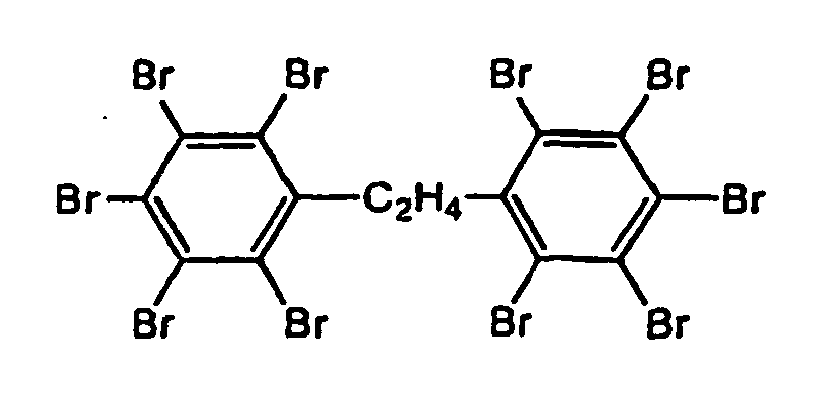
Decabromodiphenylethane is commercially available, for example, from Albemarle Corporation
(451 Florida St., Baton Rouge, LA 70801). The Albernarle product is sold as Saytex
™ 8010. Decabromodiphenylethane has been unexpectedly found to be easily dispersed
in the resin composition. Decabromodiphenylethane also has the unexpected and synergistic
result of significantly improving dielectric properties of the cured resin. As a result,
the flame retardant is preferably included in the resin composition of this invention
in amounts far greater than is necessary for a flame retardant in order to also enhance
the dielectric properties of the cured resin. When decabromodiphenylethane is used
as the flame retardant, it is preferably present in the thermosetting resin compositions
of the invention in an amount of from 10 % to 50 %, more preferably from 20 % to 45
%, based on 100 % by weight resin solids of the composition.
[0013] One or more catalysts are optionally added to the thermosetting resin compositions
of this invention in order to enhance the rate of resin cure. The catalysts chosen
may be any catalysts that are know to speed up the rate of thermosetting resin cure.
Preferred catalysts include peroxide catalysts that generate free radicals such as
dicumyl peroxide, or tert-butyl peroxybenzoate (commercially available from, for example,
Akzo-Nobel Polymer Chemicals LLC, Chicago, IL as Triganox-C). A more preferred catalyst
is dicumyl peroxide. Catalysts are present in the thermosetting resin compositions
of the invention preferably in an amount of from 2 % to 8 %, more preferably from
3 % to 5 %, based on 100 % by weight resin solids of the composition.
[0014] One or more fillers can optionally be added to the thermosetting resin compositions
of this invention to improve chemical and electrical properties of the cured resin.
Examples of properties that can be modified with fillers include coefficient of thermal
expansion, lowering CTE, increasing modulus, and reducing prepreg tack. Examples of
useful fillers include particulate forms of Teflon®, talc, quartz, ceramics, particulate
metal oxides such as silica, titanium dioxide, alumina, ceria, clay, boron nitride,
wollastonite, and mixtures thereof. Preferred fillers include calcined clay or fused
silica. Another preferred filler is fused silica. Yet another preferred filler is
silane treated silica. More preferably, the silane treated filler filler is fused
silica treated with epoxy silane.
[0015] When used, fillers may be present in the thermosetting resin compositions of the
invention in an amount of from 0 % to 40 %, preferably from 5 to 40 %, based on 100
% by weight resin solids of the composition. Preferably the particle size of the filler
is 20 µm to 80µm.
[0016] One or more solvents are optionally incorporated into the thermosetting resins of
this invention in order to control resin viscosity and in order to maintain the resin
ingredients in a suspended dispersion. Any solvent known by one of skill in the art
to be useful in conjunction with thermosetting resin systems can be used. Particularly
useful solvents include methylethylketone (MEK), toluene, and mixtures thereof. The
choice of solvent is often dictated by the resin curing method. When the resin is
cured with hot air, then ketones are typically the preferred solvent. When the resins
are IR cured, then a mixture of ketones and toluene is typically preferred. When used,
solvents are present in the thermosetting resin compositions of the invention in an
amount of from 20 % to 50 % as a weight percentage of the total weight of the composition.
[0017] The compositions of the invention can optionally include cyanate esters, which can
improve thermal performance and provide good electrical properties. Cyanate esters
can participate in the polymerization and incorporate into the resin backbone. Various
cyanate esters can be used, including 2,2-Bis(4-cyanatophenyl)isopropylidene (available
from Lonza Group under the name Primaset® BADCy), bisphenol A cyanate ester (available
from Ciba Geigy under the name AroCy™ B10), and mixtures thereof. When used, the cyanate
ester(s) are present in the thermosetting resin compositions in an amount 2 % to 15%,
preferably from 4 to 8 %, based on 100 % by weight resin solids of the composition.
[0018] One useful composition of this invention has the following formulation, wherein amounts
are based on 100 % by weight resin solids of the composition.:
| from |
25 to |
35 wt % of at least one elastomer; |
| from |
2 to |
8 wt % of at least one ester; |
| from |
20 to |
45 wt % of at least one flame retardant; |
| from |
5 to |
40 wt % of at least one filler; and |
| from |
3 to |
5 wt % of at least one catalyst. |
The ingredients are suspended in a solvent in a ratio ranging from 50-80 wt% solids
to 50-20 wt% solvent and preferably 70 wt% solids to 30 wt% solvent.
[0019] Other useful compositions of this invention have the following formulations:
| HIGH PERFORMANCE ELECTRICAL LAMINATE FORMULATION |
| Ingredients |
Range(wt%) |
Preferred Amounts(wt%) |
| Styrene-Butadiene-Divinylbenzene terpolymer from Sartomer (Elastomer) |
20 - 60 |
25-30 |
| An unsaturated Polyester |
2-15 |
5-7 |
| Decabromodiphenylethane |
10-50 |
30-40 |
| Calcined Clay or Fused Silica (filler) |
20 - 40 |
23-28 |
| Dicumyl peroxide (catalyst) |
2 - 5 |
4 |
The preferred ingredients are suspended in a solvent such as toluene, MEK or toluene/
MEK in a ratio ranging from 50-80 wt % solids to 50-20 wt % solvent and preferably
70 wt % solids to 30 wt % solvent.
[0020] Yet other useful composition of this invention has the following formulation, based
on 100 % by weight resin solids of the composition.:
| from |
30 to |
35 wt % of RICON® 250 resin; |
| from |
2 to |
4 wt % of an unsaturated polyester; |
| from |
20 to |
25 wt % of decabromodiphenylethane; |
| from |
32 to |
38 wt % of fused silica; and |
| from |
5 to |
6 wt % of dicumyl peroxide. |
[0021] The thermosetting resin compositions of this invention are useful for making prepregs
in a continuous process. Prepregs are generally manufactured using a core material
such as a roll of woven glass web which is unwound into a series of drive rolls. The
web then passes into a coating area where the web is passed through a tank which contains
a thermosetting resin system of this invention, solvents and other components. The
glass web becomes saturated with the resin in the coating area. The resin saturated
glass web is then passed through a pair of metering rolls which remove excess resin
from the resin saturated glass web and thereafter, the resin coated web travels the
length of a drying tower for a selected period of time until the solvent is at least
partially evaporated from the web. Second and subsequent coatings of resin can be
applied to the web by repeating these steps until the preparation of the prepreg is
complete whereupon the prepreg is wound onto roll.
[0022] Lamination process typically entail a stack-up of one or more prepreg layers between
one or two sheets of conductive foil (such as copper foil). Lamination methods and
parameters may vary widely, and are generally well known to the person of ordinary
skill in the art. In one example of a cure cycle, the stack is maintained at a pressure
of 2.758·10
5 Pa (40 psi) to 6.205·10
6 Pa (900 psi) and under a vacuum of 1.016·10
5 Pa (30 in/Hg). The stack temperature is raised from 82°C (180°F) to 191°C (375°F)
over a period of 20 minutes. The stack remains at a temperature of 191°C (375°F) for
75 minutes after which the stack is cooled from a temperature of 191°C (375°F) to
a temperature to 24°C (75°F) over a 20 minute period.
[0023] In another process for manufacturing laminates, thermosetting resins of this invention
are premixed in a mixing vessel under ambient temperature and pressure. The viscosity
of the pre-mix is ∼ 600 - 1000 cps and can be adjusted by adding or removing solvent
from the resin. A fabric substrate, such as E glass, is pulled through a dip tank
including the premixed resin, through an oven tower where excess solvent is driven
off and the prepreg is rolled or sheeted to size, layed up between Cu foil in various
constructions depending on glass weave style, resin content & thickness requirements.
[0024] A thermosetting resin composition of the invention can also be coated directly on
Cu substrate to form resin coated Cu using slot-die or other related coating techniques.
[0025] The following examples are illustrative of various aspects of the invention but do
not serve to limit its scope.
EXAMPLES
Example 1. Electrical and Thermal Properties
[0026] In this example, the electrical and thermal properties of a prepreg made with a composition
of the invention were measured. The ingredients of the composition and their amounts
are listed in Table 1. Toluene was used as solvent to provide a total solids content
of about 69 %.
Table 1.
| Material |
Amount |
| |
(percentage of 100 % solids) |
| Ricon® 250 resin |
31.91 % |
| an unsaturated polyester |
2.90 % |
| Saytex 8010 flame retardant |
23.21 % |
| Fused silica filler |
36.22 % |
| Dicumyl peroxide catalyst |
5.76 % |
The prepreg was prepared as described above. A 0.03" woven glass fabric was used as
the core material. The glass transition temperature (Tg) of the material was 100 °C.
Some thermal properties of the prepreg are provided in Table 2. Some electrical properties
of the prepreg are provided in Table 3. The data show that the resin composition provides
good thermal properties and maximum Dk and Df values of 3.4 and 0.0043, respectively,
at high frequency ranges of 2 GHz to 10 GHz.
Table 2. Thermal Properties
| Property |
Measurement |
| CTEa 0 to 100°C |
25-30 ppm/m/°C |
| CTE 20 to 160°C |
60-100 ppm/m/°C |
| CTE RT to 288°C |
approx 180 ppm/m/°C |
| T-260b |
> 60 minutes |
| T-288c |
Approx 30 - 60 minutes |
| acoefficient of thermal expansion; btime to delamination at 260 °C; ctime to delamination at 288°C |
Table 3. Electrical properties.
| Property |
Measurement |
| |
Permittivity (DK)max |
| 2 GHz (Bereskin method) |
3.3 |
| 5 GHz (Bereskin Method) |
3.3 |
| 10 GHz (Bereskin Method) |
3.4 |
| |
|
| |
Loss Tangent (DF)max |
| 2 GHz (Bereskin method) |
0.004 |
| 5 GHz (Bereskin Method) |
0.0042 |
| 10 GHz (Bereskin Method) |
0.0043 |
1. A thermosetting resin composition comprising:
at least one elastomer selected from the group consisting of a styrene-butadiene-divinylbenzene
terpolymer, a maleinized polybutadiene styrene copolymer and mixtures thereof;
at least one ester; and
at least one flame retardant.
2. The composition of claim 1 wherein the at least one elastomer comprises from 20 wt
% to 60 wt %; the at least one ester comprises from 1 wt % to 15 wt %; and the at
least one flame retardant comprises from 5 wt % to 50 wt %, each as a percentage of
the composition solids content.
3. The composition of claim 1 wherein the at least one ester is an unsaturated ester.
4. The composition of claim 1 further comprising at least one catalyst.
5. The composition of claim 4 wherein the at least one catalyst is a peroxide catalyst.
6. The composition of claim 4 wherein the at least one catalyst comprises 2 wt % to 8
wt % as a percentage of the composition solids content.
7. The composition of claim 1 wherein the at least one flame retardant is decabromodiphenylethane.
8. The composition of claim 3 wherein the unsaturated ester is an unsaturated polyester.
9. The composition of claim 5 wherein the at least one catalyst is selected from dicumyl
peroxide, tert-butyl peroxbenzoate, and mixtures thereof.
10. The composition of claim 1 further comprising at least one filler selected from the
group consisting of teflon, talc, quartz, ceramics, particulate metal oxides, silica,
titanium dioxide, alumina, ceria, clay, boron nitride, wollastonite, and mixtures
thereof.
11. The composition of claim 10 wherein the filler comprises 5 % to 40 % as a percentage
of the composition solids content.
12. The composition of claim 10 wherein the filler is silane treated fused silica.
13. The thermosetting resin composition of claim 1, comprising:
a polybutadiene styrene divinylbenzene graft terpolymer;
an unsaturated polyester;
decabromodiphenylethane;
fused silica; and
dicumyl peroxide,
wherein the terpolymer comprises from 30 wt % to 35 wt %; the polyester comprises
from 2 wt % to 4 wt %; the decabromodiphenylethane comprises from 20 wt % to 25 wt
%; the fused silica comprises from 32 wt % to 38 wt %; and the dicumyl peroxide comprises
from 5 wt % to 6 wt %, each as a percentage of the composition solids content.
14. A prepreg comprising a thermosetting resin composition and a core material, wherein
the thermosetting resin composition comprises:
at least one elastomer selected from the group consisting of a styrene-butadiene-divinylbenzene
terpolymer, a maleinized polybutadiene styrene copolymer, and mixtures thereof;
at least one ester; and
at least one flame retardant.
15. The prepreg of claim 14 wherein the at least one elastomer comprises from 20 wt %
to 60 wt %; the at least one ester comprises from 1 wt % to 15 wt %; and the at least
one flame retardant comprises from 5 wt % to 50 wt %, each as a percentage of the
composition solids content.
16. The prepreg of claim 14 wherein the at least one ester is an unsaturated ester.
17. The prepreg of claim 14 wherein the thermosetting resin composition further comprises
at least one catalyst.
18. The prepreg of claim 17 wherein the at least one catalyst is a peroxide catalyst.
19. The prepreg of claim 17 wherein the at least one catalyst comprises 2 wt % to 8 wt
% as a percentage of the composition solids content.
20. The prepreg of claim 14 wherein the at least one flame retardant is decabromodiphenylethane.
21. The prepreg of claim 16 wherein the unsaturated ester is an unsaturated polyester.
22. The prepreg of claim 18 wherein the at least one catalyst is selected from dicumyl
peroxide, tert-butyl peroxbenzoate, and mixtures thereof.
23. The prepreg of claim 14 wherein the thermosetting resin composition further comprises
at least one filler selected from the group consisting of teflon, talc, quartz, ceramics,
particulate metal oxides, silica, titanium dioxide, alumina, ceria, clay, boron nitride,
wollastonite, and mixtures thereof.
24. The prepreg of claim 23 wherein the filler comprises 5 % to 40 % as a percentage of
the composition solids content.
25. The prepreg of claim 23 wherein the filler is silane treated fused silica.
26. The prepreg of claim 14 wherein the core material comprises a woven glass web.
27. The prepreg of claim 14, wherein
the thermosetting resin composition comprises:
a polybutadiene styrene divinylbenzene graft terpolymer;
an unsaturated polyester;
decabromodiphenylethane;
fused silica; and
dicumyl peroxide.
28. The prepreg of claim 27 wherein the core material comprises a woven glass web.
29. A laminate comprising one or more prepregs and one or more sheets of conducting foil,
wherein the one or more prepregs comprises a thermosetting resin composition and a
core material, and wherein the thermosetting resin composition comprises: at least
one elastomer selected from the group consisting of a styrene-butadiene-divinylbenzene
terpolymer, a maleinized polybutadiene styrene copolymer, and mixtures thereof; at
least one ester; and at least one flame retardant.
30. The laminate of claim 29 wherein the one or more prepregs and the one or more sheets
of conducting foil are alternately stacked.
31. The laminate of claim 29 wherein in the thermosetting resin composition, the at least
one elastomer comprises from 20 wt % to 60 wt %; the at least one ester comprises
from 1 wt % to 15 wt %; and the at least one flame retardant comprises from 5 wt %
to 50 wt %, each as a percentage of the composition solids content.
32. The laminate of claim 29 wherein the at least one ester is an unsaturated ester.
33. The laminate of claim 29 wherein the thermosetting resin composition further comprises
at least one catalyst.
34. The laminate of claim 33 wherein the at least one catalyst is a peroxide catalyst.
35. The laminate of claim 33 wherein the at least one catalyst comprises 2 wt % to 8 wt
% as a percentage of the composition solids content.
36. The laminate of claim 29 wherein the at least one flame retardant is decabromodiphenylethane.
37. The laminate of claim 32 wherein the unsaturated ester is an unsaturated polyester.
38. The laminate of claim 34 wherein the at least one catalyst is selected from dicumyl
peroxide, tert-butyl peroxbenzoate, and mixtures thereof.
39. The laminate of claim 29 wherein the thermosetting resin composition further comprises
at least one filler selected from the group consisting of teflon, talc, quartz, ceramics,
particulate metal oxides, silica, titanium dioxide, alumina, ceria, clay, boron nitride,
wollastonite, and mixtures thereof.
40. The laminate of claim 39 wherein the filler comprises 5 % to 40 % as a percentage
of the composition solids content.
41. The laminate of claim 39 wherein the filler is silane treated fused silica.
42. The laminate of claim 29 wherein the one or more sheets of conducting foil are copper
foil.
43. A laminate comprising one or more prepregs and one or more sheets of conducting foil,
wherein the one or more prepregs comprises a thermosetting resin composition and a
core material, and wherein the thermosetting resin composition comprises: a polybutadiene
styrene divinylbenzene graft terpolymer; an unsaturated polyester; decabromodiphenylethane;
fused silica; and dicumyl peroxide.
1. Wärmehärtbare Harzzusammensetzung, umfassend:
wenigstens ein Elastomer, ausgewählt aus der Gruppe, bestehend aus einem Styrol-Butadien-Divinylbenzol-Terpolymer,
einem maleinierten Polybutadien-StyrolCopolymer und Gemischen davon;
wenigstens einen Ester und
wenigstens ein Flammverzögerungsmittel.
2. Zusammensetzung gemäß Anspruch 1, wobei das wenigstens eine Elastomer 20 Gew.-% bis
60 Gew.-% ausmacht; der wenigstens eine Ester 1 Gew.-% bis 15 Gew.-% ausmacht und
das wenigstens eine Flammverzögerungsmittel 5 Gew.-% bis 50 Gew.-% ausmacht, jeweils
als Prozentgehalt des Feststoffgehalts der Zusammensetzung.
3. Zusammensetzung gemäß Anspruch 1, wobei der wenigstens eine Ester ein ungesättigter
Ester ist.
4. Zusammensetzung gemäß Anspruch 1, die außerdem wenigstens einen Katalysator umfasst.
5. Zusammensetzung gemäß Anspruch 4, wobei der wenigstens eine Katalysator ein Peroxidkatalysator
ist.
6. Zusammensetzung gemäß Anspruch 4, wobei der wenigstens eine Katalysator 2 Gew.-% bis
8 Gew.-%, ausgedrückt als Prozentgehalt des Feststoffgehalts der Zusammensetzung,
ausmacht.
7. Zusammensetzung gemäß Anspruch 1, wobei das wenigstens eine Flammverzögerungsmittel
Decabromdiphenylethan ist.
8. Zusammensetzung gemäß Anspruch 3, wobei der ungesättigte Ester ein ungesättigter Polyester
ist.
9. Zusammensetzung gemäß Anspruch 5, wobei der wenigstens eine Katalysator aus Dicumylperoxid,
tert.-Butylperoxybenzoat und Gemischen davon ausgewählt ist.
10. Zusammensetzung gemäß Anspruch 1, die außerdem wenigstens einen Füllstoff, ausgewählt
aus der Gruppe, bestehend aus Teflon, Talcum, Quarz, Keramiken, partikulären Metalloxiden,
Siliciumdioxid, Titandioxid, Aluminiumoxid, Ceroxid, Ton, Bornitrid, Wollastonit und
Gemischen davon, umfasst.
11. Zusammensetzung gemäß Anspruch 10, wobei der Füllstoff 5% bis 40%, ausgedrückt als
Prozentgehalt des Feststoffgehalts der Zusammensetzung, ausmacht.
12. Zusammensetzung gemäß Anspruch 10, wobei der Füllstoff mit Silan behandeltes hochdisperses
Siliciumdioxid ist.
13. Wärmehärtbare Harzzusammensetzung gemäß Anspruch 1, umfassend:
ein Polybutadien-Styrol-Divinylbenzol-Pfropfterpolymer;
einen ungesättigten Polyester;
Decabromdiphenylethan;
hochdisperses Siliciumdioxid und
Dicumylperoxid,
wobei das Terpolymer 30 Gew.-% bis 35 Gew.-% ausmacht; der Polyester 2 Gew.-% bis
4 Gew.-% ausmacht; das Decabromdiphenylethan 20 Gew.-% bis 25 Gew.-% ausmacht; das
hochdisperse Siliciumdioxid 32 Gew.-% bis 38 Gew.-% ausmacht und das Dicumylperoxid
5 Gew.-% bis 6 Gew.-% ausmacht, jeweils ausgedrückt als Prozentgehalt des Feststoffgehalts
der Zusammensetzung.
14. Prepreg, umfassend eine wärmehärtbare Harzzusammensetzung und ein Kernmaterial, wobei
die wärmehärtbare Harzzusammensetzung umfasst:
wenigstens ein Elastomer, ausgewählt aus der Gruppe, bestehend aus einem Styrol-Butadien-Divinylbenzol-Terpolymer,
einem maleinierten Polybutadien-StyrolCopolymer und Gemischen davon;
wenigstens einen Ester und
wenigstens ein Flammverzögerungsmittel.
15. Prepreg gemäß Anspruch 14, wobei das wenigstens eine Elastomer 20 Gew.-% bis 60 Gew.-%
ausmacht; der wenigstens eine Ester 1 Gew.-% bis 15.Gew.-% ausmacht und das wenigstens
eine Flammverzögerungsmittel 5 Gew.-% bis 50 Gew.-% ausmacht, jeweils als Prozentgehalt
des Feststoffgehalts der Zusammensetzung.
16. Prepreg gemäß Anspruch 14, wobei der wenigstens eine Ester ein ungesättigter Ester
ist.
17. Prepreg gemäß Anspruch 14, wobei die wärmehärtbare Harzzusammensetzung außerdem wenigstens
einen Katalysator umfasst.
18. Prepreg gemäß Anspruch 17, wobei der wenigstens eine Katalysator ein Peroxidkatalysator
ist.
19. Prepreg gemäß Anspruch 17, wobei der wenigstens eine Katalysator 2 Gew.-% bis 8 Gew.-%,
ausgedrückt als Prozentgehalt des Feststoffgehalts der Zusammensetzung, ausmacht.
20. Prepreg gemäß Anspruch 14, wobei das wenigstens eine Flammverzögerungsmittel Decabromdiphenylethan
ist.
21. Prepreg gemäß Anspruch 16, wobei der ungesättigte Ester ein ungesättigter Polyester
ist.
22. Prepreg gemäß Anspruch 18, wobei der wenigstens eine Katalysator aus Dicumylperoxid,
tert.-Butylperoxybenzoat und Gemischen davon, ausgewählt ist.
23. Prepreg gemäß Anspruch 14, wobei die wärmehärtbare Harzzusammensetzung außerdem wenigstens
einen Füllstoff, ausgewählt aus der Gruppe, bestehend aus Teflon, Talcum, Quarz, Keramiken,
partikulären Metalloxiden, Siliciumdioxid, Titandioxid, Aluminiumoxid, Ceroxid, Ton,
Bornitrid, Wollastonit und Gemischen davon, umfasst.
24. Prepreg gemäß Anspruch 23, wobei der Füllstoff 5% bis 40%, ausgedrückt als Prozentgehalt
des Feststoffgehalts der Zusammensetzung, ausmacht.
25. Prepreg gemäß Anspruch 23, wobei der Füllstoff mit Silan behandeltes hochdisperses
Siliciumdioxid ist.
26. Prepreg gemäß Anspruch 14, wobei das Kernmaterial ein Textilglasgewebe umfasst.
27. Prepreg gemäß Anspruch 14, wobei die wärmehärtbare Harzzusammensetzung umfasst:
ein Polybutadien-Styrol-Divinylbenzol-Pfropfterpolymer;
einen ungesättigten Polyester;
Decabromdiphenylethan;
hochdisperses Siliciumdioxid und
Dicumylperoxid.
28. Prepreg gemäß Anspruch 27, wobei das Kernmaterial ein Textilglasgewebe umfasst.
29. Laminat, umfassend ein oder mehrere Prepreg(s) und eine oder mehrere Folie(n) bzw.
Lage(n) aus leitfähiger Folie, wobei das eine oder die mehreren Prepreg(s) eine wärmehärtbare
Harzzusammensetzung und ein Kernmaterial umfasst/umfassen und wobei die wärmehärtbare
Harzzusammensetzung umfasst: wenigstens ein Elastomer, ausgewählt aus der Gruppe,
bestehend aus einem Styrol-Butadien-Divinylbenzol-Terpolymer, einem maleinierten Polybutadien-Styrol-Copolymer
und Gemischen davon, wenigstens einen Ester und wenigstens ein Flammverzögerungsmittel.
30. Laminat gemäß Anspruch 29, wobei das eine oder die mehreren Prepreg(s) und die eine
oder die mehreren Lage(n) bzw. Folie(n) aus leitfähiger Folie alternierend gestapelt
sind.
31. Laminat gemäß Anspruch 29, wobei in der wärmehärtbaren Harzzusammensetzung das wenigstens
eine Elastomer 20 Gew.-% bis 60 Gew.-% ausmacht; der wenigstens eine Ester 1 Gew.-%
bis 15 Gew.-% ausmacht und das wenigstens eine Flammverzögerungsmittel 5 Gew.-% bis
50 Gew.-% ausmacht, jeweils als Prozentgehalt des Feststoffgehalts der Zusammensetzung.
32. Laminat gemäß Anspruch 29, wobei der wenigstens eine Ester ein ungesättigter Ester
ist.
33. Laminat gemäß Anspruch 29, wobei die wärmehärtbare Harzzusammensetzung außerdem wenigstens
einen Katalysator umfasst.
34. Laminat gemäß Anspruch 33, wobei der wenigstens eine Katalysator ein Peroxidkatalysator
ist.
35. Laminat gemäß Anspruch 33, wobei der wenigstens eine Katalysator 2 Gew.-% bis 8 Gew.-%,
ausgedrückt als Prozentgehalt des Feststoffgehalts der Zusammensetzung, ausmacht.
36. Laminat gemäß Anspruch 29, wobei das wenigstens eine Flammverzögerungsmittel Decabromdiphenylethan
ist.
37. Laminat gemäß Anspruch 32, wobei der ungesättigte Ester ein ungesättigter Polyester
ist.
38. Laminat gemäß Anspruch 34, wobei der wenigstens eine Katalysator aus Dicumylperoxid,
tert.-Butylperoxybenzoat und Gemischen davon ausgewählt ist.
39. Laminat gemäß Anspruch 29, wobei die wärmehärtbare Harzzusammensetzung außerdem wenigstens
einen Füllstoff, ausgewählt aus der Gruppe, bestehend aus Teflon, Talcum, Quarz, Keramiken,
partikulären Metalloxiden, Siliciumdioxid, Titandioxid, Aluminiumoxid, Ceroxid, Ton,
Bornitrid, Wollastonit und Gemischen davon, umfasst.
40. Laminat gemäß Anspruch 39, wobei der Füllstoff 5% bis 40%, ausgedrückt als Prozentgehalt
des Feststoffgehalts der Zusammensetzung, ausmacht.
41. Laminat gemäß Anspruch 39, wobei der Füllstoff mit Silan behandeltes hochdisperses
Siliciumdioxid ist.
42. Laminat gemäß Anspruch 29, wobei die eine Lage bzw. die Folie oder die mehreren Lagen
bzw. Folien aus leitfähiger Folie Kupferfolie ist bzw. sind.
43. Laminat, umfassend ein oder mehrere Prepreg(s) und eine oder mehrere Lage(n) oder
Folie(n) aus leitfähiger Folie, wobei das eine oder die mehreren Prepreg(s) eine wärmehärtbare
Harzzusammensetzung und ein Kernmaterial umfasst/umfassen und wobei die wärmehärtbare
Harzzusammensetzung umfasst: ein Polybutadien-Styrol-Divinylbenzol-Pfropfterpolymer;
einen ungesättigten Polyester; Decabromdiphenylethan; hochdisperses Siliciumdioxid
und Dicumylperoxid.
1. Une composition de résine thermodurcissable comprenant:
au moins un élastomère, choisi parmi le groupe consistant en un terpolymère de styrène-butadiène-benzène
divinylique, un copolymère poly(butadiène)-styrène modifié par greffage d'anhydride
maléique et les mélanges de ceux-ci,
au moins un ester et
au moins un agent ignifuge.
2. La composition selon la revendication 1, dans laquelle l'au moins un élastomère compose
20% en poids à 60% en poids; l'au moins un ester compose 1% en poids à 15% en poids
et l'au moins un agent ignifuge compose 5% en poids à 50% en poids, chacun exprimé
en pourcentage de la matière solide de la composition.
3. La composition selon la revendication 1, dans laquelle l'au moins un ester est un
ester insaturé.
4. La composition selon la revendication 1 comprenant en outre au moins un catalyseur.
5. La composition selon la revendication 4, dans laquelle l'au moins un catalyseur est
un catalyseur de peroxyde.
6. La composition selon la revendication 4, dans laquelle l'au moins un catalyseur compose
2% en poids à 8% en poids exprimé en pourcentage de la matière solide de la composition.
7. La composition selon la revendication 1, dans laquelle l'au moins un agent ignifuge
est le décabromodiphényléthane.
8. La composition selon la revendication 3, dans laquelle l'ester insaturé est un polyester
insaturé.
9. La composition selon la revendication 5, dans laquelle l'au moins un catalyseur est
choisi parmi le peroxyde de dicumyle, le peroxybenzoate de tertiobutyle et les mélanges
de ceux-ci.
10. La composition selon la revendication 1 comprenant en outre au moins un agent de remplissage
choisi parmi le groupe consistant en le téflon, le talc, le quartz, les céramiques,
les oxydes métalliques sous forme granulaire, le silica, l'oxyde titanique, l'alumine,
l'oxyde cérique, l'argile, le nitrure de bore, la wollastonite et les mélanges de
ceux-ci.
11. La composition selon la revendication 10 dans laquelle l'agent de remplissage constitue
5% en poids à 40% en poids exprimé en pourcentage de la matière solide de la composition.
12. La composition selon la revendication 10, dans laquelle l'agent de remplissage est
le quarz hautement dispersé qui est traité par un silane.
13. La composition de résine thermodurcissable selon la revendication 1 comprenant
un terpolymère greffé de polybutadiène-styrène-benzène divinylique;
un polyester insaturé;
le décabromodiphényléthane;
le silica hautement dispersé et
le peroxyde de dicumyle,
dans laquelle le terpolymère compose 30% en poids à 35% en poids; le polyester compose
2% en poids à 4% en poids; le décabromodiphényléthane compose 20% en poids à 25% en
poids; le silica hautement dispersé compose 32% en poids à 38% en poids et le peroxyde
de dicumyle compose 5% en poids à 6% en poids, chacun exprimé en pourcentage de la
matière solide de la composition.
14. Un prepreg comprenant une composition de résine thermodurcissable et une matière nucléaire,
dans lequel la composition de résine thermodurcissable comprend:
au moins un élastomère, choisi parmi le groupe consistent en un terpolymère de styrène-butadiène-benzène
divinylique, un copolymère poly(butadiène)-styrène modifié par greffage d'anhydride
maléique et les mélanges de ceux-ci;
au moins un ester et
au moins un agent ignifuge.
15. Le prepreg selon la revendication 14, dans lequel l'au moins un élastomère compose
20% en poids à 60% en poids; l'au moins un ester compose 1% en poids à 15% en poids
et l'au moins un agent ignifuge compose 5% en poids à 50% en poids, chacun exprimé
en pourcentage de la matière solide de la composition.
16. Le prepreg selon la revendication 14, dans lequel l'au moins un ester est un ester
insaturé.
17. Le prepreg selon la revendication 14, dans lequel la composition de résine thermodurcissable
comprend en outre au moins un catalyseur.
18. Le prepreg selon la revendication 17, dans lequel l'au moins un catalyseur est un
catalyseur de peroxyde.
19. Le prepreg selon la revendication 17, dans lequel l'au moins un catalyseur compose
2% en poids à 8% en poids exprimé en pourcentage de la matière solide de la composition.
20. Le prepreg selon la revendication 14, dans lequel l'au moins un agent ignifuge est
le décabromodiphényléthane.
21. Le prepreg selon la revendication 16, dans lequel l'ester insaturé est un polyester
insaturé.
22. Le prepreg selon la revendication 18, dans lequel l'au moins un catalyseur est choisi
parmi le peroxyde de dicumyle, le peroxybenzoate de tertiobutyle et les mélanges de
ceux-ci.
23. Le prepreg selon la revendication 14, dans lequel la composition de résine thermodurcissable
en outre comprend au moins un agent de remplissage choisi parmi le groupe consistant
en le téflon, le talc, le quartz, les céramiques, les oxydes métalliques sous forme
granulaire, le silica, l'oxyde titanique, l'alumine, l'oxyde cérique, l'argile, le
nitrure de bore, la wollastonite et les mélanges de ceux-ci.
24. Le prepreg selon la revendication 23, dans lequel l'agent de remplissage constitue
5% en poids à 40% en poids exprimé en pourcentage de la matière solide de la composition.
25. Le prepreg selon la revendication 23, dans lequel l'agent de remplissage est le quarz
hautement dispersé qui est traité par un silane.
26. Le prepreg selon la revendication 14, dans lequel la matière nucléaire comprend un
tissu de verre tissé.
27. Le prepreg selon la revendication 14, dans lequel la composition de résine thermodurcissable
comprend:
un terpolymère greffé de polybutadiène-styrène-benzène divinylique;
un polyester insaturé;
le décabromodiphényléthane;
le silica hautement dispersé et
le peroxyde de dicumyle.
28. Le prepreg selon la revendication 27, dans lequel la matière nucléaire comprend un
tissu de verre tissé.
29. Un stratifié comprenant un ou plusieurs prepregs et une ou plusieurs couches de feuille
conductrice, dans lequel l'un ou les plusieurs prepreg comprend une composition de
résine thermodurcissable et une matière nucléaire et dans lequel la composition de
résine thermodurcissable comprend: au moins un élastomère, choisi parmi le groupe
consistant en un terpolymère de styrène-butadiène-benzène divinylique, un copolymère
poly(butadiène)-styrène modifié par greffage d'anhydride maléique et les mélanges
de ceux-ci; au moins un ester et au moins an agent ignifuge.
30. Le stratifié selon la revendication 29, dans lequel l'un ou les plusieurs prepregs
et l'une ou les plusieurs couches de feuille conductrice sont empilés de manière alternée.
31. Le stratifié selon la revendication 29, dans lequel dans la composition de résine
thermodurcissable l'au moins un élastomère compose 20% en poids à 60% en poids; l'au
moins un ester compose 1% en poids à 15% en poids et l'au moins un agent ignifuge
compose 5% en poids à 50% en poids, chacun exprimé en pourcentage de la matière solide
de la composition.
32. Le stratifié selon la revendication 29, dans lequel l'au moins un ester est un ester
insaturé.
33. Le stratifié selon la revendication 29, dans lequel la composition de résine thermodurcissable
comprend en outre au moins un catalyseur.
34. Le stratifié selon la revendication 33, dans lequel l'au moins un catalyseur est un
catalyseur de peroxyde.
35. Le stratifié selon la revendication 33, dans lequel l'au moins un catalyseur compose
2% en poids à 8% en poids exprimé en pourcentage de la matière solide de la composition.
36. Le stratifié selon la revendication 29, dans lequel l'au moins un agent ignifuge est
le décabromodiphényléthane.
37. Le stratifié selon la revendication 32, dans lequel l'ester insaturé est un polyester
insaturé.
38. Le stratifié selon la revendication 34, dans lequel l'au moins un catalyseur est choisi
parmi le peroxyde de dicumyle, le perbenzoate de tertiobutyle et les mélanges de ceux-ci.
39. Le stratifié selon la revendication 29, dans lequel la composition de résine thermodurcissable
comprend en outre au moins un agent de remplissage choisi parmi le groupe consistant
en le téflon, le talc, le quartz, les céramiques, les oxydes métalliques sous forme
granulaire, le silica, l'oxyde titanique, l'alumine, l'oxyde cérique, l'argile, le
nitrure de bore, la wollastonite et les mélanges de ceux-ci.
40. Le stratifié selon la revendication 39, dans lequel l'agent de remplissage constitue
5% en poids à 40% en poids exprimé en pourcentage de la matière solide de la composition.
41. Le stratifié selon la revendication 39, dans lequel l'agent de remplissage est le
quarz hautement dispersé qui est traité par un silane.
42. Le stratifié selon la revendication 29, dans lequel l'une ou les plusieurs couches
de feuille conductrice sont des feuilles de cuivre.
43. Un stratifié comprenant un ou plusieurs prepreg et une ou plusieurs couches de feuille
conductrice, dans lequel l'un ou les plusieurs prepreg(s) comprend/comprennent une
composition de résine thermodurcissable et une matière nucléaire et dans lequel la
composition de résine thermodurcissable comprend: un terpolymère greffé de polybutadiène-styrène-benzène
divinylique; un polyester insaturé; décabromodiphényléthane; silica hautement dispersé
et peroxyde de dicumyle.
REFERENCES CITED IN THE DESCRIPTION
This list of references cited by the applicant is for the reader's convenience only.
It does not form part of the European patent document. Even though great care has
been taken in compiling the references, errors or omissions cannot be excluded and
the EPO disclaims all liability in this regard.
Patent documents cited in the description