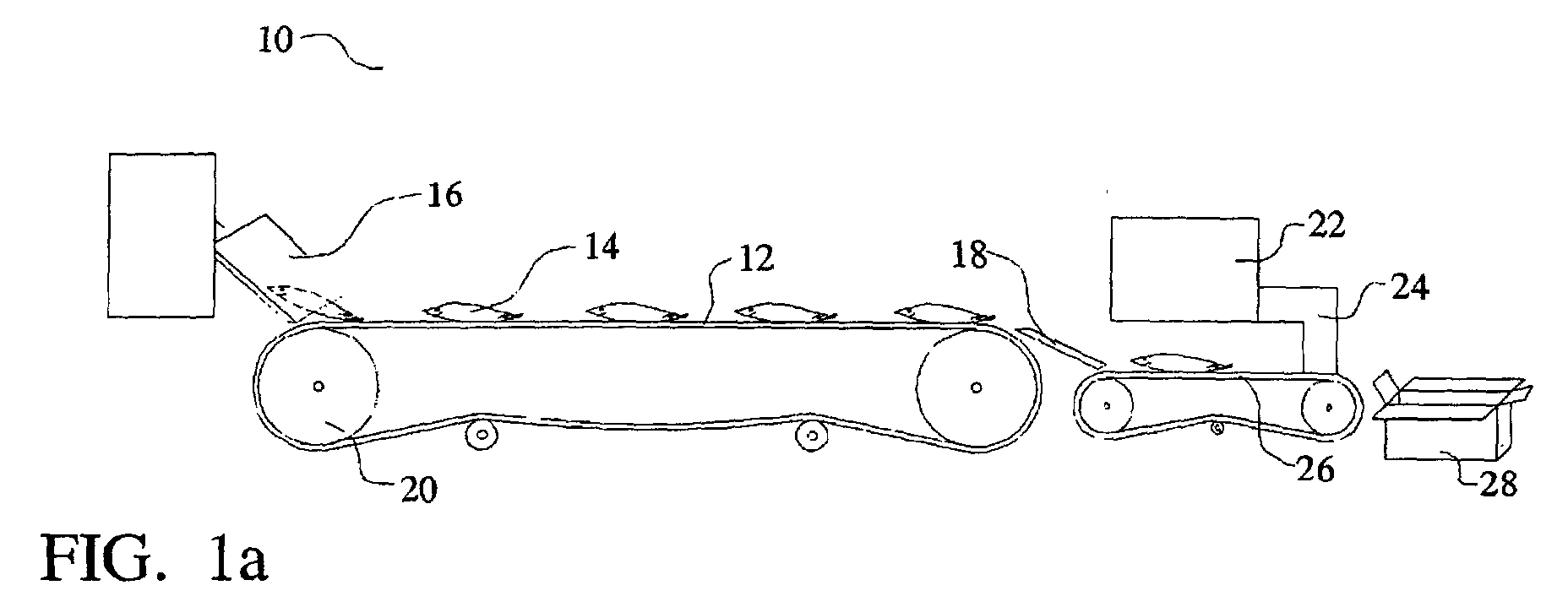
(57) Conveyors, chutes, skids, guides, and ways for the transporting of material are formed
of a conductive loaded resin-based material such that fragments of these structures
can be detected by a metal detector. The conductive loaded resin-based material comprises
micron conductive powder(s), conductive fiber(s), or a combination of conductive powder
and conductive fibers in a base resin host. The ratio of the weight of the conductive
powder(s), conductive fiber(s), or a combination of conductive powder and conductive
fibers to the weight of the base resin host is between about 0.20 and 0.40. The micron
conductive powders are formed from non-metals, such as carbon, graphite, that may
also be metallic plated, or the like, or from metals such as stainless steel, nickel,
copper, silver, that may also be metallic plated, or the like, or from a combination
of non-metal, plated, or in combination with, metal powders. The micron conductor
fibers preferably are of nickel plated carbon fiber, stainless steel fiber, copper
fiber, silver fiber, or the like. The conductive loaded resin-based structures can
be formed using methods such as injection molding compression molding or extrusion.
The conductive loaded resin-based material used to form structures can also be in
the form of a thin flexible woven fabric that can readily be cut to the desired shape.
|
|
