|
(11) | EP 1 482 792 B1 |

| (12) | EUROPEAN PATENT SPECIFICATION |
|
|
| (54) |
METHOD AND COMPOSITIONS FOR INHIBITING THE SCENT TRACKING ABILITY OF BITING MIDGES VERFAHREN UND ZUSAMMENSETZUNGEN ZUR HEMMUNG DES SPÜRSINNS VON STECHMÜCKEN METHODE ET COMPOSITIONS POUVANT INHIBER LA SENSIBILITE AUX ODEURS DE MOUCHERONS PIQUEURS |
|
|
|||||||||||||||||||||||||||||||
| Note: Within nine months from the publication of the mention of the grant of the European patent, any person may give notice to the European Patent Office of opposition to the European patent granted. Notice of opposition shall be filed in a written reasoned statement. It shall not be deemed to have been filed until the opposition fee has been paid. (Art. 99(1) European Patent Convention). |
Field of the Invention
[0001] This invention relates to a method and compositions for inhibiting the ability of biting midges to locate or track a target, such as an animal or human body, by scent detection. More particularly, the invention relates to the use of certain compounds in compositions to inhibit biting midges' ability to detect a target by scent detection.
Background
[0002] As anyone that has significant outdoor experience can attest, biting midges can be terribly annoying and amount to a significant problem. Their bites can produce burning and itching welts. Biting midges can have a significant economic impact since their presence often significantly discourages tourism in certain regions, particularly coastal regions where they may occur in large numbers.
[0003] These minute biting insects are also known commonly as "sandflies", "no-see-ums, "hequenes" in Mexico and "punkies" in Great Britain. Biting midges are particularly abundant in areas where there are mangrove swamps or salt marshes. In the United States they are particularly abundant in coastal Florida and North Carolina. Midges belong to the insect order Diptera (2-winged flies), family Ceratopogonidae, genus Leptoconops and Culicoides. It is only the female of this species that bites and takes blood, and the time of greatest biting activity is generally around dawn or dusk.
[0004] Of the many species of biting midges of the genus Culicoides, at least about 111 species, certain prevalent species, such as Culicoides furens and Culicoides barbosai species, are known to be vectors of a human nematode parasite, Mansonella ozzardi. This worm lives primarily in the blood and female midges ingest the microfilariae (juvenile forms) when they take blood and then transmit the parasite to uninfected persons. The species Leptoconops becquaerti, of the genus Leptconops prevalent in Costa Rica, is known to transmit a filarial worm in humans called Dipeialoneina ozzardi. Culicoides arabae, Culicoides foxi and Culicoides barbosai have been collected from horses and mules and Culicoides insignis collected from cattle and are a problem for these animals.
[0005] Compounds, compositions and formulations for protecting human beings from being bitten by biting midges are known in the art. Generally, these compounds, compositions and formulations are based on their ability to persist on the skin of the person upon topical or surface application for a time sufficient to repel biting midges. Numerous adjuvant materials have been added to biting midge repellents to increase the persistence of the repellents to the skin of a person. Additionally, low volume spraying of chemical insecticides has been employed, but not with great success. Moreover, spraying of such insecticidal chemicals is environmentally and from a health-wise standpoint undesirable. However, despite the various attempts to improve the repelling activity of the known biting midge repellents, these attempts have generally not been successful, as almost anyone who has used such biting midge repellents can attest.
K.P. Svoboda et al. (Flavour Fragr. J., 13, 367-372 (1998)) describe that essential oils of Myrica gale L. repel the biting midge Culicoides impunctatus and mention the potential use of the oil as midge repellent.
WO0067570 discloses that 3-alkyl-substituted 3-methyl-1-alk(e)(y)ne-ols inhibit the ability of mosquitoes to olfactory sense their targets.
GB2224934 discloses that volatile oils from leaves of Myrica Gale repel biting midges.
[0006] Thus, the art has been searching for new and more effective repellents against biting midges. However, the search for more effective biting midge repellents has not generally been met with success since most biting midge repellents have been found only to possess a limited degree of repellency and are generally not particularly effective. There is, therefore, a need for more effective means to deter biting midges from locating and biting humans and other targets such as birds and livestock. Moreover, this need has recently become more acute and urgent because biting midges have been discovered to be carriers of significant diseases that can be passed on to a target by the biting midges biting the target. A further need is to be able to reduce or eliminate the need to use environmentally unfriendly pesticides.
Summary of the Invention
[0007] The inventors have discovered that compounds, compositions and formulations heretofore proposed as repellents for biting midges have lacked the necessary efficacy due to the ability of biting midges to locate and be drawn to the targets by olfactory emissions of the target. Thus, if a biting midge enters a zone or space where a potential target is located, the biting midge can be attracted to the target by olfactory emissions of the target and, this olfactory attraction is sufficient to overcome any repellency activity of the repellent compound, composition or formulation applied on the target. Therefore, the present invention provides compositions and formulations containing compounds usable in methods and apparatus for inhibiting the olfactory target tracking abilities of biting midges when an effective amount of the inhibiting compound(s) is/are dispersed in a three dimensional atmospheric space.
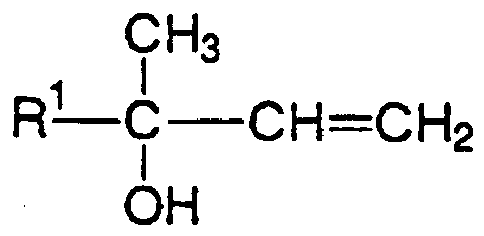
[0008] According to this invention, the ability of biting midges to locate human or livestock is inhibited by dispensing into a spatial area an inhibiting effective amount of at least one inhibiting compound selected from the group consisting of 3-methyl-1-alkene-3-ols of the formula:
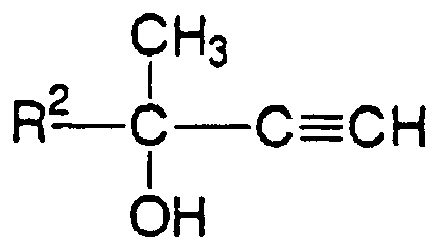
and 3-methyl-1-alkyn-3-ols of the formula:
wherein R1 and R2 are each independently a saturated or unsaturated aliphatic hydrocarbon group containing from 1 to about 12 carbon atoms.
[0009] The inhibiting compound can be dispensed into the three dimensional atmospheric space by any suitable means sufficient to provide an inhibiting effective amount of the inhibiting compound(s). Such dispensing means include, for example, evaporation, atomization and ionic dispersion of the inhibiting compound from any suitable composition or formulation. Such composition or formulation will generally comprise a base vehicle containing at least one of the inhibiting compounds.
Detailed Summary of the Invention
[0010] The inventors have discovered that if an effective amount of at least one inhibiting compound selected from the group consisting of 3-methyl-1-alkene-3-ols of the formula:
and 3-methyl-1 -alkyn-3-ols of the formula:
wherein R1 and R2 are each independently a saturated or unsaturated aliphatic hydrocarbon group containing from 1 to about 12 carbon atoms is dispensed into the atmosphere of a three dimensional environmental space, the ability of biting midges to locate and track humans, or livestock, by the target's olfactory emissions is inhibited.
[0011] Any suitable 3-methyl-1-alkene-3-ol or 3-methyl-1-alkyn-3-ol of the formulas may be employed in the method, compositions and apparatus of this invention. Especially suitable inhibiting compounds are nerolidol, 3-methyl-1-octen-3-ol, linalool and dehydrolinalool. Depending on the particular biting midge species, either the 3-methyl-1-alkyn-3-ols or the 3-methyl-1-alkene-3-ols are better inhibitors than the other class of components and will be preferred for that species of biting midge. The inhibiting compounds may be utilized singly or as mixtures of two or more of such compounds.
[0012] Any suitable inhibiting effective amount of the inhibiting compound(s) may be employed. Such inhibiting effective amounts can include amounts, based on the square footage of land or base surface area of the environmental area to be treated, within the range of from 0.000054 g/h/m2 [0.000005 g/hr/ft2] to 0.043 g/h/m2 [0.004 g/hr/ft2], preferably amounts within the range of from 0.00162 g/h/m2 [0.00015 g/hr/ft2] to 0.00215 g/h/m2 [0.0002 g/hr/ft2], and especially an amount of 0.00172 g/h/m2 [0.00016 g/hr/ft2].
[0013] The inhibiting compounds for use in this invention may be provided in an essentially pure form of the inhibiting compounds or as a component of a natural essential oil having a concentration of an inhibiting compound sufficient to make it practical and feasible to dispense an inhibiting effective amount of inhibiting compound. Generally, the essential oil will contain a concentration of the inhibiting compound of at least about 1%, preferably at least about 5%, and especially at least about 50% by weight. For example, the inhibiting compound can be provided as a synthetically produced, essentially pure compound or as a component of an essential oil such as basil oil, ho wood oil and the like.
[0014] The inhibiting compounds of this invention, or essential oils containing such inhibiting compounds, may be employed in any formulation suitable for dispensing inhibiting effective amounts of the compounds. The compounds will generally be employed in formulations comprising a suitable vehicle containing the inhibiting compounds. For example, the inhibiting compound can be formulated in a specially formulated wax-like medium or vehicle engineered to release desired amounts of vaporous inhibiting compound at ambient temperatures, such as those mediums or vehicles available from Koster Keunen of Watertown, Connecticut. An example of such a wax-like medium available from Koster Keunen is known as Insect Repellent Wax Bar No. 9, which is a blend of waxes having the following general composition: fatty acids ranging in carbon chain length of from C16 to C22, fatty alcohols ranging in carbon chain length of from C16 to C22, paraffinic hydrocarbons ranging in carbon chain length of from C19 to C47, branched hydrocarbons ranging in carbon chain length of from C23 to C69, beeswax and other natural waxes such as candelilla and carnauba. The wax mixture will generally be formulated with concentrations of the inhibiting compounds of this invention ranging from about 20% to 60% and the formulation has a congealing point which may vary from about 75°C to about 45°C. Alternatively, the inhibiting compound can be formulated in a porous medium or vehicle suitable for releasing effective amounts of the inhibiting compound. As an example of such porous medium or vehicle is a polyester membrane material having micropores encasing a block of inhibiting compound saturated fibers that gradually releases the inhibiting compound so that it permeates the microporous membrane and is released to the environment. Such porous membrane known as World of Fragrance™ cups is available from Waterbury Companies, Inc. of Waterbury, Connecticut.
[0015] The formulations can be placed in any suitable container or device for dispensing the inhibiting compound. For example, the formulations can be placed in a suitable fan-equipped device so that one can obtain, for example, fan-driven evaporation of the inhibiting compound from a porous medium or wax-like medium containing the inhibiting compound. As examples of such fan-equipped devices, there can be mentioned the devices disclosed in US Patent 5,370,829 of Waterbury Companies, Inc. and the apparatus disclosed in US Patent 5,799,436 of BioSensory Insect Control Corporation, each of said patents being incorporated herein by reference thereto.
[0016] Another suitable means of dispensing the inhibiting compound is by atomization and/or ionic dispersion of the compound as suitable-sized, positively-charged droplets from a suitable atomization or ionic dispersing apparatus, such as the Ionic Wind™ device, available from Brandenburg, Ltd. of Brierley Hill, United Kingdom.
[0017] The inhibiting compounds of this invention are effective against any biting midges, such as for example, Culicoides furens, Culicoides mississippiensis, Culicoides hollensis, Culicoidesbarbosai, Culicoides melleus, Culicoidesparaensis, Culicoides phlebotomus, Culicoides pseudodiabolicus, Culicoidesarabae, Culicoides foxi, Culicoides insignis, Culicoides insignids, Culicoidespusillus, Culicoides filarifer, Culicoides alaskensis, Culicoides edeni, Culicoides furensoides, Leptoconops becquaerti and the like.
Example 1
[0019] A device comprising a cylindrical housing essentially shaped like an opened one-gallon paint can, was equipped to release determinable amounts of one or more of CO2, octenol and test compound of this invention. The device housing was equipped (covered) at its open end with an electrical grid operating at a temperature of approximately 110ºF (44ºC) for killing any midges attracted to the grid and thereby collecting the killed midges in the housing. With the device in operation, biting midges would be attracted by the scent of CO2 and/or octenol eminating from the interior of the housing and from the heat of the electrical grid. Then, with the additional introduction of test compound from the housing it was possible to determine the inhibiting effect of the test compound by determining the decrease in biting midges attracted and killed by the test device. The test was conducted in a designated test area known for its abundance of biting midges along the Indian River in Vero Beach, Florida at the U.S. Department of Agriculture test facility.
[0020] Competitive tests were conducted over a twelve day period in September. During Days 1 to 3 and 7 to 9 the test conditions of the test device were set to mimic a bird as the target, namely the device emitted 50 cc/min CO2 and no octenol, and during Days 4 to 6 and 10 to 12 the test conditions were set to mimic a mammal as the target, namely the device emitted 50 cc/min CO2 and 7 mg/hr octenol. In these competitive tests, the inhibiting compound was either not emitted (Days 1 to 6) or emitted (Days 7 to 12). The test then determined the number of midges killed and collected in the device without the test compound present, and the number of midges killed and collected in the device with the test compound present in order to determine the ability of the test compound to inibit the ability of the biting midges (Culicoides furens) to sense the mimicked target.
[0021] Test conditions and results of the competitive tests are set forth in the following Table 1.
TABLE 1
| Day | CO2 cc/min | Octenol mg/hr | Linalool mg/hr | Midges collected |
| 1 | 50 | 0 | 0 | 103 |
| 2 | 50 | 0 | 0 | 5 |
| 3 | 50 | 0 | 0 | 68 |
| 1-3 | Total 176 | |||
| 1-3 | Avg./day 59 | |||
| 7 | 50 | 0 | 1 | 13 |
| 8 | 50 | 0 | 1 | 5 |
| 9 | 50 | 0 | 1 | 14 |
| 7-9 | Total 32 | |||
| 7-9 | Avg./day 11 | |||
| 4 | 50 | 7 | 0 | 338 |
| 5 | 50 | 7 | 0 | 1242 |
| 6 | 50 | 7 | 0 | 1830 |
| 4-6 | Total 3410 | |||
| 4-6 | Avg./day 1137 | |||
| 10 | 50 | 7 | 1 | 29 |
| 11 | 50 | 7 | 1 | 81 |
| 12 | 50 | 7 | 1 | 364 |
| 10-12 | Total 474 | |||
| 10-12 | Avg./day 158 |
[0022] Linalool reduced the average biting midge kill counts by 81 % (from 59 to 11) over the three trials for the device mimicing a bird and by 86% over the three trial for the device mimicing a mammal evidencing the ability of linalool to inhibit the ability of biting midges to sense the target when linalooluis present in the environment.
1. A method of inhibiting the ability of biting midges to sense a target by olfactory
sensing of the target within a three dimensional environmental space having a land
or base surface area, the method comprising dispenaing into the atmosphere of the
three dimensional environmental space an inhibiting effective amount of at least one
inhibiting compound selected from the group consisting of 3-methyl-1-alkene-3-ols
of the formula:
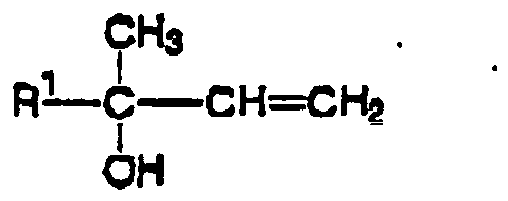
and 3-methyl-1-alkyn-3-ols of the formula:
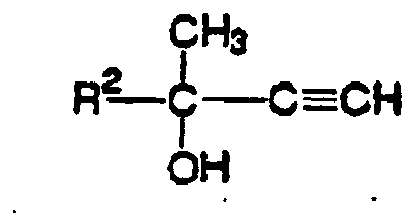
wherein R1 and R2 are each independently a saturated or unsaturated aliphatic hydrocarbon group containing from 1 to about 12 carbon atoms , wherein the target is human or livestock.
and 3-methyl-1-alkyn-3-ols of the formula:
wherein R1 and R2 are each independently a saturated or unsaturated aliphatic hydrocarbon group containing from 1 to about 12 carbon atoms , wherein the target is human or livestock.
2. The method according to Claim 1, wherein the inhibiting effective amount ranges from
0.000054 g/h/m2 [0.000005 g/hr/ft2t] to 0.0043 g/h/m2 [0.0004 g/hr/ft2] based on the square footage of the land or base surface area of the environmental
space.
3. The method according to Claim 1, wherein the inhibiting effective amount ranges from
0.00162 g/h/m2 [0.00015 g/hr/ft2] to 0.00215 g/h/m2 [0.0002 g/hr/ft2] based on the square footage of the land or base surface area of the environmental
space.
4. The method according to Claim 1, wherein the at least one inhibiting compound is selected
from nerolldol, 3-methyl-1-octen-3-ol, Ilnalool and dehydrolinalool.
5. The method according to Claim 1, wherein the at least one inhibiting compound comprises
linalool.
6. The method according to Claim 1, wherein the at least one inhibiting compound comprises
dehydrollnalool.
7. The method according to Claim 1, wherein the dispensing of the at least one inhibiting
compound comprises dispensing by a method selected from volatilization, evaporation,
atomization and ionic dispersion of the at least one inhibiting compound from a formulation
comprising a vehicle containing the at least one inhibiting compound.
8. The method according to Claim 7, wherein the dispensing comprises fan-driven evaporation
of the at least one inhibiting compound from a formulation in which the vehicle is
a porous medium.
9. The method according to Claim 7, wherein the dispensing comprises fan-driven evaporation
of the at least one inhibiting compound from a formulation in which the vehicle is
a waxy solution.
10. The method according to Claim 7, wherein the dispensing comprises atomization of the
at least one inhibiting compound from the formulation.
11. The method according to Claim 7, wherein the dispensing comprises ionic dispersion
of the at least one inhibiting compound from the formulation.
12. The method according to Claim 5, wherein the linalool is dispensed by fan-driven evaporation
of linalool from a formulation of a porous medium containing linalool.
13. The method according to Claim 5, wherein the linalool is dispensed by fan-driven evaporation
of linalool from a formulation of a waxy solution containing linalool.
14. The method according to Claim 5, wherein the linalool is dispensed by atomization
of linalool from a formulation of a vehicle and linalool.
15. The method according to Claim 5, wherein the linalool is dispersed by ionic dispersion
of linalool from a formulation of a vehicle and linalool.
16. The method according to Claim 6, wherein the dehydrolinalool is dispensed by fan-driven
evaporation of dehydrolinalool from a formulation of a porous medium containing dehydrolinalool.
17. The method according to Claim 6, wherein the dehydrolinalool is dispensed by fan-driven
evaporation of dehydrolinalool from a formulation of a waxy solution containing dehydrolinalool.
18. The method according to Claim 6, wherein the dehydrolinalool is dispensed by atomization
of dehydrolinalool from a base composition.
19. The method according to Claim 6, wherein the dehydrolinalool is dispersed by ionic
dispersion of dehydrolinalool from a formulation of a vehicle and dehydrolinalool.
1. Ein Verfahren zur Hemmung der Fähigkeit von Stechmücken, ein Ziel durch Geruchswahrnehmung
des Ziels innerhalb eines dreidimensionalen Umgebungsraums mit einem Land- oder Grundflächenbereich
wahrzunehmen, wobei das Verfahren das Abgeben einer zur Hemmung wirksamen Menge mindestens
einer hemmenden Verbindung, ausgewählt aus der Gruppe bestehend aus 3-Methyl-1-alken-3-olen
der Formel:
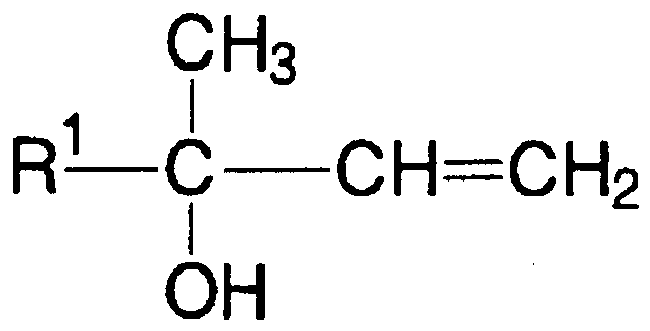
und 3-Methyl-1-alkin-3-olen der Formel:
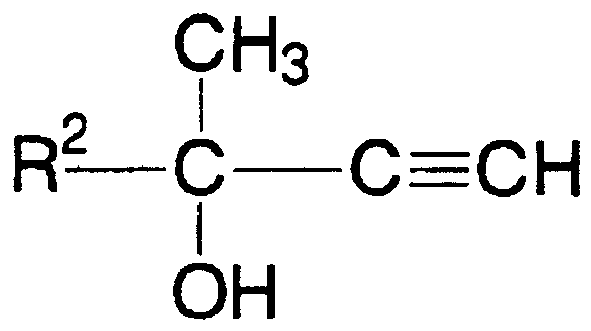
wobei R1 und R2 jeweils unabhängig voneinander eine gesättigte oder ungesättigte aliphatische Kohlenwasserstoffgruppe mit 1 bis etwa 12 Kohlenstoffatomen sind, in die Atmosphäre des dreidimensionalen Umgebungsraums umfasst, wobei das Ziel Mensch oder Vieh ist.
und 3-Methyl-1-alkin-3-olen der Formel:
wobei R1 und R2 jeweils unabhängig voneinander eine gesättigte oder ungesättigte aliphatische Kohlenwasserstoffgruppe mit 1 bis etwa 12 Kohlenstoffatomen sind, in die Atmosphäre des dreidimensionalen Umgebungsraums umfasst, wobei das Ziel Mensch oder Vieh ist.
2. Das Verfahren gemäß Anspruch 1, wobei die zur Hemmung wirksame Menge von 0,000054
g/h/m2 [0,000005 g/hr/ft2] bis 0,0043 g/h/m2 [0,0004 g/hr/ft2], bezogen auf die Quadratmeterzahl des Land- oder Grundflächenbereichs des Umgebungsraums,
beträgt.
3. Das Verfahren gemäß Anspruch 1, wobei die zur Hemmung wirksame Menge von 0,00162 g/h/m2 [0,00015 g/hr/ft2] bis 0,00215 g/h/m2 [0,0002 g/hr/ft2], bezogen auf die Quadratmeterzahl des Land- oder Grundflächenbereichs des Umgebungsraums,
beträgt.
4. Das Verfahren gemäß Anspruch 1, wobei die mindestens eine hemmende Verbindung aus
Nerolidol, 3-Methyl-1-octen-3-ol, Linalool und Dehydrolinalool ausgewählt ist.
5. Das Verfahren gemäß Anspruch 1, wobei die mindestens eine hemmende Verbindung Linalool
umfasst.
6. Das Verfahren gemäß Anspruch 1, wobei die mindestens eine hemmende Verbindung Dehydrolinalool
umfasst.
7. Das Verfahren gemäß Anspruch 1, wobei das Abgeben der mindestens einen hemmenden Verbindung
das Abgeben durch ein Verfahren ausgewählt aus Verflüchtigung, Verdampfung, Zerstäubung
und ionischer Verteilung der mindestens einen hemmenden Verbindung aus einer Zubereitung,
die einen Träger umfasst, der die mindestens eine hemmende Verbindung enthält.
8. Das Verfahren gemäß Anspruch 7, wobei das Abgeben gebläsegetriebene Verdampfung der
mindestens einen hemmenden Verbindung aus einer Zubereitung, in der der Träger ein
poröses Medium ist, umfasst.
9. Das Verfahren gemäß Anspruch 7, wobei das Abgeben gebläsegetriebene Verdampfung der
mindestens einen hemmenden Verbindung aus einer Zubereitung, in der der Träger eine
wachsartige Lösung ist, umfasst.
10. Das Verfahren gemäß Anspruch 7, wobei das Abgeben die Zerstäubung der mindestens einen
hemmenden Verbindung aus der Zubereitung umfasst.
11. Das Verfahren gemäß Anspruch 7, wobei das Abgeben ionisches Verteilen der mindestens
einen hemmenden Verbindung aus der Zubereitung umfasst.
12. Das Verfahren gemäß Anspruch 5, wobei das Linalool durch gebläsegetriebenes Verdampfen
von Linalool aus einer Zubereitung eines porösen Mediums, das Linalool enthält, abgegeben
wird.
13. Das Verfahren gemäß Anspruch 5, wobei das Linalool durch gebläsegetriebenes Verdampfen
von Linalool aus einer Zubereitung einer wachsartigen Lösung, die Linalool enthält,
abgegeben wird.
14. Das Verfahren gemäß Anspruch 5, wobei das Linalool durch Zerstäubung von Linalool
aus einer Zubereitung eines Trägers und Linalool abgegeben wird.
15. Das Verfahren gemäß Anspruch 5, wobei das Linalool durch ionisches Verteilen von Linalool
aus einer Zubereitung eines Trägers und Linalool verteilt wird.
16. Das Verfahren gemäß Anspruch 6, wobei das Dehydrolinalool durch gebläsegetriebenes
Verdampfen von Dehydrolinalool aus einer Zubereitung eines porösen Mediums, das Dehydrolinalool
enthält, abgegeben wird.
17. Das Verfahren gemäß Anspruch 6, wobei das Dehydrolinalool durch gebläsegetriebenes
Verdampfen von Dehydrolinalool aus einer Zubereitung einer wachsartigen Lösung, die
Dehydrolinalool enthält, abgegeben wird.
18. Das Verfahren gemäß Anspruch 6, wobei das Dehydrolinalool durch Zerstäubung von Dehydrolinalool
aus einer Basiszubereitung abgegeben wird.
19. Das Verfahren gemäß Anspruch 6, wobei das Dehydrolinalool durch ionisches Verteilen
von Dehydrolinalool aus einer Zubereitung eines Trägers und Dehydrolinalool verteilt
wird.
1. Procédé d'inhibition de la capacité de brûlots à sentir une cible par olfaction de
la cible au sein d'un espace environnemental tridimensionnel ayant une superficie
de terrain ou de base, le procédé comprenant la distribution dans l'atmosphère de
l'espace environnemental tridimensionnel d'une quantité efficace inhibitrice d'au
moins un composé inhibiteur choisi dans le groupe constitué par les 3-méthyl-1-alcène-3-ols
de formule :
et les 3-méthyl-1-alcyn-3-ols de formule :
dans lesquelles R1 et R2 sont chacun indépendamment un groupe hydrocarbure aliphatique saturé ou insaturé contenant de 1 à environ 12 atomes de carbone, dans lequel la cible est humaine ou est du bétail.
et les 3-méthyl-1-alcyn-3-ols de formule :
dans lesquelles R1 et R2 sont chacun indépendamment un groupe hydrocarbure aliphatique saturé ou insaturé contenant de 1 à environ 12 atomes de carbone, dans lequel la cible est humaine ou est du bétail.
2. Procédé selon la revendication 1, dans lequel la quantité efficace inhibitrice varie
de 0,000054 g/h/m2 (0,000005 g/h/pied2) à 0,0043 g/h/m2 (0,0004 g/h/pied2) en se basant sur la superficie de terrain ou de base de l'espace environnemental.
3. Procédé selon la revendication 1, dans lequel la quantité efficace inhibitrice varie
de 0,00162 g/h/m2 (0,00015 g/h/pied2) à 0,00215 g/h/m2 (0,0002 g/h/pied2) en se basant sur la superficie de terrain ou de base de l'espace environnemental.
4. Procédé selon la revendication 1, dans lequel le au moins un composé inhibiteur est
choisi parmi le nérolidol, le 3-méthyl-1-octén-3-ol, le linalool et le déshydrolinalool.
5. Procédé selon la revendication 1, dans lequel le au moins un composé inhibiteur comprend
le linalool.
6. Procédé selon la revendication 1, dans lequel le au moins un composé inhibiteur comprend
le déshydrolinalool.
7. Procédé selon la revendication 1, dans lequel la distribution du au moins un composé
inhibiteur comprend la distribution par un procédé choisi parmi la volatilisation,
l'évaporation, l'atomisation et la dispersion ionique du au moins un composé inhibiteur
à partir d'une formulation comprenant un véhicule contenant le au moins un composé
inhibiteur.
8. Procédé selon la revendication 7, dans lequel la distribution comprend une évaporation
entraînée par ventilateur du au moins un composé inhibiteur à partir d'une formulation
dans laquelle le véhicule est un milieu poreux.
9. Procédé selon la revendication 7, dans lequel la distribution comprend une évaporation
entraînée par ventilateur du au moins un composé inhibiteur à partir d'une formulation
dans laquelle le véhicule est une solution cireuse.
10. Procédé selon la revendication 7, dans lequel la distribution comprend une atomisation
du au moins un composé inhibiteur à partir de la formulation.
11. Procédé selon la revendication 7, dans lequel la distribution comprend une dispersion
ionique du au moins un composé inhibiteur à partir de la formulation.
12. Procédé selon la revendication 5, dans lequel le linalool est distribué par une évaporation
entraînée par ventilateur de linalool à partir d'une formulation d'un milieu poreux
contenant du linalool.
13. Procédé selon la revendication 5, dans lequel le linalool est distribué par une évaporation
entraînée par ventilateur de linalool à partir d'une formulation d'une solution cireuse
contenant du linalool.
14. Procédé selon la revendication 5, dans lequel le linalool est distribué par atomisation
de linalool à partir d'une formulation d'un véhicule et de linalool.
15. Procédé selon la revendication 5, dans lequel le linalool est distribué par dispersion
ionique de linalool à partir d'une formulation d'un véhicule et de linalool.
16. Procédé selon la revendication 6, dans lequel le déshydrolinalool est distribué par
une évaporation entraînée par ventilateur de déshydrolinalool à partir d'une formulation
d'un milieu poreux contenant du déshydrolinalool.
17. Procédé selon la revendication 6, dans lequel le déshydrolinalool est distribué par
une évaporation entraînée par ventilateur de déshydrolinalool à partir d'une formulation
d'une solution cireuse contenant du déshydrolinalool.
18. Procédé selon la revendication 6, dans lequel le déshydrolinalool est distribué par
atomisation de déshydrolinalool à partir d'une composition de base.
19. Procédé selon la revendication 6, dans lequel le déshydrolinalool est distribué par
dispersion ionique de déshydrolinalool à partir d'une formulation d'un véhicule et
de déshydrolinalool.
REFERENCES CITED IN THE DESCRIPTION
This list of references cited by the applicant is for the reader's convenience only. It does not form part of the European patent document. Even though great care has been taken in compiling the references, errors or omissions cannot be excluded and the EPO disclaims all liability in this regard.
Patent documents cited in the description
Non-patent literature cited in the description
- K.P. SVOBODA et al.Flavour Fragr. J., 1998, vol. 13, 367-372 [0005]