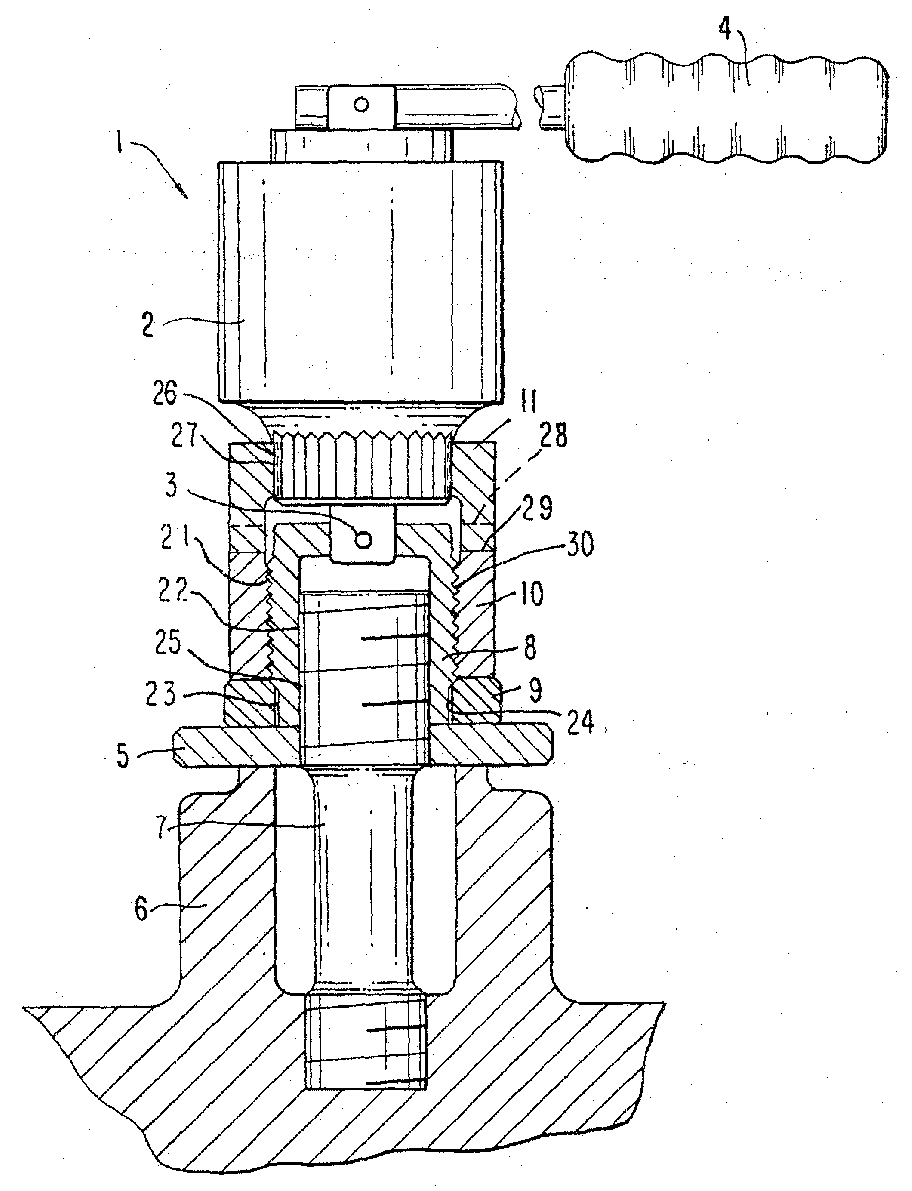
(57) A method of tightening or loosening an object (5) to or from a rotary base (6) torsion-free
includes providing a single power tool (1) having a tool housing portion (2) and a
driving portion (3) which are coaxial with one another and provide equal but opposite
forces, connecting a bolt (7) with the rotary base (6), connecting a first part which
comprises a sleeve/washer assembly to one of the portions (2, 3) to be turned by the
one portion, which sleeve/washer assembly comprises a sleeve (8) with a thread (22)
cooperating with a thread (25) of the bolt and a washer (9) abutting against the object
(5), connecting a second part to the other of the portions (2, 3) to be turned by
the other portion, which second part comprises a nut (10) having a thread (30) cooperating
with another thread (21) of the first part, turning the first part by the one portion
so that the first part, the bolt (7) and the rotary base (6) turn together while the
second part remains free of rotation to urge the bolt (7) to move in a desired axial
direction to tighten or loosen the object (5) to the rotary base, or turning the second
part by the other portion so that the rotary base (6), the bolt (7) and the first
part remain free of rotation to urge the bolt in the desired axial direction to tighten
or loosen the object (5) to the rotary base (6).
|
|
