|
(11) | EP 1 505 837 A1 |

| (12) | EUROPEAN PATENT APPLICATION |
|
|
|
|
|||||||||||||||||||||||
| (54) | Device and method for compressing digital images |
| (57) The present invention relates to a device (210) for compressing a source image by
means of a base layer, coding a base image, and of an enhancement layer, coding a
residual existing between the source image and the base image, the source image and
the base image being structured as blocks of pixels. According to the invention, such a device is characterized in that it comprises means (250) for generating the enhancement layer of a block as a function of the quality of restitution of this block, determined by comparing the coding of this block in the source image with the coding of this block in the base image, and/or as a function of information coded by this block of pixels. |
[0002] The compression of a digital image reduces the quantity of data necessary for its transmission via, for example, a telecommunication network such as the Internet network.
[0003] Certain compression standards, such as the MPEG-4 standard (Motion Picture Expert Group 4), use a so-called multilayer compression according to which an image, the so-called source image, is compressed by means of a base layer, coding a so-called base image, and of an enhancement layer, coding the deviation or the residual, between the source image and the base image.
[0004] In this case, the transmission of a compressed image can be done by transmitting, firstly, its base layer and then, secondly, its enhancement layer, in the form of binary trains.
[0005] The binary train associated with the enhancement layer has the advantage of being able to be truncated in such a way that, if transmission thereof is performed only partially following, for example, a variation in the transmission throughput in the network, the information transmitted in the correctly received part of the binary train may nevertheless still be used to enhance the image coded by the base layer.
[0006] To do this, a residual 101 (Figure 1), coding enhancement coefficients 1011, 1012, ...101n specific to each block of pixels forming the image, is decomposed into various planes MSB, MSB-1, MSB-2, MSB-3 and LSB of bits ranked in order of priority, each plane MSB, MSB-1, MSB-2, MSB-3 or LSB clustering together bits of like weight in the decomposition of the residual specific to each block.
[0007] As described later, these coefficients 1011, 1012, ...101n may arise from the discrete cosine transformation DCT of an 8x*8 block of pixels, performed by evaluating the difference between the DCT coefficients of a block of a source image, that is to say of the coded image, and the DCT coefficients of an image processed by a quantization and then by an inverse quantization of its base layer.
[0008] By generating a binary train 130 successively transmitting the planes MSB, MSB-1, MSB-2, MSB-3 or LSB, one then obtains an enhancement layer which can be truncated without compromising the transmission of the train as a whole. For example, if the transmission of the train 130 is disturbed during the transmission of the plane MSB-3, the information as a whole already transmitted by the planes MSB, MSB-1, MSB-2 and the transmitted part of MSB-3 will be able to be taken into account to enhance the image.
[0009] Such a method, dubbed Fine Granularity Scalability (Fgs) within the framework of the MPEG4 standard, has the drawback of using a compression of the residual having an efficiency lower than the efficiency of the compression of the base code. In this way, a compromise between the efficiency of the compression, increased by a base layer of significant size, and the security of the transmission of the base, increased with a base layer of small size, may possibly be made.
[0010] The present invention remedies this drawback. It pertains to a device for compressing a source image by means of a base layer, coding a base image, and of an enhancement layer, coding a residual existing between the source image and the base image, the source image and the base image being structured as blocks of pixels, characterized in that it comprises means for generating the enhancement layer of a block as a function of the quality of restitution of this block, determined by comparing the coding of this block in the source image with the coding of this block in the base image, and/or as a function of information coded by this block of pixels.
[0011] By considering the quality of restitution of the image on the basis of the base layer blockwise, the device in accordance with the invention makes it possible to optimize the generation of the enhancement layer by assigning each block a quantity of bits in the enhancement layer dependent on the base coding of this block so that the final image has a uniform quality of restitution.
[0012] Moreover, by taking into account the information relating to the coding of each block, the device in accordance with the invention optimizes the generation of the base layer by allotting more data to blocks of pixels for which an enhancement of the base layer results priority-wise, for example if resolution defects associated with this block are more visible than for other blocks.
[0013] In one embodiment, the device comprises means for determining the quality of restitution of the block (k) by means of a formula such as:
where (i,j) represents the coordinates of a pixel of the block (k) considered, for example of dimensions 8x8, in the source image (blocksource) or in the base image (block,rec) coded by the base layer, L representing the value of the maximum luminance of the image, for example equal to 255.
[0014] According to one embodiment, the device comprises means for defining an average quality Psnravg of restitution of the image and for allocating a greater number of bits in the enhancement layer to the blocks whose restitution quality is less than this average quality Pnsravg or than a reference quality Pnsrref obtained on the basis of this average quality, for example by adding a quality margin.
[0015] In one embodiment, the device comprises means for comparing the quality psnrk of restitution of the block k with a reference quality psnrref in such a way as to detect a deviation δpsnrk of quality with respect to this reference psnrref and means for allotting a number NbBitsk of bits of the enhancement layer to this block as a function of this deviation.
[0016] According to one embodiment, the device comprises means for allotting a number NbBitsk of bits of the enhancement layer by using a proportionality relation such as:
where throughputfgs is the quantity of bits per image contained in the train of the enhancement layer and Δpsnr is a sum of deviations δpsnrk measured for the block considered.
[0017] In one embodiment, the sum Δpsnr is evaluated on the basis of the deviations between the quality of each block and the reference quality, for example by means of a formula such as:
where M and N are parameters relating to the index number of each block in the image, a block being considered only if its quality psnrk of restitution is less than the reference quality of restitution (psnrk < psnrref).
[0018] According to one embodiment, the device comprises means for estimating the quality of restitution of the base layer by estimating the degradation, or the cost CostFlti, of its filtering intended to reduce contrasts between neighbouring blocks and means for allotting to a block (k) of pixels a bigger number NbBitsk of bits of the enhancement layer the higher this cost CostFlti.
[0019] In one embodiment, the device comprises means for estimating the cost CostFlti of the filtering with the aid of a formula such as:
where abs is the absolute value function, and blockbasefiltered(i,j) - blockbase(i,j) represents the difference in values of the pixel with coordinates i and j of the base layer after filtering and before filtering.
[0020] According to one embodiment, the device comprises means for comparing the cost of filtering costFlti of a block with a cost of filtering of the image COSTFlt and means for allotting a number NbBitsfgsi of bits of the enhancement layer to each block i as a function of this comparison, for example by using a relation such as:
where throughputfgs is the quantity of bits per image contained in the train of the enhancement layer.
[0021] In one embodiment, the device comprises means for determining the cost costFlt of filtering of the image by adding up the costs of filtering of all the blocks of the image, for example with the aid of a formula such as:
where i represents a block index number whilst M and N represent the dimensions of the image.
[0022] According to one embodiment, the device comprises means for generating the enhancement layer of a block as a function of a parameter relating to an average luminance (Lavg) associated with this block, determined for example by adding up the luminances of the pixels of the block considered.
[0023] In one embodiment, the device comprises means for weighting the cost of the filtering of a block as a function of a coefficient F(Lavgi) whose value depends on the average luminance of this block.
[0024] According to one embodiment, the device comprises means such that, if the average luminance Lavgi of a block is greater than a threshold, ThreshLum, then the value of this weighting coefficient is calculated according to the formula:
whereas, otherwise, the value of this weighting coefficient is constant, for example equal to 1/2.
[0025] In one embodiment, the device comprises means for weighting the cost of the filtering as a function of a coefficient F(Lavgi) whose value depends on the texture, or activity, of the considered block of pixels.
[0026] According to one embodiment, the device comprises means such that the activity Acti of a block i is calculated by means of a formula such as:
where k and l are the coordinates of the pixels contained in a block, bi,src being a block of index i of the source image and max (a,b) is equal to a when a is greater than b, and equals b otherwise.
[0027] In one embodiment, the device comprises means such that the cost of the filtering of a block is weighted by means of a factor (F(Acti)) dependent on its activity.
[0028] In one embodiment, the device comprises means such that the weighting factor F(Acti) varies between 0.5 and 1 as a function of a threshold ThreshAct such that, if the activity Acti of the block i considered is less than this threshold ThreshAct then the coefficient F(Acti) is equal to:
whereas this threshold is constant otherwise.
[0029] According to one embodiment, the device comprises means for generating the enhancement layer by considering a motion or displacement vector associated with each pixel block i, for example by means of the formula:
where the components Vx and Vy represent the horizontal and vertical displacements of the block.
[0030] According to one embodiment, the device comprises means such that the cost of the filtering of a block is weighted by means of a factor F(Vecti) dependent on the motion vector of this block.
[0031] In one embodiment, the device comprises means such that the weighting factor F(Vecti) varies between 0 and 1 as a function of a motion threshold ThreshVect, for example such that if the norm of the vector Vecti is less than this threshold ThreshVect, then this factor equals:
whereas this factor F(Vecti) is zero otherwise.
[0032] According to one embodiment, the device comprises means for generating the enhancement layer by considering the possible exit of the block in an image subsequent to the image considered.
[0033] In one embodiment, the device comprises means for anticipating the exit of the block from the image by adding the components Vx and Vy of the displacement vector Vect of this block ibnext = ib + Vx and jbnext = jb + Vy to the coordinates ib and jb of this block, in such a way that if the estimated position of the block at the next image is outside the image (ibnext <0) or (ibnext >M) or (jbnext <0) or (jbnext >N), M and N being the dimensions of the image, the enhancement layer of this block is not processed.
[0034] In one embodiment, the device comprises means for estimating the quality psnr of restitution of a block of pixels with the aid of an affine modelling such that the quality psnr of restitution of an image has a linear form:
where Dpsnr is a constant equal, for example, to 0.212 dB/bit per block and x represents the allotted number of bits per block.
[0035] According to one embodiment, the device comprises means for generating the enhancement layer by allotting more bits to the blocks of an image if this image is used to generate other images, for example in the case of an inter-image predictive coding.
[0036] In one embodiment, the device comprises means for coding the base layer with the aid of a discrete cosine transform.
[0037] The invention also relates to a method for compressing a source image by means of a base layer, coding a base image, and of an enhancement layer, coding a residual existing between the source image and the base image, the source image and the base image being structured as blocks of pixels, characterized in that a device is used which generates the enhancement layer of a block as a function of a quality of restitution of this block, in accordance with one of the preceding claims.
[0038] Other characteristics and advantages of the invention will become apparent with the description of the invention given hereinbelow, by way of nonlimiting example, while referring to the appended figures in which:
- Figure 1, already described, represents a method of coding an enhancement layer according to a known method,
- Figure 2 ,is a diagram of a compressor of images coded according to a multilayer method in accordance with the graphical invention,
- Figure 3 represents a distribution of variable restitution qualities for various blocks of one and the same image, and
- Figure 4 represents variations of efficiency during a multilayer coding.
[0039] A coder 210 (Figure 2) in accordance with the invention can comprise a receiver 211 receiving a signal 212 which codes an image to be compressed. Within the framework of coding in inter-image modes, this receiver 211 subtracts from this signal 212 information already transmitted for a previous image. This operation is performed with the aid of a subtractor 214 which receives a signal 234 corresponding to the information transmitted for the previous images.
[0040] Thus, the signal 212 is transformed into a signal 21614, which is directed to a transformer 218 which transforms the signal 21614, defined in the spatial domain, into a signal 21618 defined in the frequency domain. This operation, which is performed with no loss of information, is a discrete cosine transform or DCT.
[0041] The signals 21618 are transmitted to a quantizer 220 which reduces the dynamic swing of these signals via a quantization operation which involves approximations entailing a non-negligible loss of information of the signal 21618.
[0042] The information thus lost during this quantization operation is called the residual (residual information intended for the fgs coder), whereas the information retained after quantization constitutes the base layer of the compressed image.
[0043] Stated otherwise, the base layer comprises the data received by the coder minus this residual, the latter being coded by the enhancement layer as described later.
[0044] On exit from the quantizer 220, the signal 21620 is also transmitted to a subtraction loop which comprises an inverse quantizer 224 performing the inverse function of the quantizer 220. This inverse quantization operation is performed without any new loss of information.
[0045] One then obtains a signal 21624 which is applied to a converter 226 performing the inverse function (IDCT) to that carried out by the transformer 218, that is to say converting this signal 21624 from the frequency domain to the spatial domain, thus outputting a signal 21626 which is transmitted to a memory 228 and a motion estimation/compensation processor 230 then to the subtractor 214.
[0046] The signal 21624 is also transmitted to a subtractor 236, forming part of a branch 235 for generating the enhancement layer, a second input of the subtractor 236 receiving the output signal 21618 from the DCT transformer 218.
[0047] Thus, this subtractor 236 performs the subtraction between signals representing the signals received 21618 and sent 21624 so as to obtain the residual 21636 on output from the subtractor 236.
[0048] The branch 235 comprises a memory 238 which stores the residuals (in the spatial frequency domain) imagewise and a device 240 which performs the partition into enhancement planes of the signal 21638 on exit from the memory 238 according to the standardized method known as "Fine granularity scalability" (FGS) already described.
[0049] Furthermore, the branch 235 comprises means 250 for analysing the blocks of pixels compressed in such a way as to determine their quality of restitution, on the basis of the base layer, and for determining, as a function of this quality and of information relating to the coding of the pixels of a block considered, what quantity of bits should be allotted to this block at the enhancement layer level.
[0050] In this embodiment of the invention, the quality or "psnrk" of restitution is measured, for a block k of pixels, by means of the following formula:
where (i,j) represents the coordinates of a pixel of the block considered, for example of dimensions 8x8, in the source image (blocksource) or in the reconstructed base image (block,rec) coded by the base layer.
[0051] By means of the quality of restitution psnrk calculated for each block k of pixels, it is possible to calculate the average quality of restitution psnravg of the image, for example by averaging the qualities psnr of restitution of each of the blocks of the image or by using a graphical procedure as described later.
[0052] Finally, a reference restitution quality psnravg specific to the image is obtained on the basis of the average quality Psnravg to which is added a margin, for example, of 3 dB.
[0053] Thereupon, each measurement of restitution quality psnrk is compared with the reference psnrref to detect a possible defect δpsnrk of quality of restitution, that is to say a deficit in terms of quality of restitution with respect to the threshold psnrref defined.
[0054] As a function of this possible deficit δpsnrk in terms of quality of restitution, one allots a certain number NbBitsk of bits on the train of the enhancement layer by using a proportionality relation such as:
where throughputfgs corresponds to the throughput allotted to the image within the framework of the coding dedicated to the enhancement layer and Δpsnr represents the global deficit of the image, evaluated on the basis of the deviations between the quality of each and the reference quality, for example by means of a formula such as:
where M and N are parameters relating to the index number of each block in the image, a block being considered only if its quality psnrk of restitution is less than the reference quality of restitution (psnrk < psnrref).
[0055] Such an operation is illustrated with the aid of Figure 3 which represents blocks 343, identified by their block index number (abscissa axis 302) and for which the quality psnrk of restitution (ordinate axis 304) has been determined in accordance with the formula indicated above.
[0056] A reference quality psnrref 342 is defined on the basis of an average quality of restitution 340 and of a predetermined quality margin 341.
[0057] In accordance with the invention, no coding is performed in the enhancement layer for blocks 343i whose quality of restitution is greater than the reference threshold whereas an enhancement coding is performed for the blocks of pixels whose restitution quality is less than the reference quality (psnrref), a bigger number of bits being allotted to this coding the higher this deviation.
[0058] Another enhancement layer generation parameter taken into account by the means 250 (Figure 2) is the variation of the information in a block after its filtering intended to reduce any block effects, that is to say the problems of contrast existing between two neighbouring pixel blocks.
[0059] For this purpose, it is appropriate to recall that such a filtering is performed at the base layer level in an optional manner at the decoder level in the case of the MPEG4 standard.
[0060] Nevertheless, this post-filtering can be carried out at the coder level so as to estimate the rendition on the reconstructed image of the base layer vis-à-vis the source image.
[0061] In the latter case, the post-filtering does not intervene in the loop of the inter-image coding process which then serves only to estimate the degradation between the decoded image (of the base layer) and the source image.
[0062] On the other hand, if a filter is present in this loop, the degradation estimation operation can be carried out therein. Such is the case within the framework of the h263, h261 and MPEF-4 part 10 standards.
[0063] To do this, one can evaluate a cost (costFlti) of filtering by means, for example, of the following formula:
where abs is the absolute value function, and blockbasefiltered(i,j) - blockbase(i,j) represents the difference in quality at the level of the block comprising the pixel with coordinates i and j, belonging to the decoded image (of the base layer) after filtering and before filtering intended to reduce the block effects.
[0064] On the basis of the cost of the filtering of a block of pixels it is possible to calculate a total cost COSTFlt for the image by summing the costFlti specific to each block such that:
[0065] Finally, it is possible to determine the number of bits to be allotted in the data train of the enhancement layer to a block as a function of the following formula:
[0066] In this embodiment, a significant coding of the enhancement layer of a pixel block is also favoured if this block is situated in a zone of an image where the luminance is low. In fact, the anomalies of an image are more visible in the dark zones of this image.
[0067] For this purpose, the average luminance of each block is calculated in such a way that the blocks whose average luminance is lower benefit from increased coding in the enhancement layer.
This average luminance Lavg can be calculated by:
k and l being the coordinates of the pixels contained in the block i.
[0068] Application on the basis of the block effect (post-filtering) measured on completion of the post-filtering can be effected in the following manner:
The calculation of the filtering cost, relating to the image, weighted with local
average luminance
The distribution of the number of bits per block then becomes:
[0069] F(Lavgi) being a weighting function which varies between 0.5 and 1. In this embodiment, if the luminosity Lavgi of a block i is less than a threshold ThreshLum (Lavgi < ThreshLum), then this function may be written: F(Lavgi) = 1-( Lavgi / 2xThreshLum).
[0070] Otherwise, this weighting function F(Lavgi) may be kept constant, for example equal to 1/2, this approach making it possible to favour the blocks with low luminance vis-à-vis those with high luminance.
[0071] It is appropriate to note that the threshold value ThreshLum exhibits a maximum luminance (255).
[0072] In this embodiment, a significant coding of the enhancement layer of a pixel block is also favoured if this block is situated in a zone of an image where the texture is weak since a restitution defect located in a weakly textured zone is more visible than in a zone with strong texture.
[0073] For this purpose, this texture is measured by an activity Acti inside the block i evaluated for example, as follows:
k and l being the coordinates of the pixels contained in the block, bi,src being a block of index i of the source image and max(a-b) being equal to a if a is greater than b or equal to b otherwise.
[0074] Application on the basis of the block effect measured on completion of the post-filtering may then be effected by calculating the cost of the filtering, relating to the image, weighted with the local activity determined as indicated above:
The blockwise distribution of the number of bits then becomes:
[0075] F(Lavgi) being a weighting function which varies between 0.5 and 1 in a similar manner to the weighting function described above. In this example, if the activity Acti is less than a given threshold ThreshAct, then this weighting coefficient F(Acti) is determined by the following formula:
[0076] Otherwise, the weighting coefficient F(Acti) can be kept constant, for example equal to 1/2, thus making it possible to favour the blocks with weak texture vis-à-vis blocks with strong texture.
[0077] Furthermore, it is appropriate to note that the texture exhibits a maximum threshold value (ThreshAct = 255).
[0078] The combination of the two criteria based on the average luminance and the activity that are contained in the block can be effected, the spread of the information dedicated to the improvement layer then becomes:
[0080] The amplitude of the motion vector associated with a block of pixels can also be taken into account when considering the quantity of bits allotted to this block of pixels in the enhancement layer.
[0081] This approach makes it possible to exploit the effect of masking through motion of the restitution defects inherent in the image coding, and in particular at low and very low throughput.
[0082] In fact, if a block of pixels is associated with a significant motion vector, then the zone of the image coded by this block may be considered to correspond to an element moving in the image and for which a lesser resolution than for the still zones of the image may be satisfactory.
[0083] The determination of the modulus of the motion vector Vecti associated with a block i is determined by means of a formula such as:
where Vx corresponds to the displacement in pixel units along the x axis, generally horizontal, and Vy corresponds to the displacement in pixel units along the y axis, generally vertical.
[0084] Application on the basis of the block effect measured on completion of the post-filtering can be effected by calculating a filtering cost, relating to the image, weighted with the amplitude of the vectors, for example by means of the following formula:
[0086] F(Vecti) being a weighting function which varies between 0 and 1. In this example, if the norm of the motion vector Vecti of a block i is less than a threshold ThreshVect, then this function F(Vecti) equals:
[0087] Otherwise, if the norm of this vector is greater than this threshold, this function is zero (F(Vecti) = 0).
[0088] Thus any block whose displacement vector has a norm that is less than a threshold ThreshVect will be enhanced as a function of a cost and of its displacement whereas, if the vector is beyond a threshold, this block will have no additional enhancement layer.
[0089] It is appropriate to note that the value of the threshold is dependent, among other things, on the resolution of the image, a value of 30 giving acceptable results for an image in the CIF format (288 lines of 352 pixels).
[0090] Similarly, if a block of pixels that is situated at the border of the image is associated with a motion vector such that it is possible to anticipate that the zone of the coded image to which this block belongs will exit this image in the future, it is unnecessary to code this zone with a high resolution.
[0091] Hence, the position of a current block is estimated at the next image on the basis of the displacement vector of this block, for example by adding the components Vx and Vy of the vector Vect(Vx, Vy) respectively to the central coordinates of the block ib and jb.
[0092] Stated otherwise, if the central coordinates of the current block are ib and jb, the current block's central coordinates estimated at the next image are:
[0093] Thus, if the estimation of the coordinates for the next image exits the framework of the image ((ibnext <0) or (ibnext >M) or (jbnext <0) or (jbnext >N)), where M and N represent the dimensions of the image to be processed, then the block is not enhanced.
[0094] In accordance with the invention, various parameters have been described hereinabove which make it possible to determine a number of bits, that is allotted to a block of pixels, as a function of information coded in these blocks, such as a motion vector or significant contrasts, and/or of the quality of restitution of the image using the base layer.
[0095] Therefore, it is apparent that the number of bits in the enhancement layer can vary as a function of these parameters.
[0096] In order to control such variations, in one embodiment of the invention, use is made of models of variations of quality of restitution of an image to determine what quality of restitution is attained by the transmission of a base layer and of a variable enhancement layer, as explained hereinbelow with the aid of Figure 4.
[0097] In this Figure 4 is shown a fan of curves 402, 404 and 406 identifying a quality of restitution (ordinate axis 401, in dB), as a function of a number of bits allotted for a block (abscissa axis 403).
[0098] Each curve (respectively 402, 404 and 406) corresponds to a transmission of an image by means of a base layer (respectively at 192, 256 and 384 kbits/s) associated with an enhancement layer of increasing size.
[0099] This fan is generated from a curve 400 which represents the restitution quality/number of bits per block ratio when a single base layer is transmitted.
[0100] It is thus noted that, for one and the same quality, the transmission of a single base layer is more efficacious than the transmission of a base layer associated with an enhancement layer, this conveying the greater efficiency of the coding of the base layer with respect to the coding of the enhancement layer.
[0101] One also observes that the fan of curves 402, 404 and 406 exhibits an almost affine form such that the quality psnr of restitution of an image takes a form
where Dpsnr is a constant, equal to 0.212dB/bit per block and x represents the allotted number of bits per block.
[0102] It should be noted that this constant Dpsnr, which makes it possible to approximate the variation of restitution quality/throughput fgs, corresponds to a type of algorithm making it possible to undertake compression of fine scalability type.
[0103] However, it is also appropriate to note that this constant is dependent on the compression algorithm implemented.
[0104] Thereupon, it is possible to determine simply the number of bits that have to be allocated to an image, or to each block of this image, to obtain a given quality of restitution.
[0105] In fact, by fixing a determined quality psnrdet of restitution, it is possible to estimate the number of bits per block that have to be allotted to a block in the enhancement layer by calculating the deviation between the number of bits per block transmitted in the base layer (curve 400) and the number of bits per block that have to be transmitted to obtain the required quality of restitution.
[0106] Such a procedure for the graphical determination of the number of bits that have to be allotted in the enhancement layer to obtain a given quality of restitution is particularly simple since it requires a limited calculation capacity.
[0107] Moreover, it makes it possible to limit the number of bits that is allotted in the enhancement layer to a block of pixels by again optimizing the efficiency of the coding of this layer since it makes it possible to avoid overcoding a block by determining, in a required compression quality context, whether the restitution quality thereof has already attained the required quality.
[0108] This technique can take into consideration the combination of weighting parameters of two or more of the already described parameters relating to the block currently being coded, namely block effects, a filtering cost, the local average luminance, the local activity, an amplitude of the motion vector and/or a risk of exiting the scene in the next image.
[0109] The present invention is open to numerous variants. Thus, the position and/or the function of the image to which a pixel block belongs can also be a parameter considered in determining the quantity of bits of the enhancement layer allotted to a block.
[0110] In fact, if an image is used to generate other images, as in the particular case of a predictive coding scheme where an inter-image uses images reconstructed with the aid of their base layer and of all or part of their enhancement layer, the blocks of this image are processed with a lower enhancement layer if these blocks belong to an isolated image or to one situated at the end of a series of images.
1. Device (210) for compressing a source image by means of a base layer, coding a base
image, and of an enhancement layer, coding a residual existing between the source
image and the base image, the source image and the base image being structured as
blocks of pixels, characterized in that it comprises means (250) for generating the enhancement layer of a block (k) as a
function of the quality (psnrk) of restitution of this block (k), determined by comparing the coding of this block
in the source image with the coding of this block in the base image, and/or as a function
of information coded by this block of pixels.
2. Device according to Claim 1, characterized in that it comprises means for determining the quality (psnrk) of restitution of the block (k) by means of a formula such as:

where (i,j) represents the coordinates of a pixel of the block (k) considered, for example of dimensions 8x8, in the source image (blocksource) or in the base image (block,rec) coded by the base layer, L representing the value of the maximum luminance of the image, for example equal to 255.
where (i,j) represents the coordinates of a pixel of the block (k) considered, for example of dimensions 8x8, in the source image (blocksource) or in the base image (block,rec) coded by the base layer, L representing the value of the maximum luminance of the image, for example equal to 255.
3. Device according to Claim 1, characterized in that it comprises means for defining an average quality (Psnravg) of restitution of the image and for allocating a greater number of bits in the enhancement
layer to the blocks whose restitution quality is less than this average quality (Pnsravg) or than a reference quality (Pnsrref) obtained on the basis of this average quality, for example by adding a quality margin.
4. Device according to claim 1, characterized in that it comprises means for comparing the quality (psnrk) of restitution of the block k with a reference quality (psnrref) in such a way as to detect a deviation (δpsnrk) of quality with respect to this reference (psnrref) and means for allotting a number (NbBitsk) of bits of the enhancement layer to this block as a function of this deviation.
5. Device according to Claim 4, characterized in that it comprises means for allotting a number (NbBitsk) of bits of the enhancement layer by using a proportionality relation such as:

where throughputfgs is the quantity of bits per image contained in the train of the enhancement layer and Δpsnr is a sum of deviations (δpsnrk) measured for the block considered.
where throughputfgs is the quantity of bits per image contained in the train of the enhancement layer and Δpsnr is a sum of deviations (δpsnrk) measured for the block considered.
6. Device according to claim 1, characterized in that it comprises means for estimating the quality of restitution of the base layer by
estimating the degradation, or the cost (CostFlti), of its filtering intended to reduce
contrasts between neighbouring blocks and means for allotting to a block (k) of pixels
a bigger number (NbBitsk) of bits of the enhancement layer the higher this cost (CostFlti).
7. Device according to Claim 6, characterized in that it comprises means for estimating the cost (CostFlti) of the filtering with the aid
of a formula such as:
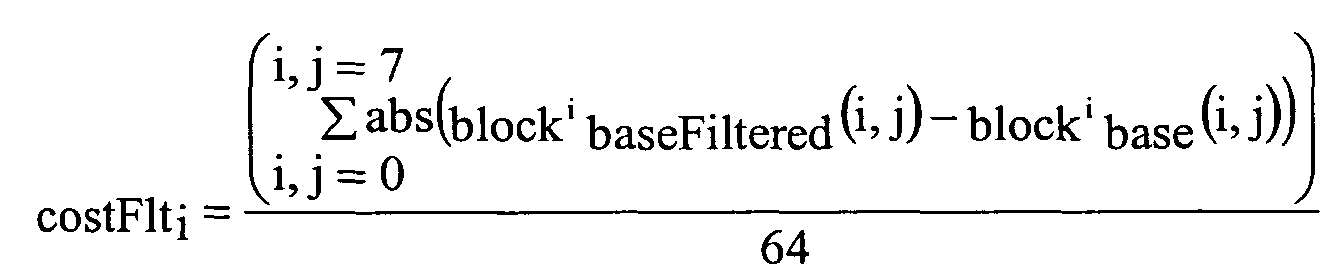
where abs is the absolute value function, and blockbasefiltered(i,j) - blockbase(i,j) represents the difference in values of the pixel with coordinates i and j of the base layer after filtering and before filtering.
where abs is the absolute value function, and blockbasefiltered(i,j) - blockbase(i,j) represents the difference in values of the pixel with coordinates i and j of the base layer after filtering and before filtering.
8. Device according to Claim 6, characterized in that it comprises means for generating the enhancement layer of a block as a function
of a parameter relating to an average luminance (Lavg) associated with this block,
determined for example by adding up the luminances of the pixels of the block considered.
9. Device according to claim 8, characterized in that it comprises means for weighting the cost of the filtering of a block as a function
of a coefficient F(Lavgi) whose value depends on the average luminance of this block.
10. Device according to claim 6, characterized in that it comprises means for weighting the cost of the filtering as a function of a coefficient
F(Lavgi) whose value depends on the texture, or activity, of the considered block of pixels.
11. Device according to claim 1, characterized in that it comprises means for generating the enhancement layer by considering a motion or
displacement vector associated with each pixel block i, for example by means of the
formula:

where the components Vx and Vy represent the horizontal and vertical displacements of the block.
where the components Vx and Vy represent the horizontal and vertical displacements of the block.
12. Device according to claim 1, characterized in that it comprises means for generating the enhancement layer by considering the possible
exit of the block in an image subsequent to the image considered.
13. Device according to claim 1, characterized in that it comprises means for estimating the quality (psnr) of restitution of a block of
pixels with the aid of an affine modelling such that the quality (psnr) of restitution
of an image has a linear form:

where Dpsnr is a constant equal, for example, to 0.212 dB/bit per block and x represents the allotted number of bits per block.
where Dpsnr is a constant equal, for example, to 0.212 dB/bit per block and x represents the allotted number of bits per block.
14. Device according to claim 1, characterized in that it comprises means for generating the enhancement layer by allotting more bits to
the blocks of an image if this image is used to generate other images, for example
in the case of an inter-image predictive coding.
15. Device according to claim 1, characterized in that it comprises means for coding the base layer with the aid of a discrete cosine transform
(DCT).
16. Method for compressing a source image by means of a base layer, coding a base image,
and of an enhancement layer, coding a residual existing between the source image and
the base image, the source image and the base image being structured as blocks of
pixels, characterized in that the enhancement layer of a block is generated as a function of the quality (psnrk) of restitution of this block (k), determined by comparing the coding of this block
in the source image with the coding of this block in the base image, and/or as a function
of information coded by this block of pixels.