|
(11) | EP 1 511 732 B9 |

| (12) | CORRECTED EUROPEAN PATENT SPECIFICATION |
| Note: Bibliography reflects the latest situation |
|
|
| (54) |
PROCESS FOR THE MANUFACTURE OF QUINOLINE DERIVATIVES VERFAHREN ZUR HERSTELLUNG VON CHINOLINDERIVATEN METHODE DE PRODUCTION DE DERIVES DE QUINOLINE |
|
|
|||||||||||||||||||||||||||||||||||
| Note: Within nine months from the publication of the mention of the grant of the European patent, any person may give notice to the European Patent Office of opposition to the European patent granted. Notice of opposition shall be filed in a written reasoned statement. It shall not be deemed to have been filed until the opposition fee has been paid. (Art. 99(1) European Patent Convention). |
FIELD OF THE INVENTION
[0001] The present invention relates to a process for the manufacturing of quinoline derivatives. More particularly, the present invention relates to an improved and simplified process for the manufacture of quinoline-3-carboxamide derivatives.
BACKGROUND OF THE INVENTION
[0002] In US Pat. No. 4,738,971 some derivatives of N-aryl-1,2-dihydro-4-substituted-1-alkyl-2-oxo-quinoline-3-carboxamide are claimed as enhancers of cell-mediated immunity. Said patent discloses four methods for the preparation of the compounds. According to the method closest to that of the present invention, the compounds are prepared by reacting a carboxylic acid or a reactive derivative thereof with an amine or reactive derivative thereof in the presence of pyridine or quinoline as an inert solvent. U.S. Patent No. 5,912,349 discloses an improved process to produce one of these compounds, roquinimex (Merck Index 12th Ed., No. 8418; Linomide®, LS2616, N-phenyl-N-methyl-1,2-dihydro-4-hydroxy-1-methyl-2-oxo-quinoline-3-carboxamide). In said patent, a reaction between N-methylisatoic anhydride and N-methyl-N-phenyl-α-carbomethoxyacetamide gives the desired compound. U.S. Patent Nos. 6,077,851, 6,133,285 and 6,121,287 disclose the preparation of quinoline-3-carboxamide derivatives. The derivatives may be prepared by various known methods, for example, by reaction of a quinoline-3-carboxylic acid ester derivative with an aniline in a suitable solvent such as toluene, xylene and the like. In the examples disclosed, wherein toluene is used as a solvent, the yields are ≤80%.
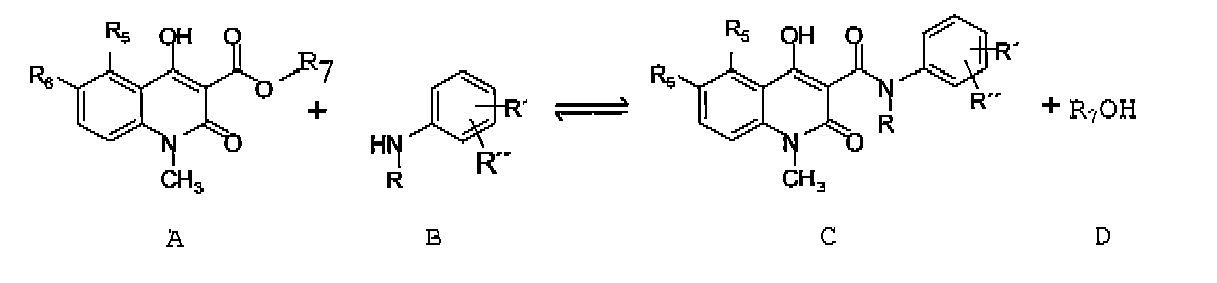
[0003] The prior art reaction disclosed below
showing the N-acylation reaction conducted with a quinoline-3-carboxylic acid ester derivative has now been found to be an equilibrium reaction where the equilibrium point unexpectedly lies far to the left. An illustrative example is provided by heating a quinoline-3-carboxamide derivative (compound C), for example, wherein R5 = chloro and R6 = H, R = ethyl and R' = R" = hydrogen, in a sealed vessel at 100°C with one equivalent of methanol in toluene as a solvent. An almost complete transformation into the corresponding methyl ester (compound A) results after less than 30 minutes.
[0004] The chemical stability of the desired product is such that degradation occurs under the reaction conditions.
[0006] An illustrative example is provided above. The degradation product (compound F) is the decarboxylated quinoline-3-carboxylic acid (compound E). Compound E is formed from the reaction between the quinoline-3-carboxamide derivative and water. It is unavoidable that small amounts of water exist in a reaction mixture. Small amounts of water are always present in the starting materials and in the solvent, and water can also enter the reaction mixture during the reaction. When using, for example, toluene, the desired product is dissolved and prone to reaction with water. The quinoline-3-carboxylic acid that is formed in the reaction between the quinoline-3-carboxamide derivative and water undergoes a decarboxylation reaction to yield the decarboxylated product (compound F). The quinoline-3-carboxylic acid is not present in the crude product in a detectable amount. The quinoline-3-carboxylic acid ester (compound A) also undergoes a similar reaction with water but at a much slower rate.
DESCRIPTION OF THE INVENTION
[0007] A primary objective of the present invention is to provide an improved process for the manufacturing of quinoline-3-carboxamide derivatives which by virtue of their pharmacological profile, with high activity and low side-effects, are considered to be of value in the treatment of disease resulting from pathologic inflammation and autoimmunity and the treatment of a plurality of malignant tumours. More particularly, the present invention relates to a greatly simplified process for the manufacture of a quinoline-3-carboxamide derivative from an aniline by a N-acylation reaction conducted with a quinoline-3-carboxylic acid ester derivative in order to improve yield and chemical purity of the desired product.
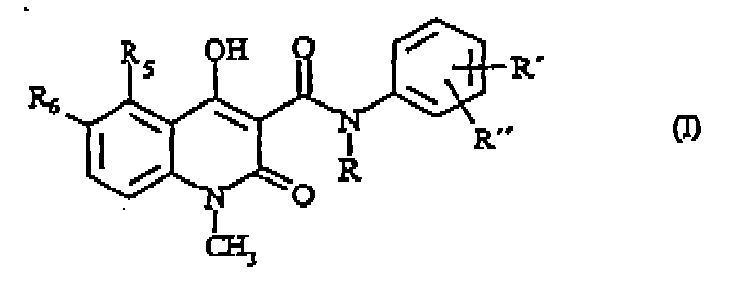
[0008] It has now surprisingly been found that the compounds of general formula (I)
wherein
R is selected from methyl, ethyl, n-propyl, iso-propyl, n-butyl, iso-butyl, sec.-butyl and allyl;
R5 is selected from methyl, ethyl, n-propyl, iso-propyl, methoxy, ethoxy, methylthio, ethylthio, n-propylthio, methylsulphinyl, ethylsulphinyl, fluoro, chloro, bromo, trifluoromethyl, and OCHxFy;
wherein
x = 0 - 2,
y = 1 - 3 with the proviso that
x + y = 3;
R6 is hydrogen; or
R5 and R6 taken together are methylenedioxy;
R' is selected from hydrogen, methyl, methoxy, fluoro, chloro, bromo, trifluoromethyl, and OCHxFy,
wherein
x=0-2,
y = 1 - 3 with the proviso that
x+y=3;
R" is selected from hydrogen, fluoro and chloro, with the proviso that R" is selected from fluoro and chloro only when R' is selected from fluoro and chloro;
by the claimed process comprising reacting a quinoline-3-carboxylic acid ester derivative of formula A with an aniline derivative of formula B
wherein R7 is selected from methyl and ethyl;
in a solvent selected from straight or branched alkanes and cycloalkanes or mixtures thereof with a boiling point between 80 and 200°C are manufactured in a greatly improved and simplified way.
[0011] The process according to the invention is especially preferred for the preparation of N-ethyl-N-pheuyl-5-chloro-1,2-dihydro-4-hydtoxy-1-methyl-2-oxo-quinoline-3-carboxamide using n-heptane as a solvent; for the preparation of N-metthyl-N-(4-trifluoromethyl-phenyl)-1,2-dihydro-4-hydroxy-5-methoxy-1-raethyl-Z-oxo-quinoline-3-carboxamide using a mixture of n-heptane and n-octane as a solvent; for the preparation of N-ethyl-N-phenyl-1,2-dihydro-5-ethyl-4-hydroxy-1-methyl-2-oxo-quinoline-3-carboxamide using cis,trans-decahydronaphthalene as a solvent.
[0012] In relation to the use of toluene, xylene and the like as solvents, it has now surprisingly and unexpectedly been found that yield and impurity profile of the desired products can be very much improved. By using a solvent wherein the desired product is in effect insoluble even at reflux temperature, combined with removal of the alcohol formed, the yield of the desired product is almost 100% with a very low level of impurities in the desired product. Precipitation of the desired product increases the reaction rate even further, and prevents the degradation, i.e., by avoiding the reaction of the desired product with water. Solvents improving the process are straight- or branch-chained alkanes and cycloalkanes or mixtures thereof with a boiling point between 80 and 200°C. Reduced pressure may be used to remove the alcohol formed.
EXAMPLES
[0013] Without further elaboration, it is believed that one skilled in the art, using the preceding description, practice the present invention to its fullest extent. The following detailed examples describe how to prepare the various compounds and/or perform the various processes of the invention and are to be considered as merely illustrative, and not limitations of the preceding disclosure in any way whatsoever.
Example 1 [starting material]
1,2-Dihydro-4-hydroxy-5-chloro-1-methyl-2-oxo-quinoline-3-carboxylic acid methyl ester
[0014] 2-Amino-6-chlorobenzoic acid (30 g) was suspended in 1,4-dioxane (225 ml) and ethyl chloroformate (75 ml) was added. The mixture was heated at reflux for 1 hour, then cooled to 50°C, and acetyl chloride (75 ml) was added. The mixture was stirred for 10 hours, after which the precipitated product was filtered off and washed with toluene. Drying in vacuum yields 5-chloroisatoic anhydride (33 g, 97% yield). 5-Chloroisatoic anhydride (30 gram) was dissolved in dimethylacetamide (300 ml), and cooled to 5°C over a nitrogen atmosphere. Sodium hydride (5.8 g, 70 %) was added portionwise, followed by addition of methyl iodide (11.5 ml). The reaction mixture was stirred at room temperature for 18 hours and the evacuated (40 mbar) for 1 hour in order to remove excess methyl iodide. Sodium hydride (5.8 g, 70 %) was added followed by addition of dimethyl malonate (20 ml), and the mixture was heated to 85°C. After 3 hours at 85°C, the mixture was cooled and diluted with cold water (2.4 litre). The product was precipitated by addition of 5 M HCl (aq) until pH=1.5-2. Filtration of the precipitated product and recrystallisation from methanol gave the title compound (29 g, 70 % yield).
[0015] In essentially the same manner the ethyl ester is obtained from the corresponding starting materials.
Example 2
[0016] N-Ethyl-N-phenyl-5-chloro-1,2-dihydro-4-hydroxy-1-methyl-2-oxo-quinoline-3-carboxamide 5-Chloro-1,2-dihydro-4-hydroxy-1-methyl-2-oxo-quinoline-3-carboxylic acid methyl ester (3.0 g), N-ethylaniline (2 eq. 2.88 ml), and heptane (60 ml) were heated and the volatiles, mainly heptane and formed methanol, (32 ml) distilled off during 6 hours and 35 minutes. After cooling to room temperature the crystalline suspension was filtered and the crystals were washed with heptane and dried in vacuum to yield the crude title compound (3.94 g, 98 %) as white to off-white crystals.
Example 3
N-Ethyl-N-phenyl-5-chloro-1,2-dihydro-4-hydroxy-1-methyl-2-oxo-quinoline-3-carboxamide (reaction in toluene, not part of the invention)
[0017] 5-Chloro-1,2-dihydro-4-hydroxy-1-methyl-2-oxo-quinoline-3-carboxylic acid methyl ester (3.0 g), N-ethylaniline (2 eq. 2.88 ml), and toluene (60 ml) were heated and the volatiles, mainly toluene and formed methanol, (32 ml) were distilled off during 6 hours and 35 minutes. After cooling to room temperature and precipitation of the product with heptane (40 ml), the crystals were filtered and washed with heptane and dried in vacuum to yield the crude title compound (3.58 g, 90 % yield) as off-white crystals.
[0018] The crude products were analysed using HPLC and reference compounds, see table 1. Only two by-products were detected in the crude products. Peaks with area-% below 0.02% are not included.
Table 1. Content of desired product and by-products in the crude products
|
weight-% in crude product |
weight-% in crude product |
weight-% in crude product |
|
| Heptane as solvent | 99.4 | 0.02 | 0.03 |
| Toluene as solvent | 94.0 | 4.55 | 0.54 |
[0019] The increased reaction rate in heptane is apparent. More untransformed ester remained in the crude product when using toluene as compared to heptane as a solvent. The rate difference may be even bigger than indicated in Table 1 since reaction in toluene occurs at a higher temperature than the corresponding reaction in heptane (toluene has bp 110-112°C and heptane has bp 98°C). The ester is more soluble in alkanes than the product, a fact that influences the equilibrium positively and favours formation of product.
[0020] The yield of crude product when using toluene was lower (90 %) than when using heptane (98%). This can be attributed to the higher solubility of product and ester in toluene than in heptane. The actual yield when using heptane is close to 100 %. The decarboxylated quinoline carboxylic acid (toluene 0.54 %, and heptane 0.03 %, see Table 1) is the result of reaction between water and the desired product.
1. A process for the preparation of the compounds of general formula (I)
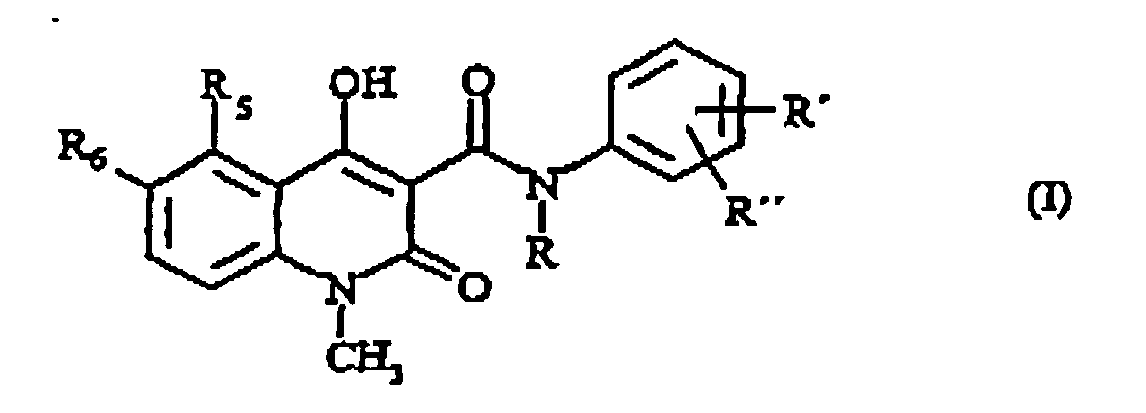
wherein
R is selected from methyl ethyl, n-propyl, iso-propyl, n-butyl, iso-butyl, sec.-butyl and allyl;
R5 is selected from methyl, ethyl, n-propyl, iso-propyl, methoxy, ethoxy, methylthio, ethylthio, n-propylthio, methylsulphinyl, ethylsulphinyl, fluoro, chloro, bromo, trifluoromethyl, and OCHxFy,
wherein
x = 0 - 2,
y = 1 - 3 with the proviso that
x+y=3;
R6 is hydrogen; or
R5 and R6 taken together are methylenedioxy;
R' is selected from hydrogen, methyl, methoxy, fluoro, chloro, bromo, trifluoromethyl, and OCHxFy,
wherein
x = 0 - 2,
y = 1 - 3 with the proviso that
x+y=3;
R" is selected from hydrogen, fluoro and chloro, with the proviso that R" is selected from fluoro and chloro only when R' is selected from fluoro and chloro;
by reacting a quinoline-3-carboxylic acid ester derivative of formula A with an aniline derivative of formula B
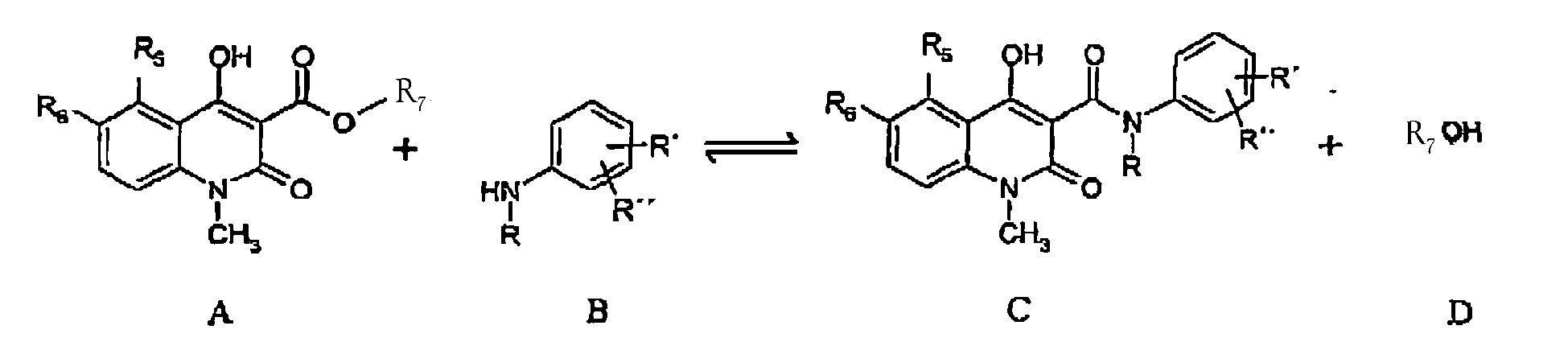
wherein R7 is selected from methyl and ethyl ;
in a solvent selected from straight or branched alkanes and cycloalkanes or mixtures thereof with a boiling point between 80 and 200°C.
wherein
R is selected from methyl ethyl, n-propyl, iso-propyl, n-butyl, iso-butyl, sec.-butyl and allyl;
R5 is selected from methyl, ethyl, n-propyl, iso-propyl, methoxy, ethoxy, methylthio, ethylthio, n-propylthio, methylsulphinyl, ethylsulphinyl, fluoro, chloro, bromo, trifluoromethyl, and OCHxFy,
wherein
x = 0 - 2,
y = 1 - 3 with the proviso that
x+y=3;
R6 is hydrogen; or
R5 and R6 taken together are methylenedioxy;
R' is selected from hydrogen, methyl, methoxy, fluoro, chloro, bromo, trifluoromethyl, and OCHxFy,
wherein
x = 0 - 2,
y = 1 - 3 with the proviso that
x+y=3;
R" is selected from hydrogen, fluoro and chloro, with the proviso that R" is selected from fluoro and chloro only when R' is selected from fluoro and chloro;
by reacting a quinoline-3-carboxylic acid ester derivative of formula A with an aniline derivative of formula B
wherein R7 is selected from methyl and ethyl ;
in a solvent selected from straight or branched alkanes and cycloalkanes or mixtures thereof with a boiling point between 80 and 200°C.
2. The process according to claim 1 wherein the solvent is n-beptane, n-octane or mixtures thereof.
3. The process according to claim 1 wherein the solvent is cis,trans-decahydxonaphthalene (Decalin®).
4. The process according to claim 1 for the preparation of N-ethyl-N-phenyl-5-chloro-1,2-dihydro-4-hydroxy-1-methyl-2-oxo-qninoline-3-carboxamide
using n-heptane as a solvent.
5. The process according to claim 1 for the preparation of N-methyl-N-(4-trifluoromethylphenyl)-1,2-dihydxo-4-hydxoxy-5-methoxy-1-methyl-2-oxo-quinoline-3-carboxamide
using a mixture of n-heptane and n-octane as a solvent.
6. The process according to claim 1 for the preparation of N-ethyl-N-phenyl-1,2-dihydro-5-ethyl-4-hydroxy-1-methyl-2-oxo-quinoline-3-carboxamide
using cis,trans-decahydronaphthalene (Decalin®) as a solvent.
1. Verfahren zur Herstellung der Verbindungen der allgemeinen Formel (I)
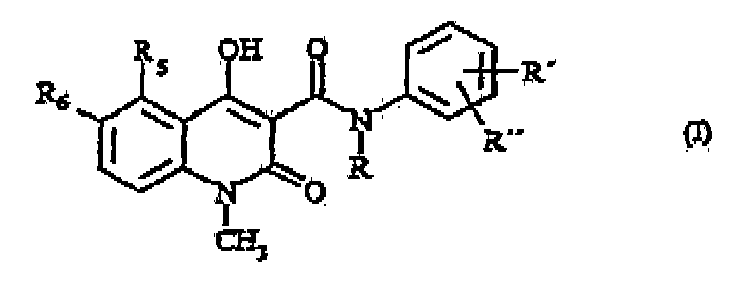
worin
R ausgewählt ist aus Methyl, Ethyl, n-Propyl, Isopropyl, n-Butyl, Isobutyl, sec-Butyl und Allyl;
R5 ausgewählt ist aus Methyl, Ethyl, n-Propyl, Isopropyl, Methoxy, Ethoxy, Methylthio, Ethylthio, n-Propylthio, Methylsulfinyl, Ethylsulfinyl, Fluor, Chlor, Brom, Trifluormethyl und OCHxFy;
worin
x = 0 - 2,
y = 1 - 3 mit der Maßgabe, dass
x + y = 3;
R6 Wasserstoff ist; oder
R5 und R6 zusammengefasst Methylendioxy sind;
R' ausgewählt ist aus Wasserstoff, Methyl, Methoxy, Fluor, Chlor, Brom, Trifluormethyl und OCHxFy,
worin
x = 0 - 2,
y = 1 - 3 mit der Maßgabe, dass
x + y = 3;
R" ausgewählt ist aus Wasserstoff, Fluor und Chlor, mit der Maßgabe, dass R" nur aus Fluor und Chlor ausgewählt ist, wenn R' aus Fluor und Chlor ausgewählt ist; durch Umsetzen Chinolin-3-carbonsäureesterderivats der Formel A mit einem Anilinderivat der Formel B
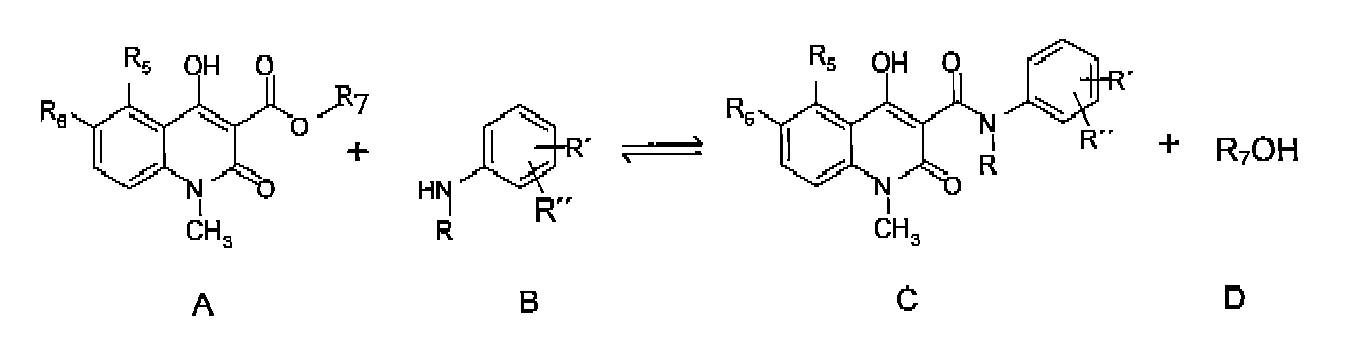
worin R7 ausgewählt ist aus Methyl und Ethyl;
in einem Lösungsmittel, ausgewählt aus geradkettigen oder verzweigten Alkanen und Cycloalkanen oder Gemischen davon mit einem Siedepunkt zwischen 80 und 200°C.
worin
R ausgewählt ist aus Methyl, Ethyl, n-Propyl, Isopropyl, n-Butyl, Isobutyl, sec-Butyl und Allyl;
R5 ausgewählt ist aus Methyl, Ethyl, n-Propyl, Isopropyl, Methoxy, Ethoxy, Methylthio, Ethylthio, n-Propylthio, Methylsulfinyl, Ethylsulfinyl, Fluor, Chlor, Brom, Trifluormethyl und OCHxFy;
worin
x = 0 - 2,
y = 1 - 3 mit der Maßgabe, dass
x + y = 3;
R6 Wasserstoff ist; oder
R5 und R6 zusammengefasst Methylendioxy sind;
R' ausgewählt ist aus Wasserstoff, Methyl, Methoxy, Fluor, Chlor, Brom, Trifluormethyl und OCHxFy,
worin
x = 0 - 2,
y = 1 - 3 mit der Maßgabe, dass
x + y = 3;
R" ausgewählt ist aus Wasserstoff, Fluor und Chlor, mit der Maßgabe, dass R" nur aus Fluor und Chlor ausgewählt ist, wenn R' aus Fluor und Chlor ausgewählt ist; durch Umsetzen Chinolin-3-carbonsäureesterderivats der Formel A mit einem Anilinderivat der Formel B
worin R7 ausgewählt ist aus Methyl und Ethyl;
in einem Lösungsmittel, ausgewählt aus geradkettigen oder verzweigten Alkanen und Cycloalkanen oder Gemischen davon mit einem Siedepunkt zwischen 80 und 200°C.
2. Verfahren nach Anspruch 1, worin das Lösungsmittel n-Heptan, n-Octan oder Gemische
davon ist.
3. Verfahren nach Anspruch 1, worin das Lösungsmittel cis,trans-Decahydronaphthalin (Decalin®)
ist.
4. Verfahren nach Anspruch 1 zur Herstellung von N-Ethyl-N-phenyl-5-chlor-1,2-dihydro-4-hydroxy-1-methyl-2-oxo-chinolin-3-carboxamid
unter Verwendung von n-Heptan als Lösungsmittel.
5. Verfahren nach Anspruch 1 zur Herstellung von N-Methyl-N-(4-trifluormethylphenyl)-1,2-dihydro-4-hydroxy-5-methoxy-1-methyl-2-oxo-chinolin-3-carboxamid
unter Verwendung eines Gemisches aus n-Heptan und n-Octan als Lösungsmittel.
6. Verfahren nach Anspruch 1 zur Herstellung von N-Ethyl-N-phenyl-1,2-dihydro-5-ethyl-4-hydroxy-1-methyl-2-oxo-chinolin-3-carboxamid
unter Verwendung von cis,trans-Decahydronaphthalin (Decalin®) als Lösungsmittel.
1. Procédé pour la préparation des composés de formule générale (I)
dans laquelle
R est choisi parmi méthyle, éthyle, n-propyle, iso-propyle, n-butyle, iso-butyle, sec.-butyle et allyle ;
R5 est choisi parmi méthyle, éthyle, n-propyle, iso-propyle, méthoxy, éthoxy, méthylthio, éthylthio, n-propylthio, méthylsulfinyle, éthylsulfinyle, fluoro, chloro, bromo, trifluorométhyle et OCHxFy ;
où
x = 0 à 2,
y = 1 à 3 avec la condition que
x + y = 3 ;
R6 est un hydrogène ; ou
R5 et R6 pris ensemble sont méthylènedioxy ;
R' est choisi parmi hydrogène, méthyle, méthoxy, fluoro, chloro, bromo, trifluorométhyle et OCHxFy,
où
x = 0 à 2,
y = 1 à 3 avec la condition que
x + y = 3 ;
R" est choisi parmi hydrogène, fluoro et chloro, avec la condition que R" est choisi parmi fluoro et chloro seulement lorsque R' est choisi parmi fluoro et chloro ;
consistant à faire réagir un ester de l'acide quinoléine-3-carboxylique de formule A avec un dérivé d'aniline de formule B
dans lequel R7 est choisi parmi méthyle et éthyle;
dans un solvant choisi parmi les alcanes linéaires ou ramifiés et les cycloalcanes ou les mélanges de ceux-ci ayant un point d'ébullition entre 80 et 200°C.
dans laquelle
R est choisi parmi méthyle, éthyle, n-propyle, iso-propyle, n-butyle, iso-butyle, sec.-butyle et allyle ;
R5 est choisi parmi méthyle, éthyle, n-propyle, iso-propyle, méthoxy, éthoxy, méthylthio, éthylthio, n-propylthio, méthylsulfinyle, éthylsulfinyle, fluoro, chloro, bromo, trifluorométhyle et OCHxFy ;
où
x = 0 à 2,
y = 1 à 3 avec la condition que
x + y = 3 ;
R6 est un hydrogène ; ou
R5 et R6 pris ensemble sont méthylènedioxy ;
R' est choisi parmi hydrogène, méthyle, méthoxy, fluoro, chloro, bromo, trifluorométhyle et OCHxFy,
où
x = 0 à 2,
y = 1 à 3 avec la condition que
x + y = 3 ;
R" est choisi parmi hydrogène, fluoro et chloro, avec la condition que R" est choisi parmi fluoro et chloro seulement lorsque R' est choisi parmi fluoro et chloro ;
consistant à faire réagir un ester de l'acide quinoléine-3-carboxylique de formule A avec un dérivé d'aniline de formule B
dans lequel R7 est choisi parmi méthyle et éthyle;
dans un solvant choisi parmi les alcanes linéaires ou ramifiés et les cycloalcanes ou les mélanges de ceux-ci ayant un point d'ébullition entre 80 et 200°C.
2. Procédé selon la revendication 1, dans lequel le solvant est le n-heptane, le n-octane ou les mélanges de ceux-ci.
3. Procédé selon la revendication 1, dans lequel le solvant est le cis,trans-décahydronaphtalène (Decaline®).
4. Procédé selon la revendication 1, pour la préparation de N-éthyl-N-phényl-5-chloro-1,2-dihydro-4-hydroxy-1-méthyl-2-oxo-quinoléine-3-carboxamide
en utilisant du n-heptane en tant que solvant.
5. Procédé selon la revendication 1, pour la préparation de N-méthyl-N-(4-trifluorométhylphényl)-1,2-dihydro-4-hydroxy-5-méthoxy-1-méthyl-2-oxo-quinoléine-3-carboxamide
en utilisant un mélange de n-heptane et de n-octane en tant que solvant.
6. Procédé selon la revendication 1, pour la préparation de N-éthyl-N-phényl-1,2-dihydro-5-éthyl-4-hydroxy-1-méthyl-2-oxo-quinoléine-3-carboxamide
en utilisant du cis,trans-décahydronaphtalène (Decaline®) en tant que solvant.
REFERENCES CITED IN THE DESCRIPTION
This list of references cited by the applicant is for the reader's convenience only. It does not form part of the European patent document. Even though great care has been taken in compiling the references, errors or omissions cannot be excluded and the EPO disclaims all liability in this regard.
Patent documents cited in the description