|
(11) | EP 1 547 266 B1 |

| (12) | EUROPEAN PATENT SPECIFICATION |
|
|
| (54) |
RAKE RECEIVER RAKE-EMPFûNGER RECEPTEUR RAKE |
|
|
||||||||||||||||||||||||||||
| Note: Within nine months from the publication of the mention of the grant of the European patent, any person may give notice to the European Patent Office of opposition to the European patent granted. Notice of opposition shall be filed in a written reasoned statement. It shall not be deemed to have been filed until the opposition fee has been paid. (Art. 99(1) European Patent Convention). |
Field of the Invention
Background to the Invention
[0002] Rake receivers are widely used in CDMA (Code Division Multiple Access) radio communication systems. A rake receiver seeks to synchronise a plurality of parallel receivers, known as rake fingers, to respective received signals having different path delays.
[0003] The transmitters and receivers in CDMA radio communication systems include filters, the consequence of which is the generation of spurious signals time shifted with respect to the original signal. For example, in a typical system the transmitter and receiver filters act to produce a raised cosine pulse shape in the receiver. Such a pulse shape has temporal side lobes. With raised cosine filters, the maximum of the first side lobes are normally at a distance of 1.4 chips from the main lobe. If the filters sample at 0.5 chip intervals, the closest in of the side lobes are 1.5 chips either side of the centre of main lobe and approximately 14dB down.
[0004] The main lobe and side lobe signals appear to a rake receiver as a relatively strong signal preceded by versions following shorter but more lossy paths and followed by signals following longer and more lossy paths.
Summary of the Invention
[0005] According to the present invention, there is provided a rake receiver comprising impulse response measurement means and path allocation means for allocating paths to rake fingers in dependence on the output of the impulse response measurement means, characterised in that the path allocating means is configured to compare the magnitudes of pairs of peaks, represented in the output of the impulse response measurement means, and ignore the lesser member of a pair for the allocation of paths to rake fingers, if the magnitudes of the pair differ in a predetermined manner so as to exclude spurious paths, the pairs comprising peaks temporally separated by a period characteristic of the separation of main and side lobes of filters for producing the baseband pulse shape expected by the receiver.
[0006] Thus, by analysing the separation and relative magnitudes of pairs of peaks, it is possible to identify spurious paths. In any given system, the separations and relative magnitudes characteristic of the presence of a spurious path will depend on the details of the system, e.g. filter design and noise spectrum.
[0007] Generally, the magnitude of the ratio of the magnitudes of a pair of peaks will fall within a predetermined, system-dependent, range if one of the peaks relates to a spurious path. Preferably, the predetermined manner comprises the magnitude of the result of their ratio minus a reference value being less than a threshold value. More preferably, the reference value corresponds to the theoretical lobe ratio increased by an amount attributable to the uncertainty introduced by noise. Still more preferably, said reference value comprises half the sum of the upper and lower bounds of a confidence interval in the probability density for the lobe ratio, the confidence interval being not less than 90% and preferably about 95% and, optionally, said threshold value is half the width of said confidence interval.
[0009] Preferably, the predetermined manner comprises meeting the criterion:-
where Mp1 and Mp2 are the magnitudes of the peaks of a pair, R is a reference ratio for a main lobe and a side lobe and I is a confidence factor. More preferably, R is approximately 0.175, preferably 0.1746, and I is approximately 0.065, preferably 0.0643.
[0010] The present invention may be implemented in a mobile phone or a base station of a mobile phone network.
Brief Description of the Drawings
[0011]
Figure 1 is a block diagram of a mobile station;
Figure 2 is a block diagram of the rake functionality of the DSP subsystem of the mobile station of Figure 1;
Figure 3 is a flowchart illustrating the delay selection process performed by the DSP subsystem; and
Figure 4 shows a mobile phone network base station including a rake receiver according to the present invention.
Detailed Description of the Preferred Embodiment
[0012] A preferred embodiment of the present invention will now be described, by way of example, with reference to the accompanying drawings.
[0013] Referring to Figure 1, a WCDMA mobile station comprises an antenna 1, an RF subsystem 2, a baseband DSP (digital signal processing) subsystem 3, an analogue audio subsystem 4, a loudspeaker 5, a microphone 6, a controller 7, a liquid crystal display 8, a keypad 9, memory 10, a battery 11 and a power supply circuit 12.
[0014] The RF subsystem 2 contains IF and RF circuits of the mobile telephone's transmitter and receiver and a frequency synthesizer for tuning the mobile station's transmitter and receiver. The antenna 1 is coupled to the RF subsystem 2 for the reception and transmission of radio waves.
[0015] The baseband DSP subsystem 3 is coupled to the RF subsystem 2 to receive baseband signals therefrom and for sending baseband modulation signals thereto. The baseband DSP subsystem 3 includes rake functionality, as well as decoding and bit detecting functionality which are well-known in the art.
The analogue audio subsystem 4 is coupled to the baseband DSP subsystem 3 and receives demodulated audio therefrom. The analogue audio subsystem 4 amplifies the demodulated audio and applies it to the loudspeaker 5. Acoustic signals, detected by the microphone 6, are pre-amplified by the analogue audio subsystem 4 and sent to the baseband DSP subsystem 3 for coding.
[0016] The controller 7 controls the operation of the mobile telephone. It is coupled to the RF subsystem 2 for supplying tuning instructions to the frequency synthesizer and to the baseband DSP subsystem 3 for supplying control data and management data for transmission. The controller 7 operates according to a program stored in the memory 10. The memory 10 is shown separately from the controller 7. However, it may be integrated with the controller 7.
[0017] The display device 8 is connected to the controller 7 for receiving control data and the keypad 9 is connected to the controller 7 for supplying user input data signals thereto.
[0018] The battery 11 is connected to the power supply circuit 12, which provides regulated power at the various voltages used by the components of the mobile telephone.
[0019] The controller 7 is programmed to control the mobile station for speech and data communication and with application programs, e.g. a WAP browser, which make use of the mobile station's data communication capabilities.
[0020] In order to ameliorate the effect of filter temporal side lobes, the DSP subsystem 3 is programmed to take the relative strengths of the filter lobes when setting up rake fingers.
[0021] Referring to Figure 2, the DSP subsystem 3 implements four conventional rake fingers 21 a, 21 b, 21 c, 21 d, a conventional impulse response measurement process 22 and a delay selection process 23 which identifies the paths to be allocated to rake fingers and supplies phase information to the rake fingers 21 a, 21 b, 21 c, 21d. The phase information is used by the rake fingers 21 a, 21 b, 21 c, 21 d to control the phase of the despreading sequence.
[0022] The received signal is supplied to the impulse response measurement process 22 and to each of the rake fingers 21 a, 21 b, 21 c, 21 d. The impulse response measurement process 22 outputs up to eight delay and magnitude values notionally corresponding to different paths. Each delay and magnitude value pair relates to one peak in the impulse response of the input signal. The output of the impulse response measurement process 22 is then processed by the delay selection process 23 to select the four best paths.
[0024] Referring to Figure 3, the delay selection process first calculates the temporal distances between the delays output by the impulse measurement process 22 (step s1). If none of these distances is the equivalent 1.5 chips (i.e. 3 x 0.5 chips which is the sampling period of the filters in the system), the four delays having the greatest magnitudes are then selected and supplied to respective rake fingers 21a, 21b, 21c, 21 d (step s3).
[0025] If any 1.5 chip distances are found at step s2, for each pair of 1.5 chip separated peaks (step S4), the following is calculated:
where Mp1 and Mp2 are the magnitudes of the peaks comprised in the pair (step s4). The resultant values are compared with 0.0643 (step s5) and, if they are lower, the peak of the current pair having the lower magnitude is removed from the set of peaks output by the impulse response measurement process 22 (step s6).
[0026] When all of the pairs of 1.5 chip separated peaks have been processed, the best four remaining peaks are selected and the corresponding delays provided to the rake fingers 21a, 21b, 21c, 21d (step s3).
[0027] If there are less than four peaks, a corresponding reduced number of rake fingers 21a, 21b, 21c, 21d are employed.
[0028] In this way, resources are not wasted by allocating rake fingers 21a, 21b, 21c, 21d to spurious paths.
[0029] In the present example, the theoretical magnitude difference between adjacent lobes, e.g. the main lobe and a first side lobe, is 14.52dB. However, uncertainties in the magnitudes of the peaks output by the impulse response measurement process 22 can result from thermal and correlation noise and jitter in the filter sampling clock. The consequence of these two effects is an asymmetrical probability density function for the ratio between the main and first side lobes. In the present example, the "sidelobe ratio" is taken to be the mid-point of the 95% confidence interval of this probability density function, i.e. 0.1746 = -15.16dB as used in equation (1) above.
[0030] The value (0.0643) with which the result of equation (1) is compared is the "sidelobe interval" which is the magnitude of the half the length of the 95% confidence interval. This value is related to the range of calculated sidelobe ratios within which spurious paths arising from side lobes can be reliably detected.
[0031] Experiments with the above example have shown that rake fingers will only be allocated to spurious paths in 5% of cases. As a result, there is a significant improvement in signal to noise ratio in the receiver and, since often not all rake fingers are allocated paths, there is a saving in power consumption by the mobile station.
[0032] Referring to Figure 4, a mobile phone network base station 30 includes and RF section 31 and a baseband digital signal processing section 32 and a controller 33 for controlling the RF section 31 and the baseband digital signal processing section 32. The RF section 31 receives RF signals from mobile phones and outputs demodulated baseband signals. The demodulated baseband signals are processed by the baseband digital signal processing section 32 which applies the signals to a plurality of rake fingers as described above. Peaks associated with spurious paths, created by filtering in the system, are removed, as described above, in the allocation of rake fingers to paths.
[0033] It will be appreciated that the temporal separation of lobes will depend on the sampling frequency used for the pulse-forming filters. Additionally, the magnitude difference between the main lobe and the first side lobes will be different for different filter designs and different pulse shapes. The values for the sidelobe ratio and the sidelobe interval will be a matter of choice to a degree and may be based on, for example, a 90% confidence range, depending on the degree of spurious path rejection that is desired.
[0034] In the above embodiment, the magnitudes of the peaks are measured in terms of the signal amplitude. In an alternative embodiment (not shown), the magnitudes of the peaks are measured in terms of the signal power. In this embodiment, the difference between the magnitudes of the peaks is the same value in dB as it is with the amplitude measuring embodiment. However, the confidence interval is modified such that it is the square of the confidence interval of the corresponding amplitude measuring embodiment.
1. A rake receiver comprising impulse response measurement means (22) and path allocation
means (23) for allocating paths to rake fingers (21 a, 21b, 21 c, 21 d) in dependence
on the output of the impulse response measurement means (22), characterised in that the path allocating means (23) is configured to compare the magnitudes of pairs of
peaks, represented in the output of the impulse response measurement means (23), and
ignore the lesser member of a pair for the allocation of paths to rake fingers (21
a, 21 b, 21 c, 21 d), if the magnitudes of the pair differ in a predetermined manner
so as to exclude spurious paths, the pairs comprising peaks temporally separated by
a period characteristic of the separation of main and side lobes of filters for producing
the baseband pulse shape expected by the receiver.
2. A rake receiver according to claim 1, wherein said predetermined manner comprises
the magnitude of their ratio being within a predetermined range.
3. A rake receiver according to claim 2, wherein said predetermined manner comprises
the magnitude of the result of their ratio less a reference value being less than
a threshold value.
4. A rake receiver according to claim 3, wherein the reference value corresponds to the
theoretical lobe ratio increased by an amount attributable to the uncertainty introduced
by noise.
5. A. rake receiver according to claim 4, wherein said reference value comprises half
the sum of the upper and lower bounds of a confidence interval in the probability
density for the lobe ratio, the confidence interval being not less than 90% and preferably
about 95%.
6. A rake receiver according to claim 5, wherein said threshold value is half the width
of said confidence interval.
7. A rake receiver according to claim 1, wherein said pulse shape is a raised cosine.
8. A rake receiver according to claim 1, wherein said predetermined manner comprises
meeting the criterion:-
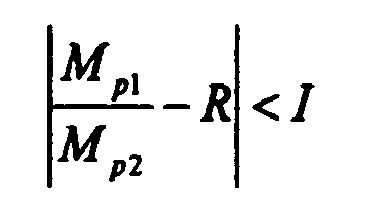
where Mp1 and Mp2 are the magnitudes of the peaks of a pair, R is a reference ratio for a main lobe and a side lobe and I is a confidence factor.
where Mp1 and Mp2 are the magnitudes of the peaks of a pair, R is a reference ratio for a main lobe and a side lobe and I is a confidence factor.
9. A rake receiver according to claim 8, wherein R is approximately 0.175, preferably
0.1746, and I is approximately 0.065, preferably 0.0643.
10. A mobile phone network receiver including a rake receiver according to any preceding
claim.
1. Rake-Empfänger, umfassend ein Impulsantwort-Messmittel (22) und ein Pfadzuweisungsmittel
(23) zum Zuweisen von Pfaden an Rake-Finger (21a, 21b, 21c, 21d) in Abhängigkeit von
der Ausgabe des Impulsantwort-Messmittels (22), dadurch gekennzeichnet, dass das Pfadzuweisungsmittel (23) eingerichtet ist, die Beträge von Paaren von Scheitelpunkten
zu vergleichen, die in der Ausgabe des Impulsantwort-Messmittels (23) repräsentiert
sind, und das kleinere Element eines Paars für die Zuweisung von Pfaden an Rake-Finger
(21 a, 21b, 21c, 21d) zu ignorieren, wenn die Beträge des Paars sich auf eine vorbestimmte
Weise unterscheiden, um störende Pfade auszuschließen, wobei die Paare Scheitelpunkte
umfassen, die zeitlich um eine Periode getrennt sind, die für die Trennung der Haupt-
und Nebenkeulen von Filtern zum Erzeugen der Basisband-Pulsform, die von dem Empfänger
erwartet wird, charakteristisch ist.
2. Rake-Empfänger nach Anspruch 1, wobei die vorbestimmte Weise umfasst, dass der Betrag
ihres Verhältnisses innerhalb eines vorbestimmten Bereichs liegt.
3. Rake-Empfänger nach Anspruch 2, wobei die vorbestimmte Weise umfasst, dass der Betrag
des Ergebnisses ihres Verhältnisses abzüglich eines Referenzwerts geringer als ein
Schwellwert ist.
4. Rake-Empfänger nach Anspruch 3, wobei der Referenzwert dem theoretischen Keulenverhältnis
entspricht, das um einen Betrag erhöht ist, welcher der durch Rauschen eingeführten
Unsicherheit zugeordnet werden kann.
5. Rake-Empfänger nach Anspruch 4, wobei der Referenzwert die Hälfte der Summe der oberen
und unteren Grenze eines Vertrauensbereichs in der Wahrscheinlichkeitsdichte für das
Keulenverhältnis umfasst, wobei der Vertrauensbereich nicht weniger als 90% ist und
vorzugsweise etwa 95%.
6. Rake-Empfänger nach Anspruch 5, wobei der Schwellwert die halbe Breite des Vertrauensbereichs
ist.
7. Rake-Empfänger nach Anspruch 1, wobei die Pulsform ein erhöhter Cosinus ist.
8. Rake-Empfänger nach Anspruch 1, wobei die vorbestimmte Weise die Erfüllung des folgenden
Kriteriums umfasst:
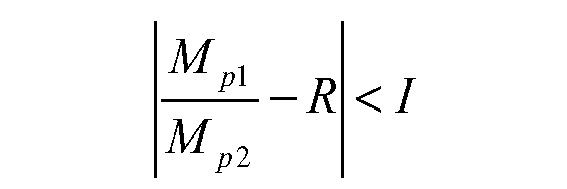
wobei Mp1 und Mp2 die Beträge der Scheitelpunkte eines Paars sind, R ein Referenzverhältnis für eine Hauptkeule und eine Nebenkeule ist und I ein Vertrauensfaktor ist.
wobei Mp1 und Mp2 die Beträge der Scheitelpunkte eines Paars sind, R ein Referenzverhältnis für eine Hauptkeule und eine Nebenkeule ist und I ein Vertrauensfaktor ist.
9. Rake-Empfänger nach Anspruch 8, wobei R etwa 0,175 ist, vorzugsweise 0,1746, und I
etwa 0,065 ist, vorzugsweise 0,0643.
10. Empfänger für ein Mobiltelefonnetz, umfassend einen Rake-Empfänger nach einem der
vorhergehenden Ansprüche.
1. Récepteur en râteau comprenant des moyens de mesure de réponse impulsionnelle (22)
et des moyens d'attribution de voie (23) pour attribuer des voies aux dents d'un râteau
(21a, 21b, 21c, 21d) en fonction de la sortie des moyens de mesure de réponse impulsionnelle
(22), caractérisé en ce que les moyens d'attribution de voie (23) sont configurés pour comparer les amplitudes
de paires de crêtes, représentées dans la sortie des moyens de mesure de réponse impulsionnelle
(23), et pour ignorer l'élément le moins significatif d'une paire pour l'attribution
de voies aux dents d'un râteau (21a, 21b, 21c, 21d), si les amplitudes de la paire
diffèrent d'une manière prédéterminée de façon à exclure des voies parasites, les
paires comprenant des crêtes temporellement séparées par une période caractéristique
de la séparation des lobes principal et latéral de filtres pour produire la forme
d'impulsion de bande de base attendue par le récepteur.
2. Récepteur en râteau selon la revendication 1, dans lequel ladite manière prédéterminée
comprend le fait que l'amplitude de leur rapport se situe à l'intérieur d'une plage
prédéterminée.
3. Récepteur en râteau selon la revendication 2, dans lequel ladite manière prédéterminée
comprend le fait que l'amplitude du résultat de leur rapport moins une valeur de référence
est inférieure à une valeur de seuil.
4. Récepteur en râteau selon la revendication 3, dans lequel la valeur de référence correspond
au rapport de lobe théorique augmenté d'une quantité attribuable à l'incertitude introduite
par du bruit.
5. Récepteur en râteau selon la revendication 4, dans lequel ladite valeur de référence
comprend une moitié de la somme des limites supérieure et inférieure d'un intervalle
de confiance dans la densité de probabilité pour le rapport de lobe, l'intervalle
de confiance étant de pas moins de 90 % et, de préférence, de 95 % environ.
6. Récepteur en râteau selon la revendication 5, dans lequel ladite valeur de seuil correspond
à la moitié de la largeur dudit intervalle de confiance.
7. Récepteur en râteau selon la revendication 1, dans lequel ladite forme d'impulsion
est une réponse en cosinus carré.
8. Récepteur en râteau selon la revendication 1, dans lequel ladite manière prédéterminée
comprend le fait de satisfaire le critère :
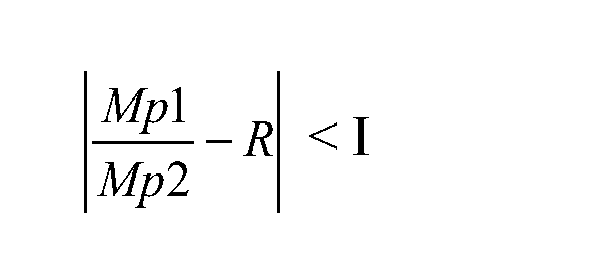
dans lequel Mp1 et Mp2 sont les amplitudes des crêtes d'une paire, R est un rapport de référence pour un lobe principal et un lobe latéral, et I est un facteur de confiance.
dans lequel Mp1 et Mp2 sont les amplitudes des crêtes d'une paire, R est un rapport de référence pour un lobe principal et un lobe latéral, et I est un facteur de confiance.
9. Récepteur en râteau selon la revendication 8, dans lequel R est égal à 0,175 environ,
à 0,1746 de préférence, et I est égal à 0,065 environ, à 0,0643 de préférence.
10. Récepteur de réseau de télécommunications mobiles comprenant un récepteur en râteau
selon l'une quelconque des revendications précédentes.