|
(11) | EP 1 577 328 A1 |

| (12) | EUROPEAN PATENT APPLICATION |
| published in accordance with Art. 158(3) EPC |
|
|
|
|
|||||||||||||||||||
| (54) | POLYMER-IMMOBILIZED FORMAMIDES, CATALYSTS CONTAINING THE SAME AND ALLYLATION PROCESS |
| (57) Polymer-immobilized form amides characterized by being represented by the general formula:
(wherein R1 is an optionally substituted hydrocarbon chain which may have a cyclic moiety or a heteroatom; R2 is an optionally substituted hydrocarbon group or an optionally substituted hydrocarbon chain which is bonded to R1 to form a ring; and the solid circle represents a polymer); novel organic catalysts containing the same, which catalysts are free from metallic catalyst components and very easy of recovery from reaction mixtures of synthesis and reuse; polymer-immobilized organic compounds useful as intermediates for synthesis; catalysts containing the same as the active ingredient; and a process for the allylation of aldehydes or hydrazones by the use of these catalysts. |
Technical Field
[0001] The present relates to polymer-immobilized formamide and catalyst containing the same, and allylation process.
Background Art
[0002] Conventionally, from the viewpoint of reducing loads on the natural environment by metal components, attentions have been directed to develop and use organic catalysts which are free from metallic components. Using an organic compound as a catalyst will be a solution for the difficulty in treating metallic catalyst components in waste liquids or waste products and loads on the natural environment exerted by the metallic catalyst components.
[0003] However, in the case where an organic compound is used as a catalyst, separation of the organic catalyst from products of synthesis reaction is not easy, and separation of such organic catalyst poses a great problem in practical organic synthesis process.
[0004] In these circumstances, immobilizing an organic compound serving as a catalytic component to a polymer so as to facilitate separation from products has been proposed. However, only few examples of polymer-immobilized organic catalysts have proved effective (Document 1).
[0005] On the other hand, the present inventors have proposed a method of synthesizing from an aldehyde compound and an allyl trihalogenosilane compound, a corresponding allyl alcohol compound by allylation in the presence of a Lewis base such as N,N-dimethylformamide (DMF) without using a metallic catalyst (Documents 2 and 3). This method is very advantageous in synthesis of an allyl alcohol compound.
[0006] With regard to this method, if the catalytic Lewis base or the like could be recovered from reaction products more efficiently, more excellent practical efficiency and catalyst recovery, as well as improved reusability would be expected.
Document 1: M. Benaglia, et al., Adv. Synth. Catal., 2002, 344, 533
Document 2: S. Kobayashi, et al., Tetrahedron Lett., 1993, 34, 3453
Document 3: S. Kobayashi, et al., J. Org. Chem. 1994, 59, 6620
[0007] In view of the forgoing circumstance, it is an object of the present invention to provide a novel organic catalyst which is useful as an organic catalyst which is free from metallic components and very easy of recovery from reaction mixture of synthesis and reuse; a polymer-immobilized organic substance which is useful as a synthetic intermediate or the like; a catalyst containing the same as an active ingredient; and an allylation process of aldehyde compound using the same.
Disclosure of Invention
[0008] As a solution for the forgoing problems, a first aspect of the present invention provides polymer-immobilized formamides represented by the formula:
(wherein, R1 is an optionally substituted hydrocarbon chain which may have a cyclic moiety or a heteroatom; R2 is an optionally substituted hydrocarbon group or an optionally substituted hydrocarbon chain which is bounded to R1 to form a ring; and the solid circle represents a polymer).
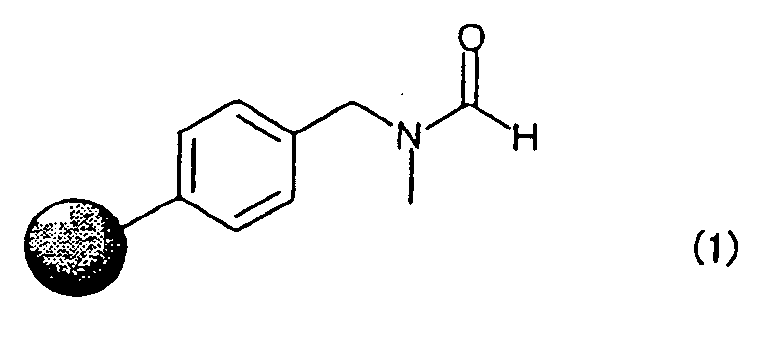
[0009] In a second aspect, the present invention provides polymer-immobilized formamides represented by the following formula (1):
; and in a third aspect, the present invention provides polymer-immobilized formamides represented by the following formula (2):
[0010] In a fourth aspect, the present invention provides a reaction catalyst comprising any one of the forgoing polymer-immobilized formamides, as an active ingredient.
[0011] In a fifth aspect, the present invention provides a process for allylation of an aldehyde compound characterized by allylating an aldehyde compound with an allyl trihalogenosilane in the presence of any one of the above polymer-immobilized formamides, thereby generating an allyl alcohol compound, and in a sixth aspect, the present invention provides a process for allylation in which the allylation is conducted in the presence of a polar solvent.
[0012] Further, in a seventh aspect, the present invention provides a process for allylation of a hydrazone compound characterized by allylating a hydrazone compound with an allyl trihalogenosilane in the presence of any one of the above polymer-immobilized formamides, thereby generating an allyl hydrazine compound, and in an eighth aspect, the present invention provides a process for allylation of a hydrazone compound in which the allylation is conducted in the presence of a polar solvent.
Best Mode for Carrying Out the Invention
[0013] The present invention has the features as described above, and embodiments thereof will be explained below.
[0014] In a polymer-immobilized formamide according to the present invention represented by the above general formula, R1 is an optionally substituted hydrocarbon chain which may have a cyclic moiety or a heteroatom other than carbon. Examples of such hydrocarbon chain include those having saturated or unsaturated, straight or branched chains such as alkylene, alkynylene and the like; those having an alicyclic moiety such as cycloalkylene or an aromatic moiety such as phenylene; and those having a hetero atom like nitrogen or oxygen.
[0015] R2 is an optionally substituted hydrocarbon group or a hydrocarbon chain which may be bounded to R1 to form a ring.
[0016] R1 and R2 may have a variety of substituents that are acceptable in application and synthesis.
[0017] The solid circle shown in the general formula usually represents a polymer. The polymer used herein may be selected from various kinds of polymers that are reaction insoluble depending on the application and synthesis method, and examples of the polymer include cross-linked polystyrene polymers which are commercially available and hence easily obtainable.
[0018] Concrete examples of the polymer-immobilized formamides of the present invention include those represented by the general formulas (1) and (2).
[0019] The polymer-immobilized formamide of the present invention may be produced, for example, by preparing a chloromethylated polymer, and causing the same to react with formamide or its derivative. Examples of the chloromethylated polymer include those obtained by reacting cross-linked polystyrene and chloromethylmethylether in the presence of a catalytic amount of SnCl4 (for example, S. Kobayashi, et al., Tetrahedron Lett., 1997, 38, 425) or commercially available Merrifield' s resin. These resins may have controlled quantity of chloromethyl groups.
[0020] In the case where a prepared chloromethylated polymer such as chloromethylated cross-linked polystyrene is used, the polymer is caused to react with N-methyl formaldehyde in DMF in the presence of NaH, to obtain a polymer-immobilized formamide represented by the general formula (1) with very high yield in the range of 99% to quantitative yield. Various polymer-immobilized formamides represented by the formula (2) may be produced in a similar manner.
[0021] Polymer-immobilized formamides according to the present invention may be utilized as catalysts, e.g., Lewis bases, for various organic synthetic reactions. Since they impose a small burden on the environment because they are organic catalysts free from metallic components, and they are immobilized on a polymer, they are very easy for separation, recovery from products after synthetic reaction and reuse. The polymer-immobilized formamides of the present invention are not only useful as catalysts or reaction promoters, but also applicable as intermediates of synthetic reaction.
[0022] The present invention also provides a novel method that uses the above-described polymer-immobilized formamide as a catalyst or a reaction promoter for allylation of an aldehyde compound or a hydrazone compound. To be more specific, provided is a method of synthesizing an allyl alcohol compound by causing an aldehyde compound to react with an allyl trihalogenosilane compound in the presence of the polymer-immobilized formamide of the present invention as described above. Also provided is a method for synthesizing an allyl hydrazine compound by causing a hydrazone compound to react with an allyl trihalogenosilane compound.
[0023] In the present reaction method, an aldehyde compound represented by the formula (3):
(wherein R represents an optionally substituted hydrocarbon group or heterocyclic group, and the hydrocarbon group may be chain or cyclic, or combination thereof) is caused to react, in the presence of the polymer-immobilized formamide, with an allyl trihalogenosilane compound represented by the formula (4):
(wherein X represents a halogen atom), to synthesize an allyl alcohol compound represented by the formula (5):
[0024] Alternatively, for example, a hydrazone compound represented by the formula (6):
(wherein R and R3 each represents an optionally substituted hydrocarbon group or heterocyclic group, and the hydrocarbon group may be chain or cyclic, or combination thereof) is caused to react, in the presence of the polymer-immobilized formamide, with an allyl trihalogenosilane compound represented by the formula (4), to synthesize a allyl hydrazine compound represented by the formula (7):
[0025] The foregoing hydrocarbon groups, heterocyclic groups, as well as substituents may be variable. Examples of such groups include alkyl groups, cycloalkyl groups, cycloalkylalkyl groups, phenyl group, phenylalkyl groups, phenyl alkenyl groups, tolyl group, naphthyl group, nitrophenyl group, methoxyphenyl group, biphenyl group, furyl group, piperidyl group and pyridinyl group.
[0026] Preferably, allylation as described above is conducted in a solvent, in particular, in a polar solvent such as nitriles, amides, sulfoxides, alcohols, halogeno hydrocarbons and the like. As a catalyst, the polymer-immobilized formamide may be generally used in an amount of more than or equal to 5% by mole, or relatively high ratio, for example about 50% by mole to 500% by mole, relative to a reaction substrate in an non -limiting manner.
[0027] Also, reaction temperature, reaction time, use ratios of aldehyde compound, hydrazone compound and allyl trihalogenosilane compound and the like differ depending on the types thereof, and may be appropriately selected. For example, in allylation of an aldehyde compound, the reaction may be conducted at 5 to 30°C for 2 hours or more. In allylation of a hydrazone compound, it may be reacted at a temperature of equal to or less than -20°C, for example. Air or inert gas atmosphere may be used.
[0028] The present invention will be now described in more detail by way of examples. It is to be noted that the following examples will not limit the present invention.
EXAMPLES
<Example 1>
[0029] Cross-linked polystyrene and chloromethylmethylether were caused to react in the presence of a catalytic amount of SnCl4, to prepare chloromethylated cross-linked polystyrene in which chloromethyl groups are introduced and bound in a range of 2.22 to 5.11 mmol/g. Commercially available Morrifield's resins included binding of chloromethyl groups of 0.63 mmol/g and 1.20 mmol/g.
[0030] These chloromethylated cross-linked polystyrenes were caused to react with N-methyl formamide under a basic condition.
[0031] The reaction was conducted in the presence of NaH in DMF solvent. Polymer-immobilized formamide (PS-Formamide 1) represented by the formula (1) was obtained in yield of 99%. This product was examined for the structure by 13C Swollen Resin. Magic Angle Spinnig (SR-MAS) and IR analysis.
[0032] Likewise, polymer-immobilized formamide (PS-Formamide 2) represented by the formula (2) was obtained..
[0033] Using these products, allylation of aldehyde compound was effected according to the reaction indicated by the following formula. The results are shown in Table 1.
Table 1
| Optimization of the Reaction Conditions | ||||||
| Entry | Polymer | x | y | z | Conc. (M) | Yield (%) |
| 1 | 1 | 100 | 0.61 | 3 | 0.06 | 40 |
| 2 | 2 | 100 | 0.61 | 3 | 0.06 | 26 |
| 3 | 1 | 50 | 0.62 | 1.5 | 0.33 | 43 |
| 4 | 1 | 50 | 1.10 | 1.5 | 0.33 | 49 |
| 5 | 1 | 50 | 2.12 | 1.5 | 0.33 | 56 |
| 6 | 1 | 50 | 3.22 | 1.5 | 0.33 | 58 |
| 7 | 1 | 50 | 4.66 | 1.5 | 0.33 | 58 |
| 8 | 1 | 100 | 3.22 | 1.5 | 0.33 | 73 |
| 9 | 1 | 100 | 3.22 | 3 | 0.33 | 91 |
| 10 | 1 | 200 | 3.22 | 3 | 0.33 | 92 |
| 11a) | 1 | 10 | 3.22 | 3 | 0.33 | 54 |
| 12 | 1 | 10 | 3.22 | 3 | 0.66 | 79 |
| a) For 24 h. |
[0034] The symbols x and y represent existence ratio and existence amount of formamide derivative groups introduced and bound to cross-linked polystyrene.
[0035] The results demonstrate that PS-Formamide 1 having a ratio of more than or equal to 100% by mole give high reaction yield.
<Example 2>
[0036] Using PS-Formamide 1 having a ratio of 300% by mole of formamide derived groups as a catalyst, allylation of different kinds of aldehyde compound was conducted.
<Example 3>
[0039] The results of Table 3 demonstrate quantitative recovery of catalyst and high reaction yield by recycle use. The recovered PS-Formamide 1 catalyst was determined as being the same with that before use by 13C-NMR spectrum
<Example 4>
[0040] Using PS-Formamide 1 catalyst (200% by mol), allylation of hydrazone compound was conducted according to the following reaction formula, to obtain an allyl hydrazine compound in a reaction yield of 50%.
Industrial Applicability
[0041] As specifically described above, the present invention provides a novel organic catalyst which does not use a metal component and is very easily recovered from a product of synthesis reaction and reused; a polymer-immobilized organic substance which is useful as a synthetic intermediate or the like; a catalyst containing the polymer-immobilized organic substance as an active ingredient; a process for allylation of an aldehyde compound or a hydrazone compound in good reaction yield by using the catalyst.
1. Polymer-immobilized formamide characterized by being represented by the general formula:
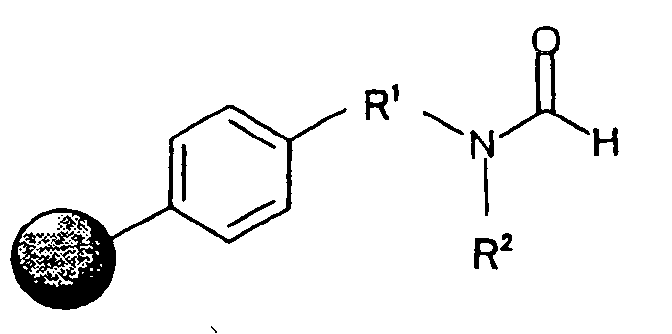
(wherein R1 is an optionally substituted hydrocarbon chain which may have a cyclic moiety or a heteroatom; R2 is an optionally substituted hydrocarbon group or an optionally substituted hydrocarbon chain which is bound to R1 to form a ring; and the solid circle represents a polymer).
(wherein R1 is an optionally substituted hydrocarbon chain which may have a cyclic moiety or a heteroatom; R2 is an optionally substituted hydrocarbon group or an optionally substituted hydrocarbon chain which is bound to R1 to form a ring; and the solid circle represents a polymer).
2. The polymer-immobilized formamide according to claim 1, characterized by being represented by the formula:
3. The polymer-immobilized formamide according to claim 1, characterized by being represented by the formula:

4. A reaction catalyst comprising any one of the polymer-immobilized formamides according
to claims 1-3 as an active ingredient.
5. A process for allylation of an aldehyde compound characterized by causing an aldehyde compound to react with allyl trihalogenosilane in the presence
of the polymer-immobilized formamides according to claims 1-3, to synthesize an allyl
alcohol compound.
6. The allylation process according to claim 5, wherein the reaction is conducted in
the presence of a polar solvent.
7. A process for allylation of a hydrazone compound characterized by causing a hydrazone compound to react with allyl trihalogenosilane in the presence
of the polymer-immobilized formamides according to claims 1-3, to synthesize an allyl
hydrazine compound.
8. The allylation process according to claim 7, wherein the reaction is conducted in
the presence of a polar solvent.