| (19) |
 |
|
(11) |
EP 1 579 797 B1 |
| (12) |
EUROPEAN PATENT SPECIFICATION |
| (45) |
Mention of the grant of the patent: |
|
09.05.2012 Bulletin 2012/19 |
| (22) |
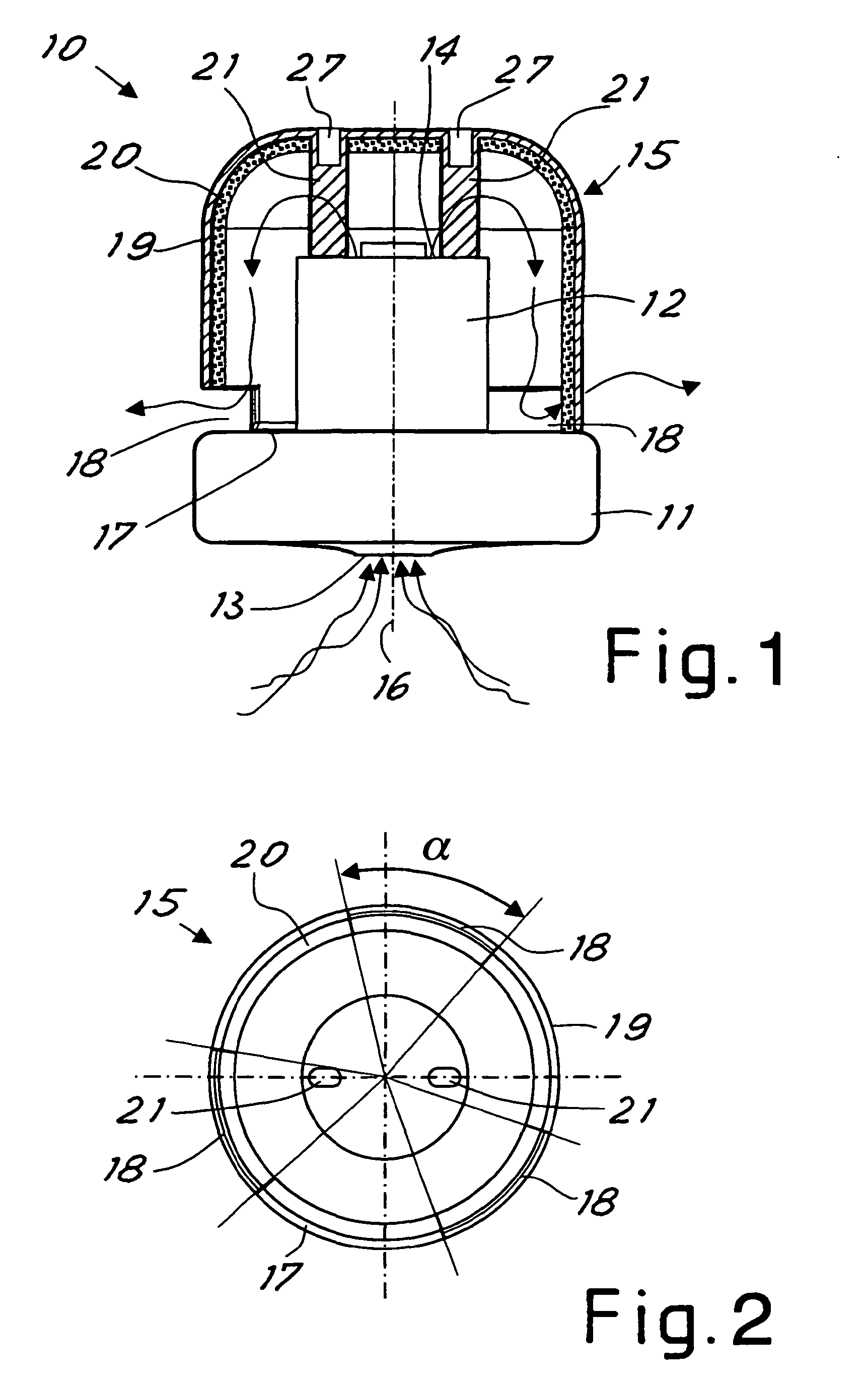
Date of filing: 16.03.2005 |
|
| (51) |
International Patent Classification (IPC):
|
|
| (54) |
Powered low-noise suction generating unit for a cleaning apparatus and apparatus with
same
Angetriebener geräuscharmer Saugkrafterzeuger und Reinigungsvorrichtung mit einem
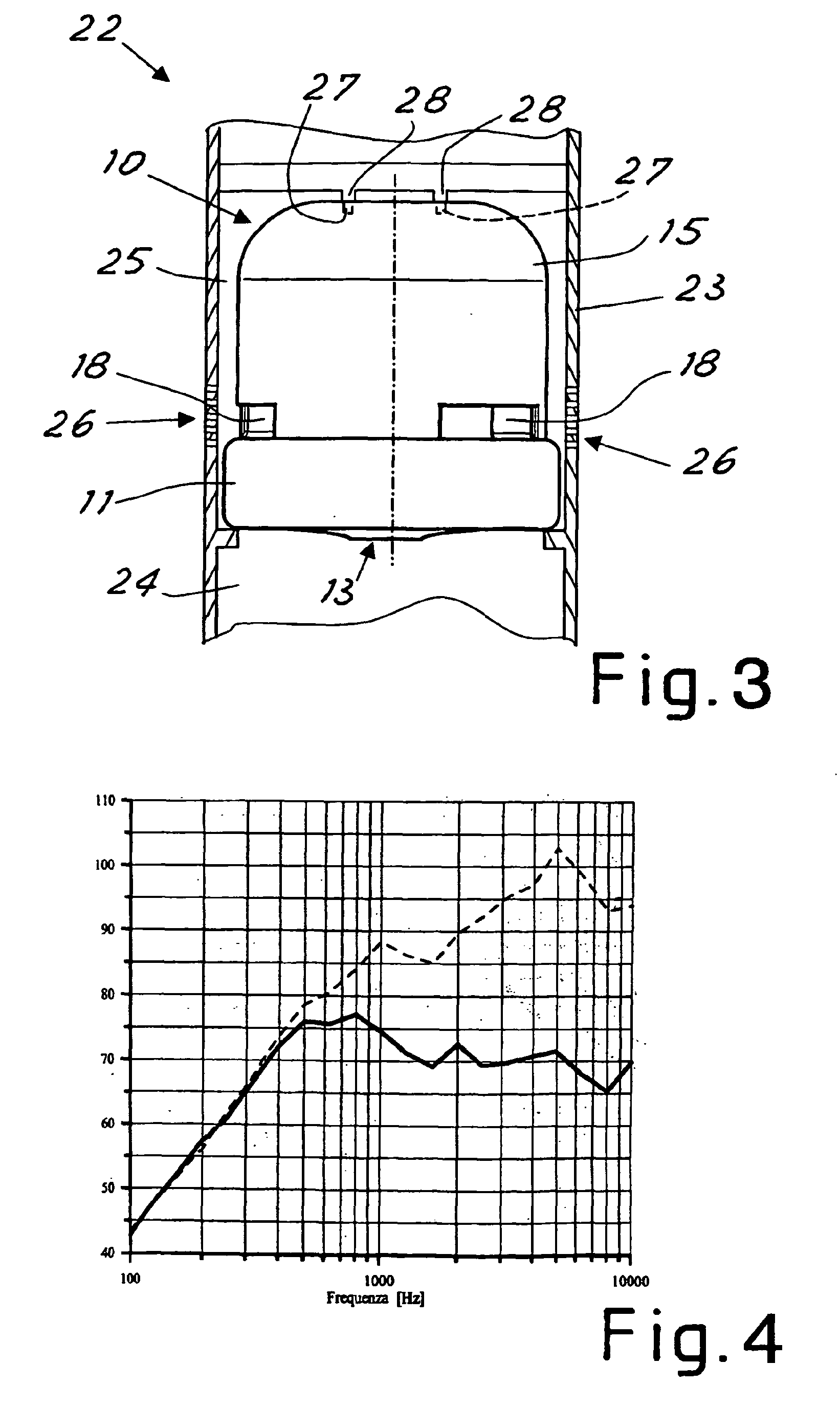
solchen Erzeuger
Unité de production d'une force d'aspiration à bruit faible et appareil de nettoyage
comportant une telle unité
|
| (84) |
Designated Contracting States: |
|
DE GB IT |
| (30) |
Priority: |
24.03.2004 IT MI20040577
|
| (43) |
Date of publication of application: |
|
28.09.2005 Bulletin 2005/39 |
| (73) |
Proprietor: AMETEK ITALIA S.r.l. |
|
20087 Robecco sul Naviglio (Milano) (IT) |
|
| (72) |
Inventor: |
|
- Simonetti, Luigi
26013 Crema CR (IT)
|
| (74) |
Representative: Coletti, Raimondo et al |
|
Barzanò & Zanardo Milano S.p.A.
Via Borgonuovo, 10
20121 Milano
20121 Milano (IT) |
| (56) |
References cited: :
WO-A-02/051296
DE-A1- 19 843 719
|
DE-A1- 3 402 603
US-A- 4 733 429
|
|
| |
|
|
- PATENT ABSTRACTS OF JAPAN vol. 1995, no. 05, 30 June 1995 (1995-06-30) -& JP 07 031564
A (TOSHIBA CORP; others: 01), 3 February 1995 (1995-02-03)
|
|
| |
|
| Note: Within nine months from the publication of the mention of the grant of the European
patent, any person may give notice to the European Patent Office of opposition to
the European patent
granted. Notice of opposition shall be filed in a written reasoned statement. It shall
not be deemed to
have been filed until the opposition fee has been paid. (Art. 99(1) European Patent
Convention).
|
[0001] This invention relates to a suction unit of the type including an impeller or turbine
keyed axially on an electric motor to suck a stream of air axially. The motor is traversed
by a cooling-air stream expelled rearward therefrom.
[0002] This type of suction unit is generally fitted into a body of a cleaning apparatus
such as a vacuum cleaner to have the suction inlet of the rotor facing into a suction
chamber of the apparatus while the outgoing air stream is started out of the apparatus
through purposeful slits.
[0003] In cleaning apparatuses the suction unit is the greater source of noise and therefore
manufacturers of apparatuses adopt soundproofing coverings that are applied in layers
on the inner walls of the apparatus. This results in various problems such as greater
manufacturing complexity and the need for larger dimensions of the apparatus compared
with what would be needed for housing of the suction unit only. In addition, the effectiveness
of soundproofed coverings is often unsatisfactory and the apparatuses remain excessively
noisy anyway.
[0004] Even attempts to supply a soundproofed casing inside for the whole motor unit did
not give fully satisfactory results because of the excessive size that the unit attains
and the difficulty given by the need to supply in any case outlet for the air streams
and cooling for the motor.
[0005] It must also be allowed for that the openings necessary for passage of the air stream
toward the outlet of the apparatus create an outlet for the noise toward the exterior.
On the other hand, reduction of the passage would unacceptably reduce the efficiency
of the apparatus and cooling of the motor.
[0006] DE-A-3402603 discloses a suction unit with a motor surrounded by a soundproof casing, wherein
the motor cooling air is evacuated through openings of the soundproof casing immediately
after having been extracted from the motor.
[0007] US4733429 discloses a suction unit with a motor surrounded by a soundproof casing.
[0008] In the evolution of apparatuses the operating speed of the motor has always increased
over the years and motors with even very high operating speeds are used ever more,
typically well over 30,000 rpm. For this reason, the noise produced has not only always
increased in intensity but has also increased in frequency to cause a considerable
increase in subjective bother.
[0009] The general purpose of this invention is to remedy the above mentioned shortcomings
by making available a powered low-noise suction unit.
[0010] In view of this purpose it was sought to provide in accordance with this invention
a suction unit for cleaning apparatuses according to claim 1. An apparatus with said
unit is also claimed.
[0011] To clarify the explanation of the innovative principles of this invention and its
advantages compared with the prior art there is described below with the aid of the
annexed drawings a possible embodiment thereof by way of non-limiting example applying
said principles. In the drawings:
FIG 1 shows a partially cross-sectioned side view of a suction unit in accordance
with this invention,
FIG 2 shows a plan view of a part of the unit of FIG 1,
FIG 3 shows a partially cross-sectioned diagrammatic view of an apparatus fitted with
the unit of FIG 1, and
FIG 4 shows a graph of the effectiveness of the solution in accordance with this invention.
[0012] With reference to the figures, FIG 1 shows a suction unit designated as a whole by
reference number 10 for cleaning apparatuses.
[0013] The unit includes a suction turbine 11 arranged coaxially with an electric rotation
motor 12. The turbine is a known type with axial suction mouth 13 and therefore not
further shown in detail. The turbine includes known air-stream paths not shown here.
[0014] In accordance with the prior art the motor is traversed by a stream of its cooling
air that is evacuated from the end 14 of the motor opposite the turbine. Advantageously,
the motor has more than 15,000 rpm and advantageously at least around 20,000 rpm to
30,000 rpm.
[0015] The electric motor part of the unit is enclosed in a soundproofing casing 15 shaped
generally like a tumbler with axis 16 coinciding virtually with the axis of the motor
and with the tumbler edge 17 closed on the turbine casing or body. The tumbler-like
casing has its inner surface spaced from the motor walls and is provided with openings
18 arranged near said edge closed on the rotor. The openings 18 on the edge are advantageously
formed of rectangular notches in the edge.
[0016] The casing shape found particularly advantageous was found to be the one shown with
cylindrical side wall and bottom joined without edges to the walls.
[0017] Again advantageously, as may be seen well in FIG 2 showing the tumbler from the mouth
to the bottom, the openings 18 are arranged at regular distances along the edge and
in particular are three in number arranged at 120° from each other.
[0018] It was found particularly advantageous that the total of the extensions of the openings
along the edge be between 1/3 and 1/2 of the total perimeter of the edge. As shown
in FIG 2, with a cylindrical-shaped tumbler each opening can advantageously have an
angular extension α between 45° and 60° and preferably around 50°. Again advantageously,
the area of the openings on the casing is at least equal to the area of the air extraction
openings on the motor.
[0019] The rearward air flow out of the motor is forced into an S-shaped path that runs
parallel to the motor wall and toward the impeller in the air space between the motor
and the outer shell 15.
[0020] As may be seen in FIGS 1 and 2, the tumbler has a wall formed by an external casing
19 of rigid plastic material and an internal layer 20 of fibrous or porous sound absorbent
material. Polypropylene was found to be a particularly advantageous material for the
rigid external shell. The thickness of the shell is between 1.5 mm and 5 mm and advantageously
around 3 mm while the internal layer has a thickness between 10 mm and 20 mm and advantageously
around 15 mm.
[0021] As may be seen again in FIGS 1 and 2, the casing has a bottom with members 21 projecting
towards the motor to constitute supports on the motor, for example between or in radial
spokes of the motor. In the preferred embodiment the projecting members are two in
number arranged symmetrically around the motor axis and extending towards the motor
in a direction parallel to said axis.
[0022] FIG 3 shows partially a cleaning apparatus 22, for example a vacuum cleaner, otherwise
of prior art and therefore not shown in detail being easily imaginable to those skilled
in the art,. The apparatus 22 has a shell 23 containing the suction unit of FIG 1
so as to identify a suction chamber 24 into which faces the suction mouth 13 of the
suction unit and a chamber 25 at the back insulated from the first and receiving the
suction unit body and that has slots 26 for evacuation outward of the air sucked by
the turbine.
[0023] Advantageously, the tumbler-shaped casing 15 of the suction unit has a bottom with
external engagement seats 27 designed to at least partially support the cleaning apparatus
unit. For this support, the apparatus has internal fastening members 28 inserted with
their end in the seats 27. The members 28 can possibly be made of material such as
for example rubber suitable for not transmitting operating vibrations.
[0024] With a suction unit in accordance with this invention it was surprisingly found that
the soundproofed casing arranged only on the motor with outlet openings as mentioned
above avoids resonance and reverberations and allows a more than adequate air stream
outlet from the motor while preventing outlet of noise with very high efficiency.
Stopping the noise near its origin avoids its diffusion and, despite the dimensions
kept reduced, provides high silence of the apparatus in which the unit is fitted even
without equipping the apparatus with soundproofing systems of relatively high space
occupied and costly. It was also found that the faster the motor's speed of rotation
(more than 15,000 rpm and in particular more than 30,000 rpm, for example around 40,000
rpm to 50,000 rpm) the more the noise is generated in the motor part of the unit and
not in the turbine. Surprisingly, it was found thus that the effectiveness of the
above-mentioned solution increases with increase in motor speed and that it is not
necessary to provide soundproofing protection for the rest of the suction unit.
[0025] FIG 4 shows a graph of the undeniable advantages of a suction unit realized in accordance
with this invention. A broken line shows the course of the noise of a prior art unit
with a 15,000 rpm motor. Note the high noise peak around 5,000 Hz. From the comparison
with the solid line showing the noise of a similar unit realized however in accordance
with the principles of this invention the noise reduction is evident with a flattening
toward the lower part of the noise curve at higher frequencies. The residual noise
is truly much reduced. Entirely without increasing the transversal dimensions of the
unit compared with prior art units of equal power (the transversal dimension is given
by the turbine that remains unchanged). It should be noted that the transverse dimensions
of a suction unit are the most important for the final dimensions of the apparatus.
[0026] Naturally the above description of an embodiment applying the innovative principles
of this invention is given by way of non-limiting example of said principles within
the scope of the exclusive right claimed here. For example, small soundproofing internal
covering panels can be used anyway in the apertures if desired to further reduce the
small residual noise possibly still heard. In addition, the members 21 can be of a
number different from that shown. It can also be thought to use a single tube-shaped
member to blend the rear hub part of the motor.
1. Suction unit (10) for a cleaning apparatus, including an electric rotation motor (12)
and a suction turbine (11) comprising a turbine body, which is keyed coaxially to
the electric rotation motor (12), with the motor (12) being traversed by a stream
of air for its cooling and the electric motor (12) being also enclosed in a soundproof
casing (15) shaped generally like a tumbler with the tumbler edge (17) closed by the
turbine body, characterized in that the motor (12) being provide with an end (14) opposed to the turbine, through which
the cooling air is evacuated, the tumbler-like casing (15) has openings (18) arranged
near said edge (17) closed by the turbine body, the tumbler-like casing (15) having
its internal surface spaced from the motor casing walls to form an air space between
the tumbler-like casing internal surface and the motor casing walls identifying an
S-shaped path for evacuated cooling air which is directed from said motor end (14),
running along said air space towards the turbine (11), to the openings (18) arranged
near said edge (17) closed by the turbine body.
2. Suction unit in accordance with claim 1 characterized in that the openings (18) on the tumbler edge (17) are formed from rectangular notches on
said edge (17).
3. Suction unit in accordance with claim 1 characterized in that the openings (18) are arranged at regular distances along the tumbler edge (17).
4. Suction unit in accordance with claim 3 characterized in that the openings (18) are three in number, arranged at 120° from each other.
5. Suction unit in accordance with claim 1 characterized in that the sum of the extensions of the openings (18) along the tumbler edge (17) is between
1/3 and 1/2 of the total edge perimeter.
6. Suction unit in accordance with claim 1 characterized in that the area of the openings (18) on the casing is at least equal to the area of openings
present on the motor (12) for extraction of said air stream.
7. Suction unit in accordance with claim 6 characterized in that said extraction openings are placed in the end (14) of the motor (12) near the bottom
of the tumbler (15).
8. Suction unit in accordance with claim 1 characterized in that the tumbler-like casing (15) has a bottom connected without edges to the walls.
9. Suction unit in accordance with claim 1 characterized in that the tumbler (15) has a wall formed by an external shell (19) of rigid plastic material
and an internal layer (20) of fibrous or porous soundproof material.
10. Suction unit in accordance with claim 9 characterized in that the external shell (19) is of polypropylene.
11. Suction unit in accordance with claim 9 characterized in that the thickness of the shell (19) is between 1.5 mm and 5 mm and advantageously around
3 mm.
12. Suction unit in accordance with claim 9 characterized in that the internal layer (20) has a thickness between 10 mm and 20 mm and advantageously
around 15 mm.
13. Suction unit in accordance with claim 1 characterized in that the tumbler-like casing (15) has a cylindrical side wall.
14. Suction unit in accordance with claim 1 characterized in that the tumbler-like casing (15) has a bottom with members (21) projecting toward the
motor (12) to constitute supports on the motor.
15. Suction unit in accordance with claim 1 characterized in that the projecting members (21) are arranged symmetrically to the motor axis (16) and
extend toward the motor (12) in a direction parallel to its axis.
16. Suction unit in accordance with claim 1 characterized in that the tumbler-like casing (15) has a bottom with engagement seats (27) on the outside,
designed as at least partial support of the unit (10) in a cleaning apparatus (22).
17. Suction unit in accordance with claim 1 characterized in that the motor (12) has a number of revolutions greater than 15,000 rpm.
18. Cleaning apparatus (22) with a suction unit (10) in accordance with any one of the
above claims.
1. Saugeinheit (10) für eine Reinigungsvorrichtung, umfassend einen elektrischen Rotationsmotor
(12) und eine Saugturbine (11), die einen Turbinenkörper umfasst, der durch eine Keilverbindung
koaxial mit dem elektrischen Rotationsmotor (12) verbunden ist, wobei der Motor (12)
von einem Luftstrom zu seiner Kühlung durchströmt wird und der Elektromotor (12) auch
in einem schalldichten Gehäuse (15) eingeschlossen ist, das im Allgemeinen wie ein
Becher geformt ist, wobei der Becherrand (17) durch den Turbinenkörper verschlossen
wird, dadurch gekennzeichnet, dass der Motor (12) mit einem der Turbine entgegengesetzten Ende (14) versehen ist, durch
das die Kühlluft abgeführt wird, das becherartige Gehäuse (15) in der Nähe des durch
den Turbinenkörper verschlossenen Rands (17) Öffnungen (18) aufweist und die Innenfläche
des becherartigen Gehäuses (15) von den Wänden des Motorgehäuses beabstandet ist,
um einen Luftzwischenraum zwischen der Innenfläche des becherartigen Gehäuses und
den Wänden des Motorgehäuses zu schaffen, der einen S-förmigen Weg für die abgeführte
Luft bestimmt, die, indem sie diesen Luftzwischenraum in Richtung der Turbine (11)
entlang strömt, vom Ende (14) des Motors zu den Öffnungen (18) geleitet wird, die
in der Nähe des durch den Turbinenkörper verschlossenen Rands (17) angeordnet sind.
2. Saugeinheit nach Anspruch 1, dadurch gekennzeichnet, dass die Öffnungen (18) am Becherrand (17) von rechteckigen Aussparungen auf diesem Rand
(17) gebildet werden.
3. Saugeinheit nach Anspruch 1, dadurch gekennzeichnet, dass die Öffnungen (18) in regelmäßigen Abständen entlang dem Becherrand (17) angeordnet
sind.
4. Saugeinheit nach Anspruch 3, dadurch gekennzeichnet, dass die Öffnungen (18) in einer Anzahl von drei vorgesehen und in einem Winkel von 120°
zueinander angeordnet sind.
5. Saugeinheit nach Anspruch 1, dadurch gekennzeichnet, dass die Summe der Ausdehnungen der Öffnungen (18) entlang dem Becherrand (17) zwischen
einem Drittel und der Hälfte des gesamten Randumfangs beträgt.
6. Saugeinheit nach Anspruch 1, dadurch gekennzeichnet, dass die Fläche der Öffnungen (18) am Gehäuse mindestens gleich der Fläche der Öffnungen
am Motor (12) zum Abführen des Luftstroms ist.
7. Saugeinheit nach Anspruch 6, dadurch gekennzeichnet, dass die Abführöffnungen am Ende (14) des Motors (12) in der Nähe des Bodens des Bechers
(15) angeordnet sind.
8. Saugeinheit nach Anspruch 1, dadurch gekennzeichnet, dass das becherartige Gehäuse (15) einen Boden aufweist, der ohne Ecken mit den Wänden
verbunden ist.
9. Saugeinheit nach Anspruch 1, dadurch gekennzeichnet, dass der Becher (15) eine aus einer Außenhülle (19) aus einem starren Kunststoff gebildete
Wand und eine Innenlage (20) aus einem faserigen oder porösen Schalldämmmaterial aufweist.
10. Saugeinheit nach Anspruch 9, dadurch gekennzeichnet, dass die Außenhülle (19) aus Polypropylen ist.
11. Saugeinheit nach Anspruch 9, dadurch gekennzeichnet, dass die Dicke der Hülle (19) zwischen 1,5mm und 5 mm und vorteilhafterweise ungefähr
3 mm beträgt.
12. Saugeinheit nach Anspruch 9, dadurch gekennzeichnet, dass die Dicke der Innenlage (20) zwischen 10mm und 20 mm und vorteilhafterweise ungefähr
15 mm beträgt.
13. Saugeinheit nach Anspruch 1, dadurch gekennzeichnet, dass das becherartige Gehäuse (15) eine zylindrische Seitenwand aufweist.
14. Saugeinheit nach Anspruch 1, dadurch gekennzeichnet, dass das becherartige Gehäuse (15) einen Boden mit Elementen (21) aufweist, die in Richtung
des Motors (12) herausragen, um Abstützungen auf dem Motor zu bilden.
15. Saugeinheit nach Anspruch 1, dadurch gekennzeichnet, dass die herausragenden Elemente (21) symmetrisch zur Motorachse (16) angeordnet sind
und sich in einer zu seiner Achse parallelen Richtung zum Motor (12) hin erstrecken.
16. Saugeinheit nach Anspruch 1, dadurch gekennzeichnet, dass das becherartige Gehäuse (15) einen Boden mit Eingriffsaufnahmen (27) auf der Außenseite
aufweist, die als eine zumindest teilweise Abstützung der Einheit (10) in einer Reinigungsvorrichtung
(22) gestaltet sind.
17. Saugeinheit nach Anspruch 1, dadurch gekennzeichnet, dass der Motor (12) eine Drehzahl von mehr als 15.000 U/min hat.
18. Reinigungsvorrichtung (22) mit einer Saugeinheit (10) nach einem der vorhergehenden
Ansprüche.
1. Unité d'aspiration (10) pour un appareil de nettoyage, incluant un moteur de rotation
électrique (12) et une turbine d'aspiration (11) comprenant un corps de turbine, qui
est claveté coaxialement au moteur de rotation électrique (12), avec le moteur (12)
étant traversé par un flux d'air pour son refroidissement et le moteur électrique
(12) étant également confiné dans un boîtier insonorisé (15) formé généralement comme
un tambour avec le bord du tambour (17) fermé par le corps de turbine, caractérisée en ce que le moteur (12) est pourvu d'une extrémité (14) opposée à la turbine, à travers laquelle
l'air de refroidissement est évacué, le boîtier similaire à un tambour (15) a des
ouvertures (18) disposées à proximité dudit bord (17) fermé par le corps de turbine,
le boîtier similaire à un tambour (15) ayant sa surface interne à distance des parois
du boîtier du moteur pour former un espace d'air entre la surface interne du boîtier
similaire à un tambour et les parois du boîtier du moteur identifiant une trajectoire
en forme de S pour l'air de refroidissement évacué qui est dirigé à partir de ladite
extrémité du moteur (14), courant le long dudit espace d'air en direction de la turbine
(11), vers les ouvertures (18) disposées à proximité dudit bord (17) fermé par le
corps de turbine.
2. Unité d'aspiration selon la revendication 1 caractérisée en ce que les ouvertures (18) sur le bord du tambour (17) sont formées à partir d'encoches
rectangulaires sur ledit bord (17).
3. Unité d'aspiration selon la revendication 1 caractérisée en ce que les ouvertures (18) sont disposées à des distances régulières le long du bord du
tambour (17).
4. Unité d'aspiration selon la revendication 3 caractérisée en ce que les ouvertures (18) sont au nombre de trois, disposées à 120° l'une de l'autre.
5. Unité d'aspiration selon la revendication 1 caractérisée en ce que la somme des extensions des ouvertures (18) le long du bord du tambour (17) est comprise
entre 1/3 et 1/2 du périmètre total du bord.
6. Unité d'aspiration selon la revendication 1 caractérisée en ce que la surface des ouvertures (18) sur le boîtier est au moins égale à la surface des
ouvertures présentes sur le moteur (12) pour l'extraction dudit flux d'air.
7. Unité d'aspiration selon la revendication 6 caractérisée en ce que les ouvertures d'extraction sont placées à l'extrémité (14) du moteur (12) à proximité
du fond du tambour (15).
8. Unité d'aspiration selon la revendication 1 caractérisée en ce que le boîtier similaire à un tambour (15) a un fond relié sans bords aux parois.
9. Unité d'aspiration selon la revendication 1 caractérisée en ce que le tambour (15) a une paroi formée par une enveloppe externe (19) de matière plastique
rigide et une couche interne (20) de matière insonorisée fibreuse ou poreuse.
10. Unité d'aspiration selon la revendication 9 caractérisée en ce que l'enveloppe externe (19) est en polypropylène.
11. Unité d'aspiration selon la revendication 9 caractérisée en ce que l'épaisseur de l'enveloppe (19) est entre 1,5 mm et 5 mm et, avantageusement, d'environ
3 mm.
12. Unité d'aspiration selon la revendication 9 caractérisée en ce que la couche interne (20) a une épaisseur entre 10 mm et 20 mm et, avantageusement,
d'environ 15 mm.
13. Unité d'aspiration selon la revendication 1 caractérisée en ce que le boîtier similaire à un tambour (15) a une paroi latérale cylindrique.
14. Unité d'aspiration selon la revendication 1 caractérisée en ce que le boîtier similaire à un tambour (15) a un fond avec des éléments (21) s'avançant
en saillie vers le moteur (12) pour constituer des supports sur le moteur.
15. Unité d'aspiration selon la revendication 1 caractérisée en ce que les éléments en saillie (21) sont disposés symétriquement par rapport à l'axe du
moteur (16) et s'étirent vers le moteur (12) dans une direction parallèle à son axe.
16. Unité d'aspiration selon la revendication 1 caractérisée en ce que le boîtier similaire à un tambour (15) a un fond avec des sièges de mise en prise
(27) sur l'extérieur, conçus comme au moins un support partiel de l'unité (10) dans
un appareil de nettoyage (22).
17. Unité d'aspiration selon la revendication 1 caractérisée en ce que le moteur (12) a un nombre de révolutions supérieur à 15 000 tr/min.
18. Appareil de nettoyage (22) avec une unité d'aspiration (10) selon une quelconque des
revendications ci-dessus.
REFERENCES CITED IN THE DESCRIPTION
This list of references cited by the applicant is for the reader's convenience only.
It does not form part of the European patent document. Even though great care has
been taken in compiling the references, errors or omissions cannot be excluded and
the EPO disclaims all liability in this regard.
Patent documents cited in the description