|
(11) | EP 1 607 091 B1 |

| (12) | EUROPEAN PATENT SPECIFICATION |
|
|
| (54) |
ANTIHEPATITIS C VIRUS AGENT AND ANTI-HIV AGENT ANTIHEPATITIS-C-VIRUS-MITTEL UND ANTI-HIV-MITTEL AGENT ANTI-VIRAL DE L'HEPATITE C ET AGENT ANTI-VIH |
|
|
|||||||||||||||||||||||||||||||
| Note: Within nine months from the publication of the mention of the grant of the European patent, any person may give notice to the European Patent Office of opposition to the European patent granted. Notice of opposition shall be filed in a written reasoned statement. It shall not be deemed to have been filed until the opposition fee has been paid. (Art. 99(1) European Patent Convention). |
Technical Field
[0001] The invention of this application relates to an anti-hepatitis C virus agent or anti-HIV agent. More particularly, the invention of this application relates to a novel anti-hepatitis C virus or anti-HIV agent comprising a fullerene derivative or a quaternary amine salt thereof as an active ingredient.
Background Art
[0002] Fullerene, which is a carbon cluster represented by C60, is a novel carbon allotrope discovered by Smally, Kroto et al. in 1985. Since a large-scale synthetic method was established in 1990, studies have dramatically progressed in both basic and application fields.
[0003] At first, fullerenes were thought to have low chemical reactivity, however, it was shown that various anionic substrates are easily added thereto as an electron deficient olefin. In addition, Diels-Alder reaction, 1,3-dipolar cyclo addition reaction or the like proceeds well to give an adduct attached to the double bond of a conjunction region of 6-membered ring and 6-membered ring of a fullerene.
[0004] An effect of such a chemically active novel substance group on a living organism also attracts the interest. For example, with regard to a fullerene derivative, an HIV protease inhibitory activity has been reported for the compound of the following formula (non-patent document 1).
[0006] In this situation, a research on a fullerene derivative further having a new bioactivity has been desired, however, in fact, an investigation for application as a bioactive agent has not so much progressed.
[0007] Therefore, the inventor of this application synthesized two types of C60 fullerene derivatives represented by the following formulae (1) and (2):
and has investigated their bioactivities. These derivatives have a characteristic that they easily dissolve in an organic solvent (such as DMSO), which is miscible in water, and can be used for a reaction in an aqueous solution.
[0008] The inventor first focused on the inhibition of hepatitis C virus RNA polymerase and the inhibition of HIV reverse transcriptase in the process of this investigation.
[0009] Hepatitis C virus (HCV) infects through the blood or the like and causes chronic hepatitis. The infected patients are more likely to develop liver cirrhosis or liver cancer, and the natural recovery rate is extremely low. The current therapeutic method is administration of interferon, which is sometimes further combined with ribavirin. However, the elimination rate of HCV is about one-third, which is low. Therefore, development of a new anti-HCV drug has been awaited.
[0010] HCV is an RNA virus. After it invades human liver cells, it produces several enzymes from its own RNA by using the protein synthesis system of the host (human) cells. One of these enzymes is HCV RNA polymerase, which is essential for growth of HCV.
[0011] It has been reported that if the activity of this RNA polymerase is inhibited, growth of hepatitis C virus can be inhibited, and the virus itself can be eliminated.
[0012] On the other hand, AIDS was first reported in 1981, and since then, it has been spread all over the world, which has become a serious social problem. This AIDS is a disease in which the immune system of the body breaks down due to the human immunodeficiency virus (HIV), therefore the patients are susceptible to a variety of infectious diseases and lead to death. HIV is similar to hepatitis C virus and is an RNA virus.
[0013] The agents currently used as an AIDS therapeutic drug can be classified into two main categories. One is an inhibitor of the reverse transcriptase that synthesizes DNA from the RNA of HIV, and the other is an inhibitor of the enzyme necessary for growth of HIV (HIV protease, an enzyme that converts a protein synthesized from the virus RNA into an enzyme having an activity). As a reverse transcriptase inhibitor, a nucleoside analogue is mainly used, however, it has a disadvantage in that it is also toxic to human cells. Also, there are few protease inhibitors which are stable in vivo and whose activities are high. In this way, there is no specific drug for AIDS in the present circumstances, and furthermore, the fact that HIV acquires resistance against these drugs has become a big problem.
[0014] In this circumstance, as mentioned above, it has been reported that a fullerene derivative has an HIV protease inhibitory activity. At present, various derivatives other than this have been attempted, however, a fullerene derivative having an inhibitory activity against HIV reverse transcriptase has not been reported.
Non-patent document 1: R. F. Schinazi, et al., Antimicrob. Agents Chemother, 37, 1707 (1993)
Disclosure of the invention
[0015] Based on the background as above, the invention of this application is aimed at providing a novel anti-hepatitis C virus agent having an inhibitory activity against hepatitis C virus RNA polymerase or a novel anti-HIV agent having an inhibitory activity against HIV reverse transcriptase, which contains a fullerene derivative as an active ingredient.
[0016] This application provides the following embodiments to solve the foregoing problems.
- 1. The use of a fullerene derivative which has a nitrogen atom forming a ring together with adjacent bonded carbon atom pairs constituting the carbon cluster skeleton of the fullerene or a quaternary amine salt thereof in the manufacture of an anti-hepatitis - C-virus agent having inhibitory activity against hepatitis C virus RNA polymerase.
- 2. The use according to claim 1, characterized in that the nitrogen atom is bonded through a hydrocarbon chain or directly bonded without a hydrocarbon chain to at least any of the adjacent bonded carbon atom pairs.
- 3. The use according to claim 1 or 2, characterized by comprising, as an active ingredient,
a quaternary amine salt of a fullerene derivative which has an organic bond structure
represented by the following formula:
wherein A and B denote adjacently bonded carbon atoms constituting the carbon cluster skeleton of the fullerene, R1 and R2 are identical or different and denote a hydrocarbon group which may have a substituent, and R3 and R4 are each identical or different and denote a hydrogen atom or a hydrocarbon group which may have a substituent) attached to at least one of the adjacent bonded carbon atom pairs constituting the carbon cluster skeleton of the fullerene - 4. The use according to claim 1 or 2, characterized by comprising, as an active ingredient,
a fullerene derivative which has an organic bond structure represented by the following
formula:
(wherein A and B denote adjacently bonded carbon atoms constituting the carbon cluster skeleton of the fullerene, R3 and R4 are each identical or different and denote a hydrogen atom or a hydrocarbon group which may have a substituent, and R5 denotes a hydrocarbon group which may have a substituent) attached to at least one of the adjacent bonded carbon atom pairs constituting the carbon cluster skeleton of the fullerene. - 5. The use according to claim 1 or 2, characterized by comprising, as an active ingredient,
a fullerene derivative which has an organic bond structure represented by the following
formula:
(wherein A and B denote adjacently bonded carbon atoms constituting the carbon cluster skeleton of the fullerene, R6 and R7 are each identical or different and denote a hydrogen atom or a hydrocarbon group which may have a substituent, and D and E are each identical or different and denote a hydrocarbon group which may have a substituent) attached to at least one of the adjacent bonded carbon atom pairs constituting the carbon cluster skeleton of the fullerene or a quaternary amine salt thereof. - 6. The use according to any of claims 1 to 5, characterized in that the hydrocarbon chain is a linear chain, branched chain or cyclic hydrocarbon group.
- 7. The use according to claim 6, characterized in that the hydrocarbon group is an alkyl group having 1 to 16 carbon atoms.
- 8. The use of at least one kind of carboxyl fullerene derivatives which have an organic
bond structure represented by the following formula:
(wherein A and B denote adjacently bonded carbon atoms constituting the carbon cluster skeleton of the fullerene, R8 and R9 are each identical or different and denote a hydrogen atom or a COOR group, R denotes a hydrogen atom or a hydrocarbon group which may have a substituent, R10 denotes a hydrocarbon group which may have a substituent, and a hydrocarbon chain may be bonded through a hetero atom and R11, R12 and R13 are each identical or different and denote a hydrogen atom or a hydrocarbon group which may have a substituent) attached to at least one of the adjacent bonded carbon atom pairs constituting the carbon cluster skeleton of the fullerene in the manufacture of an anti-hepatitis C virus agent having inhibitory activity against hepatitis C virus RNA polymerise. - 9. The use according to claim 8, characterized in that the hydrocarbon chain is a linear chain or branched chain hydrocarbon group.
- 10. The use according to any of claims 1 to 9, characterized in that the fullerene is at least one kind of C60 fullerene and higher order fullerenes.
- 11. An anti-hepatitis C virus agent having inhibitory activity against hepatitis C
virus RNA polymerase or anti-HIV agent having an inhibitory activity against HIV reverse
transcriptase, characterized by comprising, as an active ingredient, a fullefene derivative
which has an organic bond structure represented by the following formula:
(wherein A and B denote adjacently bonded carbon atoms constituting the carbon cluster skeleton of the fullerene, R6 and R7 are each identical or different and denote a hydrogen atom or a hydrocarbon group which may have a substituent, and D and E are each identical or different and denote a hydrocarbon group which may have a substituent) attached to at least one of the adjacent bonded carbon atom pairs constituting the carbon cluster skeleton of the fullerene or a quaternary amino salt thereof. - 12. The anti-hepatitis C virus agent or anti-HIV agent according to claim 11, characterized in that the hydrocarbon group is a linear chain, branched chain or cyclic hydrocarbon group.
- 13. The anti-hepatitis C virus agent or anti-HIV agent according to claim 12, characterized in that the hydrocarbon group is an alkyl group having 1 to 16 carbon atoms.
- 14. An anti-hepatitis C virus agent having inhibitory activity against hepatitis C
virus RNA polymerase or anti-HIV agent having an inhibitory activity against HIV reverse
transcriptase, characterized by comprising, as an active ingredient, a carboxyl fullerene
derivative having an organic bond structure represented by the following formula:
(wherein A and B denote adjacently bonded carbon atoms constituting the carbon cluster skeleton of the fullerene, R8 and R9 are each identical or different and denote a hydrogen atom or a COOR group, R denotes a hydrogen atom or a hydrocarbon group which may have a substituent, R10 denotes a hydrocarbon group which may have a substituent, and a hydrocarbon chain may be bonded through a hetero atom and R11, R12 and R13 are each identical or different and denote a hydrogen atom or a hydrocarbon group which may have a substituent) attached to at least one of the adjacent bonded carbon atom pairs constituting the carbon cluster skeleton of the fullerene. - 15. The anti-hepatitis C virus agent or anti-HIV agent according to claim 14 further
comprising at least one carboxyl fullerene derivative having an organic bond structure
represented by the following formula
(wherein A and B denote adjacently bonded carbon atoms constituting the carbon cluster skeleton of the fullerene, R12 and R13 are each identical or different and denote a hydrogen atom or a hydrocarbon group which may have a substituent) attached to at least one of the adjacent bonded carbon atom pairs constituting the carbon cluster skeleton of the fullerene. - 16. The anti-hepatitis C virus agent or anti-HIV agent according to claim 14 or 15, characterized in that the hydrocarbon group is a linear chain or branched chain hydrocarbon group.
- 17. The anti-hepatitis C virus agent or anti-HIV agent according to any of claims 11 to 16, characterized in that the fullerene is at least one kind of C60 fullerene and higher order fullerenes.
- 18. The use of the fullerene derivative defined in any of claims 11 to 17 in the manufacture of an anti-HIV agent having an inhibitory activity against HIV reverse transcriptase.
Best Mode for Carrying Out the Invention
[0017] The invention of this application has characteristics as described above, and the embodiments thereof will be explained below.
[0018] An active ingredient of the anti-hepatitis C virus agent or anti-HIV agent of the invention of this application is a fullerene derivative having a structure represented by the foregoing formulae or a quaternary amine salt thereof, or a carboxyl fullerene derivative.
[0019] With regard to the fullerene derivative or the quaternary amine salt thereof that is an active ingredient of the anti-hepatitis C virus agent or anti-HIV agent of the invention of this application, in the foregoing formulae, R1 and R2, and R5 are identical or different and denote a hydrocarbon group which may have a substituent, R3 and R4, and R6 and R7 are each identical or different and denote a hydrogen atom or a hydrocarbon group which may have a substituent. Here, as the hydrocarbon group, various kinds of linear or cyclic ones and various kinds of saturated or unsaturated ones are taken into account. Various kinds of aliphatic, alicyclic and aromatic hydrocarbons are taken into account.
[0020] Among them, as the hydrocarbon group, a linear chain or a branched chain aliphatic hydrocarbon group is exemplified. In this case, the carbon number is not limited, however, for example, one having about 1 to 16 carbon atoms is preferably exemplified.
[0021] In addition, the symbols D and E in the foregoing general formula are each identical or different and denote a hydrocarbon chain which may have a substituent, however, as the hydrocarbon chain in this case, for example, an alkyl chain having 1 to 3 carbon atoms is preferably exemplified.
[0022] The substituent that may be bonded to the hydrocarbon group or the hydrocarbon chain may be arbitrary, and for example, an alkoxy group, an acyl group, a carboxyl group, an ester group, an amino group, a substituted amino group, a heterocyclic group and the like are taken into account.
[0023] Still furthermore, an anion that is the paring ion of the quaternary amine salt may be various kinds of anions, and can be a pharmacologically acceptable anion. For example, it may be an inorganic acid ion such as a halogen ion or a sulfate ion, or an organic acid ion, or further, a complex ion or the like.
[0024] As a fullerene forming the carbon cluster skeleton in the fullerene derivative of the invention of this application, it may be C60 or a higher order fullerene such as C70 or C82.
[0025] In the anti-hepatitis C virus agent or anti-HIV agent of the invention of this application, one or more kinds of the fullerene derivatives and the quaternary amine salts thereof as above can be contained as the active ingredients.
[0026] With regard to the explanation of synthesis of the fullerene derivative and the quaternary amine salt thereof as the active ingredient of the invention of this application, they can be synthesized, for example, according to the following reaction formula or the like.
[0027] In this reaction formula, by variously changing the kind of aldehyde (RCHO) or by changing the ratio of the reaction materials, the side chain R or the bonding number n can be varied diversely.
[0028] In other words, for example, in toluene, C60, N-methylglycine and various aldehydes (RCHO) are dissolved, and heated under argon gas flow, whereby an N-methylpyrrolidine derivative is obtained. The reaction time and the amounts of reagents are adjusted according to the number of substituents of a desired derivative. The product is purified with a silica gel column. Subsequently, the reaction is performed in methyl iodide at room temperature, or by heating. In this way, a derivative having various alkyl substituents (R) (a 2-alkyl-N,N-dimethylpyrrolidinium derivative) or a quaternary amine salt thereof can be obtained. Specifically, for example, as described below, fullerene derivatives, in which R2 is H, and R4 is H (compound 2), C4H9 (compound 3), C6H13 (compound 4) and C9H19 (compound 5), and fullerene derivatives of compound 9, compound 12 and the like are synthesized. It has been confirmed that these are dissolved in DMSO at a concentration of 5 mM or more.
[0029] In addition, with regard to the symbols R1 and R2 in the foregoing formula, which is bonded to a nitrogen atom, by using various N-substituted glycines instead of N-methylglycine in the foregoing reaction formula, and by using various reaction materials instead of CH3I, they can be desired ones. For example, the following reaction formula or the like can be followed.
[0030] Namely, for example, in toluene, C60, N-decylglycine and formaldehyde are dissolved, and heated under argon gas flow, whereby an N-decylpyrrolidine derivative is obtained. The reaction time and the amounts of reagents are adjusted according to the number of n of a desired derivative. The product is purified with a silica gel column. Subsequently, in methyl iodide at room temperature or by heating, a (N-decyl-N-methylpyrrolidinium derivative) can be obtained. Specifically, for example, the compound 6 as described below is synthesized.
[0031] In addition, with regard to a compound having hydrocarbon chains D and E in the foregoing formula, for example, it can be easily synthesized by adding C60 fullerene and a nitrogen-containing cyclic compound such as piperazine to a solvent such as toluene, and by subjecting the mixture to heating and stirring or the like, and with regard to the quaternary amine salt thereof, it can be easily synthesized by further reacting it with CH3I or the like. In this way, for example, the compound 11 as described below can be synthesized.
[0032] Furthermore, with regard to a carboxyl derivative, for example, the synthetic method is exemplified as follows. <A> Namely, according to the following reaction formula, first, C60, diethyl bromomalonate and sodium hydride are added to toluene, and stirred under argon gas flow, whereby a diethyl malonate derivative is obtained. The reaction time and the amounts of reagents are adjusted according to the number of n of a desired derivative. The product is purified with a silica gel column. Subsequently, the diethyl malonate derivative and sodium hydride are added to toluene. Immediately after the solution is heated to reflux, methanol is added, thus a malonate derivative (carboxyl derivative 1) is obtained.
[0033] <B> In addition, according to the following reaction formula, first, C60, ethyl glyoxylate, iminodiacetic acid diethyl ester and sodium hydride are added to toluene, and heated under argon gas flow, whereby a diethyl derivative is obtained. The reaction time and the amounts of reagents are adjusted according to the number of n of a desired derivative. The product is purified with a silica gel column. Subsequently, the diethyl derivative and sodium hydride are added to toluene. Immediately after the solution is heated to reflux, methanol is added, thus the mentioned derivative (the after-mentioned carboxyl compound 8) is obtained. In this reaction, by changing the iminodiacetic acid diethyl ester to iminomethyl acetic acid ethyl ester, the after-mentioned compound 10 is synthesized. In this way, various compounds can be synthesized.
[0034] With regard to the carboxyl fullerene derivative as the active ingredient of the anti-hepatitis C virus agent or anti-HIV agent of the invention of this application, the symbols R8 and R9 in the foregoing formula may be the same as the foregoing R3, R4, R6 and R7, the symbol R10 is, for example, the same hydrocarbon chain which may have a substituent as mentioned above, and these may be bonded through a hetero atom, for example, an oxygen atom or a nitrogen atom. It can be a linear chain or branched chain hydrocarbon, for example, an alkyl chain. With regard to the number of carbons of the hydrocarbon chain, for example, the range from about 1 to 16 is taken into account.
[0035] In addition, the symbols R11, R12 and R13 denote a hydrocarbon group which may have a substituent, and the same ones as mentioned above can be taken into account.
[0036] Incidentally, the carboxyl fullerene derivative may be used as a pharmacologically acceptable salt.
[0037] With regard to a drug of the invention of this application, the form is not particularly limited, for example, it may be a solid preparation such as a tablet, a granule, a fine granule, a pill, a powder, a capsule, a troche or a chewable tablet, a jelly preparation or an adhesive preparation for external use, a liquid preparation such as an elixir, a syrup, a suspension, an emulsion, an injection or a transfusion.
[0038] For preparing a preparation, a common carrier component can be used according to the type of preparation. For example, for preparing a solid preparation, a common component, for example, an excipient such as a saccharide including starch, lactose, sucrose, mannitol, cornstarch and the like, crystal cellulose, carboxymethyl cellulose or light silicic acid anhydride; a binder such as polyvinyl alcohol, polyvinyl pyrrolidone, polyvinyl ether, ethyl cellulose, gum arabic, tragacanth, gelatin, hydroxypropyl cellulose, hydroxypropyl methylcellulose, calcium citrate, dextrin or pectin; a lubricant such as magnesium stearate, calcium stearate, talk, polyethylene glycol or colloid silica; a disintegrator such as starch, carboxymethyl cellulose, calcium carboxymethyl cellulose or croscarmellose sodium, a disintegration aid, a moisturizing agent, a surfactant or the like can be used.
[0039] For preparing a liquid preparation, a common component, for example, a solvent such as water for injection, water, ethanol or ethylene glycol, a solubilizing aid such as ethanol, polyethylene glycol, propylene glycol, D-mannitol, cholesterol, triethanolamine, sodium carbonate or sodium citrate, a surfactant such as stearyl triethanolamine, sodium lauryl sulfate, lecithin or glycerin monostearate, a suspending agent for a hydrophilic polymer or the like such as polyvinyl alcohol, polyvinyl pyrrolidone, sodium carboxymethyl cellulose, methyl cellulose, hydroxymethyl cellulose, hydroxyethyl cellulose or hydroxypropyl cellulose, a tonicity adjusting agent such as sodium chloride, glycerin or D-mannitol, a buffering agent such as a phosphate, an acetate, a carbonate or a citrate, a soothing agent such as benzyl alcohol, glucose, an amino acid or the like can be used. For the foregoing solid preparation or liquid preparation, a preservative, a solubilizer, an emulsifier, a dispersant, a thickening agent, a plasticizer, an adsorbent, a flavor, a coloring agent, a corrective, a sweetner, an antiseptic, an antioxidant or the like can be used according to need. The anti-hepatitis C virus agent or anti-HIV agent of the invention of this application can be produced by a common method, for example, such as mixing, kneading, granulating, tableting, coating, sterilizing, emulsifying according to the dosage form of preparation. With regard to production of preparations, each provision of General Rules for Preparations in Japanese Pharmacopoeia can be referred to.
[0040] In addition, a drug of the invention of this application may contain other pharmaceutically active substances as long as it contains the foregoing fullerene derivative as the active ingredient.
[0041] For example, in the case where it is prescribed as an oral medicine, an antiacid such as sodium hydrogen carbonate, calcium carbonate, magnesium carbonate, magnesium oxide, aluminum hydroxide, aluminum hydroxide gel, magnesium silicate, magnesium aluminosilicate, synthetic aluminum silicate, a coprecipitated product of aluminum hydroxide and sodium hydrogen carbonate, a coprecipitated product of magnesium hydroxide and magnesium carbonate, magnesium aluminometasilicate or dihydroxy aluminum aminoacetate, a stomachic such as gentian, swertia herb, nux vomica, japanese gentian, bitter orange peel, fennel, carnitine chloride, glutamic acid hydrochloride, betaine hydrochloride or bethanechol chloride, a digestive such as pancreatin, pepsin, lemonase chloride, cholic acid, bile powder or dehydrocholic acid, a drug for controlling intestinal function such as mallotus bark, gambir, ubai, cassia seed or geranium herb, an antidiarrheal drug such as loperamide, bismuth subnitrate, bismuth subcarbonate or berberine chloride, an analgesic and antispasmodic such as dicyclomine hydrochloride, scopolamine hydrobromide, atropine methylbromide, scopolamine methylbromide, papaverine hydrochloride, isopropamide iodide, belladonna extract or scopolia extract, a mucosa repairing agent such as sucralfate, sulpiride, gefarnate or teprenone or the like is included. Among these active substances, one or more can be used.
[0042] In addition, the drug of the invention of this application may contain, as other anti-hepatitis C virus agents, interferon or ribavirin, and as other anti-HIV agents, a reverse transcriptase inhibitor such as azidothymidine or lamivudine, or a protease inhibitor such as indinavir or saquinavir.
[0043] With regard to the drug of the invention of this application, its dose is not particularly limited, however, as a guide, in the case of oral administration, the range between 0.005 and 50 mg per kilogram of body weight per day in divided doses is taken into account.
[0044] The fullerene derivative of the invention of this application has low toxicity and is useful as a drug.
[0045] Of course, in the invention of this application, human application is taken into account, however, it goes without saying that it may apply to non-human animals.
[0046] Therefore, the inventor of this application synthesized compounds such as fullerene derivatives and the quaternary amine salts thereof illustrated in the following table, which are active ingredients of the invention of this application, and evaluated the activities of anti-hepatitis C virus and anti-HIV.
[0047] The synthesis examples and the result examples of the activity tests will be explained below.
<Synthesis Examples>
1: Synthesis of C60-bis(N-methyl-2-hexylpyyrolidine)
[0048] In 600 ml of absolute toluene, 200 mg of C60 (0.28 mmol) was dissolved, and 50 mg of N-methylglycine (0.56 mmol, 2 equivalent amounts) and 95 mg of heptanal (0.83 mmol, 3 equivalent amounts) were added, then heated to reflux at 135°C for 3 hours under argon gas flow. The reaction solution was washed with water and saturated saline, dried with sodium sulfate, then the solvent was evaporated under reduced pressure. The obtained solid was purified by silica gel column chromatography (as the eluent, toluene : hexane = 5:1, 100% toluene, toluene : ethyl acetate = 20:5 were used in this order), thus 25 mg of a regioisomer mixture of C60-bis(N-methyl-2-hexylpyyrolidine) (0.025 mmol) was obtained (the yield was 9%).
2: Synthesis of C60-bis(N,N-dimethyl-2-hexylpyyrolidinium iodido)
[0049] In 5 ml of methyl iodide, 65 mg of C60-bis(N-methyl-2-hexylpyyrolidine) (0.065 mmol) was reacted at room temperature by stirring for 24 hours. The precipitated solid was sequentially washed with toluene and ethyl acetate, thus 55 mg of C60-bis(N,N-dimethyl-2-hexylpyyrolidinium iodido) (0.043 mmol) was obtained. The yield was 65%.
<Inhibitory activity>
[0050] (1) By using an experimental system for measuring RNA polymerase activity of hepatitis C virus (D. Dhanak et al., J. Biol. Chem, 277, 38322-38237 (2002)), its inhibitory activity was examined.
[0051] With regard to the foregoing compound 2, major regioisomers were separated and purified, however, with regard to others, bioactivities were investigated using mixtures.
[0052] The results are shown in Table 1. The compound 2 shows the highest inhibitory activity, and a significant difference was not observed among the regioisomers.
Table 1
| Fullernene derivative compound | 1 | 2t-2 | 2t-3 | 2t-4 | 5 | 7 | 8 |
| 50 % inhibition concentration (µM) | 3.0 | 0.27 | 0.31 | 0.34 | 1.6 | 1.8 | 2.0 |
[0053] There is only one report concerning a compound having an inhibitory activity against RNA polymerase of hepatitis C virus, which was published in fall 2002 (D. Dhanak et al., J. Biol. Chem, 277, 38322-38327 (2002)). The compound is shown in the following formula. The 50% inhibition concentration is 0.08 µM, which is slightly better than that of our derivatives, however, it can be said that they are almost equal. A fullerene derivative is the second hepatitis C virus RNA polymerase inhibitor in the world, and shows promise as a novel anti-hepatitis C virus drug whose structure is totally different from that of the compound represented by the following formula, which is conventionally known.
[0054] (2) In addition, since HIV reverse transcriptase is one of the RNA polymerases, the inventor examined its inhibitory activity.
[0055] The experiment was performed as follows in 50 mM Tris-HCl buffer (pH 8.3); to 10 µL of a reaction solution which had been prepared so as to contain 30 mM NaCl, 10 mM MgCl, 2.5 mM DTT, 1.25 µg/mL poly(rA) oligo(dT) 12-18, 250 nM dTTP, 32P-dTTP (800 µCi/mmol), 1 µL of a sample dissolved in DMSO, 1 µL of HIV reverse transcriptase (0.01 U/mL) were added, and the total volume was made up to 20 µL. After the solution was incubated for 1 hour at 37 °C, 10 µL of the reaction solution was placed on a Whatman DE81 filter, which was washed three times with Na2HPO4, once with 70% ethanol and once with ethanol. The dried filter was placed in a vial, and the radioactivity was counted by the liquid scintillation measurement method, which was assigned to the HIV reverse transcriptase activity.
[0056] The results are shown in Table 2. It has been confirmed that the active ingredient of the invention of this application inhibits the reverse transcriptase. A reverse transcriptase inhibitor, AZT, which is used as an anti-AIDS drug, is a nucleoside analogue, therefore, by the invention of this application, a novel reverse transcriptase inhibitor which is different from a conventional one is provided.
[0057] In addition, it shows a higher inhibitory activity against HIV reverse transcriptase compared with those of delavirdine and nevirapine (F. M. Uckun et al., Bioorg. Med. Chem. Lett., 1999, 9, 2721-2726), which are currently used anti-HIV drugs as the one having the same site of action.
Table 2
| Fullernene derivative | 1 | 2 (isomer mixture) | 3 | 4 | 5 | ||
| IC50 (µM) | 1.2 | 1.0 | 1.1 | 0.8 | 0.5 | ||
| Fullernene derivative | 6 | 7 | 8 | 9 | 10 | 11 | 12 |
| IC50 (µM) | 8.9 | 1.3 | 0.029 | 1.6 | 1.0 | 2.2 | 5.2 |
<Antimicrobial activity>
[0058] Furthermore, what is emphasized in the invention of this application is that a fullerene derivative or the like used as the active ingredient in the invention of this application has an antimicrobial activity.
[0059] In particular, when people is infected with HIV, the immune system breaks down, thereby becoming susceptible to various infectious diseases to result in death, therefore, there are many cases where an antimicrobial drug is used together with an anti-HIV agent for a patient with AIDS. Accordingly, the fullerene derivative or the like of the invention of this application is superior to other anti-HIV drugs because it also has an antimicrobial activity.
[0060] For example, as the antimicrobial activity of the active ingredient of the invention of this application as above, it is shown in Table 3.
[0061] Incidentally, with regard to the foregoing compound 2, major regioisomers were separated and purified, however, with regard to others, bioactivities were investigated using mixtures.
[0062] Table 3 shows the minimum concentration (MIC) of each fullerene derivative or the like which inhibits the growth of various gram positive bacteria in comparison with that of vancomycin (VCM) (the lower the concentration is (small numerical value), the higher the activity is). Each fullerene derivative or the like was dissolved in DMSO, then added to the culture medium of bacteria. Vancomycin is an antimicrobial agent used for drug resistant bacteria (Methicillin resistant strains, MRSA) which has been in trouble now. The regioisomers of the compound 2, 2t-2, 2t-3 and 2t-4, and the compounds 3 and 4 showed an effective antimicrobial activity, however, the activities of the compounds 3 and 4 were somewhat lower than those of the regioisomers of the compound 2. Among the regioisomers of the compound 2, 2t-2, 2t-3 and 2t-4, differences in the effects are observed in some degree depending on bacteria, however, there are no significant differences, and they have an antimicrobial activity substantially equivalent to that of vancomycin, and are also effective for MRSA. Furthermore, worthy of special mention is the fact that these fullerene derivatives and the like show an effective antimicrobial activity against also vancomycin-resistant bacteria (VRE). In addition, the fact that there are no differences among the regioisomers of the compound 2 indicates that the regioisomers of the other compounds do not need to be separated. At present, vancomycin-resistant bacteria began to emerge, therefore, the compound 2 is expected to exert an effect on these.
Table 3
| MIC (mg/mL) of fullerene for gram positive bacteria | ||||||
| 2t-2 | 2t-3 | 2t-4 | 3 | 4 | VCM | |
| S. aureus 209P JC-1 | 1.56 | 0.78 | 3.12 | 6.25 | 6.25 | 1.56 |
| S. aureus M133 (MRSA) | 0.78 | 1.56 | 3.12 | 6.25 | 12.5 | 1.56 |
| S. aureus M126 (MRSA) | 3.12 | 1.56 | 3.12 | 6.25 | 12.5 | 1.56 |
| S. eidermidis ATCC 14990 | 6.25 | 3.12 | 3.12 | 6.25 | 12.5 | 3.12 |
| E. hirae ATCC 8043 | 12.5 | 6.25 | 6.25 | 6.25 | 25 | 3.12 |
| E. faecalis W-73 | 12.5 | 6.25 | 6.25 | 6.25 | 50 | 3.12 |
| E. faecium vanA (VRE) | 12.5 | 6.25 | 6.25 | 12.5 | 12.5 | >100 |
| E. faecalis NCTC 12201 (VRE) | 12.5 | 3.12 | 6.25 | 6.25 | 25 | >100 |
Advantage of the Invention
[0063] As described above, by the invention of this application, a novel anti-hepatitis C virus agent having an inhibitory activity against hepatitis C virus RNA polymerase or a novel anti-HIV agent having an inhibitory activity against HIV reverse transcriptase, which contains a fullerene derivative or a carboxyl fullerene derivative as an active ingredient is provided.
1. The use of a fullerene derivative which has a nitrogen atom forming a ring together
with adjacent bonded carbon atom pairs constituting the carbon cluster skeleton of
the fullerene or a quaternary amine salt thereof in the manufacture of an anti-hepatitis
C-virus agent having inhibitory activity against hepatitis C virus RNA polymerase.
2. The use according to claim 1, characterized in that the nitrogen atom is bonded through a hydrocarbon chain or directly bonded without
a hydrocarbon chain to at least any of the adjacent bonded carbon atom pairs.
3. The use according to claim 1 or 2, characterized by comprising, as an active ingredient, a quaternary amine salt of a fullerene derivative
which has an organic bond structure represented by the following formula:
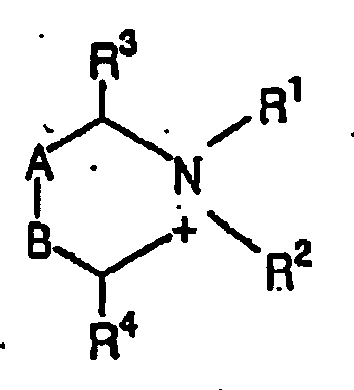
wherein A and B denote adjacently bonded carbon atoms constituting the carbon cluster skeleton of the fullerene, R1 and R2 are identical or different and denote a hydrocarbon group which may have a substituent, and R3 and R4 are each identical or different and denote a hydrogen atom or a hydrocarbon group which may have a substituent) attached to at least one of the adjacent bonded carbon atom pairs constituting the carbon cluster skeleton of the fullerene.
wherein A and B denote adjacently bonded carbon atoms constituting the carbon cluster skeleton of the fullerene, R1 and R2 are identical or different and denote a hydrocarbon group which may have a substituent, and R3 and R4 are each identical or different and denote a hydrogen atom or a hydrocarbon group which may have a substituent) attached to at least one of the adjacent bonded carbon atom pairs constituting the carbon cluster skeleton of the fullerene.
4. The use according to claim 1 or 2, characterized by comprising, as an active ingredient, a fullerene derivative which has an organic
bond structure represented by the following formula:
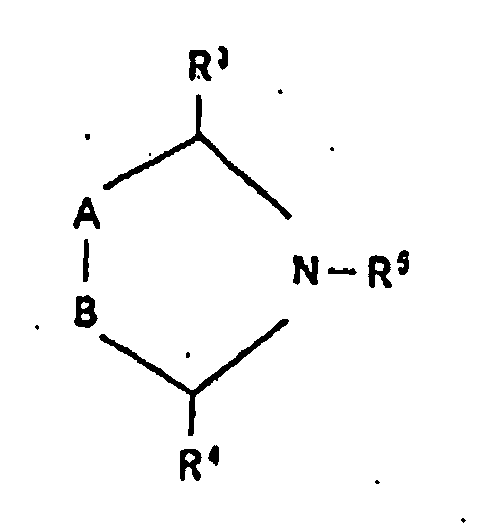
(wherein A and B denote adjacently bonded carbon atoms constituting the carbon cluster skeleton of the fullerene, R3 and R4 are each identical or different and denote a hydrogen atom or a hydrocarbon group which may have a substituent, and R5 denotes a hydrocarbon group which may have a substituent) attached to at least one of the adjacent bonded carbon atom pairs constituting the carbon cluster skeleton of the fullerene.
(wherein A and B denote adjacently bonded carbon atoms constituting the carbon cluster skeleton of the fullerene, R3 and R4 are each identical or different and denote a hydrogen atom or a hydrocarbon group which may have a substituent, and R5 denotes a hydrocarbon group which may have a substituent) attached to at least one of the adjacent bonded carbon atom pairs constituting the carbon cluster skeleton of the fullerene.
5. The use according to claim 1 or 2, characterized by comprising, as an active ingredient, a fullerene derivative which has an organic
bond structure represented by the following formula:

(wherein A and B denote adjacently bonded carbon atoms constituting the carbon cluster skeleton of the fullerene, R6 and R7 are each identical or different and denote a hydrogen atom or a hydrocarbon group which may have a substituent, and D and E are each identical or different and denote a hydrocarbon group which may have a substituent) attached to at least one of the adjacent bonded carbon atom pairs constituting the carbon cluster skeleton of the fullerene or a quaternary amine salt thereof.
(wherein A and B denote adjacently bonded carbon atoms constituting the carbon cluster skeleton of the fullerene, R6 and R7 are each identical or different and denote a hydrogen atom or a hydrocarbon group which may have a substituent, and D and E are each identical or different and denote a hydrocarbon group which may have a substituent) attached to at least one of the adjacent bonded carbon atom pairs constituting the carbon cluster skeleton of the fullerene or a quaternary amine salt thereof.
6. The use according to any of claims 1 to 5, characterized in that the hydrocarbon chain is a linear chain, branched chain or cyclic hydrocarbon group.
7. The use according to claim 6, characterized in that the hydrocarbon group is an alkyl group having 1 to 16 carbon atoms.
8. The use of at least one kind of carboxyl fullerene derivatives which have an organic
bond structure represented by the following formula 2:


(wherein A and B denote adjacently bonded carbon atoms constituting the carbon cluster skeleton of the fullerene, R8 and R9 are each identical or different and denote a hydrogen atom or a COOR group, R denotes a hydrogen atom or a hydrocarbon group which may have a substituent, R10 denotes a hydrocarbon group which may have a substituent, and a hydrocarbon chain may be bonded through a hetero atom and R11, R12 and R13 are each identical or different and denote a hydrogen atom or a hydrocarbon group which may have a substituent) attached to at least one of the adjacent bonded carbon atom pairs constituting the carbon cluster skeleton of the fullerene in the manufacture of an anti-hepatitis C virus agent having inhibitory activity against hepatitis C virus RNA polymerase.
(wherein A and B denote adjacently bonded carbon atoms constituting the carbon cluster skeleton of the fullerene, R8 and R9 are each identical or different and denote a hydrogen atom or a COOR group, R denotes a hydrogen atom or a hydrocarbon group which may have a substituent, R10 denotes a hydrocarbon group which may have a substituent, and a hydrocarbon chain may be bonded through a hetero atom and R11, R12 and R13 are each identical or different and denote a hydrogen atom or a hydrocarbon group which may have a substituent) attached to at least one of the adjacent bonded carbon atom pairs constituting the carbon cluster skeleton of the fullerene in the manufacture of an anti-hepatitis C virus agent having inhibitory activity against hepatitis C virus RNA polymerase.
9. The use according to claim 8, characterized in that the hydrocarbon chain is a linear chain or branched chain hydrocarbon group.
10. The use according to any of claims 1 to 9, characterized in that the fullerene is at least one kind of C60 fullerene and higher order fullerenes.
11. An anti-hepatitis C virus agent having inhibitory activity against hepatitis C virus
RNA polymerase or anti-HIV agent having an inhibitory activity against HIV reverse
transcriptase, characterized by comprising, as an active ingredient, a fullerene derivative which has an organic
bond structure represented by the following formula:
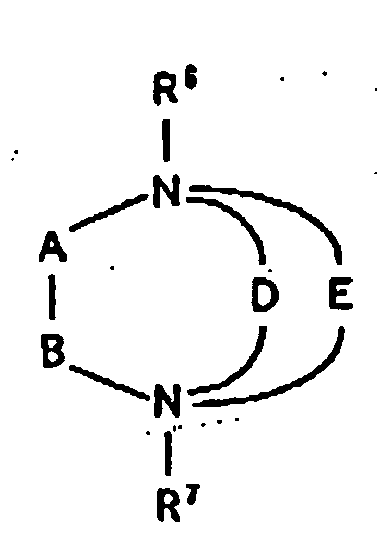
(wherein A and B denote adjacently bonded carbon atoms constituting the carbon cluster skeleton of the fullerene, R6 and R7 are each identical or different and denote a hydrogen atom or a hydrocarbon group which may have a substituent, and D and E are each identical or.different and denote a hydrocarbon group which may have a substituent) attached to at least one of the adjacent bonded carbon atom pairs constituting the carbon cluster skeleton of the fullerene or a quaternary amine salt thereof.
(wherein A and B denote adjacently bonded carbon atoms constituting the carbon cluster skeleton of the fullerene, R6 and R7 are each identical or different and denote a hydrogen atom or a hydrocarbon group which may have a substituent, and D and E are each identical or.different and denote a hydrocarbon group which may have a substituent) attached to at least one of the adjacent bonded carbon atom pairs constituting the carbon cluster skeleton of the fullerene or a quaternary amine salt thereof.
12. The anti-hepatitis C virus agent or anti-HIV agent according to claim 11, characterized in that the hydrocarbon group is a linear chain, branched chain or cyclic hydrocarbon group.
13. The anti-hepatitis C virus agent or anti-HIV agent according to claim 12, characterized in that the hydrocarbon group is an alkyl group having 1 to 16 carbon atoms.
14. An anti-hepatitis C virus agent having inhibitory activity against hepatitis C virus
RNA polymerase or anti-HIV agent having an inhibitory activity against HIV reverse
transcriptase, characterized by comprising, as an active ingredient, a carboxyl fullerene derivative having an organic
bond structure represented by the following formula:
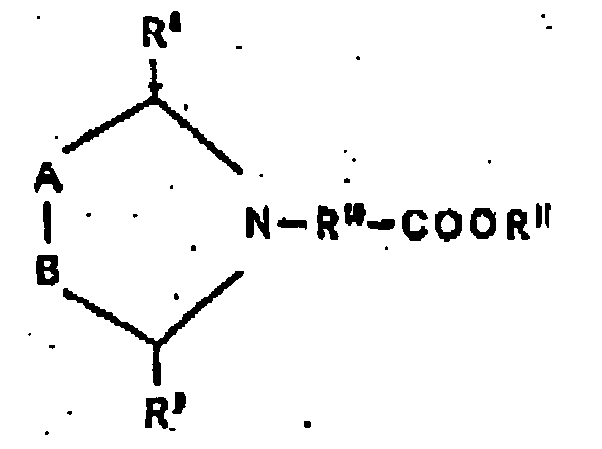
(wherein A and B denote adjacently bonded carbon atoms constituting the carbon cluster skeleton of the fullerene, R8 and R9 are each identical or different and denote a hydrogen atom or a COOR group, R denotes a hydrogen atom or a hydrocarbon group which may have a substituent, R10 denotes a hydrocarbon group which may have a substituent, and hydrocarbon chain may be bonded through hetero atom and R11 denotes a hydrogen atom or a hydrocarbon group which may have a substituent) attached to at least one of the adjacent bonded carbon atom pairs constituting the carbon cluster skeleton of the fullerene.
(wherein A and B denote adjacently bonded carbon atoms constituting the carbon cluster skeleton of the fullerene, R8 and R9 are each identical or different and denote a hydrogen atom or a COOR group, R denotes a hydrogen atom or a hydrocarbon group which may have a substituent, R10 denotes a hydrocarbon group which may have a substituent, and hydrocarbon chain may be bonded through hetero atom and R11 denotes a hydrogen atom or a hydrocarbon group which may have a substituent) attached to at least one of the adjacent bonded carbon atom pairs constituting the carbon cluster skeleton of the fullerene.
15. The anti-hepatitis C virus agent or anti-HIV agent according to claim 14 further comprising
at least one carboxyl fullerene derivative having an organic bond structure represented
by the following formula
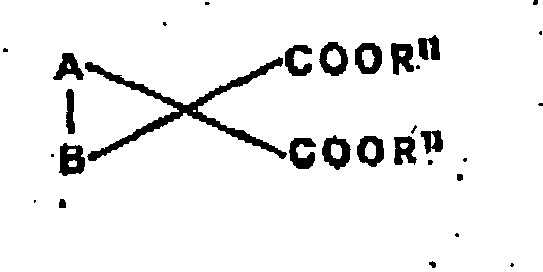
(wherein A and B denote adjacently bonded carbon atoms constituting the carbon cluster skeleton of the fullerene, R12 and R13 are each identical or different and denote a hydrogen atom or hydrocarbon group which may have a substituent) attached to at least one of the adjacent bonded carbon atom pairs constituting the carbon cluster skeleton of the fullerene.
(wherein A and B denote adjacently bonded carbon atoms constituting the carbon cluster skeleton of the fullerene, R12 and R13 are each identical or different and denote a hydrogen atom or hydrocarbon group which may have a substituent) attached to at least one of the adjacent bonded carbon atom pairs constituting the carbon cluster skeleton of the fullerene.
16. The anti-hepatitis C virus agent or anti-HIV agent according to claim 14 or 15, characterized in that the hydrocarbon group is a linear chain or branched chain hydrocarbon group.
17. The anti-hepatitis C virus agent or anti-HIV agent according to any of claims 11 to
16, characterized in that the fullerene is at least one kind of C60 fullerene and higher order fullerenes.
18. The use of the fullerene derivative defined in any of claims 11 to 17 in the manufacture
of an anti-HIV agent having an inhibitory activity against HIV reverse transcriptase.
1. Die Verwendung eines Fulleren-Derivats, welches ein Stickstoffatom besitzt, das zusammen
mit benachbarten gebundenen Kohlenstoffatompaaren, welche das Kohlenstoff-Clusterskelett
des Fullerens bilden, einen Ring bildet, oder ein quaternäres Aminsalz davon bei der
Herstellung eines Mittels gegen Hepatitis-C-Virus mit inhibitorischer Wirkung gegen
Hepatitis-C-Virus-RNA-Polymerase.
2. Die Verwendung gemäß Anspruch 1, dadurch gekennzeichnet, dass das Stickstoffatom durch eine Kohlenwasserstoffkette oder direkt ohne eine Kohlenwasserstoffkette
an wenigstens eines der benachbarten gebundenen Kohlenstoffatompaare gebunden ist.
3. Die Verwendung gemäß Anspruch 1 oder 2, dadurch gekennzeichnet, dass als ein Wirkstoff ein quaternäres Aminsalz eines Fulleren-Derivats umfasst ist, welches
eine organische Bindungsstruktur besitzt, dargestellt durch die folgende Formel:

(wobei A und B benachbart gebundene Kohlenstoffatome bedeuten, welche das Kohlenstoff-Clusterskelett des Fullerens darstellen, R1 und R2 identisch oder verschieden sind und eine Kohlenwasserstoffgruppe bedeuten, die einen Substituenten besitzen kann, und R3 und R4 jeweils identisch oder verschieden sind und ein Wasserstoffatom oder eine Kohlenwasserstoffgruppe, die einen Substituenten besitzen kann, bedeuten), gebunden an wenigstens eines der benachbarten gebundenen Kohlenstoffatompaare, die das Kohlenstoff-Clusterskelett des Fullerens darstellen.
(wobei A und B benachbart gebundene Kohlenstoffatome bedeuten, welche das Kohlenstoff-Clusterskelett des Fullerens darstellen, R1 und R2 identisch oder verschieden sind und eine Kohlenwasserstoffgruppe bedeuten, die einen Substituenten besitzen kann, und R3 und R4 jeweils identisch oder verschieden sind und ein Wasserstoffatom oder eine Kohlenwasserstoffgruppe, die einen Substituenten besitzen kann, bedeuten), gebunden an wenigstens eines der benachbarten gebundenen Kohlenstoffatompaare, die das Kohlenstoff-Clusterskelett des Fullerens darstellen.
4. Die Verwendung gemäß Anspruch 1 oder 2, dadurch gekennzeichnet, dass als ein Wirkstoff ein Fulleren-Derivat umfasst ist, welches eine organische Bindungsstruktur
besitzt, dargestellt durch die folgende Formel:

(wobei A und B benachbart gebundene Kohlenstoffatome bedeuten, welche das Kohlenstoff-Clusterskelett des Fullerens darstellen, R3 und R4 jeweils identisch oder verschieden sind und ein Wasserstoffatom oder eine Kohlenwasserstoffgruppe, die einen Substituenten besitzen kann, bedeuten und R5 eine Kohlenwasserstoffgruppe bedeutet, die einen Substituenten besitzen kann), gebunden an wenigstens eines der benachbarten gebundenen Kohlenstoffatompaare, die das Kohlenstoff-Clusterskelett des Fullerens darstellen.
(wobei A und B benachbart gebundene Kohlenstoffatome bedeuten, welche das Kohlenstoff-Clusterskelett des Fullerens darstellen, R3 und R4 jeweils identisch oder verschieden sind und ein Wasserstoffatom oder eine Kohlenwasserstoffgruppe, die einen Substituenten besitzen kann, bedeuten und R5 eine Kohlenwasserstoffgruppe bedeutet, die einen Substituenten besitzen kann), gebunden an wenigstens eines der benachbarten gebundenen Kohlenstoffatompaare, die das Kohlenstoff-Clusterskelett des Fullerens darstellen.
5. Die Verwendung gemäß Anspruch 1 oder 2, dadurch gekennzeichnet, dass als ein Wirkstoff ein Fulleren-Derivat umfasst ist, welches eine organische Bindungsstruktur
besitzt, dargestellt durch die folgende Formel:
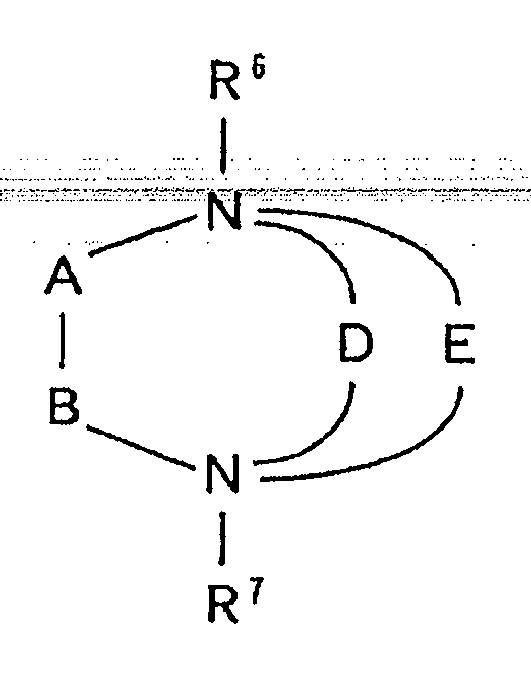
(wobei A und B benachbart gebundene Kohlenstoffatome bedeuten, welche das Kohlenstoff-Clusterskelett des Fullerens darstellen, R6 und R7 jeweils identisch oder verschieden sind und ein Wasserstoffatom oder eine Kohlenwasserstoffgruppe, die einen Substituenten besitzen kann, bedeuten und D und E jeweils identisch oder verschieden sind und eine Kohlenwasserstoffgruppe bedeuten, die einen Substituenten besitzen kann), gebunden an wenigstens eines der benachbarten gebundenen Kohlenstoffatompaare, die das Kohlenstoff-Clusterskelett des Fullerens darstellen, oder ein quaternäres Aminsalz davon.
(wobei A und B benachbart gebundene Kohlenstoffatome bedeuten, welche das Kohlenstoff-Clusterskelett des Fullerens darstellen, R6 und R7 jeweils identisch oder verschieden sind und ein Wasserstoffatom oder eine Kohlenwasserstoffgruppe, die einen Substituenten besitzen kann, bedeuten und D und E jeweils identisch oder verschieden sind und eine Kohlenwasserstoffgruppe bedeuten, die einen Substituenten besitzen kann), gebunden an wenigstens eines der benachbarten gebundenen Kohlenstoffatompaare, die das Kohlenstoff-Clusterskelett des Fullerens darstellen, oder ein quaternäres Aminsalz davon.
6. Die Verwendung gemäß einem der Ansprüche 1 bis 5, dadurch gekennzeichnet, dass die Kohlenwasserstoffkette eine Kohlenwasserstoffgruppe mit linearer Kette, verzweigter
Kette oder eine cyclische Kohlenwasserstoffgruppe ist.
7. Die Verwendung gemäß Anspruch 6, dadurch gekennzeichnet, dass die Kohlenwasserstoffgruppe eine Alkylgruppe mit 1 bis 16 Kohlenstoffatomen ist.
8. Die Verwendung von wenigstens einer Art von Carboxyfulleren-Derivaten, die eine organische
Bindungsstruktur besitzen, dargestellt durch die folgenden Formeln:
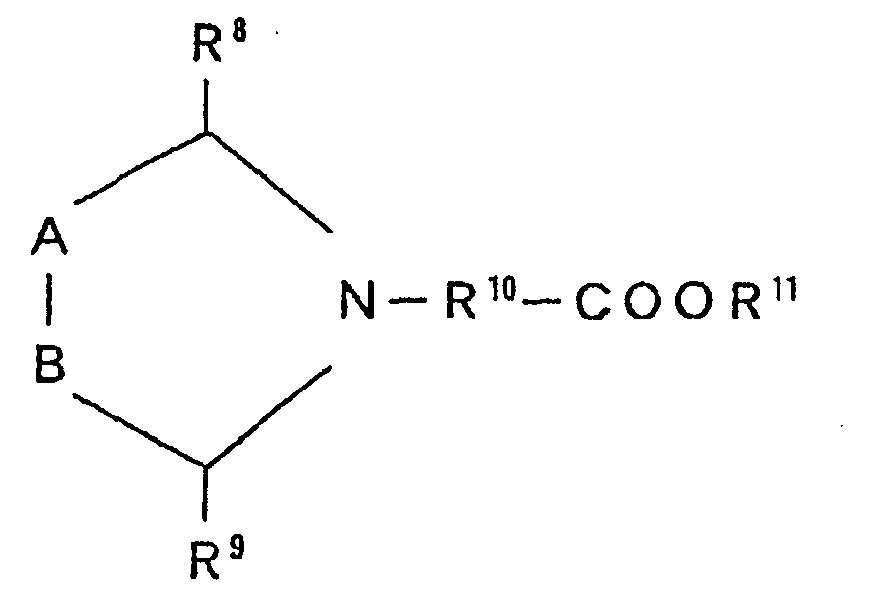

(wobei A und B benachbart gebundene Kohlenstoffatome bedeuten, welche das Kohlenstoff-Clusterskelett des Fullerens darstellen, R8 und R9 jeweils identisch oder verschieden sind und ein Wasserstoffatom oder eine COOR-Gruppe bedeuten, R ein Wasserstoffatom oder eine Kohlenwasserstoffgruppe, die einen Substituenten besitzen kann, bedeutet, R10 eine Kohlenwasserstoffgruppe bedeutet, die einen Substituenten besitzen kann, und wobei eine Kohlenwasserstoffkette durch ein Heteroatom gebunden sein kann und R11, R12 und R13 jeweils identisch oder verschieden sind und ein Wasserstoffatom oder eine Kohlenwasserstoffgruppe, die einen Substituenten besitzen kann, bedeuten), gebunden an wenigstens eines der benachbarten gebundenen Kohlenstoffatompaare, die das Kohlenstoff-Clusterskelett des Fullerens darstellen, bei der Herstellung eines Mittels gegen Hepatitis-C-Virus mit einer inhibitorischen Aktivität gegen Hepatitis-C-Virus-RNA-Polymerase.
(wobei A und B benachbart gebundene Kohlenstoffatome bedeuten, welche das Kohlenstoff-Clusterskelett des Fullerens darstellen, R8 und R9 jeweils identisch oder verschieden sind und ein Wasserstoffatom oder eine COOR-Gruppe bedeuten, R ein Wasserstoffatom oder eine Kohlenwasserstoffgruppe, die einen Substituenten besitzen kann, bedeutet, R10 eine Kohlenwasserstoffgruppe bedeutet, die einen Substituenten besitzen kann, und wobei eine Kohlenwasserstoffkette durch ein Heteroatom gebunden sein kann und R11, R12 und R13 jeweils identisch oder verschieden sind und ein Wasserstoffatom oder eine Kohlenwasserstoffgruppe, die einen Substituenten besitzen kann, bedeuten), gebunden an wenigstens eines der benachbarten gebundenen Kohlenstoffatompaare, die das Kohlenstoff-Clusterskelett des Fullerens darstellen, bei der Herstellung eines Mittels gegen Hepatitis-C-Virus mit einer inhibitorischen Aktivität gegen Hepatitis-C-Virus-RNA-Polymerase.
9. Die Verwendung gemäß Anspruch 8, dadurch gekennzeichnet, dass die Kohlenwasserstoffkette eine Kohlenwasserstoffgruppe mit linearer Kette oder verzweigter
Kette ist.
10. Die Verwendung gemäß einem der Ansprüche 1 bis 9, dadurch gekennzeichnet, dass das Fulleren wenigstens eine Art von C60-Fulleren und Fullerenen höherer Ordnung ist.
11. Ein Mittel gegen Hepatitis-C-Virus mit inhibitorischer Wirkung gegen Hepatitis-C-Virus-RNA-Polymerase
oder ein Mittel gegen HIV mit einer inhibitorischen Wirkung gegen HIV-Reverse-Transkriptase,
dadurch gekennzeichnet, dass es als Wirkstoff ein Fulleren-Derivat umfasst, welches eine organische Bindungsstruktur
besitzt, dargestellt durch die folgende Formel:
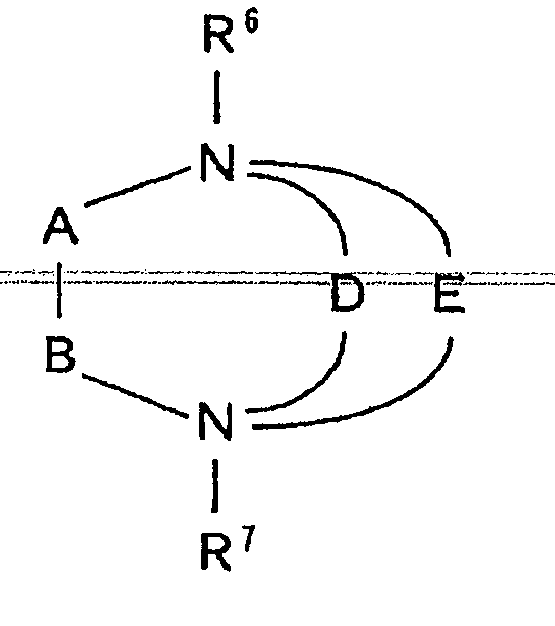
(wobei A und B benachbart gebundene Kohlenstoffatome bedeuten, welche das Kohlenstoff-Clusterskelett des Fullerens darstellen, R6 und R7 jeweils identisch oder verschieden sind und ein Wasserstoffatom oder eine Kohlenwasserstoffgruppe, die einen Substituenten besitzen kann, bedeuten und D und E jeweils identisch oder verschieden sind und eine Kohlenwasserstoffgruppe bedeuten, die einen Substituenten besitzen kann), gebunden an wenigstens eines der benachbarten gebundenen Kohlenstoffatompaare, die das Kohlenstoff-Clusterskelett des Fullerens darstellen, oder ein quaternäres Aminsalz davon.
(wobei A und B benachbart gebundene Kohlenstoffatome bedeuten, welche das Kohlenstoff-Clusterskelett des Fullerens darstellen, R6 und R7 jeweils identisch oder verschieden sind und ein Wasserstoffatom oder eine Kohlenwasserstoffgruppe, die einen Substituenten besitzen kann, bedeuten und D und E jeweils identisch oder verschieden sind und eine Kohlenwasserstoffgruppe bedeuten, die einen Substituenten besitzen kann), gebunden an wenigstens eines der benachbarten gebundenen Kohlenstoffatompaare, die das Kohlenstoff-Clusterskelett des Fullerens darstellen, oder ein quaternäres Aminsalz davon.
12. Das Mittel gegen Hepatitis-C-Virus oder das Mittel gegen HIV gemäß Anspruch 11, dadurch gekennzeichnet, dass die Kohlenwasserstoffgruppe eine Kohlenwasserstoffgruppe mit linearer Kette, verzweigter
Kette oder eine cyclische Kohlenwasserstoffgruppe ist.
13. Das Mittel gegen Hepatitis-C-Virus oder das Mittel gegen HIV gemäß Anspruch 12, dadurch gekennzeichnet, dass die Kohlenwasserstoffgruppe eine Alkylgruppe mit 1 bis 16 Kohlenstoffatomen ist.
14. Ein Mittel gegen Hepatitis-C-Virus mit inhibitorischer Wirkung gegen Hepatitis-C-Virus-RNA-Polymerase
oder ein Mittel gegen HIV mit einer inhibitorischen Wirkung gegen HIV-Reverse-Transkriptase,
dadurch gekennzeichnet, dass es als Wirkstoff ein Carboxyfulleren-Derivat umfasst, welches eine organische Bindungsstruktur
besitzt, dargestellt durch die folgende Formel:
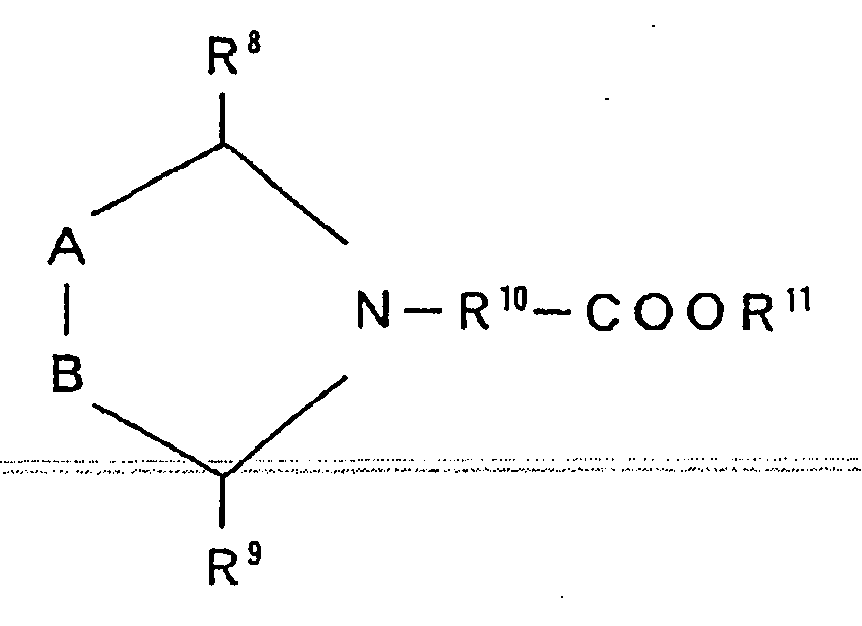
(wobei A und B benachbart gebundene Kohlenstoffatome bedeuten, welche das Kohlenstoff-Clusterskelett des Fullerens darstellen, R8 und R9 jeweils identisch oder verschieden sind und ein Wasserstoffatom oder eine COOR-Gruppe bedeuten, R ein Wasserstoffatom oder eine Kohlenwasserstoffgruppe, die einen Substituenten besitzen kann, bedeutet, R10 eine Kohlenwasserstoffgruppe bedeutet, die einen Substituenten besitzen kann, und wobei eine Kohlenwasserstoffkette durch ein Heteroatom gebunden sein kann und R11 ein Wasserstoffatom oder eine Kohlenwasserstoffgruppe, die einen Substituenten besitzen kann, bedeutet), gebunden an wenigstens eines der benachbarten gebundenen Kohlenstoffatompaare, die das Kohlenstoff-Clusterskelett des Fullerens darstellen.
(wobei A und B benachbart gebundene Kohlenstoffatome bedeuten, welche das Kohlenstoff-Clusterskelett des Fullerens darstellen, R8 und R9 jeweils identisch oder verschieden sind und ein Wasserstoffatom oder eine COOR-Gruppe bedeuten, R ein Wasserstoffatom oder eine Kohlenwasserstoffgruppe, die einen Substituenten besitzen kann, bedeutet, R10 eine Kohlenwasserstoffgruppe bedeutet, die einen Substituenten besitzen kann, und wobei eine Kohlenwasserstoffkette durch ein Heteroatom gebunden sein kann und R11 ein Wasserstoffatom oder eine Kohlenwasserstoffgruppe, die einen Substituenten besitzen kann, bedeutet), gebunden an wenigstens eines der benachbarten gebundenen Kohlenstoffatompaare, die das Kohlenstoff-Clusterskelett des Fullerens darstellen.
15. Das Mittel gegen Hepatitis-C-Virus oder das Mittel gegen HIV gemäß Anspruch 14, das
ferner wenigstens ein Carboxyfulleren-Derivat umfasst, welches eine organische Bindungsstruktur
besitzt, dargestellt durch die folgende Formel:
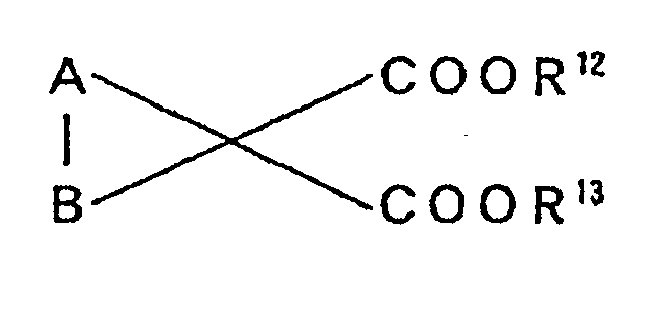
(wobei A und B benachbart gebundene Kohlenstoffatome bedeuten, welche das Kohlenstoff-Clusterskelett des Fullerens darstellen, R12 und R13 jeweils identisch oder verschieden sind und ein Wasserstoffatom oder eine Kohlenwasserstoffgruppe, die einen Substituenten besitzen kann, bedeuten), gebunden an wenigstens eines der benachbarten gebundenen Kohlenstoffatompaare, die das Kohlenstoff-Clusterskelett des Fullerens darstellen.
(wobei A und B benachbart gebundene Kohlenstoffatome bedeuten, welche das Kohlenstoff-Clusterskelett des Fullerens darstellen, R12 und R13 jeweils identisch oder verschieden sind und ein Wasserstoffatom oder eine Kohlenwasserstoffgruppe, die einen Substituenten besitzen kann, bedeuten), gebunden an wenigstens eines der benachbarten gebundenen Kohlenstoffatompaare, die das Kohlenstoff-Clusterskelett des Fullerens darstellen.
16. Das Mittel gegen Hepatitis-C-Virus oder das Mittel gegen HIV gemäß Anspruch 14 oder
15, dadurch gekennzeichnet, dass die Kohlenwasserstoffgruppe eine Kohlenwasserstoffgruppe mit linearer Kette oder
verzweigter Kette ist.
17. Das Mittel gegen Hepatitis-C-Virus oder das Mittel gegen HIV gemäß einem der Ansprüche
11 bis 16, dadurch gekennzeichnet, dass das Fulleren wenigstens eine Art von C60-Fulleren und Fullerenen höherer Ordnung ist.
18. Die Verwendung des in einem der Ansprüche 11 bis 17 definierten Fulleren-Derivats
bei der Herstellung eines Mittels gegen HIV mit einer inhibitorischen Wirkung gegen
HIV-Reverse-Transkriptase.
1. Utilisation d'un dérivé de fullerène comportant un atome d'azote formant un cycle
conjointement avec des paires d'atomes de carbone liés en position adjacente, constituant
le squelette de l'édifice carboné du fullerène, ou d'un sel d'amine quaternaire de
celui-ci, dans la fabrication d'un agent anti-virus de l'hépatite C, ayant une activité
inhibitrice contre l'ARN polymérase du virus de l'hépatite C.
2. Utilisation selon la revendication 1, caractérisée en ce que l'atome d'azote est lié par une chaîne hydrocarbonée ou lié directement sans une
chaîne hydrocarbonée à au moins l'une quelconque des paires d'atomes de carbone liés
en position adjacente.
3. Utilisation selon la revendication 1 ou 2, caractérisée en ce qu'elle comprend en tant que composant actif un sel d'amine quaternaire d'un dérivé de
fullerène ayant une structure de liaisons organiques représentée par la formule suivante
:
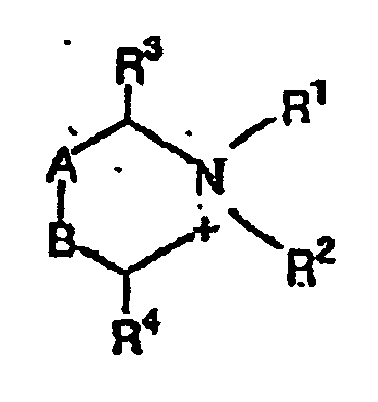
(dans laquelle A et B représentent des atomes de carbone liés en position adjacente, constituant le squelette de l'édifice carboné du fullerène, R1 et R2 sont identiques ou différents et représentent un groupe hydrocarboné pouvant comporter un substituant, et R3 et R4 sont chacun identiques ou différents et représentent un atome d'hydrogène ou un groupe hydrocarboné pouvant comporter un substituant) fixée à au moins l'une des paires d'atomes de carbone liés en position adjacente, constituant le squelette de l'édifice carboné du fullerène.
(dans laquelle A et B représentent des atomes de carbone liés en position adjacente, constituant le squelette de l'édifice carboné du fullerène, R1 et R2 sont identiques ou différents et représentent un groupe hydrocarboné pouvant comporter un substituant, et R3 et R4 sont chacun identiques ou différents et représentent un atome d'hydrogène ou un groupe hydrocarboné pouvant comporter un substituant) fixée à au moins l'une des paires d'atomes de carbone liés en position adjacente, constituant le squelette de l'édifice carboné du fullerène.
4. Utilisation selon la revendication 1 ou 2, caractérisée en ce qu'elle comprend en tant que composant actif un dérivé de fullerène ayant une structure
de liaisons organiques représentée par la formule suivante :
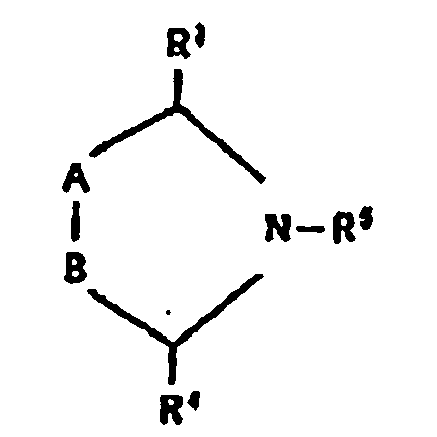
(dans laquelle A et B représentent des atomes de carbone liés en position adjacente, constituant le squelette de l'édifice carboné du fullerène, R3 et R4 sont chacun identiques ou différents et représentent un atome d'hydrogène ou un groupe hydrocarboné pouvant comporter un substituant, et R5 représente un groupe hydrocarboné pouvant comporter un substituant) fixée à au moins l'une des paires d'atomes de carbone liés en position adjacente, constituant le squelette de l'édifice carboné du fullerène.
(dans laquelle A et B représentent des atomes de carbone liés en position adjacente, constituant le squelette de l'édifice carboné du fullerène, R3 et R4 sont chacun identiques ou différents et représentent un atome d'hydrogène ou un groupe hydrocarboné pouvant comporter un substituant, et R5 représente un groupe hydrocarboné pouvant comporter un substituant) fixée à au moins l'une des paires d'atomes de carbone liés en position adjacente, constituant le squelette de l'édifice carboné du fullerène.
5. Utilisation selon la revendication 1 ou 2, caractérisée en ce qu'elle comprend en tant que composant actif un dérivé de fullerène ayant une structure
de liaisons organiques représentée par la formule suivante :
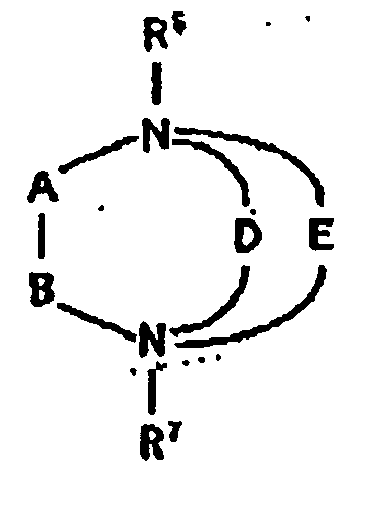
(dans laquelle A et B représentent des atomes de carbone liés en position adjacente, constituant le squelette de l'édifice carboné du fullerène, R6 et R7 sont chacun identiques ou différents et représentent un atome d'hydrogène ou un groupe hydrocarboné pouvant comporter un substituant, et D et E sont chacun identiques ou différents et représentent un groupe hydrocarboné pouvant comporter un substituant) fixée à au moins l'une des paires d'atomes de carbone liés en position adjacente, constituant le squelette de l'édifice carboné du fullerène, ou un sel d'amine quaternaire d'un tel dérivé.
(dans laquelle A et B représentent des atomes de carbone liés en position adjacente, constituant le squelette de l'édifice carboné du fullerène, R6 et R7 sont chacun identiques ou différents et représentent un atome d'hydrogène ou un groupe hydrocarboné pouvant comporter un substituant, et D et E sont chacun identiques ou différents et représentent un groupe hydrocarboné pouvant comporter un substituant) fixée à au moins l'une des paires d'atomes de carbone liés en position adjacente, constituant le squelette de l'édifice carboné du fullerène, ou un sel d'amine quaternaire d'un tel dérivé.
6. Utilisation selon l'une quelconque des revendications 1 à 5, caractérisée en ce que le groupe hydrocarboné est un groupe hydrocarboné à chaîne linéaire, à chaîne ramifiée
ou cyclique.
7. Utilisation selon la revendication 6, caractérisée en ce que le groupe hydrocarboné est un groupe alkyle ayant de 1 à 16 atomes de carbone.
8. Utilisation d'au moins un type de dérivés de carboxy-fullerène ayant une structure
de liaisons organiques représentée par la formules suivante:

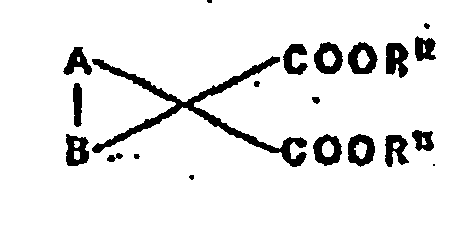
(dans laquelle A et B représentent des atomes de carbone liés en position adjacente, constituant le squelette de l'édifice carboné du fullerène, R8 et R9 sont chacun identiques ou différents et représentent un atome d'hydrogène ou un groupe COOR, R représente un atome d'hydrogène ou un groupe hydrocarboné pouvant comporter un substituant, R10 représente un groupe hydrocarboné pouvant comporter un substituant, et une chaîne hydrocarbonée peut être liée par un hétéroatome, et R11, R12 et R13 sont chacun identiques ou différents et représentent un atome d'hydrogène ou un groupe hydrocarboné pouvant comporter un substituant) fixée à au moins l'une des paires d'atomes de carbone liés en position adjacente, constituant le squelette de l'édifice carboné du fullerène, dans la fabrication d'un agent anti-virus de l'hépatite C, ayant une activité inhibitrice contre l'ARN polymérase du virus de hépatite C.
(dans laquelle A et B représentent des atomes de carbone liés en position adjacente, constituant le squelette de l'édifice carboné du fullerène, R8 et R9 sont chacun identiques ou différents et représentent un atome d'hydrogène ou un groupe COOR, R représente un atome d'hydrogène ou un groupe hydrocarboné pouvant comporter un substituant, R10 représente un groupe hydrocarboné pouvant comporter un substituant, et une chaîne hydrocarbonée peut être liée par un hétéroatome, et R11, R12 et R13 sont chacun identiques ou différents et représentent un atome d'hydrogène ou un groupe hydrocarboné pouvant comporter un substituant) fixée à au moins l'une des paires d'atomes de carbone liés en position adjacente, constituant le squelette de l'édifice carboné du fullerène, dans la fabrication d'un agent anti-virus de l'hépatite C, ayant une activité inhibitrice contre l'ARN polymérase du virus de hépatite C.
9. Utilisation selon la revendication 8, caractérisée en ce que la chaîne hydrocarbonée est un groupe hydrocarboné à chaîne linéaire ou à chaîne
ramifiée.
10. Utilisation selon l'une quelconque des revendications 1 à 9, caractérisée en ce que le fullerène est au moins un type de fullerènes en C60 et de fullerènes supérieurs.
11. Agent anti-virus de l'hépatite C ayant une activité inhibitrice contre l'ARN polymérase
du virus de l'hépatite C ou agent anti-VIH ayant une activité inhibitrice contre la
transcriptase inverse du VIH, caractérisé en ce qu'il comprend en tant que composant actif un dérivé de fullerène ayant une structure
de liaisons organiques représentée par la formule suivante :
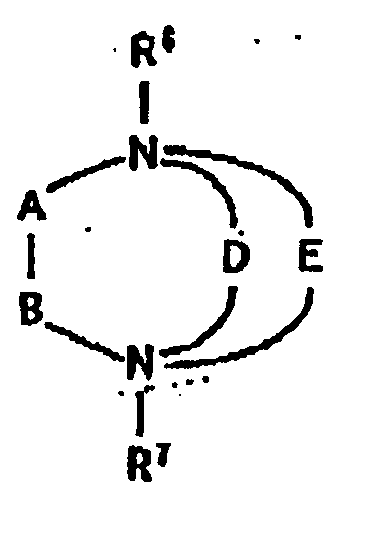
(dans laquelle A et B représentent des atomes de carbone liés en position adjacente, constituant le squelette de l'édifice carboné du fullerène, R6 et R7 sont chacun identiques ou différents et représentent un atome d'hydrogène ou un groupe hydrocarboné pouvant comporter un substituant, et D et E sont chacun identiques ou différents et représentent un groupe hydrocarboné pouvant comporter un substituant) fixée à au moins l'une des paires d'atomes de carbone liés en position adjacente, constituant le squelette de l'édifice carboné du fullerène, ou un sel d'amine quaternaire d'un tel dérivé.
(dans laquelle A et B représentent des atomes de carbone liés en position adjacente, constituant le squelette de l'édifice carboné du fullerène, R6 et R7 sont chacun identiques ou différents et représentent un atome d'hydrogène ou un groupe hydrocarboné pouvant comporter un substituant, et D et E sont chacun identiques ou différents et représentent un groupe hydrocarboné pouvant comporter un substituant) fixée à au moins l'une des paires d'atomes de carbone liés en position adjacente, constituant le squelette de l'édifice carboné du fullerène, ou un sel d'amine quaternaire d'un tel dérivé.
12. Agent anti-virus de l'hépatite C ou agent anti-VIH selon la revendication 11, caractérisé en ce que le groupe hydrocarboné est un groupe hydrocarboné à chaîne linéaire, à chaîne ramifiée
ou cyclique.
13. Agent anti-virus de l'hépatite C ou agent anti-VIH selon la revendication 12, caractérisé en ce que le groupe hydrocarboné est un groupe alkyle ayant de 1 à 16 atomes de carbone.
14. Agent anti-virus de l'hépatite C ayant une activité inhibitrice contre l'ARN polymérase
du virus de l'hépatite C ou agent anti-VIH ayant une activité inhibitrice contre la
transcriptase inverse du VIH, caractérisé en ce qu'il comprend en tant que composant actif un dérivé de carboxy-fullerène ayant une structure
de liaisons organiques représentée par la formule suivante :

(dans laquelle A et B représentent des atomes de carbone liés en position adjacente, constituant le squelette de l'édifice carboné du fullerène, R8 et R9 sont chacun identiques ou différents et représentent un atome d'hydrogène ou un groupe COOR, R représente un atome d'hydrogène ou un groupe hydrocarboné pouvant comporter un substituant, R10 représente un groupe hydrocarboné pouvant comporter un substituant, et une chaîne hydrocarbonée peut être liée par un hétéroatome, et R11 est un atome d'hydrogène ou un groupe hydrocarboné pouvant comporter un substituant) fixée à au moins l'une des paires d'atomes de carbone liés en position adjacente, constituant le squelette de l'édifice carboné du fullerène,
(dans laquelle A et B représentent des atomes de carbone liés en position adjacente, constituant le squelette de l'édifice carboné du fullerène, R8 et R9 sont chacun identiques ou différents et représentent un atome d'hydrogène ou un groupe COOR, R représente un atome d'hydrogène ou un groupe hydrocarboné pouvant comporter un substituant, R10 représente un groupe hydrocarboné pouvant comporter un substituant, et une chaîne hydrocarbonée peut être liée par un hétéroatome, et R11 est un atome d'hydrogène ou un groupe hydrocarboné pouvant comporter un substituant) fixée à au moins l'une des paires d'atomes de carbone liés en position adjacente, constituant le squelette de l'édifice carboné du fullerène,
15. Agent anti-virus de l'hépatite C ou agent anti-VIH selon la revendication 14, comprenant
en outre au moins un dérivé de carboxy-fullerène ayant une structure de liaisons organiques
représentée par la formule suivante :

(dans laquelle A et B représentent des atomes de carbone liés en position adjacente, constituant le squelette de l'édifice carboné du fullerène, R12 et R13 sont chacun identiques ou différents et représentent un atome d'hydrogène ou un groupe hydrocarboné pouvant comporter un substituant) fixée à au moins l'une des paires d'atomes de carbone liés en position adjacente, constituant le squelette de l'édifice carboné du fullerène,
(dans laquelle A et B représentent des atomes de carbone liés en position adjacente, constituant le squelette de l'édifice carboné du fullerène, R12 et R13 sont chacun identiques ou différents et représentent un atome d'hydrogène ou un groupe hydrocarboné pouvant comporter un substituant) fixée à au moins l'une des paires d'atomes de carbone liés en position adjacente, constituant le squelette de l'édifice carboné du fullerène,
16. Agent anti-virus de l'hépatite C ou agent anti-VIH selon la revendication 14 ou 15,
caractérisé en ce que le groupe hydrocarboné est un groupe hydrocarboné à chaîne linéaire ou à chaîne ramifiée.
17. Agent anti-virus de l'hépatite C ou agent anti-VIH selon l'une quelconque des revendications
11 à 16, caractérisé en ce que le fullerène est au moins un type de fullerène en C60 et de fullerènes supérieurs.
18. Utilisation du dérivé de fullerène défini dans l'une quelconque des revendications
11 à 17, dans la fabrication d'un agent anti-VIH ayant une activité inhibitrice contre
la transcriptase inverse du VIH.
REFERENCES CITED IN THE DESCRIPTION
This list of references cited by the applicant is for the reader's convenience only. It does not form part of the European patent document. Even though great care has been taken in compiling the references, errors or omissions cannot be excluded and the EPO disclaims all liability in this regard.
Patent documents cited in the description
Non-patent literature cited in the description
- R. F. SCHINAZI et al.Antimicrob. Agents Chemother, 1993, vol. 37, 1707- [0014]
- D. DHANAK et al.J. Biol. Chem, 2002, vol. 277, 38322-38237 [0050]
- D. DHANAK et al.J. Biol. Chem, 2002, vol. 277, 38322-38327 [0053]
- F. M. UCKUN et al.Bioorg. Med. Chem. Lett., 1999, vol. 9, 2721-2726 [0057]