|
(11) | EP 1 621 534 B1 |

| (12) | EUROPEAN PATENT SPECIFICATION |
|
|
| (54) |
Compositions containing oxetane compounds for use in semiconductor packaging Oxetan enthaltende Mischungen für Halbleiterpackungen Compositions contenant des composés oxétane pour utilisation dans l'empaquetage de semi-conducteurs |
|
|
|||||||||||||||||||||||||||||||
| Note: Within nine months from the publication of the mention of the grant of the European patent, any person may give notice to the European Patent Office of opposition to the European patent granted. Notice of opposition shall be filed in a written reasoned statement. It shall not be deemed to have been filed until the opposition fee has been paid. (Art. 99(1) European Patent Convention). |
[0001] This invention relates to the use of compositions containing oxetane compounds in semiconductor packaging applications, and in particular for use as underfills in assemblies of a semiconductor die attached to a substrate in which the gap between the semiconductor die and substrate is underfilled with a composition containing an oxetane compound.
[0002] In the manufacture of semiconductors, electrical connections are made between electrical terminals on the semiconductor and corresponding electrical terminals on the substrate for the semiconductor. One method for making these interconnections uses solder or polymeric material that is applied to the terminals. The terminals are aligned and contacted together and the resulting assembly of semiconductor and substrate heated to reflow the solder or polymeric material and solidify the connection. The space between the solder or polymeric connections are filled with a polymeric encapsulant or underfill to reinforce the interconnect and to absorb stress. Two prominent uses for underfill technology are in packages known in the industry as flip-chip, in which a semiconductor chip is attached to a lead frame, and ball grid array, in which a package of one or more chips is attached to a printed wire board.
[0003] In some operations the underfill process is designed so that the underfill encapsulant should cure at a higher temperature than that at which the solder or polymeric interconnect material reflows. In the case where the interconnect is lead free, the flow temperature can be as high as 217°C. Thus, the curing temperature of the underfill encapsulant needs to be higher than this temperature. Typical underfill compositions include epoxy, epoxy/phenol, epoxy/anhydride, and cyanate ester systems. These do not always cure at temperatures high enough for the underfill operations using polymeric solder without volatilizing off and, therefore, a need exists for performance materials for high temperature underfill.
[0004] WO2004/101541 A1 is directed to a compound containing an oxetane functionality and a styrenic functionality. These compounds can be homopolymerizable in reactions in which the oxetane can undergo cationic or anionic ring opening, or polymerizable with compounds such as electron acceptor compounds. Macromolecules, ACS, Washington, DC, US, vol. 32, no. 5, 9 March 1999 (1999-03-09), pages 1453-1462, XP000804233, ISSN: 0024-9297 is directed to anionic living polymerizations of protected monomers whereby the resulting polymers possess the predicted molecular weights based on the molar ratios of monomers to initiators and narrow molecular weight distributions. On Scheme 2 on page 1554, the usage of an oxetane compound in a polymerization process is displayed. US 3,278,554 is directed to esters containing two or more oxetane groups, a process for the production of such esters, and the uses of such esters. It is further disclosed, that these esters may be crosslinked and hardened with those bis- or oli-functional compounds which are in general capable of reacting with compounds containing oxetane rings. As preferred hardeners, polybasic acids and their anhydrates are described. US 3 577 438 is directed to a method of producing an oxetane ester. The oxetane esters are prepared from bicyclic ortho esters, which are converted to the oxetane isomer by heating at a temperature of from 275°C to 525°C in the presence of an alumina isomerisation catalyst. US-B1-6 753 434 discloses a compound containing oxetane functionality with an ester group. The compound further includes a polymer which can be a polybutalene. WO 2004/101646 A reveals a curable composition comprising an oxetane functionality in which the oxetane is one carbon atom once removed from the ester functionality, the composition further containing a resin having a carbon double bound, for e.g. polybutadiene.
[0005] This invention is directed to the use of a composition that is suitable as an adhesive or as an underfill encapsulant in the fabrication of electronic devices. The composition comprises an oxetane compound having one or more oxetane rings in which each oxetane ring is one carbon atom removed from an ester.
[0006] Oxetanes are known as highly reactive cyclic ethers that can undergo both cationic and anionic ring opening homopolymerization. In general, oxetanes exhibit low viscosity, shrink minimally upon cure, and polymerize readily. The compounds used according to this invention, with an appropriate catalyst, have sufficiently high curing temperatures to be suitable for use as underfill encapsulants when lead free interconnect material is used.
[0007] The preferred starting material for preparing these oxetane resins is 3-ethyl-3-(hydroxymethyl) oxetane (commercially available as OXT101 from Toagosei), having the structure:
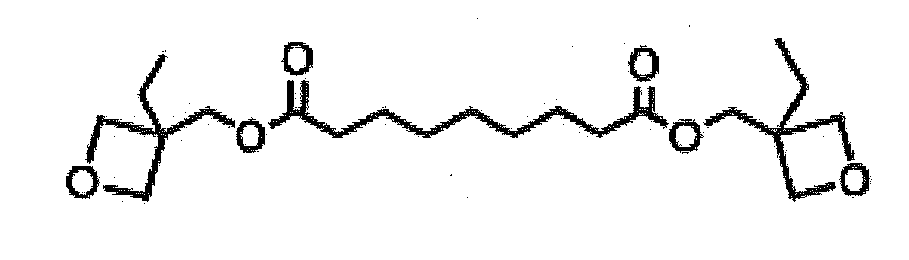
Exemplary resins prepared from 3-ethyl-3-(hydroxymethyl) oxetane and a co-reactive compound include those obtained as follows:
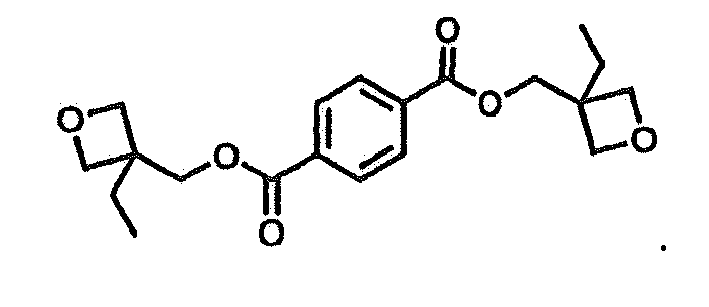
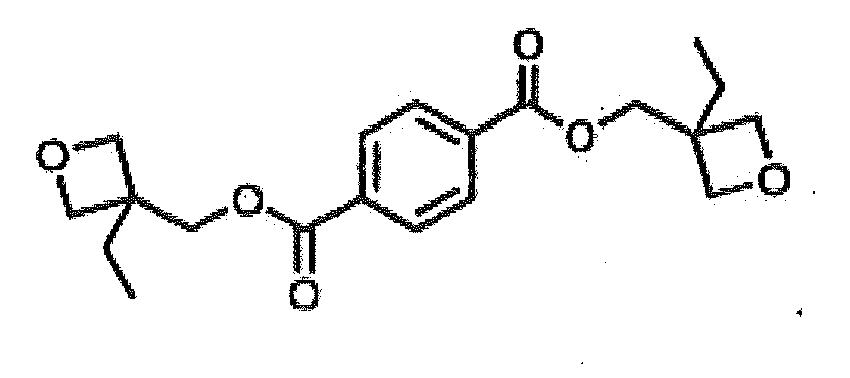
[0008] the reaction of 3-ethyl-3-(hydroxymethyl) oxetane with terephthaloyl chloride to give the compound
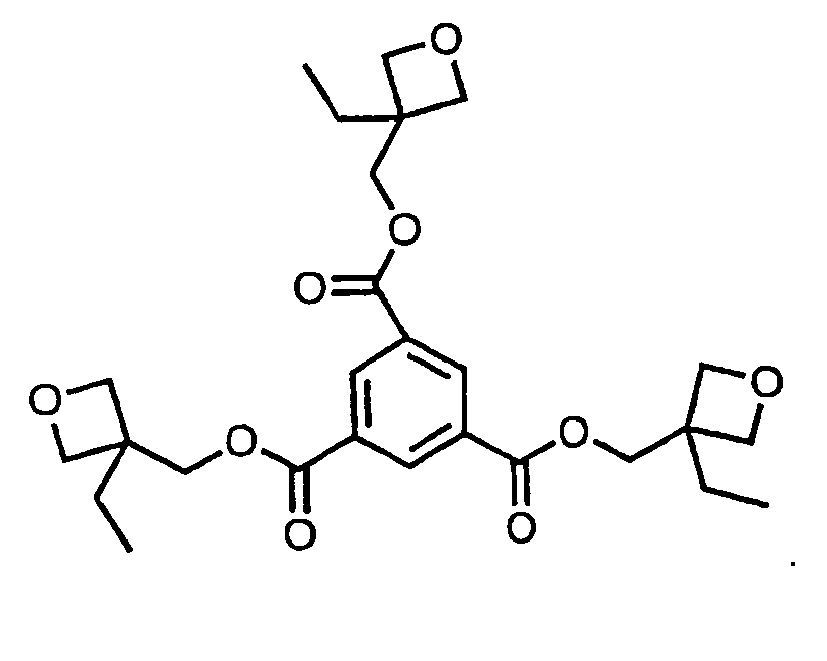
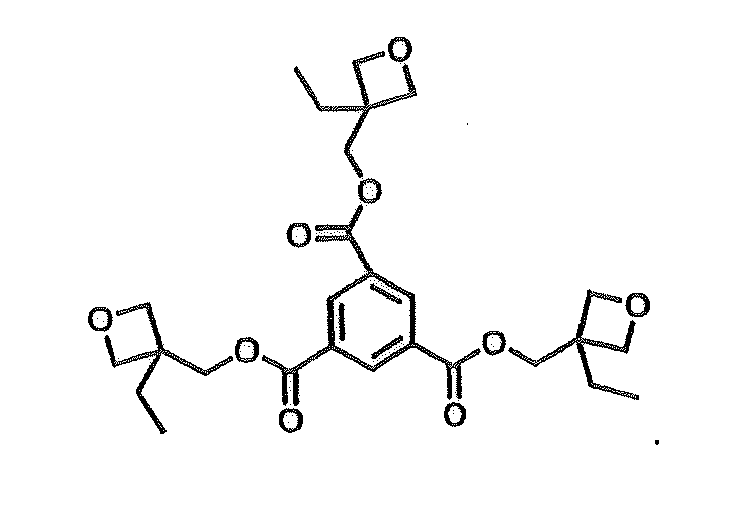
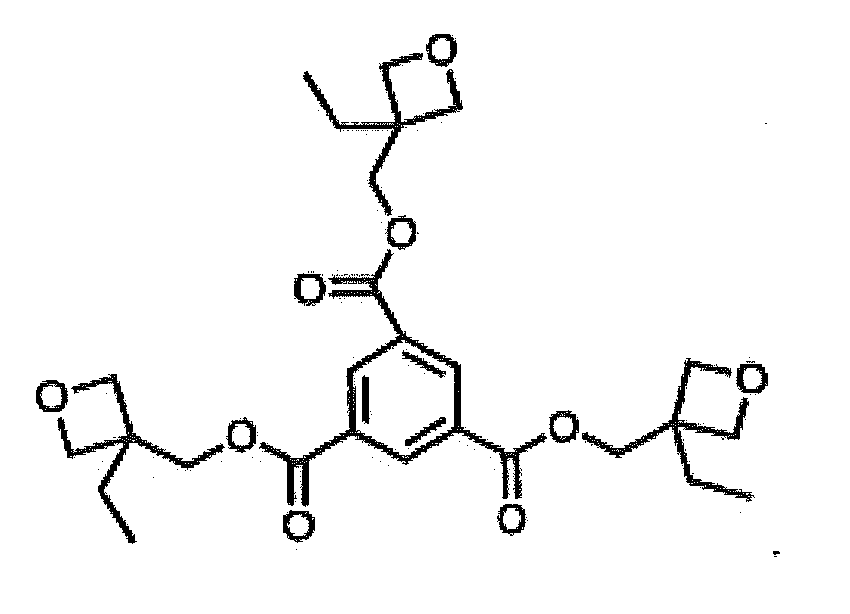
[0009] the reaction of 3-ethyl-3-(hydroxymethyl) oxetane with 1,3,5-benzene-tricarbonyl trichloride to give the compound
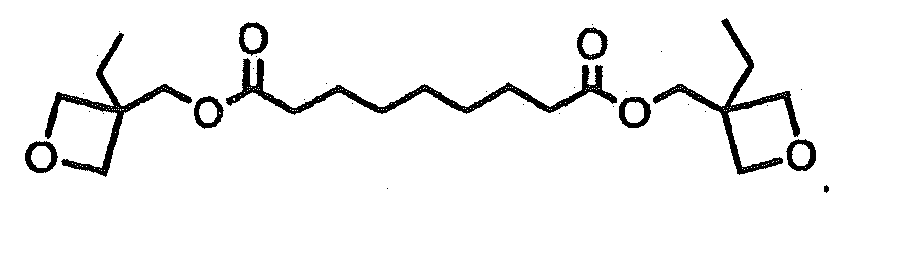
[0010] Compounds III, and IV are obtained as white solids with melting points of 71 °C, 79°C and 97°C, respectively. Compound II is obtained as a colorless liquid with a viscosity of less than 100 cPs at 25°C. Compounds II, III, and IV contain polar ester linkages, those functionalities being useful for improving adhesion.
[0011] Thermogravimetric analysis (TGA) was used to determine the volatility of the above exemplary oxetane resins by heating a sample of each from room temperature to 350°C at a ramp rate of 10°C/min. The weight loss of each resin was less than 5 wt% at 200°C. This shows that the resins will not volatilize to a detrimental extent before they reach their cure temperature.
[0012] Formulations were prepared from these resins and analyzed separately by Differential Scanning Calorimetry to measure kinetic and thermodynamic properties. Compound II was formulated with five weight % of the initiator Rhodorsil 2074 (initiator). Compounds II, and III were formulated with a cyanate ester (CE) sold as product AROCY L10 (by Lonza Group) at a 1:1 molar ratio, with and without copper boron acetoacetate (CuBAcAc) as a catalyst, and also formulated with cis-1,2,3,6-tetrahydro-phthalic anhydride (THPA) in a 1:1 molar ratio with CuBAcAc as a catalyst.
[0014] The results are disclosed in Table 1 and show that these resins cure at high temperatures. The results also show that with the proper choice of co-curing material and catalyst, the actual curing temperature of a formulation containing these oxetane materials can be adjusted to suit various curing programs.
Table 1. Kinetic and Thermodynamic Properties
| Formulation | (°C) Curing Temp | (J/g) Heat of Polymerization |
| Cmpd II + initiator | 238 | 100 |
| Cmpd II + CE | 207 | 415 |
| Cmpd II + CE + CuBAcAc | 195 | 455 |
| Cmpd II +THPA + CuBAcAc | 264 | 223 |
| Cmpd III + CE | 242 | 336 |
| Cmpd III + CE + CuBAcAc | 247 | 412 |
| Cmpd III + THPA + CuBAcAc | 294 | 245 |
[0015] In another embodiment, underfill compositions suitable for use in this invention will contain, in addition to the oxetane compound, a cyanate ester compound or resin, a curing initiator, and optionally, a filler. Suitable cyanate ester compounds or resins are commercially available or synthesized by processes known in the art, and can be either aromatic or aliphatic materials. (See, for example US patents 4,785,075 and 4,839,442.) In these embodiments, the cyanate ester will be present in an amount up to 90 weight % of the composition excluding fillers.
[0016] In another embodiment, underfill compositions suitable for use in this invention will contain, in addition to the oxetane compound, a curable resin having at least one carbon to carbon double bond, an epoxy, or both. Suitable epoxies are commercially available and can be chosen without undue experimentation by the practitioner. Curable resins having a carbon to carbon double bond include, for example, resins derived from cinnamyl and styrenic starting compounds, fumarates, maleates, acrylates, and maleimides. In these embodiments, the epoxy or the resin containing the carbon to carbon double bond will be present in an amount up to 90 weight % of the composition excluding fillers.
[0017] Suitable curing agents include cationic initiators, for example, iodonium, oxonium, sulfonium, sulfoxonium, and various other onium salts. Other suitable cationic initiators include Lewis acid catalysts, such as, copper boron acetoacetate and cobalt boron acetoacetate, and alkylation agents, such as, arylsulfonate esters, e.g., methyl-p-toluenesulfonate and methyl trifluoromethanesulfonate. A preferred series of photoinitiators are those sold under the trademark Irgacure by Ciba Specialty Chemicals or Rhodorsil 2074 by Rhodia. When present, initiators will be present in an amount up to 10 weight % of the formulation.
[0018] Suitable fillers can be conductive or nonconductive. Exemplary conductive fillers are carbon black, graphite, gold, silver, copper, platinum, palladium, nickel, aluminum, silicon carbide, boron nitride, diamond, and alumina. Exemplary nonconductive fillers are particles of vermiculite, mica, wollastonite, calcium carbonate, titania, sand, glass, fused silica, fumed silica, barium sulfate, and halogenated ethylene polymers, such as tetrafluoroethylene, trifluoro-ethylene, vinylidene fluoride, vinyl fluoride, vinylidene chloride, and vinyl chloride. Fillers generally will be present in amounts of 20% to 90% by weight of the formulation.
[0019] These compositions are useful as underfill material between the die and substrate. Typical substrates are fabricated from metal, for example, copper, silver, gold, nickel, alloys (such as, 42Fe/58Ni alloy), silver-coated copper, or palladium-coated copper; from organic material, for example, polyimides, polyamides, or polyesters; from ceramic; and from composites or laminates (such as, printed wire boards)
[0020] Various underfill operations are known and used in the art, and the materials disclosed within this specification are suitable for use in those operations. In a typical underfill operation, connections are made between electrical terminals on the die and corresponding electrical terminals on the substrate using metallic or polymeric solder. A bump of solder or lead free polymeric solder is placed on the terminals of the substrate, the terminals are aligned and contacted, and the resulting assembly heated to reflow the solder. A gap is created between the die and the substrate, which is filled with the underfill encapsulant to reinforce the interconnect.
[0021] There are variations in the processes for the underfill, which variations are known to those skilled in the art. For example, the underfill material can be placed along the periphery of the gap between the die and substrate and enter and fill the cap by capillary action. In another process, the underfill can be applied to the silicon wafer before it is diced into individual dies. Curing of the underfill material may take place after the reflow of the solder or simultaneously with the reflow of the solder, depending on the curing temperature of the underfill material and the process chosen.
SYNTHETIC EXAMPLES
[0024] The initial charge was added to a 500-mL 4-neck round bottom flask: 3-ethyl-3-(hydroxymethyl) oxetane (25.76 g, 0.222 mol), triethylamine (22.464 g, 0.222 mol), dimethylaminopyridine (2.712 g, 0.022 mol) and dichloromethane (180 mL). The reaction vessel was equipped with an overhead mixer and condenser. Stirring was continued until the mixture became homogeneous. The temperature was kept between 0° and 10°C. Azelaoyl chloride (25 g, 0.111 mol) was charged dropwise to the flask over a period of one hour. The reaction was monitored by FT-IR analysis for the consumption of carbonyl group in acid chloride (peak at 1801 cm-1) and the formation of ester group in product (peak at 1736 cm-1). The reaction was completed after 24 hours. The reaction mixture was washed with water (5 x 50 mL). The organics were dried over MgSO4, filtered, and the solvent was evaporated off at bath temperature of 50°C. Product was then dissolved in 50/50 hexane and ethyl acetate mixture (250 mL) and silica gel (8 g) was added. Silica gel was filtered out and the solvent was removed in vacuo (60°C, 0.3 mm Hg) to afford a clear yellow liquid (31 g, 0.081 mol, 67%) with a viscosity of less than 100 mPa.s at room temperature.
[0026] The initial charge was added to a 500-mL 4-neck round bottom flask: 3-ethyl-3-(hydroxymethyl) oxetane (40 g, 0.344 mol), triethylamine (34.809 g, 0.344 mol), dimethylaminopyridine (4.203 g, 0.034 mol) and dichloromethane (300 mL). The reaction vessel was equipped with an overhead mixer and condenser. Stirring was continued until the mixture became homogeneous. The temperature was kept between 0° and 10°C. Terephthaloyl chloride (35.0 g, 0.172 mol) was dissolved into dichloromethane (100 mL) and the mixture was charged to the flask by dropwise addition over a period of one hour. The reaction was monitored by FT-IR analysis for the consumption of carbonyl group in acid chloride (peak at 1801 cm-1) and the formation of ester group in product (peak at 1736 cm-1). The reaction was completed after 24 hours. The reaction mixture was washed with water (5 x 50 mL). The organics were dried over MgSO4, filtered, and the solvent was evaporated off at bath temperature of 50°C. Product was mixed with ethyl acetate (300 mL) and the temperature was reduced below -30°C by dry ice. An insoluble white solid (product) precipitated out. Product was filtered and washed with hexane (3 x 30 mL) to afford a white solid with a melting point of 79°C.
[0028] The initial charge was added to a 500-mL 4-neck round bottom flask: 3-ethyl-3-(hydroxymethyl) oxetane (40 g, 0.344 mol), triethylamine (34.809 g, 0.344 mol), dimethylaminopyridine (4.203 g, 0.034 mol) and dichloromethane (300 mL). The reaction vessel was equipped with an overhead mixer and condenser. Stirring was continued until the mixture became homogeneous. The temperature was kept between 0° and 10°C. 1,3,5-Benzenetricarbonyl trichloride (30.442 g, 0.115 mol) was dissolved into dichloromethane (100 mL) and the mixture was charged to the flask dropwise over a period of one hour. The reaction was monitored by FT-IR analysis for the consumption of carbonyl group in acid chloride (peak at 1801 cm-1) and the formation of ester group in product (peak at 1736 cm-1). The reaction was completed after 24 hours. The reaction mixture was washed with water (5 x 50 mL). The organics were dried over MgSO4, filtered, and the solvent was evaporated off at bath temperature of 50°C. Product was mixed with ethyl acetate (300 mL) and temperature was reduced below -30°C by dry ice. An insoluble white solid (product) precipitated out. Product was filtered and washed with hexane (3 x 30 mL) to afford a white solid with a melting point of 97°C.
1. Use of a curable composition comprising an oxetane compound having one or more oxetane
rings in which each oxetane ring is one carbon atom removed from an ester functionality,
the curable composition further comprising a cyanate ester compound; or further an
epoxy compound; or further a resin having a carbon to carbon double bond; or further
both an epoxy compound and a resin having a carbon to carbon double bond as an adhesive
or undefill encapsulant in the fabrication of electronic devices.
2. Use according to claim 1, in which the oxetane compound has the structure
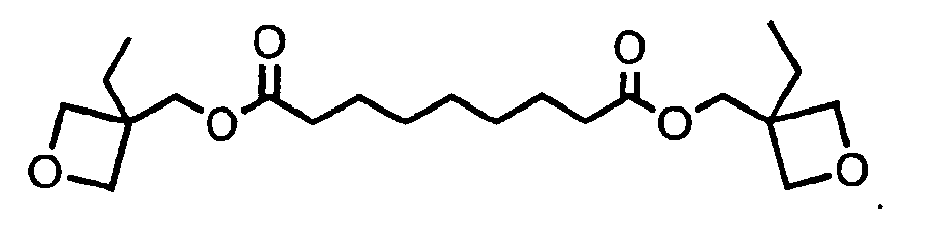
3. Use according to claim 1, in which the oxetane compound has the structure
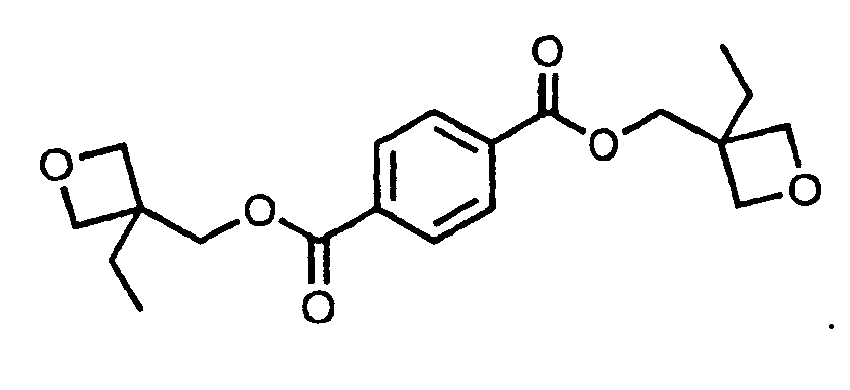
4. Use according to claim 1, in which the oxetane compound has the structure
1. Verwendung einer härtbaren Zusammensetzung, die eine Oxetanverbindung mit einem oder
mehreren Oxetanringen umfasst, wobei jeder Oxetanring ein Kohlenstoffatom von einer
Esterfunktionalität entfernt ist, wobei die härtbare Zusammensetzung weiterhin eine
Cyanatesterverbindung oder weiterhin eine Epoxyverbindung oder weiterhin ein Harz
mit einer Kohlenstoff-Kohlenstoff-Doppelbindung oder weiterhin sowohl eine Epoxyverbindung
als auch ein Harz mit einer Kohlenstoff-Kohlenstoff-Doppelbindung umfasst, als ein
Klebstoff oder Underfill-Einkapselungsmittel bei der Herstellung von elektronischen
Bauelementen.
2. Verwendung nach Anspruch 1, wobei die Oxetanverbindung die folgende Struktur aufweist:
3. Verwendung nach Anspruch 1, wobei die Oxetanverbindung die folgende Struktur aufweist:
4. Verwendung nach Anspruch 1, wobei die Oxetanverbindung die folgende Struktur aufweist:
1. Utilisation d'une composition durcissable comprenant un composé d'oxétane possédant
un ou plusieurs noyaux oxétane, chaque noyau oxétane est distant d'un atome de carbone
d'une fonctionnalité ester, la composition durcissable comprenant en outre un composé
d'ester de cyanate ou en outre un composé époxy ou en outre une résine possédant une
liaison double carbone carbone ou en outre à la fois un composé époxy et une résine
possédant une liaison double carbone carbone, à titre d'adhésif ou d'agent d'encapsulation
du type manque de métal dans la fabrication de dispositifs électroniques.
2. Utilisation selon la revendication 1, dans laquelle le composé d'oxétane possède la
structure :
3. Utilisation selon la revendication 1, dans laquelle le composé d'oxétane possède la
structure :
4. Utilisation selon la revendication 1, dans laquelle le composé d'oxétane possède la
structure :
REFERENCES CITED IN THE DESCRIPTION
This list of references cited by the applicant is for the reader's convenience only. It does not form part of the European patent document. Even though great care has been taken in compiling the references, errors or omissions cannot be excluded and the EPO disclaims all liability in this regard.
Patent documents cited in the description
- WO2004101541A1 [0004]
- US3278554A [0004]
- US3577438A [0004]
- US6753434B1 [0004]
- WO2004101646A [0004]
- US4785075A [0015]
- US4839442A [0015]
Non-patent literature cited in the description
- MacromoleculesACS19990309vol. 32, 1453-1462 [0004]