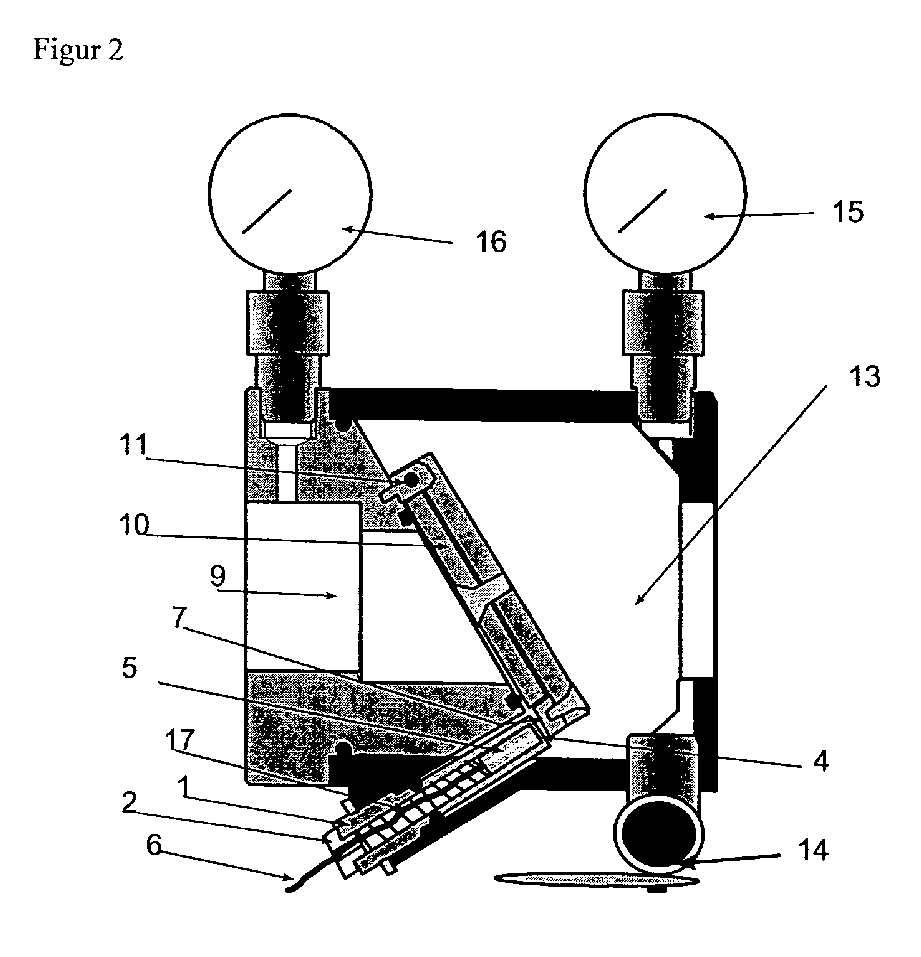
(57) A transducer for monitoring the position of movable bodies and in particular for
monitoring the position of valve flaps and other elements in connection with systems
for fire extinction, is composed of a pipe (4) which is closed at one end and thus
forms a hollow body with a bottom (4). The pipe is made of a magnetically inert material
and accommodates an inductive sensor (5) of an ordinary type. The sensor is movable
inside the pipe, but engages the internal bottom of the pipe in its normal position
of use. The transducer is kept in this position by a compression spring (17) which
presses against the free end of the cylindrical sensor. With its other end, this compression
spring (17) engages a plug (2) at the free end of the pipe. In its position of use,
the transducer is arranged such that the bottom of the pipe, and thereby the active
face of the sensor, is positioned in the immediate vicinity of the body, e.g. a valve
flap, whose position is to be monitored. A cord (6) or another pull member extends
from the sensor out through the plug and out into the open. The cord may be the wire
from the sensor.
When the function of the transducer is to be tested, an external pull is applied to
the cord (6), whereby the sensor is pulled back against the effect of the spring until
it is moved out of its scanning range. The pipe and the spring are dimensioned such
that this travel is allowed. A test may hereby be performed readily, and without it
being necessary to interfere with the normal function of the system.
|
|
