(57) A cryptographic technique that not only provides fast and extremely secure encryption
and decryption but also assures integrity of a ciphertext message. Specifically, the
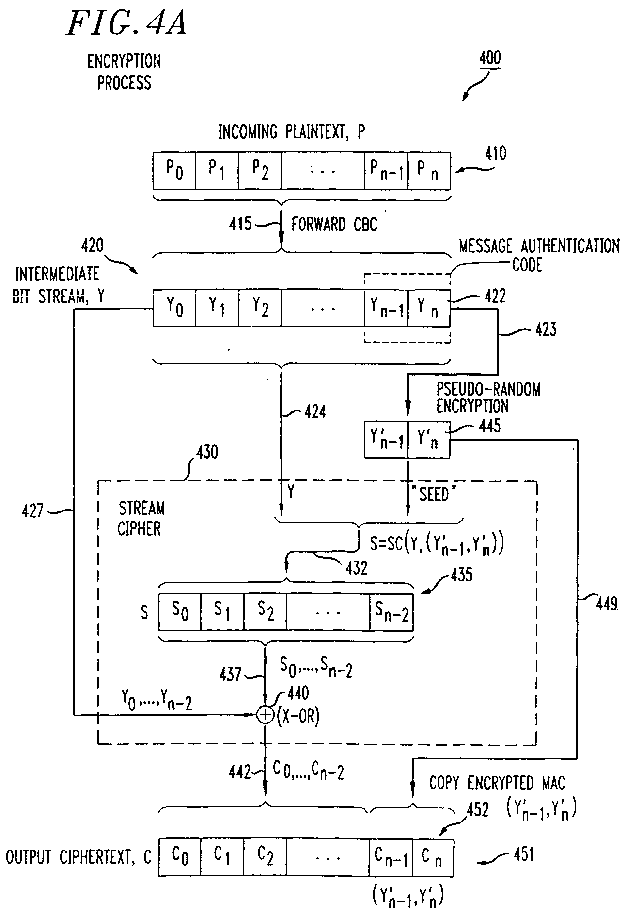
technique involves, during message encryption: generating, in response to an incoming
plaintext message, an intermediate stream -such as by chaining the message, wherein
a predefined portion of the intermediate stream defines a message authentication code
(MAC); inserting an encrypted version of the MAC into a predefined portion of a ciphertext
message; and generating, in response to the intermediate stream and the encrypted
MAC, a remainder of the ciphertext message such that the remainder exhibits a predefined
variation, e.g., a pseudo-random sequence, also contained within the encrypted MAC.
Decryption proceeds in essentially a reverse fashion to that of encryption. By virtue
of extending a specific pseudo-random sequence, as defined by the encrypted MAC, across
the remainder of the ciphertext, any subsequent change to the ciphertext would, in
all likelihood, destroy the continuity of the pseudo-random sequence that would otherwise
reside throughout the remainder of the ciphertext. Hence, during decryption, any violation
to the integrity of the ciphertext, i.e., changes made thereto, can be readily detected
by decrypting the MAC contained in the ciphertext, eliminating the pseudo-random sequence
from the ciphertext to yield an intermediate stream, recovering the plaintext from
this intermediate stream, recreating (recovering) a MAC from the recovered plaintext
and then comparing the recreated and decrypted MACs for any discrepancy therebetween.
Any such discrepancy would signify that the ciphertext has been changed and so indicate
that the recovered plaintext is invalid.
|
|
