|
(11) | EP 1 638 910 B1 |

| (12) | EUROPEAN PATENT SPECIFICATION |
|
|
| (54) |
COLOR STABILIZATION OF HYDROQUINONE HYDROXYETHYL ETHER PRODUCTS FARBSTABILISIERUNG VON HYDROCHINONHYDROXYETHYLETHERPRODUKTEN STABILISATION DES COULEURS DE PRODUITS D'ETHERS D'HYDROXYETHYLE D'HYDROQUINONE |
|
|
|||||||||||||||||||||||||||||||
| Note: Within nine months from the publication of the mention of the grant of the European patent, any person may give notice to the European Patent Office of opposition to the European patent granted. Notice of opposition shall be filed in a written reasoned statement. It shall not be deemed to have been filed until the opposition fee has been paid. (Art. 99(1) European Patent Convention). |
BACKGROUND OF THE INVENTION
1. Field of the Invention
[0001] The present invention relates to Hydroquinone di -(2-hydroxyethyl) ether, referred to as HQEE, which is widely used as a chain extender to make high performance polyurethane cast elastomers or thermoplastics elastomers in the polyurethane industry. The pure adduct of 2 moles of ethylene oxide (EO) and 1 mole of hydroquinone (HQ) is very crystalline and is believed to be desirable to get the best properties. However, for practical reasons, the pure adduct of 2 moles of EO and 1 mole of HQ is not available commercially. During ethoxylation of HQ with EO, due to kinetics, in addiction to the desirable adduct, one also gets, mono adduct, triadducts, and higher adducts. In addition, the solvent used in the process also imparts impurities. Therefore, on a commercial scale, the HQEE grades available have 1-10% of non-desirable species and 99-90% of pure adduct (2 moles EO and 1 mole HQ). The impurities lower the final part properties and cause color instability for HQEE when HQEE is exposed to heat and/or oxygen. That is the color of HQEE goes up with time and temp. In many plants, HQEE is processed at elevated temp and there the color of HQEE goes up leading to parts, which are high in color. The color increase is very significant when light or pastel color parts are to be produced. Therefore, a practical method to stabilize the color of generally available grades of HQEE is desired and this invention provides such solution.
2. Brief Description of Art
[0002] It is well known that hydroquinone hydroxyethyl ethers (HQEE) are used for manufacturing of polyurethanes. Commercial grade hydroxyethyl ethers of hydroquinone contain >90% of hydroquinone bis (2-hyroxyethyl) ether. Due to the impurities contained in the product, they have tendency to discolor especially at higher temperatures. Hydroxyethyl ethers of hydroquinone are solids at room temperature and for application purposes are kept in molten condition. At increased temperature discoloration proceeds faster and there is a need for color stabilization to allow the use in color sensitive applications.
[0003] Color stabilization of hydroquinone hydroxyethyl ethers using phosphite type color stabilizer have been described in US Patent 3592858. According to the disclosure the phosphite molecule consists of either one or two cyclic phosphite groups attached to an aryl- or cycloalkyl ring. The result of color stabilization was not good enough to protect against discoloration for prolonged usage especially with commercial grades of hydroquinone hydroxyethyl ethers.
DETAILED DESCRIPTION OF THE INVENTION
[0004] Antioxidants are known to be color stabilizers for many products and processes involving exposure to oxygen or heat. Many general mechanisms as to how the antioxidants work have been proposed in the literature. However, a variety of factors such as polymer structure, polymer processing conditions, (time, temp, pressure), and antioxidant structure, decide which antioxidant or combination of antioxidants work the best. For the current problem on hand, several chemistries were evaluated as stabilizers for hydroquinone hydroxyethyl ether products (HQEE) including: phenolic based - 2,6-di-t-butyl-p-cresol, Tetrakis[methylene(3,5-di-t-butyl-4-hydroxyhydroconnamate)]methane, 2,2-oxalydiamidobis [ethyl 3-(3,5-di-t-butyl-4-hydroxyphenyl)]propionate; acyclic phosphite based- Tris(2,4-di-t-butylphenyl)phosphite, Tris(nonylphenyl)phosphite; cyclic phosphite based- 2,4,6 tri-t-butylphenyl 2 butyl 2 ethyl 1,3 propane diol phosphite and bis-cyclic phosphite based- Diisodecyl Pentaerythritol Diphosphite, Bis( 2,4-di-t-butylphenyl)Pentaerythritol, Distearyl Pentaerythritol Diphosphite.
[0005] It has been surprisingly found, in accordance with the present invention, that phosphite compounds containing the double ring structure of bis cyclic phosphites, that are attached to the same tertiary carbon atom were very efficient in color stabilization of hydroquinone hydroxyethyl ethers and any present impurities. The phenolic-based antioxidants were found to afford no improvement in color stability and some of the products evaluated lead to an increased in color. In contrast to the prior art where the color stabilizer used was a phosphite, which had a molecule with either one cyclic phosphite group or two groups that were attached para on an aryl- or cycloalkyl ring the color stabilizer used according to the present invention have a spiro ring structure in which the two rings are attached to the same tertiary carbon atom. Color stabilization effect of the phosphite used in the previous art (US patent # 3,592,858) was found to show a slight improvement, but not sufficient to be used with commercial HQEE, the present inventors have surprisingly discovered that phosphite compounds containing double ring structure, which are attached to the same tertiary carbon atom in the phosphite molecule, are very efficient in color stabilization of hydroxylalkyl ethers of hydroquinone. Preferably such hydroxylalkyl ethers of hydroquinone contain >80% of pure adduct of 2 moles of EO and 1 mole of hydroquinone and most preferably contain >90% of pure adduct of 2 moles of EO and 1 mole of hydroquinone. Commercial hydroxyalkyl ethers of hydroquinone typically contain >90% of pure adduct of 2 moles of EO and 1 mole of hydroquinone and contain <10% of other species of which the triether (3 moles of EO and 1 mole of hydroquinone) is the predominant specie. Suitable phosphite compounds containing double ring structure of cyclic phosphates, which are attached to the same tertiary carbon atom in the molecule are phosphites like commercially available Weston 619F, and Doverphos 1220. The antioxidants of this type were evaluated to optimize the usage level that was determined to be between 0.2% to 3% and most preferably between 0.5 and 1.0%. It is believed that phosphite compounds containing double ring structure of cyclic phosphites, which are attached to the same tertiary carbon atom in the molecule have the optimal chemical structure. This is because two phosphite rings attached to the same tertiary carbon atom are in sterically stressed state
[0006] The color stabilizing agents disclosed here can be added during the manufacturing of hydroxyalkyl ethers of hydroquinone or could be post added. If added during the manufacturing, they can help to produce a lower initial color product. Also, the polyurethane articles produced from color stabilized HQEE display lighter initial color and enhanced color stability.
R1 and R2 can be aromatic ring with or without substituents
R1 and R2 can be any akyl or cycloalkyl group
R1 and R2 can be same or different
[0007] The present invention is further described in detail by means of the following Examples and Comparisons. All parts and percentages are by weight and all temperatures are degrees Celsius unless explicitly stated otherwise.
EXAMPLE 1
[0008] Experimental Procedure: Commercial HQEE with the following analysis was used to evaluate the effectiveness of antioxidants. The analysis was Diether hydroquinone (2 moles EO plus 1 mole hydroquinone)- 92%, Triether of hydroquinone ( 3 moles of EO plus 1 mole of hydroquinone)- 7%, other- 1%. To 14 gram samples of this HQEE, we initially compared the antioxidants of Table 1 by adding the antioxidant in an amount of 1% based on the weight of the mixture. The mixture was heated to 150C, under nitrogen, and the colors of the mixtures were compared at 4 hours after mixing. The colors after 4 hours were compared using an approximation of the Gardner color for the molten HQEE material. The Gardner color results are given in Table 1 below.
TABLE 1
| AO | Chemistry | CAS # | Structure | Form | Gardner Color 4 hours at 150C 150C |
| Weston 619F GE Specialty Chemicals |
Distearyl Pentaerythritol DiphosphiteAliphatic- Bis cyclic phosphite | 3806-34-6 |
|
Flakes | 1-2 |
| Naugard BHT Crompton |
2,6-di-t-butyl-p-cresol phenolic | 128-37-0 | Powder | 16 | |
| Irganox 1010 Ciba |
Tetrakis[methylene(3,5-di-t-butyl-4-hydroxyhydroconnamate)]methane Phenolic |
6683-19-8 | Powder | 16 | |
| Wytox 312 Crompton |
Tris(nonylphenyl)phosphite Aromatic- Acyclic phosphite |
26523-78-4 |
|
Liquid | 10 |
| Naugard 492 Crompton |
Phenolic-organic Acyclic phosphate blend | Not disclosed | Liquid | 6-7 | |
| Naugard XL-1 Crompton |
2,2-oxalydiamidobis[ethyl 3-(3,5-di-t-butyl-4-hydroxyphenyl)propionate] Phenolic-based |
70331-94-1 | Powder | 8 | |
| Naugard 524 Crompton |
Tris(2,4-di-t- butylphenyl)phosphite Aromatic- Acyclic phosphite |
31570-04-4 |
|
Powder | >18 |
| Doverphos 1220 Dover Chemicals |
Diisodecyl Pentaerythritol Diphosphite. (cyclic bis phosphite) | 26544-27-4 |
|
Liquid | 1-2 |
[0009] Table 2 below shows the results. As can be seen from Table 2, the most effective agents were Weston 619F (sample 2), and Doverphos 1220 (sample 10). As can be seen, for the 4 hours reading the control shows that the color goes up from 1 Gardner to 16 and for the additives of this invention, the color ranges between 1 to 2 Gardner.
TABLE 2
| Sample | Antioxidant | Initial HQEE Gardner Color |
HQEE Gardner Color- 4 hours at 150C |
| 1 | None- Control | 1 | 16 |
| 2 | Weston 619F | 1 | >1 but <2 |
| 3 | Naugard BHT | 1 | 16 |
| 4 | Irganox 1010 | 1 | 16 |
| 5 | Wytox 312 | 1 | 10 |
| 6 | Ultranox 641 | 1 | 5 |
| 7 | Naugard 492 | 1 | 6-7 |
| 8 | Naugard XL-1 | 1 | 8 |
| 9 | Naugard 524 | 1 | >18 8 |
| 10 | Doverphos 1220 | 1 | >1 but <2 |
| Notes: #1 is the control sample without any antioxidant; #2 and #10 are preferred examples of the invention; #3, #4, #5, #7, #8 and #9 are comparative examples. And #6 is an example from prior art patent # 3,592,858. HQEE Color- approximate Gardner color for molten HQEE |
1. A composition comprising: (a) a di-hydroxyalkylether of hydroquinone wherein each
hydroxyalkyl group has one to four carbon atoms, and (b) a discoloration inhibiting
effective amount of a bis cyclic phosphite compound, wherein component (b) is represented
by the structural formula:

R1 and R2 can be aromatic ring with or without substituents
R1 and R2 can be any akyl or cycloalkyl group
R1 and R2 can be same or different
R1 and R2 can be aromatic ring with or without substituents
R1 and R2 can be any akyl or cycloalkyl group
R1 and R2 can be same or different
2. The composition of claim 1 wherein said di-hydroxyalkylether of hydroquinone is a
commercial grade that is at least 80% by weight pure.
3. The composition of claim 2 wherein the commercial grade has a purity of at least 90%
based upon the weight of the composition.
4. The composition of claim 1 wherein R1 and R2 are moieties selected from stearyl, isodecyl,
and combinations thereof.
5. The composition of claim 1 wherein component (b) is present in an amount of between
about 0.1 % and about 5% based upon the weight of the composition.
6. The composition of claim 1 wherein component (b) is present in an amount of between
about 0.3% and about 2% based upon the weight of the composition.
7. The composition of claim 1 wherein component (b) is present in an amount of between
about 0.5% and about 1% based upon the weight of the composition.
8. A method for stabilizing a di-hydroxyalkylether of hydroquinone-containing composition
against discoloration which comprises incorporating a discoloration
inhibiting effective amount of a bis cyclic phosphite compound into the composition, wherein said bis cyclic phosphate has the structural formula:

R1 and R2 can be aromatic ring with or without substituents
R1 and R2 can be any akyl or cycloalkyl group
R1 and R2 can be some or different
inhibiting effective amount of a bis cyclic phosphite compound into the composition, wherein said bis cyclic phosphate has the structural formula:
R1 and R2 can be aromatic ring with or without substituents
R1 and R2 can be any akyl or cycloalkyl group
R1 and R2 can be some or different
9. The method of claim 8 wherein R1 and R2 are moieties selected from stearyl, isodecyl,
and combinations thereof.
10. The method of claim 8 wherein said discoloration inhibiting effective amount is between
about 0.1 % and about 5% based upon the weight of the di-hydroxyalkylether of hydroquinone
plus the bis cyclic phosphite.
11. The method of claim 8 wherein said discoloration inhibiting effective amount is between
about 0.3% and about 2% based upon the weight of the di-hydroxyalkylether of hydroquinone
plus the bis cyclic phosphite.
12. The method of claim 8 wherein said discoloration inhibiting effective amount is between
about 0.5% and about 1% based upon the weight of the di-hydroxyalkylether of hydroquinone
plus the bis cyclic phosphite.
1. Zusammensetzung umfassend: (a) einen Hydrochinon-Dihydroxyalkylether, wobei jede Hydroxyalkylgruppe
ein bis vier Kohlenstoffatome besitzt, und (b) eine zur Verfärbungshemmung effektive
Menge einer bi-zyklischen Phosphitverbindung, wobei Komponente (b) dargestellt wird
durch die Strukturformel:

R1 und R2 können aromatische Ringsysteme mit oder ohne Substituenten sein
R1 und R2 können eine beliebige Alkyl- oder Cykloalkylgruppe sein
R1 und R2 können gleich oder unterschiedlich sein
R1 und R2 können aromatische Ringsysteme mit oder ohne Substituenten sein
R1 und R2 können eine beliebige Alkyl- oder Cykloalkylgruppe sein
R1 und R2 können gleich oder unterschiedlich sein
2. Zusammensetzung nach Anspruch 1, wobei der Hydrochinon-Dihydroxyalkylether eine Handelssorte
mit einer Reinheit von mindestens 80 Gewichtsprozent darstellt.
3. Zusammensetzung nach Anspruch 2, wobei die Handelssorte eine Reinheit von mindestens
90% auf Grundlage des Gewichts der Zusammensetzung besitzt.
4. Zusammensetzung nach Anspruch 1, wobei R1 und R2 Reste darstellen, die aus Stearyl-, Isodecyl- und Kombinationen derselben ausgewählt
sind.
5. Zusammensetzung nach Anspruch 1, wobei die Komponente (b) in einer Menge zwischen
ungefähr 0,1% und ungefähr 5% auf Grundlage des Gewichts der Zusammensetzung vorhanden
ist.
6. Zusammensetzung nach Anspruch 1, wobei die Komponente (b) in einer Menge zwischen
ungefähr 0,3% und ungefähr 2% auf Grundlage des Gewichts der Zusammensetzung vorhanden
ist.
7. Zusammensetzung nach Anspruch 1, wobei die Komponente (b) in einer Menge zwischen
ungefähr 0,5% und ungefähr 1% auf Grundlage des Gewichts der Zusammensetzung vorhanden
ist.
8. Verfahren zur Stabilisierung gegen Verfärbung einer Zusammensetzung, die einen Hydrochinon-Dihydroxyalkylether
enthält, umfassend die Einbeziehung einer zur Verfärbungshemmung effektiven Menge
einer bi-zyklischen Phosphitverbindung in die Zusammensetzung, wobei das bizyklische
Phosphit die Strukturformel besitzt:

R1 und R2 können aromatische Ringsysteme mit oder ohne Substituenten sein
R1 und R2 können eine beliebige Alkyl- oder Cykloalkylgruppe sein
R1 und R2 können gleich oder unterschiedlich sein
R1 und R2 können aromatische Ringsysteme mit oder ohne Substituenten sein
R1 und R2 können eine beliebige Alkyl- oder Cykloalkylgruppe sein
R1 und R2 können gleich oder unterschiedlich sein
9. Verfahren nach Anspruch 8, wobei R1 und R2 Reste darstellen, die aus Stearyl-, Isodecyl- und Kombinationen derselben ausgewählt
sind.
10. Verfahren nach Anspruch 8, wobei die zur Verfärbungshemmung effektive Menge zwischen
ungefähr 0,1% und ungefähr 5% auf Grundlage des Gewichts des Hydrochinon-Dihydroxyalkylethers
plus des bi-zyklischen Phosphits beträgt.
11. Verfahren nach Anspruch 8, wobei die zur Verfärbungshemmung effektive Menge zwischen
ungefähr 0,3% und ungefähr 2% auf Grundlage des Gewichts des Hydrochinon-Dihydroxyalkylethers
plus des bi-zyklischen Phosphits beträgt.
12. Verfahren nach Anspruch 8, wobei die zur Verfärbungshemmung effektive Menge zwischen
ungefähr 0,5% und ungefähr 1% auf Grundlage des Gewichts des Hydrochinon-Dihydroxyalkylethers
plus des bi-zyklischen Phosphits beträgt.
1. Composition comprenant : (a) un di-hydroxyalkyléther d'hydroquinone dans lequel chaque
groupe hydroxyalkyle a un à quatre atomes de carbone, et (b) une quantité effective
inhibant la décoloration d'un composé de phosphite bis-cyclique, dans laquelle le
composant (b) est représenté par la formule structurelle :
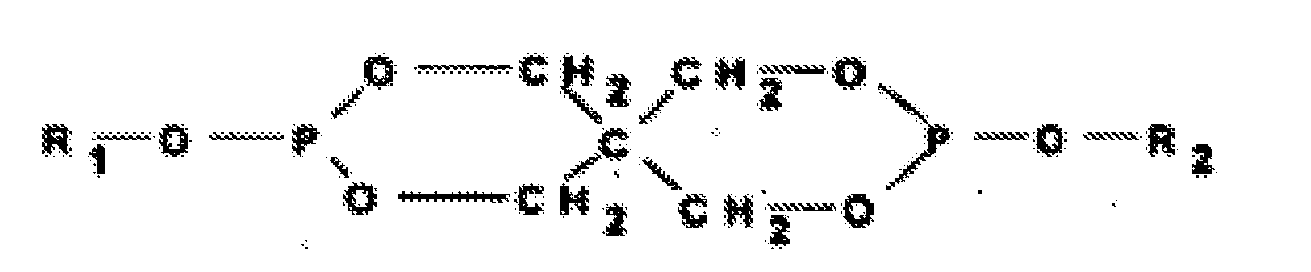
R1 et R2 peuvent être un cycle aromatique avec ou sans substituants
R1 et R2 peuvent être n'importe quel groupe alkyle ou cycloalkyle
R1 et R2 peuvent être identiques ou différents.
R1 et R2 peuvent être un cycle aromatique avec ou sans substituants
R1 et R2 peuvent être n'importe quel groupe alkyle ou cycloalkyle
R1 et R2 peuvent être identiques ou différents.
2. Composition selon la revendication 1, dans laquelle ledit di-hydroxyalkyléther d'hydroquinone
est d'une qualité commerciale qui est pure au moins à 80 % en poids.
3. Composition selon la revendication 2, dans laquelle la qualité commerciale a une pureté
d'au moins 90 % sur la base du poids de la composition.
4. Composition selon la revendication 1, dans laquelle R1 et R2 sont des portions choisies
parmi le stéaryle, l'isodécyle et des combinaisons correspondantes.
5. Composition selon la revendication 1, dans laquelle le composant (b) est présent dans
une quantité comprise entre environ 0,1 % et environ 5 %, sur la base du poids de
la composition.
6. Composition selon la revendication 1, dans laquelle le composant (b) est présent dans
une quantité comprise entre environ 0,3 % et environ 2 %, sur la base du poids de
la composition.
7. Composition selon la revendication 1, dans laquelle le composant (b) est présent dans
une quantité comprise entre environ 0,5 % et environ 1 %, sur la base du poids de
la composition.
8. Procédé de stabilisation d'un di-hydroxyalkyléther d'une composition contenant une
hydroquinone contre la décoloration qui comprend l'incorporation d'une quantité effective
inhibant la décoloration d'un composé de phosphite bis-cyclique dans la composition,
dans lequel ledit phosphate bis-cyclique a la formule structurelle suivante :
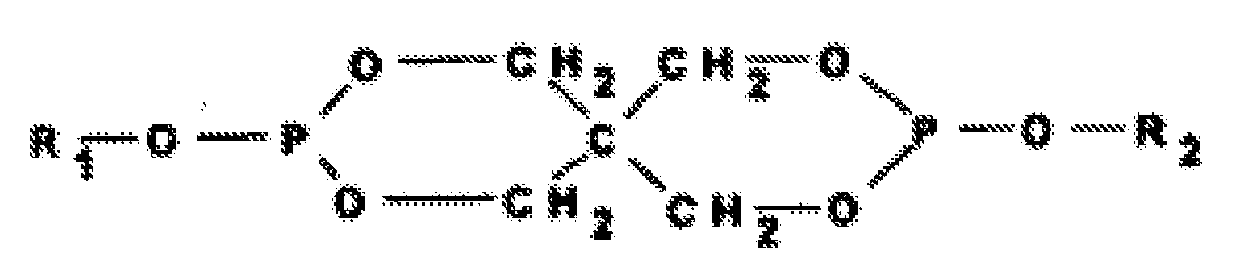
R1 et R2 peuvent être un cycle aromatique avec ou sans substituants
R1 et R2 peuvent être n'importe quel groupe alkyle ou cycloalkyle
R1 et R2 peuvent être identiques ou différents.
R1 et R2 peuvent être un cycle aromatique avec ou sans substituants
R1 et R2 peuvent être n'importe quel groupe alkyle ou cycloalkyle
R1 et R2 peuvent être identiques ou différents.
9. Procédé selon la revendication 8, dans lequel R1 et R2 sont des portions choisies
parmi un stéaryle, un isodécyle et des combinaisons correspondantes.
10. Procédé selon la revendication 8, dans lequel ladite quantité effective inhibant la
décoloration est comprise entre environ 0,1 % et environ 5 %, sur la base du poids
du di-hydroxyalkyléther d'hydroquinone plus le phosphite bis-cyclique.
11. Procédé selon la revendication 8, dans lequel ladite quantité effective inhibant la
décoloration est comprise entre environ 0,3 % et environ 2 %, sur la base du poids
du di-hydroxyalkyléther de l'hydroquinone plus le phosphite bis-cyclique.
12. Procédé selon la revendication 8, dans lequel ladite quantité effective inhibant la
décoloration est comprise entre environ 0,5 % et environ 1 %, sur la base du poids
du di-hydroxyalkyléther d'hydroquinone plus le phosphite bis-cyclique.
REFERENCES CITED IN THE DESCRIPTION
This list of references cited by the applicant is for the reader's convenience only. It does not form part of the European patent document. Even though great care has been taken in compiling the references, errors or omissions cannot be excluded and the EPO disclaims all liability in this regard.
Patent documents cited in the description