|
(11) | EP 1 640 400 B1 |

| (12) | EUROPEAN PATENT SPECIFICATION |
|
|
| (54) |
POLYCARBONATE AND PROCESS FOR PRODUCING THE SAME POLYCARBONAT UND HERSTELLUNGSVERFAHREN DAFÜR POLYCARBONATE ET PROCEDE DE FABRICATION CORRESPONDANT |
|
|
|||||||||||||||||||||||||||||||
| Note: Within nine months from the publication of the mention of the grant of the European patent, any person may give notice to the European Patent Office of opposition to the European patent granted. Notice of opposition shall be filed in a written reasoned statement. It shall not be deemed to have been filed until the opposition fee has been paid. (Art. 99(1) European Patent Convention). |
Technical Field
[0001] The present invention relates to polycarbonates containing a moiety which can be derived from a polysaccharide of renewable resources and having an excellent heat resistance, and methods for producing thereof.
Background Art
[0002] Polycarbonates are generally produced by using raw materials which can be obtained from oil resources. Because of the concern about the exhaustion of oil resources, it is desired to produce polycarbonates by using raw materials obtainable from renewable resources such as plants.
[0003] On the other hand, an ether diol expressed by the following formula (3) can be easily prepared from renewable resource, for example, polysaccharide, starch or the like.
The ether diol has three kinds of stereoisomers. In concrete terms, they are 1,4: 3,6-dianhydro-D-sorbitol (hereafter, this compound will be referred as to "isosorbide" in this description) expressed by the following formula (5),
1,4: 3,6-dianhydro-D-mannitol (hereafter, this compound will be referred as to "isomannide" in this description) expressed by the following formula (6),
and 1,4: 3,6-dianhydro-L-iditol (hereafter, this compound will be referred as to "isoidide" in this description) expressed by the following formula (7).
[0004] Isosorbide, isomannide and isoidide can be produced from D-glucose, D-mannose and L-idose, respectively. For example, isosorbide can be produced by hydrogenating D-glucose followed by dehydration with an acid catalyst.
[0005] Heretofore, it was studied to incorporate especially isosorbide among the above-mentioned ether diols into a polycarbonate as the main monomer (for example, German unexamined patent publication No. 2938464, Journal fuer praktische Chemie, p. 298-310, vol. 334, 1992, Macromolecules, p. 8077-8082, vol. 29, 1996, and Journal of Applied Polymer Science, p. 872-880, vol. 86, 2002).
[0006] However, isosorbide-derived polycarbonates have a problem of poor moldability, which is caused by extremely high glass transition temperatures and melt viscosities due to their rigid structures.
[0007] Further, methods for producing copolycarbonates which contain isosorbide and a diphenol of various types were reported (for example, JP-A 56-110723, Macromolecular Chemistry and Physics, p. 2197-2210, vol. 198, 1997, Journal of Polymer Science: Part A, p. 1611-1619, vol. 35, 1997, and Journal of Polymer Science: Part A, p.1125-1133, vol: 37, 1999). These copolycarbonates have problems that the diphenols are derived from oil.
[0008] Polyesters that are derived from 1: 4, 3: 6-dianhydroiditol, mannitol and sorbitol are disclosed in GB1079686. The acids which may be used for the esterification of the alcohols disclosed in GB1079686 include carbonic, malonic, succinic, adipic, iso- and terephthalic, galactaric and sebacoic.
[0009] On the other hand, speaking of polycarbonates which are derived from aliphatic diols, glass transition temperatures of the polycarbonates which are derived from ethylene glycol, 1,4-butanediol, 1,5-pentanediol, 1,6-hexanediol or the like are 0-5°C, -35°C, -41°C and -50°C, respectively (for example, Journal of Polymer Science: Polymer Letters Edition, p.599-602, vol. 18, 1980, Macromolecular Chemistry and Physics, p.97-102, vol. 199, 1998, and Polycarbonate resin handbook, edited by Seiichi Honma, Nikkan Kogyo Shinbun Co. p. 21, 1992).
[0010] It is possible to use renewable resources as these aliphatic diols, but aliphatic diol-derived polycarbonates are usually oily substances or solids with low melting points at the room temperature due to their flexible structures, and they have shortcomings of poor heat resistances. Polycarbonate copolymers derived from an aliphatic diol and having a higher glass transition temperature have never been reported.
[0011] Further, although reports concerning copolycarbonates of isosorbide and an aliphatic diol are few, as one of them we can find a report of copolycarbonates of an aliphatic diol such as 1,4-butanediol, 1,6-hexanediol, 1,8-octanediol or 1,10-decanediol, and isosorbide (for example, Okada et al, Abstract of the seventh open symposium on "Polymers with low environmental loads": Construction of a sustainable material system based on production of plastics with low environmental loads from renewable resources, Scientific Research on Priority Areas (B) supported by Grant-in-Aid for Scientific Research of Ministry of Education, Culture, Sports, Science and Technology, p. 26-29, 2002, and Journal of Polymer Science: Part A, p. 2312-2321, vol. 41, 2003).
[0012] These polycarbonates are block copolymers or random copolymers, and their glass transition temperatures become lower with increasing lengths of aliphatic chains. The temperatures have been determined as 65°C or 59°C, 26°C or 20°C, 12°C or 23°C, and -1°C or 7°C, respectively, and they are poor in heat resistances.
[0013] Further, JP-A 2003-292603, which was published after the date of the basic application of the present invention, describes a thermoplastic molding material containing a polycarbonate compound obtainable from isosorbide. Although the glass transition temperature of the thermoplastic molding material is sufficiently higher than the room temperature, further improvement of heat resistance is desired.
Disclosure of the Invention
[0014] It is an object of the present invention to provide new polycarbonates containing a moiety which can be derived from renewable resources and having an excellent heat resistance and moldability.
[0015] Another object of the present invention is to provide a process which is excellent in cost and through which the polycarbonates can be simply produced.
[0016] Further other objects and merits of the present invention will be made clear by the following explanations.
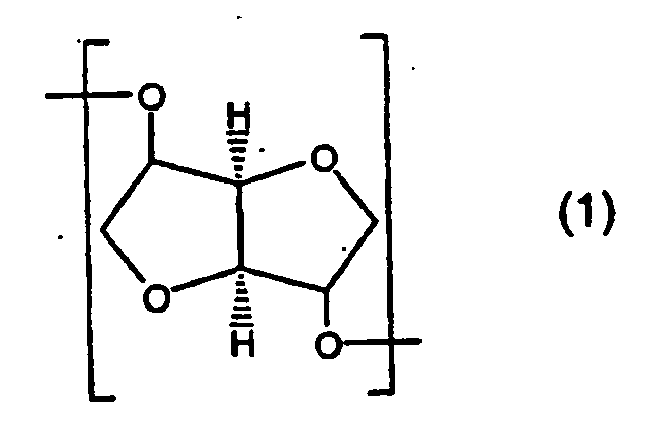
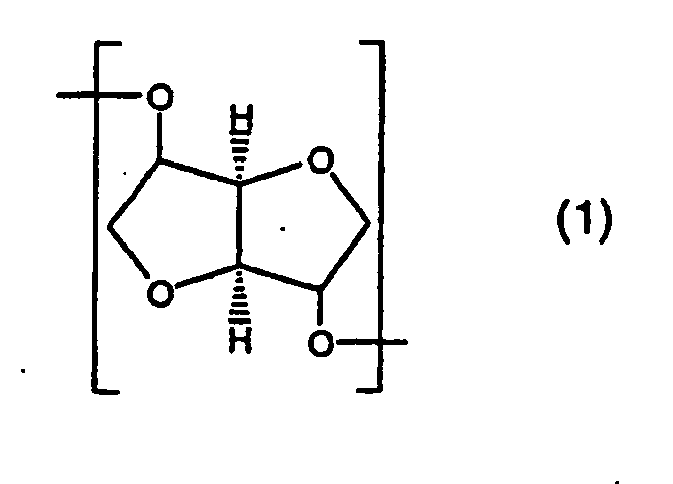
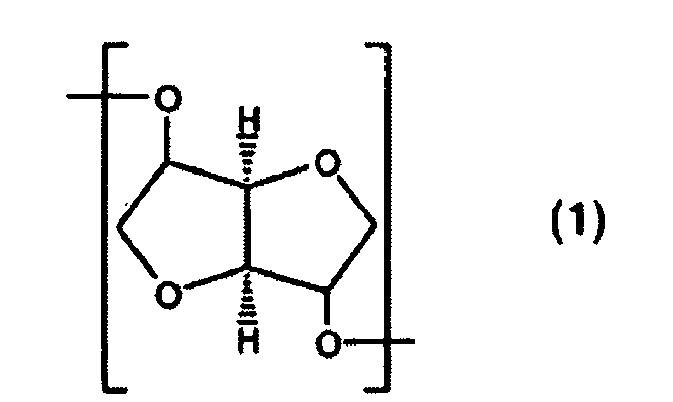
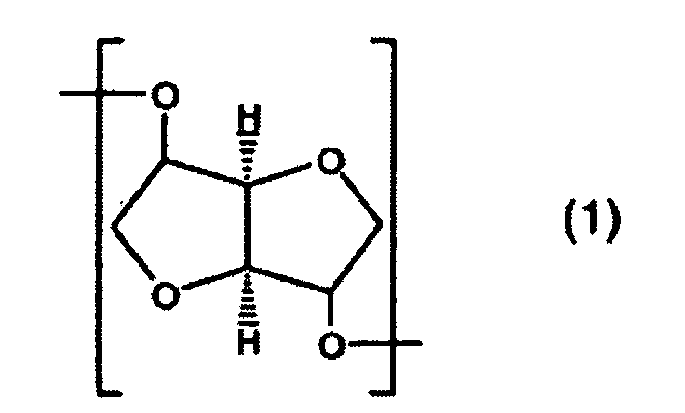
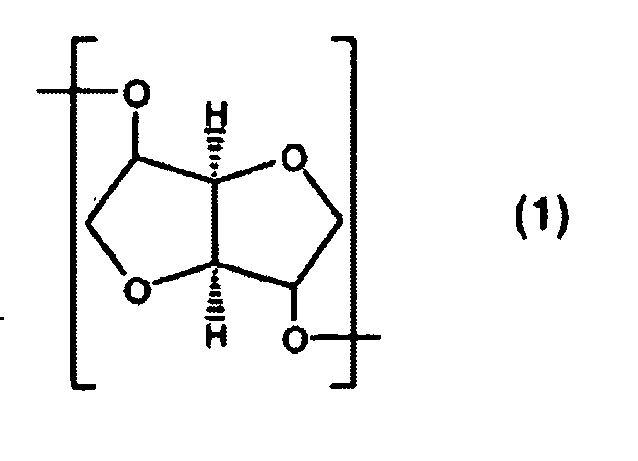
[0017] The present invention relates to polycarbonates containing an ether diol residue producible from a polysaccharide and expressed by the following formula (1),
and a diol residue selected from 1,3-propane diol and 1,6-hexane diol, wherein said ether diol residue amounts to 65-98 wt.% of all the diol residues, and having a glass transition temperature of 100 to 160 centigrade degree.
[0018] The present invention also relates to an ether diol residue producible from a polysaccharide and expressed by the following formula (1),
and ethylene glycol, wherein said ether diol is an isosorbide residue and the isosorbide residue amounts to 70.6-98 wt.% of all the diol residues, and having a glass transition temperature of 100 to 160 centigrade degree.
Best Mode for Carrying Out the Invention
[0020] Hereafter, the mode for carrying out the present invention will be explained further in detail, while the examples and explanations mentioned below are for exemplifying the present invention, and the present invention is not restricted by them. It is needless to say that other modes for carrying out the invention can be within the scope of the present invention as long as they conform to the objects of the present invention.
[0021] The polycarbonate of the present invention contains an ether diol residue expressed by the following formula (1)
and a diol residue expressed by the following formula (2)
-O-(CmH2m)-O- (2)
here, m is an integer of 2-12),
wherein when the diol is selected from 1,3-propane diol or 1,6-hexane diol, the ether diol residue amounts to 65-98 wt.% of all the diol residues, and
wherein when the ether diol is isosorbide and the diol is ethylene glycol, the ether diol residue amounts to 70.6-98 wt.% of all the diol residues, and
the polycarbonate has a glass transition temperature of from 100 to 160 centigrade degree.
[0022] That is, the polycarbonates of the present invention have a repeating unit moiety of formula (8)
and a repeating unit moiety of formula (9)
(here, m is an integer of 2 to 12).
[0023] When the content of the ether diol residue becomes lower than the above-mentioned range, the glass transition temperature of the resin to be obtained decreases, and the degree of polymerization hardly increases, so that the polymer becomes brittle. When the content of the ether diol exceeds the above-mentioned range, the glass transition temperature and the melt viscosity become extremely high, so that moldability becomes poor.
[0024] In the polycarbonate of the present invention, the diol residue expressed by the above-mentioned formula (2) is selected from the group consisting of an ethylene glycol residue, a 1,3-propanediol residue, and a 1,6-hexanediol residue.
[0025] It is also preferable that the polycarbonate contains another diol residues besides the ether diol residues and the diol residues expressed by the above-mentioned formula (2). Examples of another diol residues are alicyclic alkylenediols such as cyclohexanediol and cyclohexanedimethanol, aromatic diols such as dimethanolbenzene and diethanolbenzene, bisphenols etc. In this case, it is preferable that the total content of the third diol residues do not exceed 50 parts by weight against 100 parts by weight of the glycol residue of the above-mentioned formula (2).
[0026] Further, it is preferable that at least two kinds or more of the diol residues expressed by the above-mentioned formula (2) are used. When two kinds or more of the diol residues expressed by the above-mentioned formula (2) are used, the ratio of the diol residues is not specially restricted. It is preferable to use combinations of two kinds or more of diols selected from an ethylene glycol residue, a 1,3-propanediol residue, a 1,4-butanediol residue, a 1,5-pentanediol residue and a 1,6-hexanediol residue which have specially high degradability in nature. A more preferable combination is, for example, a 1,6-hexanediol residue and a 1,3-propanediol residue, or a 1,6-hexanediol residue and a 1,4-butanediol residue.
[0027] The polycarbonates of the present invention have a glass transition temperature of 100 to 160°C. The glass transition temperature is an important factor for heat resistance of a molded product and melt moldability. The glass transition temperature is preferably not less than 100°C nor more than 160°C for keeping practically sufficient heat resistance and moldability.
[0028] Further, the polycarbonates of the present invention have a reduced viscosity of preferably 0.1 dl/g or more, more preferably 0.35 dl/g or more, and further more preferably 0.6 dl/g or more. When the reduced viscosity is in this range, the polycarbonates have good melt fluidity, and further they have sufficient mechanical strength.
[0029] The polycarbonates of the present invention can be produced from an ether diol expressed by the following formula (3),
a diol selected from the group consisting of ethylene glycol, 1,3-propanediol, and 1,6-hexanediol, and a carbonic acid diester by a melt polymerization method.
[0030] Concrete examples of the ether diol include isosorbide, isomannide and isoidide, which are expressed by the above-mentioned formulae (5), (6) and (7), respectively, and others.
[0031] These polysaccharide-derived ether diols are materials which can be obtained also from biomass, and one of the materials which are called renewable resources. Isosorbide can be produced by hydrogenating D-glucose, which is obtainable from starch, and dehydrating the hydrogenated product. The other ether diols can be produced by the similar reactions using different starting materials.
[0032] Especially, a polycarbonate containing the isosorbide residue as the ether diol residue is preferable. Isosorbide is an ether diol which can easily be produced from starch or the like, so that it is abundantly obtainable as a raw material, and in addition, it is superior to isomannide and isoidide in all the points of easiness in production, excellences of properties and broad ranges of usage.
[0033] When the polycarbonate of the present invention contains the isosorbide residue as the ether diol residue, it is preferable that the isosorbide residue amounts to 65-98 wt.% or 70.6-98 wt.% of all the diol residues. It is more preferable that it amounts to 80-98 wt.% of all the diol residues.
[0034] The carbonic acid diester which is used in the production of the polycarbonate of the present invention is, for example, diphenyl carbonate, dinaphthyl carbonate, bis(diphenyl)carbonate, dimethyl carbonate, diethyl carbonate, dibutyl carbonate or the like. Among these carbonic acid diesters, diphenyl carbonate is preferable from the points of view of reactivity and cost.
[0035] In the production method of the present invention, a diol and a carbonic acid diester, which are raw materials, are subjected to a preliminary reaction by heating them at atmospheric pressure preferably in the presence of a polymerization catalyst, and subsequently they are stirred under reduced pressure while they are heated at 280°C or less to distil away the formed phenol. The reaction system is preferably kept in an atmosphere of a gas such as nitrogen which is inert against the raw materials, the reaction mixture and the reaction product. Besides nitrogen, the other inert gas such as argon is available.
[0036] At the initial stage of the reaction, it is preferable to carry out the heating reaction at atmospheric pressure. This progresses an oligomer forming reaction, so that when an aromatic alcohol such as phenol or an aliphatic alcohol is distilled away by reducing pressure at the later stage of the reaction, it is prevented that unreacted monomer distills away to break the mole balance and lower the degree of polymerization. In the production method of the present invention, the reaction can be promoted by properly removing the aromatic alcohol or aliphatic alcohol from the system (reactor). For this purpose, it is effective and preferable to reduce the pressure of the system.
[0037] In the production method of the present invention, it is preferable to suppress the reaction temperature as low as possible in order to prevent the decomposition of the ether diol, and obtain a resin less colored and having a high viscosity. However, for promoting the polymerization reaction properly, the polymerization temperature is preferably in the range from 180°C to 280°C, more preferably in the range from 230°C to 260°C.
[0038] In the production method of the present invention, it is preferable to use catalysts. Usable catalysts are (i) a nitrogen-containing basic compound, (ii) an alkali metal compound, (iii) an alkaline earth metal compound etc. These can be used singly or in combination of two kinds or more, and combined usages of (i) and (ii), (i) and (iii), and (i), (ii) and (iii) are often preferable.
[0039] A preferable example of (i) is tetramethylammonium hydroxide, and preferable examples of (ii) are sodium salts, and among them the usage of 2,2-bis(4-hydroxyphenyl)propane disodium salt is especially preferable.
[0040] Further, to the polycarbonates of the present invention, various function-imparting agents are optionally added according to the use of the polycarbonates. Such agents are, for example, heat stabilizers, stabilization adjuvants, plasticizers, antioxidants, photostabilizers, nucleating agents, heavy metal-inactivating agents, flame retardants, lubricants, antistatic agents, ultraviolet absorbers etc.
[0041] Further, depending on the use, the polycarbonates of the present invention are optionally compounded with various organic or inorganic fillers, fibers etc. The examples of the filler are carbon, talc, montmorillonite, hydrotalcite etc., and the examples of the fiber are various synthetic fibers, glass fibers, quartz fibers, carbon fibers etc. in addition to natural fibers such as kenaf.
[0042] As mentioned above, we can obtain polycarbonates containing a moiety which can be derived from renewable resources, and having excellent heat resistance.
[0043] By virtue of excellent heat resistance, the polycarbonates of the present invention can be widely used for various uses including optical parts such as optical sheets, optical disks, information disks, and optical lenses and prisms, various machine parts, building materials, car components, and various resin trays and dishes. The polycarbonates can be used especially preferably as film molded items such as optical sheets among these uses.
[0044] By virtue of biodegradability, the polycarbonates of the present invention can be used as films and sheets for agricultural materials including green house films, mulch films etc., packaging films and sheets for uses including food wrapping, general packaging, compost bags etc., industrial materials including tapes etc., various packaging containers etc. and molded articles for various uses in which the prevention of environmental contamination are needed.
[0045] Further, the polycarbonates of the present invention can be used after they are mixed and alloyed with a bio-based polymer, a synthetic resin, a rubber or the like of various types, for example, an aromatic polyester, an aromatic polycarbonate, a polyamide, polystyrene, a polyolefin, polyacrylic acid, ABS, a polyurethane etc. in addition to polylactic acid and an aliphatic polyester.
Examples
[0046] Hereafter, the present invention will be explained in detail with examples, while the present invention is not restricted by the examples.
[0047] Evaluations in the examples were carried out as follows. Physical properties are shown collectively in Table 1.
- (1) Measurement of glass transition temperature: Glass transition temperatures (Tg) were measured in a nitrogen stream at a temperature elevation rate of 20°C/min by using a differential scanning calorimeter of 910 Model manufactured by DuPont Co.
- (2) Measurement of reduced viscosity: Reduced viscosities (dl/g) were measured on a solution obtained by dissolving 120 mg of a polycarbonate sample in 10 ml of a mixed solvent of phenol/tetrachloroethane (volume ratio of 50/50) at 30 °C using an Ubbelohde viscometer.
- (3) Evaluation of moldability: Moldabilities were determined by molding a polycarbonate sample at a projection temperature of 240°C and a mold temperature of 80°C using a small-sized injection molding machine manufactured by Nissei Plastic Industrial Co., Ltd.. Tensile tests were carried out according to ASTM D-683, and bending tests were carried out according to ASTM D-790.
- (4) Evaluation of biodegradability: Into 200 g of a commercially available leaf mold (a bark compost manufactured by Sanyo-Bark) was added 1 liter of reservoir water, the mixture was aerated for 30 minutes or more at about 30°C in a hot water bath. Then, the mixture was filtered through a filter paper. Into the filtrate was added 100 ml of optimized testing culture solution A (a solution obtained by dissolving 37.5 g of potassium dihydrogenphosphate, 72.9 g of disodium hydrogenphosphate and 2.0 g of ammonium chloride in 1 liter of ion exchanged water), and the total volume of the mixture was made 2 liters. The obtained solution was charged into a container that was placed in a constant temperature bath at 50°C, which is close to the compost condition, and it was aerated at a ventilation volume of 200 ml/min with pressurized air. The half of the culture solution was replaced with a newly prepared solution media every fourth or fifth day.
[0048] A test piece weighing about 200 mg was cut out from a film approximately 20 µ m in thickness obtained by casting a solution prepared by dissolving a test polymer in dichloromethane on a glass base. The test piece was charged into a commercially available nonwoven cloth bag, and the bag was placed in the above-mentioned container. The bag was taken out after 3 months. The weight decreasing rate of the test piece was determined, and thus the biodegradability was evaluated.
Example 1
[0049] Into a reactor were charged 29.23 parts by weight of isosorbide, 1.51 parts by weight of ethylene glycol and 49.48 parts by weight of diphenyl carbonate, and further 2x10⁻³ parts by weight of tetramethylammonium hydroxide (1x10⁻⁴ mol of this compound to 1 mol of the diol component) and 30x10-4 parts by weight of 2,2-bis(4-hydroxyphenyl)propane disodium salt (0.5x10⁻⁶ mol of this compound to 1 mol of the diol component), and they were melted at 180°C under a nitrogen atmosphere.
[0050] The reaction was carried out for 20 minutes under stirring while the formed phenol was distilled away by reducing the inside pressure of the reactor to 13.3x10⁻³ MPa. Subsequently, after the temperature was raised to 200°C, the pressure was reduced gradually, and the reaction was carried out for 25 minutes at 4.00x10⁻³ MPa while phenol was distilled away. Further, the reaction was carried out for 10 minutes after the temperature was raised to 215°C.
[0051] Subsequently, the pressure was gradually reduced, the reaction was carried out for 10 minutes at 2.67x10⁻³ MPa, and for 10 minutes at 1.33x10⁻³ MPa. When the pressure reached to 4.00x10⁻⁵ MPa, the temperature was gradually raised up to 250°C, and finally the reaction was carried out further for 1 hour at 250°C at 6.66x10⁻⁵ MPa.
[0052] The obtained polymer had a reduced viscosity of 0.353 dl/g and a glass transition temperature of 157.4°C.
Examples 2 to 5
[0053] Isosorbide, ethylene glycol and diphenyl carbonate having amounts shown in Table 1 were charged into a reactor. As polymerization catalysts, tetramethylammonium hydroxide and 2,2-bis(4-hydroxyphenyl)propane disodium salt were charged at the same ratios of concentrations as Example 1, they were melted at 180°C under a nitrogen atmosphere, and polymerization reaction was carried out in the same manner as Example 1 to obtain a polymer. The reduced viscosity and glass transition temperature of the polymer are shown in Table 1.
Example 6 to 8
[0054] Isosorbide, 1,3-propanediol and diphenyl carbonate having amounts shown in Table 1 were charged into a reactor. As polymerization catalysts, tetramethylammonium hydroxide and 2,2-bis(4-hydroxyphenyl)propane disodium salt were charged at the same ratios of concentrations as Example 1, and they were melted at 180°C under a nitrogen atmosphere.
[0055] Polymerization reaction was carried out in the same manner as Example 1 to obtain a polymer. The reduced viscosity and glass transition temperature of the polymer are shown in Table 1.
[0056] By using the polymer obtained in Example 6, a dumbbell-shaped molded piece, that is, a tabular molded piece of 120 mm x 12 mm x 3 mm was produced, and the moldability was evaluated. The results are shown in Table 3.
[0057] A film was produced from the polymer obtained in Example 6, and the biodegradability was evaluated. The reduction in weight of the test piece was 15.9%.
Comparative Examples 9 to 10
[0058] Isosorbide, 1,4-butanediol and diphenyl carbonate having amounts shown in Table 1 were charged into a reactor. As polymerization catalysts, tetramethylammonium hydroxide and 2,2-bis(4-hydroxyphenyl)propane disodium salt were charged at the same ratios of concentrations as Example 1, and they were melted at 180°C under a nitrogen atmosphere. Polymerization reaction was carried out in the same manner as Example 1 to obtain a polymer. The reduced viscosity and glass transition temperature of the polymer are shown in Table 1.
[0059] By using the polymer obtained in Example 10, a dumbbell-shaped molded piece, that is, a tabular molded piece of 120 mm x 12 mm x 3 mm was produced, and the moldability was evaluated. The results are shown in Table 3.
Comparative Examples 11 to 12
[0060] Isosorbide, 1,5-pentanediol and diphenyl carbonate having amounts shown in Table 1 were charged into a reactor. As polymerization catalysts, tetramethylammonium hydroxide and 2,2-bis(4-hydroxyphenyl)propane disodium salt were charged at the same ratios of concentrations as Example 1, and they were melted at 180 °C under a nitrogen atmosphere. Polymerization reaction was carried out in the same manner as Example 1 to obtain a polymer. The reduced viscosity and glass transition temperature of the polymer are shown in Table 1.
Examples 13 to 16
[0061] Isosorbide, 1,6-hexanediol and diphenyl carbonate having amounts shown in Table 2 were charged into a reactor. As polymerization catalysts, tetramethylammonium hydroxide and 2,2-bis(4-hydroxyphenyl)propane disodium salt were charged at the same ratios of concentrations as Example 1, and they were melted at 180°C under a nitrogen atmosphere. Polymerization reaction was carried out in the same manner as Example 1 to obtain a polymer. The reduced viscosity and glass transition temperature of the polymer are shown in Table 2.
[0062] By using the polymer obtained in Example 15, a dumbbell-shaped molded piece, that is, a tabular molded piece of 120 mm x 12 mm x 3 mm was produced, and the moldability was evaluated. The results are shown in Table 3.
[0063] A film was produced from the polymer obtained in Example 11, and the biodegradability was evaluated. The reduction in weight of the test piece was 15.6%.
Example 17 to 21
[0064] Isosorbide, 1,6-hexanediol, 1,3-propanediol and diphenyl carbonate having amounts shown in Table 2 were charged into a reactor. As polymerization catalysts, tetramethylammonium hydroxide and 2,2-bis(4-hydroxyphenyl)propane disodium salt were charged at the same ratios of concentrations as Example 1, and they were melted at 180°C under a nitrogen atmosphere. Polymerization reaction was carried out in the same manner as Example 1 to obtain a polymer. The reduced viscosity and glass transition temperature of the polymer are shown in Table 2.
[0065] By using the polymer obtained in Example 17, a dumbbell-shaped molded piece, that is, a tabular molded piece of 120 mm x 12 mm x 3 mm was produced, and the moldability was evaluated. The results are shown in Table 3.
Example 22
[0066] Into a reactor were charged 23.38 parts by weight of isosorbide, 2.36 parts by weight of 1,6-hexanediol, 1.80 parts by weight of 1,4-butanediol and 42.84 parts by weight of diphenyl carbonate. As polymerization catalysts, tetramethylammonium hydroxide and 2,2-bis(4-hydroxyphenyl)propane disodium salt were charged at the same ratios of concentrations as Example 1, and they were melted at 180 °C under a nitrogen atmosphere.
[0067] Polymerization reaction was carried out in the same manner as Example 1 to obtain a polymer. The reduced viscosity and glass transition temperature of the polymer are shown in Table 2.
Example 23
[0068] Into a reactor were charged 24.84 parts by weight of isosorbide, 1.80 parts by weight of 1,4-butanediol, 1.24 parts by weight of ethylene glycol and 44.99 parts by weight of diphenyl carbonate. As polymerization catalysts, tetramethylammonium hydroxide and 2,2-bis(4-hydroxyphenyl)propane disodium salt were charged at the same ratios of concentrations as Example 1, and they were melted at 180°C under a nitrogen atmosphere. Polymerization reaction was carried out in the same manner as Example 1 to obtain a polymer. The reduced viscosity and glass transition temperature of the polymer are shown in Table 2.
Comparative Examples 1 to 4
[0069] Isosorbide, an aliphatic alkylene glycol of various types and diphenyl carbonate each having an amount shown in Table 2 were charged into a reactor. As polymerization catalysts, tetramethylammonium hydroxide and 2,2-bis(4-hydroxyphenyl)propane disodium salt were charged at the same ratios of concentrations as Example 1, and they were melted at 180°C under a nitrogen atmosphere.
[0070] Polymerization reaction was carried out in the same manner as Example 1 to obtain a polymer. The reduced viscosity and glass transition temperature of the polymer are shown in Table 2.
Table 1
| Isosorbide (pts. wt.) |
Kind of aliphatic alkylene glycol | Aliphatic alkylene glycol (pts. wt.) |
Diphenyl carbonate (pts. wt) |
Isosorbide (mol%) |
Aliphatic alkylene glycol (mol%) |
Ratio of isosorbide residue in all diol residues (wt%) |
Ratio of isosorbide residue in all weight (wt%) |
Reduced viscosity | Glass transition temperature (°C) |
|
| Example 1 | 29.23 | Ethylene glycol | 1.51 | 49.48 | 89.3 | 10.7 | 95.1 | 36.4 | 0.353 | 157.4 |
| Example 2 | 29.23 | 3.18 | 55.48 | 79.7 | 20.3 | 90.2 | 33.3 | 0.241 | 154.1 | |
| Example 3 | 21.92 | 3.87 | 46.91 | 63.5 | 36.5 | 85.0 | 30.2 | 0.191 | 130.1 | |
| Example 4 | 21.92 | 5.37 | 52.7 | 70.8 | 29.2 | 80.3 | 27.4 | 0.149 | 117.2 | |
| Example 5 | 14.61 | 6.08 | 41.99 | 50 | 50 | 70.6 | 23.3 | 0.128 | 107.3 | |
| Example 6 | 23.38 | 1,3-Propanediol | 3.04 | 42.84 | 80 | 20 | 88.5 | 33.8 | 0.902 | 143.8 |
| Example 7 | 26.31 | 1.52 | 42.84 | 90 | 10 | 94.5 | 37.2 | 0.298 | 150.7 | |
| Example 8 | 20.46 | 4.57 | 42.84 | 70 | 30 | 81.7 | 30.1 | 0.293 | 143.4 | |
| comparative Example 9 | 26.3 | 1,4-Butanediol | 1.8 | 42.84 | 90 | 10 | 93.6 | 37.1 | 1.155 | 156.7 |
| comparative Example 10 | 23.38 | 3.6 | 42.84 | 80 | 20 | 86.6 | 33.5 | 0.775 | 138.0 | |
| comparative Example 11 | 23.38 | 1,5-Pentanediol | 4.17 | 42.84 | 80 | 20 | 84.9 | 33.2 | 1.115 | 126.7 |
| comparative Example 12 | 20.46 | 6.25 | 42.84 | 70 | 30 | 76.6 | 29.4 | 0.585 | 90.4 |
Table 2
| Isosorbide (pts. wt.) |
Kind of aliphatic alkylene glycol | Aliphatic alkylene glycol (pts. wt.) |
Diphenyl carbonate (pts. wt) |
Isosorbide (mol%) |
Aliphatic alkylene glycol (mol%) |
Ratio of isosorbide residue in all diol residues (wt%) |
Ratio of isosorbide residue in all weight (wt%) |
Reduced viscosity | Glass transition temperature (°C) |
|
| Example 13 | 26.31 | 1,6-Hexanediol | 2.36 | 42.84 | 90 | 10 | 91.8 | 36.8 | 0.932 | 145.2 |
| Example 14 | 24.84 | 3.55 | 42.84 | 85 | 15 | 87.5 | 34.9 | 0.704 | 131.2 | |
| Example 15 | 23.38 | 4.73 | 42.84 | 80 | 20 | 83.2 | 33.0 | 1.139 | 122.6 | |
| Example 16 | 20.46 | 7.09 | 42.84 | 70 | 30 | 74.3 | 29.1 | 1.168 | 95.6 | |
| Example 17 | 23.38 | Two kinds of diols (see notes) |
HD11.8 PD2.28 | 42.84 | 80 | HD5 PD15 | 62.4 | 29.1 | 1.055 | 139.4 |
| Example 18 | 23.38 | HD2.36 PD1.52 | 42.84 | 80 | HD10 PD10 | 85.8 | 33.4 | 0.986 | 131 | |
| Example 19 | 20.46 | HD2.36 PD3.04 | 42.84 | 70 | HD10 PD20 | 79.1 | 29.8 | 0.825 | 109.4 | |
| Example 20 | 20.46 | HD3.55 PD2.28 | 42.84 | 70 | HD15 PD15 | 77.8 | 29.6 | 1.026 | 108.6 | |
| Example 21 | 20.46 | HD4.73 PD1.52 | 42.84 | 70 | HD20 PD10 | 76.6 | 29.4 | 0.914 | 101.7 | |
| Example 22 | 23.38 | HD2.36 BD1.80 | 42.84 | 80 | HD10 BD10 | 84.9 | 33.2 | 0.921 | 129.2 | |
| Example 23 | 24.84 | BD1.80 EG1.24 | 44.99 | 85 | BD10 EG5 | 89.1 | 34.1 | 0.556 | 149.9 | |
| Comparative Example 1 | 29.23 | - | - | 44.13 | - | - | 100.0 | 39.8 | 0.457 | 163.7 |
| Comparative Example 2 | 14.61 | 1,3-Propanediol | 7.61 | 44.99 | 50 | 50 | 65.8 | 21.7 | 0.166 | 63.3 |
| Comparative example 3 | 14.61 | 1,4-Butanediol | 9.01 | 44.99 | 50 | 50 | 61.9 | 21.3 | 0.104 | (Not measurable) |
| Comparative example 4 | 17.54 | 1,6-Hexanediol | 9.45 | 42.84 | 60 | 40 | 65.0 | 25.1 | 1.193 | 71.2 |
| (Notes): EG-Ethylene glycol, PD-1,3-Propanediol, BD-1,4-butanediol, PeD-1,5-Pentanediol, HD-1,6-Hexanediol |
Table 3
| Example 6 | comparative Example 10 | Example 15 | Example 17 | |
| Tensile modulus [MPa] | 3100 | 2632 | 2426 | 2534 |
| Tensile stress at yield [MPa] | 85 | 74.2 | 63 | 70.4 |
| Elongation at break[%] | 4.6 | 5.5 | 4.8 | 5.3 |
| Elongation at yield [%] | 15 | - | 4.8 | - |
| Flexural modulus [MPa] | 2993 | 3327 | 3066 | 2742 |
| Flexural strength [MPa] | 37 | 143 | 128 | 118 |
1. A polycarbonate containing an ether diol residue producible from a polysaccharide
and expressed by the following formula (1),
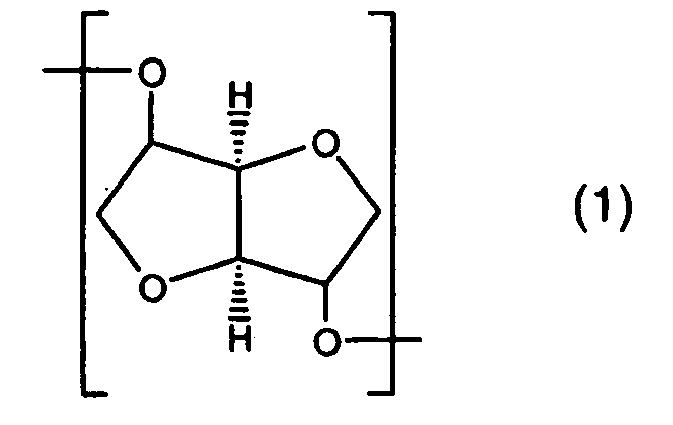
and ethylene glycol, wherein said ether diol is an isosorbide residue and the isosorbide residue amounts to 70.6-98 wt.% of all the diol residues, and having a glass transition temperature of 100 to 160 centigrade degree.
and ethylene glycol, wherein said ether diol is an isosorbide residue and the isosorbide residue amounts to 70.6-98 wt.% of all the diol residues, and having a glass transition temperature of 100 to 160 centigrade degree.
2. A polycarbonate containing an ether diol residue producible from a polysaccharide
and expressed by the following formula (1),
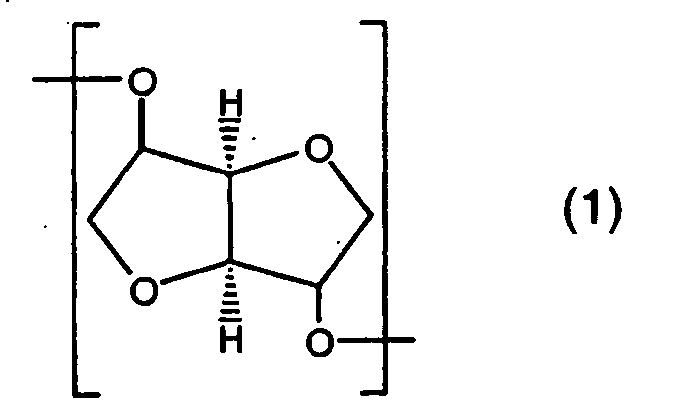
and 1,3-propane diol, wherein said ether diol residue amounts to 65-98 wt.% of all the diol residues, and having a glass transition temperature of 100 to 160 centigrade degree.
and 1,3-propane diol, wherein said ether diol residue amounts to 65-98 wt.% of all the diol residues, and having a glass transition temperature of 100 to 160 centigrade degree.
3. A polycarbonate containing an ether diol residue producible from a polysaccharide
and expressed by the following formula (1),
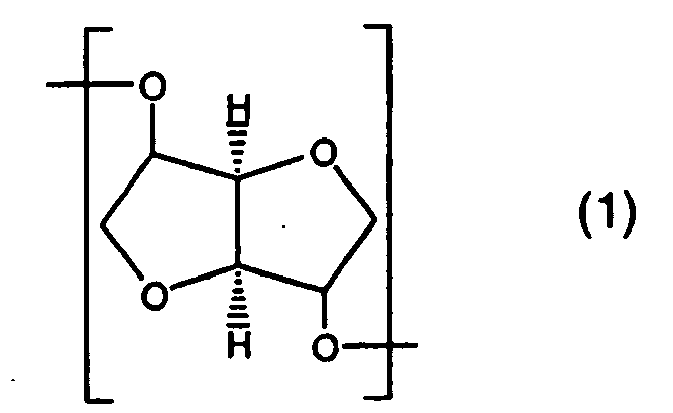
and 1,6-hexane diol, wherein said ether diol residue amounts to 65-98 wt.% of all the diol residues, and having a glass transition temperature of 100 to 160 centigrade degree.
and 1,6-hexane diol, wherein said ether diol residue amounts to 65-98 wt.% of all the diol residues, and having a glass transition temperature of 100 to 160 centigrade degree.
4. The polycarbonate according to any one of the Claims 1, 2 and 3 containing at least
two kinds of the diol residues expressed by the formula (2)
-O-(CmH2m)-O- (2)
wherein m is an integer of from 2 to 12.
-O-(CmH2m)-O- (2)
wherein m is an integer of from 2 to 12.
5. The polycarbonate according to Claims 2 or 3 containing the isosorbide residue as
the ether diol residue.
6. A method for producing the polycarbonate as defined in any one of the Claims 1, 2
and 3, wherein the polycarbonate is produced from the ether diol, the diol and a carbonic
acid diester by a melt polymerization method.
7. The polycarbonate-producing method according to Claim 6, wherein the ether diol, the
diol and the carbonic acid diester are subjected to a thermal reaction at atmospheric
pressure in the presence of polymerization catalysts, and subsequently the reaction
product is subjected to melt polycondensation under reduced pressure while heated
at a temperature in the range of 180°C to 280°C.
8. The polycarbonate-producing method according to Claim 7, wherein at least one compound
selected from the group consisting of nitrogen-containing basic compounds, alkali
metal compounds and alkaline earth metal compounds is used as the polymerization catalysts.
9. The polycarbonate-producing method according to Claim 8, wherein tetramethylammonium
hydroxide and 2,2-bis(4-hydroxyphenyl)propane disodium salt are used as the polymerization
catalysts.
10. The polycarbonate-producing method according to Claim 6, wherein diphenyl carbonate
is used as the carbonic acid diester.
1. Polycarbonat, enthaltend einen Etherdiolrest, herstellbar aus einem Polysaccharid
und dargestellt durch die folgende Formel (1),
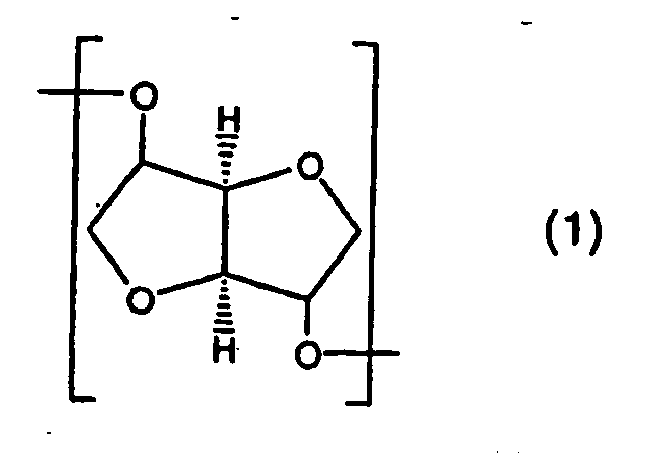
und Ethylenglycol, wobei das Etherdiol ein Isosorbidrest ist und der Isosorbidrest 70,6 - 98 Gew.-% von allen der Diolreste ausmacht, und eine Glasübergangstemperatur von 100 bis 160 Grad Celsius aufweist.
und Ethylenglycol, wobei das Etherdiol ein Isosorbidrest ist und der Isosorbidrest 70,6 - 98 Gew.-% von allen der Diolreste ausmacht, und eine Glasübergangstemperatur von 100 bis 160 Grad Celsius aufweist.
2. Polycarbonat, enthaltend einen Etherdiolrest, herstellbar aus einem Polysaccharid
und dargestellt durch die folgende Formel (1),
und 1,3-Propandiol, wobei der Etherdiolrest 65 - 98 Gew.-% von allen der Diolreste ausmacht, und eine Glasübergangstemperatur von 100 bis 160 Grad Celsius aufweist.
und 1,3-Propandiol, wobei der Etherdiolrest 65 - 98 Gew.-% von allen der Diolreste ausmacht, und eine Glasübergangstemperatur von 100 bis 160 Grad Celsius aufweist.
3. Polycarbonat, enthaltend einen Etherdiolrest, herstellbar aus einem Polysaccharid
und dargestellt durch die folgende Formel (1),
und 1,6-Hexandiol, wobei der Etherdiolrest 65 - 98 Gew.-% von allen der Diolreste ausmacht, und eine Glasübergangstemperatur von 100 bis 160 Grad Celsius aufweist.
und 1,6-Hexandiol, wobei der Etherdiolrest 65 - 98 Gew.-% von allen der Diolreste ausmacht, und eine Glasübergangstemperatur von 100 bis 160 Grad Celsius aufweist.
4. Polycarbonat nach einem der Ansprüche 1, 2 und 3, enthaltend mindestens zwei Arten
von Diolresten, dargestellt durch die Formel (2)
-O-(CmH2m)-O- (2)
wobei m eine ganze Zahl von 2 bis 12 ist.
-O-(CmH2m)-O- (2)
wobei m eine ganze Zahl von 2 bis 12 ist.
5. Polycarbonat nach Anspruch 2 oder 3, enthaltend den Isosorbidrest als den Etherdiolrest.
6. Verfahren zum Herstellen des Polycarbonats nach einem der Ansprüche 1, 2 und 3, wobei
das Polycarbonat aus dem Etherdiol, dem Diol und einem Kohlensäurediester durch ein
Schmelzpolymerisationsverfahren hergestellt wird.
7. Das Polycarbonatherstellungsverfahren nach Anspruch 6, wobei das Etherdiol, das Diol
und der Kohlensäurediester einer thermischen Reaktion bei atmosphärischem Druck in
der Gegenwart von Polymerisationskatalysatoren unterzogen werden, und anschließend
das Reaktionsprodukt einer Schmelzpolykondensation unter reduziertem Druck unterzogen
wird, während es bei einer Temperatur in dem Bereich von 180°C bis 280°C erwärmt wird.
8. Polycarbonatherstellungsverfahren nach Anspruch 7, wobei mindestens eine Verbindung,
ausgewählt aus der Gruppe, bestehend aus stickstoffhaltigen basischen Verbindungen,
Alkalimetallverbindungen und Erdalkalimetallverbindungen, als die Polymerisationskatalysatoren
verwendet wird.
9. Polycarbonatherstellungsverfahren nach Anspruch 8, wobei Tetramethylammoniumhydroxid
und 2,2-Bis(4-hydroxyphenyl)propandinatriumsalz als die Polymerisationskatalysatoren
verwendet werden.
10. Polycarbonatherstellungsverfahren nach Anspruch 6, wobei Diphenylcarbonat als der
Kohlensäurediester verwendet wird.
1. Polycarbonate contenant un résidu éther diol productible à partir d'un polysaccharide
et représenté par la formule (1) suivante:
et de l'éthylèneglycol, dans lequel ledit éther diol est un résidu isosorbide et le résidu isosorbide représente 70,6-98% en poids de tous les résidus diol, et ayant une température de transition vitreuse de 100 à 160 degrés centigrades.
et de l'éthylèneglycol, dans lequel ledit éther diol est un résidu isosorbide et le résidu isosorbide représente 70,6-98% en poids de tous les résidus diol, et ayant une température de transition vitreuse de 100 à 160 degrés centigrades.
2. Polycarbonate contenant un résidu éther diol productible à partir d'un polysaccharide
et représenté par la formule (1) suivante:
et du 1,3-propanediol, dans lequel ledit résidu éther diol représente 65-98% en poids de tous les résidus diol, et ayant une température de transition vitreuse de 100 à 160 degrés centigrades.
et du 1,3-propanediol, dans lequel ledit résidu éther diol représente 65-98% en poids de tous les résidus diol, et ayant une température de transition vitreuse de 100 à 160 degrés centigrades.
3. Polycarbonate contenant un résidu éther diol productible à partir d'un polysaccharide
et représenté par la formule (1) suivante:
et du 1,6-hexanediol, dans lequel ledit résidu éther diol représente 65-98% en poids de tous les résidus diol, et ayant une température de transition vitreuse de 100 à 160 degrés centigrades.
et du 1,6-hexanediol, dans lequel ledit résidu éther diol représente 65-98% en poids de tous les résidus diol, et ayant une température de transition vitreuse de 100 à 160 degrés centigrades.
4. Polycarbonate selon l'une quelconque des revendications 1, 2 et 3, contenant au moins
deux sortes de résidus diol représentés par la formule (2)
-O-(CmH2m)-O- (2)
dans laquelle m est un nombre entier de 2 à 12.
-O-(CmH2m)-O- (2)
dans laquelle m est un nombre entier de 2 à 12.
5. Polycarbonate selon les revendications 2 ou 3, contenant le résidu isosorbide comme
résidu éther diol.
6. Procédé de production du polycarbonate tel que défini selon l'une quelconque des revendications
1, 2 et 3, dans lequel le polycarbonate est produit à partir de l'éther diol, du diol
et d'un diester d'acide carbonique par un procédé de polymérisation à l'état fondu.
7. Procédé de production de polycarbonate selon la revendication 6, dans lequel l'éther
diol, le diol et le diester d'acide carbonique sont soumis à une réaction thermique
à pression atmosphérique en présence de catalyseurs de polymérisation, et ensuite,
le produit réactionnel est soumis à une polycondensation à l'état fondu sous pression
réduite tout en étant chauffé à une température comprise dans l'intervalle de 180°C
à 280°C.
8. Procédé de production de polycarbonate selon la revendication 7, dans lequel au moins
un composé choisi dans le groupe constitué par les composés basiques azotés, les composés
de métaux alcalins et les composés de métaux alcalino-terreux est utilisé comme catalyseur
de polymérisation.
9. Procédé de production de polycarbonate selon la revendication 8, dans lequel l'hydroxyde
de tétraméthylammonium et le sel disodique de 2,2-bis(4-hydroxyphényl)propane sont
utilisés comme catalyseurs de polymérisation.
10. Procédé de production de polycarbonate selon la revendication 6, dans lequel le carbonate
de diphényle est utilisé comme diester d'acide carbonique.
REFERENCES CITED IN THE DESCRIPTION
This list of references cited by the applicant is for the reader's convenience only. It does not form part of the European patent document. Even though great care has been taken in compiling the references, errors or omissions cannot be excluded and the EPO disclaims all liability in this regard.
Patent documents cited in the description
Non-patent literature cited in the description
- Journal fuer praktische Chemie, 1992, vol. 334, 298-310 [0005]
- Macromolecules, 1996, vol. 29, 8077-8082 [0005]
- Journal of Applied Polymer Science, 2002, vol. 86, 872-880 [0005]
- Macromolecular Chemistry and Physics, 1997, vol. 198, 2197-2210 [0007]
- Journal of Polymer Science: Part A, 1997, vol. 35, 1611-1619 [0007]
- Journal of Polymer Science: Part A, 1999, vol. 37, 1125-1133 [0007]
- Journal of Polymer Science: Polymer Letters Edition, 1980, vol. 18, 599-602 [0009]
- Macromolecular Chemistry and Physics, 1998, vol. 199, 97-102 [0009]
- Polycarbonate resin handbookNikkan Kogyo Shinbun Co.1992000021- [0009]
- Grant-in-Aid for Scientific Research of Ministry of EducationCulture, Sports, Science and Technology, 2002, 26-29 [0011]
- Journal of Polymer Science: Part A, 2003, vol. 41, 2312-2321 [0011]