| (19) |
 |
|
(11) |
EP 1 640 601 B1 |
| (12) |
EUROPEAN PATENT SPECIFICATION |
| (45) |
Mention of the grant of the patent: |
|
03.01.2007 Bulletin 2007/01 |
| (22) |
Date of filing: 28.09.2004 |
|
| (51) |
International Patent Classification (IPC):
|
|
| (54) |
Intake manifold with air vessel for an internal combustion engine
Einlasskrümmer mit Luftbehälter für eine Brennkraftmaschine
Collecteur d'admission avec réservoir à air pour un moteur à combustion interne
|
| (84) |
Designated Contracting States: |
|
AT BE BG CH CY CZ DE DK EE ES FI FR GB GR HU IE IT LI LU MC NL PL PT RO SE SI SK TR
|
| (43) |
Date of publication of application: |
|
29.03.2006 Bulletin 2006/13 |
| (73) |
Proprietor: MAGNETI MARELLI POWERTRAIN S.p.A. |
|
20011 Corbetta (IT) |
|
| (72) |
Inventor: |
|
- Arpert, Klaus Peter
38531 Rötgesbüttel (DE)
|
| (74) |
Representative: Maccagnan, Matteo et al |
|
Studio Torta S.r.l.
Via Viotti 9
I-10121 Torino
I-10121 Torino (IT) |
| (56) |
References cited: :
DE-A1- 10 217 760
US-B1- 6 302 076
|
US-A- 5 377 629
|
|
| |
|
|
- PATENT ABSTRACTS OF JAPAN vol. 010, no. 227 (M-505), 7 August 1986 (1986-08-07) &
JP 61 061912 A (YAMAHA MOTOR CO LTD), 29 March 1986 (1986-03-29)
- PATENT ABSTRACTS OF JAPAN vol. 012, no. 014 (M-659), 16 January 1988 (1988-01-16)
& JP 62 174529 A (HINO MOTORS LTD), 31 July 1987 (1987-07-31)
|
|
| |
|
| Note: Within nine months from the publication of the mention of the grant of the European
patent, any person may give notice to the European Patent Office of opposition to
the European patent
granted. Notice of opposition shall be filed in a written reasoned statement. It shall
not be deemed to
have been filed until the opposition fee has been paid. (Art. 99(1) European Patent
Convention).
|
[0001] The present invention relates to an intake manifold for an internal combustion engine.
[0002] As is known, an internal combustion engine comprises a number of cylinders, each
connected to an intake manifold by means of a respective intake valve, and to an exhaust
manifold by means of a respective exhaust valve. The intake manifold is connected
to each cylinder by a respective intake pipe, and receives fresh air (i.e. outside
air containing approximately 20% oxygen) by means of a throttle valve adjustable between
a closed position and a fully-open position; and an exhaust pipe extends from the
exhaust manifold, and terminates in a silencer to discharge the combustion gases into
the atmosphere.
[0003] Cyclic opening and closing of the intake valves prevents continuous mass flow of
the intake air, and pulsation or even return flow inside the intake pipes occurs.
This discontinuous flow impairs charging of the cylinders (and therefore engine torque)
and subjects the intake manifold to mechanical stress which prevents the manufacture
of lighter-construction intake manifolds.
[0004] DE3210239A1 describes an air vessel for compensating flow rate fluctuations in pressure
lines of pumps and the like (especially oscillating positive displacement pumps);
the air vessel has a tubular membrane through which the flow medium flows; a reservoir
fluid surrounding the tubular membrane in a housing containing the tubular membrane;
a feeler valve located on the outer face of the tubular membrane, in the reservoir
fluid; and a pressure vessel containing the reservoir fluid. In this air vessel design,
the flow medium flows through the vessel in a straight line; and the tubular membrane
is preferably a double tube to prevent the flow medium coming into contact with the
reservoir fluid of the pressure vessel.
[0005] US5826554A1 describes pressure relief means for a thin-wall air intake pipe for an
internal combustion engine; a valve is installed in an opening in a thin wall of an
air intake pipe, which supplies combustion air from a flow control device to an internal
combustion engine cylinder, to relieve excess pressure in the pipe. The valve includes
a socket connected to a segment of the air intake pipe, and an elastomer, umbrella
valve member is supported in the socket to normally cover the opening in the pipe,
and to undergo deformation, when the pressure in the pipe reaches a predetermined
value, so as to uncover the opening and connect the interior of the pipe to the ambient
atmosphere.
[0006] US6302076B1 discloses a four stroke combustion engine including a combustion chamber,
an intake manifold coupled to the combustion chamber, a one-way valve located within
the intake manifold, an intake valve for modulating the flow of a fuel-air mixture
into and out of the combustion chamber, and a plenum chamber located in the intake
manifold downstream of the one-way valve and upstream of the intake valve. During
the compression stroke of the engine, a pressurized charge of fuel-air mixture is
stored within the manifold and plenum; the amount of the fuel-air mixture stored within
the plenum is controlled by adjusting the volume of the plenum, or, alternatively,
a plenum valve is used to regulate the amount of fuel-air mixture entering/exiting
a fixed volume plenum.
[0007] It is an object of the present invention is to provide an internal combustion engine
intake manifold designed to eliminate the aforementioned drawbacks, and which in particular
is cheap and easy to produce.
[0008] According to the present invention there is provided an intake manifold for an internal
combustion engine, as recited in the accompanying Claims.
[0009] A non-limiting embodiment of the present invention will be described by way of example
with reference to the accompanying drawings, in which:
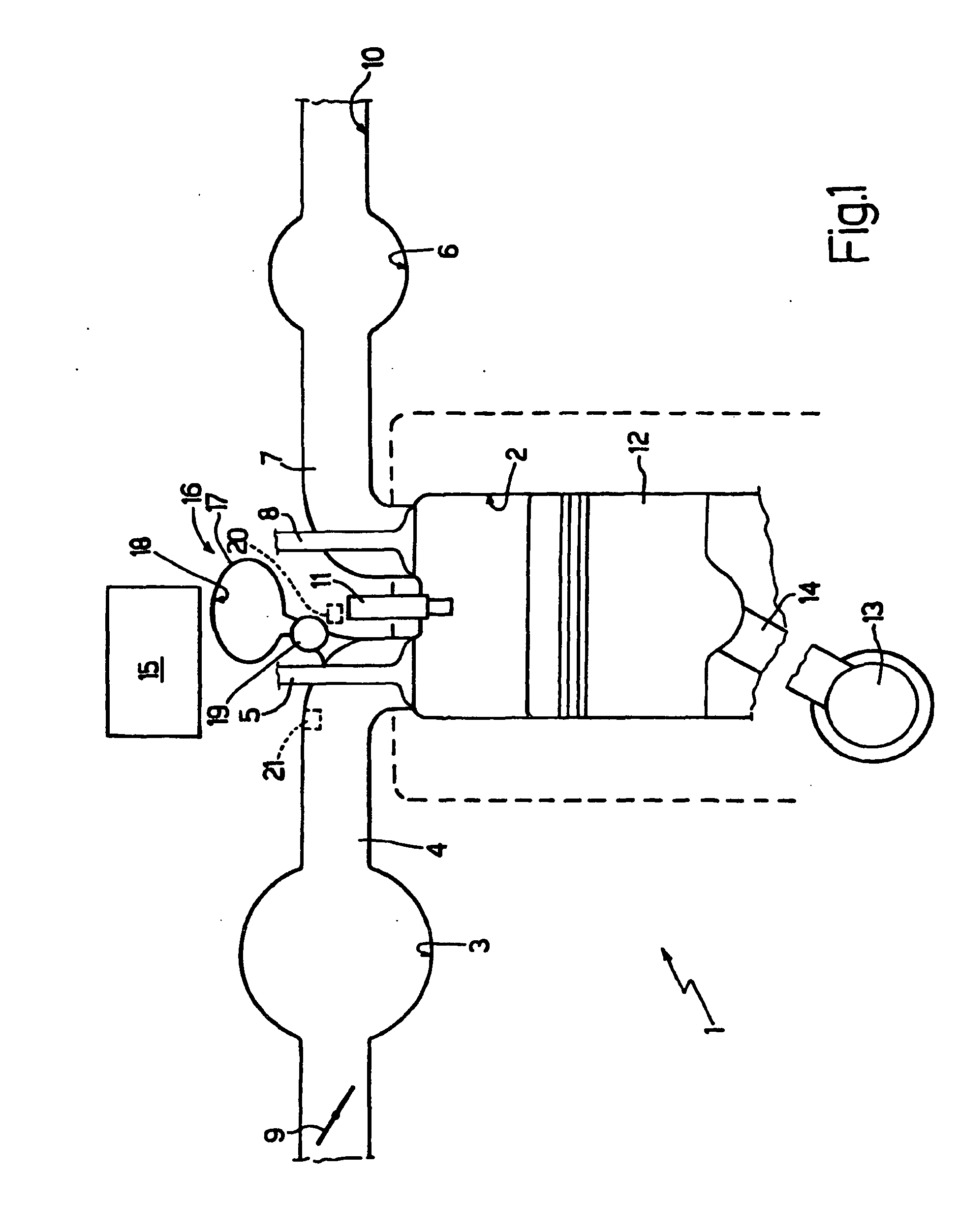
■ figure 1 shows a schematic view of an internal combustion engine having an intake
manifold in accordance with the present invention; and
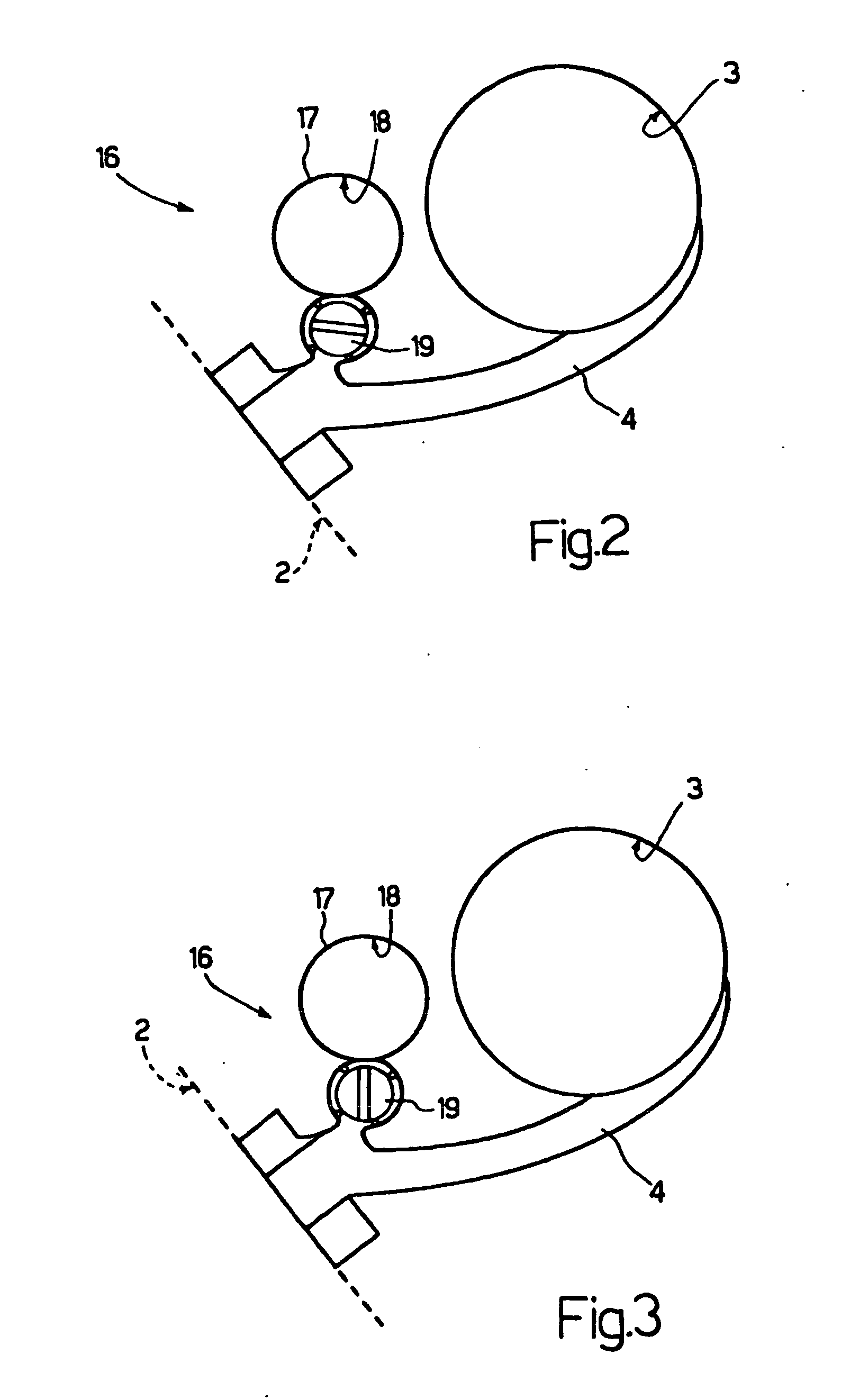
■ figures 2 and 3 show schematic lateral sections of an air vessel of the Figure 1
intake manifold in two different configurations.
[0010] Number 1 in figure 1 indicates as a whole an internal combustion engine having four
cylinders 2 (only one shown in figure 1), each connected to an intake manifold 3 by
a respective intake pipe 4 regulated by an intake valve 5, and to an exhaust manifold
6 by a respective exhaust pipe 7 regulated by an exhaust valve 8. The intake manifold
3 receives fresh air (i.e. outside air containing approximately 20% oxygen), by means
of a throttle valve 9 adjustable between a closed position and a fully-open position.
An exhaust pipe 10 extends from exhaust manifold 6, and terminates in a known silencer
(not shown) to discharge the combustion gases into the atmosphere.
[0011] In a first embodiment shown in figure 1, the fuel (e.g. petrol, diesel, methane,
LPG, etc.) is injected directly into each cylinder 2 by a respective injector 11;
in an alternative embodiment not shown, injectors 11 are located inside intake pipes
4 (indirect injection) .
[0012] Each cylinder 2 has a piston 12, which moves cyclically up and down inside cylinder
2 and is connected mechanically to a crankshaft 13 by a relative crank 14.
[0013] Engine 1 also comprises a control unit 15 which, in particular, controls throttle
valve 9 and injectors 11 at each cycle to fill cylinders 2 with a quantity of fuel-combustion
supporter (fresh air) mixture depending on the operating conditions of engine 1 and
control by the driver. Intake valves 5 and exhaust valves 8, on the other hand, are
connected mechanically to crankshaft 13 by a cam system (not shown) and so activated
by rotation of crankshaft 13.
[0014] Intake manifold 3 comprises an air vessel 16 which, for each intake pipe 4, comprises
a hollow body 17 located between intake manifold 3 and cylinder 2, and defining an
empty chamber 18, which communicates with intake pipe 4 by means of a high-speed compensation
valve 19 located in front of the cylinder intake defined by intake valve 5. In a variation
not shown, a single hollow body 17 is provided between intake manifold 3 and cylinders
2, and contains four mutually isolated empty chambers 18 (i.e. for each cylinder 2
there is a relevant isolated empty chamber 18).
[0015] In an alternative embodiment (not shown), air vessel 16 comprises only one hollow
body 17, which communicates with the four intake pipes 4 by means of four respective
compensation valves 19. In a further embodiment not shown, air vessel 16 comprises
only one hollow body 17, which communicates with intake manifold 3 by means of a single
compensation valve 19. This configuration is cheaper and more compact, but reduces
performance.
[0016] In the embodiment shown, each compensation valve 19 is powered by a known cam (not
shown) connected to crankshaft 13, and which may either be the same cam powering relative
intake valve 5, or a different cam. In an alternative embodiment shown by the dash
line, each compensation valve 19 is powered by a respective electric actuator 20 controlled
by control unit 15; in which case, control unit 15 may also be connected to a number
of pressure sensors 21, each housed, and for determining the pressure, inside a respective
intake pipe 4. Without pressure sensors 21, opening/closing of compensation valves
19 is performed solely on the basis of the angular position of crankshaft 13; with
pressure sensors 21, opening/closing of compensation valves 19 is performed on the
basis of the angular position of crankshaft 13 and the value of the pressure inside
intake pipes 4. The pressure sensors 21 could be substituted by an estimating unit,
which is able to estimate the value of the pressure inside the intake pipes 4 without
performing a direct measure.
[0017] In actual use, cyclic opening and closing of intake valves 5 prevents continuous
mass flow of the intake air, and causes pulsation inside intake pipes 4; which pulsation
of the intake air causes underpressure and overpressure inside each intake pipe 4,
and the variation in pressure is time-dependent (i.e. depends on the angular position
of crankshaft 13).
[0018] During the intake stroke of a cylinder 2 (i.e. when relative intake valve 5 is open
to feed fresh air from intake manifold 3 into cylinder 2), respective compensation
valve 19 is closed (figure 2); as soon as intake valve 5 closes and the pressure inside
relative intake pipe 4 starts to rise, respective compensation valve 19 is opened
(figure 3) until the pressure reaches maximum, and is then closed immediately to establish
an overpressure in chamber 18. When intake valve 5 is re-opened at the start of the
next intake stroke of cylinder 2, compensation valve 19 is opened to support charging
of cylinder 2. More specifically, compensation valve 19 may be opened shortly before
opening intake valve 5, so as to generate a small overpressure inside intake pipe
4 when intake valve 5 is opened. When an underpressure is produced in intake pipe
4 by suction of cylinder 2, compensation valve 19 is closed to produce an underpressure
in chamber 18; at which point, the above cycle is repeated.
[0019] The above disclosed air vessel 16 may be used in any kind of internal combustion
engine including two-strokes engines or rotating engines, which do not have intake
and exhaust valves, and also racing engines, which have an intake manifold for each
cylinder.
[0020] Air vessel 16 provides for greatly reducing the negative effects produced by pulsation
of the intake air, and in particular for improving charge of the cylinders (and therefore
engine torque) and for reducing mechanical stress on intake manifold 3.
1. An intake manifold (3) for an internal combustion engine (1) having at least one cylinder
(2); the intake manifold (3) comprises at least one intake pipe (4) connecting the
intake manifold (3) to the cylinder (2) and an air vessel (16) comprising at least
one hollow body (17) defining an empty chamber (18), which communicates with the intake
manifold (3) by means of a compensation valve (19); the intake manifold (3) is characterized in that the empty chamber (18) communicates directly with the intake pipe (4) by means of
a high-speed compensation valve (19).
2. An intake manifold (3) as claimed in Claim 1, wherein the hollow body (17) is located
between the intake manifold (3) and the cylinder (2).
3. An intake manifold (3) as claimed in Claim 1 or 2, wherein the intake pipe (4) is
regulated by at least one intake valve (5) and the compensation valve (19) is located
in front of the cylinder intake defined by the intake valve (5).
4. An intake manifold (3) as claimed in any one of Claims 1 to 3, wherein the compensation
valve (19) is actuated by a cam system powered by a crankshaft (13) of the engine
(1).
5. An intake manifold (3) as claimed in Claim 4, wherein the intake pipe (4) is regulated
by at least one intake valve (5) and the compensation valve (19) is actuated by the
cam powering the intake valve (5).
6. An intake manifold (3) as claimed in any one of Claims 1 to 3, wherein the compensation
valve (19) is actuated by an electric actuator (20) controlled by a control unit (15).
7. An intake manifold (3) as claimed in Claim 6, wherein estimating means are provided,
are connected to the control unit (15), and estimate the pressure inside the intake
pipe (4); and the control unit (15) controls opening/closing of the compensation valve
(19) on the basis of the angular position of a crankshaft (13) of the engine (1),
and of the value of the pressure inside the intake pipe (4).
8. An intake manifold (3) as claimed in Claim 7, wherein the estimating means comprise
a pressure sensor (21) located inside the intake pipe (4).
9. An intake manifold (3) as claimed in any one of Claims 1 to 8, wherein the engine
(1) comprises a number of cylinders (2), each connected to the intake manifold (3)
by a relative intake pipe (4); and the air vessel (16) comprises only one hollow body
(17), which communicates with the intake manifold (3) by means of a single compensation
valve (19).
10. An intake manifold (3) as claimed in any one of Claims 1 to 8, wherein the engine
(1) comprises a number of cylinders (2), each connected to the intake manifold (3)
by a relative intake pipe (4); and the air vessel (16) comprises only one hollow body
(17), which communicates with each intake pipe (4) by means of a relative compensation
valve (19).
11. An intake manifold (3) as claimed in any one of Claims 1 to 8, wherein the engine
(1) comprises a number of cylinders (2), each connected to the intake manifold (3)
by a relative intake pipe (4); and the air vessel (16) comprises, for each intake
pipe (4), a relative empty chamber (18) connected to the intake pipe (4) by a respective
compensation valve (19).
12. An intake manifold (3) as claimed in Claim 11, wherein the air vessel (16) comprises
a single hollow body (17), which contains a number of mutually isolated empty chambers
(18).
13. A method of operating the compensation valve (19) of the intake manifold (3) as claimed
in any one of Claims 1 to 12; the method comprises the steps of:
closing the compensation valve (19) during the intake stroke of the cylinder (2);
opening the compensation valve (19) as soon as an intake valve (5) of the cylinder
(2) closes and the pressure inside the intake pipe (4) starts to rise;
keeping the compensation valve (19) opened until the pressure inside the intake pipe
(4) reaches maximum;
closing the compensation valve (19) immediately after the pressure inside the intake
pipe (4) reaches maximum to establish an overpressure in the chamber (18);
opening the compensation valve (19) when the intake valve (5) is re-opened at the
start of the next intake stroke of the cylinder (2) to support charging of the cylinder
(2); and
14. A method as claimed in Claim 13, wherein the compensation valve (19) is closed when
an underpressure is produced in the intake pipe (4) by suction of the cylinder (2)
to produce an underpressure in the chamber (18).
15. A method as claimed in Claim 13 or 14, wherein the compensation valve (19) is opened
shortly before opening the intake valve (5), so as to generate a small overpressure
inside the intake pipe (4) when the intake valve (5) is opened.
1. Einlasskrümmer (3) für eine Brennkraftmaschine (1) mit wenigstens einem Zylinder (2);
wobei der Einlasskrümmer (3) wenigstens ein Einlassrohr (4), das den Einlasskrümmer
(3) mit dem Zylinder (2) verbindet, und einen Luftbehälter (16) aufweist, der wenigstens
einen hohlen Körper (17) umfasst, der eine leere Kammer (18) definiert, die mit dem
Einlasskrümmer (3) mit Hilfe eines Ausgleichsventils (19) in Kommunikation steht,
wobei der Einlasskrümmer (3) dadurch gekennzeichnet ist, dass die leere Kammer (18) direkt mit dem Einlassrohr (4) mit Hilfe eines Hochgeschwindigkeits-Ausgleichsventils
(19) in Kommunikation steht.
2. Einlasskrümmer (3) wie in Anspruch 1 beansprucht, worin der hohle Körper (17) zwischen
dem Einlasskrümmer (3) und dem Zylinder (2) angeordnet ist.
3. Einlasskrümmer (3) wie in Anspruch 1 oder 2 beansprucht, worin das Einlassrohr (4)
durch wenigstens ein Einlassvenfil (5) geregelt wird, und worin das Ausgleichsventil
(19) vor dem Zylindereinlass angeordnet ist, der durch das Einlassventil (5) gebildet
wird.
4. Einlasskrümmer (3) wie in einem der Ansprüche 1 bis 3 beansprucht, worin das Ausgleichsventil
(19) durch ein Nockensystem betätigt wird, das durch eine Kurbelwelle (13) der Maschine
(1) betrieben wird.
5. Einlasskrümmer (3) wie in Anspruch 4 beansprucht, worin das Einlassrohr (4) durch
wenigstens ein Einlassventil (5) geregelt wird, und worin das Ausgleichsventil (19)
durch einen Nocken betätigt wird, der das Einlassventil (5) betreibt.
6. Einlasskrümmer (3) wie in einem der Ansprüche 1 bis 3 beansprucht, worin das Ausgleichsventil
(19) durch ein elastisches Betätigungselement (20) betätigt wird, das durch eine Steuereinheit
(15) gesteuert wird.
7. Einlasskrümmer (3) wie in Anspruch 6 beansprucht, worin Abschätzmittel vorgesehen
sind, die mit der Steuereinheit (5) verbunden sind und den Druck in dem Einlassrohr
(4) abschätzen; und worin die Steuereinheit (15) das Öffnen/Schließen des Ausgleichsventils
(19) auf der Basis der Winkelposition einer Kurbelwelle (13) der Maschine und des
Betrages des Druckes innerhalb des Einlassrohres (4) steuert.
8. Einlasskrümmer (3) wie in Anspruch 7 beansprucht, worin die Abschätzmittel einen Drucksensor
(21) umfassen, der in dem Einlassrohr (4) angeordnet ist.
9. Einlasskrümmer (3) wie in einem der Ansprüche 1 bis 8 beansprucht, worin die Maschine
(1) eine Anzahl Zylinder (2) aufweist, die jeweils mit dem Einlasskrümmer (3) durch
ein zugeordnetes Einlassrohr (4) verbunden sind, und worin der Luftbehälter (16) nur
einen hohlen Körper (17) aufweist, der mit dem Einlasskrümmer (3) mit Hilfe eines
einzigen Ausgleichsventils (19) in Kommunikation steht.
10. Einlasskrümmer (3) wie in einem der Ansprüche 1 bis 8 beansprucht, worin die Maschine
(1) eine Anzahl von Zylindern (2) aufweist, die jeweils mit dem Einlasskrümmer (3)
durch ein zugeordnetes Einlassrohr (4) verbunden sind, und worin der Luftbehälter
(16) nur einen hohlen Körper (17) aufweist, der mit jedem Einlassrohr (4) mit Hilfe
eines zugeordneten Ausgleichsventils (19) in Kommunikation steht.
11. Einlasskrümmer (3) wie in einem der Ansprüche 1 bis 8 beansprucht, worin die Maschine
(1) eine Anzahl Zylinder (2) aufweist, die jeweils mit dem Einlasskrümmer (3) durch
ein zugeordnetes Einlassrohr (4) verbunden sind, und worin der Luftbehälter (16) für
jedes Einlassrohr (4) eine zugeordnete, leere Kammer (18) aufweist, die mit dem Einlassrohr
(4) durch ein zugeordnetes Ausgleichsventil (19) verbunden sind.
12. Einlasskrümmer (3) wie in Anspruch 11 beansprucht, worin der Luftbehälter (16) einen
einzigen hohlen Körper (17) aufweist, der eine Anzahl wechselseitig isolierter, leerer
Kammern (18) enthält.
13. Verfahren zum Betreiben eines Ausgleichsventils (19) eines Einlasskrümmers (3) wie
in einem der Ansprüche 1 bis 12 beansprucht, wobei das Verfahren die Schritte aufweist:
Schließen des Ausgleichsventils (19) während des Einlasshubes des Zylinders (2);
Öffnen des Ausgleichsventils (19) sobald das Einlassventil (5) des Zylinders (2) schließt
und der Druck in dem Einlassrohr (4) anzusteigen beginnt;
Offenhalten des Ausgleichsventils (19) bis der Druck in dem Einlassrohr (4) ein Maximum
erreicht;
Schließen des Ausgleichsventils (19) unmittelbar nachdem der Druck in dem Einlassrohr
(4) das Maximum erreicht, um einen Überdruck in der Kammer (18) aufzubauen;
Öffnen des Ausgleichsventils (19), wenn das Einlassventil (5) bei Beginn des nächsten
Ansaughubes des Zylinders sich erneut öffnet, um die Aufladung des Zylinders (2) zu
unterstützen.
14. Verfahren wie in Anspruch 13 beansprucht, worin das Ausgleichsventil (19) geschlossen
wird, wenn ein Unterdruck in dem Einlassrohr (4) durch die Saugwirkung des Zylinders
(2) erzeugt wird, um einen Unterdruck in der Kammer (18) zu erzeugen.
15. Verfahren wie in Anspruch 13 oder 14 beansprucht, worin das Ausgleichsventil (19)
kurz vor dem Öffnen des Einlassventils (5) geöffnet wird, um einen kleinen Überdruck
in dem Einlassrohr (4) zu erzeugen, wenn das Einlassventil (5) geöffnet wird.
1. Collecteur d'admission (3) pour un moteur à combustion interne (1) comportant au moins
un cylindre (2), ce collecteur d'admission (3) comprenant au moins un tuyau d'admission
(4) qui relie le collecteur d'admission (3) au cylindre (2) et un récipient à air
(16) qui comprend au moins un corps creux (17) formant une chambre vide (18) qui communique
avec le collecteur d'admission (3) au moyen d'un distributeur de compensation (19),
ce collecteur d'admission (3) étant caractérisé par le fait que la chambre vide (18) communique directement avec le tuyau d'admission (4) au moyen
d'un distributeur de compensation rapide (19).
2. Collecteur d'admission (3) selon la revendication 1, le corps creux (17) étant situé
entre le collecteur d'admission (3) et le cylindre (2).
3. Collecteur d'admission (3) selon l'une des revendications 1 et 2, le tuyau d'admission
(4) étant commandé par au moins une soupape d'admission (5) et le distributeur de
compensation (19) était située devant l'entrée du cylindre formée par la soupape d'admission
(5).
4. Collecteur d'admission (3) selon l'une des revendications 1 à 3, le distributeur de
compensation (19) étant actionnée par un système de cames actionné par le vilebrequin
(13) du moteur (1).
5. Collecteur d'admission (3) selon la revendication 4, le tuyau d'admission (4) étant
commandé par au moins une soupape d'admission (5) et le distributeur de compensation
19) étant actionné par la came qui actionne la soupape d'admission (5).
6. Collecteur d'admission (3) selon l'une des revendications 1 à 3, le distributeur de
compensation (19) étant actionné par un actionneur électrique (20) commandé par un
organe de commande (15).
7. Collecteur d'admission (3) selon la revendication 6, avec lequel sont prévus des moyens
d'estimation qui sont reliés à l'organe de commande (15) et estiment la pression dans
le tuyau d'admission (4), et l'organe de commande (15) commande l'ouverture et la
fermeture du distributeur de compensation (19) d'après la position angulaire du vilebrequin
(13) du moteur (1) et de la valeur de la pression dans le tuyau d'admission (4).
8. Collecteur d'admission (3) selon la revendication 7, les moyens d'estimation comprenant
un capteur de pression (21) situé dans le tuyau d'admission (4).
9. Collecteur d'admission (3) selon l'une des revendications 1 à 8, le moteur (1) comprenant
un certain nombre de cylindres (2) qui sont reliés chacun au collecteur d'admission
(3) par un tuyau d'admission respectif (4), et le récipient à air (16) comprenant
un seul corps creux (17), lequel communique avec le collecteur d'admission (2) au
moyen d'un seul distributeur de compensation (19).
10. Collecteur d'admission (3) selon l'une des revendications 1 à 8, le moteur (1) comprenant
un certain nombre de cylindres (2) qui sont reliés chacun au collecteur d'admission
(3) par un tuyau d'admission respectif (4), et le récipient à air (16) comprenant
un seul corps creux (17), lequel communique avec chaque tuyau d'admission (4) au moyen
d'un distributeur de compensation respectif (19).
11. Collecteur d'admission (3) selon l'une des revendications 1 à 8, le moteur (1) comprenant
un certain nombre de cylindres (2) qui sont reliés chacun au collecteur d'admission
(3) par un tuyau d'admission respectif (4), et le récipient à air (16) comprenant
pour chaque tuyau d'admission (4) une chambre vide respective (18) reliée au tuyau
d'admission (4) par un distributeur de compensation respectif (19).
12. Collecteur d'admission (3) selon la revendication 11, le récipient à air (16) comprenant
un seul corps creux (17), lequel contient un certain nombre de chambres vides isolées
les unes des autres (18).
13. Procédé de fonctionnement du distributeur de compensation (19) du collecteur d'admission
(3) selon l'une des revendications 1 à 12, ce procédé comprenant les étapes de :
fermeture du distributeur de compensation (19) pendant la course d'admission du cylindre
(2),
ouverture du distributeur de compensation (19) dès qu'une soupape d'admission (5)
du cylindre (2) se ferme et que la pression dans le tuyau d'admission (4) commende
à monter,
maintien du distributeur de compensation (19) ouvert jusqu'à ce que la pression dans
le tuyau d'admission (4) atteigne un maximum,
fermeture du distributeur de compensation (19) immédiatement après que la pression
dans le tuyau d'admission (4) a atteint un maximum afin d'établir une surpression
dans la chambre (18),
ouverture du distributeur de compensation (19) lorsque la soupape d'admission (4)
se rouvre au début de la course d'admission suivante du cylindre (2) afin d'assister
le chargement du cylindre (2).
14. Procédé selon la revendication 13, dans lequel le distributeur de compensation (19)
se ferme lorsqu'une dépression est produite dans le tuyau d'admission (4) par aspiration
du cylindre (2) afin de produire une dépression dans la chambre (18).
15. Procédé selon l'une des revendications 13 et 14, dans lequel le distributeur de compensation
(19) s'ouvre peu avant l'ouverture de la soupape d'admission (5) afin de produire
une petite surpression dans le tuyau d'admission (4) lorsque la soupape d'admission
(5) s'ouvre.