|
(11) | EP 1 643 019 A1 |

| (12) | EUROPEAN PATENT APPLICATION |
| published in accordance with Art. 158(3) EPC |
|
|
|
|
|||||||||||||||||||
| (54) | POLYETHER ESTER ELASTIC FIBER AND FABRICS AND CLOTHES MADE BY USING THE SAME |
| (57) A polyether ester elastic fiber comprising a polyether ester elastomer containing
polybutylene terephthalate as a hard segment and polyoxyethylene glycol as a soft
segment and copolymerized with a specific metal organic sulfonate, having a coefficient
of moisture absorption of not less than 5 % at 35°C and at a RH of 95 % and a coefficient
of water absorption extension of not less than 10 %. The above-mentioned polyether
ester elastic fiber has a good moisture-absorbing property, and is reversibly largely
expanded or contracted by the absorption or release of water. Therefore, a fabric
giving excellent comfortableness can be obtained from said elastic fibers, and can
be recycled. |
Technical Field
[0001] The present invention relates to a polyether ester elastic fiber giving a fabric which has a good moisture-absorbing or releasing property, is reversibly expanded or contracted by the absorption or release of water, and especially gives non-conventional comfortableness for sports uses, inner wear uses and the like.
Background Art
[0002] Hitherto, polyurethane elastic fibers have mainly been used as elastic fibers for clothes and industrial materials, but have defects that heat resistance, chemical resistance and weather (light) resistance are inferior. The polyurethane elastic fibers need a dry spinning process on their production, and the recovery of a solvent is therefore needed. The polyurethane elastic fibers have problems of low productivity and large energy consumption. Furthermore, the polyurethane elastic fibers have many problems directed to the coming of a future recycling-oriented society, such as the difficulty of recycling and the production of harmful gases on combustion.
[0003] Under such the background, polyether ester elastic fibers containing a highly crystalline polyester such as a polyalkylene terephthalate as a hard segment and a polyalkylene glycol as a soft segment and capable of being melt-spun have been put to practical uses, while utilizing advantages such as high productivity, excellent heat resistance and excellent heat set resistance. Furthermore, the future development of the polyether ester elastic fibers has been expected as elastic fibers suitable for the recycling-oriented society, because the polyether ester elastic fibers can be recycled and do not produce a harmful gas (for example, JP-B 47-14054 (hereinafter, JP-B means "Japanese Examined Patent Publication"), JP-A 48-10346 (hereinafter, JP-A means "Japanese Unexamined Patent Publication"), JP-A 57-77317).
[0004] As such the polyether ester elastic fibers, polyether ester elastic fibers using polybutylene terephthalate as a hard segment and polyoxybutylene glycol as a soft segment, or the like, have been used as elastic fibers having elastic performances comparable to those of polyurethane elastic fibers. However, both these hard segment and soft segment are generally hydrophobic, and polyether ester elastic fibers having hydrophilic properties such as a moisture-absorbing property or a water-absorbing property have little been put to a practical use.
[0005] On the other hand, in the pamphlet of WO 00/47802, elastic fibers having a moisture-absorbing performance given thereto have been proposed, but only the concrete examples of a polyurethane elastomer containing a water-absorbing resin having a coefficient of water absorption of 500 to 4,000 percent by weight have been described.
[0006] Additionally, only by imparting a moisture-absorbing property to fibers themselves as having been proposed, there is a limit for improving their comfortableness as a fabric or further clothing. Therefore, elastic fibers having new functions have been demanded.
Disclosure of Invention
[0007] The present invention has been completed on the basis of the above-mentioned conventional techniques as the background, and the object of the present invention is to provide the recyclable polyether ester elastic fibers giving fabrics which have a good moisture-absorbing property and is reversibly largely expanded or contracted by the absorption or release of water to give excellent comfortableness, and to provide a fabric, clothing using the elastic fibers.
[0008] The inventors of the present invention have repeatedly examined in view of such the background techniques. Consequently, it has been found that the object of the present invention can be achieved with the following polyether ester elastic fibers.
- 1. A polyether ester elastic fiber comprising a polyether ester elastomer containing polybutylene terephthalate as a hard segment and polyoxyethylene glycol as a soft segment, characterized by having a coefficient of moisture absorption of not less than 5 % at 35°C and at a RH of 95 % and a coefficient of water absorption extension of not less than 10 %.
- 2. The polyether ester elastic fiber according to Claim 1, wherein the polyether ester
elastomer is copolymerized with a metal organic sulfonate represented by the following
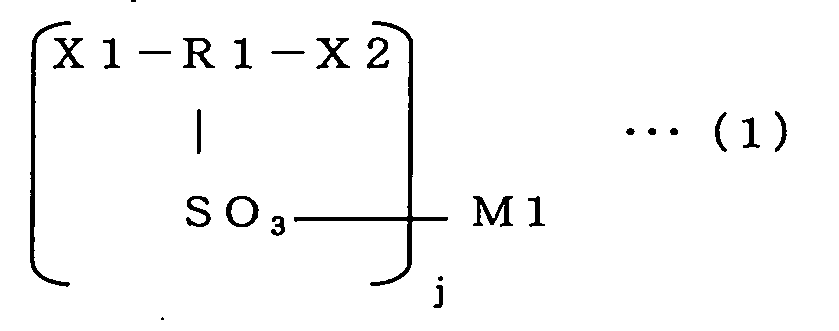
general formula (1), and the intrinsic viscosity of the elastic fiber is not less
than 0.9.
(wherein, R1 represents an aromatic hydrocarbon group or an aliphatic hydrocarbon group, X1 represents an ester-forming functional group, X2 represents an ester-forming functional group identical to or different from X1 or a hydrogen atom, M1 represents an alkali metal or an alkaline earth metal, j represents 1 or 2). - 3. The polyether ester elastic fiber according to Claim 2, wherein the shrinkage percentage of the elastic fiber in boiling water is not less than 10 %.
- 4. The polyether ester elastic fiber according to Claim 2, wherein the metal organic
sulfonate is a compound represented by the following general formula (2).
(wherein, R2 represents an aromatic hydrocarbon group or an aliphatic hydrocarbon group, M2 represents an alkali metal or an alkaline earth metal). - 5. The polyether ester elastic fiber according to Claim 2, wherein the copolymerization quantity of the metal organic sulfonate is in a range of 0.1 to 20 percent by mole based on the acid component constituting the polyether ester elastomer.
- 6. The polyether ester elastic fiber according to Claim 1, wherein the elastic fiber has two crystal-melting peaks in a DSC curve obtained with a differential scanning calorimeter, has a Hm1 / Hm2 ratio of the height Hm1 of the crystal-melting peak on the lower temperature side / the height Hm2 of the crystal-melting peak on the higher temperature side in a range of 0.6 to 1.2, and has a breaking elongation of not less than 400 %.
- 7. The polyether ester elastic fiber according to Claim 6, wherein temperature Tm1
at the crystal-melting peak on the lower temperature side and temperature Tm2 at the
crystal-melting peak on the higher temperature side between the two crystal-melting
peaks satisfy the following expression.
- 8. The polyether ester elastic fiber according to one of Claims 1, 2 and 6, wherein the ratio of the hard segment : the soft segment is in a range of 30 : 70 to 70 : 30 based on weight.
- 9. The polyether ester elastic fiber according to one of Claims 1, 2 and 6, wherein a finishing oil in which at least one lubricant selected from the group consisting of mineral oils, silicones and aliphatic esters and an ether-based or ester-based nonionic surfactant occupy 70 to 100 percent by weight and 0 to 30 percent by weight, respectively, of said finishing oil is adhered to the surface of the elastic fiber in an amount of 0.5 to 5.0 percent by weight based on the weight of said fiber.
- 10. The polyether ester elastic fiber according to Claim 9, wherein the viscosity of the finishing oil at 30°C is 5×10⁻⁶ to 4×10⁻⁵ m2/s.
- 11. A fabric in whose at least one portion the polyether ester elastic fibers according to one of Claims 1, 2 and 6 are used.
- 12. Clothing in whose at least one portion the polyether ester elastic fibers according to one of Claims 1, 2 and 6 are used.
- 13. Underwear, sportswear, lining, pantyhose, or socks in whose at least one portion the polyether ester elastic fibers according to one of Claims 1, 2 and 6 are used.
Best Mode for Carrying Out the Invention
[0009] The polyether ester elastomer is an elastic fiber comprising a polyether ester elastomer containing polybutylene terephthalate as a hard segment and polyoxyethylene glycol as a soft segment.
[0010] It is preferable that the polybutylene terephthalate as the hard segment contains butylene terephthalate units in an amount of at least 70 percent by mole. The content of the butylene terephthalate is more preferably not less than 80 percent by mole, furthermore preferably not less than 90 percent by mole.
[0011] The above-mentioned polybutylene terephthalate may be copolymerized with one or more other components within a range substantially not affecting the achievement of the object of the present invention. The dicarboxylic acid component used as the one or more other copolymerization components includes aromatic, aliphatic and alicyclic dicarboxylic acid components such as naphthalene dicarboxylic acid, isophthalic acid, diphenyl dicarboxylic acid, diphenoxyethane dicarboxylic acid, β -hydroxyethoxybenzoic acid, p-hydroxybenzoic acid, adipic acid, sebacic acid and 1,4-cyclohexane dicarboxylic acid. Furthermore, a trifunctional or more functional polycarboxylic acid such as trimellitic acid or pyromellitic acid may be used as a copolymerization component. Also, the diol component includes aliphatic, alicyclic and aromatic diol components such as trimethylene glycol, ethylene glycol, cyclohexane-1,4-dimethanol, and neopentyl glycol. Furthermore, a trifunctional or more functional polyol such as glycerol, trimethylolpropane or pentaerythritol may be used as a copolymerization component.
[0012] On the other hand, it is preferable that the polyoxyethylene glycol as the soft segment contains oxyethylene glycol units in an amount of not less than at least 70 percent by mole. The content of the oxyethylene glycol is more preferably not less than 80 percent by mole, furthermore preferably not less than 90 percent by mole. The above-mentioned polyoxyethylene glycol may be copolymerized with, for example, propylene glycol, tetramethylene glycol, glycerol or the like within a range substantially not affecting the achievement of the object of the present invention.
[0013] The number-average molecular weight of the above-mentioned polyoxyethylene glycol is preferably 400 to 8,000, especially preferably 1,000 to 6,000.
[0014] In the present invention, the weight ratio of the hard segment : the soft segment is preferably in a range of 70 : 30 to 30 : 70, more preferably in a range of 60 : 40 to 40 : 60. When the weight ratio of the hard segment exceeds 70 %, the elongation of the elastic fiber is lowered, and it becomes difficult to use the elastic fiber for high stretch uses. The moisture-absorbing property is liable to be lowered. When the weight ratio of the hard segment is less than 30 %, the strength is liable to be lowered, because the rate of the crystal portion of the polybutylene terephthalate is lowered, and it is difficult to copolymerize all of the added polyoxyethylene glycol. Washing fastness is therefore liable to be deteriorated in post-processing processes such as scouring and dyeing processes or when the elastic fiber is used as a product.
[0015] In the present invention, it is important that the elastic fiber has a coefficient of moisture absorption of not less than 5 % at 35°C and at a RH of 95 % and a coefficient of water absorption extension of not less than 10 %. Thereby, a woven or knitted fabric comprising such the elastic fibers is a fabric giving excellent comfortableness and having the so-called self-adjusting function wherein, when the woven or knitted fabric absorbs sweat or the like, the fibers are extended to open the stitches of the woven or knitted fabric to release moisture in the clothing, and when the woven or knitted fabric is dried, the fibers are contracted into the original lengths, thereby clogging the stitches of the woven or knitted fabric to prevent the release of temperature in the clothing.
[0016] When the coefficient of moisture absorption is less than 5 %, the woven or knitted fabric gives a sticky sense or stuffy sense, and when the coefficient of water absorption extension is less than 10 %, the reversibly extending or contracting characteristic due to the absorption or release of water is insufficient. Thereby, the stitches of the woven or knitted fabric are sufficiently not opened or closed, and the fabric giving excellent comfortableness is not obtained. Whereas, when the coefficient of moisture absorption or the coefficient of water absorption extension in the elastic fibers of the present invention comprising the above-mentioned polyether ester is excessively large, elastic performance, heat resistance, weather (light) resistance, chemical resistance, and the like are liable to be deteriorated. Hence, the coefficient of moisture absorption is preferably in a range of 5 to 45 %, more preferably in a range of 10 to 40 %. The coefficient of water absorption extension is preferably in a range of 10 to 100 %, more preferably in a range of 10 to 80 %, furthermore preferably in a range of 15 to 60 %. In the present invention, the finishing oil is adhered to the surface of the elastic fiber in an amount of 0.5 to 5.0 percent by weight based on the weight of said fiber, and it is preferable in said finishing oil that at least one lubricant selected from the group consisting of mineral oils, silicones, and aliphatic esters occupies 70 to 100 percent by weight of said finishing oil.
[0017] The above-mentioned lubricant selected from the mineral oils, the silicones, and the aliphatic esters little swells the elastic fiber, does not cause the increase of friction and the deterioration of dynamical characteristics due to the swelling, and improves process stability in a fiber-producing process and in post-processing processes. The content (the total content of the lubricants, when the lubricants are used) of the lubricant is controlled to 70 to 100 percent by weight. Thereby, the traveling stability of the fiber on the production of the fiber can be improved, and the abnormal elongation of the fiber and the production of scum can be prevented.
[0018] As the above-mentioned mineral oils, the mineral oils having viscosities in the range of 5×10⁻⁶ to 4×10⁻⁵ m2/s at 30°C are preferable. The mineral oils having the viscosities in such the viscosity range little evaporate during storage. Thereby, the composition ratio of the finishing oil on the elastic fiber is little changed, and the high smoothness can be maintained. It is preferable that the silicone is polydimethylsiloxane, and has a viscosity of 5×10⁻⁶ to 4×10⁻⁵ m2/s at 30°C for the same reason as in the case of the mineral oils. In addition, the above-mentioned aliphatic esters are compounds such as aliphatic acid monoalkyl esters, dialkyl aliphatic dicarboxylates, and the mono- or multi-fatty acid esters of aliphatic polyhydric alcohols, and preferably have the molecular weights in a range of 250 to 550. High smoothness can be maintained by controlling the molecular weights to such the range of the molecular weight. For example, the fatty acid monoalkyl esters in the aliphatic esters preferably used include octyl octanoate, octyl stearate, isotridecyl laurate, isotridecyl oleate, and lauryl oleate. The dialkyl aliphatic dicarboxylates include diisooctyl adipate. The mono- or multi-fatty acid esters of the aliphatic polyhydric alcohols include trimethylol propane trioctanoate. Especially, the aliphatic acid monoalkyl esters are preferable.
[0019] Whereas, it is preferable that the ether-based or ester-based nonionic surfactant is the nonionic surfactant having a viscosity of 8×10⁻⁶ to 5×10⁻⁵ m2/s at 30°C. The ether-based nonionic surfactant preferably used includes polyalkylene glycol alkyl ethers and polyalkylene glycol aryl ethers. The ester-based nonionic surfactant includes the alkylene oxide adducts of polyhydric alcohol partial esters, and polyalkylene glycol alkyl ethers are especially preferable. When the alkyl group has the carbon atoms within a range of 8 to 20 carbon atoms, the elastic fiber is hardly swollen, and high smoothness can also simultaneously be achieved. It is preferable that the alkylene group of the polyalkylene glycol chain has two or three carbon atoms, especially two carbon atoms, and it is suitable that the number of the chains (the molar number of ethylene oxide added to the alcohol) is within a range of 3 to 20. When the number of the chains is within the range, compatibility with the lubricants comprising the above-mentioned mineral oils, the silicones or the aliphatic esters is not deteriorated.
[0020] Therein, when the above-mentioned mineral oils, the silicones, and the like have viscosities of 5×10⁻⁶ to 2×10⁻⁵ m2/s at 30 °C , the above-mentioned ether-based or ester-based nonionic surfactant is not necessarily contained in the finishing oil, but it is preferable at the point of handleability, that said nonionic surfactant is contained in an amount of not more than 30 percent by weight, when the above-mentioned viscosity exceeds 2×10⁻⁵ m2/s.
[0021] The finishing oil used in the present invention is comprised of the above-mentioned components, but one or more other components may, if necessary, be added in small amounts within a range not affecting the object of the present invention. Lubricating auxiliaries, for example, another nonionic surfactant, an anionic or cationic surfactant, stability-improving agents such as an antioxidant and an ultraviolet absorber, may be added in small amounts.
[0022] Additionally, it is preferable that the above-mentioned finishing oil used in the present invention has a viscosity in a range of 5×10⁻⁶ to 4×10⁻⁵ m2/s at 30°C. When the viscosity is controlled to such the range, the components in the finishing oil are hardly evaporated during the storage of the elastic fiber, and the high smoothness can be maintained. When the finishing oil has a high viscosity in a range of 2×10⁻⁵ to 4×10⁻⁵ m2/s at 30°C, and is imparted as a neat finishing oil in a spinning process, it is preferable that the finishing oil is, for example, heated to lower the viscosity to not more than 2×10⁻⁵ m2/s. But, when the finishing oil is heated at too high temperature, the physical properties of the obtained fiber are affected. Therefore, it is preferable that the temperature is controlled to at most 60°C.
[0023] Next, the amount of the above-mentioned finishing oil adhered to the elastic fiber is preferably 0.5 to 5.0 percent by weight, more preferably 1.0 to 4.0 percent by weight, based on the weight of said fiber. Thereby, a trouble such as the breakage of the fiber or the production of scum is hardly caused in a process for producing the fiber to improve the stability of the process.
[0024] The above-mentioned high coefficient of moisture absorption and the above-mentioned high coefficient of water absorption extension can easily be achieved by copolymerizing the above-mentioned polyether ester elastomer with a metal organic sulfonate represented by the following general formula (1) and controlling the intrinsic viscosity of the elastic fiber to not less than 0.9.
[0025] Therein, R1 represents an aromatic hydrocarbon group or an aliphatic hydrocarbon group, preferably an aromatic hydrocarbon group having 6 to 15 carbon atoms or an aliphatic hydrocarbon group having not more than 10 carbon atoms. Particularly preferable R1 represents an aromatic hydrocarbon group having 6 to 12 carbon atoms, especially a benzene ring. M1 represents an alkali metal or an alkaline earth metal, and j represents 1 or 2. Especially, M1 represents preferably an alkali metal (for example, lithium, sodium or potassium), and j represents preferably 1. X1 represents an ester-forming functional group, and X2 represents an ester-forming functional group identical to or different from X1 or a hydrogen atom, but represents preferably the ester-forming functional group. The ester-forming functional group may be a group for reacting and binding to the main chain or terminal of the polyether ester, and include concretely by the following groups.
(wherein, R' represents a lower alkyl group or a phenyl group; a and d represent each an integer of 1 to 10; b represents an integer of 2 to 6).
[0026] The preferably concrete examples of the metal organic sulfonate represented by the above-mentioned general formula (1) include sodium 3,5-dicarbomethoxybenzenesulfonate, potassium 3,5-dicarbomethoxybenzenesulfonate, lithium 3,5-dicarbomethoxybenzenesulfonate, sodium 3,5-dicarboxybenzenesulfonate, potassium 3,5-dicarboxybenzenesulfonate, lithium 3,5-dicarboxybenzenesulfonate, sodium 3,5-di( β -hydroxyethoxycarbonyl)benzenesulfonate, potassium 3,5-di( β -hydroxyethoxycarbonyl)benzenesulfonate, lithium 3,5-di( β -hydroxyethoxycarbonyl)benzenesulfonate, sodium 2,6-dicarbomethoxynaphthalene-4-sulfonate, potassium 2,6-dicarbomethoxynaphthalene-4-sulfonate, lithium 2,6-dicarbomethoxynaphthalene-4-sulfonate, sodium 2,6-dicarboxynaphthalene-4-sulfonate, sodium 2,6-dicarbomethoxynaphthalene-1-sulfonate, sodium 2,6-dicarbomethoxynaphthalene-3-sulfonate, sodium 2,6-dicarbomethoxynaphthalene-4,8-disulfonate, sodium 2,6-dicarboxynaphthalene-4,8-disulfonate, sodium 2,5-bis(hydroethoxy)benzenesulfonate, and a -sodium sulfosuccinate. Only one of the above-mentioned metal organic sulfonates may singly be used, or two or more of the above-mentioned metal organic sulfonates may together be used.
[0027] In the present invention, the copolymerization of the metal organic sulfonate represented by the following general formula (2) is preferable at a point capable of easily increasing the intrinsic viscosity of the polyether ester elastomer to not less than 0.9 and further at a point capable of remarkably enhancing the coefficient of moisture absorption and the coefficient of water absorption extension of the obtained elastic fiber. According to our researches, it has been found by the copolymerization of such the metal organic sulfonate that an extremely high level coefficient of water absorption extension of not less than 20 % can be achieved to easily give a fabric giving excellent comfortableness.
[0028] Wherein, R2 represents an aromatic hydrocarbon group or an aliphatic hydrocarbon group which is the same as the definition of R1 in the above-mentioned general formula (1), M2 represents an alkali metal or an alkaline earth metal which is the same as the definition of M1 in the above-mentioned general formula (1). The preferable concrete examples of such the metal organic sulfonate includes sodium 3,5-di( β -hydroxyethoxycarbonyl)benzenesulfonate, potassium 3,5-di( β -hydroxyethoxycarbonyl)benzenesulfonate, and lithium 3,5-di( β -hydroxyethoxycarbonyl)benzenesulfonate.
[0029] When the copolymerization quantity of the above-mentioned metal organic sulfonate is too much, the melting point of the elastic fiber tends to be lowered to deteriorate heat resistance, weather (light) resistance, chemical resistance, and the like. Therefore, it is preferable that the copolymerization quantity is in the range of 0.1 to 20 percent by mole based on all the acid components constituting the polyether ester elastomer. To the contrary, when the above-mentioned copolymerization quantity is too little, the coefficient of moisture absorption and the coefficient of water absorption extension trends to be lowered. Therefore, it is more preferable that the copolymerization quantity is in the range of 0.5 to 15 percent by mole.
[0030] The polyether ester elastomer used in the present invention can be obtained, for example, by subjecting raw materials comprising dimethyl terephthalate, tetramethylene glycol and polyoxyethylene glycol to an ester interchange reaction in the presence of an ester interchange catalyst to form the bis( ω -hydroxybutyl) terephthalate and/or the oligomer and then melt-polycondensing the bis( ω -hydroxybutyl) terephthalate and/or the oligomer in the presence of a polycondensation catalyst and a stabilizer at high temperature under reduced pressures.
[0031] It is preferable to use the salt of an alkali metal such as sodium, the salt of an alkaline earth metal such as magnesium or calcium, or the compound of a metal such as titanium, zinc or manganese as the above-mentioned ester interchange catalyst.
[0032] It is preferable to use a germanium compound, an antimony compound, a titanium compound, a cobalt compound, a tin compound as the polycondensation catalyst. When being an amount necessary for advancing the ester interchange reaction or the polycondensation reaction, the amount of the used catalyst is especially not limited. A plurality of the catalysts can also together be used.
[0033] Additionally, it is more preferable that a hindered phenol-based compound or a hindered amine-based compound described later is added to the above-mentioned polyether ester, because of having effects for not only preventing the lowering in the intrinsic viscosity of the polymer, when melt-molded, but also controlling the thermal deterioration, oxidation deterioration, photo-deterioration and the like of said obtained elastic fiber .
[0034] Especially, the employment of a hindered phenol-based compound having a double bond in the molecule and represented by the general formula (3) described below is more preferable at a point that the elastic fiber having a high intrinsic viscosity is easily obtained and at a point that the polyether ester elastic fiber having the high coefficient of moisture absorption and the high coefficient of water absorption extension can easily be produced, because the hindered phenol-based compound represented by the general formula (3) has an effect for promoting the polycondensation reaction of the polyether ester elastomer of the present invention.
[0035] In the formula (3), the substituents R3 and R4 represent each independently a monovalent organic group having one to six carbon atoms, wherein when there are a plurality of the substitutents R3 and /or a plurality of the substitutents R4, the substituents may be identical or different each other; m and n represent each independently an integer of 0 to 4; and R5 represents a hydrogen atom or an organic group having one to five carbon atoms.
[0036] The concrete examples of such the hindered phenol-based compound having the double bond in the molecule include the compounds represented by the following formulas (4) to (7). Especially, the hindered phenol-based compound represented by the following formula (4) is especially preferable, because of giving the above-mentioned elastic fiber having the high coefficient of moisture absorption and the high coefficient of water absorption extension.
(Wherein, in the formulas (4) to (7), t-C5H11 represents
t-C4H9 represents
[0037] The ester interchange catalyst can be supplied at the early stage of the ester interchange reaction in addition to the time for the preparation of raw materials. Also, the stabilizer can be supplied until the early time of the polycondensation reaction, but it is preferable to add the stabilizer at the finish of the ester interchange reaction. Further, the polycondensation catalyst can be supplied until the early time of the polycondensation reaction process.
[0038] Additionally, as a method for enhancing the intrinsic viscosity of the elastic fiber to not less than 0.9, adopted can be a method for polymerizing the polyether ester elastomer in a solid phase, a method for using a chain extender at a stage for synthesizing the polyester ether elastomer and at a stage for melt-spinning the polyester ether elastomer, and the like, in addition to the above-mentioned method. The preferable concrete examples of the chain extender used herein include oxazoline compounds such as 2,2'-bis(2-oxazoline), and N,N'-terephthaloylbiscaprolactam.
[0039] As mentioned above, it is preferable that the elastic fiber comprises the above-mentioned polyether ester elastomer, and has an intrinsic viscosity of not less than 0.9. When the above-mentioned intrinsic viscosity is not less than 0.9, the extremely high coefficient of moisture absorption and the extremely high coefficient of water absorption extension can be realized, and a fabric giving excellent comfortableness can easily be obtained. On the other hand, when the intrinsic viscosity is too large, the fiber productivity of the polymer is not only deteriorated, but the cost for producing the fiber is also enhanced. Therefore, it is more preferable that the intrinsic viscosity is in a range of 0.9 to 1.2.
[0040] In the above-mentioned elastic fiber, a breaking elongation of not less than 400 % is preferable at a point that the coefficient of moisture absorption and the coefficient of water absorption extension can be enhanced to not less than 5 % and not less than 10 %, respectively, and as a point that the breakage of the elastic fiber caused by the slight changes of conditions in a process on weaving or knitting can be reduced. The above-mentioned breaking elongation is more preferably in a range of 400 to 900 %, furthermore preferably in a range of 400 to 800 %.
[0041] Further, it is more preferable on the enhancement of the coefficient of moisture absorption and the coefficient of water absorption extension to not less than 5 % and not less than 10 %, respectively, that the shrinkage percentage of the elastic fiber in boiling water is not less than 10 %.
[0042] The elastic fiber of the present invention can be produced, for example, by melt-extruding the polyether ester in a pellet-like state from a spinneret, thermally insulating a space ranging from a place just under the spinneret to a place apart from the spinneret at a distance of at least 10 cm, preferably at least 15 cm, imparting a finishing oil to the spun fiber at a place within 5 m, preferably 4 m, from the place just under the spinneret, taking off the fiber at a take-off speed of 300 to 1,200 m / minute, preferably 400 to 980 m / minute, and then winding up the fiber at a wind-up draft ratio of 1.3 to 1.6, preferably 1.4 to 1.5, based on said take-off speed. However, the wind-up draft rate of less than 1.3 is not preferable, because tensions added to the fiber between Godet rollers and between the Godet roller and a winder are insufficient to cause the winding of the fiber on the Godet roller and the subsequent breakage of the fiber. As mentioned above, it is preferable for controlling the coefficient of moisture absorption and the coefficient of water absorption extension to not less than 5 % and not less than 10 %, respectively, to thermally insulate the space under the spinneret, control the spinning speed to a low value as much as possible, shorten a distance to an oiling device to stop an advance in the orientation of the fiber, and further wind up the taken elastic fiber at a small wind-up draft ratio as much as possible within a range in which the elastic fiber can be wound up without being drawn as much as possible. From such the viewpoint, it is not preferable to wind up or take off the elastic fiber and then continuously draw or further thermally treat the elastic fiber.
[0043] Meanwhile, an elastic fiber comprising the polyether ester substantially not copolymerized with the metal organic sulfonate can also give the elastic fiber having the coefficient of moisture absorption of not less than 5 % % at 35°C and at a RH of 95 % and the coefficient of water absorption extension of not less than 10.
[0044] Namely, the elastic fiber having two crystal-melting peaks in a DSC curved line obtained with a differential scanning calorimeter, having a Hm1 /Hm2 ratio of the height Hm1 of the crystal-melting peak on the lower temperature side / the height Hm2 of the crystal-melting peak on the higher temperature side in a range of 0.6 to 1.2, and having a breaking elongation of not less than 400 % can easily achieve such the high coefficient of moisture absorption and the high coefficient of water absorption extension as mentioned above.
[0045] It is above-mentioned that the hard segment : soft segment ratio of the polyether ester is preferably 30 : = 70 to 70 : 30 based on weight, and it is preferable for controlling the Hm1 / Hm2 ratio to not more than 1.2 that the rate of the hard segment is not more than 70 percent by weight.
[0046] As mentioned above, the reason why the elastic fiber having the Hm1 / Hm2 ratio in the range of 0.6 to 1.2 exhibits the high coefficient of moisture absorption and the high coefficient of water absorption extension is estimated as follows. It can be estimated that the two crystal-melting peaks are due to the presence of two types of crystals having largely different sizes, and the peak on the lower temperature side and the peak on the higher temperature are estimated to be the melting temperature peak of the crystals having the smaller sizes and the melting temperature peak of the crystals having the higher sizes, respectively. This has approximately been confirmed by scanning the hard and soft portions of the cross section of the fiber with an interatomic force microscope and then estimating that the hard portions and the soft portions are assigned to the crystalline hard segments and the soft segments, respectively. Additionally, it can be estimated that the polyoxyethylene glycol constituting the soft segment of the polyether ester adsorbs and holds water molecules, whereby the polyether ester develops the moisture-absorbing property. From the above-mentioned estimation, the following estimation can be carried out, when the Hm1 / Hm2 ratio is not more than 1.2. Namely, the number of the crystals having the small sizes is small, and the number of crystal-cross linking points for binding the hard segments is also small. Therefore, the swelling of the soft segment is not obstructed, and the soft segment can sufficiently hold water. Thus, the coefficient of moisture absorption and the coefficient of water absorption extension can remarkably be improved. On the other hand, when the Hm1 / Hm2 ratio is not less than 0.6, the number of the crystal-cross linking points is excessively not reduced, and the extensive elasticity of the fiber can be maintained at a practical high level as a fiber physical property. The more preferable range of the Hm1 / Hm2 ratio is 0.8 to 1.2.
[0047] Furthermore, it is preferable that the temperatures Tm1 and Tm2 of the two crystal-melting peaks are not less than 200°C, and sufficient heat resistance can thereby be maintained. On the other hand, it is preferable that the temperatures Tm1 and Tm2 of the crystal-melting peaks are not more than 225°C, and the elasticity of the fiber can thereby be enhanced. This can be estimated to mean that the fiber having the relation between Tm1 and Tm2 has excessively non-large crystal sizes and the excessively non-reduced number of crystal-cross linking points.
[0048] In addition, the breaking elongation of the elastic fiber is preferably not less than 400 %, more preferably 500 to 1,000 %, furthermore preferably 600 to 900 %, as mentioned above. When the breaking elongation is not less than 400 %, the higher coefficient of moisture absorption and the higher coefficient of water absorption extension can be achieved. When the elastic fibers are knitted or woven, the elastic fibers are hardly broken even by the slight changes of conditions in the processes, because the breaking strength is sufficiently large.
[0049] The elastic fiber having the above-mentioned two crystal-melting peak temperatures can be produced, for example, by melt-extruding the polyether ester in a pellet-like shape from a spinneret, thermally insulating a space ranged from a place just under the spinneret to a place apart from the spinneret at a distance of at least 10 cm, preferably at least 15 cm, imparting a finishing oil to the melt-extruded polymer at a place within 5 m, preferably 4 m, from the place just under the spinneret, taking off the fiber at a take-off speed of 300 to 1,200 m / minute, preferably 400 to 980 m /minute, and then winding up the fiber at a wind-up draft ratio of 1.0 to 1.2, preferably 1.0 to 1.1, based on said take-off speed. In other words, it is preferable on controlling the above-mentioned two crystal-melting peak heights to the range of 0.6 to 1.2 without increasing small size crystals to thermally insulate the space under the spinneret, lower the spinning speed as much as possible, shorten a distance to an oiling device to prevent the advance in the orientation of the fiber, and further wind up the taken elastic fiber at a small winding draft ratio as much as possible so that the fiber is not drawn as little as possible. From such the view point, it is not preferable that the polyether ester elastic fiber is wound up or taken off and then continuously drawn or further thermally treated.
Examples
[0050] Hereinafter, the present invention will concretely be explained with Examples. Herein, physical properties in Examples were measured by the following methods.
- (1) Coefficient of moisture absorption
A sample was subjected to the control of humidity in an air-conditioned room controlled to prescribed conditions for 24 hours, and then the coefficient of moisture absorption was determined from the weight of the absolutely dried sample and the weight of the humidity-controlled sample according to the following expression.
- (2) Coefficient of water absorption extension and coefficient of moisture absorption
extension
A fiber was reeled, treated in boiling water under non-tension for 30 minutes, subjected to an air-drying and humidity-controlling treatment at 20°C and at 65 % RH, and then subjected to a dry thermal treatment under an environment of 160°C under non-tension for two minutes. The treated fiber was left under an environment of 20°C and 65 % RH for 24 hours, and a load of 0.88×10⁻³ cN / dtex was hung on the fiber. The length of the fiber was measured as "length of fiber when dried". Subsequently, the fiber was immersed in softened water controlled at 20°C for one minute, lifted from the water, nipped with filter paper which have been air-dried at 20°C and at 65% RH, placed on a horizontal base, subjected to the putting of a weight of 1.5 g/cm2 on the fiber, and then left for two seconds to wipe off excessive water on the surface of the fiber. After ten seconds, a load of 0.88×10⁻³ cN /dtex was hung on the fiber, and the length of the fiber was measured as "length of fiber when absorbing water". The coefficient of water absorption extension was calculated according to the following expression. All the measurements were carried out under an environment of 20°C and 65 % RH.
Further, similarly as mentioned above, "length of fiber when dried" was measured. Then, the measured fiber was subjected to a humidity-controlling treatment in an air-conditioned room controlled to 35°C and 95 % RH for 24 hours. A load of 0.88×10⁻³ cN / dtex was hung on the fiber in the air-conditioned room, and the length of the fiber was measured as "length of fiber when absorbing moisture". The coefficient of moisture absorption extension was calculated according to the following expression.
- (3) Breaking strength and breaking elongation
The breaking strength and the breaking elongation were measured by carrying out a tension test with a Tensilon RTM-100 tension tester manufactured by Toyo Baldwin Co. in an air-conditioned room controlled to 20°C × 65 % RH. - (4) Sticky sense, stuffy sense
The elastic fibers were knitted into the 132 g/m2 knitted fabrics with a cylindrical knitting machine. The fabrics were used to cover the elbows and knees of arbitrarily selected five persons for one day, and then the sticky senses and the stuffy senses were evaluated. The results were shown as (little) wherein the sticky senses and the stuffy senses are little, respectively, or (large) wherein the sticky senses and the stuffy senses are large, respectively. - (5) Crystal-melting peak temperatures Tm1, Tm2
The crystal-melting peak temperatures were measured by scanning with a differential scanning calorimeter (type 2920 DSC manufactured by TA Instruments Corp.) at a temperature-rising rate of 20°C / minute under the flow of nitrogen. Between two crystal-melting peaks, the peak temperature on the lower temperature side is referred to as Tm1, and the peak temperature on the higher temperature side is referred to as Tm2. - (6) Ratio Hm1 / Hm2 of crystal-melting peak heights
Heights from the base line to the crystal-melting peak tops on the lower temperature side (peak temperature Tm1 side) and the higher temperature side (peak temperature Tm2 side) among the above-mentioned two crystal-melting peaks were measured and referred to as Hm1 and Hm2, respectively, and then their ratio Hm1/Hm2 was determined.
[Example 1]
[0051] 100 parts by weight of dimethyl terephthalate, 23 parts by weight (5.0 percent by mole based on all the acid components) of the 40 percent by weight ethylene glycol solution of sodium 3,5-di( β -hydroxyethoxycarbonyl)benzenesulfonate, 113.4 parts by weight of polyoxyethylene glycol (number-average molecular weight: 4,000), 73.5 parts by weight (1.4 molar times based on all the acid components) of 1,4-butanediol, and 0.4 part by weight of tetrabutyl titanate as a catalyst were charged in a reaction vessel and then subjected to an ester interchange reaction at an inner temperature of 200°C. When methanol was distilled out in an amount of about 80 % of a theoretical amount, 0.4 part by weight of the above-mentioned hindered phenol-based compound (4) was added, and a polycondensation reaction was started by raising the temperature and reducing the inner pressure. The polycondensation reaction was carried by reducing the inner pressure to 30 mmHg over about 30 minutes, further reducing to 3 mmHg over 30 minutes, then reacting at an inner temperature of 250°C under a vacuum of 1 mmHg for 200 minutes, adding 1 part by weight of the following hindered phenol-based compound (8) and 2 parts by weight of the following hindered amine-based compound (9) at the time, and then further reacting at 250°C under a vacuum of not more than 1 mmHg for 20 minutes. The produced polyether ester elastomer had an intrinsic viscosity of 1.10, and a polybutylene terephthalate (hard segment) /polyoxyethylene glycol (soft segment) weight ratio of 50 / 50.
[0052] The obtained polyether ester elastomer was melted at 230°C, and extruded from a spinneret at an extrusion rate of 3.05 g / minute. At this time, a space ranged from a place just under the spinneret to a place apart from the spinneret at a distance of 9 cm was thermally insulated. A finishing oil comprising 100 % polydimethyl siloxane having a viscosity of 1 ×10⁻⁵ m2/s at 30°C was imparted to the melted and extruded polymer in an amount of 3.0 percent by weight based on the weigh of the fibers at a place of 3 m below the spinneret, and the oiled fibers were taken off on a Godet roller at a speed of 510 m / minute, and further wound up at a speed of 750 m /minute (winding draft ratio : 1.47) to obtain the polyether ester elastic fibers of 44 dtex / filament. The results are shown in Table 1.
[0053] Subsequently, the above-mentioned elastic fibers were knitted with a cylindrical knitting machine to form the knitted fabric of 132 g / m2. The knitted fabric was left under an environment of 20°C and 65 % RH for 24 hours, immersed in 20°C softened water for one minute, taken out from the water, and then nipped with filter paper to remove the water adhered to the surface of the knitted fabric. Then, the stitch openings of the treated knitted fabric were observed. Consequently, it was confirmed that the stitch openings of the knitted fabric were enlarged, after the knitted fabric was immersed in the softened water.
[Example 2]
[0054] The operations were carried out similarly as in Example 1 except that polyoxyethylene glycol (number-average molecular weight : 2,000) was used instead of the polyoxyethylene glycol (number-average molecular weight 4,000), and the elastic fibers having an intrinsic viscosity of 1.16 were consequently obtained. The results are shown in Table 1.
[Example 3]
[0055] The operations were carried out similarly as in Example 1 except that the copolymerization ratio of the polyoxyethylene glycol (number-average molecular weight : 4,000) was changed to a hard segment /soft segment weight ratio of 60 / 40 percent by weight, and the polyether ester elastic filaments having an intrinsic viscosity of 1.12 were consequently obtained. The results are shown in Table 1.
[Example 4]
[0056] The operations were carried out similarly as in Example 1 except that the copolymerization quantity of dihydroxyethyl 5-Na sulfoisophthalate (the same as sodium 3,5-di(β -hydroxyethoxycarbonyl)benzenesulfonate) was changed to 2.0 percent by mole based on all the acid components constituting the polyether ester elastomer, and the polyether ester elastic filaments having an intrinsic viscosity of 1.18 were consequently obtained. The results are shown in Table 1.
[Comparative Example 1]
[0057] The operations were carried out similarly as in Example 1 except that dimethyl 5-Na sulfoisophthalate was used instead of the dihydroxyethyl 5-Na sulfoisophthalate (the same as sodium 3,5-di( β -hydroxyethoxycarbonyl)benzenesulfonate), and the polyether ester elastomer having an intrinsic viscosity of 1.10 was consequently obtained. The polyether ester elastomer was used to melt-spin the elastomer similarly as in Example 1. The results are shown in Table 1.
[Example 5 and Comparative Example 2]
[0058] The operations were carried out similarly as in Example 1 except that the spinning speed and the winding speed were changed as shown in Table 1. The results are shown in Table 1.
[Comparative Example 3]
[0059] Elastic fibers obtained by the same method as in Example 1 were drawn between two non-heated rollers at a draw ratio of 2.0 and then wound up to obtain the elastic fibers. The results are shown in Table 1.
[Example 6]
[0060] The elastic fibers obtained in Example 1 were knitted into a circular knitted fabric (smooth) having an end spacing of 52 warps / 2.54 cm and a pick spacing of 60 wefts / 2.54 cm, and male underwear (upper half portion) and sportswear (upper half portion) in whose armpits and chest portions the pieces of the knitted fabric were used were formed. The underwear and the sportswear were worn by five persons and then subjected to their physical exercises for two hours, respectively. Consequently, the sticky senses and stuffy senses of the used underwear and the sportswear were less than those of underwear and sportswear not using the above-mentioned elastic fibers, and the comfortableness was excellent.
Table 1
| Example 1 | Example 2 | Example 3 | Example 4 | Example 5 | # 7 1 | # 7 2 | # 7 3 | |
| # 1 | 50 | 50 | 40 | 50 | 50 | 50 | 50 | 50 |
| # 2 | 4000 | 2000 | 4000 | 4000 | 4000 | 4000 | 4000 | 4000 |
| # 3 | 5.0 | 5.0 | 5.0 | 2.0 | 5.0 | 5.0 | 5.0 | 5.0 |
| Intrinsic viscosity | 1.07 | 1.16 | 1.12 | 1.18 | 1.07 | 0.81 | 1.07 | 1.07 |
| Spinning speed (m/minute) | 510 | 510 | 510 | 510 | 770 | 510 | 600 | 510 |
| Wind-up speed (m/minute) | 750 | 750 | 750 | 750 | 1000 | 750 | 750 | 750 |
| Wind-up draft ratio | 1.47 | 1.47 | 1.47 | 1.47 | 1.30 | 1.47 | 1.25 | 1.47 |
| Drawing | Nothing | Nothing | Nothing | Nothing | Nothing | Nothing | - | Drawn |
| Strength (cN/dtex) | 0.60 | 0.65 | 0.74 | 0.63 | 0.64 | 0.58 | # 8 | 1.20 |
| Elongation (%) | 568 | 534 | 435 | 604 | 487 | 430 | 250 | |
| # 4 | 20.8 | 15.3 | 18.8 | 16.5 | 25.3 | 9.7 | 35.4 | |
| # 5 | 31.3 | 26.5 | 23.6 | 26.4 | 27.6 | 27.3 | 23.3 | |
| # 6 | 25.2 | 18.6 | 16.4 | 18.1 | 21.6 | 7.9 | 8.7 | |
| Stitch openings on absorption of water | Large | Large | Large | Large | Large | Small | Small | |
| Sticky sense | Little | Little | Little | Little | Little | Large | Large | |
| Stuffy sense | Little | Little | Little | Little | Little | Large | Large |
| #1 : Soft component (polyoxyethylene glycol) ratio | ||||||||
| #2 : Average molecular weight of polyoxyethylene glycol | ||||||||
| #3 : Copolymerization quantity (percent by mole) of metal organic sulfonate | ||||||||
| #4 : Shrinkage percentage (%) in boiling water | ||||||||
| #5 : Coefficient of moisture absorption at 35°C and at 95 % RH | ||||||||
| #6 : Coefficient of water absorption extension (%) | ||||||||
| #7 : Comparative example | ||||||||
| #8 : Wound around the Godet roller and broken |
[Example 7]
[0061] A polyether ester comprising 49.8 parts by weight of polybutylene terephthalate as a hard segment and 50.2 parts by weight of polyoxyethylene glycol having a molecular weight of 4,000 as a soft segment was melted at 230°C, and melt-extruded from a spinneret as an extrusion rate of 3.05 g /minute. Herein, a space ranged from a place just under the spinneret to a place apart from the spinneret at a distance of 9 cm. A finishing oil comprising polydimethylsiloxane having a viscosity of 1×10⁻⁵ m2/s at 30°C to the melted polymer in an amount of 3.0 percent by weight based on the weight of the fibers at a place of 3 m below the spinneret, taken off on a Godet roller at a speed of 705 m / minute, and further wound up at 750 m /minute (winding draft ratio 1.06) to obtain the elastic fibers of 40 denier /filament. The results are shown in Table 2:
[0062] The elastic fibers were knitted into a knitted fabric of 132 g / m2. After the knitted fabric was left in an environment of 20°C and 65 RH% for 24 hours, and after the knitted fabric was furthermore left in an air-conditioned room of 35°C and 95 RH% for 24 hours, the stitch openings of the knitted fabric were observed, and it was consequently confirmed that the spaces were enlarged at 35°C and 95 RH%.
[0063] In addition, after a knitted fabric of 132 g / m2 prepared separately from the above-mentioned knitted fabric was left in an environment of 20°C and 65 RH% for 24 hours, and after the knitted fabric was immersed in softened water controlled to 20°C for one minute, lifted from the water and then nipped with filter paper to remove the water left on the surface of the knitted fabric, the stitch openings of the knitted fabrics were observed, and it was consequently confirmed that the spaces were enlarged, after the knitted fabric was immersed in the softened water.
[Examples 8 to 11 and Comparative Example 4]
[0064] Elastic fibers were obtained similarly as in Example 7 except that the ratio, spinning speed and winding speed of the polyoxyethylene glycol were changed as shown in Table 2. The results are shown in Table 2.
[0065] In addition, the stitch openings of the knitted fabrics were observed before and after the absorption of moisture and before or after the absorption of water, respectively, similarly as in Example 7. It was consequently confirmed that the spaces in Examples 8 to 11 were enlarged similarly as in Example 7, but the spaces were scarcely changed in Comparative Example 4.
[Example 12]
[0066] The elastic fibers obtained in Example 7 were used to make, wear and evaluate male underwear and sportswear similarly as in Example 6. Any of the wear gives less sticky sense, less stuffy sense and more excellent comfortableness than wear not using the above-mentioned fibers.
Table 2
| Example 7 | Example 8 | Example 9 | Example 10 | Example 11 | # 7 4 | |
| # 1 | 50.2 | 59.7 | 69.5 | 65.0 | 50.2 | 10.0 |
| Spinning temperature (°C) | 230 | 230 | 230 | 230 | 230 | 230 |
| Spinning speed (m/minute) | 705 | 705 | 705 | 475 | 925 | 705 |
| Take-off speed (m/minute) | 750 | 750 | 750 | 500 | 1000 | 750 |
| Take-off draft | 1.06 | 1.06 | 1.06 | 1.05 | 1.08 | 1.06 |
| Drawing | Nothing | Nothing | Nothing | Nothing | Nothing | Nothing |
| Tm1(°C) | 204 | 202 | 200 | 201 | 205 | 220 |
| Tm2(°C) | 217 | 215 | 214 | 215 | 217 | 226 |
| Hm1/Hm2 | 1.01 | 0.95 | 0.82 | 0.61 | 1.19 | 3.56 |
| Strength (cN/dtex) | 0.67 | 0.56 | 0.45 | 0.43 | 0.73 | 1.24 |
| Elongation (%) | 816 | 845 | 915 | 928 | 745 | 242 |
| # 2 | 2.8 | 3.5 | 4.8 | 3.8 | 2.6 | 0.7 |
| # 3 | 22.9 | 25.4 | 32.3 | 29.5 | 22.3 | 3.6 |
| # 4 | 20.1 1 | 21.9 | 27.5 | 25.7 | 19.7 | 2.9 |
| # 5 | 17.6 | 18.9 | 19.6 | 19.4 | 16.4 | 1.4 |
| # 6 | 12.9 | 13.5 | 17.1 | 14.4 | 13.2 | 0.9 |
| Sticky sense | Little | Little | Little | Little | Little | Large |
| Stuffy sense | Little | Little | Little | Little | Little | Large |
| # 1 : Ratio (percent by weight) of polyoxyethylene glycol | ||||||
| # 2 : Coefficient (%) of moisture absorption at 20°C and 65 RH% | ||||||
| # 3 : Coefficient (%) of moisture absorption at 35°C and 95 RH% | ||||||
| # 4 : Difference (%) between coefficients of moisture absorption | ||||||
| # 5 : Coefficient (%) of water absorption extension | ||||||
| # 6 : Coefficient (%) of moisture absorption extension | ||||||
| # 7 : Comparative Example |
Industrial applicability
[0067] The elastic fibers of the present invention have excellent recyclability, because of comprising the polyether ester. Additionally, the elastic fibers of the present invention exhibit a self-adjusting function for changing the stitch openings of the fabric by the absorption or release of water, because of having the good moisture-absorbing or releasing property and being reversibly expanded or contracted by the absorption or release of the water, and can give a fabric having excellent comfortableness. Therefore, the above-mentioned elastic fibers exhibit excellent performances in the uses of clothes, especially sportswear, inner wear, linings, stockings, socks and the like.
1. A polyether ester elastic fiber comprising a polyether ester elastomer containing
polybutylene terephthalate as a hard segment and polyoxyethylene glycol as a soft
segment, characterized by having a coefficient of moisture absorption of not less than 5 % at 35°C and at a
RH of 95 % and a coefficient of water absorption extension of not less than 10 %.
2. The polyether ester elastic fiber according to Claim 1, wherein the polyether ester
elastomer is copolymerized with a metal organic sulfonate represented by the following
general formula (1), and the intrinsic viscosity of the elastic fiber is not less
than 0.9.
(wherein, R1 represents an aromatic hydrocarbon group or an aliphatic hydrocarbon group, X1 represents an ester-forming functional group, X2 represents an ester-forming functional group identical to or different from X1 or a hydrogen atom, M1 represents an alkali metal or an alkaline earth metal, j represents 1 or 2).
(wherein, R1 represents an aromatic hydrocarbon group or an aliphatic hydrocarbon group, X1 represents an ester-forming functional group, X2 represents an ester-forming functional group identical to or different from X1 or a hydrogen atom, M1 represents an alkali metal or an alkaline earth metal, j represents 1 or 2).
3. The polyether ester elastic fiber according to Claim 2, wherein the shrinkage percentage
of the elastic fiber in boiling water is not less than 10%.
4. The polyether ester elastic fiber according to Claim 2, wherein the metal organic
sulfonate is a compound represented by the following general formula (2).

(wherein, R2 represents an aromatic hydrocarbon group or an aliphatic hydrocarbon group, M2 represents an alkali metal or an alkaline earth metal).
(wherein, R2 represents an aromatic hydrocarbon group or an aliphatic hydrocarbon group, M2 represents an alkali metal or an alkaline earth metal).
5. The polyether ester elastic fiber according to Claim 2, wherein the copolymerization
quantity of the metal organic sulfonate is in a range of 0.1 to 20 percent by mole
based on the acid component constituting the polyether ester elastomer.
6. The polyether ester elastic fiber according to Claim 1, wherein the elastic fiber
has two crystal-melting peaks in a DSC curved line obtained with a differential scanning
calorimeter, has a Hm1 / Hm2 ratio of the height Hm1 of the crystal-melting peak on
the lower temperature side / the height Hm2 of the crystal-melting peak on the higher
temperature side in a range of 0.6 to 1.2, and has a breaking elongation of not less
than 400 %.
7. The polyether ester elastic fiber according to Claim 6, wherein the temperature Tm1
of the crystal-melting peak on the lower temperature side and the temperature Tm2
of the crystal-melting peak on the higher temperature side among the two crystal-melting
peaks satisfy the following expression.

8. The polyether ester elastic fiber according to one of Claims 1, 2 and 6, wherein the
ratio of the hard segment : the soft segment is in a range of 30 : 70 to 70 : 30 based
on weight.
9. The polyether ester elastic fiber according to one of Claims 1, 2 and 6, wherein a
finishing oil in which at least one lubricant selected from the group consisting of
mineral oils, silicones and aliphatic esters and an ether-based or ester-based nonionic
surfactant occupy 70 to 100 percent by weight and 0 to 30 percent by weight, respectively,
of said finishing oil is adhered to the surface of the elastic fiber in an amount
of 0.5 to 5.0 percent by weight based on the weight of said fiber.
10. The polyether ester elastic fiber according to Claim 9, wherein the viscosity of the
finishing oil at 30°C is 5×10⁻⁶ to 4×10⁻⁵ m2/s.
11. A fabric in whose at least one portion the polyether ester elastic fibers according
to one of Claims 1, 2 and 6 are used.
12. Clothing in whose at least one portion the polyether ester elastic fibers according
to one of Claims 1, 2 and 6 are used.
13. Underwear, sportswear, lining, pantyhose, or socks in whose at least one portion the
polyether ester elastic fibers according to one of Claims 1, 2 and 6 are used.