| (19) |
 |
|
(11) |
EP 1 651 391 B1 |
| (12) |
EUROPEAN PATENT SPECIFICATION |
| (45) |
Mention of the grant of the patent: |
|
08.03.2017 Bulletin 2017/10 |
| (22) |
Date of filing: 06.07.2004 |
|
| (51) |
International Patent Classification (IPC):
|
| (86) |
International application number: |
|
PCT/FI2004/000429 |
| (87) |
International publication number: |
|
WO 2005/002802 (13.01.2005 Gazette 2005/02) |
|
| (54) |
Impact device and method for generating stress pulse therein
Schlagvorrichtung und verfahren zur erzeugung von spannungsimpulsen darin
Dispositif d'impact et procédé de génération d'une impulsion de contrainte dans ce
dispositif
|
| (84) |
Designated Contracting States: |
|
AT BE BG CH CY CZ DE DK EE ES FI FR GB GR HU IE IT LI LU MC NL PL PT RO SE SI SK TR
|
| (30) |
Priority: |
07.07.2003 FI 20031035
|
| (43) |
Date of publication of application: |
|
03.05.2006 Bulletin 2006/18 |
| (73) |
Proprietor: Sandvik Mining and Construction Oy |
|
33330 Tampere (FI) |
|
| (72) |
Inventors: |
|
- KESKINIVA, Markku
FI-33410 Tampere (FI)
- MÄKI, Jorma
FI-34140 Mutala (FI)
- ESKO, Mauri
FI-39500 Ikaalinen (FI)
- AHOLA, Erkki
FI-36240 Kangasala (FI)
- HELIN, Aimo
FI-33340 Tampere (FI)
- MUUTTONEN, Timo
FI-37200 Siuro (FI)
|
| (74) |
Representative: Kolster Oy Ab |
|
Iso Roobertinkatu 23
PO Box 148
00121 Helsinki
00121 Helsinki (FI) |
| (56) |
References cited: :
WO-A1-03/004822
US-A- 5 549 252
|
GB-A- 2 190 147
|
|
| |
|
|
|
|
| |
|
| Note: Within nine months from the publication of the mention of the grant of the European
patent, any person may give notice to the European Patent Office of opposition to
the European patent
granted. Notice of opposition shall be filed in a written reasoned statement. It shall
not be deemed to
have been filed until the opposition fee has been paid. (Art. 99(1) European Patent
Convention).
|
FIELD OF THE INVENTION
[0001] The invention relates to a pressure fluid operated impact device according to the
preamble of claim 1. An example of such a device is disclosed in
US 5,549,252. The invention further relates to a method of generating a stress pulse in a pressure
fluid operated impact device as defined in claim 16.
BACKGROUND OF THE INVENTION
[0002] In prior art impact devices, a stroke is generated by means of a reciprocating percussion
piston, which is typically driven hydraulically or pneumatically and in some cases
electrically or by means of a combustion engine. A stress pulse is generated in a
tool, such as a drill rod, when the percussion piston strikes an impact surface of
either a shank or a tool.
[0003] A problem with the prior art impact devices is that the reciprocating movement of
the percussion piston produces dynamic accelerating forces that complicate control
of the apparatus. As the percussion piston accelerates in the direction of impact,
the frame of an impact device tends to simultaneously move in the opposite direction,
thus reducing the compressive force of the end of the drill bit or the tool with respect
to the material to be processed. In order to maintain a sufficiently high compressive
force of the drill bit or the tool against the material to be processed, the impact
device must be pushed sufficiently strongly towards the material. This, in turn, requires
the additional force to be taken into account in the supporting and other structures
of the impact device, wherefore the apparatus will become larger and heavier and more
expensive to manufacture. Due to its mass, the percussion piston is slow, which restricts
the reciprocating frequency of the percussion piston and thus the striking frequency,
although it should be significantly increased in order to improve the efficiency of
the impact device. However, in the present solutions this results in far lower efficiency,
wherefore in practice it is not possible to increase the frequency of the impact device.
BRIEF DESCRIPTION OF THE INVENTION
[0004] An object of the present invention is to provide an impact device so as to enable
drawbacks of dynamic forces produced by the operation of such an impact device to
be smaller than those of the known solutions, and a method of generating a stress
pulse. The impact device according to the invention is defined in claim 1.
[0005] The method according to the invention is defined by the features of claim 16.
[0006] The idea underlying the invention is that an impact is produced by utilizing energy
being charged in a fluid while the fluid is being compressed, the energy being transferred
to a tool by allowing the pressurized fluid to suddenly influence a transmission piston
provided in a working chamber such that the transmission piston compresses the tool
in its axial direction due to the influence of a pressure pulse, thus producing an
impact, i.e. a stress pulse, in to the tool. The idea underlying yet another preferred
embodiment of the invention is that the impact device, for charging energy, is provided
with an energy charging space whereto pressure fluid is fed from a pressure fluid
pump, and that in order to generate a stress pulse, pressure fluid is discharged periodically
from the energy charging space to influence the transmission piston in order to generate
a stress pulse. Furthermore, the idea underlying a second preferred embodiment is
that the volume of the energy charging space is large as compared with the volume
of the pressure fluid amount to be fed to the working chamber during the generation
of one stress pulse, preferably at least approximately 5 to 10 times as large. Furthermore,
the idea underlying a third preferred embodiment of the invention is that pressure
fluid is fed continuously to the energy charging space when the impact device is in
operation.
[0007] An advantage of the invention is that the impulse-like impact movement thus generated
does not necessitate a reciprocating percussion piston, wherefore no large masses
are moved back and forth in the direction of impact, and the dynamic forces are small
as compared with the dynamic forces of the reciprocating, heavy percussion pistons
of the known solutions. A further advantage of this structure is that it is quite
simple, and thus easy, to implement.
BRIEF DESCRIPTION OF THE DRAWINGS
[0008] The invention is described in closer detail in the accompanying drawings, in which
Figure 1 schematically shows an operating principle of an impact device according
to the invention,
Figure 2 schematically shows an embodiment of the impact device according to the invention,
Figure 3 schematically shows a second embodiment of the impact device according to
the invention,
Figures 4a and 4b schematically show stress pulses obtained by embodiments of the
impact device according to the invention,
Figures 5a and 5b schematically show pulse energies and energy losses of the embodiments
of the impact device shown in Figures 4a and 4b,
Figures 6a and 6b schematically show a third embodiment of the impact device according
to the invention, and
Figure 7 schematically shows a fourth embodiment of the impact device according to
the invention.
DETAILED DESCRIPTION OF THE INVENTION
[0009] Figure 1 schematically shows an operating principle of an impact device according
to the invention. It shows an impact device 1 and its frame 2, and at one end of the
frame a tool 3 movably mounted in its longitudinal direction with respect to the impact
device 1. The impact device further comprises an energy charging space 4, which may
be located inside the frame 2 or it may be a separate pressure fluid tank attached
thereto. This alternative is illustrated in broken line 2a, designating a possible
joint between a separate frame and a pressure fluid tank. The energy charging space
4 may also comprise one or more hydraulic accumulators. The energy charging space
4 is entirely filled with pressure fluid. When the impact device is in operation,
pressure fluid is fed to the energy charging space 4 e.g. continuously by means of
a pressure fluid pump 5 via a pressure fluid inlet channel 6. By means of a feed channel
4a, the energy charging space 4 is further coupled to a control valve 7, which controls
pressure fluid feed to a working chamber 8. In the working chamber 8, a transmission
piston 9 resides between the working chamber and the tool 3, the transmission piston
being able to move in the axial direction of the tool 3 with respect to the frame
2. The working chamber 8 is also entirely filled with pressure fluid. The pressure
influencing the pressure fluid in the energy charging space 4 compresses the pressure
fluid with respect to the pressure acting thereon.
[0010] When being used, the impact device is pushed forward such that an end of the tool
3 is, directly or via a separate connecting piece, such as a shank or the like, firmly
pressed against the transmission piston 9 at least during the generation of a stress
pulse. Consequently, the transmission piston may first have almost no contact with
the tool, as long as it substantially immediately at the outset of the generation
of the stress pulse starts influencing the tool. When, by means of the control valve
7, pressure fluid is allowed to flow suddenly from the energy charging space 4 to
the working chamber 8, it influences a pressure surface 9a of the transmission piston
facing away from the tool in its axial direction. A sudden stream of pressurized pressure
fluid to the working chamber 8 generates a pressure pulse and, as a result, a force
affecting the transmission piston 9, pushing the transmission piston 9 towards the
tool 3 and thus compressing the tool in its longitudinal direction. As a result, a
stress pulse is generated in a drill rod or some other tool, and in propagating to
the tool end as a wave, the stress pulse produces an impact therein in the material
to be processed, as in the prior art impact devices. After the stress pulse has been
generated, the connection from the energy charging space 4 to the working chamber
8 is cut off by means of the control valve 7 so that the generation of the stress
pulse ends, and the pressure from the working chamber 8 is discharged by connecting
the working chamber 8 to a pressure fluid tank 11 via a return channel 10.
[0011] The influence of the force generated in the tool 3 by the transmission piston 9 may
also be ended in ways other than by stopping the pressure fluid feed to the working
chamber 8. This may be implemented e.g. such that the movement of the transmission
piston 9 is stopped against a shoulder 2', in which case the pressure acting behind
the transmission piston 9 is no longer capable of pushing it towards the tool 3 with
respect to the frame 2. Also in this embodiment, pressure fluid is allowed to flow
from the working chamber 8 via the return channel 10 to the pressure fluid tank 11
so that the transmission piston 9 may return to its original position.
[0012] The generation of the stress pulse in the tool 3 provided as a result of the force
generated by the pressure pulse acting in the working chamber 8 ends substantially
at the same time as the influence of the force on the tool ends, although an insignificant
delay does, however, occur therebetween.
[0013] In order to make a sufficient amount of energy to transfer to the working chamber
8 and therethrough to the transmission piston 9, the volume of the energy charging
space 4 has to be substantially larger than the volume of the amount of pressure fluid
fed to the working chamber 8 during the generation of one stress pulse. Furthermore,
the distance between the energy charging space 4 and the working chamber 8 has to
be relatively short and, correspondingly, the cross-sectional area of the feed channel
4a should be relatively large in order to keep flow losses as small as possible.
[0014] Figure 2 schematically shows an embodiment of the impact device according to the
invention. In this embodiment, pressure fluid is fed via the inlet channel 6 to the
energy charging space 4. In this embodiment, the control valve 7 is a rotating valve
comprising a sleeve-like control element 7a around the working chamber 8 and the transmission
piston 9. The control element 7a is provided with one or more openings to periodically
alternately allow pressure fluid to flow from the energy charging space 4 through
the feed channel 4a to the working chamber and, similarly, therefrom.
[0015] The length of the feed channel 4a between the energy charging space 4 and the control
valve 7 is L
k. Before the opening of the control element 7a opens the connection from the feed
channel 4a to the working chamber 8, the pressure in the energy charging space 4 and
in the feed channel 4a is the same, that is p
i. Correspondingly, the pressure in the working chamber is a "tank pressure", i.e.
the pressure in the working chamber is approximately zero. When, while rotating, the
control valve 7 reaches a situation wherein the opening of the control element 7a
opens the connection from the feed channel 4a to the working chamber 8, pressure fluid
is allowed to flow to the working chamber. The pressure in the feed channel 4a outside
the control valve decreases and, correspondingly, the pressure in the working chamber
increases so that the pressures become equal in magnitude. At the same time, a negative
pressure wave is generated, which propagates in the feed channel 4a towards the energy
charging space 4. It takes the negative pressure wave time t
k to reach the energy charging space 4. The elapsed time can be determined by the formula
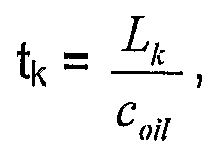
wherein C
oil is the velocity of sound in the pressure fluid used. When the pressure wave reaches
the energy charging space 4, the pressure of the feed channel 4a tends to drop, and
at the same time pressure fluid flows from the substantially constant pressure energy
charging space to the feed channel 4a. This, in turn, results in a positive pressure
wave, which now propagates via the feed channel 4a towards the working chamber 8.
If the connection from the feed channel 4a through the opening of the control element
7a of the control valve to the working chamber is still open, the positive pressure
wave discharges into the working chamber. Again, if the pressure in the working chamber
8 is still lower than the pressure in the energy charging space 4, a new negative
pressure wave is generated which again propagates towards the energy charging space
4 and which again is reflected back as a positive pressure wave. This phenomenon is
repeated until the pressure between the working chamber 8 and the energy charging
space 4 has evened out, or the control valve 7 closes the connections therebetween.
When the length L
k of the feed channel is selected such that the pressure wave has enough time to travel
the distance L
k back and forth at least once when the connection between the feed channel 4a and
the working chamber 8 is open, this results in a progressive pressure increase in
the working chamber 8. This, again, results in the shape of the stress pulse caused
in the tool 3 also being progressive in shape.
[0016] Figure 3 schematically shows a second embodiment of the impact device according to
the invention. It shows an embodiment wherein pressure fluid is fed from the energy
charging space 4 to the working chamber 8 via two separate feed channels 4a1 and 4a2.
For the sake of simplicity, the energy charging spaces are shown as two separate units.
[0017] In this embodiment, a feed channel 4a1 whose length is L
k1 and whose cross-sectional area is A
k1 leads from the energy charging space to the control valve 7. The dimensions of the
aforementioned length and cross-sectional area are larger than those of length L
k2 and cross-sectional area A
k2 of a second feed channel 4a2. In this embodiment, the stress pulse is generated mainly
in the same manner as described in connection with Figure 2. In this case, however,
the travel times of the pressure waves in the feed channels 4a1 and 4a2 are different
since the channels have different dimensions. Correspondingly, the influences of the
pressure waves travelling in the feed channels 4a1 and 4a2 on the increase in the
pressure of the working chamber 8 are different since the cross-sectional areas of
the feed channels 4a1 and 4a2 also differ in size. Consequently, the discharge of
the pressure wave travelling in the smaller feed channel 4a2 into the working chamber
8 increases the pressure less since the change in volume relating to the pressure
wave is also smaller. By selecting the lengths and cross-sectional areas of the feed
channels 4ai (i = 1 - n) appropriately, the increase in the pressure of the working
chamber 8 can be adjusted more effectively than would be possible by using one feed
channel only. The number of feed channels may be one, two or more, as necessary, although
as few as three feed channels of appropriate length suffice to enable the shape and
strength of a stress pulse to be quite effectively adjusted in a desired manner.
[0018] Figures 4a and 4b schematically show the shape and strength of stress pulses generated
by means of the embodiments shown in Figures 2 and 3, respectively. Figure 4a shows
a stress pulse according to the solution shown in Figure 2, showing how opening the
control valve first causes a stress increase from zero to approximately 40 Mpa and,
subsequently, the reflection of stress pulses results in a second increase, the resulting
peak value of stress then being approximately 90 Mpa. The solution of Figure 4b employs
three feed channels that have different dimensions. Figure 4b, in turn, shows stress
pulses generated by means of the embodiment according to Figure 3. First, a stress
increase occurs therein which subsequently, due to the influence of the pressure pulses
of both feed channels 4a1 and 4a2, increases as a whole to approximately 120 MPa.
Thus, the same pressure in the energy charging space enables a stress pulse of a more
desired shape to be generated while at the same time the maximum value of the stress
pulse increases approximately 30% as compared with the solution shown in Figure 2.
Similarly, this applies to a plurality of cases. The use of a plurality of different
feed channels also improves the efficiency of the impact device. Since the valve to
some extent always operates as a choke, energy will always be lost, which can be calculated
from the formula
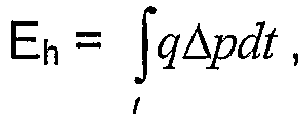
wherein q is the flow over the choke, and Δp is the pressure difference over the
choke. By using appropriately long pressure fluid feed channels, the pressure difference
over the control valve evens out very quickly without the pressures in the energy
charging space 4 and in the working chamber 8 having to be the same. As a result,
the energy loss caused by the control valve is smaller.
[0019] Figures 5a and 5b show pulse energies produced from the respective embodiments in
Figures 4a and 4b as well as energy losses in the choke over the control valve. As
can be seen in the figures, in the embodiment equipped with one feed channel, the
pulse energy is approximately 35 J at its maximum while the energy loss is approximately
10 J. In the solution implemented using three feed channels, the pulse energy is approximately
55 J while the energy loss is approximately 13 J, in which case the net benefit in
the case according to Figure 5a is approximately 25 J, and in the case according to
Figure 5b approximately 42 J.
[0020] Figures 6a and 6b show a way to implement length adjustment of feed channels when
the shape and properties of a stress pulse are to be adjusted. This embodiment employs
a solution wherein the connection length L
ki of a feed channel 4a is adjustable by using an adjustment sleeve 4b residing inside
the energy charging space 4. By moving the position of the adjustment sleeve 4b, the
connection of the feed channel 4a to the working chamber 8 can be moved closer to
or farther away from the energy charging space 4 so that the flow of pressure fluid
and the influence thereof on the stress pulse changes correspondingly. Figure 6b shows
the solution according to Figure 6a cut along line A - A.
[0021] Figure 7 schematically shows another embodiment for adjusting the length of feed
channels of the impact device according to the invention. This embodiment employs
adjustment sleeves 4b1 and 4b2 residing in one or more feed channels, in the case
shown in Figure 7 in two feed channels 4a1 and 4a2, that can be moved in the longitudinal
direction of the corresponding feed channel towards the working chamber 8 and, similarly,
away from it. This, again, enables the length of the feed channels leading from the
energy charging space 4 to the working chamber 8, and thus the shape and other properties
of the stress pulse, to be adjusted.
[0022] In the above description and drawings, the invention has been disclosed by way of
example only, and it is by no means restricted thereto. The disclosed embodiments
only show the invention schematically; similarly, the valves and couplings relating
to pressure fluid feed have only been set forth schematically. The invention may be
implemented using any suitable valve solutions. The point is that in order to generate
a stress pulse in a tool, and in order to provide a desired impacting frequency, a
pressure fluid is used which, at desired intervals, is conveyed as pressure pulses
to influence the pressure surface of a transmission piston such that a stress pulse
is generated in the tool, the stress pulse propagating through the tool to the material
to be processed. The transmission piston may be a unit separate from the tool, but
in some cases it may also be an integral part of the tool.
1. A pressure fluid operated impact device comprising a frame (2) whereto a tool (3)
is mountable movably in its longitudinal direction, control means (7) for controlling
pressure fluid feed of the impact device (1), and means for generating a stress pulse
in the tool by means of the pressure of a pressure fluid, wherein
the impact device (1) comprises a working chamber (8) entirely filled with pressure
fluid and, in the working chamber (8), a transmission piston (9) movably mounted in
the longitudinal direction of the tool (3) with respect to the frame (2), an end of
the transmission piston facing the tool (3) firmly pressed against the tool (3) either
directly or indirectly during the generation of the stress pulse, the transmission
piston, in its axial direction with respect to the tool (3) on the opposite side thereof,
being provided with a pressure surface (9a) located towards the working chamber (8),
the impact device (1) comprises energy charging means for charging energy of the pressure
fluid to be fed to the working chamber (8) of the impact device and necessary for
generating the stress pulse, and
the control means are coupled to allow periodically alternately a pressure fluid having
a pressure higher than the pressure of the pressure fluid present in the working chamber
(8) to flow to the working chamber (8), thus causing a sudden increase in the pressure
in the working chamber (8) generating a pressure pulse acting in the working chamber
(8) and, as a result, a force pushing the transmission piston (9) in the direction
of the tool (3), compressing the tool (3) in the longitudinal direction and thus generating
a stress pulse in the tool (3), the generation of the stress pulse ending substantially
at the same time as the influence of the force on the tool (3) ends, and, correspondingly,
to discharge pressure fluid from the working chamber (8) after the stress pulse has
been generated in order to enable the transmission piston (9) to return to its substantially
original position, characterized in that in order to stop the influence of the force, the control means are coupled to prevent
pressure fluid from entering the working chamber (8).
2. An impact device as claimed in claim 1, characterized in that it comprises stop elements for stopping the movement of the transmission piston (9)
in the direction of the tool (3) such that the influence of the force on the tool
ends.
3. An impact device as claimed in any one of the preceding claims, characterized in that the impact device (1), as an energy charging means, comprises an energy charging
space (4) which is entirely filled with pressurized pressure fluid and whose volume
is substantially large as compared with the volume of a pressure fluid amount to be
fed to the working chamber (8) during the generation of one stress pulse.
4. An impact device as claimed in claim 3, characterized in that when the impact device is in operation, pressure fluid is fed to the energy charging
space (4) such that a predetermined pressure level is maintained in the energy charging
space (4), and that the control means are coupled to allow periodically alternately
pressure fluid to flow from the energy charging space (4) to the working chamber (8)
and, consequently, to close the connection between the energy charging space (4) and
the working chamber (8).
5. An impact device as claimed in claim 1, characterized in that the control means comprise a rotating control valve (7) comprising a plurality of
successive openings in the direction of rotation thereof in order to feed pressure
fluid from the energy charging space (4) via a plurality of feed channels (4a) to
the working chamber (8) simultaneously.
6. An impact device as claimed in claim 5, characterized in that the length and cross-section of each feed channel (4a) are mutually the same.
7. An impact device as claimed in any one of claims 1 to 5, characterized in that it comprises at least two feed channels (4a1, 4a2) which differ in length and/or
cross-sectional area and which lead from the energy charging space to the working
chamber (8).
8. An impact device as claimed in claim 7, characterized in that it comprises at least one valve to activate and deactivate the feed channels (4a1,
4a2) differing in length and/or cross-sectional area.
9. An impact device as claimed in any one of the preceding claims, characterized in that the length of at least one feed channel (4a; 4a1, 4a2) from the energy charging space
(4) to the working chamber (8) is adjustable.
10. An impact device as claimed in any one of claims 3 to 9, characterized in that the energy charging space (4) is a tank whose walls, due to the influence of pressure,
yield such that the volume of the energy charging space increases as pressure increases.
11. An impact device as claimed in any one of claims 3 to 10, characterized in that the energy charging space (4) is a tank separate from the frame (2).
12. An impact device as claimed in any one of claims 3 to 11, characterized in that at least one energy charging space (4) is a hydraulic accumulator.
13. An impact device as claimed in any one of the preceding claims, characterized in that the transmission piston (9) is a membrane type piston.
14. An impact device as claimed in any one of the preceding claims, characterized in that it comprises means for returning the transmission piston (9) after an impact to its
pre-impact position with respect to the impact device by bringing a separate force
acting between the impact device (1) and the transmission piston (9) to influence
the transmission piston (9), the force pushing the transmission piston (9) towards
the working chamber (8).
15. An impact device as claimed in any one of the preceding claims, characterized in that the length of movement of the transmission piston (9) in the working chamber (8)
is some millimetres.
16. A method of generating a stress pulse in a pressure fluid operated impact device as
claimed in claim 1, in which method a pressure fluid having a pressure higher than
the pressure of the pressure fluid present in the working chamber (8) is fed to a
working chamber of the impact device (1), the working chamber being entirely filled
with pressure fluid, which, as a result of a sudden increase in the pressure in the
working chamber (8) generates a pressure pulse acting in the working chamber (8) and
produces a force pushing the transmission piston (9) in the direction of the tool
(3), compressing the tool (3) in the longitudinal direction and thus generating a
stress pulse in the tool (3), the generation of the stress pulse ending substantially
at the same time as the influence of the force on the tool (3) ends, and, correspondingly,
to discharge pressure fluid from the working chamber (8) after the stress pulse has
been generated in order to enable the transmission piston (9) to return to its substantially
original position, characterized in that in order to stop the influence of the force, the pressure fluid is prevented from
entering the working chamber (8)
17. A method as claimed in claim 16, characterized in that as an energy charging means, an energy charging space (4) which is entirely filled
with pressurized pressure fluid and whose volume is substantially large as compared
with the volume of a pressure fluid amount to be fed to the working chamber (8) during
the generation of one stress pulse.
18. A method as claimed in claim 17, characterized in that when the impact device (1) is in operation, pressure fluid is fed to the energy charging
space (4) such that a predetermined pressure level is maintained in the energy charging
space (4), and that the control means are coupled to allow periodically alternately
pressure fluid to flow from the energy charging space (4) to the working chamber (8)
and, consequently, to close the connection between the energy charging space (4) and
the working chamber (8).
19. A method as claimed in any one of claims 16 to 18, characterized in that a rotating control valve (7) is used as a control means, comprising a plurality of
successive openings in the direction of rotation thereof in order to feed pressure
fluid from the energy charging space (4) via a plurality of feed channels (4a) to
the working chamber (8) simultaneously.
20. A method as claimed in any one of claims 16 to 19, characterized in that pressure fluid is fed from the energy charging space (4) to the working chamber (8)
via at least two feed channels (4a) which are mutually the same in length and/or cross-sectional
area.
21. A method as claimed in any one of claims 16 to 20, characterized in that pressure fluid is fed from the energy charging space (4) to the working chamber (8)
via at least two feed channels (4a) which differ in length and/or cross-sectional
area.
22. A method as claimed in claim 21, characterized in that for adjustment of properties of a stress signal, feed channels (4a1, 4a2) which differ
in length and/or cross-sectional area are activated and deactivated.
23. A method as claimed in any one of claims 16 to 22, characterized in that the length of at least one feed channel (4a; 4a1, 4a2) from the energy charging space
(4) to the working chamber (8) is adjustable.
24. A method as claimed in any one of claims 16 to 23, characterized in that as the energy charging space (4), a tank is used whose walls, due to the influence
of pressure, yield such that the volume of the energy charging space increases as
pressure increases.
25. A method as claimed in any one of claims 16 to 24, characterized in that as the energy charging space (4), a tank separate from the frame (2) is used.
26. A method as claimed in any one of claims 16 to 25, characterized in that as at least one energy charging space (4), a hydraulic accumulator is used.
27. A method as claimed in any one of claims 16 to 26, characterized in that as the transmission piston (9), a membrane type piston is used.
28. A method as claimed in any one of claims 16 to 27, characterized in that for returning the transmission piston (9) after an impact to its pre-impact position
with respect to the impact device, a separate force acting between the impact device
(1) and the transmission piston (9) is arranged to influence the transmission piston
(9), the force pushing the transmission piston (9) towards the working chamber (8).
29. A method as claimed in any one of claims 16 to 28, characterized in that when generating a stress pulse, the transmission piston (9) is moved for some millimetres
in the working chamber (8).
1. Eine druckfluidbetriebene Schlagvorrichtung, aufweisend einen Rahmen (2) an dem ein
Werkzeug (3) in seiner Längsrichtung beweglich montierbar ist, Steuermittel (7) zum
Steuern einer Druckfluidzufuhr der Schlagvorrichtung (1), und Mittel zum Erzeugen
eines Spannungsimpulses in dem Werkzeug durch den Druck eines Druckfluids, wobei
die Schlagvorrichtung (1) eine vollständig mit Druckfluid gefüllte Arbeitskammer (8)
aufweist und in der Arbeitskammer (8) ein Übertragungskolben (9) bezüglich des Rahmens
(2) beweglich in der Längsrichtung des Werkzeugs (3) angebracht ist, wobei ein dem
Werkzeug (3) zugewandtes Ende des Übertragungskolbens fest an das Werkzeug (3) entweder
direkt oder indirekt während der Erzeugung des Spannungsimpulses angepresst wird,
wobei der Übertragungskolben in seiner axialen Richtung bezüglich des Werkzeugs (3)
auf der gegenüberliegenden Seite davon mit einer Druckfläche (9a) versehen ist, die
der Arbeitskammer (8) zugewandt ist,
wobei die Schlagvorrichtung (1) Energieaufladungsmittel zum Laden von Energie des
Druckfluids aufweist, welches der Arbeitskammer (8) der Schlagvorrichtung zuzuführen
ist und zum Erzeugen des Spannungsimpulses notwendig ist,
wobei die Steuermittel gekoppelt sind, um zu ermöglichen, dass periodisch abwechselnd
ein Druckfluid mit einem Druck, welcher größer ist als der Druck des Druckfluids in
der Arbeitskammer (8), in die Arbeitskammer (8) fließt, so dass ein plötzlicher Anstieg
des Drucks in der Arbeitskammer (8) verursacht wird, der einen in der Arbeitskammer
(8) wirkenden Druckimpuls erzeugt, und damit eine Kraft, die den Übertragungskolben
(9) in Richtung des Werkzeugs (3) drückt, das Werkzeug (3) in der Längsrichtung zusammendrückt
und somit einen Spannungsimpuls in dem Werkzeug (3) erzeugt, wobei die Erzeugung des
Spannungsimpulses im Wesentlichen zur gleichen Zeit endet wie der Einfluss der Kraft
auf das Werkzeug (3) endet, und entsprechend Druckfluid aus der Arbeitskammer (8)
abzuführen, nachdem der Spannungsimpuls erzeugt wurde, um den Übertragungskolben (9)
im Wesentlichen in seine Ausgangslage zurück zu bringen, dadurch gekennzeichnet, dass die Steuermittel gekoppelt sind, so dass ein Eintreten von Druckfluid in die Arbeitskammer
(8) verhindert wird, um somit den Einfluss der Kraft zu stoppen.
2. Schlagvorrichtung nach Anspruch 1, dadurch gekennzeichnet, dass sie Stoppelemente zum Stoppen der Bewegung des Übertragungskolbens (9) in die Richtung
des Werkzeugs (3) aufweist, so dass der Einfluss der Kraft auf das Werkzeug endet.
3. Schlagvorrichtung nach einem der vorhergehenden Ansprüche, dadurch gekennzeichnet, dass die Schlagvorrichtung (1) als ein Energielademittel einen Energieladeraum (4) aufweist,
welcher vollständig mit unter Druck stehendem Fluid gefüllt ist und dessen Volumen
im Wesentlichen groß im Vergleich zu dem Volumen der Druckfluidmenge ist, die der
Arbeitskammer (8) während der Erzeugung eines Spannungsimpulses zuzuführen ist.
4. Schlagvorrichtung nach Anspruch 3, dadurch gekennzeichnet, dass Druckfluid dem Energieladeraum (4) zugeführt wird, wenn die Schlagvorrichtung in
Betrieb ist, so dass ein vorbestimmter Drucklevel im Energieladeraum (4) gehalten
wird, und dass die Steuermittel gekoppelt sind, um zu ermöglichen, dass periodisch
abwechselnd Druckfluid vom Energieladeraum (4) in die Arbeitskammer (8) fließt, und
folglich die Verbindung zwischen dem Energieladeraum (4) und der Arbeitskammer (8)
geschlossen wird.
5. Schlagvorrichtung nach Anspruch 1, dadurch gekennzeichnet, dass die Steuermittel ein rotierendes Steuerventil (7) aufweisen, welches eine Vielzahl
von aufeinanderfolgenden Öffnungen in dessen Rotationsrichtung aufweist, um Druckfluid
aus dem Energieladeraum (4) über eine Vielzahl von Zuführungskanälen (4a) der Arbeitskammer
(8) gleichzeitig zuzuführen.
6. Schlagvorrichtung nach Anspruch 5, dadurch gekennzeichnet, dass die Länge und der Querschnitt jedes Zuführungskanals (4a) einander gleich sind.
7. Schlagvorrichtung nach einem der Ansprüche 1 bis 5, dadurch gekennzeichnet, dass sie mindestens zwei Zuführungskanäle (4a1, 4a2) aufweist, welche sich in Länge und/oder
Querschnittsfläche unterscheiden und welche vom Energieladeraum zur Arbeitskammer
(8) führen.
8. Schlagvorrichtung nach Anspruch 7, dadurch gekennzeichnet, dass sie mindestens ein Ventil zum Aktivieren und Deaktivieren der Zuführungskanäle (4a1,
4a2) aufweist, die sich in Länge und/oder Querschnittsfläche unterscheiden.
9. Schlagvorrichtung nach einem der vorhergehenden Ansprüche, dadurch gekennzeichnet, dass die Länge mindestens eines Zuführungskanals (4a, 4a1, 4a2) vom Energieladeraum (4)
zur Arbeitskammer (8) einstellbar ist.
10. Schlagvorrichtung nach einem der Ansprüche 3 bis 9, dadurch gekennzeichnet, dass der Energieladeraum (4) ein Behälter ist, dessen Wände aufgrund des Einflusses von
Druck nachgeben, so dass das Volumen des Energieladeraums größer wird, wenn der Druck
steigt.
11. Schlagvorrichtung nach einem der Ansprüche 3 bis 10, dadurch gekennzeichnet, dass der Energieladeraum (4) ein vom Rahmen (2) getrennter Behälter ist.
12. Schlagvorrichtung nach einem der Ansprüche 3 bis 11, dadurch gekennzeichnet, dass mindestens ein Energieladeraum (4) ein Hydraulikspeicher ist.
13. Schlagvorrichtung nach einem der vorhergehenden Ansprüche, dadurch gekennzeichnet, dass der Übertragungskolben (9) ein Membrankolben ist.
14. Schlagvorrichtung nach einem der vorhergehenden Ansprüche, dadurch gekennzeichnet, dass sie Mittel aufweist zum Umkehren des Übertragungskolbens (9) nach einem Aufprall
in seine Voraufprall-Position bezüglich der Schlagvorrichtung, indem eine zwischen
der Schlagvorrichtung (1) und dem Übertragungskolben (9) wirkende, separate Kraft
aufgebracht wird, um den Übertragungskolben zu beeinflussen (9), so dass die Kraft
den Übertragungskolben (9) in Richtung der Arbeitskammer (8) drückt.
15. Schlagvorrichtung nach einem der vorhergehenden Ansprüche, dadurch gekennzeichnet, dass die Länge der Bewegung des Übertragungskolbens (9) in der Arbeitskammer (8) einige
Millimeter beträgt.
16. Verfahren zum Erzeugen eines Spannungsimpulses in einer druckfluidbetriebenen Schlagvorrichtung
nach Anspruch 1, in welchem ein Druckfluid mit einem Druck, der größer ist als der
Druck des Druckfluids in der Arbeitskammer (8), in eine Arbeitskammer der Schlagvorrichtung
(1) geführt wird, wobei die Arbeitskammer vollständig mit Druckfluid gefüllt ist,
welches infolge eines plötzlichen Anstiegs des Drucks in der Arbeitskammer (8) einen
Druckimpuls erzeugt, der in der Arbeitskammer (8) wirkt und eine Kraft erzeugt, die
den Übertragungskolben (9) in Richtung des Werkzeuges (3) drückt, das Werkzeug (3)
in der Längsrichtung zusammendrückt und somit einen Spannungsimpuls in dem Werkzeug
(3) erzeugt, wobei die Erzeugung des Spannungsimpulses im Wesentlichen zur gleichen
Zeit endet wie der Einfluss der Kraft auf das Werkzeug (3) endet, und entsprechend
Druckfluid aus der Arbeitskammer (8) abgeführt wird, nachdem der Spannungsimpuls erzeugt
wurde, um den Übertragungskolben (9) im Wesentlichen in seine Ausgangslage zurück
zu bringen, dadurch gekennzeichnet, dass ein Eintreten von Druckfluid in die Arbeitskammer (8) verhindert wird, um somit den
Einfluss der Kraft zu stoppen.
17. Verfahren nach Anspruch 16, dadurch gekennzeichnet, dass als Energieaufladungsmittel ein Energieladeraum (4) vorgesehen ist, welcher vollständig
mit unter Druck stehendem Fluid gefüllt ist und dessen Volumen im Wesentlichen groß
im Vergleich zu dem Volumen der Druckfluidmenge ist, die der Arbeitskammer (8) während
der Erzeugung eines Spannungsimpulses zuzuführen ist.
18. Verfahren nach Anspruch 17, dadurch gekennzeichnet, dass Druckfluid dem Energieladeraum (4) zugeführt wird, wenn die Schlagvorrichtung (1)
in Betrieb ist, so dass ein vorbestimmter Drucklevel im Energieladeraum (4) gehalten
wird, und dass die Steuermittel gekoppelt sind, um zu ermöglichen, dass periodisch
abwechselnd Druckfluid vom Energieladeraum (4) in die Arbeitskammer (8) fließt, und
folglich die Verbindung zwischen dem Energieladeraum (4) und der Arbeitskammer (8)
geschlossen wird.
19. Verfahren nach einem der Ansprüche 16 bis 18, dadurch gekennzeichnet, dass als Steuermittel ein rotierendes Steuerventil (7) verwendet wird, welches eine Vielzahl
von aufeinanderfolgenden Öffnungen in dessen Rotationsrichtung aufweist, um Druckfluid
aus dem Energieladeraum (4) über eine Vielzahl von Zuführungskanälen (4a) der Arbeitskammer
(8) gleichzeitig zuzuführen.
20. Verfahren nach einem der Ansprüche 16 bis 19, dadurch gekennzeichnet, dass Druckfluid vom Energieladeraum (4) zur Arbeitskammer (8) über mindestens zwei Zuführungskanäle
(4a) zugeführt wird, welche in Länge und/oder Querschnittfläche einander gleich sind.
21. Verfahren nach einem der Ansprüche 16 bis 20, dadurch gekennzeichnet, dass Druckfluid vom Energieladeraum (4) zur Arbeitskammer (8) über mindestens zwei Zuführungskanäle
(4a) zugeführt wird, welche sich in Länge und/oder Querschnittsfläche unterscheiden.
22. Verfahren nach Anspruch 21, dadurch gekennzeichnet, dass zum Einstellen von Eigenschaften eines Spannungssignals Zuführungskanäle (4a, 4a1,
4a2), welche sich in Länge und/oder Querschnittsfläche unterscheiden, aktiviert und
deaktiviert werden.
23. Verfahren nach einem der Ansprüche 16 bis 22, dadurch gekennzeichnet, dass die Länge mindestens eines Zuführungskanals (4a, 4a1, 4a2) vom Energieladeraum (4)
zur Arbeitskammer (8) einstellbar ist.
24. Verfahren nach einem der Ansprüche 16 bis 23, dadurch gekennzeichnet, dass als Energieladeraum (4) ein Behälter verwendet wird, dessen Wände aufgrund des Einflusses
von Druck nachgeben, so dass das Volumen des Energieladeraums größer wird, wenn der
Druck steigt.
25. Verfahren nach einem der Ansprüche 16 bis 24, dadurch gekennzeichnet, dass als Energieladeraum (4) ein vom Rahmen (2) getrennter Behälter verwendet wird.
26. Verfahren nach einem der Ansprüche 16 bis 25, dadurch gekennzeichnet, dass als mindestens ein Energieladeraum (4) ein hydraulischer Akkumulator verwendet wird.
27. Verfahren nach einem der Ansprüche 16 bis 26, dadurch gekennzeichnet, dass als Übertragungskolben (9) ein Membrankolben verwendet wird.
28. Verfahren nach einem der Ansprüche 16 bis 27, dadurch gekennzeichnet, dass zum Umkehren des Übertragungskolbens (9) nach einem Aufprall in seine Voraufprall-Position
bezüglich der Schlagvorrichtung eine zwischen der Schlagvorrichtung (1) und dem Übertragungskolben
(9) wirkende, separate Kraft aufgebracht wird, um den Übertragungskolben zu beeinflussen
(9), so dass die Kraft den Übertragungskolben (9) in Richtung der Arbeitskammer (8)
drückt.
29. Verfahren nach einem der Ansprüche 16 bis 28, dadurch gekennzeichnet, dass der Übertragungskolben (9) einige Millimeter in der Arbeitskammer (8) bewegt wird,
wenn ein Spannungsimpuls erzeugt wird.
1. Un dispositif de percussion à commande par du fluide sous pression, comprenant un
châssis (2) sur lequel un outil (3) est apte à être monté de façon mobile selon sa
direction longitudinale, des moyens de commande (7) pour commander l'alimentation
en fluide sous pression du dispositif de percussion (1), et des moyens pour générer
une impulsion de pression dans l'outil au moyen de la pression d'un fluide sous pression,
dans lequel
le dispositif de percussion (1) comprend une chambre de travail (8) entièrement remplie
de fluide sous pression et, dans la chambre de travail (8), un piston de transmission
(9) monté de façon mobile dans la direction longitudinale de l'outil (3) par rapport
au châssis (2), une extrémité du piston de transmission tournée vers l'outil (3) étant
fermement pressée contre l'outil (3), soit directement, soit indirectement, lors de
la génération de l'impulsion de pression, le piston de transmission, dans sa direction
axiale par rapport à l'outil (3) sur le côté opposé de celui-ci, étant pourvu d'une
surface de pression (9a) située du côté de la chambre de travail (8),
le dispositif de percussion (1) comprend des moyens de chargement d'énergie pour charger
l'énergie du fluide sous pression devant être alimenté à la chambre de travail (8)
du dispositif de percussion et nécessaire pour générer l'impulsion de pression, et
les moyens de commande sont couplés pour permettre périodiquement, de façon alternative,
à du fluide sous pression ayant une pression supérieure à la pression du fluide sous
pression présent dans la chambre de travail (8) de s'écouler vers la chambre de travail
(8), provoquant ainsi une augmentation soudaine de la pression dans la chambre de
travail (8), générant une impulsion de pression agissant dans la chambre de travail
(8) et, en conséquence, une force de poussée du piston de transmission (9) dans la
direction de l'outil (3), compressant l'outil (3) dans la direction longitudinale,
et générant ainsi une impulsion de pression dans l'outil (3), la génération de l'impulsion
de pression se terminant sensiblement en même temps que se termine l'influence de
la force exercée sur l'outil (3), et, de façon correspondante, pour décharger le fluide
sous pression depuis la chambre de travail (8) après que l'impulsion de pression ait
été générée afin de permettre au piston de transmission (9) de revenir sensiblement
à sa position d'origine, caractérisé en ce qu'afin d'arrêter l'influence de la force, les moyens de commande sont couplés pour empêcher
le fluide sous pression de pénétrer dans la chambre de travail (8).
2. Un dispositif de percussion selon la revendication 1, caractérisé en ce qu'il comprend des éléments de butée pour arrêter le mouvement du piston de transmission
(9) dans la direction de l'outil (3) de telle sorte que l'influence de la force exercée
sur l'outil se termine.
3. Un dispositif de percussion selon l'une quelconque des revendications précédentes,
caractérisé en ce que le dispositif de percussion (1), en tant que moyen de chargement d'énergie, comprend
un espace (4) de chargement d'énergie qui est entièrement rempli de fluide sous pression
mis sous pression et dont le volume est sensiblement grand par rapport au volume d'une
quantité de fluide sous pression devant être introduite dans la chambre de travail
(8) pendant la génération d'une impulsion de pression.
4. Un dispositif de percussion selon la revendication 3, caractérisé en ce que, lorsque le dispositif de percussion est en fonctionnement, du fluide sous pression
est alimenté à l'espace (4) de chargement d'énergie de telle sorte qu'un niveau de
pression prédéterminé est maintenu dans l'espace (4) de chargement d'énergie et que
les moyens de commande sont couplés pour permettre périodiquement, de façon alternative,
à un fluide sous pression de s'écouler depuis l'espace (4) de chargement d'énergie
jusqu'à la chambre de travail (8) et, par conséquent, de fermer la connexion entre
l'espace (4) de chargement d'énergie et la chambre de travail (8).
5. Un dispositif de percussion selon la revendication 1, caractérisé en ce que les moyens de commande comprennent une vanne de commande rotative (7) comportant
une pluralité d'ouvertures successives dans le sens de rotation de celle-ci afin d'alimenter
du fluide sous pression depuis l'espace de chargement d'énergie (4), en passant par
une pluralité de conduits d'alimentation (4a), jusqu'à la chambre de travail (8) simultanément.
6. Un dispositif de percussion selon la revendication 5, caractérisé en ce que la longueur et la section transversale de chaque conduit d'alimentation (4a) sont
mutuellement les mêmes.
7. Un dispositif de percussion selon l'une quelconque des revendications 1 à 5, caractérisé en ce qu'il comprend au moins deux conduits d'alimentation (4a1, 4a2) qui diffèrent en longueur
et / ou en section transversale et qui mènent de l'espace de chargement d'énergie
à la chambre de travail (8).
8. Un dispositif de percussion selon la revendication 7, caractérisé en ce qu'il comprend au moins une vanne pour activer et désactiver les conduits d'alimentation
(4a1, 4a2) qui diffèrent en longueur et / ou en section transversale.
9. Un dispositif de percussion selon l'une quelconque des revendications précédentes,
caractérisé en ce que la longueur d'au moins un conduit d'alimentation (4a, 4a1, 4a2), depuis l'espace
(4) de chargement d'énergie jusqu'à la chambre de travail (8), est réglable.
10. Un dispositif de percussion selon l'une quelconque des revendications 3 à 9, caractérisé en ce que l'espace (4) de chargement d'énergie est une cuve dont les parois, en raison de l'influence
de la pression, se déplacent de telle sorte que le volume de l'espace de chargement
d'énergie augmente lorsque la pression augmente.
11. Un dispositif de percussion selon l'une quelconque des revendications 3 à 10, caractérisé en ce que l'espace (4) de chargement d'énergie est un réservoir séparé du châssis (2).
12. Un dispositif de percussion selon l'une quelconque des revendications 3 à 11, caractérisé en ce qu'au moins un espace de chargement d'énergie (4) est un accumulateur hydraulique.
13. Un dispositif de percussion selon l'une quelconque des revendications précédentes,
caractérisé en ce que le piston de transmission (9) est un piston du type à membrane.
14. Un dispositif de percussion selon l'une quelconque des revendications précédentes,
caractérisé en ce qu'il comporte des moyens de rappel du piston de transmission (9), après une percussion,
à sa position de pré-impact par rapport au dispositif de percussion en amenant une
force séparée agissant entre le dispositif de percussion (1) et le piston de transmission
(9) à influer sur le piston de transmission (9), ladite force poussant le piston de
transmission (9) vers la chambre de travail (8).
15. Un dispositif de percussion selon l'une quelconque des revendications précédentes,
caractérisé en ce que la longueur de déplacement du piston de transmission (9) dans la chambre de travail
(8) est de quelques millimètres.
16. Un procédé de génération d'une impulsion de pression dans un dispositif de percussion
fonctionnant au moyen de fluide sous pression, selon la revendication 1, dans lequel
procédé un fluide sous pression ayant une pression supérieure à la pression du fluide
sous pression présent dans la chambre de travail (8) est alimenté dans une chambre
de travail du dispositif de percussion (1), la chambre de travail étant entièrement
remplie d'un fluide sous pression, qui, à la suite d'une augmentation soudaine de
la pression dans la chambre de travail (8), génère une impulsion de pression agissant
dans la chambre de travail (8) et produit une force poussant le piston de transmission
(9) dans la direction de l'outil (3), en compressant l'outil (3) dans la direction
longitudinale, et générant ainsi une impulsion de pression dans l'outil (3), la génération
de l'impulsion de pression se terminant sensiblement en même temps que se termine
l'influence de la force sur l'outil (3), et, de façon correspondante, pour évacuer
le fluide sous pression de la chambre de travail (8) après que l'impulsion de pression
ait été générée afin de permettre au piston de transmission (9) de revenir sensiblement
à sa position initiale, caractérisé en ce qu'afin d'arrêter l'influence de la force, le fluide sous pression est empêché de pénétrer
dans la chambre de travail (8).
17. Un procédé selon la revendication 16, caractérisé en ce qu'en tant que moyen de chargement d'énergie, un espace (4) de chargement d'énergie qui
est entièrement rempli d'un fluide sous pression mis sous pression et dont le volume
est sensiblement grand par rapport au volume d'une quantité de fluide sous pression
destinée à être alimentée à la chambre de travail (8) pendant la génération d'une
impulsion de pression.
18. Un procédé selon la revendication 17, caractérisé en ce que, lorsque le dispositif de percussion (1) est en fonctionnement, du fluide sous pression
est alimenté à l'espace (4) de chargement d'énergie de telle sorte qu'un niveau de
pression prédéterminé est maintenu dans l'espace (4) de chargement d'énergie, et en ce que les moyens de commande sont couplés pour permettre périodiquement, de façon alternative,
à du fluide sous pression de s'écouler depuis l'espace (4) de chargement d'énergie
jusqu'à la chambre de travail (8) et, par conséquent, de fermer la connexion entre
l'espace (4) de chargement d'énergie et la chambre de travail (8).
19. Un procédé selon l'une quelconque des revendications 16 à 18, caractérisé en ce qu'une soupape de commande rotative (7) est utilisée en tant qu'un moyen de commande,
comprenant une pluralité d'ouvertures successives dans le sens de rotation de celle-ci
afin d'alimenter un fluide sous pression depuis l'espace (4) de chargement d'énergie,
via une pluralité de conduits d'alimentation (4a), jusqu'à la chambre de travail (8)
simultanément.
20. Un procédé selon l'une quelconque des revendications 16 à 19, caractérisé en ce que du fluide sous pression est alimenté depuis l'espace (4) de chargement d'énergie
jusqu'à la chambre de travail (8) via au moins deux conduits d'alimentation (4a) qui
ont mutuellement les mêmes en longueur et / ou en section transversale.
21. Un procédé selon l'une quelconque des revendications 16 à 20, caractérisé en ce que du fluide sous pression est alimenté depuis l'espace (4) de chargement d'énergie
jusqu'à la chambre de travail (8) via au moins deux conduits d'alimentation (4a) qui
diffèrent en longueur et / ou en surface de section transversale.
22. Un procédé selon la revendication 21, caractérisé en ce que, pour le réglage des propriétés d'un signal de pression, des conduits d'alimentation
(4a1, 4a2) qui diffèrent en longueur et / ou en surface de section transversale sont
activés et désactivés.
23. Un procédé selon l'une quelconque des revendications 16 à 22, caractérisé en ce que la longueur d'au moins un conduit d'alimentation (4a, 4a1, 4a2), depuis l'espace
(4) de chargement d'énergie jusqu'à la chambre de travail (8), est réglable.
24. Un procédé selon l'une quelconque des revendications 16 à 23, caractérisé en ce qu'un réservoir est utilisé en tant qu'espace (4) de chargement d'énergie, dont les parois
se déplacent selon l'influence de la pression, de telle sorte que le volume de l'espace
de chargement d'énergie augmente à mesure que la pression augmente.
25. Un procédé selon l'une quelconque des revendications 16 à 24, caractérisé en ce qu'un réservoir séparé du châssis (2) est utilisé en tant qu'espace (4) de chargement
d'énergie.
26. Un procédé selon l'une quelconque des revendications 16 à 25, caractérisé en ce qu'un accumulateur hydraulique est utilisé en tant qu'au moins un espace (4) de chargement
d'énergie.
27. Un procédé selon l'une quelconque des revendications 16 à 26, caractérisé en ce qu'un piston du type à membrane est utilisé en tant que piston de transmission (9).
28. Un procédé selon l'une quelconque des revendications 16 à 27, caractérisé en ce qu'après une percussion, pour le retour du piston de transmission (9) à sa position de
pré-percussion par rapport au dispositif de percussion, une force séparée agissant
entre le dispositif de percussion (1) et le piston de transmission (9) est mise en
oeuvre pour agir sur le piston de transmission (9), la force poussant le piston de
transmission (9) vers la chambre de travail (8).
29. Un procédé selon l'une quelconque des revendications 16 à 28, caractérisé en ce que lors de la génération d'une impulsion de pression, le piston de transmission (9)
est déplacé de quelques millimètres dans la chambre de travail (8).
REFERENCES CITED IN THE DESCRIPTION
This list of references cited by the applicant is for the reader's convenience only.
It does not form part of the European patent document. Even though great care has
been taken in compiling the references, errors or omissions cannot be excluded and
the EPO disclaims all liability in this regard.
Patent documents cited in the description