|
(11) | EP 1 655 854 A1 |

| (12) | EUROPEAN PATENT APPLICATION |
|
|
|
|
||||||||||||||||||||
|
|||||||||||||||||||||
| (54) | Method for calculating a path profile in a cellular communication system |
| (57) The invention relates to a method for calculating a path profile in a cellular communication
system, whereby the method can be used by a spread spectrum receiver such as a CDMA
receiver. Furthermore, the method can be used by the logic of a base station and/or
a subscriber station comprising such a spread spectrum receiver. In CDMA reception the delay of each incoming path must be calculated. Incoming paths can however only be detected if the signal-to-noise-ratio is sufficient. It is an object of the invention to provide a possibility for calculating a path profile with an improved detection of weak signals having a poor SNR. The object is achieved by applying three methods. One method applies the concept of energetic combining and adds the square of the absolute values of all time slots. Two methods apply the concept of coherent profiling and add the complex amplitudes of two consecutive time slots, whereby one solution applies this concept to at least two neighboured time slots, and the other solution to at least two neighboured slots with an overlap. |
Field of the invention
[0001] The invention relates to the field of wireless digital communication according to the preambles of the independent claims. In particular it relates to the field of wireless transmission and reception of digital information by a UMTS (Universal Mobile Communication System) system. More specifically, the invention relates to a CDMA receiver for a cellular communication system and a base station or a subscriber station (mobile station) comprising said CDMA receiver. The CDMA receiver applies a method for calculating a path profile which may be implemented as a computer software.
[0002] Cellular communication systems are well known. Such cellular communication systems comprise cells or radio zones, together covering a given geographical area. The cells include base stations that, through control and communication channels, establish and maintain communication links with mobile communication devices that are comprised in the system, and communicate with the mobile communication devices through established communication links.
[0003] One type of a cellular communication system is a so-called Direct Sequence CDMA (Code Division Multiple Access) spread spectrum system. In such a CDMA spread spectrum system, in addition to a transmitter, the mobile communication device has a CDMA receiver, typically a so-called RAKE receiver, with a number of RAKE fingers to resolve components of a multi-path received spread spectrum signal and to diversity combine resolved components so as to improve the signal-to-noise ratio of the received signal. The spread spectrum signals are received from transmitters that spread data signals over a frequency band by using spreading sequences. Elements in such a sequence are so-called chips.
[0004] In CDMA and WCDMA (Wideband Code Division Multiple Access) reception it is necessary to estimate the delay of each incoming path with respect to a certain reference point, for example with respect to the start of the observation window which has been chosen. To do this a path profile is calculated. Such a path profile is shown in Fig. 1. The receiver detects a signal having an amplitude which is plotted in arbitrary units versus the delay in an oversampled chip grid. In Fig. 1 the chip grid is four times oversampled with respect to the chosen reference point. The horizontal line represents the noise floor. A signal having a delay is detected if the signal-to-noise-ratio (SNR) is sufficient. In this case its corresponding peak in the path profile is pronounced enough as in the case of Fig. 1 The radio channel of this example contains several time resolvable delays due to multipath[R1] propagation.
[0005] It is an object of the invention to provide a method for calculating a path profile with an improved detection of weak signals having a poor SNR.
[0006] Another object is to provide a CDMA receiver and a base station enabling the detection of weak signals having a poor SNR. Still another object is the provision of a computer program product as an implementation of the above method.
[0007] According to the present invention the above mentioned object is achieved by the features of the independent claims. Further embodiments are described by the features of the sub claims.
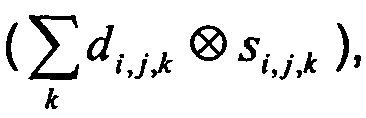
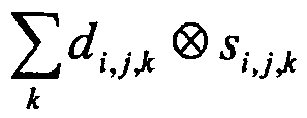
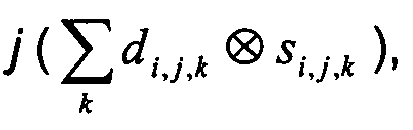
[0008] As far as the method is concerned a first solution to achieve the above mentioned object will be called energetic combining for the purposes of this disclosure. In this approach the despreading vector dk of length K, which already contains pilot pattern compensation, is correlated with the input sequence vector sk of length K over a length of P pilot symbols inside a single time slot. P and K are integers. In other words the Hadamard product dk ⊗ sk of dk and sk is summed up over all (oversampled) chips with index k forming the elements of dk and sk for a certain antenna i and a certain time slot j:
[0009] The index i denotes the antenna out of a total of I antennas. The indices i, j and k are integers. As usual, the input sequence vector s represents the digital signal in the baseband at the output of the analogue/digital converter for each antenna i.
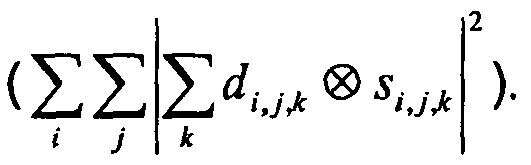
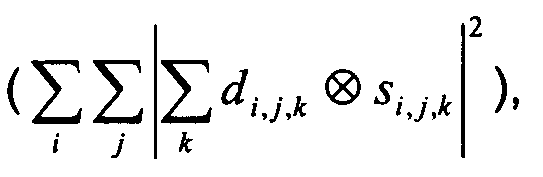
[0010] Now the square of the absolute value of the result is summed up over all antennas i and all slots j of a certain observation window. Doing this means performing a non-coherent averaging over all antennas i and all slots j of said observation window. This is repeated for all different delay values which shall be searched. In total
is calculated.
[0011] This energetic combining approach has the advantage that a change in the phase angle of the quantity
between two consecutive time slots j and j+1 can be arbitrary. In practise this means that the velocity of a mobile station with respect to the base station can be arbitrary.
[0012] Signals having a poor SNR can be detected even better in comparison to the above mentioned energetic combining approach when the summation of over the slots j is modified. In the energetic combining approach the summation over the slots j is a summation over real numbers
whereby the quantities
are complex numbers. It is however possible to add at least two of these quantities, and thus to add complex numbers, and then to calculate the square of its absolute value for all antennas i. In that case the quantities are chosen to stem from at least two consecutive time slots with indices j, j+1, j+2 ... If the complex quantities from exactly two consecutive time slots are added up
[0013] In other words the summation over all slots is performed in such a way that the sum
of a first time slot with index j is added to at least one corresponding second sum
of a second and consecutive slot with index j+1, and the square of the resulting value is summed up over all antennas with index i and all slots This second solution is feasible when the phase angle of the quantity
between two consecutive time slots doesn't exceed 90°. This corresponds to a total frequency offset between transmitter and receiver of 450 Hz, which comprises the Doppler offset (relevant when the receiver has a certain velocity with respect to the transmitter) and the oscillator frequency offset. 450 Hz is sufficient for almost all situations.
[0014] It is also possible to compensate the measured frequency offset between consecutive slots when calculating the path profile, so that even high offsets can be handled with this second solution.
[0015] The new summation over slots can be done in several ways. When summing up the index j can chosen to be 1,2,3,4,5 ... In this case a summation over all integer values of j is performed, and the summation over slots adds quantities
for slots 1+2, 2+3, 3+4, 4+5 etc. In other words the quantities are summed up with an overlap.
[0016] As indicated above, the complex quantities of more than two consecutive time slots can be added. As an example the complex values of three time slots can be added as well. In this case the quantities
are summed up for slots 1+2+3, 2+3+4, 3+4+5 etc with an increased overlap of two time slots instead of one time slot. If three and not two slots are added up in this way, the total frequency offset will be 450*(2/3) = 300 Hz only. The sensitivity will increase and the SNR will be even better.
[0017] Another possibility when summing up over all slots is that the summation is only performed for odd values of j. In this third solution the quantities are summed up for slots 1+2, 3+4, 4+5 etc and thus without an overlap. The computational burden is slightly reduced.
[0018] All three solutions show a good SNR of the path profile, whereby the SNR of the path profile of the second and the third solution is even better than the SNR of the first solution. The improved SNR allows an improved detection of incoming paths. Weaker paths which would otherwise not be detectable can also be detected. Furthermore, by detecting additional paths due to an increased SNR a time diversity can also be obtained. This is especially useful when using a linear array with low spatial diversity.
[0019] A spread spectrum receiver, preferably a CDMA receiver, and particularly a RAKE receiver, or a receiver with a RAKE-like finger processing structure can be adapted to use the above mentioned method to calculate a path profile. (Frage: ist ein "spread spectrum receiver" eine brauchbare Verallgemeinerung unter welche ein CDMA-Receiver fallen wurde?) In this case the increased path profile SNR due to the method according to the invention increases the number of detected paths and thus the number of possible RAKE fingers. This increases the SNR measured at the output of the RAKE finger combiner and thus the capacity of the air interface, for example the UTRAN interface in UMTS systems. The CDMA receiver, particularly if it is a RAKE receiver, may be a part of a base station or subscriber station for a cellular communication system such as an UMTS system.
[0021] It is particularly useful when the spread spectrum receiver is adapted to use the first solution according to the invention to calculate a path profile, and in addition the second and/or the third solution. As mentioned above, the second solution is feasible when the phase change of the quantity
between two consecutive time slots doesn't exceed 90° corresponding to a total frequency offset of 450 Hz. The same is true for the third solution. If the spread spectrum receiver is able to perform a speed estimation (a Doppler frequency estimation) and a frequency offset estimation the total frequency offset can be estimated. If the total offset exceeds 450 Hz the first solution should be used, otherwise the second or the third solution with an improved SNR is preferable. Thus the above estimation can be used to switch between two modes of operation. In the alternative, the frequency offset is compensated when calculating the path profile.
[0022] The path profile calculation might be a summation over two antennas. The solution is however particularly useful when a summation over four or more antennas per sector is performed. The reason is that in this case the received signal level will be lowered by power control. This leads to a worse SNR with less pronounced peaks in the path profile, and correspondingly to greater problems in detecting incoming paths.
[0023] As mentioned above, the spread spectrum receiver may be adapted to use the above mentioned method to calculate a path profile. For that purpose, the receiver has a hardware logic like FPGAs, ASICs or EPROMs, digital signal processors or the like which provide the functionality to calculate the path profile. This hardware logic may have a firmware which can be downloaded from other devices such as computers. The firmware is a computer program product, which is directly loadable into the internal memory of a digital computer or into a computational entity such as a FPGA, an EPROM or the like, and which comprises software code portions for performing the method as described above when said product is running on a computer or the computational entity. The computer program product can be saved on a storage medium such as a hard disk, a CD of a DVD, or may be transmitted by means of electric carrier signals through a computer network such as the internet.
[0024] These and other aspects of the invention will be apparent from and elucidated with reference to the embodiments described thereafter. It should be noted that the use of reference signs shall not be construed as limiting the scope of the invention.
- Fig. 1:
- shows the path profile when calculated with the first solution,
- Fig. 2:
- shows the path profile when calculated with the second solution,
- Fig. 3:
- shows the path profile when calculated with the third solution,
- Fig. 4:
- is a sketch of the communication system having a logic to carry out the method according to the invention.
[0025] Fig. 1 shows a path profile calculated according to the first method according to the invention. A single 12.2 kbps link using a Pedestrian B propagation channel was calculated. The CDMA receiver had four antennas. The spreading factor was 256, the number of pilot symbols was 6, and there were 15 slots. A time slot consisted of 2560 chips with a DPCCH spreading factor of 256 and double chip rate sampling at the receiver. 60% of these 2560 chips are used for the summation with index k, meaning 256*2*6=3172 samples with double chip rate. If Tchip denotes the duration from a first chip to a second chip, then 192 values in a Tchip/2 grid were used and were interpolated to a Tchip/4 grid. For all 192 taps the value
was calculated. The 383 values were plotted versus the delay. The dashed vertical lines represent the actual incoming paths of the Pedestrian B propagation channel.
[0026] Fig. 2 shows the path profile for identical parameters as for Fig. 1 when calculated with the second method according to the invention. The values of two consecutive time slots were added without overlap, such that complex values of
were added up:
[0028] The corresponding values obtained by means of the first method are added to the plot. As can be seen the peaks are more pronounced now such that the SNR is improved.
[0029] Fig. 3 shows the path profile for identical parameters as for Fig. 1 when calculated with the third method according to the invention. Two consecutive time slots were added with overlap. In other words the values of time slots 1+2, 2+3, 3+4 etc were added in the following way:
[0030] An extra normalization factor of N=15/29 were used to keep the noise floor constant. This third solution has nearly double computational complexity than the second solution, but can be easily implemented in computational entities such as FPGAs,
[0031] Fig. 4 shows in a highly schematic way the communication system which implements the method as described above. A base station 1 communicates with a subscriber station 2 by sending signals by means of an antenna array 3 to the corresponding antenna array 3' of subscriber station 2. Both devices are UMTS devices operating at frequencies below 11 GHz according to the IEEE 802.16 standard. Base station 1 and subscriber station 2 each comprise a spread spectrum receiver 4, 4'.
[0032] The base station 1 and/or the subscriber station 2 estimates the Doppler frequency offset and/or the frequency offset between the base station 1 and the subscriber station 2. The spread spectrum receiver 4, 4' performs a non-coherent averaging according to the first solution if the estimated offset is above the predefined threshold value. If the estimated offset is below the predefined threshold value a coherent averaging according to the second solution or the third solution is carried out.
1. Method for calculating a path profile in a cellular communication system, whereby
the Hadamard product dk ⊗ sk of the despreading vector dk and the input sequence vector sk is evaluated, and the Hadamard product is summed up over all chips with index k forming the elements of dk and sk for a certain antenna with index i and for a certain time slot with index j
characterized in that the square of the absolute value of this sum is summed up over all antennas and all time slots
characterized in that the square of the absolute value of this sum is summed up over all antennas and all time slots
2. Method according to the preamble of claim 1, characterized in that for summing up over all time slots the sum
of a first time slot with index j is added to at least one corresponding second sum

of a second and consecutive time slot with index j+1, and the square of the resulting value is summed up over all antennas and all time slots.
of a first time slot with index j is added to at least one corresponding second sum
of a second and consecutive time slot with index j+1, and the square of the resulting value is summed up over all antennas and all time slots.
3. Method according to claim 2, characterized in that for summing up over all time slots the sum of a first time slot with index j is added
to the sum of exactly one second and consecutive time slot with index j+1

4. Method according to claim 2 or 3, characterized in that the summation over all time slots is performed for all integer values of j.
5. Method according to claim 2 or 3, characterized in that the summation over all time slots is only performed for odd integer values of j.
6. Method according to claim 1 or 2, characterized in that the summation over at least four antennas is performed.
7. Method according to claim 1 or 2, characterized in that the path profile for a WCDMA signal is calculated.
8. Method according to claim 1 or 2, characterized in that it runs on a computer.
9. Method for operating a base station and/or a subscriber station, characterized in that the base station and/or the subscriber station estimates the Doppler frequency offset
and/or the frequency offset between the base station and the subscriber station, that
the method according to claim 1 is carried out if the estimated offset is above a
predefined threshold value, and that the method according to claim 2 is carried out
if the estimated offset is below the predefined threshold value.
10. Computer program product, directly loadable in the internal memory of a digital computer,
comprising software code portions for performing the method according to claim 8 when
said product is running on a computer.
11. Computer program product according to claim 10 on a storage medium or transmitted
by means of electric signals through a computer network.
12. Spread spectrum receiver, adapted to calculate a path profile by applying the method
according to any of the claims 1 to 8.
13. Spread spectrum receiver according to claim 12 adapted to be a CDMA receiver.
14. Spread spectrum receiver according to claim 13 adapted to be a RAKE receiver.
15. Base station and/or subscriber station for a cellular communication system, comprising
a spread spectrum receiver according to one of the claim 12 to 14, or the computer
program according to claim 10 or 11, or being adapted to carry out the method according
to claim 9.
Amended claims in accordance with Rule 86(2) EPC.
1. Method for operating a base station and/or a subscriber station, whereby the base
station and/or the subscriber station estimates the Doppler frequency offset and/or
the frequency offset between the base station and the subscriber station, whereby
a path profile in a cellular communication system is calculated, whereby the Hadamard
product dk ⊗sk of the despreading vector dk and the input sequence vector sk is evaluated, whereby the Hadamard product is summed up over all chips with index
k forming the elements of dk and sk for a certain antenna with index i and for a certain time slot with index
whereby in the case that that the estimated offset is below the predefined threshold value the square of the absolute value of this sum is summed up over all antennas and all time slots
and whereby in the case that the estimated offset is below the predefined threshold value for summing up over all time slots the sum
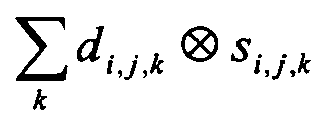
of a first time slot with index j is added to at least one corresponding second sum
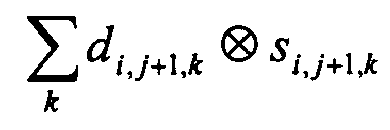
of a second and consecutive time slot with index j+1, and the square of the resulting value is summed up over all antennas and all time slots.
whereby in the case that that the estimated offset is below the predefined threshold value the square of the absolute value of this sum is summed up over all antennas and all time slots
and whereby in the case that the estimated offset is below the predefined threshold value for summing up over all time slots the sum
of a first time slot with index j is added to at least one corresponding second sum
of a second and consecutive time slot with index j+1, and the square of the resulting value is summed up over all antennas and all time slots.
2. Method according to claim 2, characterized in that in the case that the estimated offset is below the predefined threshold value for
summing up over all time slots the sum of a first time slot with index j is added to the sum of exactly one second and consecutive time slot with index

3. Method according to claim 1 or 2, characterized in that in the case that the estimated offset is below the predefined threshold value the
summation over all time slots is performed for all integer values of j.
4. Method according to claim 1 or 2, characterized in that in the case that the estimated offset is below the predefined threshold value the
summation over all time slots is only performed for odd integer values of j.
5. Method according to claim 1, characterized in that the summation over at least four antennas is performed.
6. Method according to claim 1, characterized in that the path profile for a WCDMA signal is calculated.
7. Method according to claim 1, characterized in that it runs on a computer.
8. Computer program product, directly loadable in the internal memory of a digital computer,
comprising software code portions for performing the method according to claim 7 when
said product is running on a computer.
9. Computer program product according to claim 8 on a storage medium or transmitted
by means of electric signals through a computer network.
10. Spread spectrum receiver, adapted to calculate a path profile by applying the method
according to any of the claims 1 to 7.
11. Spread spectrum receiver according to claim 10 adapted to be a CDMA receiver.
12. Spread spectrum receiver according to claim 10 adapted to be a RAKE receiver.
13. Base station and/or subscriber station for a cellular communication system, comprising
a spread spectrum receiver according to one of the claim 10 to 12, or the computer
program according to claim 8 or 9.