| (19) |
 |
|
(11) |
EP 1 661 949 B1 |
| (12) |
EUROPEAN PATENT SPECIFICATION |
| (45) |
Mention of the grant of the patent: |
|
19.12.2007 Bulletin 2007/51 |
| (22) |
Date of filing: 15.08.2003 |
|
| (51) |
International Patent Classification (IPC):
|
| (86) |
International application number: |
|
PCT/MX2003/000064 |
| (87) |
International publication number: |
|
WO 2005/017032 (24.02.2005 Gazette 2005/08) |
|
| (54) |
POLYMERIC COMPOSITION HAVING ELASTOMERIC PROPERTIES OVER WIDE TEMPERATURE RANGES,
AND PREPARATION METHOD THEREOF
POLYMERZUSAMMENSETZUNG, DIE ÜBER WEITE TEMPERATURBEREICHE ELASTOMERE EIGENSCHAFTEN
AUFWEIST, UND HERSTELLUNGSVERFAHREN DAFÜR
COMPOSITION POLYMERIQUE PRESENTANT DES PROPRIETES ELASTOMERIQUES LORS DE GRANDS ECARTS
DE TEMPERATURE ET PROCEDE DE PREPARATION
|
| (84) |
Designated Contracting States: |
|
AT BE BG CH CY CZ DE DK EE ES FI FR GB GR HU IE IT LI LU MC NL PT RO SE SI SK TR |
| (43) |
Date of publication of application: |
|
31.05.2006 Bulletin 2006/22 |
| (73) |
Proprietors: |
|
- Dynasol Elastomeros, S.A. De C.V.
89600 Altamira,
Tamaulipas (MX)
- Centro de Investigacion en Quimica Aplicada (CIQA)
25100 Saltillo, Coah. (MX)
|
|
| (72) |
Inventors: |
|
- KNIAJANSKI, Sergei
25264 Saltillo, Coah (MX)
- GARCIA-ZAMORA, Maricela,
La Fragua Nte.
25000 Saltillo, Coah. (MX)
- CORONA-GALVAN, Sergio
28023 Madrid (ES)
- FLORES-FLORES, Rodolfo
89218 Tampico, Tam. (MX)
- GARCIA-RAMIREZ, Marcela
89218 Tampico, Tam. (MX)
- CADENAS, PLIEGO, Gregorio
25169, Saltillo, Coah. (MX)
|
| (74) |
Representative: Wibbelmann, Jobst |
|
Wuesthoff & Wuesthoff
Patent- und Rechtsanwälte
Schweigerstrasse 2
81541 München
81541 München (DE) |
| (56) |
References cited: :
EP-A1- 0 324 398
EP-A1- 0 810 263
US-B1- 6 329 459
|
EP-A1- 0 639 616
EP-A2- 0 440 014
|
|
| |
|
|
|
|
| |
|
| Note: Within nine months from the publication of the mention of the grant of the European
patent, any person may give notice to the European Patent Office of opposition to
the European patent
granted. Notice of opposition shall be filed in a written reasoned statement. It shall
not be deemed to
have been filed until the opposition fee has been paid. (Art. 99(1) European Patent
Convention).
|
FIELD OF THE INVENTION
[0001] The present invention relates to the techniques used in obtaining polymer compositions
and, more particularly, it relates to a copolymer composition having elastomeric properties
at wide temperature ranges.
BACKGROUND OF THE INVENTION
[0002] There is a vast amount of polymer composition applications wherein the elements or
objects therefrom require having elastomeric properties, that is, to exhibit extensibility
and flexibility properties allowing them to recover their shape after being considerably
extended.
[0003] Due to the above, a great variety of materials having elastomeric properties have
been developed over time, with styrene-butadiene copolymers being among the most renowned
and widely used ones:
[0004] Although it is possible to find in the state of the art a great variety of elastomeric
polymer compositions having various mechanical or physical properties such as hardness,
tensile strength, or modulus of elasticity, among others, the compositions known so
far lose their elastomeric properties with temperature, which limits the optimal performance
thereof when they are to be used in high-temperature applications.
[0005] With the development of more effective polymerization catalyzers, such as the one
depicted in the patent application
MX 9801717, it has been possible to control the structure of polymers, allowing thus to obtain
regularity in chains. Thus, in the case of styrene elastomers, syndiotactic polystyrene
has been used in order to achieve beneficial results for the properties of the polymer
compositions therefrom.
[0006] For instance,
US Patent 5,260,394 depicts a syndiotactic polystyrene copolymer with inserts of olefin and/or dienic
monomers exhibiting proper chemical and thermal resistance properties, in addition
to allowing an appropriate processing and good compatibility with other compositions.
The copolymers depicted therein aim to have materials with good processing by injection
molding due to their low glass transition temperature.
[0007] Likewise,
US Patent 5,352,727 depicts a syndiotactic polystyrene composition modified with rubber aiming to provide
such composition with better processing properties when it is reprocessed after being
used once, keeping its mechanical and heat decomposition resistance properties after
being reprocessed.
[0008] Generally, other documents such as
US Patents 6,046,275;
US 6,191,197;
US 5,352,727;
US 5,260,394;
US 5,543,462; and
US 5,777,028 use various mixtures of syndiotactic polystyrene with other polymers or copolymers
allowing to modify the mechanical and processing properties of such a polymer compositions.
[0009] However, none of these documents introduce a composition having elastomeric properties
at wide temperature ranges since, due to the nature of the compatibilizing agents
normally used to obtain compositions in stereoregular polymers, such compositions
cannot be used at low temperatures and therefore the use of this kind of materials
continues to be limited to temperatures over -20°C (-4 °F).
[0010] According to the above, we have pretended to overcome the disadvantages of known
elastomeric compositions by obtaining a polymer composition not also having elastomeric
properties at wide temperature ranges, but which can be used at high temperatures
and keeps its impact strength, chemical, mechanical, and wear resistance properties
under high temperatures, in addition to keep its elastomeric properties at temperatures
under -20°C (-4 °F).
OBJECTS OF THE INVENTION
[0011] Considering the limitations of the compositions depicted in the previous art, it
is an object of the present invention to provide a polymer composition having elastomeric
properties at wide temperature ranges, which is homogeneous and compatible, such composition
resulting from stereoregular polymers and not requiring the use of additional compatibilizing
agents.
[0012] It is another object of the present invention to provide a polymer composition having
elastomeric properties at wide temperature ranges which keeps its chemical, mechanical,
and wear resistance properties, as well as its processing and impact strength properties.
[0013] Yet another object of the present invention is to provide a polymer composition having
elastomeric properties at wide temperature ranges which is compatible with other polymer
materials when being mixed with them.
[0014] Yet another object of the present invention is to provide a polymer composition having
elastomeric properties at wide temperature ranges which may be properly processed
as a film, by thermoforming, injection, or extrusion.
BRIEF DESCRIPTION OF THE FIGURES
[0015] Novel aspects considered to be characteristic of the present invention will be established
with detail in the appended claims. However, the operation, as well as other objects
and advantages thereof, will be better understood in the light of the following detailed
description of a specific embodiment thereof, considered according to the appended
figure, wherein:
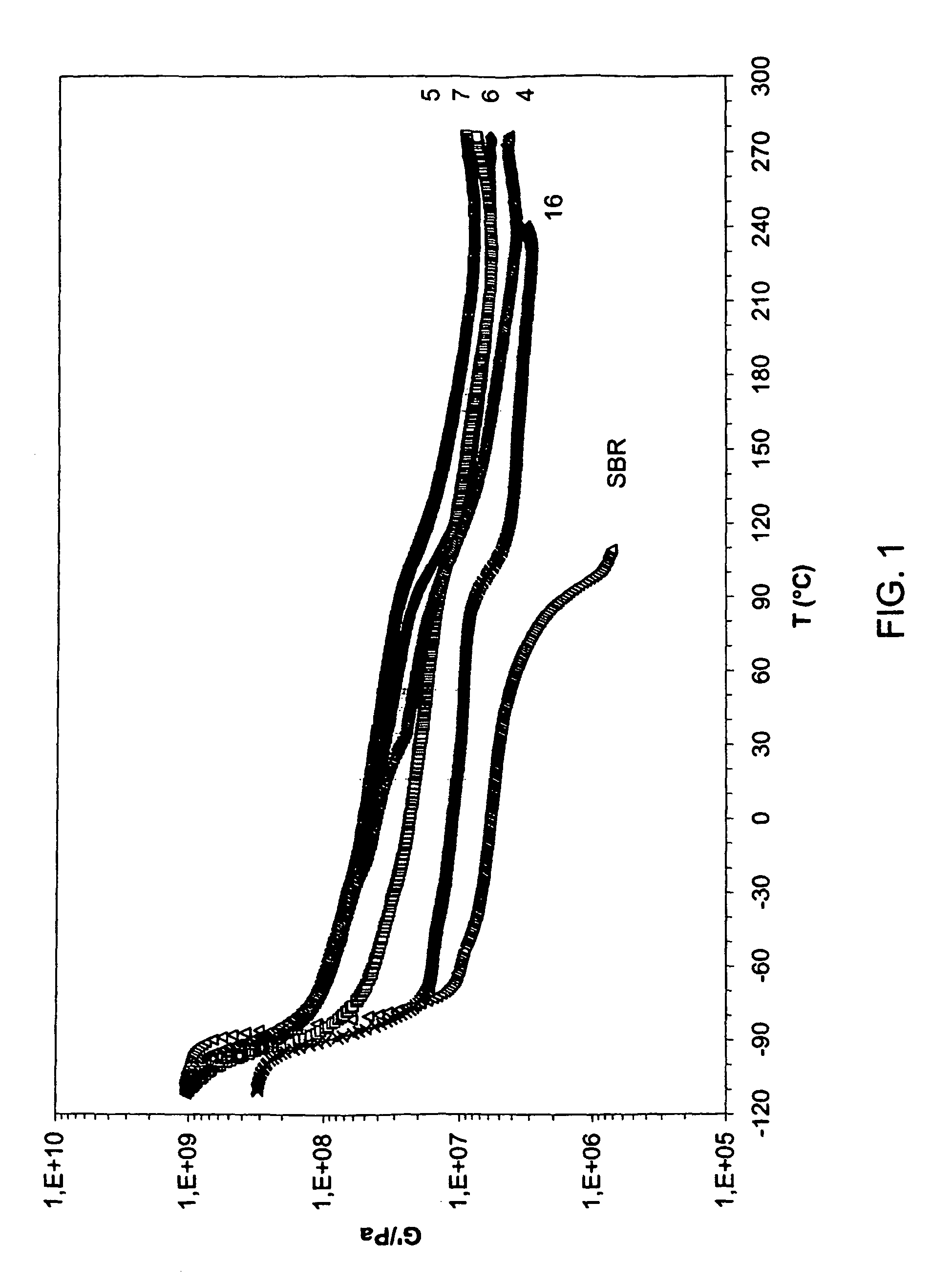
Figure 1 is a graph of the modulus of elasticity (G') of some embodiments of the polymer
composition of the present invention which are illustrated in the example.
DETAILED DESCRIPTION OF THE INVENTION
[0016] It has been found that a combination of dienic vinyl aromatic polymers having an
orderly structure may result in a polymer composition having elastomeric properties
at a temperature range from -85°C (-121 °F (188.15 K)) to 300°C (572 °F (573.15 K)).
[0017] More specifically, the polymer composition of the present invention allowing to achieve
elastomeric behavior at wide temperature ranges comprises from 15 to 85% by weight
of a copolymer having at least a block from 10 to 5000 structural sequences, which
are mainly syndiotactic in nature, of monomer units resulting from at least one substituted
or unsubstituted vinyl aromatic monomer, and at least one block formed from 10 to
4000 monomer units resulting from at least one dienic monomer having mainly a 1,4-cis
structure; from 15 to 85% by weight of a polymer resulting from dienic monomers, having
a molecular weight from 1000 to 600000, the contents of 1,4-cis-type monomer units
being of at least 90%; and up to 70% of a polymer resulting from substituted or unsubstituted
vinyl aromatic monomers, having a molecular weight from 1000 to 500000 and a degree
of syndiotacticity in terms of syndiotactic pentads of at least 95%.
[0018] In a preferred embodiment of the present invention, vinyl aromatic monomers are selected
from styrene and substituted styrene, the substituents being preferably selected from
the alkyl, halide, alkoxyl, and amine groups. In a specific embodiment, vinyl aromatic
monomers are selected from styrene, 4-methyl-styrene, 4-ter-butyl styrene, 4-methoxy
styrene, 4-trimethylsililoxy styrene, 4-bromo styrene, and 4-(N-N'-dimethyl amine)
styrene.
[0019] Regarding the dienic monomer, in the preferred embodiment of the present invention,
the dienic monomer is selected from buta-1,3-diene and 2-methyl buta-1,3-diene.
[0020] In an additional embodiment of the polymer composition of the present invention,
the fraction formed by the monomer units resulting from the dienic monomer may be
partially or fully hydrogenated, that is, monomer units -CH
2-CH=CH-CH
2- may be partially or fully converted into the monomer units -CH
2-CH
2-CH
2-CH
2-, whereas the monomer units -CH
2-C(CH=CH
2)H- may be partially or fully converted into the monomer units -CH
2-C(CH
2-CH
3)H-, 95% of the monomer units resulting from the dienic monomer being preferably hydrogenated.
[0021] In an additional embodiment of the present invention, the polymer composition contains
from 0.01 to 4% by weight of at least one organic or inorganic additive depending
on the final destination of the composition and, more preferably, less than 3.7%.
[0022] Preferably, inorganic additives are selected from compounds containing aluminum and,
more preferably, aluminum oxide, or compounds with the general formula (-Al(X)O-)n,
wherein X is a hydroxyl, alkoxyde, or alkyl group, which are obtained by making react
the compounds having the general formula (-Al(R)O-)m with water or alcohols, wherein
R is an alkyl group, n and m are natural numbers which may be residues from the catalytic
system.
[0023] Likewise, it is preferred that organic additives include at least one antioxidant
agent, preferably selected from useful antioxidants in compositions containing styrene
and butadiene and, more preferably, selected from those containing phenols, phosphates,
and amines.
[0024] The polymer composition of the present invention has a first glass transition temperature
(T
g 1) within the temperature range between -100°C (-148 °F) and -125.56°C (-194 °F);
a second glass transition temperature (T
g 2) within the temperature range between 95°C (203 °F) and 120°C (248 °F); as well
as a melting temperature T
m within the temperature range between 220°C (428 °F) and 300°C (572 °F). The elastomeric
behavior of the polymer composition of the present invention ranges from -85°C (-121
°F) up to the dienic-polymer degradation temperature. Likewise, the modulus of elasticity
may vary between 10 and 1000 MPa within the temperature range between -85°C (-121
°F) and 90°C (194 °F), and between 3 and 100 MPa within the temperature range between
120°C (248 °F) and the dienic polymer temperature.
[0025] The polymer composition of the present invention may be prepared by a process comprising
a first contact polymerization stage of at least one vinyl aromatic monomer which
is polymerizable by a catalytic system as that comprising a pre-catalyzer consisting
of one or more compounds pertaining to the class of compounds such as titanium fluorenyl
trialkoxyde (IV), and an activating compound selected from aluminum compounds obtained
by trialkylaluminum hydrolysis and, more preferably, a methyl aluminoxane, such as
that depicted in the patent application
MX 9801717, in mass form or with the presence of a dissolvent selected from aromatic dissolvent
and, more preferably, toluene, as well as from aliphatic dissolvents and, more preferably,
2,2,4-trimethyl pentane, or a mixture thereof, at a temperature between 0°C (32 °F)
and 90°C (194 °F) for a period of time between 1 and 30 minutes; such a contact being
followed by a second polymerization stage through subsequent addition of a dienic
monomer at a temperature between 0°C (32 °F) and 70°C (158 °F) to form an unsaturated
polymer composition.
[0026] The unsaturated polymer composition is polymerized for period of time between 10
minutes and 6 hours, and it is then mixed with an alcohol selected from aliphatic
alcohols in order to end the polymerization reaction. In a preferred embodiment of
the present invention, the aliphatic alcohol has from 1 to 4 carbon atoms, with isopropanol
being preferred.
[0027] Once the reaction has come to an end, the composition is finally subjected to a stage
of catalytic residue removal by using a mixture of an aliphatic alcohol and a solvent
with at least one substituted or unsubstituted aromatic ring. In a preferred embodiment
of the present invention, the aliphatic alcohol : aromatic solvent ratio is between
0.5:1 and 5:1, with a 1:1 ratio being preferred. The aliphatic alcohol from the stage
of catalytic residue removal is preferably selected from alcohols having between 1
and 4 carbon atoms, preferably isopropanol, with the preferred aromatic solvent being
toluene.
[0028] In an additional embodiment of the present invention, it has been surprisingly found
that, at the end of the dienic monomer polymerization stage or once the dienic monomer
has been converted at least by 50%, the non-hydrogenated polymer composition may be
subjected to a hydrogenation stage
in situ by direct contact with hydrogen at a partial hydrogen pressure between 68947.57 and
10342 Pa (10 and 150 psig) and a temperature between 0°C and 90°C (32 °F and 194 °F)
and, more preferably, a partial hydrogen pressure between 137895.1 and 689475.7 Pa
(20 and 100 psig) and a temperature between 20°C and 70°C (68 °F and 158 °F). It is
yet more surprising that the hydrogenation stage of the non-hydrogenated polymer composition
may be performed without the need of using additional hydrogenation catalyzers, which
results in materials having up to 95% of hydrogenated polybutadiene.
[0029] The polymer composition of the present invention will be illustrated more clearly
by the following examples, which are presented only as an illustration and thus do
not limit the same.
[0030] Polymerization processes were performed according to what is depicted below.
EXAMPLES 1-9
[0031] A glass reactor with capacity of 600 mL, provided with a stirring system, a temperature
and pressure control system, and a reagent addition system, was charged with a mixture
of: 30 mL toluene, 30 mL of a vinyl aromatic monomer (see Chart II) and 3 g of a dry
methylaluminoxane. The reactor was heated to 50°C (122 °F) and was kept at this temperature
for 10 minutes. Then, a solution of (C
9H
13)Ti(OC
3H
7)
3 in 5 mL toluene was added. The vinyl aromatic monomer / titanium compound molar ratio
was of 1000, while the Al/Ti ratio was of 250. The reactor jacket begins to cool down
from the addition of the starter compound. 20 seconds after the beginning of polymerization,
the reactor was added 200 ml toluene which was previously cooled to 10°C (50 °F).
At time t1 from the beginning of the polymerization (see Chart II), 60 mL butadiene
were added. The reaction was left to proceed for 2 hours. The reactive mixture was
mixed with 1 L isopropanol.
[0032] In order to remove the catalytic system residue, the product was extracted using
the continuous extraction apparatus for 24 hours with a mixture of toluene-isopropanol
at a 1:1 ratio, except for the case of Example 8, which has a higher content of the
D component, of which the catalytic residue is part.
[0033] In order to characterize the product, the resin was separated into one hexane-soluble
fraction and one hexane-insoluble fraction. According to the RMN analysis of
1H and
13C, the hexane-soluble fraction consists of polybutadiene having from 91 to 95% of
1,4-cis monomer units, with the rest being 1,2 monomer units. According to the RMN
results for 1H, as well as RMN for
13C and GPC, the hexane-insoluble fraction consists either of syndiotactic vinyl aromatic
polymer block copolymer and highly 1,4-cis polybutadiene, or a mixture of syndiotactic
vinyl aromatic polymer, syndiotactic vinyl aromatic polymer block copolymer, and highly
1,4-cis polybutadiene.
[0034] The characteristics of every polymer composition obtained are shown in Table II,
which uses the same abbreviations as those in Table I.
TABLE I
| A |
It generally refers to the properties of the (syndiotactic vinyl aromatic)-(1,4-cis-dienic)
copolymer |
| B |
It generally refers to the 1,4-cis dienic polymer properties |
| C |
It generally refers to the syndiotactic vinyl aromatic polymer properties |
| D |
Organic and inorganic additives |
| V |
Vinyl aromatic monomer |
| St |
Styrene |
| 4MeSt |
4-methyl styrene |
| 4BrSt |
4-bromo styrene |
| MeOSt |
4-methoxy styrene |
| 4NSt |
4-dimethylamine styrene |
| t1 |
Polymerization time for vinyl aromatic monomer, minutes |
| MWA |
Molecular weight of A by weight |
| cA,% |
Contents of 1,4-cis monomer units in A dienic blocks |
| vA,% |
Contents by weight of A vinyl aromatic blocks |
| PA,% |
Contents of copolymer A in the composition by weight |
| MpB |
Peak molecular weight of B |
| cB,% |
Contents of 1,4-cis monomer units |
| PB,% |
Contents of B in the composition by weight |
| MWC |
Molecular weight of C by weight |
| PC,% |
Contents of C in the composition by weight |
| PD,% |
Contents of D in the composition by weight |
| Pv,% |
Total contents of the vinyl aromatic portion in the composition by weight |
| SY,% |
Degree of syndiotacticity of the vinyl aromatic portion |
| Tg 1 |
First glass transition temperature |
| Tg 2 |
Second glass transition temperature |
| Tm |
Melting transition temperature |
| ΔG' |
Variation on the modulus of elasticity within the indicated temperature ranges |
TABLE II
| Properties |
EXAMPLE |
| 1 |
2 |
3 |
4 |
5 |
6 |
7 |
8 |
9 |
| V |
St |
St |
St |
St |
St |
St |
St |
4Me St |
4Br St |
| t1 |
30 |
25 |
20 |
15 |
10 |
5 |
2.5 |
20 |
20 |
| Component (A) |
|
|
|
|
|
|
|
|
|
| MWA, x 10E-3 |
245 |
267 |
201 |
202 |
176 |
207 |
96 |
295 |
304 |
| cA,% |
92 |
93 |
93 |
93 |
92 |
93 |
91 |
95 |
93 |
| VA,% |
96 |
84 |
53.2 |
95.5 |
72.7 |
82.2 |
58.9 |
60.4 |
40.2 |
| PA,% |
30.2 |
33.2 |
36.8 |
22.6 |
19.3 |
19.5 |
17.5 |
46.5 |
15.3 |
| |
|
|
|
|
|
|
|
|
|
| Component (B) |
|
|
|
|
|
|
|
|
|
| MpB, x10E-3 |
246 |
231 |
256 |
385 |
485 |
450 |
284 |
233 |
297 |
| cB,% |
92.5 |
92.6 |
94.3 |
91.0 |
93 |
91 |
92.2 |
95 |
91.8 |
| PB,% |
66.2 |
64.8 |
55.0 |
76.5 |
78.9 |
80.0 |
79.5 |
39.4 |
67.6 |
| |
|
|
|
|
|
|
|
|
|
| Component (C) |
|
|
|
|
|
|
|
|
|
| MWC, x10E-3 |
- |
- |
25.6 |
- |
- |
- |
- |
50.7 |
62.3 |
| PC,% |
0 |
0 |
7.1 |
0 |
0 |
0 |
0 |
10.3 |
14.6 |
| |
|
|
|
|
|
|
|
|
|
| Component (D) |
|
|
|
|
|
|
|
|
|
| PD,% |
3.6 |
2 |
1.1 |
0.9 |
1.8 |
0.5 |
3 |
3.8 |
2.5 |
| |
|
|
|
|
|
|
|
|
|
| Properties |
|
|
|
|
|
|
|
|
|
| Pv,% |
29.0 |
27.9 |
26.7 |
22.0 |
15.6 |
16.0 |
10.3 |
38.4 |
20.8 |
| SY,% |
99.9 |
99.9 |
99.9 |
99.9 |
99.9 |
99.9 |
99.9 |
98 |
96.6 |
| Tg1, °C (°F) |
-97.50 (-143.5) |
-97.50 (- 143.5) |
-98.06 (- 144.5) |
-96.06 (- 140.9) |
-97.0 (- 142.6) |
-97.39 (- 143.3) |
-98.50 (- 145.3) |
-99.56 (- 147.2) |
-92.17 (-133.9) |
| Tg2, °C (°F) |
112.22 (234) |
117.28 (243.1) |
105.56 (222) |
119 (246.2 ) |
110 (230) |
111.67 (233) |
107.22 (225) |
95.56 (204) |
119.78 (247.6) |
| Tm, °C (°F) |
265 (509) |
268.33 (515) |
262.39 (504.3 ) |
269 (516.2 ) |
266.67 (512) |
264.44 (508) |
264.50 (508.1 ) |
270.67 (519.2) |
296 (564.8) |
| ΔG', Mpa |
|
|
|
|
|
|
|
|
|
| From -60 to 90 °C (-76 to 194 °F) |
- |
- |
- |
98-15 (208.4 -59) |
90-60 (194- 140) |
90-35 (194- 95) |
30-20 (86-68) |
- |
- |
| From 120 to 250°C (248 to 482 °F) |
- |
- |
- |
4-3 (39.2- 37.4) |
25-15 (77- 59) |
7-4 (44.6- 39.2) |
7-6 (44.6-42.8) |
- |
- |
EXAMPLES 10-18
[0035] A glass reactor with capacity of 600 mL, provided with a stirring system, a temperature
and pressure control system, and a reagent addition system, was charged with a composed
mixture of: 30 mL 2,2,4-trimethylpentane, 30 mL of a vinyl aromatic monomer (see Table
III), and 3 g of a dry methylaluminoxane. The reactor was heated to 50°C (122 °F)
and was kept at this temperature for 10 minutes. Then, a solution of (C
9H
13)Ti(OC
3H
7)
3 in 5 mL 2,2,4-trimethylpentane was added. The vinyl aromatic monomer / titanium compound
molar ratio was of 1000, while the Al/Ti ratio was of 250. The reactor jacket begins
to cool down from the addition of the starter compound. 20 seconds after the beginning
of polymerization, the reactor was added 200 ml 2,2,4-trimethylpentane balanced to
20°C (68 °F). At time t1 from the beginning of the polymerization (see Table III),
60 mL butadiene was added. The reaction was left to proceed for 2 hours. The reactive
mixture was mixed with 1 L isopropanol.
[0036] In order to remove the catalytic system residue, the product was extracted using
the continuous extraction apparatus for 24 hours with a mixture of toluene-isopropanol
at a 1:1 ratio, except for the case of Example 10, which has a higher content of the
D component, of which the catalytic residue is part.
[0037] In order to characterize the product, the resin was separated into one hexane-soluble
fraction and one hexane-insoluble fraction.
[0038] According to the RMN analysis of
1H and
13C, the hexane-soluble fraction consists of polybutadiene having from 88 to 93% of
1,4-cis monomer units, with the rest being 1,2 monomer units.
[0039] According to the RMN results for
1H, as well as RMN for
13C and GPC, the hexane-insoluble fraction consists of a mixture of syndiotactic vinyl
aromatic polymer, the syndiotactic vinyl aromatic polymer block copolymer, and highly
1,4-cis polybutadiene.
[0040] The characteristics of every polymer composition obtained are shown in Table III,
which uses the same abbreviations as those in Table I.
TABLE III
| Properties |
EXAMPLE |
| 10 |
11 |
12 |
13 |
14 |
15 |
16 |
17 |
18 |
| V |
St |
St |
St |
St |
St |
St |
St |
St/ MeOSt = 9/1 |
St/ 4NSt = 9/1 |
| t1 |
30 |
25 |
20 |
15 |
10 |
5 |
2.5 |
15 |
5 |
| Component (A) |
|
|
|
|
|
|
|
|
|
| MWA, x 10E-3 |
248 |
201 |
220 |
195 |
151 |
175 |
499 |
193 |
333 |
| cA,% |
87.0 |
89.7 |
89.9 |
90.1 |
89.5 |
87.6 |
88.7 |
85 |
90.2 |
| vA,% |
76 |
71 |
58.5 |
59 |
53.5 |
43.5 |
40.5 |
10.5 |
21.5 |
| PA,% |
9.5 |
22.5 |
29.5 |
47.5 |
53.0 |
66.5 |
71.5 |
16.5 |
25.5 |
| |
|
|
|
|
|
|
|
|
|
| Component (B) |
|
|
|
|
|
|
|
|
|
| MpB, x10E-3 |
105 |
133 |
185 |
154 |
156 |
265 |
200 |
123 |
99 |
| cB,% |
88.7 |
90.6 |
91 |
89.2 |
90.3 |
89 |
88.1 |
93 |
91.8 |
| PB,% |
16.3 |
16.8 |
18.8 |
17.5 |
15.0 |
15.7 |
15.0 |
29.0 |
27.2 |
| |
|
|
|
|
|
|
|
|
|
| Component (C) |
|
|
|
|
|
|
|
|
|
| MwC. x10E-3 |
531 |
507 |
780 |
465 |
470 |
403 |
354 |
267 |
609 |
| PC.% |
70.2 |
57.2 |
51.1 |
32.0 |
31.0 |
14.2 |
10.5 |
51.1 |
44.8 |
| |
|
|
|
|
|
|
|
|
|
| Component (D) |
|
|
|
|
|
|
|
|
|
| PD,% |
4.0 |
3.5 |
2.8 |
3.0 |
1.0 |
3.6 |
3.0 |
3.4 |
2.5 |
| |
|
|
|
|
|
|
|
|
|
| Properties |
|
|
|
|
|
|
|
|
|
| Pv,% |
77.4 |
73.2 |
68.4 |
60.0 |
59.3 |
43.1 |
39.5 |
52.8 |
50.3 |
| SY,% |
99.9 |
99.9 |
99.9 |
99.9 |
99.9 |
99.9 |
99.9 |
98.2 |
97.1 |
| Tg1, °C (°F) |
-91 (- 131.8) |
-92.5 (- 134.5) |
-90.28 (- 130.5) |
-90.5 (- 130.9) |
-91.06 (-131.9) |
-92.39 (- 134.3) |
-90.06 (- 130.1) |
-93.67 (-136.6) |
-92.17 (-133.9) |
| Tg2, °C (°F) |
115 (239) |
116.17 (241.1) |
117 (242.6) |
113.17 (235.7) |
115.5 (239.9) |
114.5 (238.1) |
120 (248) |
93.5 (200.3) |
120.56 (249) |
| Tm, °C (°F) |
276.67 (530) |
278 (532.4) |
276 (528.8) |
280 (536) |
282 (539.6) |
274 (525.2) |
269 (516.2) |
255 (491) |
290 (554) |
| ΔG', Mpa |
|
|
|
|
|
|
|
|
|
| From -60 to 90°C (-76 to 194 °F) |
- |
- |
- |
- |
- |
- |
1000- 700 (1832- 1292) |
100-40 (212-104) |
- |
| From 115.56 to 250°C (240 to 482 °F) |
- |
- |
- |
- |
- |
- |
204.44- 148.89 (400- 300) |
40-100 (104-212) |
- |
[0041] Figure 1 compares the viscoelastic behavior of the polymer compositions of the present
invention with that of a conventional SBR elastomer. It is clearly seen that the modulus
of elasticity (G') of the polymer composition of the present invention is maintained
within the temperature range from-85 to 280°C (-121 °F to 536 °F), a range in which
the material of the present invention does not flow. Conversely, a conventional elastomer
loses its viscoelastic properties before the polystyrene-stage T
g takes place, at about 70°C (158 °F).
EXAMPLES 19-23
[0042] The process was the same as for Example 5. After 120 minutes of butadiene polymerization,
the reactor was filled up with hydrogen at the partial pressure indicated in Table
V and it was kept at such a pressure, as well as at the temperature shown in Table
V for 24 hours. The reactive mixture was mixed with 1 L isopropanol.
[0043] In order to remove the catalytic system residue, the product was extracted using
the continuous extraction apparatus for 24 hours with a mixture of toluene-isopropanol
at a 1:1 ratio.
[0044] In order to characterize the product, the resin was separated into one hexane-soluble
fraction, one hot heptane-soluble fraction, and one fraction that was insoluble in
such dissolvents.
[0045] According to the RMN analysis of
1H and
13C, the hexane-soluble fraction consists of highly 1,4-cis polybutadiene.
[0046] According to the RMN analysis of
1H and
13C, the hot heptane-soluble fraction consists of hydrogenated polybutadiene.
[0047] According to the RMN results for
1H, as well as RMN for
13C and GPC, the fraction that was insoluble in both dissolvents consists of the syndiotactic
polystyrene block copolymer and highly 1,4-cis hydrogenated polybutadiene.
[0048] The characteristics of every polymer composition obtained are shown in Table V, which
uses the same abbreviations as those in Table IV.
EXAMPLES 24-27
[0049] The process was the same as for Example 14. After 120 minutes of butadiene polymerization,
the reactor was filled up with hydrogen at the partial pressure indicated in Table
V and it was kept at such a pressure, as well as at the temperature shown in Table
V for 24 hours. The reactive mixture was mixed with 1 L isopropanol.
[0050] In order to remove the catalytic system residue, the product was extracted using
the continuous extraction apparatus for 24 hours with a mixture of toluene-isopropanol
at a 1:1 ratio.
[0051] In order to characterize the product, the resin was separated into one hexane-soluble
fraction, one hot heptane-soluble fraction, and one fraction that was insoluble in
such dissolvents.
[0052] According to the RMN analysis of
1H and
13C, the hexane-soluble fraction consists of highly 1,4-cis polybutadiene.
[0053] According to the RMN analysis of
1H and
13C, the hot heptane-soluble fraction consists of hydrogenated polybutadiene.
[0054] According to the RMN results for
1H, as well as RMN for
13C and GPC, the fraction that was insoluble in both dissolvents consists of a mixture
of syndiotactic polystyrene, syndiotactic polystyrene block copolymer, and highly
1,4-cis hydrogenated polybutadiene.
[0055] The characteristics of every polymer composition obtained are shown in Table V, which
uses the same abbreviations as those in Table IV.
TABLE IV
| A |
It generally refers to the properties of the (syndiotactic vinyl aromatic)-(1,4-cis-dienic
hydrogenated) copolymer |
| B |
It generally refers to the 1,4-cis dienic polymer properties |
| BH |
It generally refers to the 1,4-cis dienic hydrogenated polymer |
| C |
It generally refers to the syndiotactic vinyl aromatic polymer properties |
| D |
Organic and inorganic additives |
| P |
Hydrogen pressure in (psig) Pa |
| T, °C |
Hydrogenation temperature |
| MWA |
Molecular weight of A by weight |
| hA,% |
Fraction of hydrogenated monomer units in A dienic blocks |
| PA,% |
Contents of copolymer A in the composition by weight |
| MpB |
Peak molecular weight of B |
| PB,% |
Contents of B in the composition by weight |
| MWBH |
Molecular weight of BH by weight |
| hBH,% |
Fraction of hydrogenated monomer units |
| PBH,% |
Contents of BH in the composition by weight |
| MWC |
Molecular weight of C by weight |
| PC,% |
Contents of C in the composition by weight |
| PD,% |
Contents of D in the composition by weight |
| Tg 1 |
First glass transition temperature |
| Tg 2 |
Second glass transition temperature |
| Tm |
Melting transition temperature |
| ΔG' |
Variation on the modulus of elasticity within the indicated temperature ranges |
TABLE V
| Properties |
EXAMPLE |
| 19 |
20 |
21 |
22 |
23 |
24 |
25 |
26 |
27 |
| P, Pa (psig) |
68947.5 7 (10) |
137895. 1 (20) |
413685. 4 (60) |
551580. 6 (80) |
551580. 6 (80) |
275790. 3 (40) |
413685. 4 (60) |
551580. 6 (80) |
551580. 6 (80) |
| T, °C (°F) |
20 (68) |
70 (158) |
50 (122) |
50 (122) |
70 (158) |
40 (104) |
50 (122) |
50 (122) |
70 (158) |
| Component (A) |
|
|
|
|
|
|
|
|
|
| MWA, x 10E-3 |
185 |
171 |
182 |
190 |
188 |
150 |
135 |
172 |
170 |
| hA,% |
0 |
27 |
68 |
86 |
95 |
5 |
44 |
71 |
89 |
| PA,% |
27 |
21 |
23 |
27 |
26 |
14 |
14 |
15 |
12 |
| |
|
|
|
|
|
|
|
|
|
| Component (B) |
|
|
|
|
|
|
|
|
|
| MpB, x10E-3 |
263 |
151 |
128 |
101 |
360 |
133 |
105 |
71 |
287 |
| PB,% |
60 |
61 |
39 |
14 |
2 |
50 |
38 |
21 |
5 |
| |
|
|
|
|
|
|
|
|
|
| Component (BH) |
|
|
|
|
|
|
|
|
|
| MWBH, xlOE-3 |
15 |
65;4 |
122;3 |
120;3 |
99; 1.5 |
3 |
131; 2.5 |
125;2 |
102; 1.5 |
| hBH,% |
55 |
62 |
85 |
93 |
98 |
75 |
83 |
95 |
99 |
| PBH,% |
10 |
16 |
36 |
57 |
70 |
26 |
39 |
54 |
75 |
| |
|
|
|
|
|
|
|
|
|
| Component (C) |
|
|
|
|
|
|
|
|
|
| MWC, x10E-3 |
- |
- |
- |
- |
- |
465 |
482 |
290 |
472 |
| PC,% |
0 |
0 |
0 |
0 |
0 |
9 |
8 |
9 |
7 |
| |
|
|
|
|
|
|
|
|
|
| Component (D) |
|
|
|
|
|
|
|
|
|
| PD,% |
2 |
2 |
2 |
2 |
2 |
1 |
1 |
1 |
1 |
| |
|
|
|
|
|
|
|
|
|
| Properties |
|
|
|
|
|
|
|
|
|
| ΔG', Mpa |
|
|
|
|
|
|
|
|
|
| From -60 to 90°C (-76 to 194 °F) |
- |
80-35 (176-95) |
- |
- |
- |
7-0.78 (44.6-33.4 |
- |
- |
- |
| From 140 to 250°C (284 to 482 °F) |
- |
18-16 (64.4- 60.8) |
- |
- |
- |
0.67-1.0 (33.2-33.8) |
- |
- |
- |
[0056] According to what has been depicted above, it may be seen that the polymer composition
with elastomeric properties at wide temperature ranges of the present invention has
been designed to comply with the requirements as of elastomeric properties that are
needed for applications at a temperature range from -80°C to 280°C (-112 °F to 536
°F), and it will be apparent for the one skilled in the art that the embodiments of
the polymer composition depicted before and illustrated in the preceding examples,
are only illustrative in purpose.
1. A polymer composition with elastomeric properties at wide temperature ranges of a
type comprising polymers and/or copolymers resulting from substituted or unsubstituted
vinyl aromatic monomers and from dienic monomers, which comprises from 15 to 85% by
weight of a copolymer containing at least one block from 10 to 5000 mainly syndiotactic
structural sequences of monomer units resulting from at least one substituted or unsubstituted
vinyl aromatic monomer, and at least one block formed by 10 to 4000 monomer units
resulting from at least one dienic monomer having mainly a 1,4-cis structure; from
15 to 85% by weight of a polymer resulting from dienic monomers having a molecular
weight between 6000 and 600000, wherein the contents of 1,4-cis monomer units is of
at least 90%; and up to 70% of a polymer resulting from substituted or unsubstituted
vinyl aromatic monomers having a molecular weight between 10000 and 500000 and a degree
of syndiotacticity in terms of syndiotactic pentads of at least 95%.
2. The polymer composition with elastomeric properties at wide temperature ranges according
to claim 1, wherein vinyl aromatic monomers are selected from styrene and substituted
styrene.
3. The polymer composition with elastomeric properties at wide temperature ranges according
to claim 2, wherein the vinyl aromatic monomer is substituted styrene whose substituents
are selected from alkyl, halide, alkoxyl, and amine groups.
4. The polymer composition with elastomeric properties at wide temperature ranges according
to claim 2, wherein the vinyl aromatic monomers are selected from styrene, 4-methyl
styrene, 4-tert-butyl styrene, 4-methoxy styrene, 4-trimethylsililoxy styrene, 4-bromo
styrene, and 4-(N-N'-dimethyl amine)styrene.
5. The polymer composition with elastomeric properties at wide temperature ranges according
to claim 1, wherein the dienic monomer is selected from buta-1,3-diene and 2-methyl
buta-1,3-diene.
6. The polymer composition with elastomeric properties at wide temperature ranges according
to claim 1, wherein the fraction formed by the monomer units resulting from the dienic
monomer is partially or fully hydrogenated.
7. The polymer composition with elastomeric properties at wide temperature ranges according
to claim 6, wherein the fraction formed by the monomer units resulting from the dienic
monomer is hydrogenated by 95%.
8. The polymer composition with elastomeric properties at wide temperature ranges according
to claim 1 further containing from 0.01 to 4% by weight of at least one organic or
inorganic additive.
9. The polymer composition with elastomeric properties at wide temperature ranges according
to claim 8, wherein the inorganic additive is selected from compounds containing aluminum.
10. The polymer composition with elastomeric properties at wide temperature ranges according
to claim 9, wherein the compounds containing aluminum are selected from aluminum oxide
or compounds with the general formula (-Al(X)O-)n, wherein X is selected from the
hydroxyl, alkoxyde, or alkyl groups and n is a natural number.
11. The polymer composition with elastomeric properties at wide temperature ranges according
to claim 10, wherein (-Al(X)O-)n results from making react the compounds with the
general formula (-Al(R)O-)m with water or alcohols, wherein R is an alkyl group and
m is a natural number.
12. The polymer composition with elastomeric properties at wide temperature ranges according
to claim 8, wherein the organic additive is at least an antioxidant agent.
13. The polymer composition with elastomeric properties at wide temperature ranges according
to claim 12, wherein the antioxidant agent is selected from those containing phenols,
phosphates, and amines.
14. The polymer composition with elastomeric properties at wide temperature ranges according
to claim 1 further exhibiting a first glass transition temperature (Tg 1) within the temperature range from-100°C and -90°C (-148 °F and -130 °F).
15. The polymer composition with elastomeric properties at wide temperature ranges according
to claim 1 further exhibiting a second glass transition temperature (Tg 2) within the temperature range from 95°C to 120°C (203 °F to 248 °F).
16. The polymer composition with elastomeric properties at wide temperature ranges according
to claim 1 further exhibiting a melting temperature Tm within the temperature range from 220°C to 300°C (428 °F to 572 °F).
17. The polymer composition with elastomeric properties at wide temperature ranges according
to claim 1, wherein the elastomeric behavior of such a polymer composition extends
from -85°C (-121 °F) to the degradation temperature of the monomer units resulting
from the dienic monomer.
18. The polymer composition with elastomeric properties at wide temperature ranges according
to claim 1, wherein the modulus of elasticity of such a polymer composition ranges
between 10 and 1000 MPa within the temperature range from-85°C to 90°C (-121 °F to
194 °F).
19. The polymer composition with elastomeric properties at wide temperature ranges according
to claim 1, wherein the modulus of elasticity of such a polymer composition ranges
between 3 and 100 MPa within the temperature range from 120°C (248 °F) and the dienic
polymer degradation temperature.
20. A process to prepare a polymer composition with elastomeric properties at wide temperature
ranges of the type comprising a first contact polymerization stage of at least one
vinyl aromatic monomer which is polymerizable by a catalytic system comprising a pre-catalyzer
consisting of one or more compounds pertaining to the class of compounds such as titanium
fluorenyl trialkoxyde, and an activating compound selected from aluminum compounds
obtained by trialkylaluminum hydrolysis, followed by a second polymerization stage
through subsequent addition of a dienic monomer and, finally, a third stage that includes
mixing a reactive mixture with an alcohol in order to form a non-hydrogenated polymer
composition, wherein a catalytic residue removal stage is then performed by using
a mixture of an aliphatic alcohol with a dissolvent having at least one substituted
or unsubstituted aromatic ring.
21. The process to prepare a polymer composition according to claim 20, wherein the aliphatic
alcohol : aromatic solvent ratio ranges between 0.5:1 and 5:1.
22. The process to prepare a polymer composition according to claim 21, wherein the aliphatic
alcohol: aromatic solvent ratio is 1:1.
23. The process to prepare a polymer composition according to claim 20, wherein the aliphatic
alcohol from the catalytic residue removal stage is selected from alcohols having
from 1 to 4 carbon atoms.
24. The process to prepare a polymer composition according to claim 23, wherein the aliphatic
alcohol from the catalytic residue removal stage is iso-propanol, whereas the aromatic
solvent is toluene.
25. The process to prepare a polymer composition according to claim 20, wherein the pre-catalyzer
component is titanium fluorenyl triisopropoxide.
26. The process to prepare a polymer composition according to claim 20, wherein the activating
component is a methylaluminoxane.
27. The process to prepare a polymer composition according to claim 20, wherein the vinyl
aromatic monomer is polymerized in mass or with the presence of a dissolvent.
28. The process to prepare a polymer composition according to claim 27, wherein the dissolvent
is selected from aromatic dissolvents, aliphatic dissolvents, or a mixture thereof.
29. The process to prepare a polymer composition according to claim 28, wherein the aromatic
dissolvent is toluene.
30. The process to prepare a polymer composition according to claim 28, wherein the aliphatic
dissolvent is 2,2,4-trimethyl pentane.
31. The process to prepare a polymer composition according to claim 20, wherein the contact
of the polymerizable vinyl aromatic monomer with the catalytic system is performed
at a temperature from 0°C to 90°C (32 °F to 194 °F) and for a period of time from
1 to 30 minutes.
32. The process to prepare a polymer composition according to claim 20, wherein the contact
of the polymerizable vinyl aromatic monomer with the catalytic system is performed
at a temperature from 20°C to 50°C (68 °F to 122 °F) and for a period of time from
1 to 30 minutes.
33. The process to prepare a polymer composition according to claim 20, wherein the polymerization
stage of the dienic monomer is performed at a temperature from 0°C to 70°C (32 °F
to 158 °F).
34. The process to prepare a polymer composition according to claim 20, wherein the first
and second polymerization stages are performed in a period of time from 10 minutes
to 6 hours.
35. The process to prepare a polymer composition according to claim 20, wherein the alcohol
is an aliphatic alcohol.
36. The process to prepare a polymer composition according to claim 35, wherein the alcohol
is iso-propanol.
37. The process to prepare a polymer composition according to claim 20, wherein the dienic
monomer polymerization stage is followed by a hydrogenation stage through direct contact
with hydrogen without the need of using additional hydrogenation catalyzers and, finally,
by a stage that includes mixing the reactive mixture with an alcohol in order to form
a hydrogenated polymer composition.
38. The process to prepare a polymer composition according to claim 37, wherein the hydrogenation
stage is performed at a partial hydrogen pressure from 68947.57 to 1034214 Pa (10
to 150 psig).
39. The process to prepare a polymer composition according to claim 38, wherein the partial
hydrogen pressure is from 137895.1 to 689475.7 Pa (20 to 100 psig).
40. The process to prepare a polymer composition according to claim 37, wherein the hydrogenation
stage begins once the dienic monomer has been converted by at least 50% in the second
polymerization stage.
41. The process to prepare a polymer composition according to claim 37, wherein the hydrogenation
stage is performed at a temperature from 0°C to 90°C (32 °F to 194 °F).
42. The process to prepare a polymer composition according to claim 41, wherein temperature
ranges between 20°C and 70°C (68 °F and 158 °F).
43. The process to prepare a polymer composition according to claim 37, wherein the dienic
monomer is converted by at least 95%.
44. The process to prepare a polymer composition according to claim 37, wherein the resulting
materials have at least 95% of hydrogenated polybutadiene.
1. Polymerzusammensetzung mit elastomeren Eigenschaften bei weiten Temperaturbereichen
eines Typs, der Polymere und/oder Copolymere umfasst, resultierend aus substituierten
oder unsubstituierten vinyl-aromatischen Monomeren und aus Dienmonomeren, die Folgendes
umfasst: 15 bis 85 Gew.-% eines Copolymers, enthaltend mindestens einen Block von
10 bis 5 000 hauptsächlich syndiotaktischen strukturellen Sequenzen von aus mindestens
einem substituierten oder unsubstituierten vinyl-aromatischen Monomer resultierenden
Monomereinheiten und mindestens einen Block, der durch 10 bis 4 000 Monomereinheiten,
die aus mindestens einem Dienmonomer mit hauptsächlich einer 1,4-cis-Struktur resultieren,
gebildet wird; 15 bis 85 Gew.-% eines aus Dienmonomeren resultierenden Polymers mit
einem Molekulargewicht zwischen 6 000 und 600 000, wobei die Gehalte von 1,4-cis-Monomereinheiten
mindestens 90 % betragen; und bis zu 70 % eines Polymers, resultierend aus substitutierten
oder unsubstituierten vinyl-aromatischen Monomeren mit einem Molekulargewicht zwischen
10 000 und 500 000 und einem Grad der Syndiotaktizität bezüglich syndiotaktischer
Pentade von mindestens 95 %.
2. Polymerzusammensetzung mit elastomeren Eigenschaften bei weiten Temperaturbereichen
gemäß Anspruch 1, wobei vinyl-aromatische Monomere aus Styrol und substituiertem Styrol
gewählt sind.
3. Polymerzusammensetzung mit elastomeren Eigenschaften bei weiten Temperaturbereichen
gemäß Anspruch 2, wobei das vinyl-aromatische Monomer substituiertes Styrol ist, dessen
Substituenten aus Alkyl-, Halogen-, Alkoxyl- und Amingruppen gewählt sind.
4. Polymerzusammensetzung mit elastomeren Eigenschaften bei weiten Temperaturbereichen
gemäß Anspruch 2, wobei die vinyl-aromatischen Monomere aus Styrol, 4-Methylstyrol,
4-tert-Butylstyrol, 4-Methoxystyrol, 4-Trimethylsililoxystyrol, 4-Bromstyrol und 4-(N,N'-Dimethylamin)styrol
gewählt sind.
5. Polymerzusammensetzung mit elastomeren Eigenschaften bei weiten Temperaturbereichen
gemäß Anspruch 1, wobei das Dienmonomer aus Buta-1,3-dien und 2-Methyl-buta-1 ,3-dien
gewählt ist.
6. Polymerzusammensetzung mit elastomeren Eigenschaften bei weiten Temperaturbereichen
gemäß Anspruch 1, wobei die Fraktion, die durch die aus dem Dienmonomer resultierenden
Monomereinheiten gebildet wird, teilweise oder völlig hydriert ist.
7. Polymerzusammensetzung mit elastomeren Eigenschaften bei weiten Temperaturbereichen
gemäß Anspruch 6, wobei die Fraktion, die durch die aus dem Dienmonomer resultierenden
Monomereinheiten gebildet wird, zu 95 % hydriert ist.
8. Polymerzusammensetzung mit elastomeren Eigenschaften bei weiten Temperaturbereichen
gemäß Anspruch 1, weiterhin enthaltend 0,01 bis 4 Gew.-% mindestens eines organischen
oder anorganischen Additivs.
9. Polymerzusammensetzung mit elastomeren Eigenschaften bei weiten Temperaturbereichen
gemäß Anspruch 8, wobei das anorganische Additiv aus Aluminium enthaltenden Verbindungen
gewählt ist.
10. Polymerzusammensetzung mit elastomeren Eigenschaften bei weiten Temperaturbereichen
gemäß Anspruch 9, wobei die Aluminium enthaltenden Verbindungen aus Aluminiumoxid
oder Verbindungen der allgemeinen Formel (-Al(X)O-)n gewählt werden, worin X aus den Hydroxyl-, Alkoxid oder Alkylgruppen gewählt wird
und n eine natürliche Zahl ist.
11. Polymerzusammensetzung mit elastomeren Eigenschaften bei weiten Temperaturbereichen
gemäß Anspruch 10, wobei (-Al(X)O-)n daraus resultiert, dass die Verbindungen der allgemeinen Formel (-Al(R)O-)m mit Wasser oder Alkoholen umgesetzt werden, worin R eine Alkylgruppe ist und m eine
natürliche Zahl ist.
12. Polymerzusammensetzung mit elastomeren Eigenschaften bei weiten Temperaturbereichen
gemäß Anspruch 8, wobei das organische Additiv mindestens ein Antioxidationsmittel
ist.
13. Polymerzusammensetzung mit elastomeren Eigenschaften bei weiten Temperaturbereichen
gemäß Anspruch 12, wobei das Antioxidationsmittel aus solchen gewählt wird, die Phenole,
Phosphate und Amine enthalten.
14. Polymerzusammensetzung mit elastomeren Eigenschaften bei weiten Temperaturbereichen
gemäß Anspruch 1, welche weiterhin eine erste Glasübergangstemperatur (Tg 1) innerhalb eines Temperaturbereichs von -100°C und -90°C (-148°F und -130°F) zeigt.
15. Polymerzusammensetzung mit elastomeren Eigenschaften bei weiten Temperaturbereichen
gemäß Anspruch 1, welche weiterhin eine zweite Glasübergangstemperatur (Tg 2) innerhalb eines Temperaturbereichs von 95°C und 120°C (203°F bis 248°F) zeigt.
16. Polymerzusammensetzung mit elastomeren Eigenschaften bei weiten Temperaturbereichen
gemäß Anspruch 1, welche weiterhin eine Schmelztemperatur Tm innerhalb eines Temperaturbereichs von 220°C bis 300°C (428°F bis 572°F) zeigt.
17. Polymerzusammensetzung mit elastomeren Eigenschaften bei weiten Temperaturbereichen
gemäß Anspruch 1, wobei das elastomere Verhalten einer solchen Polymerzusammensetzung
sich von -85°C (-121°F) bis zur Abbautemperatur der aus dem Dienmonomer resultierenden
Monomereinheiten erstreckt.
18. Polymerzusammensetzung mit elastomeren Eigenschaften bei weiten Temperaturbereichen
gemäß Anspruch 1, wobei der Elastizitätsmodul einer solchen Polymerzusammensetzung
im Bereich zwischen 10 und 1000 MPa innerhalb eines Temperaturbereichs von -85°C bis
90°C (-121°F bis 194°F) liegt.
19. Polymerzusammensetzung mit elastomeren Eigenschaften bei weiten Temperaturbereichen
gemäß Anspruch 1, wobei der Elastizitätsmodul einer solchen Polymerzusammensetzung
im Bereich zwischen 3 und 100 MPa innerhalb eines Temperaturbereichs von 120°C (248°F)
und der Dienpolymer-Abbautemperatur liegt.
20. Verfahren zur Herstellung einer Polymerzusammensetzung mit elastomeren Eigenschaften
bei weiten Temperaturbereichen des Typs, umfassend eine erste Kontaktpolymerisationsstufe
von mindestens einem vinyl-aromatischen Monomer, welches durch ein katalytisches System
polymerisierbar ist, umfassend einen Vorkatalysator bestehend aus einer oder mehreren
Verbindungen aus der Klasse von Verbindungen, wie Titanfluorenyltrialkoxid, und einer
aktivierenden Verbindung, gewählt aus Aluminiumverbindungen, die durch Trialkylaluminium-Hydrolyse
erhalten werden, gefolgt von einer zweiten Polymerisationsstufe durch die nachfolgende
Zugabe eines Dienmonomers und schließlich einer dritten Stufe, welche das Mischen
einer reaktiven Mischung mit einem Alkohol einschließt, um eine nichthydrierte Polymerzusammensetzung
zu bilden, wobei eine Katalyserest-Entfernungsstufe danach durch Verwendung einer
Mischung eines aliphatischen Alkohols mit einem Lösemittel mit mindestens einem substituierten
oder unsubstituierten aromatischen Ring durchgeführt wird.
21. Verfahren zur Herstellung einer Polymerzusammensetzung gemäß Anspruch 20, wobei das
Verhältnis aliphatischer Alkohol : aromatisches Lösemittel im Bereich zwischen 0,5:1
und 5:1 liegt.
22. Verfahren zur Herstellung einer Polymerzusammensetzung gemäß Anspruch 21, wobei das
Verhältnis aliphatischer Alkohol : aromatisches Lösemittel 1:1 ist.
23. Verfahren zur Herstellung einer Polymerzusammensetzung gemäß Anspruch 20, wobei der
aliphatische Alkohol von der Katalyserest-Entfernungsstufe aus Alkoholen mit 1 bis
4 Kohlenstoffatomen gewählt ist.
24. Verfahren zur Herstellung einer Polymerzusammensetzung gemäß Anspruch 23, wobei der
aliphatische Alkohol von der Katalyserest-Entfernungsstufe Isopropanol ist, wohingegen
das aromatische Lösemittel Toluol ist.
25. Verfahren zur Herstellung einer Polymerzusammensetzung gemäß Anspruch 20, wobei die
Vorkatalysatorkomponente Titanfluorenyltriisopropoxid ist.
26. Verfahren zur Herstellung einer Polymerzusammensetzung gemäß Anspruch 20, wobei die
aktivierende Komponente ein Methylaluminoxan ist.
27. Verfahren zur Herstellung einer Polymerzusammensetzung gemäß Anspruch 20, wobei das
vinyl-aromatische Monomer in Masse oder in Gegenwart eines Lösemittels polymerisiert
wird.
28. Verfahren zur Herstellung einer Polymerzusammensetzung gemäß Anspruch 27, wobei das
Lösemittel aus aromatischen Lösemitteln, aliphatischen Lösemitteln oder einer Mischung
davon gewählt ist.
29. Verfahren zur Herstellung einer Polymerzusammensetzung gemäß Anspruch 28, wobei das
aromatische Lösemittel Toluol ist.
30. Verfahren zur Herstellung einer Polymerzusammensetzung gemäß Anspruch 28, wobei das
aromatische Lösemittel 2,2,4-Trimethylpentan ist.
31. Verfahren zur Herstellung einer Polymerzusammensetzung gemäß Anspruch 20, wobei der
Kontakt des polymerisierbaren vinyl-aromatischen Monomers mit dem katalytischen System
bei einer Temperatur von 0°C bis 90°C (32°F bis 194°F) und für einen Zeitraum von
1 bis 30 Minuten durchgeführt wird.
32. Verfahren zur Herstellung einer Polymerzusammensetzung gemäß Anspruch 20, wobei der
Kontakt des polymerisierbaren vinyl-aromatischen Monomers mit dem katalytischen System
bei einer Temperatur von 20°C bis 50°C (68°F bis 122°F) und für einen Zeitraum von
1 bis 30 Minuten durchgeführt wird.
33. Verfahren zur Herstellung einer Polymerzusammensetzung gemäß Anspruch 20, wobei die
Polymerisationsstufe des Dienmonomers bei einer Temperatur von 0°C bis 70°C (32°F
bis 158°F) durchgeführt wird.
34. Verfahren zur Herstellung einer Polymerzusammensetzung gemäß Anspruch 20, wobei die
erste und zweite Polymerisationsstufe in einem Zeitraum von 10 Minuten bis 6 Stunden
durchgeführt wird.
35. Verfahren zur Herstellung einer Polymerzusammensetzung gemäß Anspruch 20, wobei der
Alkohol ein aliphatischer Alkohol ist.
36. Verfahren zur Herstellung einer Polymerzusammensetzung gemäß Anspruch 35, wobei der
Alkohol Isopropanol ist.
37. Verfahren zur Herstellung einer Polymerzusammensetzung gemäß Anspruch 20, wobei auf
die Dienmonomer-Polymerisationsstufe eine Hydrierungsstufe durch direkten Kontakt
mit Wasserstoff folgt, ohne das Erfordernis des Einsatzes von zusätzlichen Hydrierungskatalysatoren,
und schließlich eine Stufe, welche das Mischen der reaktiven Mischung mit einem Alkohol
einschließt, um eine hydrierte Polymerzusammensetzung zu bilden.
38. Verfahren zur Herstellung einer Polymerzusammensetzung gemäß Anspruch 37, wobei die
Hydrierungsstufe bei einem Wasserstoff-Partialdruck von 68947,57 bis 1034214 Pa (10
bis 150 psig) durchgeführt wird.
39. Verfahren zur Herstellung einer Polymerzusammensetzung gemäß Anspruch 38, wobei der
Wasserstoff-Partialdruck 137895,1 bis 689475,7 Pa (20 bis 100 psig) beträgt.
40. Verfahren zur Herstellung einer Polymerzusammensetzung gemäß Anspruch 37, wobei die
Hydrierungsstufe beginnt, nachdem das Dienmonomer zu mindestens 50 % in der zweiten
Polymerisationsstufe umgewandelt wurde.
41. Verfahren zur Herstellung einer Polymerzusammensetzung gemäß Anspruch 37, wobei die
Hydrierungsstufe bei einer Temperatur von 0°C bis 90°C (32°F bis 194°F) durchgeführt
wird.
42. Verfahren zur Herstellung einer Polymerzusammensetzung gemäß Anspruch 41, wobei die
Temperatur zwischen 20°C und 70°C (68°F und 158°F) liegt.
43. Verfahren zur Herstellung einer Polymerzusammensetzung gemäß Anspruch 37, wobei das
Dienmonomer zu mindestens 95 % umgewandelt wird.
44. Verfahren zur Herstellung einer Polymerzusammensetzung gemäß Anspruch 37, wobei die
resultierenden Materialien mindestens 95 % hydriertes Polybutadien aufweisen.
1. Composition polymère ayant des propriétés élastomériques sur de larges plages de température
d'un type comprenant des polymères et/ou des copolymères résultant de monomères aromatiques
de vinyle substitués ou non substitués et de monomères diéniques, qui comprend de
15 à 85 % en poids d'un copolymère contenant au moins un bloc de 10 à 5 000 séquences
structurelles essentiellement syndiotactiques d'unités monomères résultant d'au moins
un monomère aromatique de vinyle substitué ou non substitué, et au moins un bloc formé
par 10 à 4 000 unités monomères résultant d'au moins un monomère diénique ayant essentiellement
une structure 1,4-cis ; de 15 à 85 % en poids d'un polymère résultant de monomères
diéniques ayant un poids moléculaire entre 6 000 et 600 000, dans lequel la teneur
en unités monomères 1,4-cis est d'au moins 90 % ; et jusqu'à 70 % d'un polymère résultant
de monomères aromatiques de vinyle substitués ou non substitués ayant un poids moléculaire
entre 10 000 et 500 000 et un degré de syndiotacticité en termes de pentades syndiotactiques
d'au moins 95 %.
2. Composition polymère ayant des propriétés élastomériques sur de larges plages de température
selon la revendication 1, dans laquelle les monomères aromatiques de vinyle sont choisis
parmi le styrène et un styrène substitué.
3. Composition polymère ayant des propriétés élastomériques sur de larges plages de température
selon la revendication 2, dans laquelle le monomère aromatique de vinyle est un styrène
substitué dont les substituants sont choisis parmi les groupements alkyle, halogénure,
alkoxyle, et amine.
4. Composition polymère ayant des propriétés élastomériques sur de larges plages de température
selon la revendication 2, dans laquelle les monomères aromatiques de vinyle sont choisis
parmi le styrène, le 4-méthyl styrène, le 4-tert-butyl styrène, le 4-méthoxy styrène,
le 4-triméthylsililoxy styrène, le 4-bromo styrène, et le 4-(N-N'-diméthyl amine)
styrène.
5. Composition polymère ayant des propriétés élastomériques sur de larges plages de température
selon la revendication 1, dans laquelle le monomère diénique est choisi parmi le buta-1,3-diène
et le 2-méthyl buta-1,3-diène.
6. Composition polymère ayant des propriétés élastomériques sur de larges plages de température
selon la revendication 1, dans laquelle la fraction formée par les unités monomères
résultant du monomère diénique est partiellement ou totalement hydrogénée.
7. Composition polymère ayant des propriétés élastomériques sur de larges plages de température
selon la revendication 6, dans laquelle la fraction formée par les unités monomères
résultant du monomère diénique est hydrogénée à hauteur de 95 %.
8. Composition polymère ayant des propriétés élastomériques sur de larges plages de température
selon la revendication 1, contenant en outre de 0,01 à 4 % en poids d'au moins un
additif organique ou inorganique.
9. Composition polymère ayant des propriétés élastomériques sur de larges plages de température
selon la revendication 8, dans laquelle l'additif inorganique est choisi parmi des
composés contenant de l'aluminium.
10. Composition polymère ayant des propriétés élastomériques sur de larges plages de température
selon la revendication 9, dans laquelle les composés contenant de l'aluminium sont
choisis parmi l'oxyde d'aluminium ou des composés ayant la formule générale (-Al(X)O-)n,
dans laquelle X est choisi parmi les groupements hydroxyle, alkoxyde ou alkyle et
n est un nombre naturel.
11. Composition polymère ayant des propriétés élastomériques sur de larges plages de température
selon la revendication 10, dans laquelle (-Al(X)O-)n résulte du fait de faire réagir
les composés ayant la formule générale (-Al(R)O-)m avec de l'eau ou des alcools, dans
laquelle R est un groupement alkyle et m est un nombre naturel.
12. Composition polymère ayant des propriétés élastomériques sur de larges plages de température
selon la revendication 8, dans laquelle l'additif organique est au moins un agent
antioxydant.
13. Composition polymère ayant des propriétés élastomériques sur de larges plages de température
selon la revendication 12, dans laquelle l'agent antioxydant est choisi parmi ceux
contenant des phénols, des phosphates, et des amines.
14. Composition polymère ayant des propriétés élastomériques sur de larges plages de température
selon la revendication 1, affichant en outre une première température de transition
vitreuse (Tg 1) dans la plage de température de -100 °C et -90 °C (-148 °F et -130 °F).
15. Composition polymère ayant des propriétés élastomériques sur de larges plages de température
selon la revendication 1, affichant en outre une deuxième température de transition
vitreuse (Tg 2) dans la plage de température de 95 °C à 120 °C (203 °F à 248 °F).
16. Composition polymère ayant des propriétés élastomériques sur de larges plages de température
selon la revendication 1, affichant en outre une température de fusion (Tm) dans la plage de température de 220 °C à 300 °C (428 °F à 572 °F).
17. Composition polymère ayant des propriétés élastomériques sur de larges plages de température
selon la revendication 1, dans laquelle le comportement élastomérique d'une telle
composition polymère s'étend de -85 °C (-121 °F) à la température de dégradation des
unités monomères résultant du monomère diénique.
18. Composition polymère ayant des propriétés élastomériques sur de larges plages de température
selon la revendication 1, dans laquelle le module d'élasticité d'une telle composition
polymère est dans la plage entre 10 et 1 000 MPa dans la plage de température de -85
°C à 90 °C (-121 °F à 194 °F).
19. Composition polymère ayant des propriétés élastomériques sur de larges plages de température
selon la revendication 1, dans laquelle le module d'élasticité d'une telle composition
polymère est dans la plage entre 3 et 100 MPa dans la plage de température de 120
°C (248 °F) et la température de dégradation du polymère diénique.
20. Procédé pour préparer une composition polymère ayant des propriétés élastomériques
sur de larges plages de température du type comprenant une première étape de polymérisation
par contact d'au moins un monomère aromatique de vinyle qui est polymérisable par
un système catalytique comprenant un pré-catalyseur consistant en un ou plusieurs
composés appartenant à la classe de composés tels que le fluorényl trialkoxyde de
titane, et un composé d'activation choisi parmi les composés d'aluminium obtenus par
hydrolyse du trialkylaluminium, suivie d'une deuxième étape de polymérisation par
l'intermédiaire de l'addition subséquente d'un monomère diénique et, enfin, d'une
troisième étape qui inclut de mélanger un mélange réactif avec un alcool afin de former
une composition polymère non hydrogénée, dans lequel une étape d'élimination d'un
résidu catalytique est ensuite exécutée en utilisant un mélange d'un alcool aliphatique
avec un dissolvant ayant au moins un cycle aromatique substitué ou non substitué.
21. Procédé pour préparer une composition polymère selon la revendication 20, dans lequel
le rapport alcool aliphatique : solvant aromatique est dans la plage entre 0,5:1 et
5:1.
22. Procédé pour préparer une composition polymère selon la revendication 21, dans lequel
le rapport alcool aliphatique : solvant aromatique est 1:1.
23. Procédé pour préparer une composition polymère selon la revendication 20, dans lequel
l'alcool aliphatique de l'étape d'élimination d'un résidu catalytique est choisi parmi
les alcools ayant de 1 à 4 atomes de carbone.
24. Procédé pour préparer une composition polymère selon la revendication 23, dans lequel
l'alcool aliphatique de l'étape d'élimination d'un résidu catalytique est l'iso-propanol,
tandis que le solvant aromatique est le toluène.
25. Procédé pour préparer une composition polymère selon la revendication 20, dans lequel
le composant pré-catalyseur est le fluorényl triisopropoxyde de titane.
26. Procédé pour préparer une composition polymère selon la revendication 20, dans lequel
le composant d'activation est le méthylaluminoxane.
27. Procédé pour préparer une composition polymère selon la revendication 20, dans lequel
le monomère aromatique de vinyle est polymérisé en masse ou en présence d'un dissolvant.
28. Procédé pour préparer une composition polymère selon la revendication 27, dans lequel
le dissolvant est choisi parmi les dissolvants aromatiques, les dissolvants aliphatiques
ou un mélange de ceux-ci.
29. Procédé pour préparer une composition polymère selon la revendication 28, dans lequel
le dissolvant aromatique est le toluène.
30. Procédé pour préparer une composition polymère selon la revendication 28, dans lequel
le dissolvant aliphatique est le 2,2,4-triméthyl pentane.
31. Procédé pour préparer une composition polymère selon la revendication 20, dans lequel
le contact du monomère aromatique de vinyle polymérisable avec le système catalytique
est effectué à une température de 0 °C à 90 °C (32 °F à 194 °F) et pendant une durée
de 1 à 30 minutes.
32. Procédé pour préparer une composition polymère selon la revendication 20, dans lequel
le contact du monomère aromatique de vinyle polymérisable avec le système catalytique
est effectué à une température de 20 °C à 50 °C (68 °F à 122 °F) et pendant une durée
de 1 à 30 minutes.
33. Procédé pour préparer une composition polymère selon la revendication 20, dans lequel
l'étape de polymérisation du monomère diénique est exécutée à une température de 0
°C à 70 °C (32 °F à 158. °F).
34. Procédé pour préparer une composition polymère selon la revendication 20, dans lequel
les première et deuxième étapes de polymérisation sont exécutées sur une durée de
10 minutes à 6 heures.
35. Procédé pour préparer une composition polymère selon la revendication 20, dans lequel
l'alcool est un alcool aliphatique.
36. Procédé pour préparer une composition polymère selon la revendication 35, dans lequel
l'alcool est l'iso-propanol.
37. Procédé pour préparer une composition polymère selon la revendication 20, dans lequel
l'étape de polymérisation du monomère diénique est suivie d'une étape d'hydrogénation
par l'intermédiaire d'un contact direct avec de l'hydrogène sans nécessité d'utiliser
des catalyseurs d'hydrogénation additionnels et, enfin, d'une étape qui inclut de
mélanger le mélange réactif avec un alcool afin de former une composition polymère
hydrogénée.
38. Procédé pour préparer une composition polymère selon la revendication 37, dans lequel
l'étape d'hydrogénation est exécutée sous une pression partielle d'hydrogène de 68
947,57 à 1 034 214 Pa (10 à 150 psig).
39. Procédé pour préparer une composition polymère selon la revendication 38, dans lequel
la pression partielle d'hydrogène est de 137 895,1 à 689 475,7 Pa (20 à 100 psig).
40. Procédé pour préparer une composition polymère selon la revendication 37, dans lequel
l'étape d'hydrogénation commence une fois que le monomère diénique a été converti
à hauteur d'au moins 50 % dans la deuxième étape de polymérisation.
41. Procédé pour préparer une composition polymère selon la revendication 37, dans lequel
l'étape d'hydrogénation est exécutée à une température de 0 °C à 90 °C (32 °F à 194
°F).
42. Procédé pour préparer une composition polymère selon la revendication 41, dans lequel
la température est dans la plage entre 20 °C et 70 °C (68 °F et 158 °F).
43. Procédé pour préparer une composition polymère selon la revendication 37, dans lequel
le monomère diénique est converti à hauteur d'au moins 95 %.
44. Procédé pour préparer une composition polymère selon la revendication 37, dans lequel
les matériaux résultants ont au moins 95 % de polybutadiène hydrogéné.
REFERENCES CITED IN THE DESCRIPTION
This list of references cited by the applicant is for the reader's convenience only.
It does not form part of the European patent document. Even though great care has
been taken in compiling the references, errors or omissions cannot be excluded and
the EPO disclaims all liability in this regard.
Patent documents cited in the description