|
(11) | EP 1 663 927 B1 |

| (12) | EUROPEAN PATENT SPECIFICATION |
|
|
| (54) |
CHIRAL COMPOUNDS AND COMPOSITIONS CONTAINING THE SAME CHIRALE VERBINDUNGEN UND ZUSAMMENSETZUNGEN, DIE DIESE ENTHALTEN COMPOSES CHIRAUX ET COMPOSITIONS LES RENFERMANT |
|
|
|||||||||||||||||||||||||||||||
| Note: Within nine months from the publication of the mention of the grant of the European patent, any person may give notice to the European Patent Office of opposition to the European patent granted. Notice of opposition shall be filed in a written reasoned statement. It shall not be deemed to have been filed until the opposition fee has been paid. (Art. 99(1) European Patent Convention). |
[0001] The present invention involves the formation of chiral nematic liquid crystal (LC) compositions using nematic materials in combination with chiral dopants.
BACKGROUND OF THE INVENTION
[0002] Chiral nematic, also known as cholesteric, liquid crystalline materials are useful in a variety of applications including various LC display components, reflective films, optical filters, polarizers, paints, and inks, among others. Methods for preparing such materials are well established. See, e.g., G. Gottarelli and G. Spada, Mol. Cryst. Liq. Crys., 123, 377 (1985); G. Spada and G. Proni, Enantiomer, 3, 301 (1998). However, improvement is still needed. While early uses of chiral nematic compositions relied upon mixtures composed mostly of chiral components, more recently such materials are composed of nematic LC mixtures combined with small amounts of chiral dopants. In such new compositions the properties of the nematic host material, for example viscosity, birefringence, electrical anisotropy, and magnetic anisotropy among others, are tailored to the desired usage by altering the chemical composition of the nematic mixture, and then a chiral dopant is incorporated to induce helical twisting so as to provide the desired chiral nematic pitch. It is apparent that the properties of this chiral nematic composition are therefore a combination of the properties of the nematic host plus those of the dopant. It is further well understood that by reducing the amount of dopant, the properties of the host nematic LC formulation might be better preserved. Certainly, reducing the concentration of a specific dopant also increases the pitch of the resulting chiral nematic formulation. Many uses of chiral nematic compositions require the formulation to reflect or transmit visible light, thus requiring compositions with substantial helical twist, i.e. short helical pitch ("p"). These considerations indicate that dopants that induce large amounts of nematic helical twist per unit concentration are prized. The figure of merit for such materials is its Helical Twisting Power ("HTP" or β).
[0003] A dopant material's HTP (β) is defined, in a specified host at a particular temperature, by Eq (1):
wherein the "p" is the measured helical pitch of the doped nematic (µm); "c" is measure of the dopant concentration (usually in terms of mole fraction, weight fraction, or weight percent on a unitless scale, wherein mole fraction and weight fraction is on a scale of 0 to 1); and "r" is the enantiomeric excess of the dopant (on a unitless scale of 0 to 1). Enantiomeric excess (r) is defined as the absolute value of the difference in mole fraction (F) of the two enantiomer in a sample r equals |F(+) - F(-)|. Thus, for a racemic mixture r equals |0.5 - 0.5| = 0; for an enantiomerically pure material r equals |1.0 - 0| = 1; and for a 75% pure mixture the r equals |0.75 - 0.25| = 0.5. The larger the HTP the lower the concentration of dopant needed to provide a specific pitch, and thereby yield a particular reflectance or transmittance. The pitch of a chiral nematic formulation can be measured using a variety of optical techniques. For example, see Z. Dogic and S. Fraden, Langmuir, 16, 7820 (2000). The dopant concentration is as formulated and the enantiomeric excess can be measured via chiral high-performance liquid chromatography (HPLC) or nuclear magnetic resonance (NMR) spectroscopy. Typically, for useful enantiomerically pure dopants, their HTP's range from one to several hundred (µm-1). Dopants with twisting power greater than 100 (based on dopant mole fraction) are often described as "high twist" dopants. The discovery of new dopants, particularly high twist dopants, is important to broadening the utility of chiral nematic formulations.
[0004] Not only can chiral nematic liquid crystals be formulated to reflect various wavelengths of incident electromagnetic radiation, but it is well understood that that reflected light is circularly polarized, depending upon the sense of chirality of the helical pitch. Thus, a chiral nematic displaying a right-handed helical mesostructure will reflect right-handed incident light. For many applications it is useful to be able to reflect both right-handed and left-handed senses of circularly polarized light, for example, in a vertically layered structure. It is further well known that enantiomers of a chiral-dopant structure induce the opposite polarity of helical rotation and, therefore, afford oppositely polarized light reflections. For this reason the preparation of enantiomeric pairs of dopants for use in separate light modulating layers can be particularly useful.
[0005] There are three general sources for obtaining substantially enantiomerically pure organic compounds for use as dopants or more likely as synthetic precursors for dopants: (1) compounds available from natural sources; (2) the preparative separation of racemic mixtures of enantiomers ; or (3) chiral synthetic methods that directly afford desired enantiomers. Most commonly, only the latter two methods provide access to both enantiomers of a potential dopant. Natural sources generally provide only one of any enantiomeric pair, reflecting the fundamental chirality of life. Thus, using natural sources for dopants or their precursors can lead to limitations in dopant utility. A discovery of new dopants available from non-natural sources would therefore be especially useful.
SUMMARY OF THE INVENTION
[0006] Applicants have found a class of compounds useful as chiral dopants, which compounds are available in both enantiomeric forms. Such compounds have an enantiomeric excess of one enantiomeric form. The invention relates to chiral nematic liquid crystal formulations comprising such chiral dopants. Such formulations are useful in displays and other products. Optionally the chiral dopants can be capable of polymerization.
DETAILED DESCRIPTION OF THE INVENTION
[0007] We have found that certain compounds represented by the following Structure I are useful as a source of chiral dopants. In particular, the enantiomerically enriched form of such compounds, including the substantially enantiomerically pure form, introduced into nematic compositions, afford useful chiral nematic mixtures.
[0008] As evident, compounds of Structure 1 comprise a central nucleus comprising a spirodiphenoxy moiety. In Structure 1, A, B, C and D are independent divalent groups; each X is any independently selected ring substituent, n independently varies from 0 to 3, and the RO groups are independently selected from hydrogen or any substituent capping the phenolic oxygen in Structure 1. Preferably, A, B, C, and D are such that A and B comprise a first five or six-membered ring, and C and D comprise a second five or six-membered ring which rings share a spirocarbon atom to which A and C are attached.
[0009] A preferred embodiment is represented by the following Structure 2:
wherein W is hydrogen or a substituent and RCO is any suitable substituent.
[0010] In general, when reference in this application is made to a particular moiety or group it is to be understood that such reference encompasses that moiety whether unsubstituted or substituted with one or more substituents (up to the maximum possible number. For example, "alkyl" or "alkyl group" refers to substituted or unsubstituted alkyl, while "benzene group" refers to a substituted or unsubstituted benzene (with up to six substituents). Generally, unless otherwise specifically stated, substituent groups usable on molecules herein include any groups, whether substituted or unsubstituted, which do not destroy properties necessary for mesophase utility. Examples of substituents on any of the mentioned groups can include known substituents, such as: chloro, fluoro, bromo, iodo; hydroxy; alkoxy, particularly those "lower alkyl" (that is, with 1 to 12 carbon atoms, for example, methoxy, ethoxy; substituted or unsubstituted alkyl, particularly lower alkyl (for example, methyl, trifluoromethyl); thioalkyl (for example, methylthio or ethylthio), particularly either of those with 1 to 12 carbon atoms; substituted or unsubstituted alkenyl, preferably of 2 to 12 carbon atoms (for example, ethenyl, propenyl, or butenyl); substituted and unsubstituted aryl, particularly those having from 6 to 20 carbon atoms (for example, phenyl); and substituted or unsubstituted heteroaryl, particularly those having a 5 or 6-membered ring containing 1 to 3 heteroatoms selected from N, O, or S (for example, pyridyl, thienyl, furyl, pyrrolyl); acid or acid salt groups; such groups as hydroxyl, amino, alkylamino, cyano, nitro, carboxy, carboxylate, acyl, alkoxycarbonyl, aminocarbonyl, sulfonamido, sulfamoyl, sulfo, sulfonate, or alkylammonium; and other groups known in the art. Alkyl substituents may specifically include "lower alkyl" (that is, having 1-12 carbon atoms), for example, methyl, ethyl, and the like. Further, with regard to any alkyl group or alkylene group, it will be understood that these can be branched or unbranched and include ring structures.
[0011] A, B, C and D in Structure 1 can independently be any bivalent substituent such as methylene, oxygen, sulfur, sulfoxyl, sulfonyl, carbonyl, mono-substituted nitrogen (N-R), di-substituted carbon (R1-C-R2), wherein R, R1 and R2 are independently hydrogen or any substituent. It is preferred the A, B, C and D independently be methylene or di-substituted carbon (R1-C-R2). It is more preferred that either A or B (and/or C or D) be methylene with the other being either methylene or di-substituted carbon (R1-C-R2). It is most preferred that A and B (and/or C and D) are both methylene. In one embodiment, A and B are the same, respectively as C and D. R, R and R' can independently be the same as X. Organic carbon-containing substituents having 1 to 12 carbon atoms are preferred.
[0012] The X substituent in Structure 1 can be any substituent. It is preferred to be an oxygen-containing organic substituent and/or a carbon-containing substituent. Preferred oxygen-containing substituents include alkoxy, aryloxy, carboalkyl (O-C(=O)R), carboaryl (O-C(=O)Ar), carboalkoxy (O-C(=O)OR), carboaryloxy (O-C(=O)OAr) either substituted or unsubstituted. Preferred carbon-containing substituents include alkyl groups of about 1-20 carbons, cycloalkyl groups of about 1-20 carbons, aryl groups of about 6-20 carbons, alkaryl groups of about 6-20 carbons, and heterocyclic groups having at least one heteroatom and 2-20 carbons; all either substituted or unsubstituted. Other preferred oxygen-containing organic substituents include carboalkoxy (C-C(=O)OR), carboaryloxy (C-C(=O)OAr), aryl or alkyl ketones (C-C(=O)R) or (C-C(=O)Ar), all either substituted or unsubstituted. Other suitable X substituents include, but are not limited to halogens; cyano (-CN); hydroxyl, amino, alkylamino, cyano, nitro, carboxy, aminocarbonyl, sulfonamido, sulfamoyl, sulfo, sulfonate, or alkylammonium; as well as a siloxane residue or polymerizable groups as mentioned below.
[0013] Furthermore, any two members of the following set: X and RO on the same aromatic ring in Structure 1 may be joined to form a fused ring, either aliphatic, unsaturated or aromatic provided that creation of the ring will not interfere with the functioning of the chiral dopant.
[0014] The W group in Structure 2 can independently be hydrogen or any substituent as defined above for X. In one preferred embodiment, W is hydrogen.
[0015] In one preferred embodiment of Structure 1, both "n" subscripts are 0 (as in the case W is hydrogen in Structure 2) or 1 (as in the case when W is a substituent in Structure 2) as in Structure 2.
[0016] The RO group in Structure 1 is independently any substituent or hydrogen, preferably having 1 to 24 carbon atoms, more preferably 8 to 18 carbon atoms. It is preferred to be alkyl, cycloalkyl, aryl, aralkyl, carbonyl such as alkylcarbonyl, arylcarbonyl, alkoxycarbonyl, aryloxycarbonyl, alkylsulfoxy, or arylsulfonyl, substituted or unsubstituted. It is more preferred to be carbonyl, C(=O)RCO, where RCO is aryl, alkyl, cycloalkyl, or alkaryl, or heterocyclic either substituted or unsubstituted. It is particularly preferred for the RCO group to contain an aromatic ring, for example, a phenyl-containing group. It is most preferred that RCO be aryl either substituted or unsubstituted as defined by: -RCO = -(Y-L)m-Z: wherein L is a single bond e.g. -(Y)m-Z or bivalent linking group chosen from the following groups: -C(=O)O- ; -OC(=O)- ; -CH2CH2- ; -CH=CH-; -C≡C-; -OCH2-; -CH2O-; -N=CH-; -CH=N-; -OC(=O)O-; -C≡C-C≡C-; -COCH=CH-; -CH=CHCO-; -O-; -S-; -and SO2; wherein Y and Z independently may be 1,4-phenylene in which, in addition, one or more methylene may be replaced by -N=, 1,4-cyclohexyl in which, in addition, one or more non-adjacent methylene units may be replaced by O or S, 1,4-cyclohexylene, 1,4-bicyclo[2.2.2]octylene, piperidine-1,4-diyl, naphthalene-1,6-diyl, dechydronaphthalene-1,6-diyl, 1,2,3,4-tetrahydronaphthalene-1,6-diyl, in which each of these groups be unsubstituted or mono-substituted or polysubstituted with halogen, cyano, isocyanato, or nitro groups; or alkyl, alkoxyl or alkanoyl groups bearing 1-12 carbons where one or more hydrogens may be substituted with chlorine or fluorine and wherein m = 0, 1, 2, 3, 4. As indicated above, RO can form a fused ring with an X group. The two RO groups in Structure 1 (or the two RCO groups in Structure 2) can also be connected to form a bridge between the two phenyl rings in, respectively, the Structure 1 or Structure 2.
[0017] A few examples of compounds according to the present invention, which examples are merely illustrative and not intended to be limiting, are as follows:
| I-1 |
|
| I-2 |
|
| I-3 |
|
| I-4 |
|
| I-5 |
|
| I-6 |
|
| I-7 |
|
| I-8 |
|
| I-9 |
|
| I-10 |
|
| I-11 |
|
| I-12 |
|
| I-13 |
|
| I-14 |
|
| I-15 |
|
| I-16 |
|
| I-17 |
|
| I-18 |
|
| I-19 |
|
| I-20 |
|
| I-21 |
|
| I-22 |
|
| I-23 |
|
| I-24 |
|
| I-25 |
|
| I-26 |
|
| I-27 |
|
| I-28 |
|
| I-29 |
|
| I-30 |
|
| I-31 |
|
| I-32 |
|
| I-33 |
|
| I-34 |
|
[0018] In a further embodiment, the dopant compound of Structure 1 or Structure 2 may contain as a part of A, B, C, D, X, RO, RCO, R, R1, R2, Y, and/or Z a polymerizable group, including, for example, a vinyl, acryloyl, methacryloyl, styryl, cyanoacrylate, vinyl ether, vinyl ester, isocyanate, epoxy, and/or derivatives thereof that are polymerizable moieties or a siloxane residue.
[0019] In one preferred embodiment of Structure 1, A is a carbon atom bearing two groups RA, (C(RA)2), B is a carbon atom bearing two groups RB (C(RB)2), C is a carbon atom bearing two groups RC, (C(RC)2), and D is a carbon atom bearing two groups RD, (C(RD)2), wherein each RA,RB, RC, and RD group is independently hydrogen or a substituent such as X above, preferably hydrogen or an organic substituent such as a substituted or unsubstituted alkyl; and X is any independently selected substituent, n varies from 0-3, and RO is a suitable substituent. In a preferred embodiment, the RO groups in Structure 1 are independently RCO as in Structure 2.
[0020] In a more preferred embodiment of Structure 1, the A, B, C and D groups are each methylene (-CH2-) as in Structure 2; each X is any independently selected substituent, n varies from 0-3, and each RO is independently a suitable substituent.
[0021] In another more preferred embodiment of Structure 1, the A, B, C and D groups are each methylene, each X is independently H or a substituent; and n is 1 on both rings common to the spirocarbon with the proviso that any X substituent in each ring is found on the carbon para (C-4 and C-4') to the indicated oxygen substituent, as in Structure 2, and each RO is any suitable substituent.
[0022] An example of a particularly preferred embodiment is described by Structure 2 wherein X is replaced by hydrogen and RCO is a carbocyclic aromatic substituent either substituted or unsubstituted.
[0023] Compounds of the present invention, used in a non-racemic mixture or with an enantiomeric excess of one enantiomer, are useful as chiral dopants in liquid crystal compositions in an effective amount. One or more chiral dopants can be used cumulatively in an effective amount, either of Structure 1 or combined with other types of dopants. Suitably, the compound of Structure 1 can be used in the amount of 0.1 to 20 weight percent, based on the total weight of the liquid crystal composition, preferably 0.5 to 10 weight percent, more preferably 1 to 6 weight percent. Preferably the non-racemic mixture comprises at least 60 weight percent of one of the enantiomers, based on the weight of both enantiomers, preferably at least 80 weight percent, more preferably greater than 90 weight percent [may want to include corresponding r values]. The enantiomeric excess is greater than 0, preferably greater than 0.6. Most preferably the non-racemic mixture is a substantially or essentially pure enantiomer. As mentioned above, the more pure the enantiomer, the less chiral dopant necessary to obtain the desired HTP and, hence, less chance of incompatibilities or adversely affecting the desired anisotropic properties of the liquid crystal composition.
[0024] Preferably the HTP, on a dopant mole fraction basis, of the compound of Structure 1, when used in a particular liquid crystal composition, is greater than 80, more preferably at least 100, most preferably greater than 100.
[0025] Compounds of this invention can be readily prepared by those skilled in the art employing standard chemical transformations. Further these materials can be isolated in enantiomerically pure using standard methods including but not limited to: chiral HPLC, chiral synthesis, chemical or chromatographic separation of chiral derivatives of the spirophenol, e.g. via diastereomeric esters, urethanes, carbonates, and the like.
[0026] The preparation of the spirophenol derivative of the following substructure 3, wherein W' is hydrogen or selected substituents, has been previously described.
[0027] See S. Tan et al., Japanese Kokai (1994) JP 06308722 A2; Y. Kawabe et al., Japanese Kokai (1992) JP 04296755 A2; and T. Tanaka, M. Miyaguchi, R. Mochisuki, S. Tanaka, M. Okamoto, Y. Kitajima, and T. Miyazaki, Heterocycles, 25(1), 463-84(1987). See also V. Birman, A. Rheingold, and K-C. Lam, Tetrahedron: Asymmetry, 10(1), 125-131(1999). The preparative isolation of the enantiomerically pure derivatives has also been described. See, for example, J-H. Zhang, J. Liao, X. Cui, K-B. Yu, J. Zhu, J.G. Deng, S.F. Zhu, L.X. Wang, O.L. Zhou, L.W. Chung, and T. Ye, Tetrahedron: Asymmetry, 13(13), 1363-1366(2002). These and related methods may be employed to prepare enantiomerically enriched samples of the requisite spirophenols.
[0028] The use of chiral compounds of the present invention, or a polymerized form thereof, in admixture with a liquid crystal material, can be used for a wide variety of uses, including displays, polarizers, color filters, non-absorptive color filters, liquid crystal pigments for decorative or security purposes or coatings, optical switching, and optical information storage. For example, compositions according to the present invention can be used for making interference pigments with a viewing-angle-dependent color impression in printing inks and surface coatings. The compounds of the present invention can also be used in diagnostic, medical, or cosmetic compositions. For example, liquid crystal compositions in accordance with the present invention can be used to detect body temperature or to protect the human skin or hair from UV radiation.
[0029] The liquid crystalline composition can comprise STN, TN, chiral nematic, and ferroelectric materials or compounds. Preferably, the material comprises one or more liquid crystal compounds forming a chiral nematic material. The composition can be coated on a substrate, for example, during the manufacture of a display comprising the coated substrate. In one embodiment of a display, the liquid crystalline composition is disposed between first and second electrodes, wherein the chiral compound according to the present invention is a chiral dopant in liquid crystals.
[0030] Novel liquid crystalline compositions contain one or more chiral compounds of the Structure 1 or 2 as chiral dopants, usually in concentrations of from 0.1 to 10% by weight, based on the total amount of the liquid crystal. The concentration can be selected so that the desired interference hue is formed. Higher concentrations shift the hue into the blue region, and lower ones shift it into the red region.
[0031] Preferably, the liquid crystal mixture comprises 2 to 25 compounds, preferably 3 to 15 compounds. Particularly suitable liquid crystalline compositions are those in which the achiral liquid crystalline compounds comprise cyclic compounds, for example biphenyls, as will be appreciated by the skilled artisan. Suitable liquid crystalline compounds are well known to the skilled artisan. The liquid crystalline compositions can advantageously be used for coating substrates. Examples of suitable substrates are metal surfaces, plastic surfaces, glass or ceramic surfaces or films. Furthermore, the novel liquid crystalline compositions can be used for the preparation of liquid crystal displays. To this end, the compositions are, for example, applied to a substrate, preferably a polymeric film, if desired by knife coating or other physical influences. One embodiment of a display in which domains of a cholesteric liquid crystal composition are dispersed in a polymeric matrix, disposed between electrodes is, for example, disclosed in U.S. Patent 6,236,442 to Stephenson et al. and US Patent 5,695,682 issued December 9, 1997 to Doane et al., the disclosures of which are incorporated by reference. In one embodiment, a display comprises: (a) a flexible transparent support; (b) a patterned first conductor layer comprising transparent first conductors; (c) a patterned second conductor layer comprising second optionally transparent conductors; and (d) at least one imaging layer comprising domains of polymer-dispersed chiral nematic (cholesteric) liquid crystal material dispersed in a continuous polymeric matrix, the imaging layer disposed between the first and second conductors. Such chiral nematic liquid crystal material can exhibit two contrasting stable states, a reflecting planar state and a light-transmissive focal conic state, which two states can be switched from one to the other by application of suitable voltages.
EXAMPLES
1. Preparation of Compounds of the Invention:
[0032] The synthesis of representative compounds of the invention, as shown in Scheme 1 below, begins with preparation of racemic (R/S)-I-1, followed by chiral resolution of this enantiomeric mixture, and finally derivatization of the enantiomerically enriched spirodiphenols (R)-I-1 and (S)-I-1. The preparation of 1,1'-spirobiindan-7,7'-diol using a minor variant of the method described by Birman, et al., (vide supra). This synthetic route is outlined in Scheme 1.
[0033] Again using the procedures of Birman, et al., the racemic (R/S)-I-1 was resolved via intermediary preparation and separation of menthyl carbonate esters, according to Scheme 2 below. Then finally, the thus prepared enantiomerically enriched spirodiphenol were derivatized using standard synthetic procedures, e.g., esterifications, alkylations, arylations, sulfonations, ketalization, acetalization, and the like. Included is a detailed, representative esterification procedure Scheme 3, shown below after Scheme 2.
Preparation of (S)-I-3:
[0034] A solution of (S)-I-1 (0.63 g, 2.5 mmol; CAS 223259-63-0), 4-cyanobenzoyl chloride (0.96g, 5.8mmol; Int-8; CAS 6068-72-0) in 10 mL of acetonitrile was treated sequentially with 4-dimethylaminopyridine (0.1g, DMAP; CAS 1122-58-3) and triethylamine (1 mL; CAS 121-44-8); a mildly exothermic reaction ensued with precipitate formation. After stirring at ambient temperature for 45min the mixture was partitioned between dilute hydrochloric acid and ethyl acetate. The organics were washed with dilute aqueous sodium bicarbonate, dried, and concentrated in vacuo to provide a glassy residue. This material was chromatographed on silica gel, eluting with methylene chloride to provide a purified glassy residue. This residue was triturated with 25mL of refluxing isopropyl ether, which upon chilling and filtration, afforded (S)-I-3 as a colorless solid, 1.13g (88%). This material proved chromatically homogenous and displayed spectral characteristics consistent with its assigned structure.
[0035] Other compounds of the invention can be prepared via modifications of this procedure or via implementation of reactions known to those skilled in the art.
[0036] The following examples are presented to illustrate the practice of this invention, but are not meant to limit it in any way. All percentages are by weight unless otherwise indicated.
EXAMPLE 1
[0037] Several enantiomerically pure derivatives of the invention were prepared (vide supra) and known amounts of these compounds combined with the commercially available liquid crystalline compound 4-n-pentyl-4'-cyanobiphenyl, 5CB, having the following structure:
[0038] The mixture was heated above its clearing point, thoroughly mixed and allowed to cool to ambient temperature. The pitches of these samples were then measured either from standard reflectance response curves or by the method of Dogic and Fraden (vide supra). The HTP's (β) of these samples, on a mole fraction basis, were then calculated as described above. Results of this experiment are found in Table 1 showing the HTP's in 5CB at ambient temperatures.
TABLE 1
|
|
| Compound | R7/R7'* | β (µm)-1 |
| I-2 |
|
153 |
| I-3 |
|
153 |
| I-4 |
|
170 |
| I-5 |
|
200 |
| I-6 |
|
238 |
| I-7 |
|
200 |
| I-8 |
|
295 |
| * Unless otherwise indicated R7 and R7' are the same substituent. |
EXAMPLE 2
[0039] Several enantiomerically pure derivatives of the invention were prepared (vide supra) and known amounts of these compounds combined with the commercially available liquid crystalline mixture BL087 (described as a mixture of 5CB (25-40%), the structurally related 2CB wherein the n-pentyl group is replaced by an ethyl group (10-25%), and a proprietary LC mixture (35-65%)) available from Merck KGaA, Darmstadt, Germany. The mixture was heated above its clearing point, thoroughly mixed and allowed to cool to ambient temperature. The pitches of these samples were then measured either from standard reflectance response curves or by the method of Dogic and Fraden (vide supra). The HTP (β) of these samples was then calculated as described above, except on a weight percent basis. Results of this experiment are found in Table 2 below showing HTP's in 5CB at ambient temperatures.
TABLE 2
|
|
| Compound | R7/R7'* | β (µm)-1 (wt. %)-1 |
| I-1 | -OH | 0.03 |
| I-2 |
|
0.72 |
| I-3 |
|
0.72 |
| I-4 |
|
0.59 |
| I-5 |
|
0.75 |
| I-6 |
|
0.75 |
| I-7 |
|
0.84 |
| I-8 |
|
0.61 |
| I-9 |
|
0.67 |
| I-10 | -OH / -O(CH2)7CH3 | 0.10 |
| I-11 | -O2C(CH2)4CH3 | 0.37 |
| *Unless otherwise indicated R7 and R7' are the same substituent. |
EXAMPLE 3
[0040] Several enantiomerically pure derivatives of the invention were prepared (vide supra) and known amounts of these compounds combined with the commercially available liquid crystalline compound MBBA having the following structure:
[0041] The mixture was heated above its clearing point, thoroughly mixed and allowed to cool to ambient temperature. The pitches of these samples were then measured either from standard reflectance response curves or by the method of Dogic and Fraden (vide supra). The HTP (β) of these samples was then calculated, on a mole fraction basis, as described above. Results of this experiment are found in Table 3 below showing HTP's in MBBA at ambient temperatures.
TABLE 3
|
|
| Compound | R7/R7'* | β (µm)-1 |
| I-5 |
|
156 |
| I-6 |
|
237 |
| I-7 |
|
155 |
| I-8 |
|
238 |
| *Unless otherwise indicated R7 and R7' are the same substituent. |
1. A liquid crystalline composition comprising as a chiral dopant admixed with a liquid
crystal material, one or more chiral compounds, or a polymerized form thereof, represented
by the following structure:
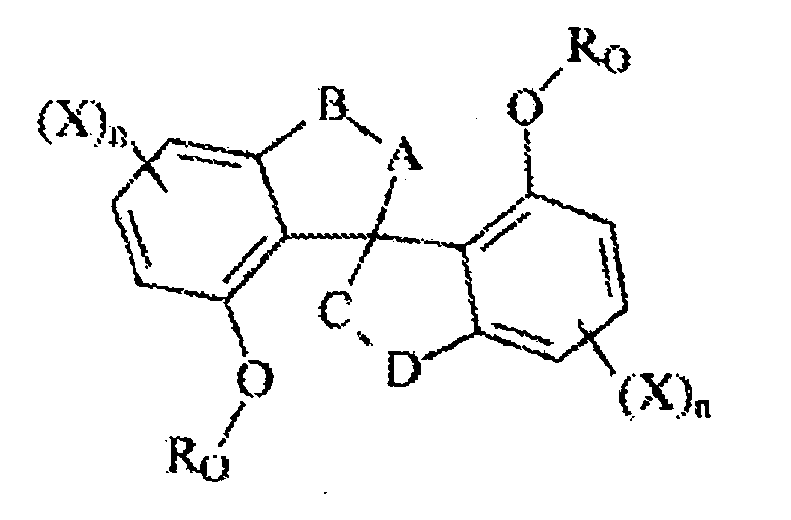
wherein A, B, C, and D are independently selected divalent groups, the X groups are independently selected substituents, the n subscripts are independently 0, 1, 2, or 3, and the RO groups are independently hydrogen or a substituent capping each oxygen, and wherein any two X and/or R0 groups can optionally form a fused ring and the two R0 groups can optionally connect to form a bridge.
wherein A, B, C, and D are independently selected divalent groups, the X groups are independently selected substituents, the n subscripts are independently 0, 1, 2, or 3, and the RO groups are independently hydrogen or a substituent capping each oxygen, and wherein any two X and/or R0 groups can optionally form a fused ring and the two R0 groups can optionally connect to form a bridge.
2. The liquid crystalline composition of claim 1 wherein A, B, C, and D is independently
selected from the group consisting of methylene, oxygen, sulfur, sulfoxyl, sulfonyl,
carbonyl, mono-substituted nitrogen (N-R), and di-substituted carbon (R1-C-R2), wherein R, R1 and R2 are independently hydrogen or a substituent and any two R, R1 and R2 groups on the same ring in said structure can optionally form a fused ring.
3. The liquid crystalline composition of claim 2 wherein A, B, C, and D are independently
methylene or di-substituted carbon (R1-C-R2).
4. The liquid crystalline composition of claim 1 wherein A and B are the same, respectively,
as C and D.
5. The liquid crystalline composition of claim 1 wherein each X substituent is independently
selected from the group consisting of oxygen-containing organic substituents and/or
a carbon-containing substituents.
6. The liquid crystalline composition of claim 5 wherein each X is independently selected
from the group consisting of alkoxy, aryloxy, carboalkyl (O-C(=O)R), carboaryl (O-C(=O)Ar),
carboalkoxy (O-C(=O)OR), carboaryloxy (O-C(=O)OAr), alkyl groups of about 1-20 carbons,
cycloalkyl groups of about 1-20 carbons, aryl groups of about 6-20 carbons, alkaryl
groups of about 6-20 carbons, carboalkoxy (C-C(=O)OR), carboaryloxy (C-C(=O)OAr),
aryl or alkyl ketones (C-C(=O)R) or (C-C(=O)Ar), all either substituted or unsubstituted,
or any two members of the X and R0 groups on a ring may be joined to form a fused ring.
7. The liquid-crystalline composition of claim 1 further comprising a polymer binder
in which domains of the liquid crystals are dispersed.
8. The liquid crystalline composition of claim 1 wherein the liquid crystalline composition
is STN, TN, chiral nematic, or ferroelectric.
9. The liquid crystalline composition of claim 1 wherein the liquid crystalline composition
is chiral nematic.
10. A coated substrate comprising the liquid-crystalline composition of claim 1.
11. A display comprising the liquid-crystalline composition of claim 1 wherein the composition
is disposed between first and second electrodes.
12. The display of claim 11 wherein the liquid-crystalline composition is bistable and
dispersed in the form of domains in a polymeric matrix.
13. The use of a chiral compound of the structure of claim 1 or a polymerized form thereof,
as a chiral dopant in liquid crystals.
14. The use of chiral compounds of claim 1, or a polymerized form thereof, in admixture
with a liquid crystal material in a display, polarizer, color filter, non-absorptive
color filter, liquid crystal pigment for decorative coatings or security markings,
optical switching, optical information storage, or diagnostic or medical compositions.
1. Flüssigkristalline Zusammensetzung, enthaltend als chiralen Dotierstoff in Abmischung
mit einem Flüssigkristallmaterial eine oder mehrere chirale Verbindungen der folgenden
Struktur:

worin A, B, C und D für unabhängig ausgewählte zweiwertige Gruppen stehen, die Gruppen X für unabhängig ausgewählte Substituenten stehen, die Subskripte n unabhängig für 0, 1, 2 oder 3 stehen und die Gruppen RO unabhängig für Wasserstoff oder einen jeden Sauerstoff verkappenden Substituenten stehen und zwei beliebige Gruppen X und/oder RO gegebenenfalls einen anellierten Ring bilden können und die beiden Gruppen RO gegebenenfalls zu einer Brücke verbunden sein können, oder eine polymerisierte Form davon.
worin A, B, C und D für unabhängig ausgewählte zweiwertige Gruppen stehen, die Gruppen X für unabhängig ausgewählte Substituenten stehen, die Subskripte n unabhängig für 0, 1, 2 oder 3 stehen und die Gruppen RO unabhängig für Wasserstoff oder einen jeden Sauerstoff verkappenden Substituenten stehen und zwei beliebige Gruppen X und/oder RO gegebenenfalls einen anellierten Ring bilden können und die beiden Gruppen RO gegebenenfalls zu einer Brücke verbunden sein können, oder eine polymerisierte Form davon.
2. Flüssigkristalline Zusammensetzung nach Anspruch 1, worin A, B, C und D unabhängig
aus der Gruppe bestehend aus Methylen, Sauerstoff, Schwefel, Sulfoxyl, Sulfonyl, Carbonyl,
monosubstituiertem Stickstoff (N-R) und disubstituiertem Kohlenstoff (R1-C-R2) ausgewählt sind, worin R, R1 und R2 unabhängig für Wasserstoff oder einen Substituenten stehen und zwei beliebige Gruppen
R, R1 und R2 am gleichen Ring in der Struktur gegebenenfalls einen anellierten Ring bilden können.
3. Flüssigkristalline Zusammensetzung nach Anspruch 2, bei der A, B, C und D unabhängig
für Methylen oder disubstituierten Kohlenstoff (R1-C-R2) stehen.
4. Flüssigkristalline Zusammensetzung nach Anspruch 1, bei der A und B gleich C bzw.
D sind.
5. Flüssigkristalline Zusammensetzung nach Anspruch 1, bei der jeder Substituent X unabhängig
aus der Gruppe bestehend aus sauerstoffhaltigen organischen Substituenten und/oder
kohlenstoffhaltigen Substituenten ausgewählt ist.
6. Flüssigkristalline Zusammensetzung nach Anspruch 5, bei der jedes X unabhängig aus
der Gruppe bestehend aus Alkoxy, Aryloxy, Carboalkyl (0-C(=O)R), Carboaryl (O-C(=O)Ar),
Carboalkoxy (0-C(=O)OR), Carboaryloxy (O-C(=O)OAr), Alkylgruppen mit etwa 1-20 Kohlenstoffatomen,
Cycloalkylgruppen mit etwa 1-20 Kohlenstoffatomen, Arylgruppen mit etwa 6-20 Kohlenstoffatomen,
Alkarylgruppen mit etwa 6-20 Kohlenstoffatomen, Carboalkoxy (C-C(=O)OR), Carboaryloxy
(C-C(=O)OAr), Aryl- oder Alkylketonen (C-C(=0)R) oder (C-C(=O)Ar), alle entweder substituiert
oder unsubstituiert, ausgewählt ist oder zwei beliebige Mitglieder der Gruppen X und
RO an einem Ring zu einem anellierten Ring verbunden sein können.
7. Flüssigkristalline Zusammensetzung nach Anspruch 1, die ferner ein Polymerbindemittel,
in dem Domänen der Flüssigkristalle dispergiert sind, enthält.
8. Flüssigkristalline Zusammensetzung nach Anspruch 1, die STN, TN, chiral nematisch
oder ferroelektrisch ist.
9. Flüssigkristalline Zusammensetzung nach Anspruch 1, die chiral nematisch ist.
10. Beschichtetes Substrat mit der flüssigkristallinen Zusammensetzung nach Anspruch 1.
11. Anzeige mit der flüssigkristallinen Zusammensetzung nach Anspruch 1, bei der die Zusammensetzung
zwischen einer ersten Elektrode und einer zweiten Elektrode angeordnet ist.
12. Anzeige nach Anspruch 11, bei der die flüssigkristalline Zusammensetzung bistabil
und in Form von Domänen in einer polymeren Matrix dispergiert ist.
13. Verwendung einer chiralen Verbindung der Struktur nach Anspruch 1 oder einer polymerisierten
Form davon als chiraler Dotierstoff in Flüssigkristallen.
14. Verwendung einer chiralen Verbindung nach Anspruch 1 oder einer polymerisierten Form
davon in Abmischung mit einem Flüssigkristallmaterial in einer Anzeige, einem Polarisator,
einem Farbfilter, einem nichtabsorptiven Farbfilter, einem Flüssigkristallpigment
für dekorative Beschichtungen oder Sicherheitsmarkierungen, optischen Schaltungen,
der optischen Informationsspeicherung oder diagnostischen oder medizinischen Zusammensetzungen.
1. Composition cristalline liquide comprenant un dopant chiral, en mélange avec un matériau
de cristaux liquides, un ou plusieurs composés chiraux, ou une forme polymérisée de
ceux-ci, représentés par la structure suivante :
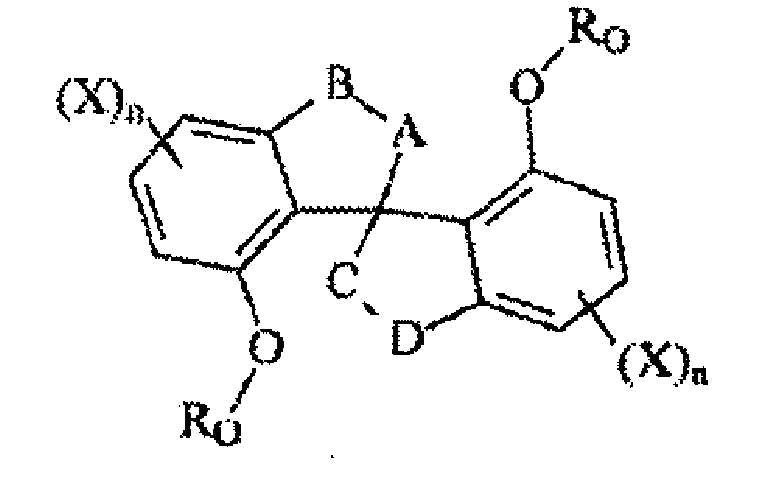
dans laquelle A, B, C et D sont des groupements divalents choisis indépendamment, les groupements X sont des substituants indépendamment choisis, les indices n sont indépendamment 0, 1, 2, ou 3, et les groupements Ro sont indépendamment hydrogène ou un substituant coiffant chaque oxygène, et dans laquelle deux groupements X et/ou Ro quelconques peuvent éventuellement former un cycle condensé et les deux groupements Ro peuvent éventuellement se lier pour former un pont.
dans laquelle A, B, C et D sont des groupements divalents choisis indépendamment, les groupements X sont des substituants indépendamment choisis, les indices n sont indépendamment 0, 1, 2, ou 3, et les groupements Ro sont indépendamment hydrogène ou un substituant coiffant chaque oxygène, et dans laquelle deux groupements X et/ou Ro quelconques peuvent éventuellement former un cycle condensé et les deux groupements Ro peuvent éventuellement se lier pour former un pont.
2. Composition cristalline liquide de la revendication 1, caractérisée en ce que A, B, C et D sont choisis indépendamment dans le groupe constitué de méthylène, oxygène,
soufre, sulfoxyle, sulfonyle, carbonyle, azote mono-substitué (N-R) et carbone di-substitué
(R1-C-R2), où R, R1 et R2 sont indépendamment hydrogène ou un substituant et deux groupements R, R1 et R2 quelconques sur le même cycle dans ladite structure peuvent éventuellement former
un cycle condensé.
3. Composition cristalline liquide de la revendication 2, caractérisée en ce que A, B, C et D sont indépendamment méthylène ou carbone di-substitué (R1-C-R2).
4. Composition cristalline liquide de la revendication 1, caractérisée en ce que A et B sont identiques, respectivement à C et D.
5. Composition cristalline liquide de la revendication 1, caractérisée en ce que chaque substituant X est choisi indépendamment dans le groupe constitué de substituants
organiques oxygénés et/ou de substituants carbonés.
6. Composition cristalline liquide de la revendication 5, caractérisée en ce que chaque substituant X est choisi indépendamment dans le groupe constitué d'alcoxy,
aryloxy, carboalkyle (O-C(=O)R), carboaryle (O-C(=O)Ar), carboalcoxy (O-C(=O)OR),
carboaryloxy (O-C(=O)OAr), de groupements alkyle d'environ 1-20 carbones, de groupements
cycloalkyle d'environ 1-20 carbones, de groupements aryle d'environ 6-20 carbones,
de groupements alkaryle d'environ 6-20 carbones, carboalcoxy (C-C(=O)OR), carboaryloxy
(C-C(=O)OAr), aryl- ou alkyl-cétones (C-C(=O)R) ou (C-C(=0)Ar), tous étant soit substitués
soit non substitués, ou deux membres quelconques des groupements X et Ro sur un cycle
peuvent être liés pour former un cycle condensé.
7. Composition cristalline liquide de la revendication 1, comprenant en outre un lieur
polymère dans lequel des domaines des cristaux liquides sont dispersés.
8. Composition cristalline liquide de la revendication 1, caractérisée en ce que la composition cristalline liquide est de type STN, TN, nématique chiral, ou ferroélectrique.
9. Composition cristalline liquide de la revendication 1, caractérisée en ce que la composition cristalline liquide est de type nématique chiral.
10. Substrat revêtu comprenant la composition cristalline liquide de la revendication
1.
11. Affichage comprenant la composition cristalline liquide de la revendication 1, caractérisé en ce que la composition est disposée entre une première électrode et une seconde électrode.
12. Affichage de la revendication 11, caractérisé en ce que la composition cristalline liquide est bistable et dispersée sous forme de domaines
dans une matrice polymère.
13. Utilisation d'un composé chiral de la structure de la revendication 1, ou d'une forme
polymérisée de celui-ci, en tant que dopant chiral dans des cristaux liquides.
14. Utilisation de composés chiraux de la revendication 1, ou d'une forme polymérisée
de ceux-ci, en mélange avec un matériau de cristaux liquides dans un affichage, un
polariseur, un filtre couleur, un filtre couleur non absorbant, un pigment de cristaux
liquides pour des revêtements décoratifs ou des marquages de sécurité, un commutateur
optique, un stockage optique d'informations, ou des compositions de diagnostic ou
médicales.
REFERENCES CITED IN THE DESCRIPTION
This list of references cited by the applicant is for the reader's convenience only. It does not form part of the European patent document. Even though great care has been taken in compiling the references, errors or omissions cannot be excluded and the EPO disclaims all liability in this regard.
Patent documents cited in the description
Non-patent literature cited in the description
- G. GottarelliG. SpadaMol. Cryst. Liq. Crys., 1985, vol. 123, 377- [0002]
- G. SpadaG. ProniEnantiomer, 1998, vol. 3, 301- [0002]
- Z. DogicS. FradenLangmuir, 2000, vol. 16, 7820- [0003]
- T. TanakaM. MiyaguchiR. MochisukiS. TanakaM. OkamotoY. KitajimaT. MiyazakiHeterocycles, 1987, vol. 25, 1463-84 [0027]
- V. BirmanA. RheingoldK-C. LamTetrahedron: Asymmetry, 1999, vol. 10, 1125-131 [0027]
- J-H. ZhangJ. LiaoX. CuiK-B. YuJ. ZhuJ.G. DengS.F. ZhuL.X. WangO.L. ZhouL.W. ChungTetrahedron: Asymmetry, 2002, vol. 13, 131363-1366 [0027]