|
(11) | EP 1 689 404 B9 |

| (12) | CORRECTED EUROPEAN PATENT SPECIFICATION |
| Note: Bibliography reflects the latest situation |
|
|
| (54) |
COMBINATION OF ET-743 WITH 5-FLUOROURACIL PRO-DRUGS FOR THE TREATMENT OF CANCER KOMBINATION VON ET-743 MIT 5-FLUOROURACIL PRO-DRUGS ZUR BEHANDLUNG VON KREBS COMBINAISON DU ET-743 AVEC DES PRO-DRUGS DU 5-FLUOROURACILE POUR LE TRAITEMENT DU CANCER |
|
|
|||||||||||||||||||||||||||||||||||
| Note: Within nine months from the publication of the mention of the grant of the European patent, any person may give notice to the European Patent Office of opposition to the European patent granted. Notice of opposition shall be filed in a written reasoned statement. It shall not be deemed to have been filed until the opposition fee has been paid. (Art. 99(1) European Patent Convention). |
[0001] The invention relates to a combination of medicaments, more particularly a combination of medicaments for use in the treatment of cancer.
FIELD OF THE INVENTION
[0002] The present invention is directed to the use of ecteinascidin 743 in combination with a 5-fluorouracil pro-drug for the treatment of cancer.
BACKGROUND OF THE INVENTION
[0003] Cancer comprises a group of malignant neoplasms that can be divided into two categories, carcinoma, comprising a majority of the cases observed in the clinics, and other less frequent cancers, which include leukemia, lymphoma, central nervous system tumors and sarcoma. Carcinomas have their origin in epithelial tissues while sarcomas develop from connective tissues and those structures that had their origin in mesoderm tissues. Sarcomas can affect, for instance, muscle or bone and occur in the bones, bladder, kidneys, liver, lung, parotid, spleen, etc.
[0004] Cancer is invasive and tends to metastasise to new sites. It spreads directly into surrounding tissues and also may be disseminated through the lymphatic and circulatory systems.
[0005] Many treatments are available for cancer, including surgery and radiation for localised disease, and drugs. However, the efficacy of available treatments on many cancer types is limited, and new, improved forms of treatment showing clinical benefit are needed.
[0006] This is especially true for those patients presenting with advanced and/or metastatic disease. It is also true for patients relapsing with progressive disease after having been previously treated with established therapies for which further treatment with the same therapy is mostly ineffective due to acquisition of resistance or to limitations in administration of the therapies due to associated toxicities.
[0007] Chemotherapy plays a significant part in cancer treatment, as it is required for treatment of advanced cancers with distant metastasis and often helpful for tumor reduction before surgery. Many anti-cancer drugs have been developed based on various modes of action.
[0008] The most commonly used types of anticancer agents include: DNA-alkylating agents (for example, cyclophosphamide, ifosfamide), antimetabolites (for example, methotrexate, a folate antagonist, and 5-fluorouracil, a pyrimidine antagonist), microtubule disrupters (for example, vincristine, vinblastine, paclitaxel), DNA intercalators (for example, doxorubicin, daunomycin, cisplatin), and hormone therapy (for example, tamoxifen, flutamide). The ideal antineoplastic drug would kill cancer cells selectively, with a wide therapeutic index relative to its toxicity towards non-malignant cells. It would also retain its efficacy against malignant cells, even after prolonged exposure to the drug.
[0009] Unfortunately, none of the current chemotherapies possess an ideal profile. Most possess very narrow therapeutic indexes and, in practically every instance, cancerous cells exposed to slightly sublethal concentrations of a chemotherapeutic agent will develop resistance to such an agent, and quite often cross-resistance to several other antineoplastic agents.
[0010] The ecteinascidins (herein abbreviated ETs) are exceedingly potent antitumor agents isolated from the marine tunicate Ecteinascidia turbinata. Several ecteinascidins have been reported previously in the patent and scientific literature. See, for example U.S. Pat. No. 5,089,273, which describes novel compounds extracted from the tropical marine invertebrate, Ecteinascidia turbinata, and designated therein as ecteinascidins 729, 743, 745, 759A, 759B and 770. These compounds are useful as antibacterial and/or antitumor agents in mammals. U.S. Pat. No. 5,478,932 describes ecteinascidins isolated from the Caribbean tunicate Ecteinascidia turbinata, which provide in vivo protection against P388 lymphoma, B16 melanoma, M5076 ovarian sarcoma, Lewis lung carcinoma, and the LX-1 human lung and MX-1 human mammary carcinoma xenografts.
[0011] One of the ETs, ecteinascidin-743 (ET-743), is a novel tetrahydroisoquinoline alkaloid with considerable antitumor activity in murine and human tumors in vitro and in vivo, and is presently in clinical trials. ET-743 possesses potent antineoplastic activity against a variety of human tumor xenografts grown in athymic mice, including melanoma and ovarian and breast carcinoma.
[0012] A clinical development program of ET-743 in cancer patients was started with phase I studies investigating 1-hour, 3-hour, 24-hour and 72-hour intravenous infusion schedules and a 1 hour daily x 5 (dx5) schedule. Promising responses were observed in patients with sarcoma and breast and ovarian carcinoma. Therefore this new drug is currently under intense investigation in several phase II clinical trials in cancer patients with a variety of neoplastic diseases. Further detail on the use of ET-743 for the treatment of the human body for cancer is given in WO 0069441.
[0013] A recent review of ET-743, its chemistry, mechanism of action and preclinical and clinical development can be found in van Kesteren, Ch- et al, 2003, Anti-Cancer Drugs, 14 (7), pages 487-502: "Yondelis (trabectedin, ET-743}: the development of an anticancer agent of marine origin", and references therein.
[0014] Combination therapy using drugs with different mechanisms of action is an accepted method of treatment which helps prevent development of resistance by the treated turnor. In vitro activity of ET-743 in combination with other anticancer agents has been studied, see for example WO02 36135.
[0015] WO 03/039571 discloses the possibility of the use of several drugs in combination with ET-743, including 5- fluorouracil.
[0016] US 5,472,949 describes 5- fluorouracil and its precursors; there is no suggestion that the drug may be used in combination with ET-743.
[0017] Takahashi et al, Cancer Research, 2002, 62 (23) 6909-6915 describes in vitro experiments using combinations of ET-743 and other drugs, including 5- fluorouracil. The publication notes an antagonistic cytotoxicity when administering ET-743 and 5-FU.
[0018] It is an object of the invention to provide the use of an efficacious combination product for treatment of cancer.
SUMMARY OF THE INVENTION
[0019] According to the present invention, we provide the use of ET-743 in combination with an effective amount of a 5-fluorouracil pro-drug for the preparation of a medicament for the treatment of cancer in accordance with claim 1. Typical dosing protocols for the combination therapy are provided, where the 5-fluorouracil is given in the form of a pro-drug, especially an oral pro-drug exemplifies by capecitabine (Xeloda®). From phase 1 clinical trials, we have determined that a combination of ET-743 and capecitabine is tolerable and feasible, with evidence of antitumor activity.
[0020] In a further embodiment the pro-drug of 5-fluorouracil, is notably capecitabine. The ET-743 and pro-drug of 5-fluorouracil are preferably administered sequentially, with multiple oral administrations of the pro-drug of 5-fluorouracil following infusion of ET-743.
DETAILED DESCRIPTION
[0022] As used herein, the term "ET-743" also covers any pharmaceutically acceptable salt, ester, solvate, hydrate or a prodrug compound which, upon administration to the recipient is capable of providing (directly or indirectly) the compound ET-743. The preparation of salts and other derivatives, and prodrugs, can be carried out by methods known in the art.
[0023] ET-743 is typically supplied and stored as a sterile lyophilized product, with ET-743 and excipient in a formulation adequate for therapeutic use, in particular a formulation containing mannitol and a phosphate salt buffered to an adequate pH.
[0024] It is currently preferred to administer the ET-743 by infusion. The infusing step is typically repeated on a cyclic basis, which may be repeated as appropriate over for instance 1 to 35 cycles. The cycle includes a phase of infusing ET-743, and usually also a phase of not infusing ET-743. Typically the cycle is worked out in weeks, and thus the cycle normally comprises one or more weeks of an ET-743 infusion phase, and one or more weeks to complete the cycle. In one embodiment a cycle of 3 weeks is preferred, alternatively it can be from 2 to 6 weeks. The infusion phase can itself be a single administration in each cycle of say 1 to 72 hours, more usually of about 1, 3 or 24 hours, or infusion on a daily basis in the infusion phase of the cycle for preferably 1 to 5 hours, especially 1 or 3 hours. Thus, for example, the ET-743 might be administered on each of the first five days of a 3 week cycle. We currently prefer a single administration at the start of each cycle. Preferably the infusion time is about 1, 3 or 24 hour. In one embodiment an infusion time of about 3 hours is preferred.
[0025] The dose will be selected according to the dosing schedule, having regard to the existing data on Dose Limiting Toxicity, on which see for example the incorporated WO patent specifications, and also see van Kesteren, Ch. et al., 2003, Anti-Cancer Drugs, 14 (7), pages 487-502: "Yondelis (trabectedin, ET-743): The development of an anticancer agent of marine origin".
[0026] For a single administration of ET-743 at the start of each cycle, we prefer a dose in the range 0.2 to 2 mg/m2, more preferably 0.4 to 1.5 mg/m2, and most preferably 0.7 to 1.2 mg/m2. More generally, for other cycles which involve a single administration at intervals of 1 week or more, the amount of ET-743 is ordinarily in the range 0.7 to 1.2 mg/m2. Lower amounts are suitable where there is repeat dosing on a daily schedule.
[0027] Most preferably, the ET-743 is given by infusion at a dose of about 0.75 mg/m2- 1.4 mg/m2, preferably about 0.9 mg/m2- 1.2 mg/m2, most preferably about 0.75 mg/m2 or about 0.9 mg/m2 on day 1 of a 3 week cycle.
[0028] As noted in the incorporated article by van Kesteren, the combination of ET-743 with dexamethasone gives unexpected advantages. It has a role in hepatic prophylaxis. We therefore prefer to administer dexamethasone to the patient, typically at around the time of infusing the ET-743. For example, we prefer to give dexamethasone on the day before ET-743, and/or the day after ET-743. The administration of dexamethasone can be extended, for example to more than one day following ET-743. In particular, we prefer to give dexamethasone at days -1, 2, 3 and 4 relative to a single administration of ET-743 on day 1 of a cycle.
[0029] The ET-743 is administered as part of a combination therapy with a pro-drug of 5-fluorouracil, preferably capecitabine.
[0031] Capecitabine is indicated for the treatment of certain cancers. Information is available on the website www.xeloda.com, and the extensive scientific literature on capecitabine. Capecitabine is a pro-drug which is readily absorbed from the gastrointestinal tract. In the liver, a 60 kDa carboxylesterase hydrolyses much of the compound to 5'-deoxy-5-fluorocytidine (5'- DFCR). Cytidine deaminase, an enzyme found in most tissues, including tumors, subsequently converts 5'-DFCR to 5'-deoxy-5-fluorouridine (5'-DFUR). The enzyme thymidine phosphorylase (dThdPase) then hydrolyses 5'-DFUR to the active drug 5-fluorouracil (5-FU). Many tissues throughout the body express thymidine phosphorylase. Some human carcinomas express this enzyme in higher concentrations than surrounding normal tissues.
[0032] Capecitabine is administered orally as part of the cycle of treating the patient. In the present invention we prefer repeat doses on a daily basis as part of the cycle. We prefer that capecitabine is given for a majority of the days of the cycle, for example for about 2/3, 3/4 or some other fraction of the cycle. For a cycle of 3 weeks, we prefer administration for 14 days, especially days 2 to 15 of a 3 week cycle. preferably commencement of administration of capecitabine is on a day after ET-743 administration.
[0033] In one embodiment the dosage amount of capecitabine is preferably it in the range from 500 to 3000 mg/m2/day, more preferably 1500 to 2500 mg/m2/day. At this stage, we currently prefer a dose of 2000 mg/m2/day. This dosage can be administered in fractions, for example in a twice-daily regimen.
[0034] Most preferably, the capecitabine is given orally at a dose of about 2000 mg/m2/day on days 2 to 15 of each cycle.
[0035] Other pro-drugs of 5-fluorouracil can be employed in place of capecitabine. Such pro-drugs include other compounds which metabolize to 5'-deoxy-5-fluorouridine, and thence to 5-fluorouracil. For example, reference is made to US 4,996,891 to Fujiu et al, and US 5,472,949 to Arasaki et al. In particular as disclosed in claim 1, for the present invention, we prefer that the prodrug is a compound of claim 1 of US 4,966,891 or a compound of claim 1 of US 5,472,949.
[0036] Depending on the type of tumor and the developmental stage of the disease, the treaments of the invention are useful in preventing the risk of developing tumors, in promoting tumor regression, in stopping tumor growth and/or in preventing metastasis. In particular, the method of the invention is suited for human patients, especially those who are relapsing or refractory to previous chemotherapy. First line therapy is also envisaged.
[0037] Preferably, the combination therapy is used according to the above schedules and dosages for the treatment of sarcoma, osteosarcoma, therapy is also envisaged.
[0038] Preferably, the combination therapy is used according to the above schedules and dosages for the treatment of sarcoma, osteosarcoma, ovarian cancer, breast cancer, melanoma, vaginal cancer, gastric cancer, adenocarcinoma, colorectal cancer, mesothelioma, renal cancer, endometrial cancer and lung cancer. Most preferably the patients are breast cancer patients.
EXAMPLE: Phase I Clinical trial
[0039] The objective of this study was to determine the maximum tolerated dose (MTD) of the combination of ET-743 administered over 3 hours intravenously on Day 1 and capecitabine orally administered twice daily on Days 2-15. An additional objective was to evaluate the safety profile of this regimen.
[0040] The patients' enrolment to the study was carried out according to the standard inclusion criteria, including creatinine and liver function tests within normal limits and ECOG performance status 0-1. In addition, standard exclusion criteria were also followed including known CNS metastasis and peripheral neuropathy > grade 1.
[0041] Dose-limiting toxicity (DLT) was defined as:
- Grade 3-4 non-hematologic toxicity, excluding nausea & vomiting (N/V) in the absence of optimal supportive care, grade 3 transaminitis < 7 days, and hand-foot syndrome.
- Grade 4 neutropenia x 5 days or with fever/sepsis.
- Treatment delay of more than 21 days.
- Platelets < 25,000.
[0042] Drug administration was conducted on 21-day cycles. ET-743 was administered as a 3-hour infusion i.v. on day 1 of each cycle (every 3 weeks). Dexamethasone was administered from day -1 to day 3. Capecitabine was orally administered twice-daily on days 2-15 every 3 weeks. In addition, capecitabine was administered at the fixed dose of 2000 mg/m2/day, while ET-743 was started at 400 µg/m2 and escalated thereafter in subsequent cohorts of at least 3 new cases.
[0043] Table 1 shows the patient characteristics.
Table 1
| Number of patients (courses) | 14 (50) |
| Median courses/patient (range) | 2 (1-10) |
| Male:female | 5:9 |
| PS 0:1 | 3:11 |
| Median age (range) | 52 (19-70) |
| Prior chemotherapy (none) | 13 (1) |
| Tumor types | |
| sarcoma | 7 |
| breast, ovarian, cervical, cholangiocarcinoma, gastric, melanoma, vaginal, adenocarcinoma | 1 each |
[0044] Table 2 shows the number of patients exposed in each dose escalation level and the dose limiting toxicities observed.
Table 2
| Cohort | ET-743 (mg/m2) | Capecitabine (mg/m2) | # Patients | # cycles |
| 1 | 0.4 | 2000 | 3 | 13 |
| 2 | 0.6 | 2000 | 6* | 23 |
| 3 | 0.75 | 2000 | 3 | 10 |
| 4 | 0.9 | 2000 | 2** | 4 |
| *DLT: grade 3 mucositis and febrile neutropenia **DLT: grade 3 nausea and dehydration |
[0045] Table 3 shows the frequently reported drug-related hematologic toxicities. In order to define the toxicity grade, NCI common criteria is used.
Table 3
(Total courses administered: 50)| Grade/Number of Cycless | ||
| 3 | 4 | |
| Neutropenia | 2 | 1 |
| Thrombocytopenia | 0 | 0 |
| Anemia | 1 | 0 |
[0046] Table 4 shows the frequently reported drug-related non-hematologic toxicities. In order to define the toxicity grade, NCI common criteria is used.
Table 4
(Total courses administered: 50)| Grade/Number of Cycles | ||||
| 1 | 2 | 3 | 4 | |
| Nausea/Vomiting | 25/11 | 0 | 4/2 | 0 |
| Fatigue | 15 | 7 | 1 | 0 |
| Transaminitis | 29 | 7 | 0 | 0 |
| Hand-Foot Syndrome | 10 | 9 | 2 | 0 |
| Diarrhea/Constipation | 8/13 | 1/3 | 4/0 | 0 |
| Alk Phos/Bilirubin | 11/6 | 1/5 | 0 | 0 |
| Mucositis | 4 | 1 | 1 | 0 |
[0047] Regarding the antitumoral activity of the combination, 13 of 14 patients were evaluable for response (1 patient were removed from study for toxicity after 1 cycle). Seven patients (4 sarcoma, 1 each gastric, breast, vaginal, adenocarcinoma) had stable disease after 10, 6, 5,2, 3, 4, and 3 cycles. One patient with cholangiocarcinoma had a partial response after 8 cycles. Five patients progressed after 1- 2 cycles
1. The use of ET-743 in combination with an effective therapeutic amount of a 5-fluorouracil
pro-drug, selected from capecitabine or
a compound of the formula:
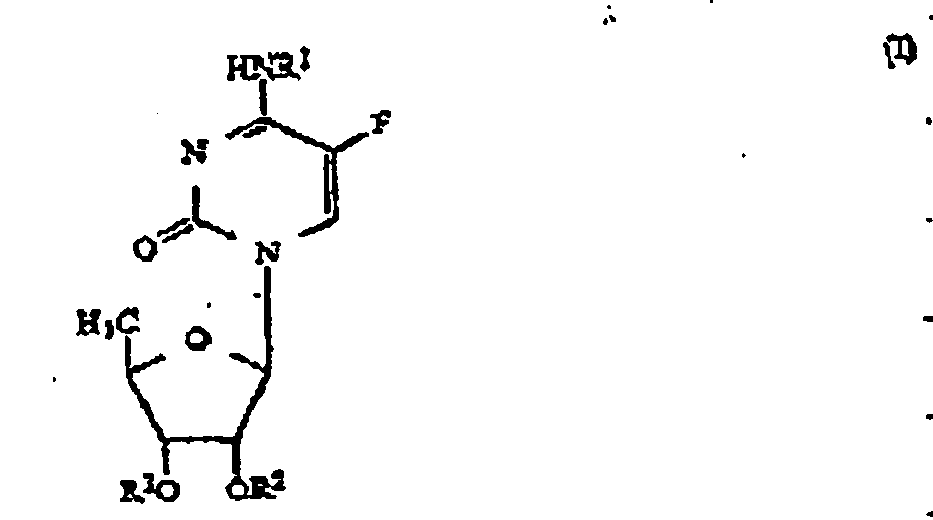
wherin R1, R2 and R3 are each independently hydrogen, or an easily hydrolyzable radical under physiological conditions, with the proviso that, at least one of R1, R2, or R3 is an easily hydrolyzable radical under physiological conditions;
as well as hydrates or solvates of the compounds of the general formula (I);
or
a compound of formula (II)
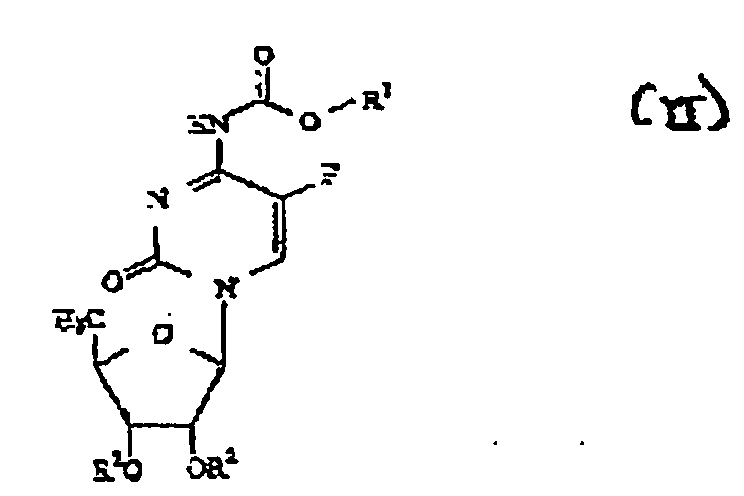
wherein R1 is a saturated straight or branched hydrocarbon radical wherein the number of carbon atoms in the longest straight chain of this hydrocarbon radical ranges from three to seven, or is a radical of the formula —(CH2)n—Y wherein Y is a cyclohexyl radical, a C1-C4 alkoxy radical or a phenyl radical and wherein when Y is a cycloharyl radical n is an integer from 0 to 4, and when Y is C1-C4 alkoxy radical or a phenyl radical n is an integer from 2 to 4, and R2 is a hydrogen atom or a radical easily hydrolyzable under physiological conditions,
or a hydrate or solvate thereof,
for the preparation of a medicament for the treatment of a human body having cancer.
a compound of the formula:
wherin R1, R2 and R3 are each independently hydrogen, or an easily hydrolyzable radical under physiological conditions, with the proviso that, at least one of R1, R2, or R3 is an easily hydrolyzable radical under physiological conditions;
as well as hydrates or solvates of the compounds of the general formula (I);
or
a compound of formula (II)
wherein R1 is a saturated straight or branched hydrocarbon radical wherein the number of carbon atoms in the longest straight chain of this hydrocarbon radical ranges from three to seven, or is a radical of the formula —(CH2)n—Y wherein Y is a cyclohexyl radical, a C1-C4 alkoxy radical or a phenyl radical and wherein when Y is a cycloharyl radical n is an integer from 0 to 4, and when Y is C1-C4 alkoxy radical or a phenyl radical n is an integer from 2 to 4, and R2 is a hydrogen atom or a radical easily hydrolyzable under physiological conditions,
or a hydrate or solvate thereof,
for the preparation of a medicament for the treatment of a human body having cancer.
2. The use according to claim 1, wherein ET-743 is to be administered in combination
with capecitabine.
3. The use according to claim 1 or claim 2, wherein ET-743 is to be administered in a
dose range between 0.75mg/m2 and 1.4mg/m2.
4. The use according to claim 2, wherein capecitabine and ET-743 are provided as separate
medicaments for administration at different times.
5. The use according to any preceding claim wherein ET-743 is to be administered in a
dosage of about 0.9 mg/m2- 1.2 mg/m2.
6. The use according to any of claims 1 to 4 wherein ET-743 is to be administered in
a dosage of about 0.9 mg/m2 on day 1 of a 3 week cycle.
7. The use according to any of claims 4 to 6, wherein capecitabine is to be administered
in a dose range between 1500 to 2500 mg/m2/day.
8. The use according to any preceding claim wherein capecitabine is to be administered
in a dosage of about 2000 mg/m2/day.
9. The use according to any of claims 1 to 7 wherein capecitabine is to be administered
in a dosage of about 1600 mg/m2/day.
10. The use according to claim 9, wherein capecitabine is to be administered in a dosage
about 1600 mg/m2/day and ET-743 is administered in a dosage about 0.9 mg/m2.
11. The use according to claim 1 or claim 2, wherein capecitabine is to be orally administered.
12. The use according to claim 1, wherein ET-743 is to be administered by intravenous
injection.
13. The use according to claim 12, wherein the infusion time for intravenous injection
of ET-743 is up to 24 hours.
14. The use according to claim 13, wherein the infusion time for intravenous injection
of ET-743 is about 3 hours for ET-743.
15. The use according to claim 12, where the infusions of ET-743 are carried out at an
interval of 1 to 6 weeks.
16. The use according to claim 15, wherein the infusion of ET-743 is carried out once
every 21 days.
17. The use according to claim 16, wherein the infusion of ET-743 is carried out on day
1 and the administration of capecitabine from days 2 to 15, every 21 days.
18. The use according to claim 17, wherein capecitabine is to be administered twice-daily.
19. The use according to any preceding claim, in which the patient has a cancer selected
from sarcoma, osteosarcoma, ovarian cancer, breast cancer, melanoma, vaginal cancer,
colorectal cancer, gastric cancer, adenocarcinoma, mesothelioma, renal cancer, endometrial
cancer and lung cancer.
20. The use according to claim 19, in which the patient has a cancer selected from sarcoma,
breast cancer, gastric cancer, vaginal cancer and adenocarcinoma.
1. Verwendung von ET-743 in Kombination mit einer therapeutisch wirksamen Menge eines
5-Fluoracil-Prodrugs bzw. Vor-Medikaments, das unter Capecitabin oder einer Verbindung
mit der Formel
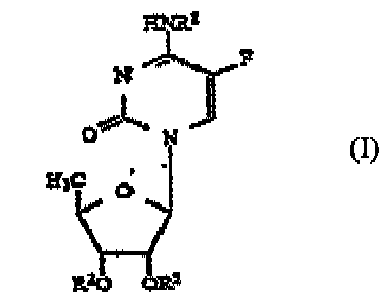
ausgewählt ist, wobei R1, R2 und R3 jeweils unabhängig voneinander für Wasserstoff oder ein unter physiologischen Bedingungen leicht hydrolysierbares Radikal stehen, unter dem Vorbehalt, daß mindestens eine der Komponenten R1, R2 oder R3 ein unter physiologischen Bedingungen leicht hydrolysierbares Radikal ist;
sowie von Hydraten oder Solvaten der Verbindungen mit der allgemeinen Formel (I);
oder einer Verbindung mit der Formel (II)
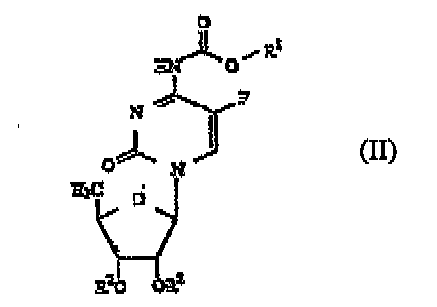
wobei R1 ein gesättigtes geradkettiges oder verzweigtes Kohlenwasserstoffradikal, wobei die Anzahl von Kohlenstoffatomen in der längsten geraden Kette dieses Kohlenwasserstoffradikals im Bereich von drei bis sieben liegt, oder ein Radikal mit der Formel -(CH2)-Y ist, wobei Y ein Cyclohexylradikal, ein C1-C4-Alkoxyradikal oder ein Phenylradikal ist, und wobei, wenn Y ein Cyclohexylradikal ist, n eine ganze Zahl von 0 bis 4 ist, und wenn Y ein C1-C4-Alkoxyradikal oder ein Phenylradikal ist, n eine ganze Zahl von 2 bis 4 ist, und wobei R2 ein Wasserstoffatom oder ein unter physiologischen Bedingungen leicht hydrolysierbares Radikal ist,
oder eines Hydrats oder Solvats davon,
für die Herstellung eines Medikaments zur Behandlung eines an Krebs erkrankten menschlichen Körpers.
ausgewählt ist, wobei R1, R2 und R3 jeweils unabhängig voneinander für Wasserstoff oder ein unter physiologischen Bedingungen leicht hydrolysierbares Radikal stehen, unter dem Vorbehalt, daß mindestens eine der Komponenten R1, R2 oder R3 ein unter physiologischen Bedingungen leicht hydrolysierbares Radikal ist;
sowie von Hydraten oder Solvaten der Verbindungen mit der allgemeinen Formel (I);
oder einer Verbindung mit der Formel (II)
wobei R1 ein gesättigtes geradkettiges oder verzweigtes Kohlenwasserstoffradikal, wobei die Anzahl von Kohlenstoffatomen in der längsten geraden Kette dieses Kohlenwasserstoffradikals im Bereich von drei bis sieben liegt, oder ein Radikal mit der Formel -(CH2)-Y ist, wobei Y ein Cyclohexylradikal, ein C1-C4-Alkoxyradikal oder ein Phenylradikal ist, und wobei, wenn Y ein Cyclohexylradikal ist, n eine ganze Zahl von 0 bis 4 ist, und wenn Y ein C1-C4-Alkoxyradikal oder ein Phenylradikal ist, n eine ganze Zahl von 2 bis 4 ist, und wobei R2 ein Wasserstoffatom oder ein unter physiologischen Bedingungen leicht hydrolysierbares Radikal ist,
oder eines Hydrats oder Solvats davon,
für die Herstellung eines Medikaments zur Behandlung eines an Krebs erkrankten menschlichen Körpers.
2. Verwendung nach Anspruch 1, wobei ET-743 in Kombination mit Capecitabin zu verabreichen
ist.
3. Verwendung nach Anspruch 1 oder Anspruch 2, wobei ET-7A3 in einem Dosisbereich zwischen
0,75 mg/m2 und 1,4 mg/m2 zu verabreichen ist.
4. Verwendung nach Anspruch 2, wobei Capecitabin und ET-743 als getrennte Medikamente
zur Verabreichung zu verschiedenen Zeiten bereitgestellt werden.
5. Verwendung nach einem der vorstehenden Ansprüche, wobei ET-743 in einer Dosierung
von etwa 0,9 mg/m2 -1,2 mg/m2 zu verabreichen ist.
6. Verwendung nach einem der Ansprüche 1 bis 4, wobei ET-743 in einer Dosierung von etwa
0,9 mg/m2 am Tag 1 eines dreiwöchigen Zyklus zu verabreichen ist.
7. Verwendung nach einem der Ansprüche 4 bis 6, wobei Capecitabin in einem Dosisbereich
zwischen 1500 und 2500 mg/m2/Tag zu verabreichen ist.
8. Verwendung nach einem der vorstehenden Ansprüche, wobei Capecitabin in einer Dosis
von etwa 2000 mg/m2/Tag zu verabreichen ist.
9. Verwendung nach einem der Ansprüche 1 bis 7, wobei Capecitabin in einer Dosis von
etwa 1600 mg/m2/Tag zu verabreichen ist.
10. Verwendung nach Anspruch 9, wobei Capecitabin in einer Dosis von etwa 1600 mg/m2/Tag zu verabreichen ist und ET-743 in einer Dosis von etwa 0,9 mg/m2 verabreicht wird.
11. Verwendung nach Anspruch 1 oder Anspruch 2, wobei Capecitabin oral zu verabreichen
ist.
12. Verwendung nach Anspruch 1, wobei ET-743 durch intravenöse Injektion zu verabreichen
ist.
13. Verwendung nach Anspruch 12, wobei die Infusionszeit für die intravenöse Injektion
von ET-743 bis zu 24 Stunden beträgt.
14. Verwendung nach Anspruch 13, wobei die Infusionszeit für die intravenöse Injektion
von ET-743 etwa 3 Stunden für ET-743 beträgt.
15. Verwendung nach Anspruch 12, wobei die Infusionen von ET-743 in einem Intervall von
1 bis 6 Wochen ausgeführt werden.
16. Verwendung nach Anspruch 15, wobei die Infusion von ET-743 alle 21 Tage ausgeführt
wird.
17. Verwendung nach Anspruch 16, wobei alle 21 Tage die Infusion von ET-743 am Tag 1 und
die Verabreichung von Capecitabin an den Tagen 2 bis 15 ausgeführt werden.
18. Verwendung nach Anspruch 17, wobei Capecitabin zweimal täglich zu verabreichen ist.
19. Verwendung nach einem der vorstehenden Ansprüche, wobei der Patient an einem Karzinom
leidet, das unter Sarkom, Osteosarkom, Ovarialkarzinom, Mammakarzinom, Melanom, Vaginakarzinom,
Kolorektalkarzinom, Magenkarzinom, Adenokarzinom, Mesotheliom, Nierenkarzinom, Endometriumkarzinom
und Lungenkarzinom ausgewählt ist.
20. Verwendung nach Anspruch 19, wobei der Patient an einem Karzinom leidet, das unter
Sarkom, Mammakarzinom, Magenkarzinom, Vaginakarzinom und Adenokarzinom ausgewählt
ist.
1. Utilisation de ET-743 en combinaison avec une quantité thérapeutique efficace d'un
promédicament de 5-fluorouracile, choisi parmi la capécitabine ou
un composé de la formule:
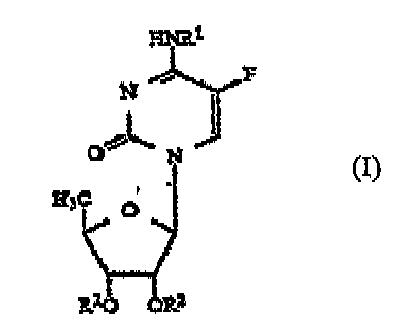
dans laquelle R1, R2 et R3 sont chacun indépendamment un hydrogène ou un radical facilement hydrolysable sous des conditions physiologiques, sous réserve que au moins un parmi R1, R2 ou R3 soit un radical facilement hydrolysable sous des conditions physiologiques;
aussi bien que des hydrates ou des solvates des composés de la formule générale (I);
ou
un composé de la formule (II):
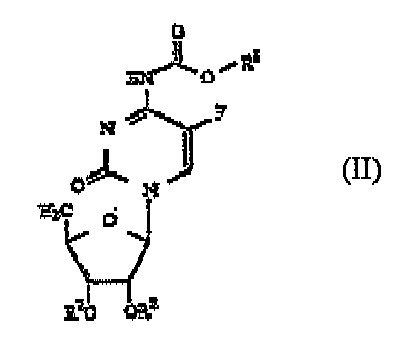
dans laquelle R1 est un radical hydrocarbure droit ou ramifié saturé où le nombre d'atomes de carbone dans la chaîne droite la plus longue de ce radical hydrocarbure varie de trois à sept ou est un radical de la formule -(CH2)n-Y où Y est un radical cyclohexyle, un radical alcoxy C1-C4 ou un radical phényle et
où lorsque Y est un radical cyclohexyle, n est un nombre entier de 0 à 4 et lorsque Y est un radical alcoxy C1-C4 ou un radical phényle, n est un nombre entier de 2 à 4, et R2 est un atome d'hydrogène ou un radical facilement hydrolysable sous des conditions physiologiques,
ou un hydrate ou un solvate de celui-ci,
pour la préparation d'un médicament pour le traitement d'un corps humain présentant un cancer.
un composé de la formule:
dans laquelle R1, R2 et R3 sont chacun indépendamment un hydrogène ou un radical facilement hydrolysable sous des conditions physiologiques, sous réserve que au moins un parmi R1, R2 ou R3 soit un radical facilement hydrolysable sous des conditions physiologiques;
aussi bien que des hydrates ou des solvates des composés de la formule générale (I);
ou
un composé de la formule (II):
dans laquelle R1 est un radical hydrocarbure droit ou ramifié saturé où le nombre d'atomes de carbone dans la chaîne droite la plus longue de ce radical hydrocarbure varie de trois à sept ou est un radical de la formule -(CH2)n-Y où Y est un radical cyclohexyle, un radical alcoxy C1-C4 ou un radical phényle et
où lorsque Y est un radical cyclohexyle, n est un nombre entier de 0 à 4 et lorsque Y est un radical alcoxy C1-C4 ou un radical phényle, n est un nombre entier de 2 à 4, et R2 est un atome d'hydrogène ou un radical facilement hydrolysable sous des conditions physiologiques,
ou un hydrate ou un solvate de celui-ci,
pour la préparation d'un médicament pour le traitement d'un corps humain présentant un cancer.
2. Utilisation suivant la revendication 1, dans laquelle ET-743 est à administrer en
combinaison avec la capécitabine.
3. Utilisation suivant la revendication 1 ou la revendication 2, dans laquelle ET-743
est à administrer dans une gamme de dose entre 0,75 mg/m2 et 1,4 mg/m2,
4. Utilisation suivant la revendication 2, dans laquelle la capécitabine et ET-743 sont
fournis sous forme de médicaments séparés pour une administration à des temps différents.
5. Utilisation suivant l'une quelconque des revendications précédentes, dans laquelle
ET-743 est à administrer dans une dose d'environ 0,9 mg/m2-1,2 mg/m2.
6. Utilisation suivant l'une quelconque des revendications 1 à 4, dans laquelle ET-743
est à administrer dans une dose d'environ 0,9 mg/m2 le jour 1 d'un cycle de 3 semaines.
7. Utilisation suivant l'une quelconque des revendications 4 à 6, dans laquelle la capécitabine
est à administrer dans une gamme de dose entre 1500 et 2500 mg/m2/jour.
8. Utilisation suivant l'une quelconque des revendications précédentes, dans laquelle
la capécitabine est à administrer dans une dose d'environ 2000 mg/m2/jour.
9. Utilisation suivant l'une quelconque des revendications 1 à 7, dans laquelle la capécitabine
est à administrer dans une dose d'environ 1600 mg/m2/jour.
10. Utilisation suivant la revendication 9, dans laquelle la capécitabine est à administrer
dans une dose d'environ 1600 mg/m2/jour et ET-743 est à administrer dans une dose d'environ 0,9 mg/m2.
11. Utilisation suivant la revendication 1 ou la revendication 2, dans laquelle la capécitabine
est à administrer oralement.
12. Utilisation suivant la revendication 1, dans laquelle ET-743 est à administrer par
une injection intraveineuse.
13. Utilisation suivant la revendication 12, dans laquelle le temps de perfusion pour
l'injection intraveineuse de ET-743 est jusqu'à 24 heures.
14. Utilisation suivant la revendication 13, dans laquelle le temps de perfusion pour
l'injection intraveineuse de ET-743 est d'environ 3 heures pour ET-743.
15. Utilisation suivant la revendication 12, dans laquelle les perfusions de ET-743 sont
réalisées à un intervalle de 1 à 6 semaines.
16. Utilisation suivant la revendication 15, dans laquelle la perfusion de ET-743 est
réalisée une fois tous les 21 jours.
17. Utilisation suivant la revendication 16, dans laquelle la perfusion de ET-743 est
réalisée le jour 1 et l'administration de la capécitabine des jours 2 à 15, tous les
21 jours.
18. Utilisation suivant la revendication 17, dans laquelle la capécitabine est à administrer
deux fois par jour.
19. Utilisation suivant l'une quelconque des revendications précédentes, dans laquelle
le patient présente un cancer choisi parmi un sarcome, un ostéosarcome, un cancer
de l'ovaire, un cancer du sein, un mélanome, un cancer vaginal, un cancer colorectal,
un cancer gastrique, un adénocarcinome, un mésothéliome, un cancer rénal, un cancer
de l'endomètre et un cancer du poumon.
20. Utilisation suivant la revendication 19, dans laquelle le patient présente un cancer
choisi parmi un sarcome, un cancer du sein, un cancer gastrique, un cancer vaginal
et un adénocarcinome.
REFERENCES CITED IN THE DESCRIPTION
This list of references cited by the applicant is for the reader's convenience only. It does not form part of the European patent document. Even though great care has been taken in compiling the references, errors or omissions cannot be excluded and the EPO disclaims all liability in this regard.
Patent documents cited in the description
- US5089273A [0010]
- US5478932A [0010]
- WO0069441A [0012]
- WO0236135A [0014]
- WO03039571A [0015]
- US5472949A [0016] [0035] [0035]
- US4996891A [0035]
- US4966891A [0035]
Non-patent literature cited in the description
- VAN KESTEREN, CH et al.Yondelis (trabectedin, ET-743}: the development of an anticancer agent of marine originAnti-Cancer Drugs, 2003, vol. 14, 7487-502 [0013]
- TAKAHASHI et al.Cancer Research, 2002, vol. 62, 236909-6915 [0017]
- KESTEREN, CH. et al.Yondelis (trabectedin, ET-743): The development of an anticancer agent of marine originAnti-Cancer Drugs, 2003, vol. 14, 7487-502 [0025]