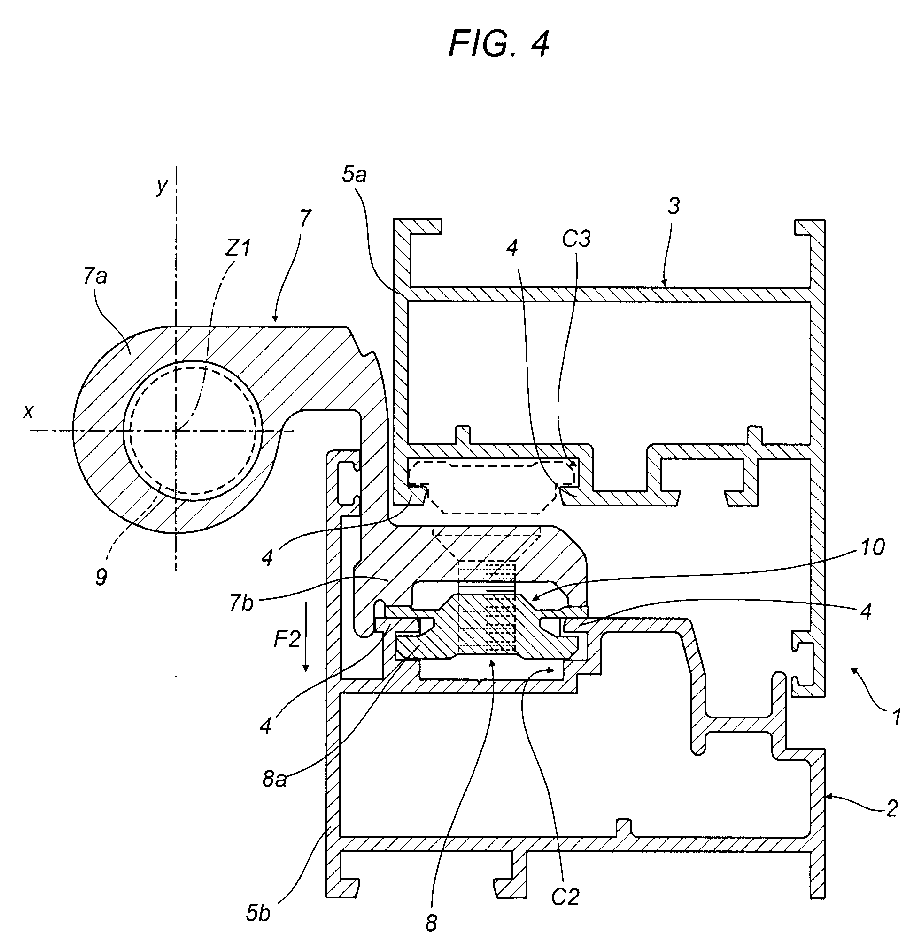
(57) Described is a positioning device for heavy doors or windows with a fixed frame (3)
and a sash (2), each having a profile which forms a longitudinal groove (C3, C2) consisting
of a pair of opposite "L"-shaped protrusions (4); the fixed frame and the sash (3,
2) are fastened to one another by two hinge units (GCI, GCS), lower and upper. Each
hinge unit (GCI, GCS) comprises: a first, lower hinge body (6), having a first cylindrical
socket (6a) and a first flap (6b); a second, upper hinge body (7), having a second
cylindrical socket (7a) and a second flap (7b); means (8) for fixing the first and
second hinge bodies (6, 7) respectively to the fixed frame and the sash (3, 2), comprising
a block (8a), housed inside the corresponding groove (C3, C2), and which can be connected
to the respective flap (6b, 7b) in such a way as to lock it in place; a hinge pin
(9) which can be housed inside the sockets (6a, 7a) and defining a vertical axis of
rotation (Zl, Z2) for each hinge unit (GCI, GCS); on the first or the second hinge
body (6, 7) of the lower hinge unit (CGI) there being a spacer component (10) inserted
between the respective flap (6b, 7b) and the pair of protrusions (4) in such a way
that it modifies the position, that is to say, moves the hinge body (6, 7) away from
the fixed frame or sash (3, 2), so that in practice it makes the position of the vertical
axis of rotation (Z1) of the lower hinge unit (GCI) and the vertical axis of rotation
(z2) of the upper hinge unit (GCS) coaxial.
|
|
