TECHNICAL FIELD
[0001] This is an invention in metallurgy, referring specifically to steel with high ductility
in subzero temperatures, good weldability, resistance to brittle behavior and corrosion,
heat-resistance in high temperatures. Such steel can be used for the production of
oil pipelines, natural gas pipelines, product pipelines, offshore platforms, welded
structures and containers which can operate under pressure, different equipment and
its component parts operating in temperatures from - 100°C to +450°C.
BACKGROUND ART
[0002] There is steel having the following component ratio (weight, %):
| Carbon |
0.03 - 0.11 |
| Manganese |
0.9 - 1.8 |
| Silicium |
0.06 - 0.6 |
| Chrome |
0.005 - 0.30 |
| Nickel |
0.005 - 0.3 |
| Vanadium |
0.02-0.12 |
| Niobium |
0.03-0.1 |
| Titanium |
0.01-0.04 |
| Aluminium |
0.01-0.055 |
| Calcium |
0.001-0.005 |
| Sulphur |
0.0005-0.008 |
| Phosphorus |
0.0005-0.010 |
| Nitrogen |
0.001-0.012 |
| Copper |
0.005-0.25 |
| Stibium |
0.001-0.005 |
| Stannum |
0.001-0.007 |
| Arsenic |
0.001-0.008 |
| Iron |
remaining share |
(Patent of the Russian Federation No. 2141002, publication date 10.11.1999).
[0003] This steel has all properties required for the production of oil pipelines, natural
gas pipelines, product pipelines and other welded structures which can operate in
temperatures from -100°C to +450°C. However, such steel has strength properties which
are insufficient for the manufacture of the above and other products made of steel
sheets above 20 mm thick. This drawback can be eliminated by way of increasing hardening
characteristics through higher content of alloying agents; nevertheless such steel
may demonstrate brittle behavior.
DISCLOSURE OF THE INVENTION
[0004] This invention is aimed at improvement of steel strength properties. The result of
this invention is as follows: sheets and billets up to 50 mm thick with the following
properties: yield stress above 550 N/mm
2, breaking strength above 620 N/mm
2; preserving high ductility in temperatures down to -100°C, resistance to brittle
behavior during manufacture and operation, good weldability in factory and field environment.
[0005] Technically, the required result is obtained due to the fact that the steel containing
carbon, manganese, silicium, chrome, nickel, vanadium, niobium, titanium, aluminium,
calcium, sulphur, phosphorus, nitrogen, copper, stibium, stannum, arsenic and iron
additionally includes molybdenum, with the following component ratio (weight, %):
| Carbon |
0.02 - 0.11 |
| Manganese |
0.10 - 1.8 |
| Silicium |
0.06 - 0.6 |
| Chrome |
0.005 - 0.30 |
| Nickel |
0.005 - 1.0 |
| Vanadium |
0.01-0.12 |
| Niobium |
0.02-0.1 |
| Titanium |
0.01-0.04 |
| Aluminium |
0.01-0.05 |
| Calcium |
0.0005-0.008 |
| Sulphur |
0.0005-0.008 |
| Phosphorus |
0.001-0.012 |
| Nitrogen |
0.001-0.012 |
| Copper |
0.005-0.25 |
| Stibium |
0.0001-0.005 |
| Stannum |
0.0001-0.007 |
| Arsenic |
0.0001-0.008 |
| Molybdenum |
0.0001- 0.5 |
| Iron |
remaining share |
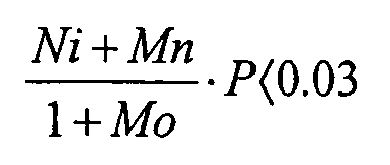
This being the case, total content of nickel and manganese is related to molybdenum
and phosphorus content (weight. %) according to the following equation:
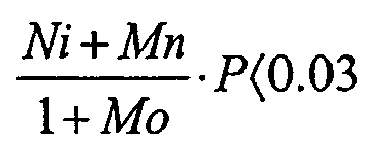
[0006] The above mentioned nickel, manganese, molybdenum and phosphorus limits in steel
supported by the enumerated ration of components provide both improved hardening characteristics
for steel sheets up to 50 mm thick, high values of strength and ductility in low temperatures
(down to -100°C) and elimination of embrittlement in the process of manufacture and
use of products made from these sheets.
THE BEST MODE FOR CARRYING OUT THE INVENTION
[0007] Table 1 shows the chemical composition of three heats of this steel in comparison
with a known composition of steel. Compositions have been selected in such a way so
as to estimate molybdenum and nickel contribution to steel sheet strength.
[0008] All heats have been performed in a vacuum induction furnace. Furnace charge consisted
of armco iron and, depending on variant of composition, of nickel, ferromolybdenum,
copper and other charge materials. When the required underpressure in the furnace
was achieved charge meltdown was started. After complete meltdown and metal heating
up to 1630-1650°C the charge was degasified and the required predetermined amounts
of manganese, ferrovanadium and ferroniobium were added to the molten pool; then deoxidizing
agents (ferrosilicium, aluminium and ferrotitanium) were added.
[0009] As the temperature of liquid steel reached the required level (1560-1580°C) the airfree
metal was run off directly from the smelting crucible to the casting mold. Molded
ingots were then cooled in casting molds under normal pressure, not in vacuum.
[0010] On the whole, 12 trial heats have been performed in the vacuum induction furnace.
Analysis of metal chemical composition has been performed for all heats and, on the
basis of its results, three heats were selected with equivalent carbon content equal
to 0.37.
[0011] The equivalent carbon content was determined by the following formula:

Table 2 shows the properties of these heats in comparison with heats of a known composition
whose
Ceq is equal to 0.37. The obtained results demonstrate that the new steel of the above
composition possesses the required strength properties in 50-mm cross-sections and
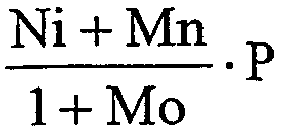
high ductility in low temperatures. The ratio between the total content of nickel
and manganese and the concentration of molybdenum and phosphorus for heats 1, 2 and
3 is 0.01, 0.0057 and 0.0064, respectively, i.e. less than 0.03.
Table 1. Chemical composition of three heats of the proposed steel in comparison with
a known composition of steel.
| Component |
Content (weight,%) |
| Heat 1 |
Heat 2 |
Heat 3 |
Heat of known steel |
| carbon |
0.02 |
0.04 |
0.09 |
0.06 |
| manganese |
1.5 |
1.0 |
0.3 |
1.4 |
| silicium |
0.1 |
0.18 |
0.25 |
0.25 |
| chrome |
0.05 |
0.28 |
0.2 |
0.15 |
| nickel |
0.5 |
0.1 |
0.9 |
0.1 |
| vanadium |
0.1 |
0.05 |
0.01 |
0.07 |
| niobium |
0.032 |
0.06 |
0.087 |
0.06 |
| titanium |
0.01 |
0.015 |
0.035 |
0.015 |
| aluminium |
0.012 |
0.021 |
0.028 |
0.024 |
| calcium |
0.0005 |
0.003 |
0.006 |
0.005 |
| sulphur |
0.0035 |
0.004 |
0.008 |
0.003 |
| phosphorus |
0.005 |
0.007 |
0.008 |
0.005 |
| nitrogen |
0.005 |
0.006 |
0.007 |
0.007 |
| copper |
0.23 |
0.1 |
0.01 |
0.15 |
| stibium |
0.0003 |
0.0009 |
0.004 |
0.005 |
| stannum |
0.0005 |
0.005 |
0.007 |
0.005 |
| arsenic |
0.0002 |
0.004 |
0.008 |
0.006 |
| molybdenum |
0.0001 |
0.35 |
0.5 |
- |
| equivalent carbon content |
0.37 |
0.37 |
0.37 |
0.37 |
|
0.01 |
0.0057 |
0.0064 |
- |
Table 2. Properties of the heats of Table 1.
| Heat |
Cross section, mm |
Breaking strength, N/mm2 |
Yield stress, N/mm2 |
Ductile-brittle transition point, °C |
| 1 |
20/50 |
836/687 |
706/583 |
-90/-100 |
| 2 |
20/50 |
807/712 |
683/600 |
-90/-100 |
| 3 |
20/50 |
767/675 |
650/566 |
-90/-100 |
| Heat of known steel |
20/50 |
621/528 |
528/449 |
-80/-30 |
1. Steel, containing carbon, manganese, silicium, chrome, nickel, vanadium, niobium,
titanium, aluminium, calcium, sulphur, phosphorus, nitrogen, copper, stibium, stannum,
arsenic and iron. Its distinctive feature is additional content of molybdenum, with
the following component ratio (weight, %):
| Carbon |
0.02-0.11 |
| Manganese |
0.10-1.8 |
| Silicium |
0.06-0.6 |
| Chrome |
0.005-0.30 |
| Nickel |
0.005-1.0 |
| Vanadium |
0.01-0.12 |
| Niobium |
0.02-0.1 |
| Titanium |
0.01-0.04 |
| Aluminium |
0.01-0.05 |
| Calcium |
0.0005-0.008 |
| Sulphur |
0.0005-0.008 |
| Phosphorus |
0.001-0.012 |
| Nitrogen |
0.001-0.012 |
| Copper |
0.005-0.25 |
| Stibium |
0.0001-0.005 |
| Stannum |
0.0001-0.007 |
| Arsenic |
0.0001-0.008 |
| Molybdenum |
0.0001-0.5 |
| Iron |
remaining share, |
this being the case, total content of nickel and manganese is related to molybdenum
and phosphorus content (weight. %) according to the following equation: