|
(11) | EP 1 716 616 B1 |

| (12) | EUROPEAN PATENT SPECIFICATION |
|
|
| (54) |
NON-AQUEOUS ELECTROLYTE FOR BATTERY NICHT-WÄSSRIGER ELEKTROLYT FÜR EINE BATTERIE ELECTROLYTE NON-AQUEUX POUR BATTERIE |
|
|
|||||||||||||||||||||||||||||||
| Note: Within nine months from the publication of the mention of the grant of the European patent, any person may give notice to the European Patent Office of opposition to the European patent granted. Notice of opposition shall be filed in a written reasoned statement. It shall not be deemed to have been filed until the opposition fee has been paid. (Art. 99(1) European Patent Convention). |
Technical Field
[0001] The present invention relates to a nonaqueous electrolyte for a battery, and more particularly to a nonaqueous electrolyte for a lithium battery composed of an organic solvent and a lithium salt and having an excellent stability upon overcharging thereof, wherein a benzene-substituted phosphate derivative is included.
Background Art
[0002] A lithium secondary battery has advantages such as high energy density, low self-discharge rate and low-weight, and thus receives a great deal of attention as a high performance energy source for portable electronic instruments requiring slimness and low-weight such as a notebook computer, a camcorder, a mobile phone, and the like. This lithium secondary battery generally uses mixed oxides of lithium metal as its cathode active material, and carbon material or metallic lithium as its anode material, respectively. The lithium battery is typically designed with a high pressure, and thus an organic solvent capable of withstanding a high voltage, that is, a nonaqueous electrolyte, is employed as the electrolyte. In this connection, the nonaqueous electrolyte in which lithium salts are dissolved in an organic solvent is primarily used.
[0003] The electrolyte for the lithium battery is required to be stable against a lithium anode, but it is said that there is no solvent showing a thermodynamic stability to lithium. In practice, there has been considered that the electrolyte is decomposed relative to the anode upon initial charging and resulting products form an ionic conductivity protection film, i.e., SEI (Solid Electrode Interface) on a surface of lithium and then inhibits a reaction between the electrode and electrolyte thereby stabilizing the battery.
[0004] However, in case of such a nonaqueous electrolyte based secondary battery, if a power circuit or a charger of electronic instruments is out of order or overcharged, aberrant heat generation occurs in the battery and further, in extreme case, damage or catching fire of the battery may occur. As such, it is an important problem to effectively inhibit such heat generation and secure stability of the battery so as to prevent thermal runaway, upon abnormal operation such as overcharging the battery.
[0005] As a measure to prevent rupture and catching fire of the battery upon overcharging thereof, there has been to control primarily a charging voltage of the battery by a charger. However, at the present time, since use of a protection circuit, a protection device, and the like, significantly limits miniaturization and reduced production costs of a battery pack, there is an urgent need for a method capable of securing stability of the battery without the protection circuit or protection device. In addition, there have been proposed cutting off electric current by gas production when overcurrent is generated in the battery, or cutting off overcharge current by fusion of a separator, but a satisfactory protection mechanism to prevent overcharge has yet to be realized.
[0006] In order to overcome these problems, JP 7-302614 A, JP 0-50822 A and JP 9-106835 A and JP 2939469 B2 have proposed methods to ensure stability against overcharging of the battery by adding a small amount of an aromatic compound to the electrolyte of the lithium secondary battery. US 2003/157413A1, EP 1050 916A, EP 0 696077A and Y.E Hyung et al in journal of power sources, vol. 119-121,1.6.2003,p 383-387 describe different non-aqueous electrolyte composition for batteries.
[0007] More specifically, JP 7-302614 A and JP-50822 A propose the use of a lower molecular weight organic compound with a molecular weight of less than 500, such as anisole, having a reversible redox potential at above a cathode potential upon full charging of the secondary battery, and a π electron orbit, in the electrolyte as an additive. Such a lower molecular weight organic compound serves as a redox shuttle and consumes overcharge current between the cathode and anode to establish a protection mechanism.
Disclosure of Invention
Technical Problem
[0008] Meanwhile, JP 9-106835 A suggests a method for protecting the battery upon overcharging thereof using aromatic compounds such as biphenyl, 3-chlorothiophene and furane which initiate a polymerization reaction at voltage when overcharged and therefore increase internal resistance of the battery.
[0009] However, anisole proposed in JP 7-302614 A and JP 9-50822 A clearly functions as the redox shuttle upon overcharging, while it also participates in a reaction within a general range of the battery voltage thereby adversely affecting cycle characteristics of discharge capacity of the battery.
Technical Solution
[0010] Therefore, the present invention has been made in view of the above problems, and it is an object of the present invention to provide a nonaqueous electrolyte for a battery capable of inhibiting explosion/catching fire that may occur if the battery is overcharged.
[0011] The present invention provides a nonaqueous electrolyte for a battery capable of effectively inhibiting heat generation so as to prevent thermal runaway without affecting characteristics of the battery, and ensuring reliability and stability of the battery.
[0012] The present invention provides a nonaqueous electrolyte for a battery capable of realizing miniaturization and reduced production costs of a battery pack by preventing thermal runaway due to overcharging of the battery without a separate protection circuit or protection device.
[0013] In accordance with an aspect of the present invention, the provision of a nonaqueous electrolyte for a lithium battery composed of an organic solvent and a lithium salt, comprising 0.1 to 10% by weight of a benzene-substituted phosphate derivative.
Advantageous Effects
[0014] The nonaqueous electrolyte for a battery in accordance with the present invention can be used to prepare a lithium battery by a conventional method. The lithium battery thus prepared has electrochemical stability higher than that of a battery using a conventional nonaqueous electrolyte and thus exhibits excellent stability when the battery is overcharged.
Brief Description of the Drawings
[0015] The above and other objects, features and other advantages of the present invention will be more clearly understood from the following detailed description taken in conjunction with the accompanying drawings, in which:
[0016] Fig. 1 is a graph showing overcharging results of a battery to which a nonaqueous electrolyte of the Comparative Example is applied;
[0017] Figs 2 and 3 are graphs showing overcharging results of a battery to which a nonaqueous electrolyte in accordance with the present invention is applied; and
[0018] Fig. 4 is a graph comparing the performance of a charging/discharging service life between a battery to which a nonaqueous electrolyte in accordance with the present invention is applied and a battery to which a nonaqueous electrolyte of a Comparative Example is applied.
Best Mode for Carrying Out the Invention
[0020] The present invention provides a nonaqueous electrolyte for a lithium battery composed of an organic solvent and a lithium salt, comprising 0.1 to 10% by weight of a benzene-substituted phosphate derivative having the following formula (I):
[0022] wherein R represents a halogen-substituted C1-C8 alkyl or allyl compound or an unsubstituted C1-C8 alkyl or allyl compound, and n is an integer between 1 and 3.
[0023] Addition amount of the benzene-substituted phosphate derivative in the present invention is within a range of 0.1 to 10% by weight, and preferably 1 to 5% by weight of the nonaqueous electrolyte. If the amount of the benzene-substituted phosphate derivative of the present invention added is less than 0.1% by weight, the desired stability effect upon overcharging the battery, intended in the present invention is not sufficiently obtained. On the contrary, even when addition amount of the benzene-substituted phosphate derivative exceeds 10% by weight, stability of the battery does not increase in proportion to the amount thereof used. Therefore, addition amount of the benzene-substituted phosphate derivative in the present invention is preferably within the above-mentioned range.
[0024] As cathode active material for a conventional lithium secondary battery, layered lithium cobalt oxide (LiCoO2), lithium nickel oxide (LiNiO2) or lithium manganese oxide (LiMn2O4), which has a large capacity per weight, is generally employed, but when overcharged, most of the lithium ions of these compounds are in released state, thus becoming significantly unstable, and they react with the electrolyte to cause acute decomposition and exothermic reaction or deposit lithium on the anode, which in turn may rupture or set fire the battery, in the worst case. The present invention intends to resolve a problem associated with stability occurring upon overcharging the battery by adding the benzene-substituted phosphate derivative to the nonaqueous electrolyte.
[0025] As examples of organic solvents of the nonaqueous electrolyte which may be used in the present invention, mention may be made of cyclic carbonates such as ethylene carbonate, propylene carbonate and γ-butyrolactone, linear carbonates such as dimethyl carbonate, diethyl carbonate, dipropyl carbonate, methylpropyl carbonate, ethylmethyl carbonate and ethylpropyl carbonate, propyl acetate, methyl acetate, ethyl acetate, butyl acetate, methyl propionate, and ethyl propionate. Preferably, in the present invention, a mixture of two or more of cyclic carbonate based organic solvent (for example, ethylene carbonate and propylene carbonate) and linear carbonate based organic solvent (for example, dimethyl carbonate, diethyl carbonate, ethylmethyl carbonate and methylpropyl carbonate) or fluorobenzene may be used as an organic solvent. An example of the preferred organic solvent is a mixture of ethylene carbonate and dimethyl carbonate.
[0026] In addition to those, at least one selected from the group consisting of propyl acetate, methyl acetate, ethyl acetate, butyl acetate, methyl propionate and ethyl propionate may be additionally mixed and used, if desired. The mixing ratio of the respective organic solvents selected from each group is not particularly limited as long as it does not interfere with the purpose of the present invention, and follows the mixing ratio used in preparing a conventional nonaqueous electrolyte for a lithium battery.
[0027] As lithium salt contained in the nonaqueous electrolyte in accordance with the present invention, at least one selected from the group consisting of LiPF6, LiClO4, LiAsF6, LiBF4 and LiN(C2F5 SO2)2 and LiN(CF3SO2)2 is preferably used. More preferably, LiPF6 may be used. Preferably, concentration of the lithium salt in the present invention ranges from 0.8 to 2 M. Where the concentration of the lithium salt added is less than 0.8 M, conductivity of the electrolyte may be lowered leading to deterioration of performances thereof. Where it exceeds 2 M, a viscosity of the electrolyte increases at a low temperature and thus performance thereof at a low temperature may be lowered.
[0028] The nonaqueous electrolyte for a battery in accordance with the present invention can be used to prepare a lithium battery by a conventional method. The lithium battery thus prepared has electrochemical stability higher than that of a battery using a conventional nonaqueous electrolyte and thus exhibits excellent stability when the battery is overcharged.
Mode for the Invention
[0029] Now, the present invention will be described in more detail with reference to the following Examples. These examples are provided only for illustrating the present invention and should not be construed as limiting the scope of the present invention.
[0032] Ethylene carbonate (EC), ethylmethyl carbonate (EMC) and diethyl carbonate (DEC) were mixed in a ratio of 1:1:1 and 1 M of LiPF6 as solute was dissolved therein to prepare a basic electrolyte. To the basic electrolyte thus obtained was added 1% by weight of a benzene-substituted phosphate derivative (n = 1, R = CH3) to obtain a final nonaqueous electrolyte. The nonaqueous electrolyte for a battery was used to prepare a square type battery 423048, using graphite as the active material of the anode and polyvinylidene fluoride (PVDF) as the binding agent. LiCoO2 was used as the active material of the cathode and PVDF was used as the binding agent. As the conductive agent, acetylene black was used. The resistance of the battery, thus prepared, to 1.0C-rate 10V overcharging was tested and the results obtained are shown in Table 1.
[0034] A battery was prepared following the same procedure as in Example 1, except that 3% by weight of a benzene-substituted phosphate derivative (n = 1, R = CH3) was added to the basic electrolyte in which ethylene carbonate (EC), ethylmethyl carbonate (EMC) and diethyl carbonate (DEC) were mixed in a ratio of 1:1:1 and 1M of LiPF6 as solute was dissolved therein. The resistance of the battery, thus prepared, to overcharging was tested and the results obtained are shown in Table 1.
[0036] A battery was prepared following the same procedure as in Example 1, except that 5% by weight of a benzene-substituted phosphate derivative (n = 1, R = CH3) was added to the basic electrolyte in which ethylene carbonate (EC), ethylmethyl carbonate (EMC) and diethyl carbonate (DEC) were mixed in a ratio of 1:1:1 and 1M of LiPF as solute was dissolved therein. The resistance of the battery, thus prepared, to overcharging was tested and the results obtained are shown in Table 1.
[0038] A battery was prepared following the same procedure as in Example 1, except that 1% by weight of a benzene-substituted phosphate derivative (n = 2, R = CH3) was added to the basic electrolyte in which ethylene carbonate (EC), ethylmethyl carbonate (EMC) and diethyl carbonate (DEC) were mixed in a ratio of 1:1:1 and 1M of LiPF6 as solute was dissolved therein. The resistance of the battery, thus prepared, to overcharging was tested and the results obtained are shown in Table 1.
[0040] A battery was prepared following the same procedure as in Example 1, except that 3% by weight of a benzene-substituted phosphate derivative (n = 2, R = CH3) was added to the basic electrolyte in which ethylene carbonate (EC), ethylmethyl carbonate (EMC) and diethyl carbonate (DEC) were mixed in a ratio of 1:1:1 and 1 M of LiPF6 as solute was dissolved therein. The resistance of the battery, thus prepared, to overcharging was tested and the results obtained are shown in Table 1.
[0042] A battery was prepared following the same procedure as in Example 1, except that 5% by weight of a benzene-substituted phosphate derivative (n = 2, R = CH3) was added to the basic electrolyte in which ethylene carbonate (EC), ethylmethyl carbonate (EMC) and diethyl carbonate (DEC) were mixed in a ratio of 1:1:1 and 1M of LiPF6 as solute was dissolved therein. The resistance of the battery, thus prepared, to overcharging was tested and the results obtained are shown in Table 1.
[0044] A battery was prepared using the basic electrolyte in which ethylene carbonate (EC), ethylmethyl carbonate (EMC) and diethyl carbonate (DEC) were mixed in a ratio of 1:1:1 and 1M of LiPF6 as solute was dissolved therein, but no benzene-substituted phosphate derivative was added. The characteristics of the battery thus prepared were evaluated and the results obtained are shown in Table 1.
[0045]
Table 1
| Formation charging (mAh) | Formation discharging (mAh) | Formation efficiency (%) | 1C-rate overcharging | |
| Ex.1 | 723.8 | 646.4 | 89.3 | Normal |
| Ex.2 | 720.9 | 640.2 | 88.8 | Normal |
| Ex.3 | 716.5 | 629.8 | 87.9 | Normal |
| Ex.4 | 722.8 | 646.9 | 89.5 | Normal |
| Ex.5 | 721.1 | 642.5 | 89.1 | Normal |
| Ex.6 | 720.3 | 636.0 | 88.3 | Normal |
| Comp. Ex. | 725.1 | 651.1 | 89.8 | Explosion/Catching fire |
[0048] Formation charging/discharging : In the charging/discharging test of the initial battery, a capacity obtained when the battery was charged up to 4.2 V at a constant current/constant voltage of 0.2C-rate was taken as a formation charging capacity, and a capacity obtained when the battery was discharged up to 3 V at constant current of 0.2C-rate was taken as a formation discharging capacity.
[0049] 1C-rate 10 V overcharging : A fully-charged state battery was charged up to 10 V at constant current of 1C-rate and after reaching 10 V, then charged at constant voltage for 2 hours and 30 min. If battery does not explode or catch fire during the overcharging test, it can be considered to be effective at preventing overcharging of the battery.
[0050] Fig. 1 shows a graph of overcharge characteristics of the battery to which a nonaqueous electrolyte for the battery of the Comparative Example was applied, while Figs 2 and 3, respectively, show graphs comparing overcharge characteristics of the batteries to which each of the nonaqueous electrolytes of Examples 1 and 4 was applied. The batteries (Examples 2 and 3) to which nonaqueous electrolytes in accordance with the present invention were applied, exhibited an excellent stability as compared to the battery to which a nonaqueous electrolyte of the Comparative Example (Fig. 1) was applied, when the battery was overcharged. Fig. 4 shows a graph of comparison results for charge/discharge cycle performances between the battery to which the nonaqueous electrolyte in accordance with the present invention was applied and the battery to which a nonaqueous electrolyte of the Comparative Example was applied. As can be seen, the battery to which the nonaqueous electrolyte in accordance with the present invention was applied, exhibited excellent service life characteristics compared to the battery to which a nonaqueous electrolyte of the Comparative Example was applied.
Industrial Applicability
[0051] The battery to which the nonaqueous electrolyte in accordance with the present invention was applied, has advantages such as excellent reliability and stability of the battery because of no catching fire or explosion due to thermal runaway resulting from overcharging the battery, and nonaqueous electrolyte in accordance with the present invention can realize a battery having a small size, light-weight, long service life, lower production costs and high energy density.
1. A nonaqueous electrolyte for a lithium battery composed of an organic solvent and
a lithium salt, comprising 0.1 to 10% by weight of a benzene-substituted phosphate
derivative having the following formula (I):
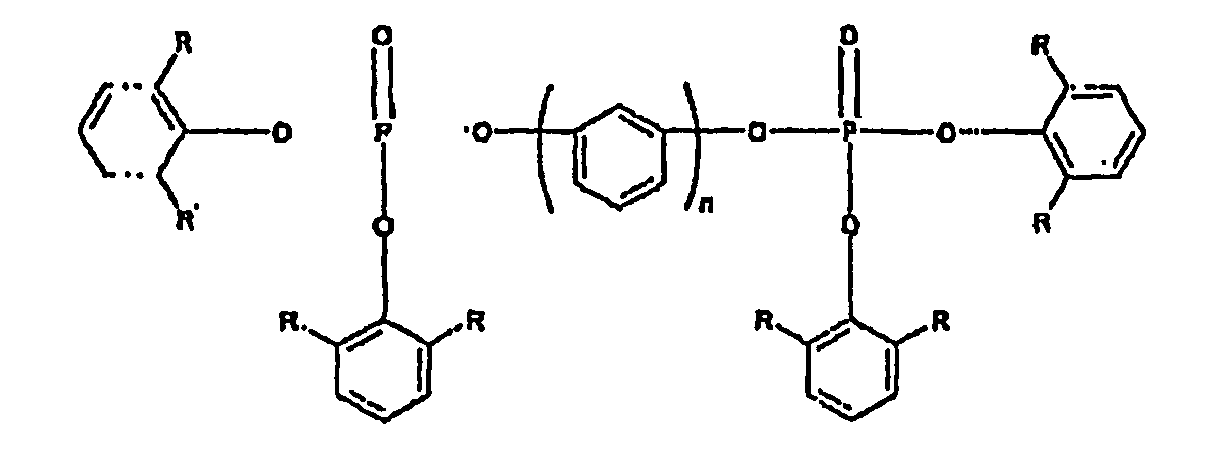
wherein R represents a halogen-substituted C1-C8 alkyl or allyl compound or an unsubstituted C1-C8 alkyl or allyl compound, and n is an integer between 1 and 3.
wherein R represents a halogen-substituted C1-C8 alkyl or allyl compound or an unsubstituted C1-C8 alkyl or allyl compound, and n is an integer between 1 and 3.
2. The nonaqueous electrolyte as set forth in claim 1, wherein the solvent of the nonaqueous
electrolyte is a mixture of at least two organic solvents selected from the group
consisting of ethylene carbonate(EC), propylene carbonate(PC), dimethyl carbonate(DMC),
diethyl carbonate(DEC), ethylmethyl carbonate(EMC) and fluorobenzene(FB).
3. The nonaqueous electrolyte as set forth in claim 1, wherein the lithium salt is at
least one selected from the group consisting of LiPF6, LiBF4 , LiClO4, , LiN(C2F5SO2)2 and LiN(CF3SO2)2, and the concentration of the lithium salt in the electrolyte ranges from 0.8 to
2 M.
4. A battery comprising an anode, a cathode and an electrolyte, wherein the electrolyte
comprises the nonaqueous electrolyte as set forth in claim 1.
1. Nichtwässriger aus einem organischen Lösungsmittel und einem Lithiumsalz zusammengesetzter
Elektrolyt für eine Lithiumbatterie, umfassend 0,1 bis 10 Gew.-% eines benzolsubstituierten
Phosphatderivats mit der folgenden Formel (I):
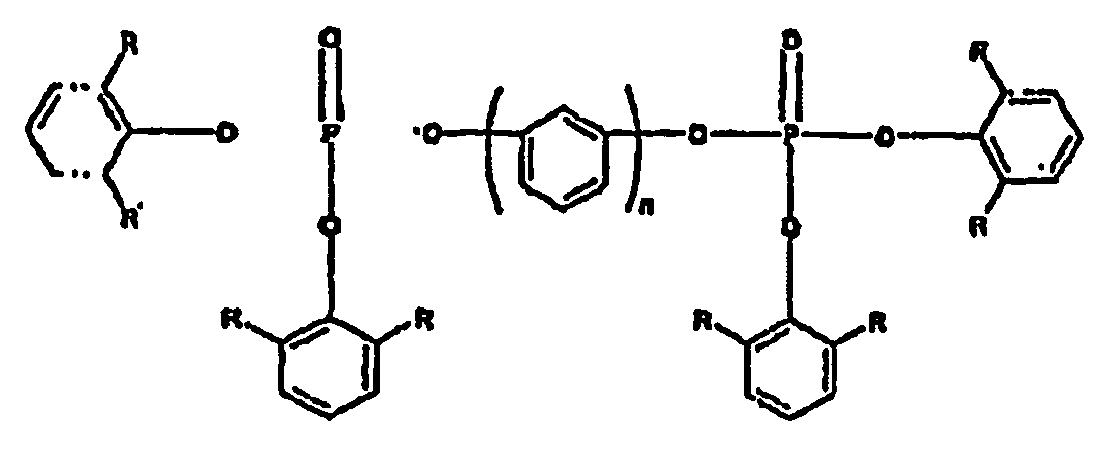
wobei R eine halogensubstituierte C1-C8-Alkyl oder - Allylverbindung oder eine unsubstituierte C1-C8-Alkyl- oder - Allylverbindung darstellt und n eine ganze Zahl zwischen 1 und 3 ist.
wobei R eine halogensubstituierte C1-C8-Alkyl oder - Allylverbindung oder eine unsubstituierte C1-C8-Alkyl- oder - Allylverbindung darstellt und n eine ganze Zahl zwischen 1 und 3 ist.
2. Nichtwässriger Elektrolyt nach Anspruch 1, wobei das Lösungsmittel des nichtwässrigen
Elektrolyten ein Gemisch aus mindestens zwei organischen Lösungsmitteln ist, die ausgewählt
sind aus der Gruppe, bestehend aus Ethylencarbonat (EC), Propylencarbonat (PC), Dimethylcarbonat
(DMC, Diethylcarbonat (DEC), Ethylmethylcarbonat (EMC) und Fluorbenzol (FB).
3. Nichtwässriger Elektrolyt nach Anspruch 1, wobei das Lithiumsalz mindestens eines
ist, das ausgewählt ist aus der Gruppe, bestehend aus LiPF6, LiBF4, LiClO4, LiN(C2F5SO2)2 und LiN(CF3SO2)2, und die Konzentration des Lithiumsalzes im Elektrolyten im Bereich von 0,8 bis 2
M liegt.
4. Batterie, umfassend eine Anode, eine Kathode und einen Elektrolyten, wobei der Elektrolyt
den nichtwässrigen Elektrolyten nach Anspruch 1 umfasst.
1. Electrolyte non aqueux pour une batterie au lithium, composé d'un solvant organique
et d'un sel de lithium, comprenant 0,1 à 10 % en poids d'un dérivé phosphate à substitution
benzénique ayant la formule (I) ci-après :
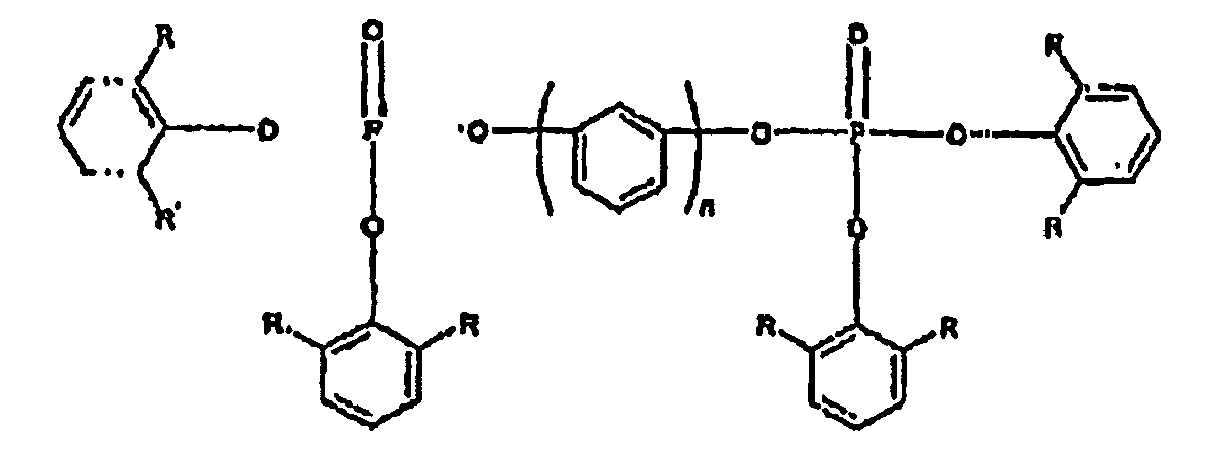
dans laquelle R représente un composé alkyle ou allyle en C1-C8 halogéné, ou un composé alkyle ou allyle en C1-C8 non substitué, et n est un entier de 1 à 3.
dans laquelle R représente un composé alkyle ou allyle en C1-C8 halogéné, ou un composé alkyle ou allyle en C1-C8 non substitué, et n est un entier de 1 à 3.
2. Electrolyte non aqueux selon la revendication 1, dans lequel le solvant de l'électrolyte
non aqueux est un mélange d'au moins deux solvants organiques choisis dans le groupe
consistant en le carbonate d'éthylène (EC), le carbonate de propylène (PC), le carbonate
de diméthyle (DMC), le carbonate de diéthyle (DEC), le carbonate d'éthylméthyle (EMC)
et le fluorobenzène (FB).
3. Electrolyte non aqueux selon la revendication 1, dans lequel le sel de lithium est
au moins un sel choisi dans le groupe consistant en LiPF6, LiBF4, LiClO4, LiN(C2F5SO2)2 et LiN (CF3SO2)2, la concentration du sel de lithium dans l'électrolyte étant comprise dans la plage
de 0,8 à 2 M.
4. Batterie comprenant une anode, une cathode et un électrolyte, dans laquelle l'électrolyte
comprend l'électrolyte non aqueux selon la revendication 1.
REFERENCES CITED IN THE DESCRIPTION
This list of references cited by the applicant is for the reader's convenience only. It does not form part of the European patent document. Even though great care has been taken in compiling the references, errors or omissions cannot be excluded and the EPO disclaims all liability in this regard.
Patent documents cited in the description
- JP7302614A [0006] [0007] [0009]
- JP050822A [0006]
- JP9106835A [0006] [0008]
- JP2939469B [0006]
- US2003157413A1 [0006]
- EP1050916A [0006]
- EP0696077A [0006]
- JP50822A [0007]
- JP9050822A [0009]
Non-patent literature cited in the description
- Y.E Hyung et al.journal of power sources, 2003, vol. 119-121, 383-387 [0006]