|
(11) | EP 1 719 546 A1 |

| (12) | EUROPEAN PATENT APPLICATION |
|
|
|
|
||||||||||||||||
| (54) | Hair conditioning composition |
| (57) The present invention relates to a conditioning composition for hair showing excellent
volume and body enhancing effect. The conditioner compositions of the present invention
comprise at least one hair conditioning compound and at least two ethoxylated fatty
alcohols with 10 to 22 C atoms, one having up to 3 ethoxy groups and the other having
4 to 20 ethoxy groups and show excellent volumizing and bodyfying effects. The bodyfying
and volumizing effects are found to be synergistic as no such effect could be observed
with compositions comprising only one of the ethoxylated fatty alcohol. |
[0001] The present invention relates to a conditioning composition for hair having excellent volume and body enhancing effect.
[0002] Hair conditioners of various types either in application or in the form of preparation have found their wide range of usage in hair dressing practice. Among those rinse off types of conditioners have always been preferred in daily hair care. Usually rinse off type of conditioners are in the form of emulsions and comprising fatty alcohols and emulsifiers of different ionic characters as the main principal ingredients. In addition, they comprise conditioning ingredients of various types and especially those of cationic surfactants and/or cationic polymers. A general overview on the known hair conditioning products and also their usual compositions can be found in the monography of K. Schrader, "Grundlage und Rezepturen der Kozmetika", 2nd Ed. 1989, pp 722 - 781.
[0003] Although the state of the art is quite well advanced, some of the problems with conditioners have not yet been well addressed or solved. One of them is variability of conditioning properties of conventional conditioners depending on the hair type, i.e. damaged, fine, thick, normal, healthy hair types. As conditioners are used mainly for detangling and/or softening hair, the mainly used cationic compounds are deposited onto hair surface for achieving those effects, They usually make hair heavy and therefore cause volume down effect (loss of volume by making hair "heavy"), although the surface conditioning properties are excellent. Without making a rule, conditioners are generally designed for different hair types depending on their damage levels. On the other hand, conditioners are highly desirable designed for different hair strengths depending on for example hair diameter as defined such as coarse and fine hair. Although the big efforts, volume reducing effect of conditioners has not been overcome satisfactorily and conditioning compositions improving volume and body of hair are highly desirable.
[0004] Thus, the objective of the present application is to find out a conditioner composition, which does not show above mentioned disadvantageous and excellently suitable for using in rinse-off application and enhances hair body and volume. It should be noted that the volume down problem with the conventional conditioners is especially aggravated problem with fine hair so that conditioner compositions of the present invention is especially suitable for conditioning fine hair.
[0005] It has surprisingly been found out that conditioner composition comprising at least one hair conditioning compound and at least two ethoxylated fatty alcohol with alkyl chain length of 10 to 22 C atoms, one having up to 3 ethoxy groups and the other having 4 to 20 ethoxy groups show excellent volumizing and bodyfying effects. The bodyfying and volumizing effects are found to be synergistic as no such effect is observed with compositions comprising only one of the ethoxylated fatty alcohol.
[0006] Accordingly the object of the present invention is a conditioner composition comprising at least one hair conditioning compound, at least one ethoxylated fatty alcohol with alkyl chain length of 10 to 22 C atoms with 1 to 3 ethoxy units and a second ethoxylated fatty alcohol with alkyl chain length of 10 to 22 C atoms with 4 to 20, preferably 4 to 10, more preferably 4 to 8 ethoxy units and most preferably 4 to 6 ethoxy units.
[0007] Another object of the present invention is the use of a composition comprising in a cosmetically acceptable medium, at least one hair conditioning compound, at least one ethoxylated fatty alcohol with 1 to 3 ethoxy units and a second ethoxylated fatty alcohol with 4 to 20, preferably 4 to 10, more preferably 4 to 8 ethoxy units and most preferably 4 to 6 ethoxy units for enhancing volume and body of hair.
[0008] Although the compositions of the present invention is also suitable for leave-in application, the preferred usage is rinse off meaning after application of conditioner onto hair and after appropriate processing time usually up to 10 min, preferably up to 5 min, the product is removed from hair by rinsing off with water.
[0009] Accordingly, further object of the present invention is that process for increasing volume and body of hair wherein a composition comprising in a cosmetically acceptable medium, at least one hair conditioning compound, at least one ethoxylated fatty alcohol with 1 to 3 ethoxy units and a second ethoxylated fatty alcohol with 4 to 20, preferably 4 to 10, more preferably 4 to 6 ethoxy units is applied onto shampooed, preferably freshly, hair-and left on the hair for 1 to 20 min, preferably 1 to 15 min and most preferably 1 to 10 min and rinsed of with water.
[0010] The conditioners of the present invention improve additionally combability, shine and elasticity of hair.
[0011] The ethoxylated fatty alcohols having 10 to 22, preferably 10 to 18, more preferably 10 to 16 and most preferably 12 to 14 carbon atoms in the alkyl chain are useful for the compositions of the present invention.
[0012] Examples to the suitable ethoxylated fatty alcohols are as the first compound laureth-1 to 3, myreth 2 and 3, ceteth 1 to 3, steareth 2 and 3, and ceteareth 2 and 3, and as the second compound laureth-4 to 20, myreth 5 to 10, ceteth 4 to 20, steareth 4 to 20, and ceteareth 4 to 20. The most preferred fatty alcohol is the lauryl alcohol and accordingly, the preferred first ethoxylated fatty alcohol is Laureth-2, and the second ethoxylated fatty alcohol is Laureth-4.
[0013] Total concentration of the ethoxylated fatty alcohols is in the range of 0.1 to 10%, preferably 0.25 to 7.5% and more preferably 0.5 to 5% and most preferably 0.5 to 3% by weight. The ratio of the two types of ethoxylated fatty alcohols is in the range of 10:1 to 1 : 10, preferably 5:1 to 1:5, more preferably 3:1 to 1: 1 and most preferably 1:1, by weight.
[0014] Without making a rule, it Is the preferred embodiment of the present invention that conditioning composition comprises the two ethoxylated fatty alcohol compounds with the same fatty alkyl chain length, i.e. lauryl, myristyl, behenyl, stearyl, cetyl etc.
[0015] Conditioning compositions of the present invention comprise at least one hair conditioning compound. Suitable and the preferred ones are those of cationic compounds, especially cationic polymers and cationic surfactants. The most preferred conditioning compounds are cationic surfactants. Olly substances and non-ionic substances can as well be suitably used as conditioners in the compositions of the present invention.
[0016] Suitable cationic polymers are those of best known with their CTFA category name Polyquatemium. Typical examples of those Polyquatemium 6, Polyquatemium 7, Polyquatemium 10, Polyquatemium 11, Polyquatemium 16, Polyquaternium 22, Polyquatemium 28 and Polyquatemium 37.
[0017] As well those polymers known with their CTFA category name Quatemium are suitable. Those are for example Quaternium-8, Quaternium-14, Quaternium-15, Quaternium-18, Quaternium-22, Quaternium-24, Quaternium-26, Quaternium-27, Quaternium-30, Quaternium-33, Quaternium-53, Quaternium-60, Quaternium-61, Quaternium-72, Quaternium-78, Quaternium-80, Quaternium-81, Quaternium-81, Quaternium-82, Quaternium-83 and Quaternium-84.
[0018] It has further been found out that especially those of cationic cellulose type polymers known as Polymer JR type from Amerchol such as Polyquatemium 10 or cationic guar gum known with trade name Jaguar from Rhône-Poulenc and chemically for example Guar hydroxyprvpyl trimonium chloride, are preferred ones. Furthermore, chitosan and chitin can also be included in the compositions as cationic natural polymers. In this context reference is also made to the cationic polymers disclosed in DE 25 21 960, 28 11 010, 30 44 738 and 32 17 059, as well as to the products described in EP-A 337 354 on pages 3 to 7. It is also possible to use mixtures of various cationic polymers.
[0019] The most preferred cationic polymers are those of cationic cellulose derivatives, cationic guar gum derivatives, polyquatemium 6 and polyquatemium 7.
[0020] The cationic polymers also include the quatemized products of graft polymers from organopolysiloxanes and polyethyl oxazolines described in EP-A 524 612 and EP-A 640 643.
[0021] Typical concentration range for cationic polymers can be 0.01- 5% by weight, preferably 0.01 - 3.5% by weight, more preferably 0.05 - 2.5% and most preferably 0.1 -1.5% by weight calculated to the total composition.
[0022] In the most preferred from of the present invention, conditioning compositions comprise at least one cationic surfactant as conditioning agent and as well as emulsifier. Suitable cationic surfactants are presented with the general formula
where R1 is a saturated or unsaturated, branched or non-branched alkyl chain with 8-22 C atoms or
R5 CO NH (CH2)n
where R6 is saturated or unsaturated, branched or non-branched alkyl chain with 7-21 C atoms and n has value of 1 - 4,
or
R6 CO O (CH2)n
where R6 is saturated or unsaturated, branched or non-branched alkyl chain with 7-21 C atoms and n has value of 1 - 4, and
R2 is H or unsaturated or saturated, branched or non-branched alkyl chain with 1 - 4 C atoms or
R5 CO NH (CH2)n
or
R6 CO O (CH2)n
where R5, R6 and n are same as above.
[0023] R3 and R4 are H or lower alkyl chain with 1 to 4 carbon atoms, and X is anion such as chloride, bromide, methosulfate.
[0024] Typical examples of those ingredients are cetyl trimethyl ammonium chloride, stear trimonium chloride, behentrimoinium chloride, stearamidopropyl trimonium chloride, cocamidopropyl trimonium chloride dioleoylethyl dimethyl ammonium methosulfate, dioleoylethyl hydroxyethylmonium methosulfate.
[0025] From the above quaternary ammonium compounds disclosed with the general formula, especially to mention are those compounds known per se and are on the market, for example, under the trade names "Schercoquat®", "Dehyquart® F30" and "Tetranyl®". Use of these compounds, the so-called "esterquats", In hair care compositions is described, for example, in WO-A 93/107 48, WO-A 92/068 99 and WO-A 94/166 77, wherein, however, there is no reference made to the combinations according to the present invention and the advantageous properties thereof.
[0026] Again from the above quaternary ammonium compounds disclosed with the general formula, especially to mention are those compounds are known per se and on the market, for example, under the trade name "INCROQUAT® HO" or "OCS". Those compounds known with a general ingredient category under "amidoquat" in the cosmetic industry.
[0027] Typical concentration range for cationic surfactants can be 0.01 - 5% by weight, preferably 0.01 - 3.5% by weight, more preferably 0.05 - 2.5% and most preferably 0.1 - 1.5% by weight calculated to the total composition.
[0028] It is further preferred embodiment of the invention, that the cationic surfactants and cationic polymers are used in combination in principal at any ratio, preferably at a ration in the range of 3:1 - 1:3, more preferably 2:1 - 1:2 and most preferably 1:1, all ratio's are by weith.
[0029] Oily substances are selected from such as silicone oils, either volatile or non-volatile, natural and synthetic oils. Among silicone oils those can be added to the compositions include dimethicone, amodimethicone (a cationic silicone), dimethiconol, polydimethylsiloxane, DC fluid ranges from Dow Coming, natural oils such as olive oil, almond oil, avocado oil, weizenkeim oil, ricinus oil and the synthetic oils, such as mineral oil, isopropyl myristate, palmitate, stearate and isostearate, oleyl oleate, lsocetyl stearate, hexyl laurate, dibutyl adipate, dioctyl adipate, myristyl myristate and oleyl erucate.
[0030] Non-ionic conditioning agents may be polyols such as glycerin, glycol and derivatives, poiyethyleneglycoles known with trade names Carbowax PEG from Union Carbide and Polyox WSR range from Amerchol, polyglycerin, polyethyleneglycol mono or di fatty acid esters having general formula
R7 CO (O CH2 CH2)n OH
R7 CO (O CH2 CH2)n O OC R8
where R7 and R8 are independent from each other saturated, unsaturated or branched or non-branched alkyl chain with 7 to 21 C atoms and n is typically 2 - 100.
[0031] The compositions according to the invention may also comprise further conditioning substances such as protein hydrolyzates and polypeptides, e.g., keratin hydrolyzates, collagen hydrolyzates of the type "NutrilanR" or elastin hydrolyzates, as well as also in particular plant protein hydrolyzates, optionally, cationized protein hydrolyzates, e.g., "GluadinR".
[0032] In principal, the conditioning compositions of the present invention can be in any product form such as emulsions, gels, solutions, dispersions, aerorols etc. As a product form, foam is as well suited when packed into a pressurized can or delivered through a pump-foamer (non-aerosol). In the case that an aerosol foam preparation is preferred, propellant gas must be added to the formulation. The suitable propellant gasses are carbondioxide, dimethylether and alkanes such as butane, propane, isobutane or their mixtures.
[0033] However, it is further preferred embodiment of the present invention that the conditioning compositions are in the form of emulsion. The emulsion type of conditioners comprise additionally at least one fatty alcohol with alkyl chanin length of 8 - 24 C atoms. Concentration of fatty alcohols is usually less than 20%, preferably less than 15% by weight calculated to total composition. More preferably the concentration of one or more fatty alcohols is in the range of 0.5 to 15% by weight, most preferably 0.5 to 10% by weight calculated to total composition. Typical examples to the most useful fatty alcohols are myristyl alcohol, palmityl alcohol, cetyl alcohol, stearyl alcohol, behenyl alcohol and their mixtures. As a mixed fatty alcohol the mostly used one is the cetearyl alcohol and it is the most preferred fatty alcohol mixture in the compositions of the present invention.
[0034] According to the invention, conditioning composition can comprises at least one direct acting dyestuff and be used as conditioning and colouring composition. The direct dyes referred are cationic, anioni, neutral and of plant dyes.
[0035] Suitable cationic dyestuffs are in principal those available on the market for hair colouring applications. Some examples to those are: Basic Blue 6, Basic Blue 7, Basic Blue 9, Basic Blue 26, Basic Blue 41, Basic Blue 99, Basic Brown 4, Basic Brown 16, Basic Brown 17, Natural Brown 7, Basic Green 1, Basic Red 2, Basic Red 12 Basic Red 22, Basic Red 76, Basic Violet 1, Basic Violet 2, Basic Violet 3, Basic Violet 10, Basic Violet 14 and Basic Yellow 57.
[0036] For this purpose, special reference is made to the PCT application WO 95/15144 of Ciba-Geigy AG. The cationic dyestuffs with the following chemical structures are especially preferred ones according to the present invention.
and
wherein R9, R10, R11 and R12 stand for hydrogen, a CH3- or C2H5- group, R13 stands for hydrogen, -OCH3 or -OC2H5 and Y Is an anion such as chloride, bromide, methosulfate.
[0037] The most preferred cationic dyestuffs are the ones according to the formula I, where R1, R2, R3 and R4 are methyl and Y is chloride, according to formula 11 where R1 and R2 are methyl and Y is chloride and according to the formula IV, where R1 and R2, are methyl, R5 is hydrogen and Y is methosulfate.
[0038] Cationic dyestuffs can be included into the compositions of the present invention at a concentration of 0,001 to 2%, preferably 0.005 to 1.5% and more preferably 0.01 to 1% by weight, calculated to total aqueous composition.
[0039] Anionic dyes may as well be used either alone or in combination with cationic direct dyes at minor quantities. The suitable ones are:
[0040] Acid Black 1, Acid Blue 1, Acid Blue 3, Food Blue 5, Acid Blue 7, Acid Blue 9, Acid Blue 74, Acid Orange 3, Acid Orange 6, Acid Orange 7, Acid Orange 10, Acid Red 1, Acid Red 14, Acid Red 18, Acid Red 27, Acid Red 50, Acid Red 52, Acid Red 73, Acid Red 87, Acid Red 88, Acid Red 92, Acid Red 155, Acid Red 180, Acid Violet 9, Acid Violet 43, Acid Violet 49, Acid Yellow 1, Acid Yellow 23, Acid Yellow 3, Food Yellow No. 8, D&C Brown No. 1, D&C Green No. 5, D&C Green No. 8, D&C Orange No. 4, D&C Orange No. 10, D&C Orange No. 11, D&C Red No. 21, D&C Red No. 27, D&C Red No. 33, D&C Violet 2, D&C Yellow No. 7, D&C Yellow No. 8, D$C Yellow No. 10, FD&C Red 2, FD&C Red 40, FD&C Red No. 4, FD&C Yellow No. 6, FD&C Blue 1, Food Black 1, Food Black 2, Disperse Black 9 and Disperse Violet 1 and their alkali metal salts such as sodium, potassium.
[0041] According to the invention, anionic dyes may be included at a concentration of 0.001 to 2%, preferably 0.005 to 1.5% and more preferably 0.01 to 1% by weight, calculated to total aqueous composition.
[0042] Additionally, the coloring compositions of the present invention may comprise neutral dyes (HC dyes), so called nitro dyes either alone or in addition to the cationic and/or anionic direct dyes. Concentration of those can typically be in the range of 0.001 to 1%, preferably 0.01 to 0.75% and more preferably 0.05 to 0.5% by weight calculated to total aqueous composition.
[0043] Some examples to those are: HC Blue No.2, HC Blue No.4, HC Blue No.5, HC Blue No.6, HC Blue No.7, HC Blue No.8, HC Blue No.9, HC Blue No.10, HC Blue No.11, HC Blue No.12, HC Blue No.13, HC Brown No.1, HC Brown No.2, HC Green No.1, HC Orange No.1, HC Orange No.2, HC Orange No.3, HC Orange No.5, HC Red BN, HC Red No.1, HC Red No.3, HC Red No.7, HC Red No.8, HC Red No.9, HC Red No.10, HC Red No.11, HC Red No.13, HC Red No.54, HC Red No.14, HC Violet BS, HC Violet No.1, HC Violet No.2, HC Yellow No.2, HC Yellow No.4, HC Yellow No.5, HC Yellow No.6, HC Yellow No.7, HC Yellow No.8, HC Yellow No.9, HC Yellow No.10, HC Yellow No.11, HC Yellow No.12, HC Yellow No.13, HC Yellow No.14, HC Yellow No.15, 2- Amino-6-chloro-4-nitrophenol, picramic acid, 1,2-Diamino-4-nitrobenzol, 1,4-Diamino-2-nitrobenzol, 3-Nitro-4-aminophenol, 1-Hydroxy-2-amino-3-nitrobenzol and 2-hydroxyethylpicramic acid.
[0044] Plant dyestuffs may also be used in combination with cationic direct-acting dyestuffs, for example henna (red or black), alkanna root, laccaic acid, indigo, logwood powder, madder root and rhubarb powder, etc.
[0045] Compositions of the present invention can comprise UV filters for protection of hair from environmental influences such as loss of elasticity, loss of hair colour (bleaching effect of sun light). The UV-absorbing substance is preferably selected from the following compounds: 4-Aminobenzoic acid and the esters and salts thereof, 2-phenyl benzimidazole-5-sulfonic acid and the alkali and amine salts thereof, 4-dimethyl aminobenzoic acid and the esters and salts thereof, cinnamic acid and the esters and salts thereof, 4-methoxycinnamic acid and the esters and salts thereof, salicylic acid and the esters and salts thereof, 2.4-dihydroxybenzophenone, 2.2'.4.4'-tetrahydroxy- benzophenone, 2-hydroxy-4-methoxybenzophenone and its 5-sulfonic acid or the sodium salt thereof, 2.2'-dihydroxy-4.4'-dimethoxybenzophenone, 2-hydroxy-5-chlorobenzophenone, 2.2'-dihydroxy-4-methoxybenzophenone, 2.2'-dihydroxy-4.4'-dimethoxy-5.5'-disulfobenzo-phenone or the sodium salt thereof, 2-hydroxy-4-octyloxybenzophenone, 2-hydroxy-4-methoxy-4'-methylbenzophenone, 3-benzyl-idenecampher, 3-(4'-sulfo)-benzyl-ldenebomane-2-one and the salts thereof and/or 3-(4'-methyl benzylidene)-DL-campher.
[0046] The preferred amount of the UV-absorber ranges from about 0.01 % to 2.5%, more preferably from 0.05 % to 1 % by weight, calculated to the total composition.
[0047] The conditioner composition can contain active ingredients selected from moisturisers, sequestering agents, hair restructuring agents and natural ingredients showing conditioning benefits.
[0048] The compositions of the present invention can comprise hair-restructuring agents. The hair restructuring agents preferred are especially the ones disclosed in the German patent DE 197 51 550 C2.
[0049] One of the known hair restructuring agents is ceramide type of compound with the general formula
where R14 and R15 are independent from each other alkyl- or, alkenyl group mlt 10 to 22 carbon atoms, R16 is methyl, ethyl, n-propyl or isopropyl group and n is a number between 1 to 6, preferably 2 or 3,
[0050] Other preferred hair restructuring agents are fatty acids with 10 to 24 carbon atoms and especially with 16 to 24 carbon atoms.
[0051] Sterols,especially the phytosterols, are as well preferred hair restructuring agents as disclosed in the above mentioned german patent. Especially preferred ones are of plant origin for example ergosterol, sitosterol, stigmasterol, fucosterol, brassicasterol, fungisterol, campesterol, zymosterol, ascosterol, cerevisterol, episterol, faecosterol, spinasterol. Among those phytosterols, the ones found in "Avocadin" which is the unsaponified fraction of the avocado oil is more preferred.
[0052] The concentration of ceramide in the compositions of the present invention can be in the range of 0.01 to 2% and especially 0.01 to 1% by weight calculated to the total weight of the composition. The fatty acids may be contained at a level of 0.01 to 2.5% and epecially 0.01 to 1% by weight calculated to the total weight of the composition. Phytosterol concentration of the conditioners is less than 1% and preferably less than 0.5% by weight calculated to the total weight of the composition. It should be noted without limiting the use of those ingredients the effect of those hair restructuring ingredients Is especially elevated when used in combination with penetration enhancers.
[0053] The moisturizing agents are selected from panthenol, polyols, such as glycerol, polyethylene glycols with molecular weight 200 to 20,000. The moisturizing ingredients can be included in the conditioner compositions at a concentration range of 0.01 - 2.5% by weight calculated to the total composition.
[0054] The sequestering agents are selected from polycarboxy acids. The preferred one is ethylene diamine tetraacetic acid, EDTA. Typical useful concentration range for sequestering agents is of 0.01 - 2.5% by weight calculated to the total composition.
[0055] Conditioner compositions of the present invention can optionally contain non-ionic polymers such as hydroxyethylcellulose, hydroxypropylclellulose, xyloglucan, xanthan gum, polyvinylalcohol, polyvinylpyrrolidone or their derivatives.
[0056] The concentration of polymers is typically from 0.01 to 5%, preferably 0.05 - 3%, and more preferably 0.05 - 2% by weight, calculated to the total composition.
[0057] Conditioners of the present invention may comprise one or more surfactants as emulsifier and/or solubilizers other than those fatty alcohol ethoxylates. Suitable surfactants are of anionic, amphoteric and non-ionic type or their mixtures. Suitable non-ionic surfactants are compounds from the category of alkyl polyglucosides with the general formula
R17-O-(CH2CH2O)n-Zx,
wherein R17 is an alkyl group with 8 to 20, preferably 10 to 14 carbon atoms, Zx is a saccharide group with 5 to 6 carbon atoms, n stands for a number from 0 to 10, and x is a number between 1 and 5, preferably 1.1 to 2.5.
[0058] Other additionally useful non-ionic surfactants are, for example, the various sorbitan esters, such as polyethylene glycol sorbitan stearic acid ester, fatty acid polyglycol ester or also mixed condensates of ethylene oxide and propylene oxide, as they are on the market, for example, under the trade name "PluronicsR".
[0059] Hydrogenated castor oil with variable ethylene glycol units is found to be suitable non-ionic solubilizers. Those are for example known from BASF under the trade name Cremophor.
[0060] Further optional nonionic surfactant components are fatty acid mono- and dialkanolamides, such as coco fatty acid monoethanolamide and myristic fatty acid monoisopropanolamide.
[0061] Suitable anionic surfactants are of the sulfate, sulfonate, carboxylate and alkyl phosphate type, for example, the known C10-C18-alkyl sulfates, and in particular the respective ether sulfates, for example, C12-C14-alkyl ether sulfate, lauryl ether sulfate, especially with 1 to 4 ethylene oxide groups in the molecule, monoglyceride (ether) sulfates, fatty acid amide sulfates obtained by ethoxylation and subsequent sulfatation of fatty acid alkanolamides, and the alkali salts thereof, as well as the salts of long-chain mono- and dialkyl phosphates.
[0062] Additional anionic surfactants useful within the scope of the Invention are a-olefin sulfonates or the salts thereof, and in particular alkali salts of sulfosuccinlc acid semiesters, for example, the disodium salt of monooctyl sulfosuccinate and alkali salts of long-chain monoalkyl ethoxysulfosuccinates.
[0063] Suitable surfactants of the carboxylate type are alkyl polyether carboxylic acids and the salts thereof of the formula
R18 - (C2H4O)n - O - CH2COOX,
wherein R18 is a C8-C20-alkyl group, preferably a C12-C14-alkyl group, n is a number from 1 to 20, preferably 2 to 17, and X is H or preferably a cation of the group sodium, potassium, magnesium and ammonium, which can optionally be hydroxyalkyl-substituted, as well as alkyl amido polyether carboxylic acids of the general formula
wherein R19 and X have the above meanings, and n is in particular a number from 1 to 10, preferably 2.5 to 5. Such products have been known for some time and are on the market, for example, under the trade name "AKYPO®" and "AKYPO-SOFT®".
[0064] Further as the surfactants amphoteric or zwitterionic ones may be included in the conditioning compositions. The examples to menation are those of betaine, amido betaine, sulfobetaine or amido sulfobetaines. Specific examples aare coco betaine, cocamidopropyl betaine, coco amphoacetate, cocamidopropyl sultaine.
[0065] The concentration of surfactants other than those of ethoxalted fatty alcohols may be typically from 0.01 to 10%, preferably 0.1- 7.5%, and more preferably 0.2 - 5% by weight, calculated to the total composition.
[0066] Natural plant extracts showing hair conditioning and/or restructuring effects can be used in the conditioners. Those are preferably the extracts from almond, Aloe Vera, coconut, mango, peach, lemon, wheat, rosemary, apricot, algae, grapefruit, sandalwood, lime and orange. Those extracts used are the ones commercially available and generally include organic solvents such as propylene glycol, butylenes glycol, ethanol, isopropanol. The active matter in those extracts can vary largely, i.e. in the range of 1 - 30% by weight. Concentration of those as an extract depending on the compatibility with the other ingredients can be in the range of 0.1 to 5%, preferably 0.1 to 2% by weight calculated to the total composition.
[0067] The pH of the conditioners of the present invention varies from 2 to 6.5, particularly 2 to 5, more particularly 2.5 to 4.5, most preferably 2.5 to 4.0.
[0068] The pH of the conditioner composition is adjusted to the required pH by using alkaline solution such as sodium hydroxide, potassium hydroxide, triethanolamine. For adjusting the pH of the conditioner compositions, following ingredients can as well be used: Organic acids such as citric acid, lactic acid, tartaric acid, malic acid, maleic acid, fumaric acid, levulinic acid, butyric acid and hydroxybutyric acids, valeric acid, oxalic acid, succinic acid, mandelic acid, glycolic acid, glucuronic acid, propionic acid, salloylic acid or acetic acid or inorganic acids such as hydrochloric acid, phosphoric acid, sulphuric acid, nitric acid. Concentration of the organic and/or inorganic acids or their mixtures should be adjusted in a way that conditioner composition is so obtained has a pH value between 2 and 6.5.
[0069] The conditioner compositions may contain organic solvents, for example, as penetration enhancer for any active substance in compositions such as ethanol. propanol, isopropanol, benzyl alcohol, benzyloxyethanol, alkylene carbonates such as ethylene carbonate and propylene carbonate, phenoxyethanol, butanol, isobutanol, cyclohexane, cyclohexanol, hexyleneglycol, ethylene glycol, butylenes glycol, propylene glycol, benzyl glycol, ethylene glycol monoethylether, ethylene glycol monobutyl ether, ethylene glycol monophenyl ether, 1-phenylethylalcohol, 2-phenylethylalcohol, o-methoxyphenol. Concentration of organic solvents in the conditioner composition can be in the range from 0.1 to 20% by weight, preferably 0.5 to 15% by weight, and more preferably 1 to 15% by weight calculated to the total composition. The organic solvents may at the same time serve to solubillze ingredients, which are not readily soluble or dispersible in the conditioner composition.
[0070] The conditioner compositions can have viscosity values between 1,000 mPa.s to 100,000 mPa.s, preferably 1,000 mPa.s to 80,000 mPa.s and more preferably 1,000 mPa.s to 60,000 mPa.s measured at 20°C with Brookfield viscosimetre with, for example, Spindle 4 at 10 rpm. The viscosity values are read after 30 seconds from the start of the measurement. In the selection of the viscosity, special attention must be paid to the way of application and packaging to be used. For example in the case an aerosol type of product is targeted, the viscosity of the composition is preferably lower than around 500 mPa.s. measured with the above method or any mother suitable method.
Example 1
[0072]
| Composition | ||||
| A | B | C | D | |
| Panthenol | 0.50 | 0.50 | 0.50 | 0.50 |
| Dimethicone | 0.20 | 0.20 | 0.20 | 0.20 |
| Cetearyl alcohol | 5.00 | 5.00 | 5.00 | 5.00 |
| Cetrimonium chloride | 1.00 | 1.00 | 1.00 | 1.00 |
| Laureth-2 | - | - | 1.00 | 1.00 |
| Laureth-4 | - | 1.00 | - | 1.00 |
| Fragrance | q.s. | |||
| Preservative | q.s. | |||
| Lactic acid/sodium hydroxide | q.s. to pH 3.5 | |||
| Water | to 100 | |||
[0073] Composition A, B and C are comparative compositions and Composition D is the inventive composition. All four compositions (inventive and comparative) are tested in a two week home use test. As the cleansing compositions a shampoo for normal hair is used from the brand Goldwell. The volunteers aging 20 to 45, 10 in each group were selected from females have up to shoulder length hair and having declared themselves as having volume and/or body problem. The volunteers in each group were asked to answer questions after using the conditioner concerning their hair quallty. The marking was 1 being the worst and 5 being the best. Obviously a result around 3 is the sign of no change in hair quality. The results are presented in the table below. In the table only invention relevant points are taken.
Table I: Results of the home use test of the example I
| Composition | |||||
| A | B | C | D | ||
| Wet hair | Easy combing | 3.8 | 3.7 | 3.8 | 3.9 |
| Smooth | 4.1 | 4.0 | 4.2 | 4.3 | |
| Dry hair | Easy combing | 3.7 | 3.6 | 3.8 | 3.9 |
| Softness | 3.6 | 3.6 | 3.5 | 4.1 | |
| Shine | 3.6 | 3.4 | 3.2 | 4.1 | |
| Body | 2.9 | 3.1 | 3.0 | 4.3 | |
| Volume | 2.8 | 2.9 | 3.0 | 4.4 | |
| Elasticity | 3.1 | 2.8 | 3.1 | 3.9 | |
| Liking | 2.9 | 3.1 | 2.9 | 4.4 | |
[0074] From the above results it is clear that the inventive composition score significantly higher than those of comparative compositions A, B and C. As the higher scores for volume and body were only observed when both ethyoxalted fatty alcohols are present in the composition, those effects are the result of synergism between the two components.
Example 2
[0076]
| Ctearyl alcohol | 7.00 |
| Behentrimonium chloride | 1.50 |
| Panthenol | 0.50 |
| Laureth 2 | 1.00 |
| Laureth 4 | 1.00 |
| Ceramide of the formula* | 0.10 |
| Behenic acid | 0.10 |
| Avocadin | 0.20 |
| Almond oil | 0.10 |
| Fragrance | q.s. |
| Preservative | q.s. |
| Malic acid/sodium hydroxide | q.s to pH 3.7 |
| Water | to 100 |
| * as given in the description R14 is C15H31; R15 is C16H33 and R16 is CH3 and n=2 |
Example 3
[0077]
| Ctearyl alcohol | 7.00 |
| dioleoylethyl dimethyl ammonium methosulfate | 1.50 |
| Glycerin | 1.50 |
| Laureth 2 | 0.75 |
| Laureth 4 | 1.00 |
| Polyquatemium 10 | 0.75 |
| Almond oil | 0.10 |
| Fragrance | q.s. |
| Preservative | q.s. |
| Lactic acid/sodium hydroxide | q.s to pH 4.0 |
| Basic red 51 | 0.07 |
| Water | to 100 |
[0078] The use of the composition on a dark blonde hair at a tone level of 6, resulted in a intensive red shine. The hair had improved volume and body.
Example 4
[0079]
| Ctearyl alcohol | 7.00 |
| Stearamidopropyltrimethylammonium chloride | 0.75 |
| Glycerin | 1.50 |
| Laureth 2 | 0.75 |
| Laureth 4 | 1.00 |
| Polyquaternium 10 | 0.75 |
| Almond oil | 0.10 |
| Fragrance | q.s. |
| Preservative | q.s. |
| Lactic acid/sodium hydroxide | q.s to pH 4.0 |
| Basic Yellow 87 | 0.04 |
| Basic Red 51 | 0.005 |
| Water | to 100 |
[0080] The use of the composition on a light blonde hair at a tone level of 9, resulted in a intensive gold shine. The hair had improved volume and body.
Example 5
[0081]
| Ctearyl alcohol | 7.00 |
| Cetrlmonium chloride | 0.60 |
| Glycerin | 1.50 |
| Laureth 2 | 0.75 |
| Laureth 4 | 0.75 |
| Polyquaternium 10 | 0.60 |
| Fragrance | q.s. |
| Preservative | q.s. |
| Malic acid/sodium hydroxide | q.s to pH 3.6 |
| Benzophenone-3 | 0.10 |
| Water | to 100 |
[0082] With the use of the above composition hair volume and body was increased and it protedted hair from sunlight / U light from colour changes.
Example 6
[0083]
| Ctearyl alcohol | 5.00 |
| Behentrimonium chloride | 1.00 |
| Glycerin | 1.50 |
| Laureth 2 | 1.50 |
| Laureth 4 | 1.50 |
| Polyquatemium 10 | 0.50 |
| Fragrance | q.s. |
| Preservative | q.s. |
| Citric acid/sodium hydroxide | q.s to pH 3.6 |
| Benzophenone-4 | 0.15 |
| Water | to 100 |
[0084] The above formula gave hair volume and body and after usage excellent shine and smoothness were observed.
Example 7
[0085]
| Ctearyl alcohol | 5.00 |
| Behentrimonium chloride | 0.50 |
| Dimethicone | 0.50 |
| Laureth 2 | 1.50 |
| Laureth 4 | 1.50 |
| Guar hydroxypropyltrimonium chloride | 0.50 |
| Fragrance | q.s. |
| Preservative | q.s. |
| Citric acid/sodium hydroxide | q.s to pH 4.0 |
| Basic blue 99 | 0.05 |
| Basic yellow 57 | 0.04 |
| Basic brown 16 | 0.08 |
| Basich red 76 | 0.06 |
| Water | to 100 |
1. Conditioning composition for hair comprising at least one hair conditioning compound
in a cosmetically acceptable medium characterised in that it comprises additionally
a- at least one first ethoxylated fatty alcohol with 1 to 3 ethoxy groups, and
b- at least one second ethoxylated fatty alcohol with 4 to 20 ethoxy gropus
with the condition that first and second ethoxylated fatty alcohols having a alkyl chain length of 10 to 22 carbon atoms.2. Conditioning composition according to claim 1 characterised in that the first and second ethoxylated fatty alcohols are present at a weight ratio of
10:1 to 1:10.
3. Conditioning composition according to claims 1 and 2 characterised in that it comprises fist and second ethoxylated fatty alcohols at a total concentration
of 0.1 to 10% by weight.
4. Composition according to any of the preceding claims characterized in that conditioning compound is a cationic surfactant according to formula
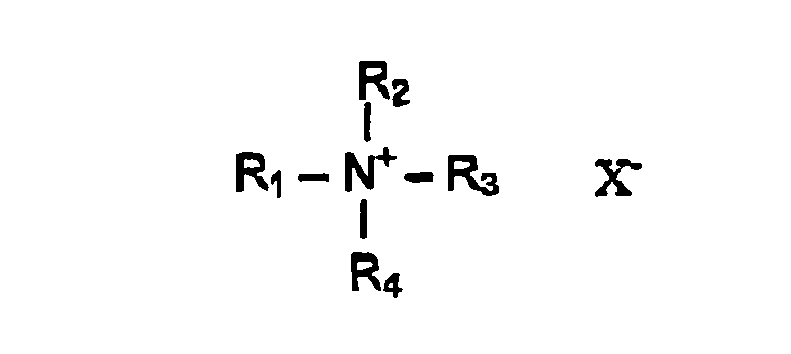
where R1 is a saturated or unsaturated, branched or non-branched alkyl chain with 8-22 C atoms or
R5 CO NH (CH2)n
where R5 is saturated or unsaturated, branched or non-branched alkyl chain with 7-21 C atoms and n has typical value of 0 - 4 or
R8 CO O (CH2)n
where R11 is saturated or unsaturated, branched or non-branched alkyl chain with 7-21 C atoms and n has typical value of 0 - 4, and
R2 is a hydrogen, lower alkyl chain with 1 to 4 carbon atoms, saturated or unsaturated, branched or non-branched alkyl chain with 8-22 C atoms or
R5 CO NH (CH2)n
where R5 is saturated or unsaturated, branched or non-branched alkyl chain with 7-21 C atoms and n has typical value of 0 - 4 or
R6 CO O (CH2)n
where R8 is saturated or unsaturated, branched or non-branched alkyl chain with 7-21 C atoms and n has typical value of 0 - 4, and
R3 and R4 are independent from each other H or lower alkyl chain with 1 to 4 carbon atoms, and X is chloride, bromide or methosulfate.
where R1 is a saturated or unsaturated, branched or non-branched alkyl chain with 8-22 C atoms or
R5 CO NH (CH2)n
where R5 is saturated or unsaturated, branched or non-branched alkyl chain with 7-21 C atoms and n has typical value of 0 - 4 or
R8 CO O (CH2)n
where R11 is saturated or unsaturated, branched or non-branched alkyl chain with 7-21 C atoms and n has typical value of 0 - 4, and
R2 is a hydrogen, lower alkyl chain with 1 to 4 carbon atoms, saturated or unsaturated, branched or non-branched alkyl chain with 8-22 C atoms or
R5 CO NH (CH2)n
where R5 is saturated or unsaturated, branched or non-branched alkyl chain with 7-21 C atoms and n has typical value of 0 - 4 or
R6 CO O (CH2)n
where R8 is saturated or unsaturated, branched or non-branched alkyl chain with 7-21 C atoms and n has typical value of 0 - 4, and
R3 and R4 are independent from each other H or lower alkyl chain with 1 to 4 carbon atoms, and X is chloride, bromide or methosulfate.
5. Composition according to any of the preceding claims characterized in that conditioning compound is a cationic polymer.
6. Composition according to any of the preceding claims characterized in that conditioning compound is a silicone compound.
7. Composition according to any of the preceding claims characterized in that the composition comprise at least one direct dye
8. Composition according to claim 7 characterized in that the composition comprise as the direct dye at least one cationic direct dye.
9. Composition according to claim 7 characterized in that the composition comprise as the direct dye at least one anionic direct dye.
10. Composition according to any of the preceding claims characterized in that the composition comprise at least one UV fitter.
11. Composition according to any of the preceding claims characterized in that the composition comprise at least one organic solvent
12. Composition according to any of the preceding claims characterized in that the composition comprise at least one fatty alcohol with 8 to 24 C.
13. Conditioning composition according to any of the preceding claims characterised in that it further comprises active ingredients selected from hair restructuring ingredients,
moisturising ingredients, sequestering agents and natural plant extracts.
14. Conditioning composition according to any of the preceding claims characterised in that it has a pH in the range of 2 to 6.5.
15. Use of conditioning composition according to any of the preceding claims for enhancing
volume and body of hair.
16. Process for increasing volume and body of hair characterised in that a conditioning composition according to claims 1 to 14 is applied onto shampooed
hair and left on the hair for 1 to 20 min and rinsed of with water.
REFERENCES CITED IN THE DESCRIPTION
This list of references cited by the applicant is for the reader's convenience only. It does not form part of the European patent document. Even though great care has been taken in compiling the references, errors or omissions cannot be excluded and the EPO disclaims all liability in this regard.
Patent documents cited in the description
- DE2521960 [0018]
- DE2811010 [0018]
- DE3044738 [0018]
- DE3217059 [0018]
- EP337354A [0018]
- EP524612A [0020]
- EP640643A [0020]
- WO9310748A [0025]
- WO9206899A [0025]
- WO9416677A [0025]
- WO9515144A [0036]
- DE19751550C2 [0048]
Non-patent literature cited in the description
- K. SCHRADERGrundlage und Rezepturen der Kozmetika19890000722-781 [0002]