|
(11) | EP 1 752 512 A1 |

| (12) | EUROPEAN PATENT APPLICATION |
|
|
|
|
|||||||||||||||||||||||
| (54) | A method of reducing piston deposits, smoke or wear in a diesel engine |
| (57) A method of reducing piston deposits, smoke or wear in a diesel engine. The method
involves the step of running the engine on fuel comprising an oil soluble iron carboxylate
or iron complex that includes Fe3+. |
[0001] This invention relates to a method of reducing piston deposits, smoke or wear in a diesel engine.
[0002] EP 689 577A discloses the use of ferrocene in fuels to reduce deposits or to facilitate their removal. Ferrocene includes Fe2+ only.
[0003] The aim of the present invention is to reduce piston deposits, smoke or wear in a diesel engine. In particular, the aim of the present invention is to reduce piston deposits, smoke or wear in a marine diesel engine running on heavy fuel oil.
[0004] In accordance with the present invention there is provided a method of reducing piston deposits, smoke or wear in a diesel engine, the method involving the step of running the engine on fuel comprising an oil soluble or oil dispersible iron carboxylate or iron complex that includes Fe3+; with the proviso that when the method is a method of reducing smoke in a diesel engine, the ratio of the number of equivalents of organic acid to the number of equivalents of Fe3+ in the oil soluble or oil dispersible iron carboxylate or iron complex is 3 or more.
[0006] The iron carboxylate or iron complex is preferably derived from a compound of the formula
wherein R1, R2, R3 and R4 represent hydrogen or a hydrocarbyl having 1-30 carbon atoms (C1-C30), but at least two of R1, R2, R3 or R4 are C1-C30 hydrocarbyl; R5 is a hydrocarbyl having 1 to 120 carbon atoms and m and n may each be zero or an integer such that the total number of carbon atoms in the carboxylate is not more than 125.
[0007] The formula above is intended to represent a carboxylic acid which has at least two side chains of at least 1 to 30 carbon atoms in length, and preferably both R1 and R2 are hydrocarbyl so that the carboxylate is a neocarboxylate, i.e., having the carbon atom which is alpha to the carbonyl carbon connected to four other carbon atoms. The term hydrocarbyl is intended to apply to aromatic or aliphatic radicals composed principally of carbon and hydrogen, optionally substituted with oxygen or nitrogen, preferably aliphatic and particularly straight or branched chain alkyl or substituted alkyl, the substituents being nitrogen or oxygen. Most preferably the carboxylate is a neodecanoate.
[0008] Suitable examples of R5 moieties are hydrocarbyl groups made from homo- or interpolymers (e.g. copolymers, terpolymers) of mono- and diolefins having 2 to 10 carbon atoms, such as ethylene, propylene, 1-butene, isobutene, butadiene, isoprene, 1-hexene, 1-octene, etc. Typically, these olefins are 1-monoolefins. This hydrocarbyl can also be derived from the halogenated (e.g. chlorinated or brominated) analogs of such homo- or interpolymers or from polyethers.
[0009] The hydrocarbyl may be saturated. The hydrocarbyl may be predominantly aliphatic in nature, that is, containing no more than one non-aliphatic moiety (cycloalkyl, cycloalkenyl or aromatic) group of 6 or less carbon atoms for every 10 carbon atoms in the substituent. Usually, however, the hydrocarbyl contains no more than one such non-aliphatic group for every 50 carbon atoms, and in many cases, they contain no such non-aliphatic groups at all; that is, the typical substituents are purely aliphatic. Typically, these purely aliphatic hydrocarbyls are alkyl or alkenyl groups.
[0010] The hydrocarbyl may also contain some unsaturation. The hydrocarbyl may be derived from oils from seeds, fats and trees. Examples of oils are rapeseed oil, coriander oil, soyabean oil, linseed oil, cottonseed oil, sunflower oil, castor oil, tall oil, olive oil, peanut oil, maize oil, almond oil, palm kernel oil, coconut oil, mustard seed oil, beef tallow and fish oils.
[0011] A preferred source of the R5 moiety are poly(isobutene)s obtained by polymerization of a C4 refinery stream having a butene content of 35 to 75 wt.% and isobutene content of 30 to 60 wt.% in the presence of a Lewis acid catalyst such as aluminum trichloride or boron trifluoride. These polybutenes predominantly contain monomer repeating units of the configuration -C(CH3)2CH2-.
[0012] The iron carboxylate or iron complex is preferably present in an additive solution or dispersion. The additive solution or dispersion will preferably comprise 10-80%, more preferably 20-70%, most preferably 35-65%, by weight of the carboxylate or complex, with the remainder being hydrocarbon solvent.
[0013] The iron carboxylate or complex may include mixtures of Fe2+ and Fe3+; however, the iron carboxylate or complex preferably includes more than 25%, even more preferably more than 50%, of Fe3+. More preferably, the iron carboxylate or complex includes more than 75%, and preferably more than 90%, of Fe3+.
[0014] The iron carboxylate or complex additive may also be acidic, that is, the iron carboxylate or iron complex composition may contain up to about 20% of unreacted free acid such as 1-20% by weight free acid, more preferably 0-10%, most preferably 0-5% free acid.
[0015] The iron carboxylate or complex additive may be overbased, acidic or neutral, but preferably is neutral.
[0016] The iron carboxylate may be neutral in that it contains a stoichiometric ratio of iron cations to carboxylate anions. It may also be acidic, overbased or micellised. Acidic salts contain an excess of carboxylic acid/carboxylate over that which would be considered stoichiometric and overbased salts contains an excess of iron species over the stoichiometric ratio. This excess iron may exist in one or a combination of forms including oxides, hydroxides or mixed oxidic salts. Lattice-like polynuclear-iron complexes or iron clusters may also be present.
[0017] For overbased carboxylates, the excess iron may be introduced, either intentionally or unintentionally, during the main reaction process or alternatively may be introduced subsequent to this via post treatment. The elemental iron, oxides and hydroxides are common feedstocks for the overbasing process.
[0018] The solvent used to prepare stable additive solutions or dispersions may generally be characterized as a normally liquid petroleum or synthetic hydrocarbon or oxygenated hydrocarbon or alcohol solvents, such as hexanol, 2-ethylhexanol or isodecyl alcohol solvent. Typical examples include kerosene, hydrotreated kerosene, isoparaffinic and paraffinic solvents and naphthenic aliphatic hydrocarbon solvents, aromatic solvents, dimers and higher oligomers of propylene, butene and similar olefins and mixtures thereof. Commercial products such as "Solvesso", "Varsol", "Norpar" and "Isopar" are suitable. Such solvents may also contain functional groups other than carbon and hydrogen provided such groups do not adversely affect the performance of the additive composition. Preferred are isoparaffinic and paraffinic hydrocarbon solvents. Preferably, the solvent has a flash point greater than 20°C, more preferably greater than 40°C, most preferably greater than 55°C.
[0019] The iron carboxylates or complexes may be used as additives in a wide variety of fuel oils, particularly diesel fuel oils and heavy fuel oils.
[0020] Such fuel oils include "middle distillate" fuel oil which refers to petroleum-based fuel oils obtainable in refining crude oil as the fraction from the light, kerosene or jet fuel, fraction to the heavy fuel oil fraction. These fuel oils may also comprise atmospheric or vacuum distillate, cracked gas oil or a blend, in any proportions, of straight run and thermally and/or catalytically cracked or hydrocracked distillate. Examples include hydrocracked streams, kerosene, jet fuel, diesel fuel, heating oil, visbroken gas oil, light cycle oil and vacuum gas oil. Such middle distillate fuel oils usually boil over a temperature range, generally within the range of 100°C to 500°C, as measured according to ASTM D86, more especially between 150°C and 400 °C.
[0021] Preferably the fuel is residual fuel oil and the diesel engine is a marine diesel engine, which can be 2- or 4-stroke.
[0022] Vegetable-based and fat-based fuel oils are triglycerides of monocarboxylic acids, for example, acids containing 10-25 carbon atoms, and typically have the general formula shown below
where R is an aliphatic radical of 10-25 carbon atoms which may be saturated or unsaturated.
[0023] Generally, such oils contain glycerides of a number of acids, the number and kind varying with the source of the vegetable or fat.
[0024] Suitable fuel oils also include mixtures of 1-50% by weight of vegetable oils or methyl esters of fatty acids with petroleum based diesel fuel oils. Also suitable are fuels emulsified with water and alcohols, which contain suitable surfactants.
[0025] Examples of oils are rapeseed oil, coriander oil, soyabean oil, linseed oil, cottonseed oil, sunflower oil, castor oil, tall oil, olive oil, peanut oil, maize oil, almond oil, palm kernel oil, coconut oil, mustard seed oil, beef tallow and fish oils. Rapeseed oil, which is a mixture of fatty acids partially esterified with glycerol, is preferred as it is available in large quantities and can be obtained in a simple way by pressing from rapeseed. Esters of tall oil fatty acids are also suitable as fuels.
[0026] Further examples of vegetable-based and fat-based fuel oils are alkyl esters, such as methyl esters, of fatty acids of the vegetable or animal oils and fats. Such esters can be made by transesterification.
[0027] As lower alkyl esters of fatty acids, consideration may be given to the following, for example as commercial mixtures: the ethyl, propyl, butyl and especially methyl esters of fatty acids with 12 to 22 carbon atoms, for example of lauric acid, myristic acid, palmitic acid, palmitoleic acid, stearic acid, oleic acid, elaidic acid, petroselic acid, ricinoleic acid, elaeostearic acid, linoleic acid, linolenic acid, eicosanoic acid, gadoleic acid, docosanoic acid or erucic acid, which have an iodine number from 50 to 150, especially 90 to 140, more especially 100 to 130. Mixtures with particularly advantageous properties are those which contain mainly, i.e. to at least 50 wt %, such as 1-5 wt.% or 1-15 wt.% methyl esters of fatty acids with 16 to 22 carbon atoms and 1, 2 or 3 double bonds. The preferred lower alkyl esters of fatty acids are the methyl esters of oleic acid, linoleic acid, linolenic acid and erucic acid.
[0028] Commercial mixtures of the stated kind are obtained for example by cleavage and esterification of natural fats and oils by their transesterification with lower aliphatic alcohols. For production of lower alkyl esters of fatty acids it is advantageous to start from fats and oils with high iodine number, such as, for example, palmoil, linseed oil, tall oil, sunflower oil, rapeseed oil, coriander oil, castor oil, soyabean oil, cottonseed oil, peanut oil or beef tallow. Lower alkyl esters of fatty acids based on a new variety of rapeseed oil, the fatty acid component of which is derived to more than 80 wt % from unsaturated fatty acids with 18 carbon atoms, are preferred.
[0030] The concentration of iron carboxylates or complexes in the fuels is usually expressed in terms of the level of addition of the iron from such carboxylates. These fuels preferably contain at least 1 part to 50, preferably 1 to 25, parts of iron per million parts (ppm) by weight of fuel, preferably from about 2 to about 20 parts, more preferably from about 2 to 10 parts, even more preferably 5 to 10 parts, of iron per million parts of fuel.
[0031] The iron carboxylate or complex solution or dispersion can be combined with the diesel fuel by direct addition, or as part of a concentrate or in admixtures with other fuel additives.
[0032] The additive solution can also be maintained in a separate fuel additive dispenser apart from the fuel. The additive solution or dispersion can then be combined or blended with the fuel during re-filling of the fuel tank. The additive solution or dispersion may be maintained in the fuel additive dispenser and may form a part of a fuel additive concentrate of the concentrate being combined with the fuel. Other techniques comprise adding the iron carboxylate or complex additive into the intake or exhaust manifold or adding the additive to the fuel at fuel depots prior to filling the fuel tank. Preferably the addition is made direct to the fuel line prior to the main fuel pump in order to optimise mixing of the additive within the fuel. The addition is preferably controlled by an injection system that is capable of varying the treat rate of fuel additive dependent on fuel flow rate, fuel type and engine operating parameters. The injection system is preferably used with a separate additive tank
[0033] It is preferred that the fuel is a heavy fuel oil which is used for example in railroad, power generation and marine type applications which employ large engines and boilers or furnaces.
[0034] The heavy fuel may in particular have one or more of the following characteristics:
- (i) a 95% distillation point (ASTM D86) of greater than 330°C, preferably greater than 360°C, more preferably greater than 400°C, and most preferably greater than 430°C;
- (ii) a cetane number (measured by ASTM D613) of less than 53, preferably less than 49, more preferably less than 45;
- (iii) an aromatic content of greater than 15% wt., preferably greater than 25% and more preferably greater than 40%;
- (iv) a Ramsbottom carbon residue (by ASTM D524) of greater than 0.01% mass, preferably greater than 0.15% mass, more preferably greater than 0.3% mass, such as 1% or 5% mass, and most preferably greater than 10% mass; and
- (v) adherence to the ISO specification 8217:1996 and modifications of said specification.
[0035] As defined earlier, marine diesel fuels may in particular contain streams such as streams produced from fluid catalytic cracking. Such materials usually having a density @ 15°C of 900 to 970 kg/m3 and characterised by low cetane number values, typically ranging from 10 or lower to around 30 to 35; from thermal cracking processes, like visbreaking and coking. Such streams typically having a density range @ 15°C of 830 to 930 kg/m3 and a cetane value of 20 to 50; and from hydrocracking that uses severe conditions, e.g. temperature in excess of 400°C coupled with pressures of 130 bars or greater, to produce streams characterized by cetane number from 45 to 60 and having a density range @ 15°C from 800 to 860 kg/m3.
[0036] Typically, marine fuels accord with the standard specification ASTM D-2069 and may be either distillate or residual fuels as described within that specification, and may in particular have sulphur contents of greater than 0.05%, preferably greater than 0.1 %, more preferably greater than 0.2% by weight, and a kinematic viscosity of 40°C in cSt of at least 1.40.
[0037] The engines suitable in the use include compression-ignition (diesel) engines such as those found in vehicles.
[0038] In particular, suitable engines are those larger diesel engines of four-stroke or two-stroke design having one or more of the following operating parameters:
- (i) a maximum engine speed of no more than 2500 rpm (revolutions per minute) for four-stroke engines, and of no more than 1500 rpm for two-stroke engines;
- (ii) a power output of greater than 200 bhp (brake horse-power);
- (iii) a cylinder bore dimension of greater than 150 mm for four-stroke engines (such as greater than 200 mm) or greater than 200 mm for two-stroke engines (such as greater than 500 mm); and
- (iv) a piston stroke of greater than 150 mm for four-stroke engines (such as greater than 250 mm) or of greater than 500 mm for two-stroke engines (such as greater than 1000 mm).
[0039] The additive can be used in four stroke marine diesel engines defined by the above operating parameters and found primarily in fishing vessels and other medium-sized craft. This combination of parameters appear to correlate both with the type of application for these engines, and also with the problems observed during use. Alternatively, two-stroke engines lubricated by means of a separate lubricating oil system (such as, for example, marine diesel cylinder engines) having the above operating parameters may be used. Such engines may also be found in stationary applications and railway applications.
[0040] The four-stroke engines suitable in the invention preferably possess the operating parameters (i) and (ii) as defined above, more preferably the parameters (i), (ii) and (iii), and most preferably the parameters (i), (ii), (iii) and (iv).
[0041] The two-stroke engines suitable in the present invention preferably possess the operating parameters (i) and (ii) as defined above, more preferably the parameters (i), (ii) and (iii), and most preferably the parameters (i), (ii), (iii) and (iv).
[0042] The preferred engines are two-stroke. Particularly suitable engines are those having a power output of above 250 bhp, and preferably above 1000 bhp. Especially suitable are those engines having bores of greater than 200 mm (such as greater than 500 mm) and strokes of greater than 500 mm (such as greater than 1000 mm). Such large two-stroke engines include the 'crosshead' type engines used in marine applications.
[0043] The engines considered for this application can also have a variety of after treatment systems to control/reduce noxious emissions such as NOx, particulate matter, smoke, SOx, CO and HC. Some of these systems known in the art are: diesel particulate filters, scrubbers, oxidation catalysts and others.
[0044] The invention will now be described, by way of example only, with reference to the following examples:
Examples
[0045] Testing was performed using the Bolnes 3(1) DNL 190 single cylinder test engine. The tests were run for 96 hours using an engine speed of 500 rpm with an average power output of 110kW.
[0046] Tests were conducted using:
- i) heavy fuel oil A including 10 ppm of iron neodecanoate;
- ii) heavy fuel oil A including 10 ppm ferrocene; and
- iii) heavy fuel oil A (as a control).
| Bolnes 3 (1) DNL 190 Single Cylinder Engine | ||||||
| Ave. Smoke | Ave. liner wear | Total Gap Increase | Ave. Ring Wear | Total Groove Fill | Total Merits | |
| Heavy Fuel Oil A plus iron neodecanoate | 0.0818 | 0.011 mm | 1.55mm | 0.08 mm | 3.95g | 0.76 |
| Heavy Fuel Oil A plus ferrocene | 0.1391 | 0.016 mm | 1.95mm | 0.11 mm | 4.94g | 0.67 |
| Heavy Fuel Oil A | 0.0927 | 0.013mm | 2.15mm | 0.00mm | 4.38g | 0.74 |
1. A method of reducing piston deposits, smoke or wear in a diesel engine, the method
involving the step of running the engine on fuel comprising an oil soluble or oil
dispersible iron carboxylate or iron complex that includes Fe3+; with the proviso that when the method is a method of reducing smoke in a diesel
engine, the ratio of the number of equivalents of organic acid to the number of equivalents
of Fe3+ in the oil soluble or oil dispersible iron carboxylate or iron complex is 3 or more.
2. The method as claimed in claim 1, wherein the iron carboxylate or iron complex includes
more than 25% of Fe3+, preferably more than 50% of Fe3+, and most preferably more than 75% of Fe3+.
3. The method as claimed in any one of the preceding claims, wherein the iron carboxylate
or iron complex is derived from a compound of the formula:
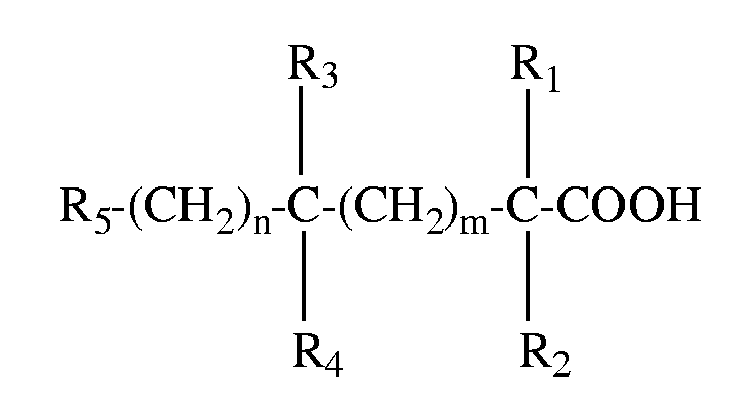
where R1, R2, R3 and R4 represent hydrogen or a hydrocarbyl having 1-30 carbon atoms (C1-C30), but at least two of R1, R2, R3 or R4 are C1-C30 hydrocarbyl; R5 is a hydrocarbyl having 1 to 120 carbon atoms and m and n may each be zero or an integer such that the total number of carbon atoms in the carboxylate is not more than 125.
where R1, R2, R3 and R4 represent hydrogen or a hydrocarbyl having 1-30 carbon atoms (C1-C30), but at least two of R1, R2, R3 or R4 are C1-C30 hydrocarbyl; R5 is a hydrocarbyl having 1 to 120 carbon atoms and m and n may each be zero or an integer such that the total number of carbon atoms in the carboxylate is not more than 125.
4. The method as claimed in claim 3, wherein R1 and R2 are both hydrocarbyl and R3 and R4 are hydrogen.
5. The method as claimed in any one of the preceding claims, wherein the fuel is a heavy
fuel oil.
6. The method as claimed in any one of the preceding claims, wherein the carboxylate
is neodecanoate.
7. The method as claimed in any one of the preceding claims, wherein the fuel contains
1 to 50 ppm, preferably 1 to 25 ppm, more preferably 5 to 15 ppm, of iron by weight
of fuel
8. The method as claimed in any one of the preceding claims, wherein the fuel is a marine
diesel fuel and the iron caboxylate is iron neodecanoate.
9. The method as claimed in any one of the preceding claims, wherein the method reduces
piston groove deposits.
10. The method as claimed in any one of the preceding claims, wherein the method reduces
piston deposits and smoke, or piston deposits and wear, or smoke and wear in a diesel
engine.
REFERENCES CITED IN THE DESCRIPTION
This list of references cited by the applicant is for the reader's convenience only. It does not form part of the European patent document. Even though great care has been taken in compiling the references, errors or omissions cannot be excluded and the EPO disclaims all liability in this regard.
Patent documents cited in the description