|
(11) | EP 1 779 893 A1 |

| (12) | EUROPEAN PATENT APPLICATION |
|
|
|
|
||||||||||||||||
| (54) | Process for producing an aqueous composition |
| (57) The present invention relates to a process for producing aqueous compositions comprising
a water-soluble polymer in powder form. The object of the present invention is that
process for producing a composition comprising a water-soluble powder polymer characterised
in that powder polymer is first dispersed in a liquid medium in which it is insoluble
and subsequently combined with the remaining of the formulation. |
[0001] The present invention relates to a process for producing aqueous compositions comprising a water-soluble polymer in powder form.
[0002] Polymers are used for various purposes such as thickening, conditioning and gelling agents in various type of products. In cosmetic compositions and especially of hair care composition the polymers have found their wide range of application. On one hand, they are unavoidable conditioning agents, especially cationic ones, and on the other hand, they are consistency giving or enhancing agents which makes application and/or usage easy.
[0003] Majority of the polymers are supplied in powder form and they are conventionally mixed with the remaining part of the formulation after dissolving in major part of water available in water. Such a process is first of all timely, requires at least, when considering large scale production, two large vessels and, therefore, extremely costly as well. Furthermore, when preparing solution of powdery polymer in water usually heat is needed in order to shorten the preparation time by increasing dissolution rate and more importantly due to the aggregation of powder particles, lumpiness, the preparation time of such solution is extremely extended, which is not economical.
[0005] The object of the present invention is that process for producing an aqueous composition comprising a water-soluble powder polymer characterised in that powder polymer is first dispersed in a liquid medium in which it is insoluble and subsequently combined with the remaining of the composition.
[0006] Furthermore it has also surprisingly found out that a composition comprising a powder polymer which forms a thixothropic gel in aqueous medium is produced easily without introducing air bubbles into the gel composition as bubbler are almost impossible to get rid off if not wished.
[0008] With the term "water-soluble polymer" it is meant that at least at the concentration of usage in the composition, powder polymer forms a solution in water without leaving any particulate matter when inspected macroscopically by naked eye. Transparency of solution is not a criterion, as there are number of powder polymers which do not form transparent solutions when dissolved in water.
[0009] With the term "insoluble" it is meant that a particulate dispersion is obtained after mixing polymer in the liquid dispersion medium. It is preferred that consistency of mixture of powder polymer and liquid medium does not exceed or equal to 500 mPa.s measured at 20°C with an appropriate viscosimeter, preferably Brookfield viscometer using appropriate spindle and rotation speed and preferably is not increased from the viscosity of the dispersing liquid medium.
[0010] With the term "liquid" it is meant that the dispersion medium is liquid at approximately 20°C and more preferably liquid at temperatures above 5°C.
[0011] Examples to powder polymers without making any limitation are those of natural polymers such as cellulose, guar gum, xanthan gum and their derivatives and of cationic polymers such as Polyquaternium 10, cationic cellulose commercially available under trade names Celquat, Polymer JR, Polyqauternium-37 which is commercially available in powder form under the trade name Ultragel, and anionic acrylate polymers and their derivatives such as available under the trade name Carbopol.
[0012] As a liquid dispersion medium for powder polymers, suitable ones are of lipophilic ones with a viscosity of less than or equal to 500 mPa.s, preferably in the range of 1 to 400mPa.s and more preferably in the range of 1 to 350 mPa.s and most preferably 1 to 250 mPa.s measured at 20°C with an appropriate viscosimeter, preferably a capillary viscosimeter. Examples to suitable liquids without making any limitation are di(ethylhexyl) carbonate, linear or cyclic silicones having viscosity less than 500 mPa. s such as DC 200 series from Dow Corning (linear silicones), DC 244 Fluid (cylomethicone), arylated silicones such as phenyltrimethicone (DC 556), mineral oil, natural oil such as almond oil, peach kernel oil, ricinus oil, and esters of aliphatic linear or branched carboxylic acid with a primary or secondary linear or branched alcohol such as isopropyl myristate, palmitate, stearate and isostearate, oleyl oleate, isocetyl stearate, hexyl laurate, dibutyl adipate, dioctyl adipate, myristyl myristate and oleyl erucate.
[0013] For the selection of the dispersion liquid medium for powder polymer, an important criterion is that it should be compatible with the remaining of the composition and not effecting its stability as well as its preferred physical appearance.
[0014] It has as well been found out that the amount of the liquid dispersion medium used should be kept as low as possible. Therefore, it is preferred that the weight ratio of powder polymer to liquid dispersion medium is in the range of 1:1 to 1:10, more preferably 1:1 to 1:5 and most preferably 1:1 to 1:2.
[0015] It is further preferred form of the invention that the composition produced according to the process disclosed herewith, comprises powder polymer at a concentration of 0.01 to 10%, preferably 0.01 to 7.5%, more preferably 0.1 to 5% by weight, calculated to total composition.
[0016] In the preferred form of the invention, compositions produced according to the process of the present invention are aqueous cosmetic compositions. Examples to those without making any limitation are hair and body cleansing preparations, hair conditioners, hair colours, skin creams or lotions, hair permanent shaping compositions, scalp products, hair styling gel, etc.
[0017] In the case that the compositions produced according to the process of the present invention are cleansing preparations, and then, they comprise at least one foaming surfactant selected from anionic, non-ionic and amphoteric ones. Examples to those without making any limitation are anionic surfactants such as alkyl sulfates or alkyl ether sulfates and their salts such as sodium laureth sulphate, alkyl carboxylates or alkyl ether carboxylates or alkyl amido ether carboxylates and their salts, sulfosuccinates, non-ionic ones such as alkyl glucosides according to general formula
R1-O-(CH2CH2O)n-Zx,
wherein R1 is an alkyl group with 8 to 20, preferably 10 to 14 carbon atoms, Zx is a saccharide group with 5 to 6 carbon atoms, n stands for a number from 0 to 10, and x is a number between 1 and 5, preferably 1.1 to 2.5, sorbitan esters, amin oxides, amphoteric ones such as betaine types, alkyl betaines or alkyl amido betaines, and alkyl sulphobetaines.
[0018] Conditioning composition especially for hair comprises further conditioning ingredients such as cationic polymers known with the INCI name Polyquaternium or Quaternium, cationic surfactants, oily ingredients etc. Cationic surfactsnts are selected form the compounds of the general formula
where R2 is a saturated or unsaturated, branched or non-branched alkyl chain with 8-22 C atoms or
R6 CO NH (CH2)n
where R6 is saturated or unsaturated, branched or non-branched alkyl chain with 7-21 C atoms and n has value of 1 - 4, or
R7 CO O (CH2)n
where R7 is saturated or unsaturated, branched or non-branched alkyl chain with 7-21 C atoms and n has value of 1 - 4, and
R3 is hydrogen or unsaturated or saturated, branched or non-branched alkyl chain with 1 to 22 C atoms or
R6 CO NH (CH2)n
or
R7 CO O (CH2)n
where R6 R7 and n are same as above, and
[0019] R4 and R5 are H or lower alkyl or hydroxyalkyl or polyhydroxyalkyl with 1 to 4 C atoms and X is chloride, bromide, methosulfate.
[0020] Examples to cationic polymers Polyquaternium 6, Polyquaternium 7, Polyquaternium 10, Polyquaternium 11, Polyquaternium 16, Polyquaternium 22 and Polyquaternium 28. It has been found out that especially those of cationic cellulose type polymers know as Polymer JR type from Amerchol such as Polyquaternium 10 or cationic guar gum known with trade name Jaguar from Rhône-Poulenc and chemically for example Guar hydroxypropyl trimonium chloride, are preferred ones. Furthermore, chitosan and chitin can also be included in the compositions as cationic natural polymers.
[0021] As well those polymers known with their CTFA category name Quaternium are suitable. Those are for example Quaternium-8, Quaternium-14, Quaternium-15, Quaternium-18, Quaternium-22, Quaternium-24, Quaternium-26, Quaternium-27, Quaternium-30, Quaternium-33, Quaternium-53, Quaternium-60, Quaternium-61, Quaternium-72, Quaternium-78, Quaternium-80, Quaternium-81, Quaternium-81, Quaternium-82, Quaternium-83 and Quaternium-84.
[0022] The cationic polymers also include the quaternized products of graft polymers from organopolysiloxanes and polyethyl oxazolines described in EP-A 524 612 and EP-A 640 643.
[0023] Examples to cationic surfactants are particularly cetyl trimethly ammonium chloride, steartrimonium chloride, behentrimonium chloride, stearamidopropyl trimonuim chloride, behenamidopropylethyldimonium ethosulfate, behenamidopropyltrimonium methosulfate, cocamidopropytrimonium chloride, cocotrimonim chloride, palmitamidopropyltrimonum chloride, distearyldimonium chloride, dipalmitoylethylhydroxyethylmonium chloride, dioleoylethyl dimethyl ammonium methosulfate, dioleoylethyl hydroxyethylmonium methosulfate, dilinolamidopropyldimonium chloride, dioleylethyl hydroxyethylmonium chloride, dipalmitoylethyldimonium chloride.
[0024] In the case that an emulsion composition is prepared so it contains at least one fatty alcohol. The fatty alcohols preferred are linear or branched, saturated or unsaturated with 10 to 24, preferably 12 to 22 carbon atoms in its alkyl chain. Nonlimiting examples are myristyl alcohol, cetyl alcohol, stearyl alcohol, palmityl alcohol, oleyl alcohol, lauryl alcohol, coconut alcohol, palm alcohol, behenyl alcohol, arachidyl alcohol and their mixtures. Preferred are myristyl alcohol, cetyl alcohol, stearyl alcohol, palmityl alcohol, oleyl alcohol, behenyl alcohol and their mixtures.
[0025] Emulsion compositions comprise in addition to fatty alcohols at least one emulsifier selected from non-ionic, anionic, cationic and amphoteric surfactants. In addition to the above disclosed surfactants, preferred are C10-C22-fatty alcohol ethoxylates. Especially suited C10-C22-fatty alcohol ethers are the alkyl polyglycol ethers known by the generic terms "Laureth", "Myristeth", "Oleth", "Ceteth", "Deceth", "Steareth" and "Ceteareth" according to the CTFA nomenclature, including addition of the number of ethylene oxide molecules, e.g., "Laureth-16", "Ceteareth-20".
[0026] Composition produced according to present invention can be a hair colouring composition and comprise at least one dyeing agent selected from oxidative dye precursors, eventually in combination with one or more coupling agent, direct acting dyestuffs. The direct dyes referred are cationic, anionic, neutral and of plant dyes.
[0027] Suitable cationic dyestuffs are in principal those available on the market for hair colouring applications. Some examples to those are: Basic Blue 6, Basic Blue 7, Basic Blue 9, Basic Blue 26, Basic Blue 41, Basic Blue 99, Basic Brown 4, Basic Brown 16, Basic Brown 17, Natural Brown 7, Basic Green 1, Basic Red 2, Basic Red 12 Basic Red 22, Basic Red 51 Basic Red 76, Basic Violet 1, Basic Violet 2, Basic Violet 3, Basic Violet 10, Basic Violet 14 and Basic Yellow 57, Basic Orange 31 and Basic Yellow 87. For this purpose, special reference is made to the PCT application WO 95/15144 of Ciba-Geigy AG. All cationic dyes disclosed therein are included here by reference.
[0028] Anionic dyes may as well be used either alone or in combination with cationic direct dyes. The suitable ones are Acid Black 1, Acid Blue 1, Acid Blue 3, Food Blue 5, Acid Blue 7, Acid Blue 9, Acid Blue 74, Acid Orange 3, Acid Orange 6, Acid Orange 7, Acid Orange 10, Acid Red 1, Acid Red 14, Acid Red 18, Acid Red 27, Acid Red 50, Acid Red 52, Acid Red 73, Acid Red 87, Acid Red 88, Acid Red 92, Acid Red 155, Acid Red 180, Acid Violet 9, Acid Violet 43, Acid Violet 49, Acid Yellow 1, Acid Yellow 23, Acid Yellow 3, Food Yellow No. 8, D&C Brown No. 1, D&C Green No. 5, D&C Green No. 8, D&C Orange No. 4, D&C Orange No. 10, D&C Orange No. 11, D&C Red No. 21, D&C Red No. 27, D&C Red No. 33, D&C Violet 2, D&C Yellow No. 7, D&C Yellow No. 8, D&C Yellow No. 10, FD&C Red 2, FD&C Red 40, FD&C Red No. 4, FD&C Yellow No. 6, FD&C Blue 1, Food Black 1, Food Black 2, Disperse Black 9 and Disperse Violet 1 and their alkali metal salts such as sodium, potassium.
[0029] Additionally, the coloring compositions may comprise neutral dyes (HC dyes), so called nitro dyes either alone or in addition to the cationic and/or anionic direct dyes. Concentration of those can typically be in the range of 0.001 to 2%, preferably 0.01 to 1.5% and more preferably 0.05 to 1% by weight calculated to total aqueous composition.
[0030] Some examples to those are: HC Blue No.2, HC Blue No.4, HC Blue No.5, HC Blue No.6, HC Blue No.7, HC Blue No.8, HC Blue No.9, HC Blue No.10, HC Blue No.11, HC Blue No.12, HC Blue No.13, HC Brown No.1, HC Brown No.2, HC Green No.1, HC Orange No.1, HC Orange No.2, HC Orange No.3, HC Orange No.5, HC Red BN, HC Red No.1, HC Red No.3, HC Red No.7, HC Red No.8, HC Red No.9, HC Red No.10, HC Red No.11, HC Red No.13, HC Red No.54, HC Red No.14, HC Violet BS, HC Violet No.1, HC Violet No.2, HC Yellow No.2, HC Yellow No.4, HC Yellow No.5, HC Yellow No.6, HC Yellow No.7, HC Yellow No.8, HC Yellow No.9, HC Yellow No.10, HC Yellow No.11, HC Yellow No.12, HC Yellow No.13, HC Yellow No.14, HC Yellow No.15, 2- Amino-6-chloro-4-nitrophenol, picramic acid, 1,2-Diamino-4-nitrobenzol, 1,4-Diamino-2-nitrobenzol, 3-Nitro-4-aminophenol, 1-Hydroxy-2-amino-3-nitrobenzol and 2-hydroxyethylpicramic acid.
[0031] Plant dyestuffs may also be used in combination with cationic direct-acting dyestuffs, for example henna (red or black), alkanna root, laccaic acid, indigo, logwood powder, madder root and rhubarb powder, etc.
[0032] Oxidative dye precursors are pyrazole derivatives are such as 1-hydroxyethyl-4,5-diaminopyrazole, 3,4-diamino-5-hydroxypyrazole, 3,5-diaminopyrazole, 3,5-diamino pyrazol-1-carboxamide, 3-amino-5-hydroxypyrazole, 1-phenyl-2-methylpyrazole, 1-phenyl-3-methylpyrazole-5-one, 3,5-dimethylpyrazole, 3,5-dimethylpyrazole-1-methanol, 1-methyl-4,5-diaminopyrazole, 1-methylethyl-4,5-diaminopyrazole, 1-phenylmethyl-4,5-diaminopyrazole, 1-methyl-4,5-diaminopyrazole, 1-(4-methylphenyl)methyl-4,5-diaminopyrazole, 1-methyl-3-phenyl-4,5-diaminopyrazole and the water-soluble salts. Further suitable are tetraaminopyrimidines are in particular 2,4,5,6-tetraaminopyrimidine and the lower alkyl derivatives thereof; suitable triaminohydroxypyrimidines are, for example 4-hydroxy-2,5,6-triaminopyrimidine, 2-hydroxy-4,5,6-triaminopyrimidine and 5-hydroxy-2,4,6-triaminopyrimidine; suitable mono- and diamino dihydroxypyrimidines are, for example, 2,6-dihydroxy-4,5-diaminopyrimidine, 2,4-diamino-6-hydroxy-pyrimidine or 4,6-dihydroxy-2,5-diaminopyrimidine or the water-soluble salts thereof, aminophenol derivatives such as 4-aminophenol, 4-amino-3-methylphenol, 2-chloro-4-aminophenol, 2,6-dichloro-4-aminophenol, 2,4-diamino-phenol, 2,6-dibromo-4-aminophenol and/or 2-aminophenol and water-soluble salts thereof, furthermore, phenylenedimanine derivatives such as 2,5-diamino-toluene, 2-n-propyl or 2-ethyl-p-phenylene-diamine, 2,6-dimethyl-p-phenylenediamine, 2-(2,5-diaminophenyl) ethanol, 1-amino -4-bis-(2'-hydroxy-ethyl)aminobenzene, 2-(2-hydroxyethyl amino)-5-aminotoluene, 4,4'-diaminodiphenylamine, 4-aminodiphenylamine, 2-amino-5-N,N-diethyl aminotoluene, 4-amino-N-ethyl-N-isopropyl aniline, 2-chloro-p-phenylenediamine, 1-β-hydroxyethyl-2,5-diamino-4-chlorobenzene, 1-β-hydroxyethyl-2,5-diamino-4-methyl benzene, 2-methoxy-p-phenylenediamine, N,N-diethyl-p-phenylenediamine, 1-amino-4-β-methoxyethyl aminobenzene, 1-dimethylamino-4-aminobenzene, 1-hydroxy-2,5-diamino-4-methyl benzene, 1-hydroxymethyl-2,5-diaminobenzene, 1.3-dimethyl-2,5-diaminobenzene, 1,4-diamino isopropyl benzene and/or 1-amino-4-β-hydroxypropyl aminobenzene or the water-soluble salts thereof.
[0033] Coupling substance, are resorcinol, 2-methyl resorcinol, 4-amino-2-methylphenol, 4-chlororesorcinol, 2-amino-4-chlorophenol, 5-amino-4-methoxy-2-methylphenol, 3-amino-phenol, 1-methyl-2-hydroxy-4-aminobenzene, 3-N,N-dimethyl aminophenol, 2.6-dihydroxy-3.5-dimethoxypyridine, 5-amino-3-methylphenol, 6-amino-3-methylphenol, 3-amino-2-methylamino-6-methoxypyridine, 2-amino-3-hydroxypyridine, 2-dimethyl-amino-5-aminopyridine, 2,6-diaminopyridine, 1,3-diaminobenzene, 1-amino-3-(2'-hydroxyethylamino)benzene, 1-amino-3-[bis(2'-hydroxyethyl) amino]benzene, α-naphthol, 4,6-dichlororesorcinol, 1,3-diamino-toluene, 1-hydroxy naphthalene, 4-hydroxy-1,2-methylenedioxy benzene, 1,5-dihydroxy naphthalene, 1,6-dihydroxy naphthalene, 1,7-dihydroxy naphthalene, 2,7-dihydroxy naphthalene, 1-hydroxy-2-methyl naphthalene, 4-hydroxy-1,2-methyldioxy benzene, 2,4-diamino-3-chlorophenol, 2,6-dihydroxyethylamino toluene, 5-amino-2-methoxyphenol and/or 1-methoxy-2-amino-4-(2'-hydroxyethyl amino)benzene or the water-soluble salts thereof.
[0034] Concentration of any hair dye should be in the range of 0.001 to 5% by weight, calculated to total composition, in the case of oxidative dyes excluding the oxidizing agent which may be hydrogen peroxide.
[0035] The compositions may contain organic solvents, for example, as penetration enhancer such as ethanol. propanol, isopropanol, benzyl alcohol, benzyloxyethanol, ethylene carbonate, propylene carbonate, phenoxyethanol, butanol, isobutanol, cyclohexane, cyclohexanol, hexyleneglycol, ethylene glycol, butylenes glycol, propylene glycol, benzyl glycol, ethylene glycol monoethylether, ethylene glycol monobutyl ether, ethylene glycol monophenyl ether, 1-phenylethylalcohol, 2-phenylethylalcohol, o-methoxyphenol. Concentration of organic solvents in the conditioner composition can be in the range from 0.1 to 50% by weight, calculated to total composition.
[0036] Compositions may further comprise UV filters for protection of hair or skin, in the case of a cosmetic composition, from environmental influences such as loss of elasticity, loss of hair colour (bleaching effect of sun light). The UV-absorbing substance is preferably selected from the following compounds: 4-Aminobenzoic acid and the esters and salts thereof, 2-phenyl benzimidazole-5-sulfonic acid and the alkali and amine salts thereof, 4-dimethyl aminobenzoic acid and the esters and salts thereof, cinnamic acid and the esters and salts thereof, 4-methoxycinnamic acid and the esters and salts thereof, salicylic acid and the esters and salts thereof, 2.4-dihydroxybenzophenone, 2.2'.4.4'-tetrahydroxy- benzophenone, 2-hydroxy-4-methoxybenzophenone and its 5-sulfonic acid or the sodium salt thereof, 2.2'-dihydroxy-4.4'-dimethoxybenzophenone, 2-hydroxy-5-chlorobenzophenone, 2.2'-dihydroxy-4-methoxybenzophenone, 2.2'-dihydroxy-4.4'-dimethoxy-5.5'-disulfobenzo-phenone or the sodium salt thereof, 2-hydroxy-4-octyloxybenzophenone, 2-hydroxy-4-methoxy-4.'-methylbenzophenone, 3-benzylidenecampher, 3-(4'-sulfo)-benzyl-idenebornane-2-one and the salts thereof and/or 3-(4'-methyl benzylidene)-DL-campher.
[0037] The preferred amount of the UV-absorber ranges from about 0.01 % to 5%, by weight, calculated to the total composition.
[0038] The pH of the compositions, in the case of cosmetic compositions, varies from 2 to 11. In the case of hair or skin care compositions particularly 2 to 7 and more particularly 2.5 to 6.0 and for colouring composition, especially those mixed with an oxidizing agent prior to application, it may be 6 to 11 and particularly 6 to 10. For adjusting the pH of the said conditioner compositions, following ingredients can be used: Organic acids such as citric acid, lactic acid, tartaric acid, malic acid, maleic acid, fumaric acid, levulinic acid, butyric acid and hydroxy butyric acids, valeric acid, oxalic acid, succinic acid, mandelic acid, glycolic acid, glucuronic acid, propionic acid, salicylic acid or acetic acid or inorganic acids such as hydrochloric acid, phosphoric acid, sulphuric acid, nitric acid. Concentration of the organic and/or inorganic acids or their mixtures should be adjusted in a way that conditioner composition so obtained has a pH value between 2 to 7. Typically concentration for acids can be 0.01 - 5% by weight, preferably 0.01 - 4% by weight, more preferably 0.05 - 2.5% by weight calculated to the total composition. In the alkaline range ammonium hydroxide and/or monoethanolamine are used for adjusting pH.
[0039] The composition may contain in principal any benefit agent serving the purpose of the usage and products designed for hair and skin may comprise further moisturisers and natural ingredients showing hair conditioning benefits.
[0040] The moisturising agents are selected from panthenol, polyols, such as glycerol, polyethylene glycols with molecular weight 200 to 20,000.
[0041] Additional natural plant extracts can as well form part of the compositions produced according to present invention. Those are incorporated usually in an amount of about 0.01 % to about 10 %, preferably 0.05 % to 7.5 %, in particular 0.1 % to 5 % by weight, calculated as dry residue thereof to the total composition. Suitable aqueous (e.g. steam-distilled) alcoholic or hydro-alcoholic plant extracts known per se are in particular extracts from leaves, fruits, blossoms, roots, rinds or stems of almond, aloe, pineapple, artichoke, arnica, avocado, valerian, henbane, birch, stinging nettle, echinacea, ivy, wild angelica, gentian, ferns, pine needles, silver weed, ginseng, broom, oat, rose hip, hamamelis, hay flowers, elderberry, hop, coltsfoot, currants, chamomile, carrots, chestnuts, clover, burr root, coconut, cocoanut, mango, peach, lemon, cornflower, wheat, apricot, lime blossom, lily of the valley, marine algae, balm, mistletoe, passion flower, ratanhia, marigold, rosemary, horse chestnut, pink hawthorn, sage, horsetail, yarrow, primrose, nettle, thyme, walnut, wine leaves, white hawthorn, etc.
[0042] Suitable trade products are, for example, the various "Extrapon®" products, "HerbasolR", "SedaplantR" and "HexaplantR". Extracts and the preparation thereof are also described in "Hagers Handbuch der pharmazeutischen Praxis", 4th Ed..
Example 1
[0044] All values are in % by weight
| Ultragel 300 | 1.80 |
| Di(ethylhexyl)carbonate | 3.60 |
| Cetearyl alcohol | 3.00 |
| Cetrimonium chloride | 1.00 |
| Stearamidopropyldimethylamine | 1.00 |
| Isopropylmyristate | 0.25 |
| Dimethicone | 0.50 |
| Panthenol | 0.50 |
| Glycerin | 2.00 |
| Polyquaternium-11 | 0.30 |
| Lactic acid | q.s to pH 4.0 |
| Fragrance | q.s. |
| Preservative | q.s. |
| Water | to 100 |
[0045] The conditioner composition as above was prepared by first combining all ingredients in a vessel other than fragrance, Ultragel 300 (polyquaternium 37), di(ethylhexyl)carbonate and lactic acid, for pH adjustment, and heating the batch up to 70°C for melting fatty alcohol and homogenizing the mixture for about 5 min at a speed of 2000 rpm and subsequently Ultragel 300 dispersed in di(ethylhexyl)carbonate was added to the vessel and stirred until polymer was dissolved. Subsequently the batch is cooled down to around 35°C and fragrance was added. Finally pH was adjusted with lactic acid. The conditioner thus obtained has a pH value of 4 and has a viscosity of approximately 30,000 mPa.s measured with Brookfield viscosimeter at 20°C with spindle 4 at 10 rpm. The conditioner so obtained is opaque. The above composition was stable at room temperature for a period of longer than 6 months, at 40°C and 50°C for 3 months. The tests were interrupted after the said period at 40 and 50°C.
[0046] The above composition is produced with a batch size of 1.5 t in relatively short time (2 hrs) with using only one large vessel. A batch without dispersion of Ultragel 300 in a liquid medium, Di(ethylhexyl)carbonate, required at least 2 large vessels and production time was considerably longer, 3.5 hrs.
Example 2
[0047] All values are in % by weight.
| Sodium laureth sulphate | 8.0 |
| Coco glucoside | 3.0 |
| Cocamidopropyl betaine | 3.0 |
| Panthenol | 0.5 |
| Polyquaternium 10 | 0.5 |
| Di(ethylhexyl)carbonate | 0.5 |
| Sodium chloride | q.s to viscosity 3000 mPa.s (Höppler at 20°C) |
| Preservative, fragrance | q.s. |
| Citric acid | q.s pH 5.2 |
| Water | q.s. to 100 |
[0048] The shampoo composition with the above formula was produced by first combining the surfactants, panthenol, and fragrance and major part of water. The batch was mixed until homogeneity and Polyquaternium 10 dispersed in Di(ethylhexyl)carbonate was added to the batch and finally viscosity and pH were adjusted.
1. Process for producing an aqueous composition comprising at least one water soluble
powder polymer characterised in that powder polymer is first dispersed in a liquid medium in which it is insoluble and
subsequently combined with remaining of the composition.
2. Process according to claim 1 characterised in that liquid medium wherein powder polymer is dispersed has a viscosity of less than or
equal to 500 mPa.s measured with a capillary viscosimeter at 20°C.
3. Process acoording to claim 2 characterised in that liquid medium is selected from di(ethylhexyl)carbonate, linear, cyclic or arylated
silicones, natural oils and esters of aliphatic linear or branched carboxylic acids
with a primary or secondary linear or branched alcohol.
4. Process according to any of the preceding claims characterised in that mixing weight ratio of powder polymer and liquid dispersion medium is in the range
of 1:1 to 1:10.
5. Process according to any of the preceding claims characterised in that final composition comprises powder polymer at a concentration of 0.01 to 10% by weight,
calculated to total composition.
6. Composition produced according to process of claim 1 to 5 is an aqueous cosmetic composition.
7. Composition according to claim 6 is a shampoo and comprises additionally at least
one foaming surfactant selected from non-ionic, anionic, amphoteric ones.
8. Composition according to claim 6 is an emulsion and comprises additionally at least
one fatty alcohol.
9. Compositions according to claims 7 and 8 characterised in that it comprises additionally at least one conditioning compound selected from cationic
polymers, cationic surfactants and oily ingredients.
10. Composition according to claim 9 characterised in that cationic surfactants are selected from compounds of general formula
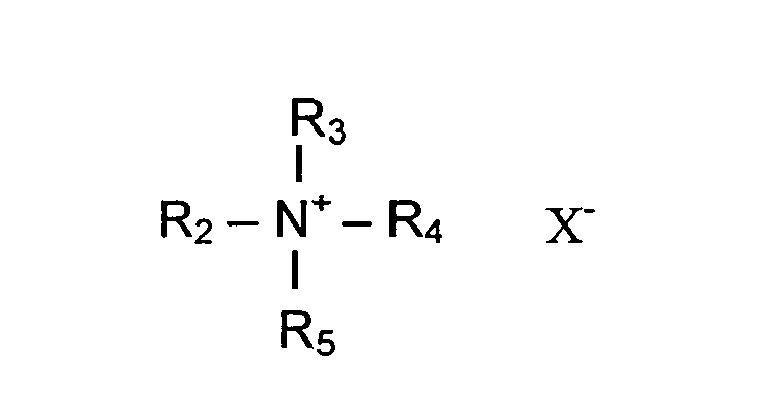
where R2 is a saturated or unsaturated, branched or non-branched alkyl chain with 8-22 C atoms or
R6 CO NH (CH2)n
where R6 is saturated or unsaturated, branched or non-branched alkyl chain with 7-21 C atoms and n has value of 1 - 4,
or
R7 CO O (CH2)n
where R7 is saturated or unsaturated, branched or non-branched alkyl chain with 7-21 C atoms and n has value of 1 - 4, and
R3 is hydrogen or unsaturated or saturated, branched or non-branched alkyl chain with 1 to 22 C atoms or
R6 CO NH (CH2)n
or
R7 CO O (CH2)n
where R6, R7 and n are same as above, and
R4 and R5 are H or lower alkyl or hydroxyalkyl or polyhydroxyalkyl with 1 to 4 C atoms and X is chloride, bromide, methosulfate.
where R2 is a saturated or unsaturated, branched or non-branched alkyl chain with 8-22 C atoms or
R6 CO NH (CH2)n
where R6 is saturated or unsaturated, branched or non-branched alkyl chain with 7-21 C atoms and n has value of 1 - 4,
or
R7 CO O (CH2)n
where R7 is saturated or unsaturated, branched or non-branched alkyl chain with 7-21 C atoms and n has value of 1 - 4, and
R3 is hydrogen or unsaturated or saturated, branched or non-branched alkyl chain with 1 to 22 C atoms or
R6 CO NH (CH2)n
or
R7 CO O (CH2)n
where R6, R7 and n are same as above, and
R4 and R5 are H or lower alkyl or hydroxyalkyl or polyhydroxyalkyl with 1 to 4 C atoms and X is chloride, bromide, methosulfate.
11. Composition according to claim 6 characterised in that it is a hair colouring composition comprising at least one dyestuff selected from
oxidative dyestuffs precursors and direct dyes of anionic, cationic and non-ionic
character.
REFERENCES CITED IN THE DESCRIPTION
This list of references cited by the applicant is for the reader's convenience only. It does not form part of the European patent document. Even though great care has been taken in compiling the references, errors or omissions cannot be excluded and the EPO disclaims all liability in this regard.
Patent documents cited in the description