| (19) |
 |
|
(11) |
EP 1 785 570 B2 |
| (12) |
NEW EUROPEAN PATENT SPECIFICATION |
|
After opposition procedure |
| (45) |
Date of publication and mentionof the opposition decision: |
|
02.03.2016 Bulletin 2016/09 |
| (45) |
Mention of the grant of the patent: |
|
18.08.2010 Bulletin 2010/33 |
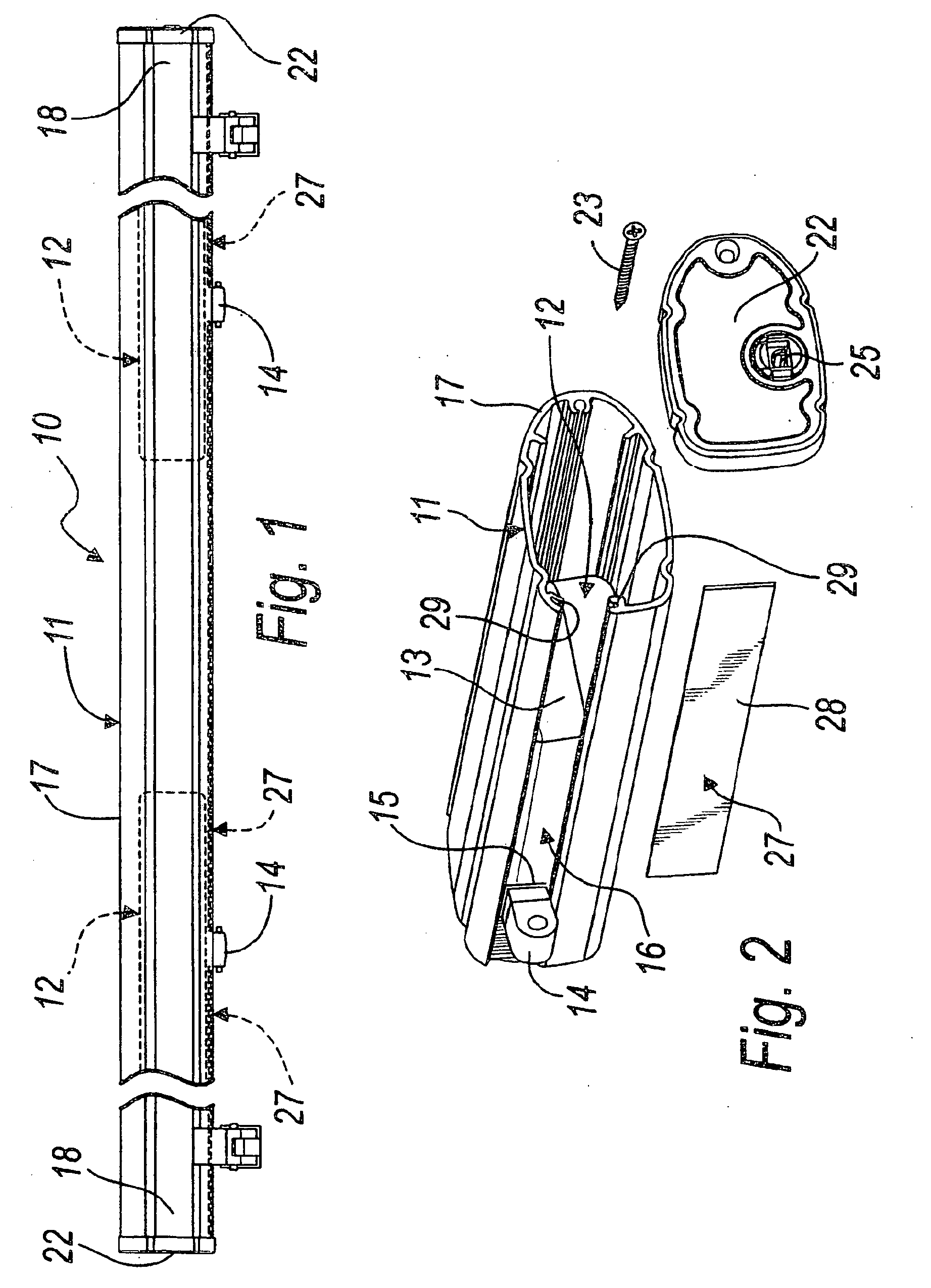
| (22) |
Date of filing: 13.10.2006 |
|
| (51) |
International Patent Classification (IPC):
|
|
| (54) |
Chain-drive actuator assembly
Kettenantrieb
Actionneur à transmission par chaîne
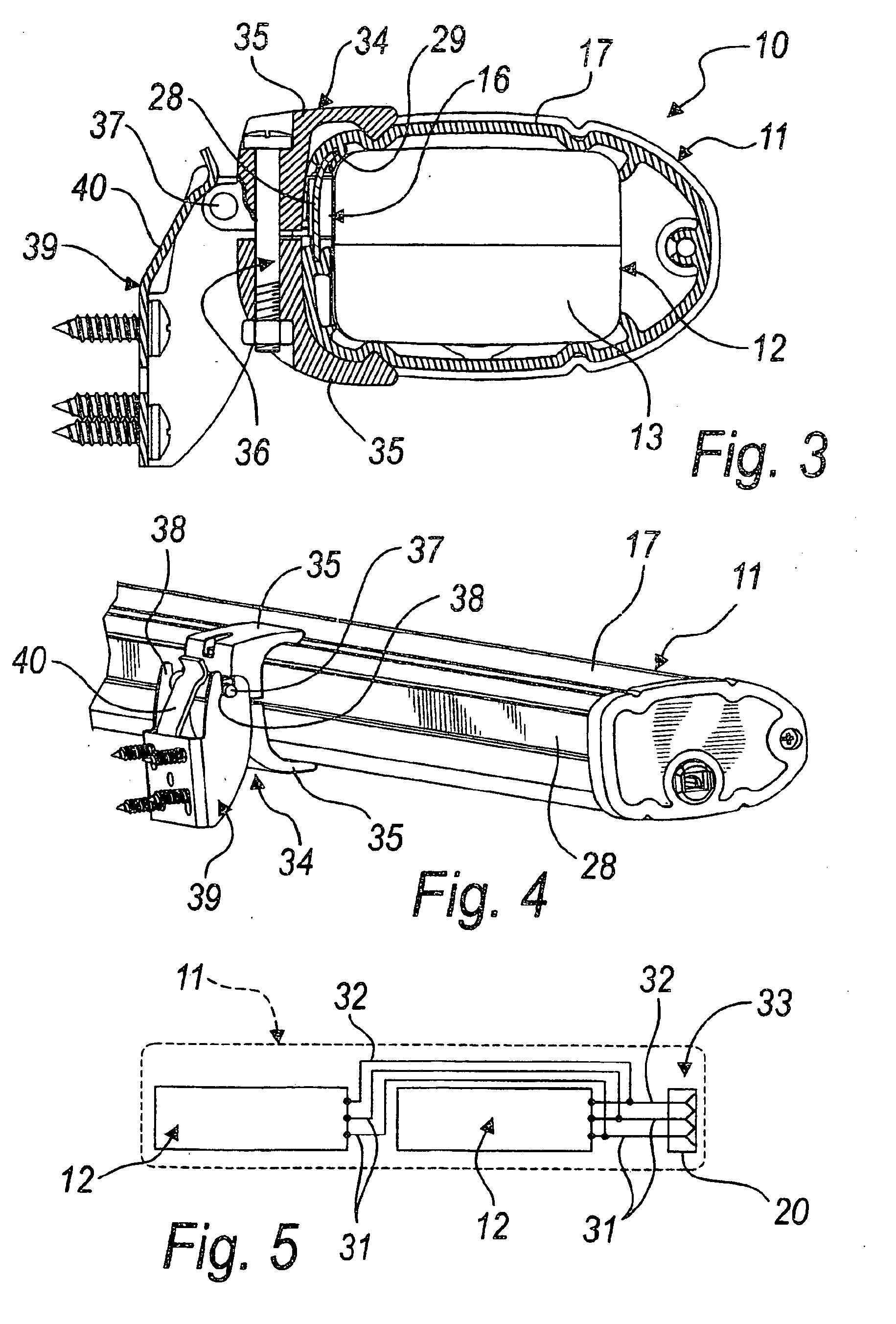
|
| (84) |
Designated Contracting States: |
|
DE ES FR GB IT |
| (30) |
Priority: |
10.11.2005 IT PD20050088 U
|
| (43) |
Date of publication of application: |
|
16.05.2007 Bulletin 2007/20 |
| (73) |
Proprietor: Topp Srl a socio unico |
|
36066 Sandrigo (VI) (IT) |
|
| (72) |
Inventor: |
|
- CAVALCANTE, Toni
36031, DUEVILLE VI (IT)
|
| (74) |
Representative: Modiano, Micaela Nadia |
|
Modiano & Partners (IT)
Via Meravigli, 16
20123 Milano
20123 Milano (IT) |
| (56) |
References cited: :
EP-A- 0 777 028
DE-U1- 9 214 724
|
DE-U1- 2 806 108
|
|
| |
|
|
|
|
| |
|
[0001] The present invention relates to a chain-drive actuator assembly particularly but
not exclusively for moving large doors or windows.
[0002] As it is known, in various fields of application and particularly in the field of
doors and windows, chain-drive actuators have long been used which allow effective
movement of door and window parts, especially of the tilting type.
[0003] Among the various constructive types of known chain-drive actuators, the most widely
used ones are those that comprise substantially a containment box which accommodates
motor means, usually constituted by an electric motor, which is connected to a reduction
unit, which in turn is mated, by means of a gear, to a guided chain which protrudes
with a working end from the box-like body.
[0004] In the case of chain-drive actuators for large doors or windows, multiple thrust
points are required to open and support them; for these reasons, twin-chain actuators
are used.
[0005] In practice, these twin-chain actuators have an elongated containment box, which
contains motor means connected to two separate reduction units, which in turn are
mated to corresponding chains which are mutually spaced by a preset distance.
[0006] The containment box is formed internally so as to accommodate directly all the reduction
mechanisms, the guides for the chains and the electric motors.
[0007] Such twin-chain actuators, therefore, are products that are certainly more complex
and expensive than single-chain actuators, since they require a larger and more complex
containment box.
[0008] Since twin-chain actuators are to be applied to large doors or windows, they must
be designed according to standardized measurements of the distance between the chains:
wider doors or windows have elongated containment boxes in which the distance between
the chains is suitable for correct force balancing.
[0009] It is therefore evident that manufacturers of twin-chain actuators must provide a
range of actuators of various sizes, with the evident industrial costs that arise
from the design and manufacture of a plurality of complex products which are mutually
different, albeit only in terms of dimensions.
[0010] EP-A-0 777 028 discloses a double chain operator for opening and closing pivotal windows, that comprises
a common housing with stationary guide grooves that receive the operator chains and
with housing portions that receive sprocket wheels for driving the chains. The gooves
lead to lead-in openings provided in fixed positions in a side wall of the common
housing.
DE 92 14 724 U1 discloses double chain device for tilting a window, that comprises a housing for
each chain device and each connected to a cross-piece of the window frame. A rigid
link interconnects the chain devices for synchronized movement thereof.
[0011] The aim of the present invention is to solve the problems linked to the production
of know types of twin-chain actuator.
[0012] Within this aim, an object of the present invention is to provide a chain-drive actuator
assembly that allows to reduce production and inventory costs with respect to known
types of twin-chain actuator.
[0013] Another object of the present invention is to provide a chain-drive actuator assembly
that can be installed and maintained easily.
[0014] Another object of the present invention is to provide a chain-drive actuator assembly
that is structurally simple.
[0015] In accordance with the invention there is provided a chain-drive actuator assembly
as defined in the appended claims.
[0016] Further characteristics and advantages of the invention will become better apparent
from the following detailed description of a preferred but not exclusive embodiment
thereof, illustrated by way of non-limiting example in the accompanying drawings,
wherein:
Figure 1 is a top view of an actuator assembly according to a preferred embodiment
of the invention;
Figure 2 is an exploded view of a portion of an actuation assembly according to a
preferred embodiment of the invention;
Figure 3 is a transverse sectional view of an actuation assembly according to a preferred
embodiment of the invention;
Figure 4 is a view of an end portion of an actuation assembly according to a preferred
embodiment of the invention;
Figure 5 is a diagram of the electrical connection of an actuation assembly according
to a preferred embodiment of the invention.
[0017] With reference to the figures, a chain-drive actuator assembly according to a preferred
embodiment of the invention is generally designated by the reference numeral 10.
[0018] The chain-drive actuator assembly 10 comprises an outer enclosure 11, which is predominantly
longitudinally elongated and inside which two similar single-chain actuators 12 are
aligned at a preset distance.
[0019] The outer enclosure 11 has a supporting and covering function for the single-chain
actuators 12, which are substantially identical and of a known type.
[0020] For example, each one is constituted by a containment box 13, inside which there
are motor means (not shown in the figures), which are connected to a reduction unit,
which in turn is mated by means of a gear which meshes with a guided chain which has
a working end 14 preset so as to pass through a corresponding opening 15 formed in
the containment box 13.
[0021] Each single-chain actuator 12 has the outer working end 14 of the chain preset so
as to pass through an opening 16 formed in the outer enclosure 11.
[0022] The outer enclosure 11 is constituted by an extruded body 17 (made for example of
aluminum) having an open transverse profile, from the two end portions 18 of which
the two single-chain actuators 12 are inserted respectively.
[0023] The open portion of the transverse profile of the extruded body forms along the extruded
body 17 the opening 16, which is thus longitudinal and from which the outer working
ends 14 of the chains of the single-chain actuators 12 protrude.
[0024] At the two end portions 18 of the extruded body 17 there are two complementarily
shaped closure plugs 22, which also are associated by insertion and locked on the
extruded body 17 by means of screws 23.
[0025] Each closure plug 22 is provided with a through hole 25.
[0026] Depending on the side on which the wiring for powering and controlling the actuators
12 is to exit, a closure plug or a grommet is associated with the through hole 25.
[0027] Means 27 for covering the opening 16 in the regions that are not occupied at the
outer working ends 14 of the chains of the single-chain actuators 12 are associated
with the extruded body 17 and are constituted by plates 28 made of plastic material,
which are fixed on the internal portions of the edges of the opening 16 and are in
particular inserted in mutually opposite slots 29 formed on the edges of the opening
16.
[0028] Each single-chain actuator 12 is provided, as shown in the diagram of Figure 5, with
a pair of electric power supply cables 31 and an electric control cable 32, which
carries the control pulses to the electronic board (not shown in the figures) that
controls the actuator 12.
[0029] In order to allow the simultaneous operation of the two single-chain actuators 12,
there are means 33 for simultaneous actuation, which are constituted by the common
connection connection to a terminal strip 20 of the respective electric power supply
cables 31 and of the electric control cables 32 (in practice, the motors are arranged
in parallel as regards the electric power supply and so are the electric control cables
32 that transmit the control pulses to the electronic boards).
[0030] It is evident that in constructive variations not shown the figures, the means 33
for simultaneous actuation can also comprise electronic synchronization boards.
[0031] The two single-chain actuators 12 are associated with means 34 for locking by interference
within the extruded body 17, which are constituted by two pairs of jaws 35, each pair
being arranged so as to grip mutually opposite portions of the extruded body 17 with
respect to the opening 16; the jaws 35 of each pair are mutually connected by a bolt
36 arranged transversely to the opening 16.
[0032] The jaws 35, when they are moved mutually closer by way of the action of the bolt
36, are adapted to produce the deformation of the extruded body 17 by flexing, since
it is constituted by a profile having an open cross-section.
[0033] A horizontal pivot 37 is provided on one of the two jaws 35 of each pair and its
ends rest against a fork 38 provided on a bracket 39 for fixing to a supporting structure,
such as typically a wall.
[0034] The bracket 39 is provided with a tab 40 for reversible locking, by elastic deformation,
of the horizontal pivot 37 in the fork 38.
[0035] In practice it has been found that the invention thus described solves the problems
noted in known types of twin-chain actuator; in particular, the present invention
provides a chain-drive actuator assembly particularly for moving large doors or windows
that allows to reduce production and storage costs with respect to known types of
twin-chain actuator.
[0036] The present invention in fact provides an actuator assembly that has two or more
single-chain actuators, normally usable as individual actuators, which are combined
together inside a common supporting structure which can be sized cheaply for the specific
requirements of the market.
[0037] The actuator manufacturer will in fact manufacture and keep in stock single-chain
actuators and use simple extruded bodies, which can be manufactured easily and cheaply
according to the intended measurements, into which he will insert the single-chain
actuators so as to provide a multiple-chain actuator.
[0038] The costs for design and production (as well as for inventory) of all twin-chain
actuators that require a dedicated containment box for actuation components (electric
motors, reduction units, chains) are thus reduced.
[0039] Moreover, said actuator assembly has an extremely simple structure, and this facilitates
considerably both installation and maintenance.
[0040] In practice, the materials employed, so long as they are compatible with the specific
use, as well as the dimensions, may be any according to requirements and to the state
of the art.
[0041] Where technical features mentioned in any claim are followed by reference signs,
those reference signs have been included for the sole purpose of increasing the intelligibility
of the claims and accordingly such reference signs do not have any limiting effect
on the interpretation of each element identified by way of example by such reference
signs.
1. A chain-drive actuator assembly, particularly for moving large doors or windows, comprising
at least two similar single-chain actuators (12), said at least two single-chain actuators
(12) being associated with means (33) for their simultaneous actuation, characterized in that said chain-drive actuator assembly comprises an outer enclosure (11), constituted
by an extruded body having an open transverse profile, which is predominantly longitudinally
elongated and inside which said at least two similar single-chain actuators (12) are
aligned at a preset distance, each actuator having the outer working end (14) of the
respective chain preset so as to pass through a longitudinal opening (16) provided
in said outer enclosure (11) by the open portion of the transverse profile, said outer
enclosure (11) having a supporting and covering function for said at least two single-chain
actuators (12).
2. The chain-drive actuator assembly according to claim 1, characterized in that said outer enclosure (11) is constituted by an extruded body (17) which has an open
transverse profile, said external working ends (14) of the chains of said actuators
(12) protruding from said longitudinal opening (16) formed by the open portion of
the transverse profile of said extruded body (17), two complementarily shaped closure
plugs (22) for closing said extruded body (17) being provided at the two end portions
(18) of said extruded body (17).
3. The chain-drive actuator assembly according to claim 2, characterized in that said at least two similar single-chain actuators (12) are associated with means (34)
for locking by interference within said extruded body (17).
4. The chain-drive actuator assembly according to claim 3, characterized in that said means (17) for locking by interference comprise at least one pair of jaws (35),
which is arranged so as to grip opposite portions of said extruded body (17) with
respect to said opening (16), said jaws (35) of said pair being mutually connected
by a bolt (36) arranged transversely to said opening (16), said jaws (35), when moved
mutually closer by way of the action of said bolt (36), being adapted to deform said
extruded body (17) by flexing, since it is constituted by a profile having an open
cross-section.
5. The chain-drive actuator assembly according to claim 4, characterized in that a horizontal pivot (37) is provided on one of said two jaws (35) and its ends rest
on a fork (38) which is formed on a bracket (39) for fixing to a supporting structure,
said bracket (39) having a tab (40) for the reversible locking, by elastic deformation,
of said horizontal pivot (37) in said fork (38).
6. The chain-drive actuator assembly according to claim 2 or 3, characterized in that said at least one said closure plug (22) is provided with a through hole (25), with
which a grommet is associated for the electrical wiring for power supply and control
of said single-chain actuators (12) contained within said outer enclosure (11).
7. The chain-drive actuator assembly according to claim 2 or 3, characterized in that it comprises means (27) for covering said opening (16) of said outer enclosure (11)
in the regions that are not occupied at the outer working ends (14) of the chains
of said single-chain actuators (18).
8. The chain-drive actuator assembly according to claim 7, characterized in that said covering means (27) are constituted by plates (28) made of plastic material,
which are fixed to the internal portions of the edges of said opening (16).
9. The chain-drive actuator assembly according to claim 8, characterized in that said means (33) for simultaneous actuation of said at least two single-chain actuators
(12) are constituted by a common connection of the respective electrical power supply
cables (31) and electrical control cables (32).
1. Kettentrieb-Betätigeranordnung, insbesondere zum Bewegen großer Türen oder Fenster,
der Folgendes aufweist: mindestens zwei gleichartige Einzelkettenbetätiger (12), wobei
den mindestens zwei Einzelkettenbetätigern (12) Einrichtungen (33) zu ihrer gleichzeitigen
Betätigung zugeordnet sind, dadurch gekennzeichnet, dass die Kettentrieb-Betätigeranordnung ein Außengehäuse (11) aufweist, das durch einen
extrudierten Körper gebildet ist, der ein offenes Querprofil hat, das vorwiegend in
Längsrichtung langgestreckt ist und in dem die mindestens zwei gleichartigen Einzelkettenbetätiger
(12) in einem vorgegebenen Abstand ausgefluchtet sind, wobei das äußere Arbeitsende
(14) der jeweiligen Kette jedes Betätigers so voreingestellt ist, dass es durch eine
Längsöffnung (16) hindurch tritt, die in dem Außengehäuse (11) durch den offenen Abschnitt
des Querprofils vorgesehen ist, wobei das Außengehäuse (11) eine Stütz- und Abdeckfunktion
für die mindestens zwei Einzelkettenbetätiger (12) hat.
2. Kettentrieb-Betätigeranordnung nach Anspruch 1, dadurch gekennzeichnet, dass das Außengehäuse (11) von einem extrudierten Körper (17) gebildet ist, der ein offenes
Querprofil hat, wobei die äußeren Arbeitsenden (14) der Ketten der Betätiger (12)
von der Längsöffnung (16) vorstehen, die von dem offenen Bereich des Querprofils des
extrudierten Körpers (17) gebildet ist, wobei zwei komplementär gestaltete Verschlussstopfen
(22) zum Verschließen des extrudierten Körpers (17) an den zwei Endbereichen (18)
des extrudierten Körpers (17) vorgesehen sind.
3. Kettentrieb-Betätigeranordnung nach Anspruch 2, dadurch gekennzeichnet, dass den mindestens zwei gleichartigen Einzelkettenbetätigern (12) Einrichtungen (34)
zum Feststellen durch Eingriff in den extrudierten Körper zugeordnet sind.
4. Kettentrieb-Betätigeranordnung nach Anspruch 3, dadurch gekennzeichnet, dass die Einrichtungen (17) zum Feststellen durch Eingriff mindestens ein Paar von Backen
(35) aufweisen, die so angeordnet sind, dass sie einander gegenüberliegende Bereiche
des extrudierten Körpers (17) in Bezug auf die Öffnung (16) ergreifen, wobei die Backen
(35) des Paars durch einen Bolzen (36), der quer zu der Öffnung (16) angeordnet ist,
miteinander verbunden sind, wobei die Backen (35) dann, wenn sie durch die Wirkung
des Bolzens (36) auf einander zu bewegt werden, dazu geeignet sind, den extrudierten
Körper (17) durch Biegen zu verformen, da er von einem Profil mit einem offenen Querschnitt
gebildet ist.
5. Kettentrieb-Betätigeranordnung nach Anspruch 4, dadurch gekennzeichnet, dass ein horizontaler Zapfen (37) an einem der zwei Backen (35) vorgesehen ist und seine
Enden auf einer Gabel (38) liegen, die an einer Halterung (39) zum Festlegen an einer
Stützkonstruktion ausgebildet ist, wobei die Halterung (39) eine Lasche (40) hat,
um den horizontalen Zapfen (37) in der Gabel (38) durch elastische Verformung reversibel
zu arretieren.
6. Kettentrieb-Betätigeranordnung nach Anspruch 2 oder 3, dadurch gekennzeichnet, dass mindestens einer der genannten Verschlussstopfen (22) mit einem Durchgangsloch (25)
versehen ist, dem eine Durchführungshülse zugeordnet ist zur elektrischen Verdrahtung
für die Energiezufuhr und Steuerung der Einzelkettenbetätiger (12), die in dem Außengehäuse
(11) enthalten sind.
7. Kettentrieb-Betätigeranordnung nach Anspruch 2 oder 3, dadurch gekennzeichnet dass sie Einrichtungen (27) zum Abdecken der Öffnung (16) des Außengehäuses (11) in Bereichen
aufweist, die an den äußeren Arbeitsenden (14) der Ketten der Einzelkettenbetätiger
(18) nicht belegt sind.
8. Kettentrieb-Betätigeranordnung nach Anspruch 7, dadurch gekennzeichnet, dass die Abdeckeinrichtungen (27) aus Kunststoffmaterial bestehenden Platten (28) gebildet
sind, die an den inneren Bereichen der Ränder der Öffnung (16) festgelegt sind.
9. Kettentrieb-Betätigeranordnung nach Anspruch 8, dadurch gekennzeichnet, dass die Einrichtungen (33) zur gleichzeitigen Betätigung der mindestens zwei Einzelkettenbetätiger
(12) durch eine gemeinsame Verbindung der jeweiligen Stromversorgungskabel (31) und
elektrischen Steuerungskabel (32) gebildet sind.
1. Ensemble d'actionneur d'entraînement à chaînes, en particulier pour déplacer de grandes
portes ou fenêtres, comprenant au moins deux actionneurs à chaîne unique similaires
(12), lesdits actionneurs à chaîne unique au nombre d'au moins deux (12) étant associés
à des moyens (33) pour leur actionnement simultané, caractérisé en ce que ledit ensemble d'actionneur d'entraînement à chaînes comprend une enceinte extérieure
(11), constituée par un corps extrudé ayant un profil transversal ouvert, qui est,
de façon prédominante, allongée de façon longitudinale et à l'intérieur de laquelle
lesdits actionneurs à chaîne unique similaires au nombre d'au moins deux (12) sont
alignés à une distance pré-établie, chaque actionneur ayant l'extrémité de travail
extérieure (14) de la chaîne respective qui est pré-établie de façon à traverser une
ouverture longitudinale (16) réalisée dans ladite enceinte extérieure (11) par la
portion ouverte du profil transversal, ladite enceinte extérieure (11) ayant une fonction
de support et de recouvrement pour lesdits actionneurs à chaîne unique au nombre d'au
moins deux (12).
2. Ensemble d'actionneur d'entraînement à chaînes selon la revendication 1, caractérisé en ce que ladite enceinte extérieure (11) est constituée par un corps extrudé (17) qui a un
profil transversal ouvert, lesdites extrémités de travail extérieures (14) des chaînes
desdits actionneurs (12) faisant saillie à partir de ladite ouverture longitudinale
(16) formée par la partie ouverte du profil transversal dudit corps extrudé (17),
deux bouchons de fermeture de forme complémentaire (22) pour fermer ledit corps extrudé
(17) étant disposés aux deux parties d'extrémité (18) dudit corps extrudé (17).
3. Ensemble d'actionneur d'entraînement à chaînes selon la revendication 2, caractérisé en ce que lesdits actionneurs à chaîne unique similaires au nombre d'au moins deux (12) sont
associés à des moyens (34) de verrouillage par interférence à l'intérieur dudit corps
extrudé (17).
4. Ensemble d'actionneur d'entraînement à chaînes selon la revendication 3, caractérisé en ce que lesdits moyens (17) de verrouillage par interférence comprennent au moins une paire
de mâchoires (35), qui sont configurées de façon à saisir des parties opposées dudit
corps extrudé (17) par rapport à ladite ouverture (16), lesdites mâchoires (35) de
ladite paire étant mutuellement reliées par un boulon (36) disposé transversalement
à ladite ouverture (16), lesdites mâchoires (35), lorsqu'elles sont mutuellement rapprochées
grâce à l'action dudit boulon (36), étant adaptées de façon à déformer ledit corps
extrudé (17) par flexion, du fait qu'il est constitué par un profil ayant une section
transversale ouverte.
5. Ensemble d'actionneur d'entraînement à chaînes selon la revendication 4, caractérisé en ce qu'un pivot horizontal (37) est disposé sur l'une desdites deux mâchoires (35) et en ce que ses extrémités reposent sur une fourche (38) qui est formée sur un étrier (39) pour
la fixation à une structure de support, ledit étrier (39) comportant une patte (40)
pour le verrouillage réversible, par déformation élastique, dudit pivot horizontal
(37) dans ladite fourche (38).
6. Ensemble d'actionneur d'entraînement à chaînes selon la revendication 2 ou 3, caractérisé en ce que ledit bouchon de fermeture au nombre d'au moins un (22) est muni d'un trou traversant
(25), auquel est associé un presse-étoupe pour le câblage électrique pour l'alimentation
et la commande desdits actionneurs à chaîne unique (12) contenus à l'intérieur de
ladite enceinte extérieure (11).
7. Ensemble d'actionneur d'entraînement à chaînes selon la revendication 2 ou 3, caractérisé en ce qu'il comprend des moyens (27) pour recouvrir ladite ouverture (16) de ladite enceinte
extérieure (11) dans les régions qui ne sont pas occupées aux extrémités de travail
extérieures (14) des chaînes desdits actionneurs à chaîne unique (18).
8. Ensemble d'actionneur d'entraînement à chaînes selon la revendication 7, caractérisé en ce que lesdits moyens de recouvrement (27) sont constitués par des plaques (28) réalisées
en matière plastique, qui sont fixées aux parties intérieures des bords de ladite
ouverture (16).
9. Ensemble d'actionneur d'entraînement à chaînes selon la revendication 8, caractérisé en ce que lesdits moyens (33) pour l'actionnement simultané desdits actionneurs à chaîne unique
au nombre d'au moins deux (12) sont constitués par une connexion commune des câbles
d'alimentation électrique (31) et des câbles de commande électrique (32) respectifs.
REFERENCES CITED IN THE DESCRIPTION
This list of references cited by the applicant is for the reader's convenience only.
It does not form part of the European patent document. Even though great care has
been taken in compiling the references, errors or omissions cannot be excluded and
the EPO disclaims all liability in this regard.
Patent documents cited in the description