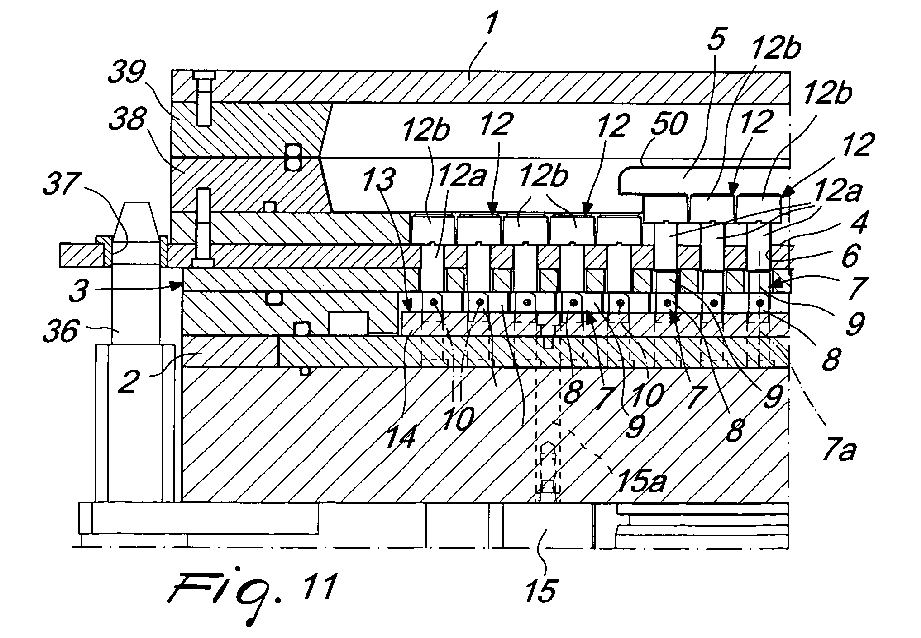
(57) A press comprising an upper pressing surface (1) and a lower pressing surface (2),
which face each other, and a part supporting tray (3) provided with a bottom (4) which
forms a substantially horizontal supporting surface for the parts (5) to be clad and
can be rested on the lower pressing surface (2). The bottom (4) of the part supporting
tray (3) is crossed by a plurality of holes (6) which have a substantially vertical
axis and are arranged in a grid, and the lower pressing surface (2) is provided with
a plurality of actuation pins (7) which have a substantially vertical axis (7a) and
are arranged so as to correspond to the holes (6) of the part supporting tray (3).
The part supporting tray (3) can be arranged so that the axes of its holes (6) are
aligned with the axes of the actuation pins (7) and the actuation pins have a vertical
length which is variable as a function of the contour of the parts (5) arranged on
the part supporting tray (3) in order to be inserted, in their maximum-length condition,
through the holes (6), producing support regions which are raised, with respect to
a substantially horizontal supporting surface formed by the part supporting tray (3),
and make contact with the lower face of the parts (5) in regions which are spaced
from the perimetric edge of the parts (5), or so as to not create, in their minimum-length
condition, support regions which are raised with respect to the supporting surface
formed by the part supporting tray (3).
|
|
