|
(11) | EP 1 792 958 A1 |

| (12) | EUROPEAN PATENT APPLICATION |
|
|
|
|
|||||||||||||||||||||||
| (54) | Phase change inks containing Fischer-Tropsch waxes |
| (57) Disclosed is a phase change ink comprising (a) a colorant and (b) a phase change
ink carrier, said carrier comprising (i) an amide and (ii) a Fischer-Tropsch wax having
an average peak molecular weight of from about 300 to about 800 and a polydispersity
of from about 1.001 to about 3. Also disclosed is a process which comprises (1) incorporating
into an ink jet printing apparatus a phase change ink comprising (a) a colorant and
(b) a phase change ink carrier, said carrier comprising (i) an amide and (ii) a Fischer-Tropsch
wax having an average peak molecular weight of from about 300 to about 800 and a polydispersity
of from about 1.001 to about 3; (2) melting the ink; and (3) causing droplets of the
melted ink to be ejected in an imagewise pattern onto a substrate.
|
BACKGROUND
[0001] Disclosed herein are hot melt or phase change inks and methods for the use thereof. More specifically, disclosed herein are hot melt or phase change inks particularly suitable for use in phase change ink jet printing processes with reduced energy requirements. One embodiment is directed to a phase change ink comprising (a) a colorant and (b) a phase change ink carrier, said carrier comprising (i) an amide and (ii) a Fischer-Tropsch wax having an average peak molecular weight of from about 300 to about 800 and a polydispersity of from about 1.001 to about 3. Also disclosed herein is a process which comprises (1) incorporating into an ink jet printing apparatus a phase change ink comprising (a) a colorant and (b) a phase change ink carrier, said carrier comprising (i) an amide and (ii) a Fischer-Tropsch wax having an average peak molecular weight of from about 300 to about 800 and a polydispersity of from about 1.001 to about 3; (2) melting the ink; and (3) causing droplets of the melted ink to be ejected in an imagewise pattern onto a substrate.
[0002] In general, phase change inks (sometimes referred to as "hot melt inks") are in the solid phase at ambient temperature, but exist in the liquid phase at the elevated operating temperature of an ink jet printing device. At the jet operating temperature, droplets of liquid ink are ejected from the printing device and, when the ink droplets contact the surface of the recording substrate, either directly or via an intermediate heated transfer belt or drum, they quickly solidify to form a predetermined pattern of solidified ink drops. Phase change inks have also been used in other printing technologies, such as gravure printing, as disclosed in, for example, U.S. Patent 5,496,879 and German Patent Publications DE 4205636AL and DE 4205713AL, the disclosures of each of which are totally incorporated herein by reference.
[0003] Phase change inks for color printing typically comprise a phase change ink carrier composition which is combined with a phase change ink compatible colorant. In a specific embodiment, a series of colored phase change inks can be formed by combining ink carrier compositions with compatible subtractive primary colorants. The subtractive primary colored phase change inks can comprise four component dyes, namely, cyan, magenta, yellow and black, although the inks are not limited to these four colors. These subtractive primary colored inks can be formed by using a single dye or a mixture of dyes. For example, magenta can be obtained by using a mixture of Solvent Red Dyes or a composite black can be obtained by mixing several dyes. U.S. Patent 4,889,560, U.S. Patent 4,889,761, and U.S. Patent 5,372,852, the disclosures of each of which are totally incorporated herein by reference, teach that the subtractive primary colorants employed can comprise dyes from the classes of Color Index (C.I.) Solvent Dyes, Disperse Dyes, modified Acid and Direct Dyes, and Basic Dyes. U.S. Patent 5,621,022, the disclosure of which is totally incorporated herein by reference, discloses the use of a specific class of polymeric dyes in phase change ink compositions.
[0004] Phase change inks have also been used for applications such as postal marking, industrial marking, and labelling.
[0005] Phase change inks are desirable for ink jet printers because they remain in a solid phase at room temperature during shipping, long term storage, and the like. In addition, the problems associated with nozzle clogging as a result of ink evaporation with liquid ink jet inks are largely eliminated, thereby improving the reliability of the ink jet printing. Further, in phase change ink jet printers wherein the ink droplets are applied directly onto the final recording substrate (for example, paper, transparency material, and the like), the droplets solidify immediately upon contact with the substrate, so that migration of ink along the printing medium is prevented and dot quality is improved.
[0006] Compositions suitable for use as phase change ink carrier compositions are known. Some representative examples of references disclosing such materials include U.S. Patent 3,653,932, U.S. Patent 4,390,369, U.S. Patent 4,484,948, U.S. Patent 4,684,956, U.S. Patent 4,851,045, U.S. Patent 4,889,560, U.S. Patent 5,006,170, U.S. Patent 5,151,120, U.S. Patent 5,372,852, U.S. Patent 5,496,879, European Patent Publication 0187352, European Patent Publication 0206286, German Patent Publication DE 4205636AL, German Patent Publication DE 4205713AL, and PCT Patent Application WO 94/04619, the disclosures of each of which are totally incorporated herein by reference. Suitable carrier materials can include paraffins, microcrystalline waxes, polyethylene waxes, ester waxes, fatty acids and other waxy materials, fatty amide containing materials, sulfonamide materials, resinous materials made from different natural sources (tall oil rosins and rosin esters, for example), and many synthetic resins, oligomers, polymers, and copolymers.
[0007] U.S. Patent 6,860,930 (Wu et al.), the disclosure of which is totally incorporated herein by reference, discloses a phase change ink composition comprising (a) a colorant and (b) a carrier comprising a polyamide, wherein the polyamide component of the carrier contains at least about 10 percent by weight of a branched triamide.
[0008] U.S. Patent Publication 2005/0130054 (Yuan et al.), the disclosure of which is totally incorporated herein by reference, discloses wax based inks for phase change/hot melt inkjet printing or thermal transfer printing applications. Also disclosed are waxes useful for toners for use in electrostatographic printing applications. Both materials are prepared using a wax having a narrow melting range. The narrow melting range of the wax reduces energy requirements in printing applications. The use of the waxes also promotes release for high speed printing and especially promotes fast drying in wax based ink applications.
[0009] U.S. Patent 6,001,904 (Matzinger et al.), the disclosure of which is totally incorporated herein by reference, discloses phase change (hot melt) ink compositions for use in a phase change (hot melt) ink jet recording device in which recording is conducted by thermally melting the ink at a temperature above ambient temperature (20°C) to provide prints that possess high quality images, scratch resistance, abrasion resistance, low-temperature storage stability and flexibility, offset and pick resistance, adhesion, and other desired properties to comprise: (a) from about 0.1% to about 30% of one or more colorants; and (b) from about 0.1 to about 99.9% of one or more reversibly-crosslinked-polymers. Components other than those listed above may be included in the ink compositions to achieve specific printer, substrate, or end use requirements. Furthermore, the invention also includes methods for the preparation of reversibly-crosslinked-polymers and for their use in the above-described inks.
[0010] While known compositions and processes are suitable for their intended purposes, a need remains for improved phase change ink compositions. In addition, a need remains for phase change inks that can be jetted at temperatures below about 125°C. Further, a need remains for phase change inks that can be jetted with reduced energy requirements. Additionally, a need remains for phase change inks that can be jetted with less expensive printheads. There is also a need for phase change inks that enable improved thermal stability of the inks manifested as the color's stability over time when heated in printers. In addition, there is a need for phase change inks that enable improved printer reliability. Further, there is a need for phase change inks that enable quick recovery times from standby mode. Additionally, there is a need for phase change inks that enable printing with "instant-on" mode. A need also remains for phase change inks that exhibit desirable viscosity values at reduced printing temperatures. In addition, a need remains for phase change inks that enable the aforementioned advantages and also exhibit good printing characteristics, such as transfixing properties (including dither and solid fill dropout performance), acceptable missed jets, folding and creasing performance, gloss, color intensity, recovery after standby mode, and the like. Further, a need remains for phase change inks that generate images with improved hardness. Additionally, a need remains for phase change inks that generate images with improved gloss. There is also a need for phase change inks that exhibit reduced sweating; sweating is a problem wherein some ink ingredients migrate to the surface of solid ink sticks and aggregate at the ink stick surface inside the printer; the sticky "sweat" gradually drains down to the bottom and can cause the ink sticks to be difficult to slide in the ink load racks in the printers. In addition, there is a need for phase change inks that generate images with reduced showthrough when printed on paper substrates. Further, there is a need for phase change inks that exhibit reduced clogging of printheads while exhibiting all of the aforementioned advantages. Additionally, there is a need for phase change inks that enable reduced standby temperatures of phase change ink jet printheads without leading to clogging of the printhead. A need also remains for phase change inks with desirably low freezing points. In addition, a need remains for phase change inks that transfer efficiently from an intermediate transfer member to a final recording substrate with reduced pixels left on the intermediate transfer member when the intermediate transfer member is at a desirably high temperature to enable efficient transfer member cooling and avoid automatic printer shutoff from heating of the intermediate transfer member by the ink, while also enabling jetting of the ink at a desirably low temperature. Further, a need remains for phase change inks that exhibit desirably high smudge temperatures when still-hot prints pass along guidance tracks in the printer, thereby reducing accumulation of ink along these guidance tracks that could later be transferred to blank paper. Additionally, a need remains for phase change inks that exhibit the above advantages and can also be prepared at desirably low costs. There is also a need for phase change inks that have desirably high cohesive failure temperatures.
SUMMARY
[0011] The present invention provides:
- (1) a phase change ink comprising (a) a colorant and (b) a phase change ink carrier, said carrier comprising (i) an amide and (ii) a Fischer-Tropsch wax having an average peak molecular weight of from about 300 to about 800 and a polydispersity of from about 1.001 to about 3;
- (2) the ink according to (1) wherein the Fischer-Tropsch wax has an average peak molecular weight of at least about 375;
- (3) the ink according to (1) wherein the Fischer-Tropsch wax has an average peak molecular weight of at least about 400;
- (4) the ink according to (1) wherein the Fischer-Tropsch wax has an average peak molecular weight of no more than about 750;
- (5) the ink according to (1) wherein the Fischer-Tropsch wax has an average peak molecular weight of no more than about 700;
- (6) the ink according to (1) wherein the Fischer-Tropsch wax has an average peak molecular weight of from about 375 to about 750;
- (7) the ink according to (1) wherein the Fischer-Tropsch wax has an average peak molecular weight of from about 400 to about 700;
- (8) the ink according to (1) wherein the Fischer-Tropsch wax has a polydispersity of no more than about 2.5;
- (9) the ink according to (1) wherein the Fischer-Tropsch wax has q polydispersity of no more than about 2;
- (10) the ink according to (1) wherein the Fischer-Tropsch wax has a peak melting point of at least about 50°C;
- (11) the ink according to (1) wherein the Fischer-Tropsch wax has a peak melting point of no more than about 105°C;
- (12) the ink according to (1) wherein the Fischer-Tropsch wax has an onset melting point of at least about 40°C;
- (13) the ink according to (1) wherein the Fischer-Tropsch wax has an onset melting point of no more than about 105°C;
- (14) the ink according to (1) wherein the Fischer-Tropsch wax has a viscosity at about 110°C of at least about 2 centipoise;
- (15) the ink according to (1) wherein the Fischer-Tropsch wax has a viscosity at about 110°C of no more than about 11 centipoise;
- (16) the ink according to (1) wherein the Fischer-Tropsch wax is present in the ink in an amount of at least about 1 percent by weight of the ink carrier;
- (17) the ink according to (1) wherein the Fischer-Tropsch wax is present in the ink in an amount of no more than about 99 percent by weight of the ink carrier;
- (18) the ink according to (1) wherein the amide is a tetra-amide;
- (19) the ink according to (18) wherein the tetra-amide is a dimer acid based tetra-amide that is the reaction product of dimer acid, ethylene diamine, and a carboxylic acid having at least about 36 carbon atoms;
- (20) the ink according to (1) wherein the amide is a branched triamide;
- (21) the ink according to (20) wherein the branched triamide is of the formula
wherein x, y, and z each independently represent the number of propyleneoxy repeat units and x+y+z is from about 5 to about 6, and wherein p, q, and r each, independently of the others, are integers representing the number of repeat -(CH2)- units; - (22) the ink according to (21) wherein p, q, and r have an average peak value of from about 15 to about 60;
- (23) the ink according to (21) wherein p, q, and r have an average peak value of from about 26 to about 45;
- (24) the ink according to (1) wherein the amide is present in the ink in an amount of at least about 2 percent by weight of the ink carrier;
- (25) the ink according to (1) wherein the amide is present in the ink in an amount of no more than about 50 percent by weight of the ink carrier;
- (26) the ink according to (1) wherein the colorant is present in the ink in an amount of at least about 0.1 percent by weight of the ink;
- (27) the ink according to (1) further containing a monoamide;
- (28) the ink according to (27) wherein the monoamide is stearyl stearamide;
- (29) the ink according to (27) wherein the monoamide is present in the ink in an amount of at least about 2 percent by weight of the ink;
- (30) the ink according to (1) further containing an isocyanate-derived material;
- (31) the ink according to (30) wherein the isocyanate-derived material is a urethane resin obtained from the reaction of two equivalents of hydroabietyl alcohol and one equivalent of isophorone diisocyanate;
- (32) the ink according to (31) wherein the urethane resin is present in the ink in an amount of at least about 2 percent by weight of the ink carrier;
- (33) the ink according to (30) wherein the isocyanate-derived material is a urethane resin that is the adduct of three equivalents of stearyl isocyanate and a glycerol-based alcohol;
- (34) the ink according to (33) wherein the urethane resin is present in the ink in an amount of at least about 1 percent by weight of the ink carrier;
- (35) the ink according to (1) further containing a triglyceride of hydrogenated abietic acid;
- (36) the ink according to (1) wherein the ink has a peak melting point of at least about 50°C;
- (37) the ink according to (1) wherein the ink has a peak melting point of at least about 60°C;
- (38) the ink according to (1) wherein the ink has a peak melting point of no more than about 105°C;
- (39) the ink according to (1) wherein the ink has a peak melting point of no more than about 95°C;
- (40) the ink according to (1) wherein the ink has a viscosity at the jetting temperature of no more than about 30 centipoise;
- (41) the ink according to (40) wherein the jetting temperature is no more than about 150°C;
- (42) the ink according to (1) wherein the ink has a viscosity at the jetting temperature of no more than about 20 centipoise;
- (43) the ink according to (42) wherein the jetting temperature is no more than about 150°C;
- (44) the ink according to (1) wherein the ink has a viscosity of from about 7 to about 15 centipoise at about 110°C;
- (45) the ink according to (1) wherein the ink has a viscosity of from about 7 to about 15 centipoise at about 115°C;
- (46) the ink according to (1) wherein the ink has a viscosity of from about 7 to about 15 centipoise at about 120°C;
- (47) the ink according to (1) wherein the colorant is of the formula
wherein M is an atom or group of atoms capable of bonding to the central cavity of a phthalocyanine molecule, wherein axial ligands optionally can be attached to M; - (48) the ink according to (1) wherein the colorant is of the formula
wherein (A) R1 is (i) an alkylene group, (ii) an arylene group, (iii) an arylalkylene group, (iv) an alkylarylene group, (v) an alkyleneoxy group, (vi) an aryleneoxy group, (vii) an arylalkyleneoxy group, (viii) an alkylaryleneoxy group, (ix) a polyalkyleneoxy group, (x) a polyaryleneoxy group, (xi) a polyarylalkyleneoxy group, (xii) a polyalkylaryleneoxy group, (xiii) a heterocyclic group, (xiv) a silylene group, (xv) a siloxane group, (xvi) a polysilylene group, or (xvii) a polysiloxane group, (B) R2 and R2' each, independently of the other, is (i) an alkyl group, (ii) an aryl group, (iii) an arylalkyl group, (iv) an alkylaryl group, (v) an alkoxy group, (vi) an aryloxy group, (vii) an arylalkyloxy group, (viii) an alkylaryloxy group, (ix) a polyalkyleneoxy group, (x) a polyaryleneoxy group, (xi) a polyarylalkyleneoxy group, (xii) a polyalkylaryleneoxy group, (xiii) a heterocyclic group, (xiv) a silyl group, (xv) a siloxane group, (xvi) a polysilylene group, (xvii) a polysiloxane group, or (xviii) a group of the formula
wherein r and s are each, independently of the other, integers representing a number of repeat -CH2- groups, (C) R3 and R3' each, independently of the other, is (i) an alkyl group, (ii) an aryl group, (iii) an arylalkyl group, or (iv) an alkylaryl group, (D) X and X' each, independently of the other, is (i) a direct bond, (ii) an oxygen atom, (iii) a sulfur atom, (iv) a group of the formula -NR40-wherein R40 is a hydrogen atom, an alkyl group, an aryl group, an arylalkyl group, or an alkylaryl group, or (v) a group of the formula -CR50R60- wherein R50 and R60 each, independently of the other, is a hydrogen atom, an alkyl group, an aryl group, an arylalkyl group, or an alkylaryl group, and (E) Z and Z' each, independently of the other, is (i) a hydrogen atom, (ii) a halogen atom, (iii) a nitro group, (iv) an alkyl group, (v) an aryl group, (vi) an arylalkyl group, (vii) an alkylaryl group, (viii) a group of the formula
wherein R70 is an alkyl group, an aryl group, an arylalkyl group, an alkylaryl group, an alkoxy group, an aryloxy group, an arylalkyloxy group, an alkylaryloxy group, a polyalkyleneoxy group, a polyaryleneoxy group, a polyarylalkyleneoxy group, a polyalkylaryleneoxy group, a heterocyclic group, a silyl group, a siloxane group, a polysilylene group, or a polysiloxane group, (ix) a sulfonyl group of the formula -SO2R80 wherein R80 is a hydrogen atom, an alkyl group, an aryl group, an arylalkyl group, an alkylaryl group, an alkoxy group, an aryloxy group, an arylalkyloxy group, an alkylaryloxy group, a polyalkyleneoxy group, a polyaryleneoxy group, a polyarylalkyleneoxy group, a polyalkylaryleneoxy group, a heterocyclic group, a silyl group, a siloxane group, a polysilylene group, or a polysiloxane group, or (x) a phosphoryl group of the formula -PO3R90 wherein R90 is a hydrogen atom, an alkyl group, an aryl group, an arylalkyl group, an alkylaryl group, an alkoxy group, an aryloxy group, an arylalkyloxy group, an alkylaryloxy group, a polyalkyleneoxy group, a polyaryleneoxy group, a polyarylalkyleneoxy group, a polyalkylaryleneoxy group, a heterocyclic group, a silyl group, a siloxane group, a polysilylene group, or a polysiloxane group; - (49) the ink according to (1) wherein the colorant is of the formula
wherein Y is a hydrogen atom or a bromine atom, n is an integer of 0, 1, 2, 3, or 4, R1 is an alkylene group or an arylalkylene group, and X is (a) a hydrogen atom, (b) a group of the formula
wherein R2 is an alkyl group, an aryl group, an arylalkyl group, or an alkylaryl group, (c) an alkyleneoxy, aryleneoxy, arylalkyleneoxy, or alkylaryleneoxy group, or (d) a group of the formula
wherein R4 is an alkyl group, an aryl group, an arylalkyl group, or an alkylaryl group; - (50) the ink according to (1) wherein the colorant is of the formula
wherein M is either (1) a metal ion having a positive charge of +y wherein y is an integer which is at least 2, said metal ion being capable of forming a compound with at least two
chromogen moieties, or (2) a metal-containing moiety capable of forming a compound with at least two
chromogen moieties, z is an integer representing the number of
chromogen moieties associated with the metal and is at least 2, R1, R2, R3, and R4 each, independently of the others, is (i) a hydrogen atom, (ii) an alkyl group, (iii) an aryl group, (iv) an arylalkyl group, or (v) an alkylaryl group, wherein R1 and R2 can be joined together to form a ring, wherein R3 and R4 can be joined together to form a ring, and wherein R1, R2, R3, and R4 can each be joined to a phenyl ring in the central structure, a and b each, independently of the others, is an integer which is 0, 1, 2, or 3, c is an integer which is 0, 1, 2, 3, or 4, each R5, R6, and R7, independently of the others, is (i) an alkyl group, (ii) an aryl group, (iii) an arylalkyl group, (iv) an alkylaryl group, (v) a halogen atom, (vi) an ester group, (vii) an amide group, (viii) a sulfone group, (ix) an amine group or ammonium group, (x) a nitrile group, (xi) a nitro group, (xii) a hydroxy group, (xiii) a cyano group, (xiv) a pyridine or pyridinium group, (xv) an ether group, (xvi) an aldehyde group, (xvii) a ketone group, (xviii) a carbonyl group, (xix) a thiocarbonyl group, (xx) a sulfate group, (xxi) a sulfide group, (xxii) a sulfoxide group, (xxiii) a phosphine or phosphonium group, (xxiv) a phosphate group, (xxv) a mercapto group, (xxvi) a nitroso group, (xxvii) an acyl group, (xxviii) an acid anhydride group, (xxix) an azide group, (xxx) an azo group, (xxxi) a cyanato group, (xxxii) an isocyanato group, (xxxiii) a thiocyanato group, (xxxiv) an isothiocyanato group, (xxxv) a urethane group, or (xxxvi) a urea group, wherein R5, R6, and R7 can each be joined to a phenyl ring in the central structure,
or
R8, R9, and R10 each, independently of the others, is (i) a hydrogen atom, (ii) an alkyl group, (iii) an aryl group, (iv) an arylalkyl group, or (v) an alkylaryl group, provided that the number of carbon atoms in R1+R2+R3+R4+R5+R6+R7+R8+R9+R10 is at least about 16, Q- is a COO- group or a SO3- group, d is an integer which is 1, 2, 3, 4, or 5, A is an anion, and CA is either a hydrogen atom or a cation associated with all but one of the Q-groups; - (51) the ink according to (48) further containing a colorant of the formula
wherein Y is a hydrogen atom or a bromine atom, n is an integer of 0, 1, 2, 3, or 4, R1 is an alkylene group or an arylalkylene group, and X is (a) a hydrogen atom, (b) a group of the formula
wherein R2 is an alkyl group, an aryl group, an arylalkyl group, or an alkylaryl group, (c) an alkyleneoxy, aryleneoxy, arylalkyleneoxy, or alkylaryleneoxy group, or (d) a group of the formula
wherein R4 is an alkyl group, an aryl group, an arylalkyl group, or an alkylaryl group; - (52) the ink according to (1) wherein the Fischer-Tropsch wax has a freezing point of at least about 40°C;
- (53) the ink according to (1) wherein the Fischer-Tropsch wax has a freezing point of at least about 55°C;
- (54) the ink according to (1) wherein the Fischer-Tropsch wax has a freezing point of no more than about 90°C;
- (55) the ink according to (1) wherein the Fischer-Tropsch wax has a melting point range of no more than about 40°C;
- (56) the ink according to (1) wherein the Fischer-Tropsch wax has a melting point range of no more than about 25°C;
- (57) a process which comprises (1) incorporating into an ink jet printing apparatus a phase change ink comprising (a) a colorant and (b) a phase change ink carrier, said carrier comprising (i) an amide and (ii) a Fischer-Tropsch wax having an average peak molecular weight of from about 300 to about 800 and a polydispersity of from about 1.001 to about 3; (2) melting the ink; and (3) causing droplets of the melted ink to be ejected in an imagewise pattern onto a substrate;
- (58) the process according to (57) wherein the printing apparatus employs a piezoelectric printing process wherein droplets of the ink are caused to be ejected in imagewise pattern by oscillations of piezoelectric vibrating elements;
- (59) the process according to (57) wherein the substrate is a final recording sheet and droplets of the melted ink are ejected in an imagewise pattern directly onto the final recording sheet;
- (60) the process according to (57) wherein the substrate is an intermediate transfer member and droplets of the melted ink are ejected in an imagewise pattern onto the intermediate transfer member followed by transfer of the imagewise pattern from the intermediate transfer member to a final recording sheet;
- (61) the process according to (60) wherein the intermediate transfer member is heated to a temperature above that of the final recording sheet and below that of the melted ink in the printing apparatus;
- (62) the process according to (60) wherein both the intermediate transfer member and the final recording sheet are heated to a temperature below that of the melted ink in the printing apparatus, and wherein the final recording sheet is heated to a temperature above that of the intermediate transfer member and below that of the melted ink in the printing apparatus; and
- (63) the process according to (60) wherein both the intermediate transfer member and the final recording sheet are heated to a temperature below that of the melted ink in the printing apparatus, and wherein the intermediate transfer member is heated to a temperature above that of the final recording sheet and below that of the melted ink in the printing apparatus.
BRIEF DESCRIPTION OF THE DRAWING
[0012] The Figure is a reproduction of high temperature gel permeation chromatography (also called size exclusion chromatography (SEC)) curves obtained for polyethylene waxes and Fischer-Tropsch waxes of different average peak molecular weight values, showing the relative amounts of molecules with different molecular weights present in the sample on the "y" axis and the retention time on the "x" axis.
DETAILED DESCRIPTION
[0013] The phase change inks disclosed herein contain a carrier comprising a Fischer-Tropsch wax. Fischer-Tropsch waxes can be prepared from the hydrogen and carbon monoxide mixture obtained by passing steam over hot coal. The synthesis can be carried out with metallic catalysts at high temperature and pressure. They are synthetic hydrocarbons, as opposed to natural hydrocarbons. They differ from polyethylene waxes, which are prepared by the polymerization of ethylene (CH2=CH2) in that polyethylene waxes tend to be completely linear, whereas Fischer-Tropsch waxes tend to have some degree of branching therein. Because of this branching, Fischer-Tropsch waxes tend to be somewhat less crystalline and somewhat less hard compared to the perfectly linear polyethylene waxes.
[0014] Fischer-Tropsch waxes included in the inks disclosed herein have an average peak molecular weight, as measured by high temperature gel permeation chromatography, of in one embodiment at least about 300, in another embodiment at least about 375, and in yet another embodiment at least about 400, and in one embodiment no more than about 800, in another embodiment no more than about 750, and in yet another embodiment no more than about 700, although the average peak molecular weight can be outside of these ranges.
[0015] The Fischer-Tropsch wax has a polydispersity (determined by dividing weight average molecular weight by number average molecular weight) in one embodiment of at least about 1.001, in another embodiment of at least about 1.005, and in yet another embodiment of at least about 1.010, and in one embodiment of no more than about 3, in another embodiment of no more than about 2.5, and in yet another embodiment of no more than about 2, although the polydispersity can be outside of these ranges.
[0016] The Fischer-Tropsch wax has a peak melting point (as measured by differential scanning calorimetry (DSC)) in one embodiment of at least about 50°C, in another embodiment at least about 55°C, and in yet another embodiment of at least about 60°C, and in one embodiment of no more than about 105°C, in another embodiment of no more than about 100°C, and in yet another embodiment of no more than about 95°C, although the peak melting point can be outside of these ranges.
[0017] The Fischer-Tropsch wax has an onset melting point (as measured by differential scanning calorimetry (DSC)) in one embodiment of at least about 40°C, in another embodiment at least about 45°C, and in yet another embodiment of at least about 50°C, and in one embodiment of no more than about 105°C, in another embodiment of no more than about 100°C, and in yet another embodiment of no more than about 95°C, although the onset melting point can be outside of these ranges.
[0018] The Fischer-Tropsch wax has a melting range, which is defined as the difference between ending melting point and onset melting point as defined in ASTM D3418-03, in one embodiment of at least about 5°C, in another embodiment at least about 8°C, and in yet another embodiment of at least about 10°C, and in one embodiment of no more than about 40°C, in another embodiment of no more than about 30°C, and in yet another embodiment of no more than about 25°C, although the melting range can be outside of these ranges.
[0019] The Fischer-Tropsch wax has a freezing point (as measured by differential scanning calorimetry (DSC)) in one embodiment of at least about 40°C, in another embodiment at least about 50°C, and in yet another embodiment of at least about 55°C, and in one embodiment of no more than about 90°C, in another embodiment of no more than about 88°C, and in yet another embodiment of no more than about 85°C, although the freezing point can be outside of these ranges.
[0020] The Fischer-Tropsch wax has a viscosity at about 110°C in one embodiment of at least about 2 centipoise, in another embodiment of at least about 3 centipoise, and in yet another embodiment of at least about 4 centipoise, and in one embodiment of no more than about 11 centipoise, in another embodiment of no more than about 10 centipoise, and in yet another embodiment of no more than about 9 centipoise, although the viscosity can be outside of these ranges.
[0021] By "average peak molecular weight" is meant that the Fischer-Tropsch wax, while comprising a mixture of molecules of the formula -(CH2)n- wherein n is an integer representing the number of repeat -CH2- units, has a distribution of molecules such that a plot of the relative amount of molecules versus the retention time or molecular weight would appear as a bell curve, wherein the peak of the bell curve represents the average peak molecular weight. In contrast, polyethylene waxes having a different average peak molecular weight value, while they may contain materials that overlap in the value of "n", will have different characteristics.
[0022] Shown in the Figure are measurements of molecular weight taken for some polyethylene waxes and some Fischer-Tropsch waxes by high temperature gel permeation chromatography with a Polymer Labs 220HT system using refractive index detection, a mobile phase of 1,2,4-trichlorobenzene, and two Polymer 3 µm Mixed-E columns for separation. The entire system and the sample solution before injection were heated to 140°C. The molecular weights were characterized using polyethylene standards for calibration. One material (PE500) was a polyethylene wax commercially available from Baker Petrolite, Tulsa, OK, being POLYWAX® 500 (PE 500). Also measured was a polyethylene wax commercially available from Baker Petrolite, Tulsa, OK, being POLYWAX® 655 (PE655). Also measured was a polyethylene wax commercially available from Baker Petrolite, Tulsa, OK, having a molecular weight of about 655 (PE 655). Also measured (PE-A) was a polyethylene wax obtained from Baker Petrolite, Tulsa, OK, being similar to POLYWAX® 500 but having had removed by distillation the lowest 10 percent molecular weight fraction. This distillation can be carried out as described in, for example, U.S. Patent Publication 2005/0130054, the disclosure of which is totally incorporated herein by reference. Also measured (PE-B) was a polyethylene wax obtained from Baker Petrolite, Tulsa, OK, being similar to POLYWAX® 500 but having had removed by distillation the lowest 15 percent molecular weight fraction. Also measured (PE-C) was a polyethylene wax obtained from Baker Petrolite, Tulsa, OK, being similar to POLYWAX® 500 but having had removed by distillation both the lowest 15 percent molecular weight fraction and the highest 15 percent molecular weight fraction. Also measured (FT-A) was a Fischer-Tropsch wax commercially available from Sasol Wax Americas, Inc., Shelton, CT as SASOLWAX® C77, said wax having been fractioned by distillation. Also measured (FT-B) was a Fischer-Tropsch wax commercially available from Sasol Wax Americas, Inc. as SASOLWAX® C80, said wax having been fractioned by distillation. Also measured (FT-C) was a Fischer-Tropsch wax obtained from Sasol Wax Americas, Inc., said wax being similar to SASOLWAX® C80 but having had removed by distillation the lowest 9 percent molecular weight fraction. Also measured (FT-D) was a Fischer-Tropsch wax obtained from Sasol Wax Americas, Inc., said wax being similar to SASOLWAX® C80 but having had removed by distillation the lowest 20 percent molecular weight fraction. Also measured (FT-E) was a Fischer-Tropsch wax obtained from Sasol Wax Americas, Inc., said wax being similar to SASOLWAX® C80 but having had removed by distillation the lowest 30 percent molecular weight fraction.
| retention times (sec.) | PE 500 | PE 655 | PE-A | PE-B | PE-C | FT-A | FT-B | FT-C | FT-D | FT-E |
| 750 | 0.1 | -0.7 | -1.4 | -1.8 | -0.9 | -0.4 | -0.8 | -0.7 | -0.1 | -1.1 |
| 755 | 0.2 | -0.6 | -1.4 | -1.8 | -0.9 | -0.4 | -0.8 | -0.7 | -0.1 | -1.1 |
| 760 | 0.2 | -0.4 | -1.4 | -1.8 | -0.9 | -0.4 | -0.8 | -0.7 | -0.1 | -1.1 |
| 765 | 0.2 | -0.1 | -1.4 | -1.8 | -0.9 | -0.4 | -0.7 | -0.7 | -0.1 | -1.0 |
| 770 | 0.3 | 0.1 | -1.3 | -1.7 | -0.9 | -0.4 | -0.6 | -0.7 | -0.1 | -1.0 |
| 775 | 0.3 | 0.6 | -1.3 | -1.6 | -0.9 | -0.4 | -0.6 | -0.7 | -0.1 | -1.0 |
| 780 | 0.4 | 1.2 | -1.2 | -1.4 | -0.9 | -0.4 | -0.5 | -0.7 | 0.0 | -1.0 |
| 785 | 0.6 | 2.1 | -1.2 | -1.2 | -0.9 | -0.4 | -0.5 | -0.7 | 0.0 | -1.0 |
| 790 | 0.8 | 3.6 | -1.0 | -1.0 | -0.9 | -0.4 | -0.4 | -0.7 | 0.0 | -1.0 |
| 795 | 1.0 | 6.0 | -0.8 | -0.6 | -1.0 | -0.4 | -0.3 | -0.6 | 0.0 | -1.0 |
| 800 | 1.3 | 9.7 | -0.5 | -0.1 | -1.0 | -0.4 | -0.3 | -0.6 | 0.1 | -1.0 |
| 805 | 1.8 | 14.8 | 0.0 | 0.6 | -1.0 | -0.4 | -0.2 | -0.6 | 0.1 | -0.9 |
| 810 | 2.3 | 21.8 | 0.6 | 1.5 | -1.0 | -0.4 | -0.1 | -0.5 | 0.2 | -0.8 |
| 815 | 3.2 | 30.6 | 1.7 | 2.8 | -1.0 | -0.4 | 0.1 | -0.4 | 0.3 | -0.7 |
| 820 | 4.5 | 41.1 | 3.2 | 4.8 | -1.0 | -0.4 | 0.2 | -0.2 | 0.6 | -0.4 |
| 825 | 6.3 | 52.6 | 5.6 | 7.5 | -0.9 | -0.4 | 0.5 | 0.2 | 1.0 | 0.0 |
| 830 | 8.9 | 64.5 | 8.9 | 11.4 | -0.9 | -0.4 | 0.8 | 0.8 | 1.7 | 0.8 |
| 835 | 12.6 | 75.9 | 13.5 | 16.5 | -0.7 | -0.4 | 1.4 | 2.1 | 3.1 | 2.3 |
| 840 | 17.6 | 85.8 | 19.6 | 23.1 | -0.3 | -0.3 | 2.5 | 4.4 | 5.6 | 5.0 |
| 845 | 24.1 | 93.5 | 27.1 | 30.9 | 0.6 | -0.3 | 4.4 | 8.3 | 9.8 | 9.6 |
| 850 | 32.0 | 98.3 | 35.9 | 40.0 | 2.8 | -0.2 | 7.6 | 14.6 | 16.5 | 16.8 |
| 855 | 41.3 | 100.0 | 45.9 | 50.0 | 7.0 | 0.1 | 12.6 | 23.9 | 26.7 | 27.6 |
| 860 | 51.4 | 98.6 | 56.5 | 60.4 | 14.4 | 0.4 | 20.0 | 36.9 | 40.5 | 42.3 |
| 865 | 61.9 | 94.3 | 67.2 | 70.6 | 26.0 | 1.2 | 30.0 | 52.9 | 57.3 | 59.9 |
| 870 | 72.2 | 87.8 | 77.3 | 80.1 | 41.3 | 2.6 | 42.3 | 70.2 | 75.1 | 77.9 |
| 875 | 81.7 | 79.7 | 86.2 | 88.2 | 58.7 | 5.2 | 56.2 | 86.0 | 90.2 | 92.4 |
| 880 | 89.6 | 70.6 | 93.2 | 94.4 | 75.3 | 10.1 | 70.1 | 96.7 | 98.9 | 99.6 |
| 881 | 90.9 | 68.8 | 94.3 | 95.4 | 78.2 | 11.5 | 72.8 | 98.0 | 99.6 | 100.0 |
| 882 | 92.2 | 66.9 | 95.3 | 96.3 | 81.0 | 13.0 | 75.5 | 99.0 | 100.0 | 99.9 |
| 884 | 94.5 | 63.1 | 97.1 | 97.8 | 86.1 | 16.4 | 80.6 | 100.0 | 99.5 | 98.7 |
| 885 | 95.5 | 61.2 | 97.9 | 98.4 | 88.4 | 18.4 | 83.1 | 99.9 | 98.8 | 97.6 |
| 890 | 99.0 | 52.0 | 99.9 | 99.9 | 96.6 | 31.1 | 93.6 | 94.9 | 89.9 | 87.2 |
| 891 | 99.4 | 50.3 | 100.0 | 100.0 | 97.7 | 34.2 | 95.3 | 93.0 | 87.2 | 84.4 |
| 895 | 100.0 | 43.4 | 99.1 | 99.0 | 99.9 | 48.5 | 99.6 | 82.5 | 74.4 | 71.3 |
| 896.5 | 99.8 | 41.0 | 98.4 | 98.3 | 100.0 | 54.5 | 100.0 | 77.7 | 69.0 | 65.9 |
| 900 | 98.6 | 35.7 | 95.4 | 95.9 | 98.5 | 69.3 | 97.3 | 64.9 | 55.9 | 53.1 |
| 905 | 95.0 | 28.7 | 89.0 | 90.4 | 93.4 | 89.5 | 84.0 | 45.3 | 37.6 | 35.5 |
| 910 | 89.7 | 22.8 | 79.8 | 82.6 | 84.9 | 99.9 | 62.9 | 27.3 | 22.2 | 20.8 |
| 910.5 | 89.1 | 22.2 | 78.8 | 81.8 | 83.9 | 100.0 | 60.7 | 25.7 | 20.9 | 19.5 |
| 915 | 82.8 | 17.9 | 67.9 | 73.6 | 73.2 | 90.7 | 42.5 | 13.9 | 11.5 | 10.4 |
| 920 | 75.0 | 13.9 | 54.8 | 63.6 | 60.1 | 64.8 | 28.1 | 6.0 | 5.3 | 4.3 |
| 925 | 67.4 | 10.5 | 41.2 | 51.9 | 46.3 | 38.8 | 19.4 | 2.4 | 2.5 | 1.5 |
| 930 | 58.8 | 8.0 | 28.0 | 41.8 | 32.7 | 21.8 | 13.9 | 0.9 | 1.4 | 0.4 |
| 935 | 51.2 | 5.7 | 17.8 | 30.7 | 22.0 | 12.1 | 9.5 | 0.4 | 1.0 | 0.0 |
| 940 | 43.9 | 4.3 | 9.7 | 22.3 | 13.2 | 6.5 | 5.6 | 0.1 | 0.8 | -0.2 |
| 945 | 36.7 | 2.9 | 4.9 | 14.5 | 7.7 | 3.3 | 2.7 | -0.1 | 0.7 | -0.4 |
| 950 | 31.3 | 2.0 | 1.8 | 9.2 | 3.9 | 1.5 | 1.1 | -0.2 | 0.6 | -0.5 |
| 955 | 25.2 | 1.2 | 0.3 | 4.9 | 2.0 | 0.6 | 0.3 | -0.3 | 0.5 | -0.5 |
| 960 | 21.4 | 0.8 | -0.6 | 2.6 | 0.7 | 0.1 | -0.1 | -0.4 | 0.5 | -0.6 |
| 965 | 16.9 | 0.2 | -1.0 | 0.5 | 0.1 | -0.1 | -0.3 | -0.4 | 0.4 | -0.7 |
| 970 | 13.5 | 0.1 | -1.3 | -0.2 | -0.4 | -0.2 | -0.3 | -0.5 | 0.4 | -0.7 |
| 975 | 11.4 | -0.3 | -1.4 | -1.1 | -0.6 | -0.2 | -0.3 | -0.6 | 0.3 | -0.8 |
| 980 | 7.4 | -0.4 | -1.5 | -1.4 | -0.8 | -0.2 | -0.3 | -0.6 | 0.2 | -0.8 |
| 985 | 6.8 | -0.6 | -1.5 | -1.7 | -0.9 | -0.3 | -0.3 | -0.7 | 0.2 | -0.9 |
| 990 | 4.4 | -0.8 | -1.6 | -1.9 | -1.0 | -0.3 | -0.4 | -0.7 | 0.2 | -0.9 |
| 995 | 2.9 | -0.7 | -1.6 | -1.9 | -1.0 | -0.3 | -0.6 | -0.8 | 0.1 | -1.0 |
| 1000 | 2.6 | -0.9 | -1.6 | -2.0 | -1.0 | -0.3 | -0.8 | -0.8 | 0.1 | -1.0 |
| 1005 | 1.5 | -0.9 | -1.6 | -2.1 | -1.1 | -0.3 | -0.9 | -0.8 | 0.1 | -1.1 |
| 1010 | 0.9 | -0.9 | -1.7 | -2.0 | -1.1 | -0.4 | -1.0 | -0.9 | 0.1 | -1.1 |
| 1015 | 0.9 | -0.9 | -1.7 | -2.1 | -1.1 | -0.4 | -1.0 | -0.9 | 0.1 | -1.1 |
| 1020 | 0.6 | -1.1 | -1.7 | -2.1 | -1.1 | -0.4 | -1.1 | -0.9 | 0.1 | -1.1 |
| 1025 | 0.4 | -1.1 | -1.7 | -2.3 | -1.2 | -0.4 | -1.2 | -0.9 | 0.1 | -1.1 |
| 1030 | 0.4 | -1.5 | -1.8 | -2.6 | -1.2 | -0.5 | -1.4 | -0.8 | 0.1 | -1.0 |
| 1035 | 0.7 | -2.0 | -2.1 | -3.1 | -1.4 | -0.6 | -1.7 | -0.8 | 0.2 | -0.9 |
| 1040 | 0.9 | -2.2 | -2.6 | -3.1 | -1.8 | -0.8 | -1.7 | -0.6 | 0.4 | -0.7 |
| 1045 | 0.8 | -1.6 | -2.7 | -2.6 | -1.8 | -0.8 | -1.5 | 0.0 | 1.0 | -0.2 |
| Mp | Mn | Mw | MWD | |
| PE 500 | 572 | 516 | 570 | 1.10 |
| PE 655 | 795 | 729 | 785 | 1.08 |
| PE-A | 582 | 574 | 613 | 1.07 |
| PE-B | 611 | 613 | 646 | 1.05 |
| PE-C | 582 | 562 | 579 | 1.03 |
| FT-A | 516 | 520 | 528 | 1.02 |
| FT-B | 558 | 565 | 588 | 1.04 |
| FT-C | 620 | 619 | 635 | 1.03 |
| FT-D | 631 | 627 | 643 | 1.03 |
| FT-E | 637 | 630 | 646 | 1.03 |
| peak MP | onset MP | melting range | viscosity | FP | |
| PE 500 | 81.2 | 52.5 | 42.2 | 5.44 | 70.3 |
| PE 655 | 94.6 | 72.3 | 29.6 ~ 33.0 | 9.80 | 85.5 |
| PE-A | 82.8 | 57.4 | 36.9 | 6.03 | 70.7 |
| PE-B | 86.0 | 66.3 | 30.0 | 6.65 | 77.6 |
| PE-C | 83.8 | 65.5 | 24.1 | 5.18 | 67.4 |
| FT-A | 78.2 | 68.7 | - - - | 4.49 | 66.3 |
| FT-B | 82.1 | 69.5 | 22.1 | 5.53 | 70.1 |
| FT-C | 85.1 | 73.3 | 17.1 | 6.09 | 76.6 |
| FT-D | 86.1 | 74.5 | 16.2 | 6.26 | 78.2 |
| FT-E | 86.7 | 74.6 | 17.7 | 6.33 | 77.6 |
| - - - = not measured or determined |
[0023] In some specific embodiments, the Fischer-Tropsch wax in the inks disclosed herein have had some of the lowest molecular weight fraction removed therefrom, in one embodiment at least about the lowest 5 percent molecular weight fraction removed therefrom, in another embodiment at least about the lowest 7.5 percent molecular weight fraction removed therefrom, in yet another embodiment at least about the lowest 10 percent molecular weight fraction removed therefrom, in still another embodiment, at least about the lowest 12.5 molecular weight fraction removed therefrom, in another embodiment at least about the lowest 15 percent molecular weight fraction removed therefrom, in yet another embodiment at least about the lowest 20 percent molecular weight fraction removed therefrom, in still another embodiment at least about the lowest 25 percent molecular weight fraction removed therefrom, in another embodiment at least about the lowest 30 percent molecular weight fraction removed therefrom, and in yet another embodiment at least about the lowest 35 percent molecular weight fraction removed therefrom, although the amount removed therefrom can be outside of these ranges.
[0024] The lowest molecular weight fraction and the highest molecular weight fraction can be removed from the Fischer-Tropsch wax by any desired or effective method, including (but not limited to) the distillation methods described in U.S. Patent Publication 2005/0130054, the disclosure of which is totally incorporated herein by reference, the purification methods set forth in Copending Application 11/126,745, the disclosure of which is totally incorporated herein by reference, or the like.
[0025] As stated hereinabove, the Fischer-Tropsch process used to generate the Fischer-Tropsch waxes differs from the polymerization of ethylene process used to generate polyethylene waxes in that the Fischer-Tropsch process tends to generate more branching in the resulting materials. 13C and 1H NMR spectra were used to measure the branching extent and number of pendant -OH groups in some of the Fischer-Tropsch and polyethylene waxes. Samples were dissolved in deuterated benzene and 13C NMR spectra were obtained on a Bruker Avance 400 NMR spectrometer at 78°C. In addition, DEPT (distortionless enhancement by polarization transfer) experiments were carried out to distinguish CH, CH2, and CH3 carbons as an aid to spectral assignment. 1H NMR measurements were made on the same samples on a Bruker Avance 500 NMR spectrometer at 78°C. The results were as follows:
| Wax | # isolated long branches per 100 chains | # methyl branches per 100 chains | # pendant -OH groups per 100 chains |
| PE 500 | trace | 0 | trace |
| PE-C | 0 | 1 | 1.2 |
| FT- B | 1.2 | 6.4 | 0 |
[0026] The Fischer-Tropsch wax is present in the ink in any desired or effective amount, in one embodiment at least about 1 percent by weight of the phase change ink carrier, in another embodiment at least about 3 percent by weight of carrier, and in yet another embodiment at least about 5 percent by weight of the carrier, and in one embodiment no more than about 99 percent by weight of the carrier, in another embodiment no more than about 97 percent by weight of the carrier, and in yet another embodiment no more than about 95 percent by weight of the carrier, although the amount can be outside of these ranges.
[0027] The ink carrier further comprises an amide. Examples of suitable ink carrier materials include fatty amides, such as monoamides, triamides, tetra-amides, mixtures thereof, and the like. Specific examples of suitable fatty amide ink carrier materials include a dimer acid based tetra-amide that is the reaction product of dimer acid, ethylene diamine, and stearic acid, a dimer acid based tetra-amide that is the reaction product of dimer acid, ethylene diamine, and a carboxylic acid having at least about 36 carbon atoms, and the like, as well as mixtures thereof. When the fatty amide ink carrier is a dimer acid based tetra-amide that is the reaction product of dimer acid, ethylene diamine, and a carboxylic acid having at least about 36 carbon atoms, the carboxylic acid is of the general formula
wherein R is an alkyl group, including linear, branched, saturated, unsaturated, and cyclic alkyl groups, said alkyl group in one embodiment having at least about 36 carbon atoms, in another embodiment having at least about 40 carbon atoms, said alkyl group in one embodiment having no more than about 200 carbon atoms, in another embodiment having no more than about 150 carbon atoms, and in yet another embodiment having no more than about 100 carbon atoms, although the number of carbon atoms can be outside of these ranges. Carboxylic acids of this formula are commercially available from, for example, Baker Petrolite, Tulsa, OK, and can also be prepared as described in Example 1 of U.S. Patent 6,174,937, the disclosure of which is totally incorporated herein by reference. Further information on fatty amide carrier materials is disclosed in, for example, U.S. Patent 4,889,560, U.S. Patent 4,889,761, U.S. Patent 5,194,638, U.S. Patent 4,830,671, U.S. Patent 6,174,937, U.S. Patent 5,372,852, U.S. Patent 5,597,856, U.S. Patent 6,174,937, and British Patent GB 2 238 792, the disclosures of each of which are totally incorporated herein by reference.
[0028] In one specific embodiment, the amide is a branched triamide. Branched triamides are disclosed in, for example, U.S. Patent 6,860,930, the disclosure of which is totally incorporated herein by reference. By "branched triamide" is meant that the structure of the triamide can be drawn so that each amide group is bonded to an atom or group of atoms contained in a branch other than that of the others, and that each amide group is in a different branch. By "each amide group is in a different branch" is meant that the triamide is not linear; by "linear" is meant a molecule wherein all three amide groups can be drawn as being in the same molecular chain or branch, such as linear triamides of the formulae
or the like. For purposes of the present invention, linear triamides include those wherein a line can be drawn through the three amide groups, even if one would ordinarily draw a different line. For example, a compound of the formula
is considered a linear compound for purposes of the present invention, because it can also be drawn as follows:
and accordingly would not be considered to be a branched triamide for the purposes of the inks discloses herein. For purposes of the inks disclosed herein, "branched triamines", "branched triacids", "branched monoamino diacids", and "branched diamino monoacids" have similar definitions in that each of the three functional groups named can be drawn as being in a different branch from the other two.
[0029] Examples of suitable branched triamides include (but are not limited to) those generated from branched triamines, said branched triamides being of the formula
wherein R1 is (i) an alkylene group (including linear, branched, saturated, unsaturated, cyclic, acyclic, substituted, and unsubstituted alkylene groups, and wherein hetero atoms, such as oxygen, nitrogen, sulfur, silicon, phosphorus, boron, and the like either may or may not be present in the alkylene group), in one embodiment with at least about 3 carbon atoms, in another embodiment with at least about 4 carbon atoms, in yet another embodiment with at least about 5 carbon atoms, in another embodiment with at least about 15 carbon atoms, and in yet another embodiment with at least about 21 carbon atoms, and in one embodiment with no more than about 200 carbon atoms, in another embodiment with no more than about 150 carbon atoms, and in yet another embodiment with no more than about 100 carbon atoms, although the number of carbon atoms can be outside of these ranges, (ii) an arylene group (including unsubstituted and substituted arylene groups, and wherein hetero atoms, such as oxygen, nitrogen, sulfur, silicon, phosphorus, boron, and the like either may or may not be present in the arylene group), in one embodiment with at least about 6 carbon atoms, in another embodiment with at least about 10 carbon atoms, and in yet another embodiment with at least about 14 carbon atoms, and in one embodiment with no more than about 200 carbon atoms, in another embodiment with no more than about 150 carbon atoms, and in yet another embodiment with no more than about 100 carbon atoms, although the number of carbon atoms can be outside of these ranges, (iii) an arylalkylene group (including unsubstituted and substituted arylalkylene groups, wherein the alkyl portion of the arylalkylene group can be linear, branched, saturated, unsaturated, cyclic, and/or acyclic, and wherein hetero atoms, such as oxygen, nitrogen, sulfur, silicon, phosphorus, boron, and the like either may or may not be present in either or both of the alkyl portion and the aryl portion of the arylalkylene group), in one embodiment with at least about 7 carbon atoms, in another embodiment with at least about 8 carbon atoms, and in yet another embodiment with at least about 9 carbon atoms, and in one embodiment with no more than about 200 carbon atoms, in another embodiment with no more than about 150 carbon atoms, and in yet another embodiment with no more than about 100 carbon atoms, although the number of carbon atoms can be outside of these ranges, such as benzylene or the like, or (iv) an alkylarylene group (including unsubstituted and substituted alkylarylene groups, wherein the alkyl portion of the alkylarylene group can be linear, branched, saturated, unsaturated, cyclic, and/or acyclic, and wherein hetero atoms, such as oxygen, nitrogen, sulfur, silicon, phosphorus, boron, and the like either may or may not be present in either or both of the alkyl portion and the aryl portion of the alkylarylene group), in one embodiment with at least about 7 carbon atoms, in another embodiment with at least about 8 carbon atoms, and in yet another embodiment with at least about 9 carbon atoms, and in one embodiment with no more than about 200 carbon atoms, in another embodiment with no more than about 150 carbon atoms, and in yet another embodiment with no more than about 100 carbon atoms, although the number of carbon atoms can be outside of these ranges, such as tolylene or the like, Ra, Rb, and Rc each, independently of the others, is (i) a hydrogen atom, (ii) an alkyl group (including linear, branched, saturated, unsaturated, cyclic, acyclic, substituted, and unsubstituted alkyl groups, and wherein hetero atoms, such as oxygen, nitrogen, sulfur, silicon, phosphorus, boron, and the like either may or may not be present in the alkyl group), in one embodiment with at least 1 carbon atom, in another embodiment with at least about 2 carbon atoms, in yet another embodiment with at least about 6 carbon atoms, in another embodiment with at least about 7 carbon atoms, and in yet another embodiment with at least about 10 carbon atoms, and in one embodiment with no more than about 200 carbon atoms, in another embodiment with no more than about 150 carbon atoms, and in yet another embodiment with no more than about 100 carbon atoms, although the number of carbon atoms can be outside of these ranges, (iii) an aryl group (including unsubstituted and substituted aryl groups, and wherein hetero atoms, such as oxygen, nitrogen, sulfur, silicon, phosphorus, boron, and the like either may or may not be present in the aryl group), in one embodiment with at least about 6 carbon atoms, in another embodiment with at least about 10 carbon atoms, and in yet another embodiment with at least about 14 carbon atoms, and in one embodiment with no more than about 200 carbon atoms, in another embodiment with no more than about 150 carbon atoms, and in yet another embodiment with no more than about 100 carbon atoms, although the number of carbon atoms can be outside of these ranges, (iv) an arylalkyl group (including unsubstituted and substituted arylalkyl groups, wherein the alkyl portion of the arylalkyl group can be linear, branched, saturated, unsaturated, cyclic, and/or acyclic, and wherein hetero atoms, such as oxygen, nitrogen, sulfur, silicon, phosphorus, boron, and the like either may or may not be present in either or both of the alkyl portion and the aryl portion of the arylalkyl group), in one embodiment with at least about 6 carbon atoms, in another embodiment with at least about 7 carbon atoms, and in yet another embodiment with at least about 8 carbon atoms, and in one embodiment with no more than about 200 carbon atoms, in another embodiment with no more than about 150 carbon atoms, and in yet another embodiment with no more than about 100 carbon atoms, although the number of carbon atoms can be outside of these ranges, such as benzyl or the like, or (v) an alkylaryl group (including unsubstituted and substituted alkylaryl groups, wherein the alkyl portion of the alkylaryl group can be linear, branched, saturated, unsaturated, cyclic, and/or acyclic, and wherein hetero atoms, such as oxygen, nitrogen, sulfur, silicon, phosphorus, boron, and the like either may or may not be present in either or both of the alkyl portion and the aryl portion of the alkylaryl group), in one embodiment with at least about 6 carbon atoms, in another embodiment with at least about 7 carbon atoms, and in yet another embodiment with at least about 8 carbon atoms, and in one embodiment with no more than about 200 carbon atoms, in another embodiment with no more than about 150 carbon atoms, and in yet another embodiment with no more than about 100 carbon atoms, although the number of carbon atoms can be outside of these ranges, such as tolyl or the like, Rd, Re, and Rf each, independently of the others, is (i) an alkyl group (including linear, branched, saturated, unsaturated, cyclic, acyclic, substituted, and unsubstituted alkyl groups, and wherein hetero atoms, such as oxygen, nitrogen, sulfur, silicon, phosphorus, boron, and the like either may or may not be present in the alkyl group), in one embodiment with at least 1 carbon atom, in another embodiment with at least about 2 carbon atoms, in yet another embodiment with at least about 6 carbon atoms, in another embodiment with at least about 17 carbon atoms, and in yet another embodiment with at least about 36 carbon atoms, and in one embodiment with no more than about 200 carbon atoms, in another embodiment with no more than about 150 carbon atoms, and in yet another embodiment with no more than about 100 carbon atoms, although the number of carbon atoms can be outside of these ranges, (ii) an aryl group (including unsubstituted and substituted aryl groups, and wherein hetero atoms, such as oxygen, nitrogen, sulfur, silicon, phosphorus, boron, and the like either may or may not be present in the aryl group), in one embodiment with at least about 6 carbon atoms, in another embodiment with at least about 10 carbon atoms, and in yet another embodiment with at least about 14 carbon atoms, and in one embodiment with no more than about 200 carbon atoms, in another embodiment with no more than about 150 carbon atoms, and in yet another embodiment with no more than about 100 carbon atoms, although the number of carbon atoms can be outside of these ranges, (iii) an arylalkyl group (including unsubstituted and substituted arylalkyl groups, wherein the alkyl portion of the arylalkyl group can be linear, branched, saturated, unsaturated, cyclic, and/or acyclic, and wherein hetero atoms, such as oxygen, nitrogen, sulfur, silicon, phosphorus, boron, and the like either may or may not be present in either or both of the alkyl portion and the aryl portion of the arylalkyl group), in one embodiment with at least about 6 carbon atoms, in another embodiment with at least about 7 carbon atoms, and in yet another embodiment with at least about 8 carbon atoms, and in one embodiment with no more than about 200 carbon atoms, in another embodiment with no more than about 150 carbon atoms, and in yet another embodiment with no more than about 100 carbon atoms, although the number of carbon atoms can be outside of these ranges, such as benzyl or the like, or (iv) an alkylaryl group (including unsubstituted and substituted alkylaryl groups, wherein the alkyl portion of the alkylaryl group can be linear, branched, saturated, unsaturated, cyclic, and/or acyclic, and wherein hetero atoms, such as oxygen, nitrogen, sulfur, silicon, phosphorus, boron, and the like either may or may not be present in either or both of the alkyl portion and the aryl portion of the alkylaryl group), in one embodiment with at least about 6 carbon atoms, in another embodiment with at least about 7 carbon atoms, and in yet another embodiment with at least about 8 carbon atoms, and in one embodiment with no more than about 200 carbon atoms, in another embodiment with no more than about 150 carbon atoms, and in yet another embodiment with no more than about 100 carbon atoms, although the number of carbon atoms can be outside of these ranges, such as tolyl or the like, those generated from branched triacids, said branched triamides being of the formula
wherein R2 is (i) an alkylene group (including linear, branched, saturated, unsaturated, cyclic, acyclic, substituted, and unsubstituted alkylene groups, and wherein hetero atoms, such as oxygen, nitrogen, sulfur, silicon, phosphorus, boron, and the like either may or may not be present in the alkylene group), in one embodiment with at least about 3 carbon atoms, in another embodiment with at least about 4 carbon atoms, in yet another embodiment with at least about 5 carbon atoms, in another embodiment with at least about 15 carbon atoms, and in yet another embodiment with at least about 21 carbon atoms, and in one embodiment with no more than about 200 carbon atoms, in another embodiment with no more than about 150 carbon atoms, and in yet another embodiment with no more than about 100 carbon atoms, although the number of carbon atoms can be outside of these ranges, (ii) an arylene group (including unsubstituted and substituted arylene groups, and wherein hetero atoms, such as oxygen, nitrogen, sulfur, silicon, phosphorus, boron, and the like either may or may not be present in the arylene group), in one embodiment with at least about 6 carbon atoms, in another embodiment with at least about 10 carbon atoms, and in yet another embodiment with at least about 14 carbon atoms, and in one embodiment with no more than about 200 carbon atoms, in another embodiment with no more than about 150 carbon atoms, and in yet another embodiment with no more than about 100 carbon atoms, although the number of carbon atoms can be outside of these ranges, (iii) an arylalkylene group (including unsubstituted and substituted arylalkylene groups, wherein the alkyl portion of the arylalkylene group can be linear, branched, saturated, unsaturated, cyclic, and/or acyclic, and wherein hetero atoms, such as oxygen, nitrogen, sulfur, silicon, phosphorus, boron, and the like either may or may not be present in either or both of the alkyl portion and the aryl portion of the arylalkylene group), in one embodiment with at least about 7 carbon atoms, in another embodiment with at least about 8 carbon atoms, and in yet another embodiment with at least about 9 carbon atoms, and in one embodiment with no more than about 200 carbon atoms, in another embodiment with no more than about 150 carbon atoms, and in yet another embodiment with no more than about 100 carbon atoms, although the number of carbon atoms can be outside of these ranges, such as benzylene or the like, or (iv) an alkylarylene group (including unsubstituted and substituted alkylarylene groups, wherein the alkyl portion of the alkylarylene group can be linear, branched, saturated, unsaturated, cyclic, and/or acyclic, and wherein hetero atoms, such as oxygen, nitrogen, sulfur, silicon, phosphorus, boron, and the like either may or may not be present in either or both of the alkyl portion and the aryl portion of the alkylarylene group), in one embodiment with at least about 7 carbon atoms, in another embodiment with at least about 8 carbon atoms, and in yet another embodiment with at least about 9 carbon atoms, and in one embodiment with no more than about 200 carbon atoms, in another embodiment with no more than about 150 carbon atoms, and in yet another embodiment with no more than about 100 carbon atoms, although the number of carbon atoms can be outside of these ranges, such as tolylene or the like, Rg, Rj, and Rp each, independently of the others, is (i) a hydrogen atom, (ii) an alkyl group (including linear, branched, saturated, unsaturated, cyclic, acyclic, substituted, and unsubstituted alkyl groups, and wherein hetero atoms, such as oxygen, nitrogen, sulfur, silicon, phosphorus, boron, and the like either may or may not be present in the alkyl group), in one embodiment with at least about 1 carbon atom, in another embodiment with at least about 2 carbon atoms, in yet another embodiment with at least about 3 carbon atoms, in another embodiment with at least about 6 carbon atoms, and in yet another embodiment with at least about 18 carbon atoms, and in one embodiment with no more than about 200 carbon atoms, in another embodiment with no more than about 150 carbon atoms, and in yet another embodiment with no more than about 100 carbon atoms, although the number of carbon atoms can be outside of these ranges, (iii) an aryl group (including unsubstituted and substituted aryl groups, and wherein hetero atoms, such as oxygen, nitrogen, sulfur, silicon, phosphorus, boron, and the like either may or may not be present in the aryl group), in one embodiment with at least about 6 carbon atoms, in another embodiment with at least about 10 carbon atoms, and in yet another embodiment with at least about 14 carbon atoms, and in one embodiment with no more than about 200 carbon atoms, in another embodiment with no more than about 150 carbon atoms, and in yet another embodiment with no more than about 100 carbon atoms, although the number of carbon atoms can be outside of these ranges, (iv) an arylalkyl group (including unsubstituted and substituted arylalkyl groups, wherein the alkyl portion of the arylalkyl group can be linear, branched, saturated, unsaturated, cyclic, and/or acyclic, and wherein hetero atoms, such as oxygen, nitrogen, sulfur, silicon, phosphorus, boron, and the like either may or may not be present in either or both of the alkyl portion and the aryl portion of the arylalkyl group), in one embodiment with at least about 7 carbon atoms, in another embodiment with at least about 8 carbon atoms, and in yet another embodiment with at least about 9 carbon atoms, and in one embodiment with no more than about 200 carbon atoms, in another embodiment with no more than about 150 carbon atoms, and in yet another embodiment with no more than about 100 carbon atoms, although the number of carbon atoms can be outside of these ranges, such as benzyl or the like, or (v) an alkylaryl group (including unsubstituted and substituted alkylaryl groups, wherein the alkyl portion of the alkylaryl group can be linear, branched, saturated, unsaturated, cyclic, and/or acyclic, and wherein hetero atoms, such as oxygen, nitrogen, sulfur, silicon, phosphorus, boron, and the like either may or may not be present in either or both of the alkyl portion and the aryl portion of the alkylaryl group), in one embodiment with at least about 7 carbon atoms, in another embodiment with at least about 8 carbon atoms, and in yet another embodiment with at least about 9 carbon atoms, and in one embodiment with no more than about 200 carbon atoms, in another embodiment with no more than about 150 carbon atoms, and in yet another embodiment with no more than about 100 carbon atoms, although the number of carbon atoms can be outside of these ranges, such as tolyl or the like, Rh, Rk, and Rq each, independently of the others, is (i) a hydrogen atom, (ii) an alkyl group (including linear, branched, saturated, unsaturated, cyclic, acyclic, substituted, and unsubstituted alkyl groups, and wherein hetero atoms, such as oxygen, nitrogen, sulfur, silicon, phosphorus, boron, and the like either may or may not be present in the alkyl group), in one embodiment with at least about 1 carbon atom, in another embodiment with at least about 2 carbon atoms, in yet another embodiment with at least about 3 carbon atoms, in another embodiment with at least about 4 carbon atoms, and in yet another embodiment with at least about 5 carbon atoms, and in one embodiment with no more than about 200 carbon atoms, in another embodiment with no more than about 150 carbon atoms, and in yet another embodiment with no more than about 100 carbon atoms, although the number of carbon atoms can be outside of these ranges, (iii) an aryl group (including unsubstituted and substituted aryl groups, and wherein hetero atoms, such as oxygen, nitrogen, sulfur, silicon, phosphorus, boron, and the like either may or may not be present in the aryl group), in one embodiment with at least about 6 carbon atoms, in another embodiment with at least about 7 carbon atoms, and in yet another embodiment with at least about 8 carbon atoms, and in one embodiment with no more than about 200 carbon atoms, in another embodiment with no more than about 150 carbon atoms, and in yet another embodiment with no more than about 100 carbon atoms, although the number of carbon atoms can be outside of these ranges, (iv) an arylalkyl group (including unsubstituted and substituted arylalkyl groups, wherein the alkyl portion of the arylalkyl group can be linear, branched, saturated, unsaturated, cyclic, and/or acyclic, and wherein hetero atoms, such as oxygen, nitrogen, sulfur, silicon, phosphorus, boron, and the like either may or may not be present in either or both of the alkyl portion and the aryl portion of the arylalkyl group), in one embodiment with at least about 7 carbon atoms, in another embodiment with at least about 8 carbon atoms, and in yet another embodiment with at least about 9 carbon atoms, and in one embodiment with no more than about 200 carbon atoms, in another embodiment with no more than about 150 carbon atoms, and in yet another embodiment with no more than about 100 carbon atoms, although the number of carbon atoms can be outside of these ranges, such as benzyl or the like, or (v) an alkylaryl group (including unsubstituted and substituted alkylaryl groups, wherein the alkyl portion of the alkylaryl group can be linear, branched, saturated, unsaturated, cyclic, and/or acyclic, and wherein hetero atoms, such as oxygen, nitrogen, sulfur, silicon, phosphorus, boron, and the like either may or may not be present in either or both of the alkyl portion and the aryl portion of the alkylaryl group), in one embodiment with at least about 7 carbon atoms, in another embodiment with at least about 8 carbon atoms, and in yet another embodiment with at least about 9 carbon atoms, and in one embodiment with no more than about 200 carbon atoms, in another embodiment with no more than about 150 carbon atoms, and in yet another embodiment with no more than about 100 carbon atoms, although the number of carbon atoms can be outside of these ranges, such as tolyl or the like, those generated from branched diamino monoacid compounds, said branched triamides being of the formula
wherein R1, Ra, Rb, Rd, Re, Rg, and Rh are as defined hereinabove, those generated from branched monoamino diacid compounds, said branched triamides being of the formula
wherein R2, Ra, Rd, Rg, Rh, Rj, and Rk are as defined hereinabove, and the like, wherein the substituents on the substituted alkyl, alkylene, aryl, arylene, arylalkyl, arylalkylene, alkylaryl, and alkylarylene groups can be (but are not limited to) hydroxy groups, halogen atoms, imine groups, ammonium groups, cyano groups, pyridine groups, pyridinium groups, ether groups, aldehyde groups, ketone groups, ester groups, carbonyl groups, thiocarbonyl groups, sulfate groups, sulfonate groups, sulfonic acid groups, sulfide groups, sulfoxide groups, phosphine groups, phosphonium groups, phosphate groups, nitrile groups, mercapto groups, nitro groups, nitroso groups, sulfone groups, azide groups, azo groups, cyanato groups, carboxylate groups, mixtures thereof, and the like, wherein two or more substituents can be joined together to form a ring.
[0030] In one specific embodiment, when the triamide is of the formula
the total number of carbon atoms in R1 + Ra +Rb + Rc +Rd + Re + Rf is at least about 7, in another embodiment at least about 10, and in yet another embodiment at least about 12, and in one embodiment no more than about 500, in another embodiment no more than about 350, and in yet another embodiment no more than about 300, although the total number of carbon atoms can be outside of these ranges. In another specific embodiment, each of Ra, Rd, Rb, Re, Rc, and Rf, independently of the others, has no more than about 50 carbon atoms, and in yet another specific embodiment no more than about 48 carbon atoms, although the number of carbon atoms can be outside of these ranges.
[0031] In one specific embodiment, when the triamide is of the formula
the total number of carbon atoms in R2 + Rg +Rh + Rj +Rk + Rp + Rq is at least about 7, in another embodiment at least about 10, and in yet another embodiment at least about 12, and in one embodiment no more than about 500, in another embodiment no more than about 350, and in yet another embodiment no more than about 300, although the total number of carbon atoms can be outside of these ranges. In another specific embodiment, each of Rg, Rh, Rj, Rk, Rp, and Rq, independently of the others, has no more than about 50 carbon atoms, and in yet another specific embodiment no more than about 48 carbon atoms, although the number of carbon atoms can be outside of these ranges.
[0032] In one specific embodiment, when the triamide is of the formula
the total number of carbon atoms in R1 + Ra +Rb + Rd +Re + Rg + Rh is at least about 7, in another embodiment at least about 10, and in yet another embodiment at least about 12, and in one embodiment no more than about 500, in another embodiment no more than about 350, and in yet another embodiment no more than about 300, although the total number of carbon atoms can be outside of these ranges. In another specific embodiment, each of Ra, Rd, Rb, Re, Rg, and Rh, independently of the others, has no more than about 50 carbon atoms, and in yet another specific embodiment no more than about 48 carbon atoms, although the number of carbon atoms can be outside of these ranges.
[0033] In one specific embodiment, when the triamide is of the formula
the total number of carbon atoms in R2 + Ra +Rd + Rg +Rh + Rj + Rk is at least about 7, in another embodiment at least about 10, and in yet another embodiment at least about 12, and in one embodiment no more than about 500, in another embodiment no more than about 350, and in yet another embodiment no more than about 300, although the total number of carbon atoms can be outside of these ranges. In another specific embodiment, each of Ra, Rd, Rg, Rh, Rj, and Rk, independently of the others, has no more than about 50 carbon atoms, and in yet another specific embodiment no more than about 48 carbon atoms, although the number of carbon atoms can be outside of these ranges.
[0034] It must be emphasized that not all of the amide groups in the first formula need to be directly bonded to the same atom in the R1 or R2 group, and in one specific embodiment of the present invention, each amide group is bonded to a different atom in the R1 or R2 group.
[0035] In one specific embodiment, the branched triamide is of the formula
wherein x, y, and z each, independently represent the number of propyleneoxy repeat units and x+y+z is from about 5 to about 6, and wherein p, q, and r each, independently of the others, are integers representing the number of repeat -(CH2)- units and are in one embodiment at least about 15, in another embodiment is at least about 20, and in another embodiment is at least about 26, and are one embodiment no more than about 60, in another embodiment are no more than about 55, and are in yet another embodiment no more than about 45, although the value of p, q, and r can be outside of these ranges. The triamide composition is frequently obtained as a mixture of materials, wherein p, q, and r are each peak average chain length numbers within the composition, rather than uniform compositions wherein each molecule has the same value for p, q, and r, and it must be understood that within the mixture, some individual chains may be longer or shorter than the given numbers.
[0036] In this specific embodiment, the triamide is present in the ink in any desired or effective amount, in one embodiment at least about 2 percent by weight of the phase change ink carrier, in another embodiment at least about 5 percent by weight of carrier, and in yet another embodiment at least about 10 percent by weight of the carrier, and in one embodiment no more than about 50 percent by weight of the carrier, in another embodiment no more than about 40 percent by weight of the carrier, and in yet another embodiment no more than about 35 percent by weight of the carrier, although the amount can be outside of these ranges.
[0037] Additional examples of suitable phase change ink carrier materials are monoamides. Specific examples of suitable fatty amide ink carrier materials include stearyl stearamide, such as KEMAMIDE S-180, available from Crompton Corporation, Greenwich, CT, and the like. Further information on fatty amide carrier materials is disclosed in, for example, U.S. Patent 4,889,560, U.S. Patent 4,889,761, U.S. Patent 5,194,638, U.S. Patent 4,830,671, U.S. Patent 6,174,937, U.S. Patent 5,372,852, U.S. Patent 5,597,856, U.S. Patent 6,174,937, and British Patent GB 2 238 792, the disclosures of each of which are totally incorporated herein by reference. In one specific embodiment, a monoamide is present in the ink carrier in an amount in one embodiment of at least about 0.01 percent by weight of the carrier, in another embodiment of at least 2 percent by weight of the carrier, and in yet another embodiment of at least about 5 percent by weight of the carrier, and in one embodiment of no more than about 90 percent by weight of the carrier, in another embodiment of no more than about 80 percent by weight of the carrier, and in yet another embodiment of no more than about 70 percent by weight of the carrier, although the amount can be outside of these ranges.
[0038] Also suitable as phase change ink carrier materials are isocyanate-derived resins and waxes, such as urethane isocyanate-derived materials, urea isocyanate-derived materials, urethane/urea isocyanate-derived materials, mixtures thereof, and the like. Further information on isocyanate-derived carrier materials is disclosed in, for example, U.S. Patent 5,750,604, U.S. Patent 5,780,528, U.S. Patent 5,782,966, U.S. Patent 5,783,658, U.S. Patent 5,827,918, U.S. Patent 5,830,942, U.S. Patent 5,919,839, U.S. Patent 6,255,432, U.S. Patent 6,309,453, British Patent GB 2 294 939, British Patent GB 2 305 928, British Patent GB 2 305 670, British Patent GB 2 290 793, PCT Publication WO 94/14902, PCT Publication WO 97/12003, PCT Publication WO 97/13816, PCT Publication WO 96/14364, PCT Publication WO 97/33943, and PCT Publication WO 95/04760, the disclosures of each of which are totally incorporated herein by reference.
[0039] In one specific embodiment, the ink can contain a urethane resin obtained from the reaction of two equivalents of ABITOL® E hydroabietyl alcohol (available from Hercules Inc., Wilmington, DE) and one equivalent of isophorone diisocyanate, prepared as described in Example 1 of U.S. Patent 5,782,966, the disclosure of which is totally incorporated herein by reference. When present, this resin is present in the ink in one embodiment in an amount of at least about 1 percent by weight of the ink carrier, in another embodiment at least about 2 percent by weight of the ink carrier, in yet another embodiment at least about 3 percent by weight of the ink carrier, in still another embodiment at least about 4 percent by weight of the ink carrier, and in yet still another embodiment at least about 5 percent by weight of the ink carrier, and in one embodiment no more than about 80 percent by weight of the ink carrier, in another embodiment no more than about 70 percent by weight of the ink carrier, and in yet another embodiment no more than about 60 percent by weight of the ink carrier, although the amount can be outside of these ranges.
[0040] In another specific embodiment, the ink can contain a urethane resin that is the adduct of three equivalents of stearyl isocyanate and a glycerol-based alcohol prepared as described in Example 4 of U.S. Patent 6,309,453, the disclosure of which is totally incorporated herein by reference. When present, this resin is present in the ink in one embodiment in an amount of at least about 0.5 percent by weight of the ink carrier, in another embodiment at least about 1 percent by weight of the ink carrier, and in yet another embodiment at least about 2 percent by weight of the ink carrier, and in one embodiment no more than about 40 percent by weight of the ink carrier, in another embodiment no more than about 35 percent by weight of the ink carrier, and in yet another embodiment no more than about 30 percent by weight of the ink carrier, although the amount can be outside of these ranges.
[0041] The ink carrier is present in the phase change ink in any desired or effective amount, in one embodiment of at least about 0.1 percent by weight of the ink, in another embodiment of at least about 50 percent by weight of the ink, and in yet another embodiment of at least about 90 percent by weight of the ink, and in one embodiment of no more than about 99 percent by weight of the ink, in another embodiment of no more than about 98 percent by weight of the ink, and in yet another embodiment of no more than about 95 percent by weight of the ink, although the amount can be outside of these ranges.
[0042] The phase change ink compositions also contain a colorant. The phase change carrier compositions can be used in combination with phase change ink colorant materials such as Color Index (C.I.) Solvent Dyes, Disperse Dyes, modified Acid and Direct Dyes, Basic Dyes, Sulphur Dyes, Vat Dyes, and the like. Examples of suitable dyes include Neozapon Red 492 (BASF); Orasol Red G (Ciba-Geigy); Direct Brilliant Pink B (Crompton & Knowles); Aizen Spilon Red C-BH (Hodogaya Chemical); Kayanol Red 3BL (Nippon Kayaku); Levanol Brilliant Red 3BW (Mobay Chemical); Levaderm Lemon Yellow (Mobay Chemical); Spirit Fast Yellow 3G; Aizen Spilon Yellow C-GNH (Hodogaya Chemical); Sirius Supra Yellow GD 167; Cartasol Brilliant Yellow 4GF (Sandoz); Pergasol Yellow CGP (Ciba-Geigy); Orasol Black RLP (Ciba-Geigy); Savinyl Black RLS (Sandoz); Dermacarbon 2GT (Sandoz); Pyrazol Black BG (ICI); Morfast Black Conc. A (Morton-Thiokol); Diaazol Black RN Quad (ICI); Orasol Blue GN (Ciba-Geigy); Savinyl Blue GLS (Sandoz); Luxol Blue MBSN (Morton-Thiokol); Sevron Blue 5GMF (ICI); Basacid Blue 750 (BASF), Neozapon Black X51 [C.I. Solvent Black, C.I. 12195] (BASF), Sudan Blue 670 [C.I. 61554] (BASF), Sudan Yellow 146 [C.I. 12700] (BASF), Sudan Red 462 [C.I. 26050] (BASF), Intratherm Yellow 346 from Crompton and Knowles, C.I. Disperse Yellow 238, Neptune Red Base NB543 (BASF, C.I. Solvent Red 49), Neopen Blue FF-4012 from BASF, Lampronol Black BR from ICI (C.I. Solvent Black 35), Morton Morplas Magenta 36 (C.I. Solvent Red 172), metal phthalocyanine colorants such as those disclosed in U.S. Patent 6,221,137, the disclosure of which is totally incorporated herein by reference, and the like. Polymeric dyes can also be used, such as those disclosed in, for example, U.S. Patent 5,621,022 and U.S. Patent 5,231,135, the disclosures of each of which are totally incorporated herein by reference, and commercially available from, for example, Milliken & Company as Milliken Ink Yellow 12, Milliken Ink Blue 92, Milliken Ink Red 357, Milliken Ink Yellow 1800, Milliken Ink Black 8915-67, uncut Reactant Orange X-38, uncut Reactant Blue X-17, Solvent Yellow 162, Acid Red 52, Solvent Blue 44, and uncut Reactant Violet X-80.
[0043] Also suitable are colorants of the formula
wherein M is an atom or group of atoms capable of bonding to the central cavity of a phthalocyanine molecule, wherein axial ligands optionally can be attached to M, as disclosed in U.S. Patent 6,472,523, U.S. Patent 6,726,755, and U.S. Patent 6,476,219, the disclosures of each of which are totally incorporated herein by reference, colorants of the formula
wherein (A) R1 is (i) an alkylene group, (ii) an arylene group, (iii) an arylalkylene group, (iv) an alkylarylene group, (v) an alkyleneoxy group, (vi) an aryleneoxy group, (vii) an arylalkyleneoxy group, (viii) an alkylaryleneoxy group, (ix) a polyalkyleneoxy group, (x) a polyaryleneoxy group, (xi) a polyarylalkyleneoxy group, (xii) a polyalkylaryleneoxy group, (xiii) a heterocyclic group, (xiv) a silylene group, (xv) a siloxane group, (xvi) a polysilylene group, or (xvii) a polysiloxane group, (B) R2 and R2' each, independently of the other, is (i) an alkyl group, (ii) an aryl group, (iii) an arylalkyl group, (iv) an alkylaryl group, (v) an alkoxy group, (vi) an aryloxy group, (vii) an arylalkyloxy group, (viii) an alkylaryloxy group, (ix) a polyalkyleneoxy group, (x) a polyaryleneoxy group, (xi) a polyarylalkyleneoxy group, (xii) a polyalkylaryleneoxy group, (xiii) a heterocyclic group, (xiv) a silyl group, (xv) a siloxane group, (xvi) a polysilylene group, (xvii) a polysiloxane group, or (xviii) a group of the formula
wherein r and s are each, independently of the other, integers representing a number of repeat -CH2- groups, (C) R3 and R3' each, independently of the other, is (i) an alkyl group, (ii) an aryl group, (iii) an arylalkyl group, or (iv) an alkylaryl group, (D) X and X' each, independently of the other, is (i) a direct bond, (ii) an oxygen atom, (iii) a sulfur atom, (iv) a group of the formula -NR40- wherein R40 is a hydrogen atom, an alkyl group, an aryl group, an arylalkyl group, or an alkylaryl group, or (v) a group of the formula -CR50R60- wherein R50 and R60 each, independently of the other, is a hydrogen atom, an alkyl group, an aryl group, an arylalkyl group, or an alkylaryl group, and (E) Z and Z' each, independently of the other, is (i) a hydrogen atom, (ii) a halogen atom, (iii) a nitro group, (iv) an alkyl group, (v) an aryl group, (vi) an arylalkyl group, (vii) an alkylaryl group, (viii) a group of the formula
wherein R70 is an alkyl group, an aryl group, an arylalkyl group, an alkylaryl group, an alkoxy group, an aryloxy group, an arylalkyloxy group, an alkylaryloxy group, a polyalkyleneoxy group, a polyaryleneoxy group, a polyarylalkyleneoxy group, a polyalkylaryleneoxy group, a heterocyclic group, a silyl group, a siloxane group, a polysilylene group, or a polysiloxane group, (ix) a sulfonyl group of the formula -SO2R80 wherein R80 is a hydrogen atom, an alkyl group, an aryl group, an arylalkyl group, an alkylaryl group, an alkoxy group, an aryloxy group, an arylalkyloxy group, an alkylaryloxy group, a polyalkyleneoxy group, a polyaryleneoxy group, a polyarylalkyleneoxy group, a polyalkylaryleneoxy group, a heterocyclic group, a silyl group, a siloxane group, a polysilylene group, or a polysiloxane group, or (x) a phosphoryl group of the formula -PO3R90 wherein R90 is a hydrogen atom, an alkyl group, an aryl group, an arylalkyl group, an alkylaryl group, an alkoxy group, an aryloxy group, an arylalkyloxy group, an alkylaryloxy group, a polyalkyleneoxy group, a polyaryleneoxy group, a polyarylalkyleneoxy group, a polyalkylaryleneoxy group, a heterocyclic group, a silyl group, a siloxane group, a polysilylene group, or a polysiloxane group, as disclosed in U.S. Patent 6,576,747, U.S. Patent 6,713,614, U.S. Patent 6,663,703, and U.S. Patent 6,576,748, the disclosures of which are totally incorporated herein by reference, colorants of the formula
wherein Y is a hydrogen atom or a bromine atom, n is an integer of 0, 1, 2, 3, or 4, R1 is an alkylene group or an arylalkylene group, and X is (a) a hydrogen atom, (b) a group of the formula
wherein R2 is an alkyl group, an aryl group, an arylalkyl group, or an alkylaryl group, (c) an alkyleneoxy, aryleneoxy, arylalkyleneoxy, or alkylaryleneoxy group, or (d) a group of the formula
wherein R4 is an alkyl group, an aryl group, an arylalkyl group, or an alkylaryl group, as disclosed in U.S. Patent 6,958,406, U.S. Patent 6,821,327, and Copending Application U.S. Serial No. 10/2b0,379, filed September 27, 2002, entitled "Methods for Making Colorant Compounds," the disclosures of each of which are totally incorporated herein by reference, colorants of the formula
wherein M is either (1) a metal ion having a positive charge of +y wherein y is an integer which is at least 2, said metal ion being capable of forming a compound with at least two
chromogen moieties, or (2) a metal-containing moiety capable of forming a compound with at least two
chromogen moieties, z is an integer representing the number of
chromogen moieties associated with the metal and is at least 2, R1, R2, R3, and R4 each, independently of the others, is (i) a hydrogen atom, (ii) an alkyl group, (iii) an aryl group, (iv) an arylalkyl group, or (v) an alkylaryl group, wherein R1 and R2 can be joined together to form a ring, wherein R3 and R4 can be joined together to form a ring, and wherein R1, R2, R3, and R4 can each be joined to a phenyl ring in the central structure, a and b each, independently of the others, is an integer which is 0, 1, 2, or 3, c is an integer which is 0, 1, 2, 3, or 4, each R5, R6, and R7, independently of the others, is (i) an alkyl group, (ii) an aryl group, (iii) an arylalkyl group, (iv) an alkylaryl group, (v) a halogen atom, (vi) an ester group, (vii) an amide group, (viii) a sulfone group, (ix) an amine group or ammonium group, (x) a nitrile group, (xi) a nitro group, (xii) a hydroxy group, (xiii) a cyano group, (xiv) a pyridine or pyridinium group, (xv) an ether group, (xvi) an aldehyde group, (xvii) a ketone group, (xviii) a carbonyl group, (xix) a thiocarbonyl group, (xx) a sulfate group, (xxi) a sulfide group, (xxii) a sulfoxide group, (xxiii) a phosphine or phosphonium group, (xxiv) a phosphate group, (xxv) a mercapto group, (xxvi) a nitroso group, (xxvii) an acyl group, (xxviii) an acid anhydride group, (xxix) an azide group, (xxx) an azo group, (xxxi) a cyanato group, (xxxii) an isocyanato group, (xxxiii) a thiocyanato group, (xxxiv) an isothiocyanato group, (xxxv) a urethane group, or (xxxvi) a urea group, wherein R5, R6, and R7 can each be joined to a phenyl ring in the central structure,
or
R8, R9, and Rio each, independently of the others, is (i) a hydrogen atom, (ii) an alkyl group, (iii) an aryl group, (iv) an arylalkyl group, or (v) an alkylaryl group, provided that the number of carbon atoms in R1+R2+R3+R4+R5+R6+R7+R8+R9+R10 is at least about 16, Q- is a COO- group or a SO3- group, d is an integer which is 1, 2, 3, 4, or 5, A is an anion, and CA is either a hydrogen atom or a cation associated with all but one of the Q-groups, as disclosed in U.S. Patent 6,835,238, Copending Application U.S. Serial No. 10/607,373, filed June 26, 2003, entitled "Colorant Compounds," Copending Application U.S. Serial No. 10/898,724, filed July 23, 2004, entitled "Processes for Preparing Phase Change Inks," Copending Application U.S. Serial No. 10/898,028, entitled "Colorant Compounds," and Copending Application U.S. Serial No. 10/898,432, entitled "Phase Change Inks," the disclosures of each of which are totally incorporated herein by reference, and colorants as disclosed in U.S. Patent 6,472,523, U.S. Patent 6,726,755, U.S. Patent 6,476,219, U.S. Patent 6,663,703, U.S. Patent 6,755,902, U.S. Patent 6,590,082, U.S. Patent 6,696,552, U.S. Patent 6,576,748, U.S. Patent 6,646,111, and U.S. Patent 6,673,139, the disclosures of each of which are totally incorporated herein by reference.
[0044] Other ink colors besides the subtractive primary colors can be desirable for applications such as postal marking, industrial marking, and labelling using phase change printing, and the inks are applicable to these needs. Further, infrared (IR) or ultraviolet (UV) absorbing dyes can also be incorporated into the inks for use in applications such as "invisible" coding or marking of products. Examples of such infrared and ultraviolet absorbing dyes are disclosed in, for example, U.S. Patent 5,378,574, U.S. Patent 5,146,087, U.S. Patent 5,145,518, U.S. Patent 5,543,177, U.S. Patent 5,225,900, U.S. Patent 5,301,044, U.S. Patent 5,286,286, U.S. Patent 5,275,647, U.S. Patent 5,208,630, U.S. Patent 5,202,265, U.S. Patent 5,271,764, U.S. Patent 5,256,193, U.S. Patent 5,385,803, and U.S. Patent 5,554,480, the disclosures of each of which are totally incorporated herein by reference.
[0045] In a specific embodiment, the colorant is an isocyanate-derived colored resin as disclosed in, for example, U.S. Patent 5,780,528 and U.S. Patent 5,919,839, the disclosures of each of which are totally incorporated herein by reference. In this embodiment, the colorant is the reaction product of a hydroxyl-substituted or primary or secondary amino-subsiituted chromophore with an isocyanate. Examples of suitable isocyanates include monoisocyanates, diisocyanates, triisocyanates, copolymers of a diisocyanate, copolymers of a triisocyanate, polyisocyanates (having more than three isocyanate functional groups), and the like, as well as mixtures thereof. Specific examples of suitable isocyanates include those listed hereinabove as being suitable for reaction with the hydroxyl-substituted or amino-substituted antioxidant. Examples of suitable hydroxyl-substituted and primary or secondary amino-subsfituted chromophores include those disclosed in, for example, U.S. Patent 3,157,633, U.S. Patent 3,927,044, U.S. Patent 3,994,835, U.S. Patent 4,102,644, U.S. Patent 4,113,721, U.S. Patent 4,132,840, U.S. Patent 4,137,243, U.S. Patent 4,170,564, U.S. Patent 4,284,729, U.S. Patent 4,507,407, U.S. Patent 4,640,690, U.S. Patent 4,732,570, U.S. Patent 4,751,254, U.S. Patent 4,751,254, U.S. Patent 4,761,502, U.S. Patent 4,775,748, U.S. Patent 4,812,141, U.S. Patent 4,846,846, U.S. Patent 4,871,371, U.S. Patent 4,912,203, U.S. Patent 4,978,362, U.S. Patent 5,043,013, U.S. Patent 5,059,244, U.S. Patent 5,149,800, U.S. Patent 5,177,200, U.S. Patent 5,270,363, U.S. Patent 5,290,921, and U.S. Patent 5,731,398, the disclosures of each of which are totally incorporated herein by reference. Hydroxyl-containing and primary or secondary amino-containing colorants from the classes of Color Index (C.I.) Solvent Dyes, Disperse Dyes, modified Acid and Direct Dyes, Basic Dyes, Sulphur Dyes, Vat Dyes, and the like can also be used.
[0046] The colorant is present in the phase change ink in any desired or effective amount to obtain the desired color or hue, in one embodiment at least about 0.1 percent by weight of the ink, in another embodiment at least about 0.2 percent by weight of the ink, and in yet another embodiment at least about 0.5 percent by weight of the ink, and in one embodiment no more than about 50 percent by weight of the ink, in another embodiment no more than about 20 percent by weight of the ink, and in yet another embodiment no more than about 10 percent by weight of the ink, although the amount can be outside of these ranges.
[0047] The inks can also optionally contain an antioxidant. The optional antioxidants of the ink compositions protect the images from oxidation and also protect the ink components from oxidation during the heating portion of the ink preparation process. Specific examples of suitable antioxidants include NAUGUARD® 524, NAUGUARD® 76, and NAUGUARD® 512 (commercially available from Uniroyal Chemical Company, Oxford, CT), IRGANOX® 1010 (commercially available from Ciba Geigy), and the like. When present, the optional antioxidant is present in the ink in any desired or effective amount, in one embodiment of at least about 0.01 percent by weight of the ink, in another embodiment of at least about 0.05 percent by weight of the ink, in yet another embodiment of at least about 0.1 percent by weight of the ink, and in yet still another embodiment of at least about 1 percent by weight of the ink, and in one embodiment of no more than about 20 percent by weight of the ink, in another embodiment of no more than about 5 percent by weight of the ink, and in yet another embodiment of no more than about 3 percent by weight of the ink, although the amount can be outside of these ranges.
[0048] Other optional additives to the inks include clarifiers, such as UNION CAMP® X37-523-235 (commercially available from Union Camp), in an amount in one embodiment of at least about 0.01 percent by weight of the ink, in another embodiment of at least about 0.1 percent by weight of the ink, and in yet another embodiment of at least about 5 percent by weight of the ink, and in one embodiment of no more than about 98 percent by weight of the ink, in another embodiment of no more than about 50 percent by weight of the ink, and in yet another embodiment of no more than about 10 percent by weight of the ink, although the amount can be outside of these ranges, tackifiers, such as FORAL® 85, a glycerol ester of hydrogenated abietic (rosin) acid (commercially available from Hercules), FORAL® 105, a pentaerythritol ester of hydroabietic (rosin) acid (commercially available from Hercules), CELLOLYN® 21, a hydroabietic (rosin) alcohol ester of phthalic acid (commercially available from Hercules), ARAKAWA KE-311 and KE-100 Resins, triglycerides of hydrogenated abietic (rosin) acid (commercially available from Arakawa Chemical Industries, Ltd.), synthetic polyterpene resins such as NEVTAC® 2300, NEVTAC® 100, and NEVTAC® 80 (commercially available from Neville Chemical Company), WINGTACK® 86, a modified synthetic polyterpene resin (commercially available from Goodyear), and the like, in an amount in one embodiment of at least about 0.1 percent by weight of the ink, in another embodiment of at least about 0.5 percent by weight of the ink, and in yet another embodiment of at least about 1 percent by weight of the ink, and in one embodiment of no more than about 98 percent by weight of the ink, in another embodiment of no more than about 75 percent by weight of the ink, and in yet another embodiment of no more than about 50 percent by weight of the ink, although the amount can be outside of these ranges, adhesives, such as VERSAMID® 757, 759, or 744 (commercially available from Henkel), in an amount in one embodiment of at least about 0.1 percent by weight of the ink, in another embodiment of at least about 1 percent by weight of the ink, and in yet another embodiment of at least about 5 percent by weight of the ink, and in one embodiment of no more than about 98 percent by weight of the ink, in another embodiment of no more than about 50 percent by weight of the ink, and in yet another embodiment of no more than about 10 percent by weight of the ink, although the amount can be outside of these ranges, plasticizers, such as UNIPLEX® 250 (commercially available from Uniplex), the phthalate ester plasticizers commercially available from Monsanto under the trade name SANTICIZER®, such as dioctyl phthalate, diundecyl phthalate, alkylbenzyl phthalate (SANTICIZER® 278), triphenyl phosphate (commercially available from Monsanto), KP-140®, a tributoxyethyl phosphate (commercially available from FMC Corporation), MORFLEX® 150, a dicyclohexyl phthalate (commercially available from Morflex Chemical Company Inc.), trioctyl trimellitate (commercially available from Eastman Kodak Co.), and the like, in an amount in one embodiment of at least about 0.1 percent by weight of the ink, in another embodiment of at least about 1 percent by weight of the ink, and in yet another embodiment of at least about 2 percent by weight of the ink, and in one embodiment of no more than about 50 percent by weight of the ink, in another embodiment of no more than about 30 percent by weight of the ink, and in yet another embodiment of no more than about 10 percent by weight of the ink, although the amount can be outside of these ranges, and the like.
[0049] The ink compositions in one embodiment have peak melting points of no lower than about 50°C, in another embodiment of no lower than about 55°C, and in yet another embodiment of no lower than about 60°C, and have melting points in one embodiment of no higher than about 105°C, in another embodiment of no higher than about 100°C, and in yet another embodiment of no higher than about 95°C, although the peak melting point can be outside of these ranges.
[0050] The ink compositions generally have melt viscosities at the jetting temperature (in one embodiment no lower than about 75°C, in another embodiment no lower than about 85°C, and in yet another embodiment no lower than about 95°C, and in one embodiment no higher than about 150°C, and in another embodiment no higher than about 120°C, although the jetting temperature can be outside of these ranges) in one embodiment of no more than about 30 centipoise, in another embodiment of no more than about 20 centipoise, and in yet another embodiment of no more than about 15 centipoise, and in one embodiment of no less than about 2 centipoise, in another embodiment of no less than about 5 centipoise, and in yet another embodiment of no less than about 7 centipoise, although the melt viscosity can be outside of these ranges. In another specific embodiment, the inks have viscosities of from about 7 to about 15 centipoise at temperatures of about 110, 115, and/or 120°C.
[0051] The ink compositions can be prepared by any desired or suitable method. For example, the ink ingredients can be mixed together, followed by heating, to a temperature in one embodiment of at least about 100°C, and in one embodiment of no more than about 140°C, although the temperature can be outside of these ranges, and stirring until a homogeneous ink composition is obtained, followed by cooling the ink to ambient temperature (typically from about 20 to about 25°C). The inks are solid at ambient temperature. In a specific embodiment, during the formation process, the inks in their molten state are poured into molds and then allowed to cool and solidify to form ink sticks.
[0052] The inks can be employed in apparatus for direct printing ink jet processes and in indirect (offset) printing ink jet applications. Another embodiment disclosed herein is directed to a process which comprises incorporating an ink as disclosed herein into an ink jet printing apparatus, melting the ink, and causing droplets of the melted ink to be ejected in an imagewise pattern onto a recording substrate. A direct printing process is also disclosed in, for example, U.S. Patent 5,195,430, the disclosure of which is totally incorporated herein by reference. Yet another embodiment disclosed herein is directed to a process which comprises incorporating an ink as disclosed herein into an ink jet printing apparatus, melting the ink, causing droplets of the melted ink to be ejected in an imagewise pattern onto an intermediate transfer member, and transferring the ink in the imagewise pattern from the intermediate transfer member to a final recording substrate. In a specific embodiment, the intermediate transfer member is heated to a temperature above that of the final recording sheet and below that of the melted ink in the printing apparatus. In another specific embodiment, both the intermediate transfer member and the final recording sheet are heated; in this embodiment, both the intermediate transfer member and the final recording sheet are heated to a temperature below that of the melted ink in the printing apparatus; in this embodiment, the relative temperatures of the intermediate transfer member and the final recording sheet can be (1) the intermediate transfer member is heated to a temperature above that of the final recording substrate and below that of the melted ink in the printing apparatus; (2) the final recording substrate is heated to a temperature above that of the intermediate transfer member and below that of the melted ink in the printing apparatus; or (3) the intermediate transfer member and the final recording sheet are heated to approximately the same temperature. An offset or indirect printing process is also disclosed in, for example, U.S. Patent 5,389,958, the disclosure of which is totally incorporated herein by reference. In one specific embodiment, the printing apparatus employs a piezoelectric printing process wherein droplets of the ink are caused to be ejected in imagewise pattern by oscillations of piezoelectric vibrating elements. Inks as disclosed herein can also be employed in other hot melt printing processes, such as hot melt acoustic ink jet printing, hot melt thermal ink jet printing, hot melt continuous stream or deflection ink jet printing, and the like. Phase change inks as disclosed herein can also be used in printing processes other than hot melt ink jet printing processes.
[0053] Any suitable substrate or recording sheet can be employed, including plain papers such as XEROX® 4024 papers, XEROX® Image Series papers, Courtland 4024 DP paper, ruled notebook paper, bond paper, silica coated papers such as Sharp Company silica coated paper, JuJo paper, HAMMERMILL LASERPRINT® paper, and the like, transparency materials, fabrics, textile products, plastics, polymeric films, inorganic substrates such as metals and wood, and the like.
[0054] Specific embodiments will now be described in detail. These examples are intended to be illustrative, and the claims are not limited to the materials, conditions, or process parameters set forth in these embodiments. All parts and percentages are by weight unless otherwise indicated.
EXAMPLE I
[0055] Ink compositions were prepared by the following process. All ink ingredients except colorant(s) were charged into a stainless steel beaker. The resulting mixture was then melted together at a temperature of about 110°C in an oven, followed by blending by stirring in a temperature controlled mantle at about 110°C for about 0.3 hour. To this mixture was then added the colorant(s). After stirring for about 2 additional hours, the ink thus formed was filtered through a heated MOTT® apparatus (obtained from Mott Metallurgical) using Whatman #3 filter paper under a pressure of about 15 pounds per square inch. The filtered phase change ink thus formed was poured into molds and allowed to solidify to form ink sticks. Inks were prepared from the following ingredients: polyethylene wax, Mp=572, Mn=516, Mw=570, MWD=1.10 as measured by HT-GPC (POLYWAX® 500, obtained from Baker Petrolite, Tulsa, OK); narrow molecular weight distribution polyethylene wax (PE-C), obtained from Baker Petrolite, Tulsa, OK, similar to POLYWAX® 500 but distilled to remove about 15 percent of the lower molecular weight fraction and about 15 percent of the upper molecular weight fraction, Mp=582, Mn=562, Mw=579, MWD=1.03 as measured by HT-GPC (obtained from Baker Petrolite, Tulsa, OK); Fischer-Tropsch wax (FT-A) obtained from Sasol Wax Americas, Inc., Shelton, CT as SASOLWAX® C77, Mp=516, Mn=520, Mw=528, MWD=1.02 as measured by HT-GPC; Fischer-Tropsch (FT-B) wax obtained from Sasol Wax Americas, Inc. as SASOLWAX® C80, Mp=558, Mn=565, Mw=588, MWD=1.04 as measured by HT-GPC; Fischer-Tropsch wax (FT-F) obtained from Sasol Wax Americas, Inc., said wax being similar to SASOLWAX® C80 but having had removed by distillation the lowest 5 percent molecular weight fraction, Mp=612, Mn=605, Mw=626, MWD=1.03 as measured by HT-GPC; Fischer-Tropsch wax (FT-C) obtained from Sasol Wax Americas, Inc., said wax being similar to SASOLWAX® C80 but having had removed by distillation the lowest 9 percent molecular weight fraction, Mp=620, Mn=619, Mw=635, MWD=1.03 as measured by HT-GPC; Fischer-Tropsch wax (FT-D) obtained from Sasol Wax Americas, Inc., said wax being similar to SASOLWAX® C80 but having had removed by distillation the lowest 20 percent molecular weight fraction, Mp=631, Mn=627, Mw=643, MWD=1.03 as measured by HT-GPC; Fischer-Tropsch wax (FT-E) obtained from Sasol Wax Americas, Inc., said wax being similar to SASOLWAX® C80 but having had removed by distillation the lowest 30 percent molecular weight fraction, Mp=637, Mn=630, Mw=646, MWD=1.03 as measured by HT-GPC; a branched triamide of the formula
wherein p, q, and r each have an average value of about 35, prepared as described in Example II of U.S. Patent 6,860,930, the disclosure of which is totally incorporated herein by reference; stearyl stearamide wax (KEMAMIDE® S-180, obtained from Crompton Corporation, Greenwich, CT); KE-100 Resin (triglycerides of hydrogenated abietic (rosin) acid, obtained from Arakawa Chemical Industries (USA) Inc., Chicago, IL); a urethane resin that was the adduct of three equivalents of stearyl isocyanate and a glycerol-based alcohol, prepared as described in Example 4 of U.S. Patent 6,309,453, the disclosure of which is totally incorporated herein by reference; NAUGUARD® 445 antioxidant (obtained from Uniroyal Chemical Co., Middlebury, CT); a cyan colorant as disclosed in Examples V through XI of U.S. Patent 6,472,523, the disclosure of which is totally incorporated herein by reference; a yellow colorant as described in Examples I, II, and IV of U.S. Patent 6,713,614, the disclosure of which is totally incorporated herein by reference; and dodecyl benzene sulfuric acid (DDBSA, Bio-soft S-100, obtained from Stepan Company, Elwood, IL). The amounts in percent by weight of the ink of each ingredient are listed in the table below for each ink:
| Ink | A | B | C | 1 | 2 | 3 | 4 |
| PE 500 | 50.20 | 0 | 0 | 0 | 0 | 0 | 0 |
| PE-C | 0 | 50.00 | 52.49 | 0 | 0 | 0 | 0 |
| FT-A | 0 | 0 | 0 | 47.00 | 50.00 | 48.00 | 0 |
| FT-B | 0 | 0 | 0 | 0 | 0 | 0 | 50.00 |
| triamide | 13.90 | 13.95 | 14.98 | 15.95 | 13.95 | 16.00 | 13.95 |
| S-180 | 15.14 | 15.14 | 14.38 | 15.14 | 15.14 | 15.20 | 15.14 |
| KE-100 | 12.30 | 12.42 | 13.59 | 13.42 | 12.42 | 16.70 | 12.42 |
| urethane wax | 4.42 | 4.42 | 0.92 | 4.42 | 4.42 | 0 | 4.42 |
| DDBSA | 0.32 | 0.35 | 0 | 0.35 | 0.35 | 0.35 | 0.35 |
| N-445 | 0.17 | 0.17 | 0.17 | 0.17 | 0.17 | 0.20 | 0.17 |
| cyan colorant | 3.55 | 3.55 | 3.47 | 3.55 | 3.55 | 3.55 | 3.55 |
| Ink | 5 | 6 | 7 | 8 | 9 | 10 |
| FT-B | 50.63 | 50.70 | 0 | 0 | 0 | 0 |
| FT-F | 0 | 0 | 49.40 | 0 | 0 | 0 |
| FT-C | 0 | 0 | 0 | 55.60 | 0 | 0 |
| FT-D | 0 | 0 | 0 | 0 | 56.66 | 0 |
| FT-E | 0 | 0 | 0 | 0 | 0 | 56.66 |
| triamide | 17.86 | 18.50 | 18.38 | 16.81 | 15.51 | 15.50 |
| S-180 | 18.64 | 19.30 | 19.50 | 14.56 | 14.70 | 14.70 |
| KE-100 | 9.22 | 9.32 | 9.00 | 8.40 | 8.50 | 8.50 |
| urethane wax | 0 | 0 | 0 | 0.90 | 0.91 | 0.91 |
| N-445 | 0.18 | 0.17 | 0.17 | 0.17 | 0.17 | 0.17 |
| cyan colorant | 0 | 3.55 | 3.56 | 3.56 | 3.56 | 3.56 |
| yellow colorant | 2.00 | 0 | 0 | 0 | 0 | 0 |
INK CHARACTERISTICS
[0056] Various characteristics of the inks were measured and are indicated in the table below. Viscosity (η, centipoise) was measured by a Rheometrics DSR-2000 cone-plate rheometer at 110°C. The spectral strength was determined using a spectrophotographic procedure based on the measurement of the ink absorption in solution by dissolving the ink in toluene and measuring the absorbance using a Perkin Elmer Lambda 2S UV/VIS spectrophotometer. Glass transition temperature (Tg) was measured by Dynamic Mechanic Analysis using a Rheometrics Solid Analyzer (RSA II). Peak melting point (MPp), onset melting point (MPo) and peak freezing point (FP) were measured by differential scanning calorimetry (DSC) using a DUPONT 2100 calorimeter.
As the data indicate, the melting points of these inks are about 80°C, the freezing points are lower than 80°C, and the viscosities of most of them are close to about 10.6 at 110°C, indicating that they are suitable for jetting at temperatures of from about 105 to about 115°C. The spectral strengths confirm good dissolution of the cyan, magenta, and yellow colorants.
PRINTHEAD CLOGGING
[0057] One aspect of ink reliability in a printhead is whether it will clog the printhead during performance in a printer over time. Tests were performed mimicking the true filtration behavior inside a printer in which the ink passed through a screen filter driven by gravity at 115°C. Inks 3 through 10 were tested fresh and after 6 days at 115°C. The inks passed this test with no obvious clogging of the filter.
PRINTING TEMPERATURE PERFORMANCE
[0058] Inks A, B, C, 1, 2, 4, 5, 6, 8, 9, and 10 were incorporated into a XEROX® PHASER® 8400 printer modified to enable various temperatures to be tested. From a systems design point of view, it can be desirable to increase the temperature of both the final printing substrate and the intermediate transfer drum. Increased drum temperature facilitates the needed temperature gradient relative to ambient in order to transfer sufficient heat such that sustained printing can be achieved. To measure cohesive failure the drum temperature is increased until the ink is so soft that it fractures and, therefore, does not transfer off the drum. Increased final medium preheating typically maximizes image transfer efficiency and ink durability. Medium preheating can be accomplished using direct heat conduction through the contact of a metal plate-on-plate paper preheater that contacts the medium on both sides just prior to transferring the image to the medium. During a duplex print job, however, the medium already has one side imaged, and the ink itself thus must contact the metal plate preheater. If the ink smears or smudges down the page during the contact of the preheater, this is termed smudge. The highest temperature the medium preheater can obtain without any noticeable smudge is the smudge temperature, and is the highest temperature at which the preheater can be operated. Accordingly, it can be desirable to increase the setpoint of the intermediate transfer member, desirable to increase the temperature of the final transfer recording sheet medium, and desirable to increase the preheater setpoint temperature for better control, or to avoid blocking, duplex smudging, or the like. Thus, phase change inks that provide the flexibility of allowing such temperature increases are desirable. Dropout refers to the efficiency of ink transfer from the print engine to the final recording sheet. When dropout is very bad, part of the image is missing from the print (i.e., the pixels are not transferred from the intermediate transfer member to the final recording sheet). Dither dropout refers to a transfer failure when printing dithered images (for example, 30 percent to 70 percent coverage) and on rough recording sheets. Solid dropout refers to a transfer failure when printing a solid fill (the highest fill for any given color) on smooth or rough recording sheets. To measure dropout, a chase recording sheet with a very smooth surface is run at relatively slow transfix velocity immediately after a print. The chase sheet is used to pick up any ink that was left on the intermediate transfer member. The chase sheet was scanned and the dropout performance was compared to that of the prints generated by commercial PHASER® 8400 printer under its standard setting conditions as listed in the table below. As the term implies, fold durability relates to the ability of the ink (on the recording sheet) to be folded without cracking, breaking, and/or falling off the page leaving a line of missing ink. Fold is quantified by measuring the average width of the white area left after a fold. A solid fill is used since it is a stress case. Gloss is a visual impression that is caused when a surface is evaluated. The more direct light that is reflected, the more obvious will be the impression of gloss. Gloss is measured with a meter such as the BYK Gardner micro-TRI-gloss meter. A solid primary or secondary fill is used when measuring gloss. The results were as follows:
| Ink | smudge temp. (°C) | offset temp (°C) | cohesive failure temp. (°C) | gloss | fold |
| A | 45 | 45 | 61 | - - - | 2.1 |
| B | 60 | 65 | 64 | 20 | 5.6 |
| C | 75 | 70 | 65 | - - - | 11.9 |
| 1 | 50 | 50 | 63 | 19 | 2 |
| 2 | 50 | 50 | 61 | 19 | 0.6 |
| 4 | 55 | 60 | 63 | 23 | - - - |
| 5 | 70 | 55 | 68 | - - - | 11.8 |
| 6 | 75 | 60 | 68 | - - - | 9.9 |
| 8 | 65 | 75 | 70 | - - - | 9.7 |
| 9 | 75 | 75 | 70 | - - - | 9.8 |
| 10 | 80 | 80 | 70 | - - - | 9.6 |
| - - - = not measured |
| Ink | solid fill dropout | dither dropout | solid fill duplex | 50% fill duplex |
| A | OK | worse | - - - | - - - |
| B | OK | OK | OK | OK |
| C | OK | OK | OK | OK |
| 1 | worse | better | better | better |
| 2 | worse | better | better | better |
| 4 | worse | better | - - - | - - - |
| 5 | better | OK | better | better |
| 6 | better | OK | better | better |
| 8 | OK | worse | OK | OK |
| 9 | OK | better | OK | better |
| 10 | OK | better | better | better |
| - - - = not measured |
INK PRINT SHOWTHROUGH
[0059] With prints on paper with inks containing polyethylene wax, ink showthrough sometimes occurs with these prints under high temperature conditions, wherein the ink diffuses through the paper to show color on the back side of the paper. In a lab experiment designed to study this phenomenon, Inks A, B, C, 4, 8, 9, and 10 were incorporated into a K-Printing Proofer (manufactured by RK Print Coat Instruments, Royston, UK) and prints were generated at 135°C on HAMMERMILL paper. Color space data were obtained for the back sides of the paper on an ACS® Spectro Sensor® II Colorimeter (obtained from Applied Color Systems Inc.) in accordance with the measuring methods stipulated in ASTM 1E805 (Standard Practice of Instrumental Methods of Color or Color Difference Measurements of Materials) using the appropriate calibration standards supplied by the instrument manufacturer. For purposes of verifying and quantifying the overall colorimetric performance of the inks, measurement data were reduced, via tristimulus integration, following ASTM E308 (Standard Method for Computing the Colors of Objects using the CIE System) in order to calculate the 1976 CIE L* (Lightness), a* (redness-greenness), and b* (yellowness-blueness) CIELAB values for each phase change ink sample. Thereafter, the prints were separated with blank pieces of paper and placed inside ovens at various temperatures for various periods of time. The showthrough extents were expressed in backside color changes (in terms of Delta E) from the original colors before cooking (Time Zero) as a function of time; delta E vs. time is indicated in the tables below:
| Aging time (days) | 0 | 1 | 2 | 3 | 4 | 7 | 9 | 11 | 14 |
| tested at 60°C | |||||||||
| Ink A | 0 | 0.58 | 0.64 | 0.68 | 0.54 | 0.92 | 0.94 | 0.97 | 1.02 |
| Ink B | 0 | 0.53 | 0.53 | 0.50 | 0.47 | 0.66 | 0.67 | 0.70 | 0.65 |
| Ink 4 | 0 | 0.57 | 0.65 | 0.66 | 0.60 | 0.73 | 0.77 | 0.87 | 0.84 |
| tested at 65°C | |||||||||
| Ink A | 0 | 2.58 | 3.53 | 4.00 | 4.49 | 5.77 | 6.09 | 5.16 | 6.78 |
| Ink B | 0 | 0.60 | 0.59 | 0.62 | 0.75 | 0.84 | 0.86 | 0.98 | 0.96 |
| Ink 4 | 0 | 0.89 | 1.16 | 1.27 | 1.63 | 2.27 | 2.37 | 2.42 | 2.94 |
| tested at 70°C | |||||||||
| Ink A | 0 | 16.64 | 23.88 | 27.44 | 28.02 | 29.74 | 30.77 | 31.15 | 23.59 |
| Ink B | 0 | 5.03 | 7.28 | 8.86 | 9.87 | 12.98 | 13.80 | 15.35 | 16.14 |
| Ink 4 | 0 | 4.91 | 8.31 | 10.19 | 12.45 | 16.39 | 18.34 | 12.19 | 9.80 |
| Aging time (days) | 0 | 1 | 2 | 6 | 10 |
| tested at 60°C | |||||
| Ink C | 0 | 0.80 | 1.07 | 1.01 | 1.00 |
| Ink 8 | 0 | 0.91 | 1.00 | 1.09 | 1.20 |
| Ink 9 | 0 | 0.93 | 1.30 | 1.22 | 1.34 |
| Ink 10 | 0 | 0.95 | 1.24 | 1.18 | 1.15 |
| tested at 65°C | |||||
| Ink C | 0 | 1.15 | 1.25 | 1.28 | 1.38 |
| Ink 8 | 0 | 0.93 | 0.96 | 1.13 | 1.34 |
| Ink 9 | 0 | 0.95 | 1.04 | 1.21 | 1.35 |
| Ink 10 | 0 | 1.01 | 1.18 | 1.18 | 1.18 |
| tested at 70°C | |||||
| Ink C | 0 | - - - | - - - | 6.35 | 6.04 |
| Ink 8 | 0 | 1.79 | 2.12 | 2.75 | 2.65 |
| Ink 9 | 0 | 1.78 | 2.10 | 2.79 | 2.90 |
| Ink 10 | 0 | 0.99 | 1.15 | 1.41 | 1.59 |
| --- = not measured |
INK STICK SWEATING
[0060] Inks A, B, C, 1, 2, 3, 4, 8, 9, and 10 were evaluated for sweating, which is a problem wherein some ink ingredients migrate to the surface of solid ink sticks and aggregate at the ink stick surface inside the printer; the sticky "sweat" gradually drains down to the bottom and can cause the ink sticks to adhere to the ink load racks in the printers. Sticks were formed of the inks and sweating was evaluated visually by placing the sticks in pans in an oven at 65°C and at 70°C for various periods of time. The results are summarized in the tables below.
As the results indicate, the inks containing the narrow polydispersity Fischer-Tropsch waxes exhibit sweating behavior that is comparable to or better than the inks containing the narrow polydispersity polyethylene waxes, and superior sweating performance with respect to the ink containing the relatively wide polydispersity polyethylene wax.
1. A phase change ink comprising (a) a colorant and (b) a phase change ink carrier, said
carrier comprising (i) an amide and (ii) a Fischer-Tropsch wax having an average peak
molecular weight of from about 300 to about 800 and a polydispersity of from about
1.001 to about 3.
2. An ink according to claim 1 wherein the Fischer-Tropsch wax has an average peak molecular
weight of from about 375 to about 750.
3. An ink according to claim 1 wherein the Fischer-Tropsch wax has an average peak molecular
weight of from about 400 to about 700.
4. An ink according to claim 1 wherein the Fischer-Tropsch wax has a polydispersity of
no more than about 2.5.
5. An ink according to claim 1 wherein the amide is a branched triamide.
6. An ink according to claim 5 wherein the branched triamide is of the formula
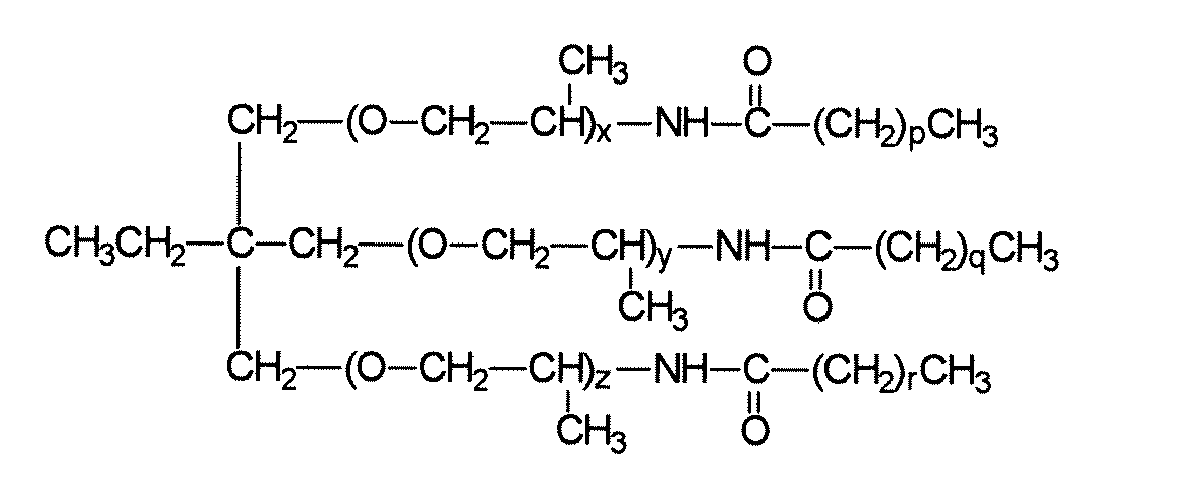
wherein x, y, and z each independently represent the number of propyleneoxy repeat units and x+y+z is from about 5 to about 6, and wherein p, q, and r each, independently of the others, are integers representing the number of repeat -(CH2)- units.
wherein x, y, and z each independently represent the number of propyleneoxy repeat units and x+y+z is from about 5 to about 6, and wherein p, q, and r each, independently of the others, are integers representing the number of repeat -(CH2)- units.
7. An ink according to claim 1 further containing an isocyanate-derived material.
8. A process which comprises (1) incorporating into an ink jet printing apparatus a phase
change ink comprising (a) a colorant and (b) a phase change ink carrier, said carrier
comprising (i) an amide and (ii) a Fischer-Tropsch wax having an average peak molecular
weight of from about 300 to about 800 and a polydispersity of from about 1.001 to
about 3; (2) melting the ink; and (3) causing droplets of the melted ink to be ejected
in an imagewise pattern onto a substrate.
9. A process according to claim 8 wherein the printing apparatus employs a piezoelectric
printing process wherein droplets of the ink are caused to be ejected in imagewise
pattern by oscillations of piezoelectric vibrating elements.
10. A process according to claim 8 wherein the substrate is an intermediate transfer member
and droplets of the melted ink are ejected in an imagewise pattern onto the intermediate
transfer member followed by transfer of the imagewise pattern from the intermediate
transfer member to a final recording sheet.
REFERENCES CITED IN THE DESCRIPTION
This list of references cited by the applicant is for the reader's convenience only. It does not form part of the European patent document. Even though great care has been taken in compiling the references, errors or omissions cannot be excluded and the EPO disclaims all liability in this regard.
Patent documents cited in the description
- US5496879A [0002] [0006]
- DE4205636 [0002] [0006]
- DE4205713 [0002] [0006]
- US4889560A [0003] [0006] [0027] [0037]
- US4889761A [0003] [0027] [0037]
- US5372852A [0003] [0006] [0027] [0037]
- US5621022A [0003] [0042]
- US3653932A [0006]
- US4390369A [0006]
- US4484948A [0006]
- US4684956A [0006]
- US4851045A [0006]
- US5006170A [0006]
- US5151120A [0006]
- EP0187352A [0006]
- EP0206286A [0006]
- WO9404619A [0006]
- US6860930B [0007] [0028] [0055]
- US20050130054A [0008] [0022] [0024]
- US6001904A [0009]
- US11126745B [0024]
- US6174937B [0027] [0027] [0027] [0037] [0037]
- US5194638A [0027] [0037]
- US4830671A [0027] [0037]
- US5597856A [0027] [0037]
- GB2238792A [0027] [0037]
- US5750604A [0038]
- US5780528A [0038] [0045]
- US5782966A [0038] [0039]
- US5783658A [0038]
- US5827918A [0038]
- US5830942A [0038]
- US5919839A [0038] [0045]
- US6255432B [0038]
- US6309453B [0038] [0040] [0055]
- GB2294939A [0038]
- GB2305928A [0038]
- GB2305670A [0038]
- GB2290793A [0038]
- WO9414902A [0038]
- WO9712003A [0038]
- WO9713816A [0038]
- WO9614364A [0038]
- WO9733943A [0038]
- WO9504760A [0038]
- US6221137B [0042]
- US5231135A [0042]
- US6472523B [0043] [0043] [0055]
- US6726755B [0043] [0043]
- US6476219B [0043] [0043]
- US6576747B [0043]
- US6713614B [0043] [0055]
- US6663703B [0043] [0043]
- US6576748B [0043] [0043]
- US6958406B [0043]
- US6821327B [0043]
- US102B0379A [0043]
- US6835238B [0043]
- US10607373B [0043]
- US10898724B [0043]
- US10898028B [0043]
- US10898432B [0043]
- US6755902B [0043]
- US6590082B [0043]
- US6696552B [0043]
- US6646111B [0043]
- US6673139B [0043]
- US5378574A [0044]
- US5146087A [0044]
- US5145518A [0044]
- US5543177A [0044]
- US5225900A [0044]
- US5301044A [0044]
- US5286286A [0044]
- US5275647A [0044]
- US5208630A [0044]
- US5202265A [0044]
- US5271764A [0044]
- US5256193A [0044]
- US5385803A [0044]
- US5554480A [0044]
- US3157633A [0045]
- US3927044A [0045]
- US3994835A [0045]
- US4102644A [0045]
- US4113721A [0045]
- US4132840A [0045]
- US4137243A [0045]
- US4170564A [0045]
- US4284729A [0045]
- US4507407A [0045]
- US4640690A [0045]
- US4732570A [0045]
- US4751254A [0045] [0045]
- US4761502A [0045]
- US4775748A [0045]
- US4812141A [0045]
- US4846846A [0045]
- US4871371A [0045]
- US4912203A [0045]
- US4978362A [0045]
- US5043013A [0045]
- US5059244A [0045]
- US5149800A [0045]
- US5177200A [0045]
- US5270363A [0045]
- US5290921A [0045]
- US5731398A [0045]
- US5195430A [0052]
- US5389958A [0052]