| (19) |
 |
|
(11) |
EP 1 796 095 B1 |
| (12) |
EUROPEAN PATENT SPECIFICATION |
| (45) |
Mention of the grant of the patent: |
|
20.06.2012 Bulletin 2012/25 |
| (22) |
Date of filing: 06.11.2006 |
|
| (51) |
International Patent Classification (IPC):
|
|
| (54) |
Method and device for cache pre-storage of streamed multimedia data for editing in
a network environment.
Verfahren und Vorrichtung zur Vorherspeicherung von gestreamten Multimedia Daten im
Zwischenspeicher zum Editieren in einer Netzwerkumgebung.
Procédé et dispositif de pré-stockage en mémoire tampon de données multimédia diffusées
en flux continu pour édition dans un environnement réseau.
|
| (84) |
Designated Contracting States: |
|
DE FR GB |
| (30) |
Priority: |
08.12.2005 DE 102005059044
|
| (43) |
Date of publication of application: |
|
13.06.2007 Bulletin 2007/24 |
| (73) |
Proprietor: Thomson Licensing |
|
92130 Issy-les-Moulineaux (FR) |
|
| (72) |
Inventors: |
|
- Aust, Andreas
30177 Hannover (DE)
- Brocke, Jens
30880 Laatzen (DE)
- Gläser, Frank
30163 Hannover (DE)
- Köhler, Ralf
30455 Hannover (DE)
|
| (74) |
Representative: Ruellan-Lemonnier, Brigitte et al |
|
Thomson
1-5, rue Jeanne d'Arc
92443 Issy-les-Moulineaux, Cedex
92443 Issy-les-Moulineaux, Cedex (FR) |
| (56) |
References cited: :
EP-A- 1 072 983
WO-A-01/99374
US-B1- 6 201 924
|
EP-A- 1 503 381
US-A1- 2002 116 716
|
|
| |
|
|
|
|
| |
|
| Note: Within nine months from the publication of the mention of the grant of the European
patent, any person may give notice to the European Patent Office of opposition to
the European patent
granted. Notice of opposition shall be filed in a written reasoned statement. It shall
not be deemed to
have been filed until the opposition fee has been paid. (Art. 99(1) European Patent
Convention).
|
[0001] The invention relates to the technical field of postediting of media contents in
a network environment. Media contents are understood to mean audio/video contents
and computer-generated contents, such as slide shows, electronic books or other larger
text or graphics documents.
Background of the invention
[0002] In the domain of studio engineering, what is known as server technology is making
an ever greater entrance. The original material produced is no longer archived primarily
on magnetic tapes. This is increasingly being done using what are known as server
devices such as video servers and audio servers, which store the original data streams
on large hard discs.
[0003] Previously, the original material has been postedited using primarily standalone
computer systems equipped with appropriate replaceable hard discs/magnetic tape drives.
The entry of streaming server technology into studios was also accompanied by networking
at the individual server devices to one another and to the postediting computers.
Today, powerful network systems are available for networking. Networks based on Ethernet
technology - either using fibre optics or based on copper wires - are available today
with transmission rates of up to 10 GB/s.
[0004] The server-based approach to postediting in the studio or during communication production
has various advantages, such as greater availability of the original material, immediate
access to the original material, better technical quality, etc., and will therefore
be continued.
[0005] The document
US-A-2002/0116716 has disclosed an online video postediting system in which a series of server devices
storing the original data from media contents are networked to one another. This server
system is also accessible externally via the Internet. A computer connected to the
Internet can be used by a user to access the server system and to create his own media
contents - based on the original data stored there. To this end, what are known as
editing lists are produced in the external computer which are transmitted by Internet
to the server system, are evaluated there and are then used to deliver an appropriately
compiled media data stream. Application servers are provided in the server system
in order to store the editing lists and to process them upon reproduction.
[0007] The document
EP-A-1 503 381 shows a video/audio editing system and a control method in which video/audio material
is archived on a server. Between the server and editing system memory storage devices
are also arranged. In the method the whole data section is stored in the memory storage
devices.
[0008] The document
U.S. 6 201 924 goes a bit further into this point. It mentions that only a portion of the requested
media section is stored in the cache memory, which is typically a few seconds at the
beginning and at end of the media section.
[0009] Document
WO 01/99374 defines a cache store using RTP/RTSP for autonomously thinning multimedia data according
to priority of frames, key-frames having high or priority, followed by P-frames and
B-frames having the lowest priority.
[0010] In paragraph 2.3.1 and reference [6], aforementioned document Ref. XP-000951790 briefly
describes a Real Time Transport Protocol RTP. RTP is used extensively in communication
and systems that involve streaming media Paragraph 2.4 and reference [8] of document
Ref. XP-000951790 briefly describes Real Time Streaming Protocol RTSP protocol. RTSP
is a network control protocol for use in entertainment and communications systems
to control streaming media servers. The protocol is used to establish and control
media sessions between endpoints. Clients of media servers issue VCR-Like commands,
such as "play" and "pause" to facilitate real-time control of playback of media files
from servers.
Invention
[0011] When postediting media contents, great importance is attached to cut editing, particularly
in the case of video films. Typically, the process of cut editing is a successive
process in which coarse cuts and fine cuts come after one another relatively frequently,
which means that after one another relatively frequently, which means that sections
of video contents recurrently need to be transmitted to the cut editing device via
the network. What is important is that the cut positions are produced with individual
frame accuracy and that the transitions are made smoothly if appropriate and without
disturbance. When editing a piece of documentation which makes use of a wide variety
of sources, the problem may be a special one.
[0012] The aim of the invention is to reduce the burden on the network as a result of frequent
transmission of the same or similar sections of audio/video contents.
[0013] The invention solves this problem by means of the measures based on independent Claims
1 and 8. In line with the invention, in the case of a method for editing media contents,
particularly audio and/or video articles, in a network environment, the data path
between the server device and the editing device contains a cache store which buffer-stores
parts of the media contents around the start and end of a loaded section for the purpose
of fast retrieval by the editing device. The cache store is also known by the term
"Cache Memory". Buffer-storage of these critical passages around the start and end
of a loaded section has a very advantageous effect for the postediting in a network
environment. This allows multiple repetition of the video content in the network to
be avoided. In one embodiment, the cache store may be part of the actual editing device.
[0014] The measures presented in the dependent claims allow developments and improvements
for the inventive method. The Real Time Transport Protocol RTP is suitable for transmitting
the data in the network, with the Real Time Streaming Protocol being able to be used
for controlling the transmissions of the various sections. Both protocols are suitable
for real time transmission of data streams.
[0015] The editing device creates and stores what is known as an editing list, e.g. cuts
list, for the new composition. For playing back the article compiled in this manner,
it is advantageous if the editing list is processed such that an RTSP command is produced
for each data section in the new composition. This RTSP command is then passed to
the server device, which delivers the desired data using RTP.
[0016] The start and end of a data section are characterized in the media domain, particularly
the audio and video domains, by means of time statements. It is advantageous if the
"Range" parameter indicated within an RTSP command is the start time and the end time
for a data section in SMPTE time format. This allows the data to be characterized
with individual frame accuracy.
[0017] It is very advantageous if for the purpose of buffer-storing the data sections around
the start and end of a requested section the respective RTSP commands for the request
for the section are evaluated and the time statements they contain for the start and
end of the section are taken as a basis for producing new RTSP commands which relate
to the reloading of the important parts of the media contents at least around the
start and end of the requested section. This allows the reloading process to be fully
automated. It is advantageous if a particular period is stipulated, particularly a
number of seconds before and a number of seconds after the relevant time.
[0018] In the studio domain, it is desirable for the data to be transmitted in uncompressed
form, so that no quality losses have to be accepted. The method described here can
also be applied to the known practice using proxy files without restriction, however.
When using proxy files, compressed versions of the original files are used in order
to be able to operate with a greater resource saving. Cuts lists which have been created
on the basis of the compressed files are applied to the uncompressed original files
during mastering.
[0019] The invention also relates to a device for buffer-storing media contents for a method
for editing media contents in a network environment. For this device, the invention
provides that it has a cache store which is to buffer-store parts of requested media
contents around the start and end of a requested section.
Drawings
[0020] Exemplary embodiments of the invention are illustrated in the drawings and are explained
in more detail in the description below.
[0021] In the drawings:
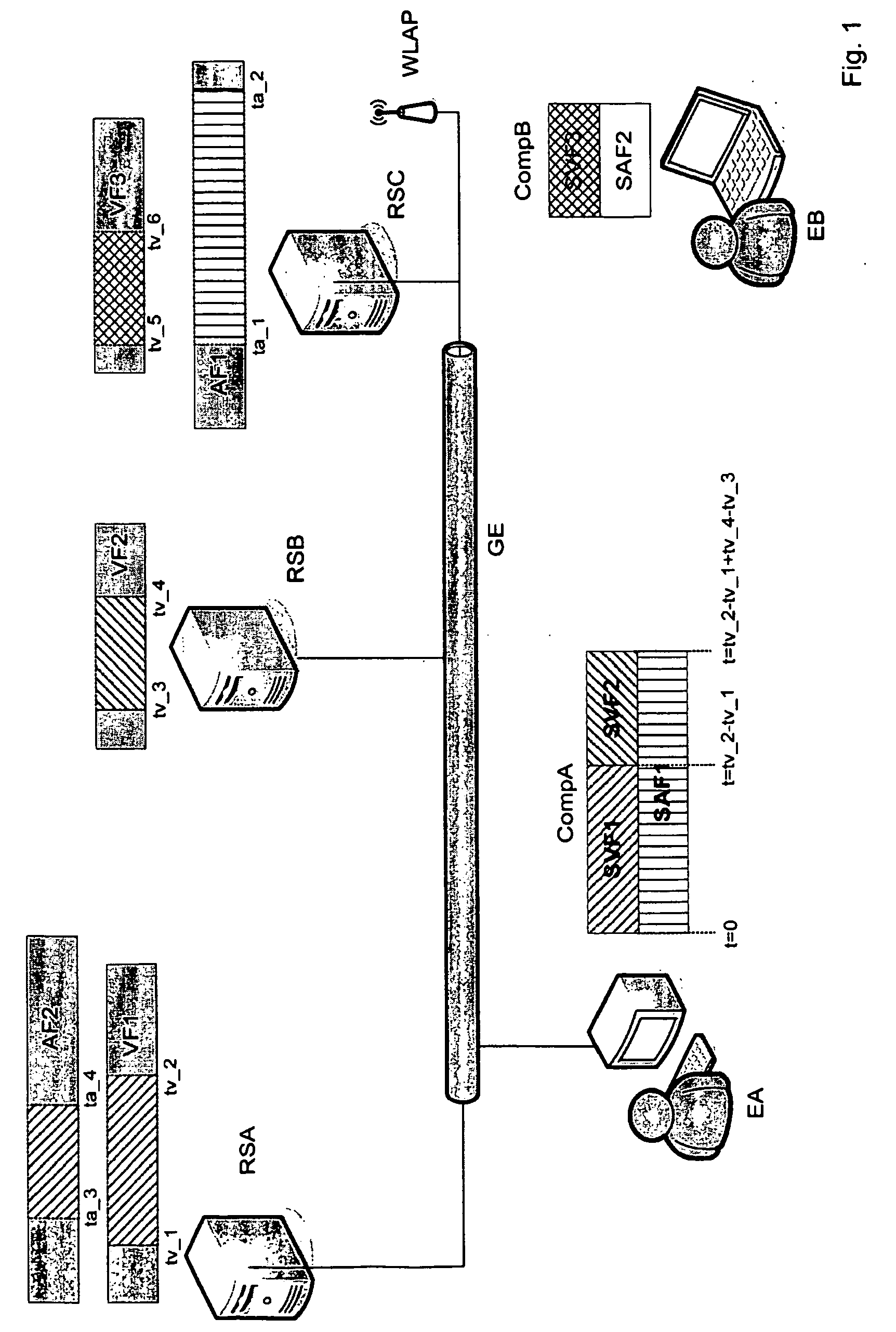
Figure 1
shows a network system having a plurality of server devices and also two editing devices;
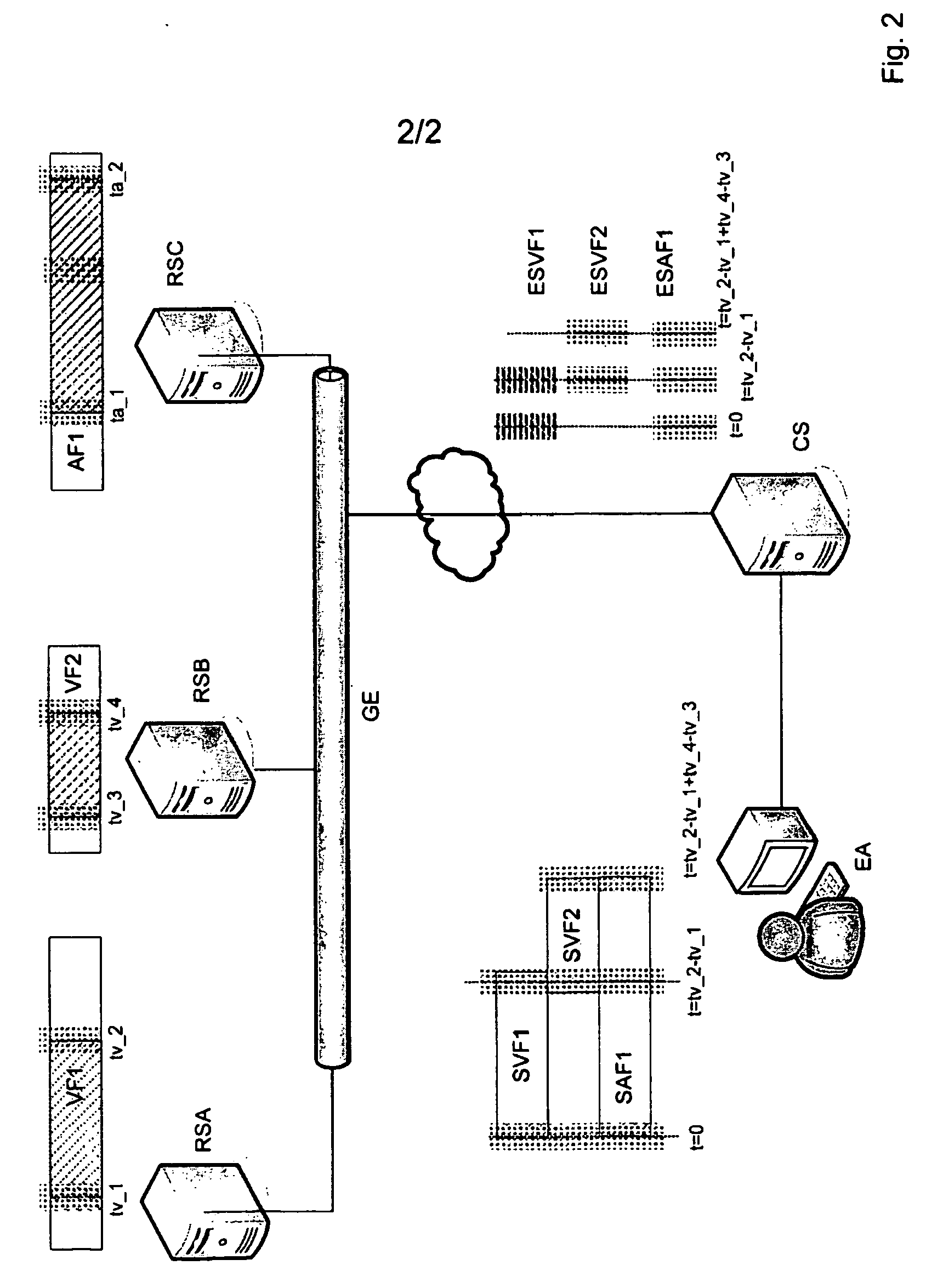
and Figure 2
shows a network having a plurality of server devices and also an editing device and
an upstream device for buffer-storing parts of the media contents which are stored
on the server devices and which are of particular importance for postediting.
Exemplary embodiments of the invention
[0022] In Figure 1, the reference symbols RSA, RSB and RSC denote three different server
devices which contain implementations of the protocols RTP and RTSP. These server
devices store the starting material, e.g. video material or audio material recorded
by a camera. The reference number VF1 denotes a first video document and accordingly
the reference numbers VF2 and VF3 denote a second and a third video document. In addition,
Figure 1 shows that it is also possible for audio documents to be stored. By way of
example, the server device RSC stores an audio document AF1 and the server device
RSA stores an audio document AF2. The individual server devices are connected to one
another by means of a network. The network GE is a high-speed network, such as a 10-GB
Ethernet network. The network GE has postediting devices EA and EB connected to it.
In this case, the figure shows that the second postediting device EB is connected
wirelessly to the network GE by means of a high-speed transmission link, the access
point of said network being identified by WLAP in Figure 1. The transmission system
WIFI is suitable for this, for example.
[0023] Each postediting device has access to the data stored on the individual server devices
RSA to RSC via the network GE. For such postediting devices, applications are known
which allow non-destructive, nonlinear postediting of video material and audio material
on a document basis, with editing lists being created.
[0024] In this case, the editing list is the new composition without itself comprising the
associated data content. The recorded video and/or audio material remains stored in
the original content on the server devices. In the postediting device, the user produces
the editing list, which, in a simple case, may contain the following entries, for
example:
- at a time T = 0, play back the section of video file VF1 on RTP server A, from position
tv_1 to position tv_2;
- at time T = 0, play back the section of audio file AF1 stored on RTP server RSC, from
position ta_1 to position ta_2;
- at time T = tv_2, play back the section of video file VF2 on RTP server RSB from position
tv_3 to tv_4.
[0025] This editing list would be used to describe the composition identified by the reference
symbol CompA in Figure 1. The composition is shown in the form of a timeline.
[0026] A second example of an editing list for a composition CompB has the following entries:
- at time T = 0, play back a section of the video document VF3 on RTP server RSC from
position tv_5 to position tv_6;
- at time T = 0, play back a section of the audio document AF2, stored on RTP server
RSA, from position ta_3 to position ta_4.
[0027] The composition CompB is likewise shown in Figure 1. For playback in the respective
editing device, every article composed in this manner is converted by an appropriate
software program into individual RSTP commands which are transmitted to the associated
server device via the network. In this case, the time statements in the editing lists
are preferably indicated on the basis of the SMPTE time format in the form hour:minute:second:frame
number, so that the data can be transmitted with individual frame accuracy. The RTSP
protocol itself is known, which means that the details of this protocol do not need
to be discussed below. Some RTSP commands are specified for initializing a session,
requesting data and for the subsequent responses. The text below assumes that an RTSP
session has been set up and is in existence. For the first entry in the editing list
for composition B, the associated RTSP playback request would have the following appearance:
PLAY rtsp://rtpserver_C.com/VideoFile_3 RTSP/1.0
CSeq: 2
Session: 23456789
Range: smpte=0:10:00-0:15:00
[0028] The first line of this command contains the URL for the video document VF3 on the
RTP server RSC. The statement in the second line C-Sequence:2 relates to the indication
of a sequence number which is allocated by the request device. The third line contains
the identification number for the session and the fourth line then contains the "Range"
parameter with the two time statements in SMPTE format, from where to where the video
document VF3 is intended to be played back.
[0029] Should the person editing composition B also have inserted a commentary track into
his composition then this can also be stored on a server device. This can be done
using the RTSP command "Record", and the commentary text can be recorded as an additional
recording track for the sound.
[0030] Figure 2 shows an arrangement of three streaming server devices RSA to RSC which
are connected by means of the network GE. An editing device EA is likewise connected
to the network GE, with a device for buffer-storing CS media contents also being arranged
between the editing device EA and the network GE. In line with the invention, the
device for buffer-storage CS is intended to be used to relieve the network GE of repeat
transmissions of media contents. This is done such that it holds frequently recurring
sections of the media contents ready as in a cache memory arrangement or a proxy server.
[0031] One problem in this case is stipulating rules for how the frequently required media
contents are to be identified. In this context, the invention takes the route that
the areas around the start and end of a section of a media content which has been
requested by the editing device are reloaded into the device for cache storage CS
as a precaution. To this end, the device evaluates the RTSP commands which are sent
from the editing device to the server devices. Experience shows that a new composition
comprises a compilation of individual sections of recorded starting material. The
cut boundaries with individual frame accuracy which are required in the case of new
video compositions are, as described above, often stipulated accurately only little
by little. Therefore, in line with the invention, for each section of a media document
which is to be edited the areas around the boundaries of the respectively considered
section of a media document are transferred to the cache store CS as a precaution.
These boundary areas are respectively identified by a greyscale pattern in Figure
1. A special feature is shown for the audio document AF1. This is because in that
case an area from the centre of the data section shown is likewise loaded into the
buffer store CS between the times ta_1 and ta_2. Since, for the two video sections
played back in parallel with the audio section, the conditions for cache storage are
met during playback of the audio section, the relevant part from the centre of the
audio section is also buffer-stored.
[0032] The relevant data sections are reloaded into the buffer store CS using the RTSP protocol.
In this case, it is possible to define what area around the limit value needs to be
requested. One implementation may involve requesting from the streaming server the
area relating to a number of seconds before and a number of seconds after the respective
limit value. An example value is the value 5 seconds before and after the respective
start, end of the requested data section, for example.
[0033] To transmit the areas frequently requested by the editing device EA, just one respective
data stream is then required between the memory CS and the editing device EA. The
rest of the network GE is freed of this data traffic.
[0034] The buffer store can handle the RTSP commands in a similar manner to the known method
for buffer-storing HTTP requests (HTTP Proxy). In this case, all requests from editing
devices are intercepted, interpreted and forwarded. The forwarded requests are modified
possibly in line with the method described here.
[0035] In another implementation, the buffer-store arrangement can also be integrated in
the editing device EA.
1. Method for post editing media contents (VF1, VF2, AF1), particularly audio and/or
video contents, in a network environment, where media contents (VF1, VF2, AF1) are
stored on more than one server devices (RSA, RSB, RSC), where data sections (SVF1,
SVF2, SAF1) of media contents are loaded into an editing device (EA, EB) via the network
(GE), wherein said editing device (EA, EB) request messages to load said data sections,
and an editing list is created in order to describe a new composition pointing on
data sections (SVF1, SVF2, SAF1) of media contents and sent to said server devices
(RSA, RSB, RSC), wherein a first data section (SVF1) being played back first followed
by a continuous playback of a second data section (SVF2) and in parallel with a third
data section (AF1) having a start time and end time (ta_2 - ta_1) defining a period
along the same timeline which is larger than the period defined by the start time
and end time (tv_2-tv_1, tv_4-tv_3) of said first and second data section (SVF1, SVF2),
wherein the data path between the server devices (RSA, RSB, RSC) and the editing device
(EA) contains a cache store (CS) device, wherein parts (ESVF1, ESVF2) of the first
and second data sections (SVF1, SVF2) and parts of the third data section (AF1) of
the media contents around the respective start time and end time of said data sections
(SVF1, SVF2, SAF1) to be edited being loaded in the cache store (CS) device for the
purpose of faster retrieval, characterized in that an additional part (ESAF1) of the third data section (AF1), different from said parts
of said third data section (AF1), is loaded in the cache store (CS) device, said additional
part (ESAF1) corresponding to the end time of the first data section (SVF1) and to
the start time of the second data section (SVF2) time limits, in that time limits of said additional part are (ESAF1) defined by said cache store (CS)
device around the end time (tv_2-tv_1) of the first data section (SVF1) and the start
time (tv_2-tv_1 of th second data section (SVF2), and in that said cache store (CS) device intercepts and interprets said request messages for
loading said parts.
2. Method according to Claim 1, where the real time transport protocol RTP is used for
transmitting the data sections (SVF1, SVF2, SAF1) of media contents (VF1, VF2, AF1)
in the network environment and the real time streaming protocol RTSP is used for controlling
the transmission of the data sections (SVF1, SVF2, SAF1) of media contents (VF1, VF2,
AF1).
3. Method according to Claim 2, where the editing list is processed in order to play
back the new composition and the real time streaming protocol RTSP is used for the
respective request for a data section (SVF1, SVF2, SAF1) in the new composition.
4. Method according to one of Claims 1 to 3, where the command "Record" of real time
transport protocol RTP is used for transmitting commentary text relating to the new
composition for archiving on one of the server devices (RSA, RSB, RSC), and the commentary
text is stored as a track, particularly an audio track, on a server device (RSA, RSB,
RSC) additionally.
5. Method according to claim 4, wherein for the purpose of buffer-storing parts (ESVF1,
ESVF2, ESAF1) of data sections (SVF1, SVF2, SAF1) to be edited, the respective RTSP
commands for the request of a data section (SVF1, SVF2, SAF1) are evaluated and new
RTSP commands which relate to the reloading of the parts (ESVF1, ESVF2, ESAF1) of
the first, second and third data sections (SVF1, SVF2, SAF1) are generated based on
the time statements they contain for the start time and end time of the data section
(SVF1, SVF2, SAF1).
6. Method according to Claim 5, where the parts (ESVF1, ESVF2, ESAF1) of the first, second
and third data sections (SVF1, SVF2, SAF1) relate to a stipulated period, particularly
a number of seconds before and a number of seconds after the given time.
7. Method according to one of the preceding claims, where the data sections (SVF1, SVF2,
SAF1) of media contents (VF1, VF2, AF1) are transmitted in uncompressed form via the
network (GE).
8. Device for the cache storage of media data comprising evaluation means for intercepting
and interpreting request messages produced by an editing device (EA), said request
messages requiring a data section of media contents (VF1, VF2, AF1) stored on more
than one server devices, a first requested data section (SVF1) being intended to be
played back first followed by a continuous second requested data section (SVF2) and
a third requested data section (SAF1) being intended to be played back in parallel
with said first and second data sections (SVF1, SVF2), said third requested data section
(SAF1) having a start time and end time(ta_2- ta_1) defining a period along the same
timeline which is larger than the period defined by the start time and end time (tv_2-tv_1,
tv_4-tv_3) of said first and second data section (SVF1, SVF2), said device being connected
to said server devices (RSA, RSB, RSC) via a network and said device further comprising
a cache store (CS) in which parts (ESVF1, ESVF2) of the first, second and third data
sections (SVF1, SVF2, SAF1) of the media contents around the respective start time
and end time of the requested data sections (SVF1, SVF2, SAF1) are loaded for the
purpose of fast retrieval in response to a request forwarded by said evaluation means,
said cache store is comprised in a data path of said network between the server devices
(RSA, RSB, RSC) and the editing device (EA), characterized in that the evaluation means are designed such that an additional part (ESAF1) of the third
requested data section (SAF1), different from said parts of said third data section
(AF1), corresponding to the start time of first data section (SVF1) and to the end
time of second data section (SVF2) is further loaded in the cache store (CS) and in that time limits of said additional part (ESAF1) are defined by said evaluation means
from time statements indicating the end time (tv_2-tv_1) of the first data section
(SVF1) and the start time (tv_2-tv_1) of the second data section (SVF2) comprised
in said request messages.
9. Device according to Claim 8, where evaluation means on the basis of the evaluation
they perform, create separate request messages in order to load parts (ESVF1, ESVF2,
ESAF1) of the first, second and third requested data sections (SVF1, SVF2, SAF1) automatically
in the cache store.
10. Device according to one of Claims 8 or 9, where the evaluation means are designed
to evaluate commands of the real time streaming protocol RTSP which are used to request
the data sections (SVF1, SVF2, SAF1) of media contents (VF1, VF2, AF1).
11. Device according to one of Claims 8 to 10, where the evaluation means are designed
to create request messages for loading the parts (ESVF1, ESVF2, ESAF1) of the first,
second and third requested data sections (SVF1, SVF2, SAF1) in the format of commands
of the real time streaming protocol RTSP.
1. Verfahren zum Nachbearbeiten von Medieninhalten (VF1, VF2, AF1), insbesondere Audio-
und/oder Videoinhalten, in einer Netzwerkumgebung, wobei Medieninhalte (VF1, VF2,
AF1) auf mehr als einem Servergerät (RSA, RSB, RSC) abgespeichert sind, wobei Datenabschnitte
(SVF1, SVF2, SAF1) von Medieninhalten über das Netzwerk (GE) in ein Bearbeitungsgerät
(EA, EB) geladen werden, wobei das Bearbeitungsgerät (EA, EB) Anforderungsnachrichten
zum Laden der Datenabschnitte sendet, und wobei eine Bearbeitungsliste erstellt wird,
um eine Neukomposition zu beschreiben, die auf Datenabschnitte (SVF1, SVF2, SAF1)
von Medieninhalten zeigt, und an die Servergeräte (RSA, RSB, RSC) gesendet wird, wobei
ein erster Datenabschnitt (SVF1) zuerst abgespielt wird, gefolgt von einem ununterbrochenen
Abspielen eines zweiten Datenabschnitts (SVF2) und parallel mit einem dritten Datenabschnitt
(AF1) mit einer Anfangszeit und einer Endzeit (t_ 2-ta_1), die eine Zeitdauer entlang
derselben Zeitachse definieren, die größer als die Zeitdauer ist, die durch die Anfangszeit
und die Endzeit (tv_2-tv_1, tv_4-tv_3) des ersten und des zweiten Datenabschnitts
(SVF1, SVF2) definiert ist, wobei der Datenpfad zwischen den Servergeräten (RSA, RSB,
RSC) und dem Bearbeitungsgerät (EA) ein Vorratsspeichergerät (CS) enthält, in dem
Teile (ESVF1, ESVF2) des ersten und des zweiten Datenabschnitts (SVF1, SVF2) und Teile
des dritten Datenabschnitts (AF1) der Medieninhalte um die Anfangszeit bzw. um die
Endzeit der zu bearbeiteten Datenabschnitte (SVF1, SVF2, SAF1) zur schnelleren Wiedergewinnung
in das Vorratsspeichergerät (CS) geladen werden, dadurch gekennzeichnet, dass ein von den Teilen des dritten Datenabschnitts (AF1) verschiedener zusätzlicher Teil
(ESAF1) des dritten Datenabschnitts (AF1) in das Vorratsspeichergerät (CS) geladen
wird, wobei der zusätzliche Teil (ESAF1) der Endzeit des ersten Datenabschnitts (SVF1)
und der Anfangszeit des zweiten Datenabschnitts (SVF2) entspricht, dass durch das
Vorratsspeichergerät (CS) um die Endzeit (tv_2-tv_1) des ersten Datenabschnitts (SVF1)
und um die Anfangszeit (tv_2-tv_1) des zweiten Datenabschnitts (SVF2) Zeitgrenzen
des zusätzlichen Teils (ESAF1) definiert werden und dass das Vorratsspeichergerät
(CS) die Anforderungsnachrichten zum Laden der Teile abfängt und interpretiert.
2. Verfahren nach Anspruch 1, wobei für die Übertragung der Datenabschnitte (SVF1, SVF2,
SAF1) von Medieninhalten (VF1, VF2, AF1) in der Netzwerkumgebung das Real-Time-Transport-Protokoll
RTP verwendet wird und zur Steuerung der Übertragung der Datenabschnitte (SVF1, SVF2,
SAF1) von Medieninhalten (VF1, VF2, AF1) das Real-Time-Streaming-Protokoll RTSP verwendet
wird.
3. Verfahren nach Anspruch 2, wobei die Bearbeitungsliste zum Abspielen der Neukomposition
abgearbeitet wird und jeweils für die Anforderung eines Datenabschnitts (SVF1, SVF2,
SAF1) in der Neukomposition das Real-Time-Streaming-Protokoll RTSP verwendet wird.
4. Verfahren nach einem der Ansprüche 1 bis 3, wobei das Kommando "Record" des Real-Time-Transport-Protokolls
RTP für die Übertragung von Kommentartext, der sich auf die Neukomposition zur Archivierung
auf einem der Servergeräte (RSA, RSB, RSC) bezieht, verwendet wird, und der Kommentartext
als Spur, insbesondere Audio-Spur, auf einem Servergerät (RSA, RSB, RSC) zusätzlich
abgespeichert wird.
5. Verfahren nach Anspruch 4, bei dem zur Pufferspeicherung von Teilen (ESVF1, ESVF2,
ESAF1) von zu bearbeitenden Datenabschnitten (SVF1, SVF2, SAF1) die jeweiligen RTSP-Kommandos
für die Anforderung eines Datenabschnitts (SVF1, SVF2, SAF1) ausgewertet werden und
auf der Grundlage der Zeitaussagen, die sie für die Anfangszeit und für die Endzeit
des Datenabschnitts (SVF1, SVF2, SAF1) enthalten, neue RTSP-Kommandos erzeugt werden,
die sich auf das Nachladen der Teile (ESVF1, ESVF2, ESAF1) des ersten, des zweiten
und des dritten Datenabschnitts (SVF1, SVF2, SAF1) beziehen.
6. Verfahren nach Anspruch 5, wobei sich die Teile (ESVF1, ESVF2, ESAF1) des ersten,
des zweiten und des dritten Datenabschnitts (SVF1, SVF2, SAF1) auf einen festgelegten
Zeitraum, insbesondere eine Anzahl Sekunden vor und eine Anzahl Sekunden nach dem
gegebenen Zeitpunkt, beziehen.
7. Verfahren nach einem der vorhergehenden Ansprüche, wobei die Datenabschnitte (SVF1,
SVF2, SAF1) von Medieninhalten (VF1, VF2, AF1) in unkomprimierter Form über das Netzwerk
(GE) übertragen werden.
8. Gerät zur Vorratsspeicherung von Mediendaten, das Auswertemittel zum Abfangen und
Interpretieren von Anforderungsnachrichten umfasst, die durch ein Bearbeitungsgerät
(EA) erzeugt werden, wobei die Anforderungsnachrichten einen Datenabschnitt von Medieninhalten
(VF1, VF2, AF1) anfordern, die in mehr als einem Servergerät gespeichert sind, wobei
auf einen ersten angeforderten Datenabschnitt (SVF1), der zuerst abgespielt werden
soll, ein ununterbrochener zweiter angeforderter Datenabschnitt (SVF2) und dritter
angeforderter Datenabschnitt (SAF1) folgt, die parallel zu dem ersten und zu dem zweiten
Datenabschnitt (SVF1, SVF2) abgespielt werden sollen, wobei der dritte angeforderte
Datenabschnitt (SAF1) eine Anfangszeit und eine Endzeit (ta_2-ta_1) besitzt, die eine
Zeitdauer entlang derselben Zeitachse definieren, die größer als die Zeitdauer ist,
die durch die Anfangszeit und die Endzeit (tv_2-tv_1, tv_4-tv_3) des ersten und des
zweiten Datenabschnitts (SVF1, SVF2) definiert ist, wobei das Gerät mit den Servergeräten
(RSA, RSB, RSC) über ein Netz verbunden ist und wobei das Gerät ferner ein Vorratsspeichergerät
(CS) umfasst, in das Teile (ESVF1, ESVF2) des ersten, des zweiten und des dritten
Datenabschnitts (SVF1, SVF2, SAF1) der Medieninhalte um die Anfangszeit bzw. um die
Endzeit der angeforderten Datenabschnitte (SVF1, SVF2, SAF1) zur schnellen Wiedergewinnung
in Reaktion auf eine durch das Auswertemittel weitergeleitete Anforderung geladen
werden, wobei der Vorratsspeicher in einem Datenpfad des Netzwerks zwischen den Servergeräten
(RSA, RSB, RSC) und dem Bearbeitungsgerät (EA) enthalten ist, dadurch gekennzeichnet, dass die Auswertemittel so ausgelegt sind, dass ferner ein von den Teilen des dritten
Datenabschnitts (AF1) verschiedener zusätzlicher Teil (ESAF1) des dritten angeforderten
Datenabschnitts (SAF1), der der Anfangszeit des ersten Datenabschnitts (SVF1) und
der Endzeit des zweiten Datenabschnitts (SVF2) entspricht, in das Vorratsspeichergerät
(CS) geladen wird, und dass durch die Auswertemittel aus Zeitaussagen, die die Endzeit
(tv_2-tv_1) des ersten Datenabschnitts (SVF1) und die Anfangszeit (tv_2-tv_1) des
zweiten Datenabschnitts (SVF2) angeben, die in den Anforderungsnachrichten enthalten
sind, Zeitgrenzen des zusätzlichen Teils (ESAF1) definiert werden.
9. Gerät nach Anspruch 8, wobei die Auswertemittel auf der Grundlage der Auswertung,
die sie ausführen, getrennte Anforderungsnachrichten erzeugen, um Teile (ESVF1, ESVF2,
ESAF1) des ersten, des zweiten und des dritten Datenabschnitts (SVF1, SVF2, SAF1)
automatisch in den Vorratsspeicher zu laden.
10. Gerät nach einem der Ansprüche 8 oder 9, wobei die Auswertemittel zur Auswertung von
Kommandos des Real-Time-Streaming-Protokolls RTSP ausgelegt sind, die verwendet werden,
um die Datenabschnitte (SVF1, SVF2, SAF1) von Medieninhalten (VF1, VF2, AF1) anzufordern.
11. Gerät nach einem der Ansprüche 8 bis 10, wobei die Auswertemittel zur Erstellung von
Anforderungsnachrichten für die Ladung der Teile (ESVF1, ESVF2, ESAF1) des ersten,
des zweiten und des dritten angeforderten Datenabschnitts (SVF1, SVF2, SAF1) in dem
Format von Kommandos des Real-Time-Streaming-Protokolls RTSP ausgelegt sind.
1. Procédé pour la post-édition de contenus média (VF1, VF2, AF1), et particulièrement
des contenus audio eUou vidéo, dans un environnement de réseau, où les contenus média
(VF1, VF2, AF1) sont stockés sur plus d'un dispositif de serveur (RSA, RSB, RSC),
où les sections de données (SVF1, SVF2, SAF1) des contenus média sont chargées dans
un dispositif d'édition (EA, EB) via le réseau (GE), dans lequel ledit dispositif
d'édition (EA, EB) émet des messages de demande pour charger lesdites sections de
données, et une liste d'édition est créée afin de décrire une nouvelle composition
pointant sur des sections de données (SVF1, SVF2, SAF1.) de contenus média et envoyée
auxdits dispositifs de serveur (RSA, RSB, RSC), où une première section de données
(SVF1) est reproduite d'abord et suivie par une reproduction continue d'une deuxième
section de données (SVF2) et parallèlement à une troisième section de données (AF1)
ayant une heure de début et une heure de fin (ta_2 - ta_1) définissant une période
dans la même frise chronologique qui est plus longue que la période définie par l'heure
de début et l'heure de fin (tv_2-tv_1, tv_4-tv_3) desdites première et seconde sections
de données (SVF1, SVF2), où le chemin de données entre les dispositifs de serveur
(RSA, RSB, RSC) et le dispositif d'édition (EA) contient un dispositif de stockage
en mémoire tampon (CS), dans lequel les parties (ESVF1, ESVF2) des première et seconde
sections de données (SVF1, SVF2) et les parties de la troisième section de données
(AF1) des contenus média concernant les heures respectives de début et de fin desdites
sections de données (SVF1, SVF2, SAF1) à éditer et étant situées dans le dispositif
de stockage en mémoire tampon (CS) pour une récupération plus rapide, caractérisé en ce qu'une partie supplémentaire (ESAF1) de la troisième section de données (AF1), différente
desdites parties de ladite troisième section de données (AF1), est chargée dans le
dispositif de stockage en mémoire tampon (CS), ladite partie supplémentaire (ESAF1)
correspondant à l'heure de fin de la première section de données (SVF1) et à l'heure
de début de la deuxième section de données (SVF2), dans ces limites de temps desdites
parties supplémentaires (ESAF1) définies par ledit dispositif de stockage mémoire
tampon (CS) concernant l'heure de fin (tv_2-tv_1) de la première section de données
(SVF1) et l'heure de début (tv_2-tv_1) de la seconde section de données (SVF2), et
en ce que ledit dispositif de stockage mémoire tampon (CS) intercepte et interprète lesdits
messages de requête pour le chargement desdites parties.
2. Procédé selon la revendication 1, où le protocole RTP de transport en temps réel est
utilisé pour transmettre les sections de données (SVF1, SVF2, SAF1) des contenus média
(VF1, VF2, AF1) dans l'environnement de réseau et le protocole RTSP de flux en temps
réel est utilisé pour contrôler la transmission des sections de données (SVF1, SVF2,
SAF1) des contenus média (VF1, VF2, AF1).
3. Procédé selon la revendication 2, où la liste d'édition est traitée afin de reproduire
la nouvelle composition et le protocole RTSP de flux en temps réel est utilisé pour
la demande respective d'une section de données (SVF1, SVF2, SAF1) dans la nouvelle
composition.
4. Procédé selon l'une des revendications 1 à 3, où la commande « Record » du protocole
RTP de transport en temps réel est utilisée pour transmettre le texte de commentaire
relatif à la nouvelle composition pour archiver sur un des dispositifs de serveur
(RSA, RSB, RSC), et le texte de commentaire est stocké comme une piste, particulièrement
une piste audio, et de plus sur un dispositif de serveur (RSA, RSB, RSC).
5. Procédé selon la revendication 4, dans lequel à des fins de stockage en mémoire tampon
des parties (ESVF1, ESVF2, ESAF1) des sections de données (SVF1, SVF2, SAF1) à éditer,
les commandes RTSP respectives pour la demande d'une section de données (SVF1, SVF2,
SAF1) sont évaluées et les nouvelles commandes RTSP qui sont relatives au rechargement
des parties (ESVF1, ESVF2, ESAF1) des première, deuxième et troisième sections de
données (SVF1, SVF2, SAF1) sont générées d'après les déclarations d'heure qu'elles
contiennent pour l'heure de début et l'heure de fin de la section de données (SVF1,
SVF2, SAF1).
6. Procédé selon la revendication 5, où les parties (ESVF1, ESVF2, ESAF1) des première,
deuxième et troisième sections de données (SVF1, SVF2, SAF1) renvoient à une période
stipulée, particulièrement à un nombre de secondes avant et à un nombre de secondes
après l'heure donnée.
7. Procédé selon l'une des revendications précédentes, où les sections de données (SVF1,
SVF2, SAF1) des contenus média (VF1, VF2, AF1) sont transmises sous forme non compressée
via le réseau (GE).
8. Dispositif pour le stockage en mémoire tampon des données média comprenant un moyen
d'évaluation pour intercepter et interpréter les messages de requête produits par
un dispositif d'édition (EA), lesdits messages de requête exigeant une section de
données de contenus média (VF1, VF2, AF1) stockée sur des dispositifs de serveur,
une première section de données requise (SVF1) étant destinée à être reproduite d'abord
suivie d'une deuxième section de donnée requise continue (SVF2) et d'une troisième
section de données requise (SAF1) étant destinée à être reproduite parallèlement auxdites
première et deuxième sections de données (SVF1, SVF2), ladite troisième section de
données requise (SAF1) ayant une heure de début et une heure de fin (ta_2- ta_1) définissant
une période dans une même frise chronologique qui est plus longue que la période définie
par l'heure de début et l'heure de fin (tv_2-tv_1, tv_4-tv_3) desdites première et
deuxième sections de données (SVF1, SVF2), ledit dispositif étant raccordé auxdits
dispositifs de serveur (RSA, RSB, RSC) via un réseau et ledit dispositif comprenant
en outre un dispositif de stockage en mémoire tampon (CS) dans lequel les parties
(ESVF1, ESVF2) des première, deuxième et troisième sections de données (SVF1, SVF2,
SAF1) des contenus média autour des heures respectives de début et de fin des sections
de données (SVF1, SVF2, SAF1) sont chargées à des fins de récupération rapide en réponse
à une demande transmise par ledit moyen d'évaluation, ledit dispositif de stockage
en mémoire tampon est compris dans un chemin de données dudit réseau entre les dispositifs
de serveur (RSA, RSB, RSC) et le dispositif d'édition (EA), caractérisé en ce que les moyens d'évaluation sont conçus de sorte qu'une partie supplémentaire (ESAF1)
de la troisième section de données requise (SAF1), différente desdites parties de
ladite troisième section de données (AF1), correspondant à l'heure de début de la
première section de données (SVF1) et à l'heure de fin de la deuxième section de données
(SVF2) est en outre chargée dans le dispositif de stockage en mémoire tampon (CS)
et en ce que les limites de temps de ladite partie supplémentaire (ESAF1) sont définies par lesdits
moyens d'évaluation à partir des déclarations de temps indiquant l'heure de fin (tv_2-tv_1)
de la première section de données (SVF1) et l'heure de début (tv_2-tv_1) de la seconde
section de données (SVF2) comprise dans lesdits messages de requête.
9. Dispositif selon la revendication 8, où les moyens d'évaluation d'après l'évaluation
qu'ils effectuent, créent des messages de requête séparés afin de charger des parties
(ESVF1, ESVF2, ESAF1) des première, deuxième et troisième sections de données (SVF1,
SVF2, SAF1) automatiquement dans le dispositif de stockage en mémoire tampon.
10. Dispositif selon l'une des revendications 8 ou 9, où les moyens d'évaluation sont
conçus pour évaluer les commandes du protocole RTSP de flux en temps réel qui sont
utilisées pour la requête des sections de données (SVF1, SVF2, SAF1.) des contenus
média (VF1, VF2, AF1).
11. Dispositif selon l'une des revendications 8 à 10, où les moyens d'évaluation sont
conçus pour créer des messages de requête pour le chargement des parties (ESVF1, ESVF2,
ESAF1) des première, deuxième et troisième sections de données requises (SVF1, SVF2,
SAF1.) dans le format des commandes du protocole RTSP de flux en temps réel.
REFERENCES CITED IN THE DESCRIPTION
This list of references cited by the applicant is for the reader's convenience only.
It does not form part of the European patent document. Even though great care has
been taken in compiling the references, errors or omissions cannot be excluded and
the EPO disclaims all liability in this regard.
Patent documents cited in the description
Non-patent literature cited in the description
- K. SchröderH. GebhardtAudio-/ Video-Streaming über IP (Internet-Protokoll)Fernseh-und Kinotechnik, 2000,
vol. 54, 1 [0006]