|
(11) | EP 1 798 278 A1 |

| (12) | EUROPEAN PATENT APPLICATION |
|
|
|
|
|||||||||||||||||||||||
| (54) | Lubricating oil composition |
| (57) Use of an oil-soluble hydrocarbyl phenol aldehyde condensate as a rust inhibitor
in a lubricating oil composition having a sulfated ash content of less than 1.0 %
by weight of the composition, of an ashless, the oil-soluble hydrocarbyl phenol aldehyde
condensate having the following structure,
wherein n is 0 to 10, Y is a divalent bridging group, and is preferably a hydrocarbyl group, preferably having from 1 to 4 carbon atoms; and R is a hydrocarbyl group having from 4 to 30 carbon atoms. |
[0001] The invention is directed to lubricating oil compositions, in particular, although not exclusively to lubricating oil compositions that exhibit improved rust inhibition.
[0002] Lubricating oil compositions for use in crankcase engine oils comprise a major amount of base stock oil and minor amounts of additives that improve the performance of the engine. There are many different types of additives used in lubricating oil compositions, each performing one or more different functions in the oil.
[0003] As the permitted levels of sulfated ash, phosphorus and sulfur (SAPS) emissions from passenger car motor vehicles decrease the levels of conventional additives such as metal-based detergents that can be used are decreased. This leads to an imbalance in the additive combinations conventionally used in passenger car motor vehicles and leads the formulator to consider new additive combinations in order to meet the requirements of vehicle manufacturers.
[0004] European patent application number 0 575 154 discloses a lubricating oil comprising a carboxylic dispersant, a rust inhibitor combination comprising a mixture of a hydrocarbyl-substituted carboxylic acid and a non-ionic surfactant, an antioxidant combination comprising at least a reaction product of a hydrocarbyl-substituted phenol and an aldehyde and optionally a hindered phenol, and at least one material having an acidic or phenolic functionality which has been reacted with a basic metal species, such that the total sulfated ash content of the composition is between 0.25 and 1 wt%.
[0005] Preferred embodiments of the present invention provide alternative lubricating oil compositions, which seek to provide adequate engine cleanliness and corrosion resistance in lower SAPS lubricating oil composition, whilst maintaining other performance characteristics.
[0006] The present invention provides a method of passing the ASTM D6557 Ball Rust Test using a lubricating oil composition having a sulfated ash content of less than 1.0 % by weight of the composition, comprising a major amount of an oil of lubricating viscosity and an ashless, oil-soluble hydrocarbyl phenol aldehyde condensate represented by general Formula (I),
wherein n is 0 to 10, Y is a divalent bridging group, and is preferably a hydrocarbyl group, preferably having from 1 to 4 carbon atoms; and R is a hydrocarbyl group having from 4 to 30 carbon atoms.
[0007] The present invention further provides use of an oil-soluble hydrocarbyl phenol aldehyde condensate as a rust inhibitor in a lubricating oil composition having a sulfated ash content of less than 1.0 % by weight of the composition, of an ashless, oil-soluble hydrocarbyl phenol aldehyde condensate having the following structure,
wherein n is 0 to 10, Y is a divalent bridging group, and is preferably a hydrocarbyl group, preferably having from 1 to 4 carbon atoms; and R is a hydrocarbyl group having from 4 to 30 carbon atoms.
[0008] Other and further objects, advantages and features of the present invention will be understood by reference to the following specification.
[0009] The hydrocarbyl phenol aldehyde condensate of the present invention is preferably a hydrocarbyl phenol formaldehyde condensate. The term "hydrocarbyl" as used herein means that the group concerned is primarily composed of hydrogen and carbon atoms and is bonded to the remainder of the molecule via a carbon atom, but does not exclude the presence of other atoms or groups in a proportion insufficient to detract from the substantially hydrocarbon characteristics of the group. The hydrocarbyl group is preferably composed of only hydrogen and carbon atoms. Advantageously, the hydrocarbyl group is an aliphatic group, preferably alkyl or alkylene group, especially alkyl groups, which may be linear or branched. R is preferably an alkyl or alkylene group. R is preferably branched.
[0010] Preferred embodiments of the present invention comprise a hydrocarbyl phenol aldehyde condensate according to Formula (I) above, wherein n is preferably 1 to 8, more preferably 2 to 7, and most preferably 3 to 6 and/or R preferably comprises 8 to 18, and most preferably 9 to 15 carbon atoms.
[0011] The hydrocarbyl phenol aldehyde condensate preferably has a weight average molecular weight (Mw) in the range of 600 to 4000, preferably 800 to 3500, more preferably 1000 to 2000, even more preferably 1200 to 1900, and most preferably 1250 to 1680, as measured by MALDI-TOF (Matrix Assisted Laser Desorption Ionization- Time of Flight) Mass Spectrometry.
[0012] The hydrocarbyl phenol aldehyde condensate is preferably one obtained by a condensation reaction between at least one aldehyde or ketone or reactive equivalent thereof and at least one hydrocarbyl phenol, in the presence of an acid catalyst such as, for example, an alkyl benzene sulphonic acid. The product is preferably subjected to stripping to remove any unreacted hydrocarbyl phenol, preferably to less than 5 mass %, more preferably to less than 3 mass %, even more preferably to less than 1 mass %, of unreacted hydrocarbyl phenol. Most preferably, the product includes less than 0.5 mass %, such as, for example, less than 0.1 mass % of unreacted hydrocarbyl phenol.
[0013] Although a basic catalyst can be used, an acid catalyst is preferred. The acid catalyst may be selected from a wide variety of acidic compounds such as, for example, phosphoric acid, sulphuric acid, sulphonic acid, oxalic acid and hydrochloric acid. The acid may also be present as a component of a solid material such as acid treated clay. The amount of catalyst used may vary from 0.05 to 10 mass % or more, such as for example 0.1 to 1 mass % of the total reaction mixture.
[0014] In particular, the hydrocarbyl phenol aldehyde condensate is preferably branched dodecyl phenol formaldehyde condensate, such as, for example, a tetrapropenyl tetramer phenol formaldehyde condensate.
[0015] The ashless hydrocarbyl phenol aldehyde condensate of the present invention has a Total Base Number (TBN) of 0, because of the absence of metal ions in the compound.
[0016] The lubricating oil composition used in performance of the present invention may further comprise one or more detergent additives. Suitable detergent additives include overbased metal salts of organic acids.
[0017] Overbased metal salts of an organic acid useful in the context of the invention generally comprise a polar head with a long hydrophobic tail. The polar head comprises a metal salt of an acidic organic compound. In a neutral or normal salt the salt may contain a substantially stoichiometric amount of the metal and would typically have a total base number or TBN (as can be measured by ASTM D2896) of from 0 to 80. In an overbased metal salt a large amount of a metal base may be incorporated by reacting excess metal compound (e.g., an oxide or hydroxide) with an acidic gas (e.g., carbon dioxide). The resulting overbased detergent comprises neutralized detergent as the outer layer of a metal base (e.g. carbonate) micelle. Such overbased detergents may have a TBN of 150 or greater, and typically will have a TBN of from 250 to 450 or more.
[0018] Overbased metal salts of organic acids that may be used in the detergent composition of the present invention include oil-soluble, overbased sulfonates, phenates, sulfurized phenates, thiophosphonates, salicylates, including hydroxybenzoates, naphthenates and other oil-soluble carboxylates of a metal, particularly the alkali or alkaline earth metals, e.g., barium, sodium, potassium, lithium, calcium, and magnesium. The most commonly used metals are calcium, magnesium and sodium, and mixtures of thereof calcium and/or magnesium.
[0019] In respect of the present invention, particularly convenient overbased metal salts of organic acids are overbased metal salts of sulfonates, phenates, sulfurized phenates and salicylates.
[0020] The metal of the metal salt is preferably, sodium, magnesium or calcium, and more preferably calcium or magnesium. The one of more overbased metal salts of organic acids useful as a detergent in respect of the present invention may comprise a plurality of different metal salts derived from different organic acids and comprising different metals. In one embodiment, the plurality of overbased metal salts comprise metal salts derived from the same or different organic acids and each comprising the same metal. For example, the detergent may comprise a plurality of overbased calcium salts of organic acids. Alternatively, the detergent may comprise a plurality of overbased magnesium salts of organic acids. As a further alternative, the detergent may comprise a mixture of one or more overbased magnesium salt of an organic acid and one or more calcium salt of an organic acid.
[0021] Sulfonates may be prepared from sulfonic acids which are typically obtained by the sulfonation of alkyl substituted aromatic hydrocarbons such as those obtained from the fractionation of petroleum or by the alkylation of aromatic hydrocarbons. Examples include those obtained by alkylating benzene, toluene, xylene, naphthalene, diphenyl or their halogen derivatives such as chlorobenzene, chlorotoluene and chloronaphthalene. The alkylation may be carried out in the presence of a catalyst with alkylating agents having from about 3 to more than 70 carbon atoms. The alkaryl sulfonates usually contain from about 9 to about 80 or more carbon atoms, preferably from about 16 to about 60 carbon atoms per alkyl substituted aromatic moiety.
[0022] The oil soluble sulfonates or alkaryl sulfonic acids may be neutralized with oxides, hydroxides, alkoxides, carbonates, carboxylate, sulfides, hydrosulfides, nitrates, borates and ethers of the metal. The amount of metal compound is chosen having regard to the desired TBN of the final product but typically ranges from about 100 to 220 mass % (preferably at least 125 mass %) of that stoichiometrically required.
[0023] Metal salts of phenols and sulfurized phenols are prepared by reaction with an appropriate metal compound such as an oxide or hydroxide and neutral or overbased products may be obtained by methods well known in the art. Sulfurized phenols may be prepared by reacting a phenol with sulfur or a sulfur containing compound such as hydrogen sulfide, sulfur monohalide or sulfur dihalide, to form products which are generally mixtures of compounds in which 2 or more phenols are bridged by sulfur containing bridges.
[0024] Carboxylate detergents, e.g., salicylates, can be prepared by reacting an aromatic carboxylic acid with an appropriate metal compound such as an oxide or hydroxide and neutral or overbased products may be obtained by methods well known in the art. The aromatic moiety of the aromatic carboxylic acid can contain heteroatoms, such as nitrogen and oxygen. Preferably, the moiety contains only carbon atoms; more preferably the moiety contains six or more carbon atoms; for example benzene is a preferred moiety. The aromatic carboxylic acid may contain one or more aromatic moieties, such as one or more benzene rings, either fused or connected via alkylene bridges. The carboxylic moiety may be attached directly or indirectly to the aromatic moiety. Preferably the carboxylic acid group is attached directly to a carbon atom on the aromatic moiety, such as a carbon atom on the benzene ring. More preferably, the aromatic moiety also contains a second functional group, such as a hydroxy group or a sulfonate group, which can be attached directly or indirectly to a carbon atom on the aromatic moiety.
[0025] Preferred examples of aromatic carboxylic acids are salicylic acids and sulfurized derivatives thereof, including hydroxybenzoates such as those described in US 5,808,145 or EP 933 417, such as hydrocarbyl substituted salicylic acid and derivatives thereof. Processes for sulfurizing, for example a hydrocarbyl - substituted salicylic acid, are known to those skilled in the art. Salicylic acids are typically prepared by carboxylation, for example, by the Kolbe - Schmitt process, of phenoxides, and in that case, will generally be obtained, normally in a diluent, in admixture with uncarboxylated phenol.
[0026] Preferred substituents in oil - soluble salicylic acids are alkyl substituents. In alkyl - substituted salicylic acids, the alkyl groups advantageously contain 5 to 100, preferably 9 to 30, especially 14 to 20, carbon atoms. Where there is more than one alkyl group, the average number of carbon atoms in all of the alkyl groups is preferably at least 9 to ensure adequate oil solubility.
[0027] Overbased metal salts of organic acids generally useful in the formulation of lubricating oil compositions also include "hybrid" detergents formed with mixed surfactant systems, e.g., phenate/salicylates, sulfonate/phenates, sulfonate/salicylates, and sulfonate/phenate/salicylates, as described, for example, in pending U.S. Patent Nos. 6,429,178, 6,429,179, 6,153,565 and 6,281,179.
[0028] Overbased metal salts of organic acids suitable for use in the present invention suitably have a total base number (TBN) of at least 250, and preferably at least 300. The one or more overbased metal salts of organic acids providing component (A) of the detergent composition may comprise a combination of additives with different TBN values. In this case, the average TBN of the overbased metal salts of organic acids is suitably at least 250 and preferably at least 300.
[0029] Overbased metal salts of organic acids can be defined by their metal ratio, which is the ratio of the total equivalents of metal to the equivalents of acidic organic compound reacted with the metal Overbased metal salts of organic acids suitable for use in the present invention suitably have a metal ratio of greater than 1, preferably at least 5, more preferably at least 10 and possibly of up to 25.
[0030] The total amount of the one or more overbased metal salts of organic acids suitably provides the lubricating oil composition with a sulfated ash content of less than 1.0 mass % based on the mass of the lubricating oil composition, preferably less than 0.5 mass % and more preferably less than 0.3 mass %.
[0031] The oil of lubricating viscosity, useful for making lubricating oil compositions of the present invention, may be selected from natural (vegetable, animal or mineral) and synthetic lubricating oils and mixtures thereof. It may range in viscosity from light distillate mineral oils to heavy lubricating oils such as gas engine oil, mineral lubricating oil, motor vehicle oil, and heavy duty diesel oil. Generally, the viscosity of the oil ranges from 2 centistokes to 30 centistokes, especially 5 centistokes to 20 centistokes, at 100°C.
[0032] Natural oils include animal oils and vegetable oils (e.g., castor oil, lard oil); liquid petroleum oils and hydro-refined, solvent-treated or acid-treated mineral oils of the paraffinic, naphthenic and mixed paraffinic-naphthenic types. Oils of lubricating viscosity derived from coal or shale also serve as useful base oils.
[0033] Synthetic lubricating oils include hydrocarbon oils and halo-substituted hydrocarbon oils such as polymerized and interpolymerized olefins (e.g., polybutylenes, polypropylenes, propylene-isobutylene copolymers, chlorinated polybutylenes, poly(1-hexenes), poly(1-octenes), poly(1-decenes)); alkylbenzenes (e.g., dodecylbenzenes, tetradecylbenzenes, dinonylbenzenes, di(2-ethylhexyl)benzenes); polyphenyls (e.g., biphenyls, terphenyls, alkylated polyphenols); and alkylated diphenyl ethers and alkylated diphenyl sulfides and derivative, analogs and homologs thereof.
[0034] Alkylene oxide polymers and interpolymers and derivatives thereof where the terminal hydroxyl groups have been modified by esterification, etherification, etc., constitute another class of known synthetic lubricating oils. These are exemplified by polyoxyalkylene polymers prepared by polymerization of ethylene oxide or propylene oxide, and the alkyl and aryl ethers of polyoxyalkylene polymers (e.g., methyl-polyiso-propylene glycol ether having a molecular weight of 1000 or diphenyl ether of poly-ethylene glycol having a molecular weight of 1000 to 1500); and mono- and polycarboxylic esters thereof, for example, the acetic acid esters, mixed C3-C8 fatty acid esters and C13 Oxo acid diester of tetraethylene glycol.
[0035] Another suitable class of synthetic lubricating oils comprises the esters of dicarboxylic acids (e.g., phthalic acid, succinic acid, alkyl succinic acids and alkenyl succinic acids, maleic acid, azelaic acid, suberic acid, sebasic acid, fumaric acid, adipic acid, linoleic acid dimer, malonic acid, alkylmalonic acids, alkenyl malonic acids) with a variety of alcohols (e.g., butyl alcohol, hexyl alcohol, dodecyl alcohol, 2-ethylhexyl alcohol, ethylene glycol, diethylene glycol monoether, propylene glycol). Examples of such esters include dibutyl adipate, di(2-ethylhexyl) sebacate, di-n-hexyl fumarate, dioctyl sebacate, diisooctyl azelate, diisodecyl azelate, dioctyl phthalate, didecyl phthalate, dieicosyl sebacate, the 2-ethylhexyl diester of linoleic acid dimer, and the complex ester formed by reacting one mole of sebacic acid with two moles of tetraethylene glycol and two moles of 2-ethylhexanoic acid.
[0036] Esters useful as synthetic oils also include those made from C5 to C12 monocarboxylic acids and polyols and polyol esters such as neopentyl glycol, trimethylolpropane, pentaerythritol, dipentaerythritol and tripentaerythritol.
[0037] Silicon-based oils such as the polyalkyl-, polyaryl-, polyalkoxy- or polyaryloxysilicone oils and silicate oils comprise another useful class of synthetic lubricants; such oils include tetraethyl silicate, tetraisopropyl silicate, tetra-(2-ethylhexyl)silicate, tetra-(4-methyl-2-ethylhexyl)silicate, tetra-(p-tert-butyl-phenyl) silicate, hexa-(4-methyl-2-ethylhexyl)disiloxane, poly(methyl)siloxanes and poly(methylphenyl)siloxanes. Other synthetic lubricating oils include liquid esters of phosphorous-containing acids (e.g., tricresyl phosphate, trioctyl phosphate, diethyl ester of decylphosphonic acid) and polymeric tetrahydrofurans.
[0038] The oil of lubricating viscosity may comprise a Group I, Group II, Group III, Group IV or Group V oil or blends of the aforementioned oils. The oil of lubricating viscosity may also comprise a blend of a Group I oil and one or more of Group II, Group III, Group IV or Group V oil.
[0039] Definitions for the oils as used herein are the same as those found in the American Petroleum Institute (API) publication "Engine Oil Licensing and Certification System", Industry Services Department, Fourteenth Edition, December 1996, Addendum 1, December 1998. Said publication categorizes oils as follows:
- a) Group I oils contain less than 90 percent saturates and/or greater than 0.03 percent sulfur and have a viscosity index greater than or equal to 80 and less than 120 using the test methods specified in Table 1.
- b) Group II oils contain greater than or equal to 90 percent saturates and less than or equal to 0.03 percent sulfur and have a viscosity index greater than or equal to 80 and less than 120 using the test methods specified in Table 1. Although not a separate Group recognized by the API, Group II oils having a viscosity index greater than about 110 are often referred to as "Group II+" oils.
- c) Group III oils contain greater than or equal to 90 percent saturates and less than or equal to 0.03 percent sulfur and have a viscosity index greater than or equal to 120 using the test methods specified in Table 1.
- d) Group IV oils are polyalphaolefins (PAO).
- e) Group V oils are all other base stocks not included in Group I, II, III, or IV.
Table 1
| Property | Test Method |
| Saturates | ASTM D2007 |
| Viscosity Index | ASTM D2270 |
| Sulfur | ASTM D4294 |
[0040] The oil of lubricating viscosity preferably has a saturate content of at least 65%, more preferably at least 75%, such as at least 85%. Most preferably, the oil of lubricating viscosity has a saturate content of greater than 90%. Preferably, the oil of lubricating viscosity has a sulfur content of less than 1%, preferably less than 0.6%, more preferably less than 0.3%, by mass, such as 0 to 0.3% by mass.
[0041] Preferably the volatility of the oil of lubricating viscosity, as measured by the Noack test (ASTM D5880), is less than or equal to about 40 mass %, such as less than or equal to about 35 mass %, preferably less than or equal to about 32 mass %, such as less than or equal to about 28 mass %, more preferably less than or equal to about 16 mass %. Preferably, the viscosity index (VI) of the oil of lubricating viscosity is at least 85, preferably at least 100, most preferably from about 105 to 140.
[0042] The TBN of a lubricating oil composition according to the present invention will depend to some extent on the application of the composition. For lubricating the crankcase of an internal combustion engine, the TBN of the composition is suitably less than 20, preferably less than 15, and more preferably less than 10.
[0043] The sulfated ash content of the lubricating oil composition useful in the present invention will also depend to some extent upon the application of the composition and the current market requirements. The total sulfated ash content of a lubricating oil composition suitable for use in the present invention may have a sulfated ash content of less than 0.8 mass %, more preferably less than 0.5 mass % and potentially less than 0.1 mass %.
[0044] A lubricating oil composition according to the present invention suitably has a sulfur content of less than 1.0 mass%, preferably less than 0.5 mass % and more preferably less than 0.3 mass %, based on the mass of the lubricating oil composition.
[0045] A lubricating oil composition according to the present invention suitably has a phosphorus content of less than 0.5 mass %, preferably less than 0.3 mass % and suitably 0.1 wt% or less.
[0046] A lubricating oil composition suitable for use in the present invention, may further comprise one or more other performance improving additives selected from ashless dispersants, antiwear agents, oxidation inhibitors or antioxidants, ashless and metal-containing friction modifiers and fuel economy agents, antifoamants, corrosion inhibitors, and polyalkenyl acylating agent. Conventionally, when formulating a lubricant, the additives will be provided to the formulator in one or more, preferably a single concentrated additive package, oftentimes referred to as a DI (dispersant-inhibitor) package and a VI improver and/or VI improver and LOFI, will be provided in a second package.
[0047] Ashless dispersants maintain in suspension oil insolubles resulting from oxidation of the oil during wear or combustion. They are particularly advantageous for preventing the precipitation of sludge and the formation of varnish, particularly in gasoline engines.
[0048] Dihydrocarbyl dithiophosphate metal salts are frequently used as antiwear and antioxidant agents. The metal may be an alkali or alkaline earth metal, or aluminum, lead, tin, molybdenum, manganese, nickel or copper. The zinc salts are most commonly used in lubricating oil and may be prepared in accordance with known techniques by first forming a dihydrocarbyl dithiophosphoric acid (DDPA), usually by reaction of one or more alcohol or a phenol with P2S5 and then neutralizing the formed DDPA with a zinc compound. For example, a dithiophosphoric acid may be made by reacting mixtures of primary and secondary alcohols. Alternatively, multiple dithiophosphoric acids can be prepared where the hydrocarbyl groups on one are entirely secondary in character and the hydrocarbyl groups on the others are entirely primary in character. To make the zinc salt, any basic or neutral zinc compound could be used but the oxides, hydroxides and carbonates are most generally employed. Commercial additives frequently contain an excess of zinc due to the use of an excess of the basic zinc compound in the neutralization reaction.
[0049] Oxidation inhibitors or antioxidants reduce the tendency of mineral oils to deteriorate in service. Oxidative deterioration can be evidenced by sludge in the lubricant, varnish-like deposits on the metal surfaces, and by viscosity growth. Such oxidation inhibitors include hindered phenols, alkaline earth metal salts of alkylphenolthioesters having preferably C5 to C12 alkyl side chains, calcium nonylphenol sulfide, oil soluble phenates and sulfurized phenates, phosphosulfurized or sulfurized hydrocarbons, phosphorous esters, metal thiocarbamates, oil soluble copper compounds as described in U.S. Patent No. 4,867,890, and molybdenum-containing compounds and aromatic amines.
[0050] Known metal-containing friction modifiers include oil-soluble organo-molybdenum compounds. Such organo-molybdenum friction modifiers also provide antioxidant and antiwear credits to a lubricating oil composition. As an example of such oil soluble organo-molybdenum compounds, there may be mentioned the dithiocarbamates, dithiophosphates, dithiophosphinates, xanthates, thioxanthates, sulfides, and the like, and mixtures thereof. Particularly preferred are molybdenum dithiocarbamates, dialkyldithiophosphates, alkyl xanthates and alkylthioxanthates.
[0051] Metal free friction modifiers are commonly known as organic friction modifiers, and include oil-soluble compounds containing at least one polar group selected from hydroxyl and amine groups, which compounds are capable of reducing friction under hydrodynamic and mixed hydrodynamic/boundary layer conditions. Examples of such materials include glycerol esters of higher fatty acids, for example, glycerol mono-oleate; esters of long chain polycarboxylic acids with diols, for example, the butane diol ester of a dimerized unsaturated fatty acid; oxazoline compounds; and alkoxylated alkyl-substituted mono-amines, diamines and alkyl ether amines, for example, ethoxylated tallow amine and ethoxylated tallow ether amine. Particularly preferred surface active agents include glycerol oleates, particularly glycerol monooleate, and ethoxylated amines, particularly ethoxylated tallow amine.
[0052] Foam control can be provided by an antifoamant of the polysiloxane type, for example, silicone oil or polydimethyl siloxane.
[0053] Suitably, a lubricating oil composition according to the present invention comprises no rust inhibitor apart from the ashless, oil-soluble hydrocarbyl phenol aldehyde condensate of formula (I). In particular the lubricating oil composition preferably does not comprise a non-ionic surfactant rust inhibitor or a hydrocarbyl-substituted carboxylic acid or derivative thereof rust inhibitor as described on page 4, lines 16-48 of EP 0 575 154.
[0054] Some of the above-mentioned additives can provide a multiplicity of effects; thus for example, a single additive may act as a dispersant-oxidation inhibitor. This approach is well known and need not be further elaborated herein.
[0055] Representative effective amounts of such additional additives, when used in fully formulated crankcase lubricants, are listed below in Table 2:
Table 2
| ADDITIVE | Mass % (Broad) | Mass % (Preferred) |
| Ashless Dispersant | 0.1 - 20 | 1 - 8 |
| Corrosion Inhibitor | 0 - 5 | 0 - 1.5 |
| Metal Dihydrocarbyl Dithiophosphate | 0.1 - 6 | 0.1 - 4 |
| Antioxidant | 0 - 5 | 0.01 - 2 |
| Pour Point Depressant | 0.01 - 5 | 0.01 - 1.5 |
| Antifoaming Agent | 0 - 5 | 0.001 - 0.15 |
| Supplemental Antiwear Agents | 0 - 1.0 | 0 - 0.5 |
| Friction Modifier | 0 - 5 | 0 - 1.5 |
| Basestock | Balance | Balance |
[0056] This invention will be further understood by reference to the following examples, which are illustrative of the invention.
EXAMPLES
Example 1
[0057] Oils having the compositions set out in Table 3 below, were blended and subjected to the ASTM D6557 Ball Rust Test, which measures iron corrosion. In performance of the Ball Rust Test, multiple test tubes each containing the test oil and a specimen are placed in a rack which is attached to a mechanical shaker. The shaker speed and temperature are controlled. Air and an acidic solution are continuously fed into each tube over a period of 18 hours to create a corrosive environment. The specimens are then removed, rinsed and analysed by an optical imaging system designed to quantify the antirust capability of each oil. The ASTM D6557 Ball Rust Test is a merit test that measures average grey value, with a higher numerical value indicating less rust formation.
[0058] The quantities given in Table 3 are in mass % of the total mass of the fully formulated oil composition.
Table 3
| Component | Oil 1 | Oil 2 | Oil 3 | Oil 4 |
| Detergent 1 | - | - | 1.00 | - |
| Detergent 2 | - | - | 0.61 | 1.10 |
| Detergent 3 | 1.51 | - | - | - |
| Detergent 4 | 0.95 | 1.33 | - | - |
| Hydrocarbyl phenol aldehyde condensate | - | 0.54 | - | 0.50 |
| Additive Package 1 | 10.20 | 10.20 | 10.20 | 10.20 |
| Base Oil + Viscosity Modifier | 87.34 | 87.93 | 88.19 | 88.2 |
| % Sulfated Ash | 0.56 | 0.56 | 0.56 | 0.56 |
| Mass soap | 0.77 | 0.76 | 0.58 | 0.62 |
| % Ca | 0.035 | 0.000 | 0.054 | 0.000 |
| % Mg | 0.072 | 0.100 | 0.056 | 0.100 |
| % P | 0.05 | 0.05 | 0.05 | 0.05 |
| % S | 0.18 | 0.18 | 0.21 | 0.18 |
[0059] Detergent 1 is a calcium phenate detergent having a TBN of 145. Detergent 2 is a magnesium sulfonate detergent having a TBN of 400. Detergent 3 is a Calcium salicylate detergent having a TBN of 64 and Detergent 4 is a Magnesium salicylate detergent having a TBN of 342.
[0060] The hydrocarbyl phenol aldehyde condensate is in accordance with Formula (1) set out above, and has a number average molecular weight of 1500.
[0061] Each of Oils 1, 2, 3, and 4 comprised additional additives in the same quantities, referred to above as Additive Package 1. Additive package 1 comprised dispersant, zinc dialkyldithiophosphate, friction modifier, antioxidant and antifoamant. The base stock and viscosity modifier used for each of Oils 1, 2, 3, and 4 were the same, although the quantity of diluent oil in the additive package varied slightly due to the variation in detergent quantities. The quantity of detergent and hydrocarbyl phenol aldehyde condensate in each oil was balanced such that each of Oils 1 & 2 and 3 & 4 have equivalent sulfated ash, soap, phosphorus and sulfur content.
[0062] It can be seen from Table 3, that Oils 1 and 3 are comparative examples and Oils 2 and 4 are in accordance with the present invention.
[0063] The results of the Ball Rust Test are set out below in Table 4.
Table 4
| Oil | Oil 1 | Oil 2 | Oil 3 | Oil 4 |
| Result | 80 | 106 | 67 | 110 |
[0064] Table 4 clearly illustrates that at constant sulfated ash, use of an ashless hydrocarbyl phenol aldehyde condensate effects an improved performance in the ASTM D6557 Ball Rust Test.
Example 2
[0065] The Oils set out in Table 5 below, were blended and subjected to the ASTM D6557 Ball Rust Test, described above. The quantities given in Table 5 are in mass % of the total mass of the fully formulated oil composition.
Table 5
| Component | Oil 5 | Oil 6 | Oil 7 | Oil 8 |
| Detergent 5 | - | - | 0.77 | 0.98 |
| Detergent 6 | 0.92 | 0.70 | - | - |
| Calcium salt of hydrocarbyl phenol aldehyde condensate | - | 0.95 | 0.90 | - |
| Hydrocarbyl phenol aldehyde condensate | 0.80 | - | - | 0.75 |
| Additive Package 2 | 14.13 | 14.13 | 14.13 | 14.13 |
| Additive Package Diluent | 1.05 | 1.12 | 1.10 | 1.04 |
| Base Oil + Viscosity Modifier | 83.1 | 83.1 | 83.1 | 83.1 |
| % Sulfated Ash | 0.54 | 0.54 | 0.54 | 0.54 |
| Mass soap | 0.66 | 0.66 | 0.66 | 0.66 |
| % Ca | 0.115 | 0.114 | 0.114 | 0.114 |
| % P | 0.05 | 0.05 | 0.05 | 0.05 |
| % S | 0.125 | 0.124 | 0.133 | 0.137 |
[0066] Detergent 5 is a calcium sulfonate detergent having a TBN of 300. Detergent 6 is a calcium salicylate detergent having a TBN of 344.
[0067] The hydrocarbyl phenol aldehyde condensate of Oils 5 and 8 is in accordance with Formula (1) set out above, and has a number average molecular weight of 1500. The calcium salt of hydrocarbyl phenol aldehyde condensate of Oils 6 and 7 is the calcium salt of the hydrocarbyl phenol aldehdye condensate used in Oils 5 and 8.
[0068] Each of oils 5, 6, 7, and 8 comprised additional additives in the same quantities, referred to above as Additive Package 2. Additive package 2 comprised dispersant, zinc dialkyldithiophosphate, friction modifier, antioxidant and antifoamant. The diluent oil, base stock and viscosity modifier used for each of Oils 5, 6, 7, and 8 were the same, although the quantity of diluent oil in the additive package varied slightly due to the variation in detergent quantities. The quantity of detergent and hydrocarbyl phenol aldehyde condensate or its calcium salt in each oil was balanced such that each of Oils 5 & 6 and Oils 7 & 8 have equivalent sulfated ash, soap, calcium, phosphorus and sulfur content.
[0069] It can be seen from Table 5 that Oils 6 and 7 are comparative examples and Oils 5 and 8 are in accordance with the present invention
[0070] The results of the Ball Rust Test are set out below in Table 6.
Table 6
| Test | Oil 5 | Oil 6 | Oil 7 | Oil 8 |
| 88 | 68 | 61 | 69 | |
| % improvement of hydrocarbyl phenol aldehyde condensate compared to calcium salt. | 29 | 12 |
1. A method of passing the ASTM D6557 Ball Rust Test using a lubricating oil composition
having a sulfated ash content of less than 1.0 % by weight of the composition, comprising
an oil of lubricating viscosity and as a rust inhibitor an ashless, oil-soluble hydrocarbyl
phenol aldehyde condensate represented by general Formula (I),
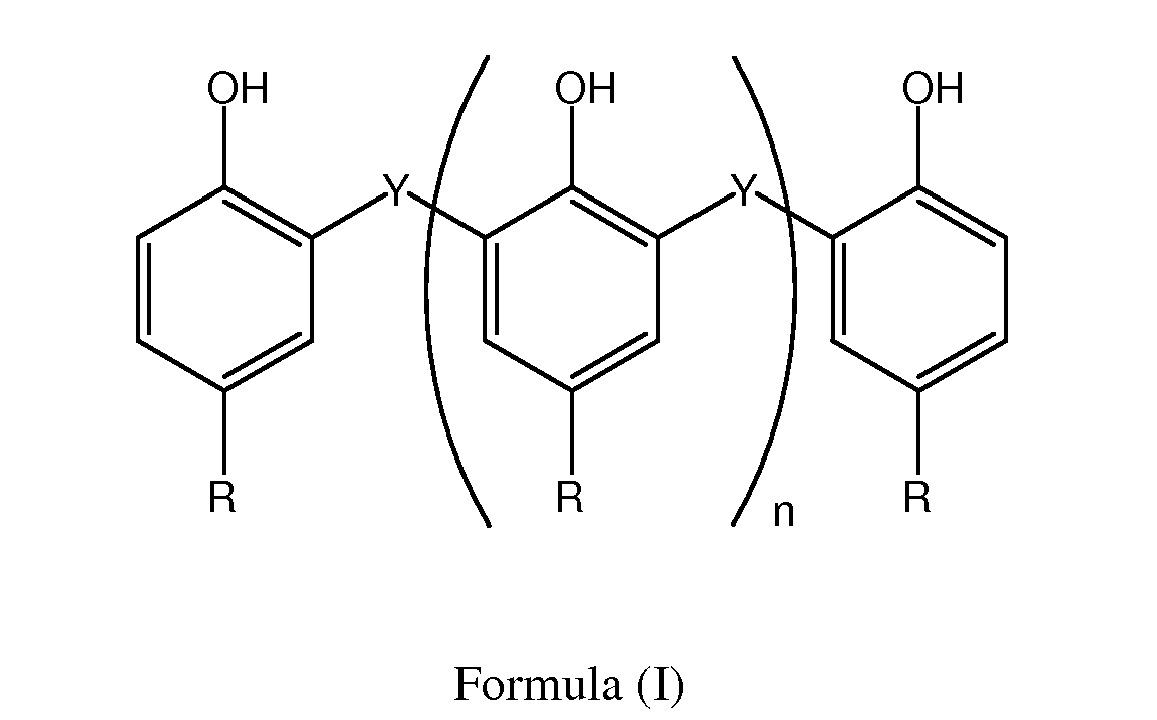
wherein n is 0 to 10, Y is a divalent bridging group, and is preferably a hydrocarbyl group, preferably having from 1 to 4 carbon atoms; and R is a hydrocarbyl group having from 4 to 30 carbon atoms.
wherein n is 0 to 10, Y is a divalent bridging group, and is preferably a hydrocarbyl group, preferably having from 1 to 4 carbon atoms; and R is a hydrocarbyl group having from 4 to 30 carbon atoms.
2. A method according to claim 1, wherein the oil-soluble hydrocarbyl phenol aldehyde
condensate has a weight average molecular weight (Mw) of 600 to 4000, preferably 800
to 3500, more preferably 1000 to 2000, even more preferably 1200 to 1900 and most
preferably 1250 to 1680, as measured by MALDI-TOF (Matrix Assisted Laser Desorption
Ionization- Time of Flight) mass spectrometry.
3. A method according to claim 1 or 2, wherein n is 1 to 8, more preferably 2 to 6, and
most preferably 3 to 5.
4. A method according to claim 1, 2 or 3, wherein R is a hydrocarbyl group having from
8 to 18, preferably from 9 to 15 carbon atoms.
5. A method according to any one of the preceding claims, wherein the lubricating oil
further comprises one or more overbased metal salts of an organic acids, preferably,
one or more alkali metal salt or an alkaline earth metal salt of a phenate, sulfonate,
salicylate or a complex detergent comprising a combination of any two of an alkali
metal salt or an alkaline earth metal salt of a phenate, sulfonate or salicylate.
6. Use of an oil-soluble hydrocarbyl phenol aldehyde condensate as a rust inhibitor in
a lubricating oil composition having a sulfated ash content of less than 1.0 % by
weight of the composition, of an ashless, the oil-soluble hydrocarbyl phenol aldehyde
condensate having the following structure,

wherein n is 0 to 10, Y is a divalent bridging group, and is preferably a hydrocarbyl group, preferably having from 1 to 4 carbon atoms; and R is a hydrocarbyl group having from 4 to 30 carbon atoms.
wherein n is 0 to 10, Y is a divalent bridging group, and is preferably a hydrocarbyl group, preferably having from 1 to 4 carbon atoms; and R is a hydrocarbyl group having from 4 to 30 carbon atoms.
7. A use according to claim 6, wherein the oil-soluble hydrocarbyl phenol aldehyde condensate
has a weight average molecular weight (Mw) of 600 to 4000, preferably 800 to 3500,
more preferably 1000 to 2000, even more preferably 1200 to 1900 and most preferably
1250 to 1680, as measured by MALDI-TOF (Matrix Assisted Laser Desorption Ionization-
Time of Flight) mass spectrometry.
8. A use according to claim 6 or 7, wherein n is 1 to 8, more preferably 2 to 6, and
most preferably 3 to 5.
9. A use according to claim 6, 7 or 8, wherein R is a hydrocarbyl group having from 8
to 18, preferably from 9 to 15 carbon atoms.
10. A use according to any one claims 6, 7, 8 or 9, wherein the lubricating oil further
comprises one or more overbased metal salts of an organic acids, preferably, one or
more alkali metal salt or an alkaline earth metal salt of a phenate, sulfonate, salicylate
or a complex detergent comprising a combination of any two of an alkali metal salt
or an alkaline earth metal salt of a phenate, sulfonate or salicylate.
REFERENCES CITED IN THE DESCRIPTION
This list of references cited by the applicant is for the reader's convenience only. It does not form part of the European patent document. Even though great care has been taken in compiling the references, errors or omissions cannot be excluded and the EPO disclaims all liability in this regard.
Patent documents cited in the description
- EP0575154A [0004] [0053]
- US5808145A [0025]
- EP933417A [0025]
- US6429178B [0027]
- US6429179B [0027]
- US6153565A [0027]
- US6281179B [0027]
- US4867890A [0049]
Non-patent literature cited in the description
- Engine Oil Licensing and Certification System19961200 [0039]