| (19) |
 |
|
(11) |
EP 1 803 677 B1 |
| (12) |
EUROPEAN PATENT SPECIFICATION |
| (45) |
Mention of the grant of the patent: |
|
02.05.2012 Bulletin 2012/18 |
| (22) |
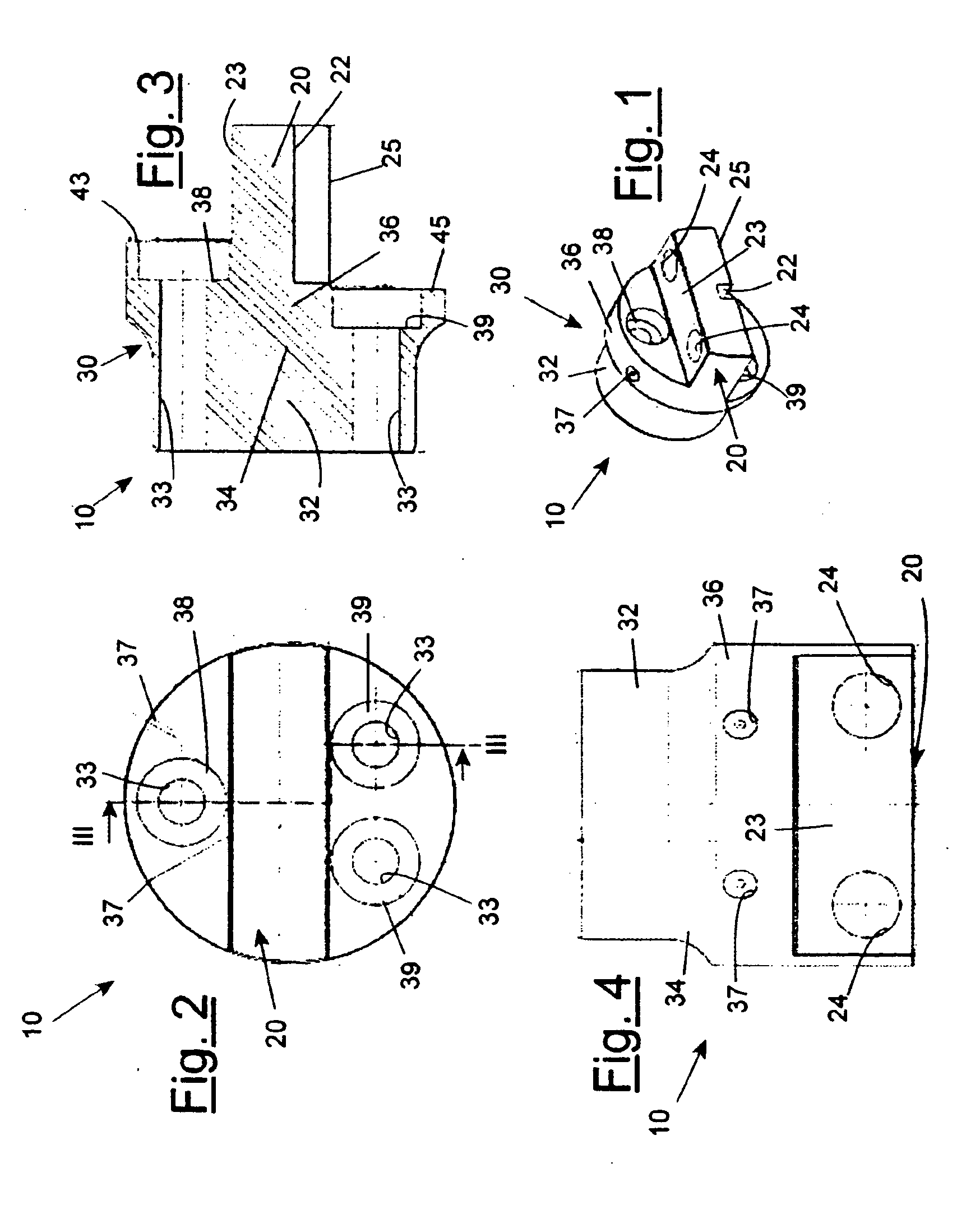
Date of filing: 20.12.2006 |
|
| (51) |
International Patent Classification (IPC):
|
|
| (54) |
Resting element for compressor or turbine
Unterstützendes Element für Kompressor oder Turbine
Élément d'arrêt pour un compresseur ou une turbine
|
| (84) |
Designated Contracting States: |
|
CH DE FR GB LI NL |
| (30) |
Priority: |
28.12.2005 IT MI20052506
|
| (43) |
Date of publication of application: |
|
04.07.2007 Bulletin 2007/27 |
| (73) |
Proprietor: Nuovo Pignone S.p.A. |
|
50127 Florence (IT) |
|
| (72) |
Inventors: |
|
- Sarri, Franco
50018 Scandicci (Firenze) (IT)
- Vitellozzi, Rossano
51037 Montale (Pistoia) (IT)
- Lippi, Simone
55049 Viareggio (Lucca) (IT)
|
| (74) |
Representative: Illingworth-Law, William Illingworth |
|
Global Patent Operation - Europe
GE International Inc.
15 John Adam Street
London WC2N 6LU
London WC2N 6LU (GB) |
| (56) |
References cited: :
JP-A- 10 147 490
|
US-B1- 6 443 514
|
|
| |
|
|
|
|
| |
|
| Note: Within nine months from the publication of the mention of the grant of the European
patent, any person may give notice to the European Patent Office of opposition to
the European patent
granted. Notice of opposition shall be filed in a written reasoned statement. It shall
not be deemed to
have been filed until the opposition fee has been paid. (Art. 99(1) European Patent
Convention).
|
[0001] The present invention relates to a resting element for a compressor or turbine predisposed
for being externally fixed to the case of the compressor or turbine by means of a
series of screws.
[0003] A resting element for a compressor or turbine, commonly called "rest foot", has a
substantially "L"-shaped conformation, with a first fixing portion to the case and
a cantilever resting portion, which is laid against a base or pedestal constrained
thereto.
[0004] In particular the resting element has edges as each portion is substantially in the
form of a parallelepiped.
[0005] A first drawback is that it is not possible to move the compressor or turbine by
means of a bridge crane or even by ropes unless with further gripping elements, which
are also fixed by means of screws inserted in corresponding threaded holes situated
in the case of the compressor or turbine, with an increase in production times and
costs.
[0006] An objective of the present invention is to provide a resting element for a compressor
or turbine which can be used either as a resting element or as a lifting and moving
element of the compressor or turbine.
[0007] A further objective is to provide a resting element for a compressor or turbine which
avoids the necessity of gripping elements fixed to the case of the compressor or turbine
for lifting or moving the compressor or turbine itself and which at the same time
avoids the necessity of providing threaded holes for their fixing.
[0008] Another objective is to provide a resting element for a compressor or turbine which
allows a better stress distribution with the same number of screws used for the external
fixing to the case of the compressor or turbine.
[0009] Yet another objective is to have a resting element for a compressor or turbine which
allows a reduction in the production times and costs of the compressor or turbine.
[0010] These objectives according to the present invention are achieved by providing a resting
element for a compressor or turbine as specified in claim 1.
[0011] Further characteristics of the invention are indicated in the subsequent claims.
[0012] The characteristics and advantages of a resting element for a compressor or turbine
according to the present invention will appear more evident from the following illustrative
and non-limiting description, referring to the enclosed schematic drawings, in which:
Figure 1 is a raised left-side perspective view from above of a preferred embodiment
of a resting element for a compressor or turbine according to the present invention;
Figure 2 is a raised front view of the resting element of figure 1;
Figure 3 is a raised side cross-section view according to the line III-III of the
resting element of figure 2;
Figure 4 is a view from above of the resting element of figure 1;
Figure 5 is a raised left-side perspective view from above of the element of figure
1 fixed by means of screws to a case of a compressor.
[0013] With reference to the figures, these show a resting element 10 for a compressor or
turbine comprising a first cantilever resting portion 20 and a second fixing portion
30 to a case of the compressor or turbine by means of a series of screws 60.
[0014] The second fixing portion 30 comprises a third end portion 32 externally axialsymmetrical
and also a fourth counter-portion 36 situated between the third portion 32 and the
first resting portion 20 to prevent the disengagement of a hauling rope.
[0015] In this way, it is possible to both correctly rest and also lift and move the turbine
or compressor by means of a bridge crane or similar moving system, in particular with
the help of hauling ropes which are suitable for being engaged with said third portion
32 avoiding the possibility of disengagement with said third portion itself thanks
to said fourth counter-portion 36.
[0016] In other words, said resting element 10 is capable of also exerting the function
of a possible gripping element, advantageously avoiding both the necessity thereof
and also the production time and cost of the threaded holes for fixing it to the case
of the compressor or turbine.
[0017] Said third end portion 32 is preferably a cylindrical portion which has a substantially
lower diameter with respect to said fourth counter-portion 36 and is also coaxial
therewith.
[0018] This prevents the disengagement of the hauling ropes during the moving of the compressor
or turbine.
[0019] In particular, according to a preferred embodiment, the third end portion 32 is connected
to the fourth counter-portion 36 by means of a connecting portion 34, in order to
have a better stress distribution.
[0020] Said first cantilever resting portion 20 is preferably substantially orthogonal to
said fourth counter-portion 36, i.e. it substantially extends in an orthogonal direction
starting from a base end of the fourth counter-portion 36 to which it is connected.
[0021] Said first cantilever resting portion 20 is preferably basically arranged centrally
with respect to said base end of said fourth portion 36 to which it is connected so
as to define a first base surface 43 and a second base surface 45.
[0022] Said first cantilever portion 20 in turn has a first base surface 23 and a second
base surface 25 opposite the first, said second base surface 25 is suitable for being
coupled with a pedestal for supporting said compressor or turbine.
[0023] The second base surface 45 of said fourth portion 36 is preferably withdrawn with
respect to the first base surface 43, as shown in figure 3, to allow a better stress
distribution and increase the resting surface area 25 with the pedestal.
[0024] Said first base surface 23 of said first resting portion 20 is preferably adjacent
to said first base surface 43 of said fourth portion 36 and is also substantially
orthogonal to it, said second base surface 25 of said first resting portion 20 is
adjacent to said second base surface 45 of said fourth portion 36 and is also substantially
orthogonal thereto.
[0025] Said first resting portion 20 preferably comprises a groove 22 suitable for being
engaged with a supporting pedestal situated on said second base surface 25 of said
first resting portion 20.
[0026] Said first resting portion 20 preferably comprises two pass-through holes 24 situated
on said first base surface 23 which completely pass through said first portion 20
as far as said second base surface 25 for the insertion of elements suitable for constraining
said resting element 10 to a pedestal, not shown.
[0027] Said fourth counter-portion 36 preferably comprises a series of moving holes 37 for
the insertion of corresponding lifting elements for a correct positioning and fixing
of said resting element 10 to said compressor or turbine.
[0028] In particular, said second base surface 45 of said fourth counter-portion 36 is in
a withdrawn position with respect to said first base surface 43 of said fourth counter-portion
36.
[0029] At least one axial pass-through hole 33 in particular equipped with a corresponding
seat 38 for the insertion of a corresponding screw 60, is preferably situated on said
first base surface 43 of said fourth counter-portion 36.
[0030] In particular, said seat 38 is obtained starting from said base surface 43 of said
fourth counter-portion 36.
[0031] At least two axial pass-through holes 33 in particular equipped with a corresponding
seats 39 for the insertion of a corresponding screw 60, are preferably situated on
said second base surface 45 of said fourth counter-portion 36.
[0032] In particular, said seats 39 are obtained starting from said base surface 45 of said
fourth counter-portion 36 and are preferably in a withdrawn position with respect
to said seat 38 so as to allow a better stress distribution and a correct dimensioning
of the base coupling surface 25 with the supporting pedestal.
[0033] In this way, it is advantageously possible to reduce the stress on said resting element
10 as there are at least two screws 60 which oppose the flexing moment generated by
the reaction force to the weight force of the compressor or turbine which is generated
on the second base surface 25 of said first resting portion 20.
[0034] This advantageously increases the useful life and reliability of the resting element
and consequently of the compressor or turbine, and also allows the dimension/number
of coupling screws 60 to be reduced.
[0035] It can thus be seen that a resting element 10 for a compressor or turbine according
to the present invention achieves the objectives indicated above.
[0036] The resting element for a compressor or turbine of the present invention thus conceived
can undergo numerous modifications and variants, all included in the same inventive
concept.
[0037] Furthermore, in practice the materials used, as also the dimensions and components
can vary, according to technical demands.
1. A resting element (10) for a compressor or turbine comprising a first cantilever resting
portion (20) and a second fixing portion (30) to a case of said compressor or turbine
by means of a series of screws (60), characterized in that said second fixing portion (30) comprises a third end portion (32) externally axialsymmetrical
and also a fourth counter-portion (36) situated between said third portion (32) and
said first resting portion (20) to prevent the disengagement of a hauling rope.
2. The resting element (10) according to claim 1, characterized in that said third end portion (32) is an externally cylindrical portion which has a smaller
diameter with respect to said fourth counter-portion (36) and is also coaxial thereto.
3. The resting element (10) according to claim 1 or 2, characterized in that said third end portion (32) is connected to said fourth counter-portion (36) by means
of a connecting portion (34).
4. The resting element (10) according to any of the claims from 1 to 3, characterized in that said first cantilever resting portion (20) substantially extends in an orthogonal
direction starting from a base end of the fourth counter-portion (36) to which it
is connected.
5. The resting element (10) according to any of the claims from 1 to 4, characterized in that said first cantilever resting portion (20) is substantially arranged in a central
position with respect to an end of said fourth portion (36) to which it is connected
so as to define a first base surface (43) and a second base surface (45).
6. The resting element (10) according to any of the claims from 1 to 5, characterized in that said first cantilever portion (20) has a first base surface (23) and a second base
surface (25) opposite to the first, said second base surface (25) is suitable for
being coupled with a pedestal for supporting said compressor or turbine.
7. The resting element (10) according to claim 6, characterized in that said first base surface (23) of said first resting portion (20) is adjacent to said
first base surface (43) of said fourth counter-portion (36) and is also substantially
orthogonal thereto, said second base surface (25) of said first resting portion (20)
is adjacent to said second base surface (45) of said fourth portion (36) and is also
substantially orthogonal thereto.
8. The resting element (10) according to claim 6 or 7, characterized in that said first resting portion (20) comprises a groove (22) suitable for being engaged
with a supporting pedestal situated on said second base surface (25).
9. The resting element (10) according to any of the claims from 6 to 8, characterized in that said first resting portion (20) comprises two pass-through holes (24) situated on
said first base surface (23) which completely pass through said first portion (20)
as far as said second base surface (25).
10. The resting element (10) according to any of the claims from 1 to 9, characterized in that said fourth counter-portion (36) comprises a series of moving holes (37) for the
insertion of corresponding lifting elements for a correct positioning and fixing of
said resting element (10) to said compressor or turbine.
11. The resting element (10) according to any of the claims from 5 to 10, characterized in that said second base surface (45) of said fourth counter-portion (36) is in a withdrawn
position with respect to said first base surface (43) of said fourth counter-portion
(36).
12. The resting element (10) according to any of the claims from 5 to 11, characterized in that at least one axial pass-through hole (33) is situated on said first base surface
(43) of said fourth counter-portion (36).
13. The resting element (10) according to any of the claims from 5 to 12, characterized in that at least two axial pass-through holes (33) are situated on said second base surface
(45) of said fourth counter-portion (36).
1. Auflageelement (10) für einen Verdichter oder eine Turbine mit einem ersten freitragenden
Auflageabschnitt (20) und einem zweiten Befestigungsabschnitt (30) an einem Gehäuse
des Verdichters oder der Turbine mittels einer Reihe von Schrauben (60), dadurch gekennzeichnet, dass der zweite Befestigungsabschnitt (30) einen außen axialsymmetrischen dritten Endabschnitt
(32) und auch einen zwischen dem dritten Abschnitt (32) und dem ersten Auflageabschnitt
(20) befindlichen vierten Absatzabschnitt (36) aufweist, um das Lösen eines Zugseils
zu verhindern.
2. Auflageelement (10) nach Anspruch 1, dadurch gekennzeichnet, dass der dritte Endabschnitt (32) ein außen zylindrischer Abschnitt ist, welcher einen
kleineren Durchmesser in Bezug auf den vierten Absatzabschnitt (36) hat und auch koaxial
dazu ist.
3. Auflageelement (10) nach Anspruch 1 oder 2, dadurch gekennzeichnet, dass der dritte Endabschnitt (32) mit dem vierten Absatzabschnitt (36) mittels eines Verbindungsabschnittes
(34) verbunden ist.
4. Auflageelement (10) nach einem der Ansprüche 1 bis 3, dadurch gekennzeichnet, dass sich der erste freitragende Auflageabschnitt (20) sich im Wesentlichen in einer rechtwinkligen
Richtung von einem Basisende des vierten Absatzabschnittes (36) aus beginnend erstreckt,
mit welchem er verbunden ist.
5. Auflageelement (10) nach einem der Ansprüche 1 bis 4, dadurch gekennzeichnet, dass der erste freitragende Auflageabschnitt (20) im Wesentlichen in einer mittigen Position
in Bezug auf ein Ende des vierten Abschnittes (36) angeordnet ist, mit welchem er
verbunden ist, um so eine erste Basisoberfläche (43) und eine zweite Basisoberfläche
(45) zu definieren.
6. Auflageelement (10) nach einem der Ansprüche 1 bis 5, dadurch gekennzeichnet, dass der erste freitragende Auflageabschnitt (20) eine erste Basisoberfläche (23) und
eine der ersten gegenüberliegende zweite Basisoberfläche (25) hat, wobei die zweite
Basisoberfläche (25) für eine Verbindung mit einem Sockel zur Lagerung des Verdichters
oder der Turbine geeignet ist.
7. Auflageelement (10) nach Anspruch 6, dadurch gekennzeichnet, dass die erste Basisoberfläche (23) des ersten Auflageabschnittes (20) an die erste Basisoberfläche
(43) des vierten Absatzabschnittes (36) angrenzt und auch im Wesentlichen rechtwinklig
dazu ist, wobei die zweite Basisoberfläche (25) des ersten Auflageabschnittes (20)
an die zweite Basisoberfläche (45) des vierten Abschnittes (36) angrenzt und ebenfalls
im Wesentlichen rechtwinklig dazu ist.
8. Auflageelement (10) nach Anspruch 6 oder 7, dadurch gekennzeichnet, dass der erste Auflageabschnitt (20) eine Nut (22) aufweist, die für einen Eingriff mit
einem Lagerungssockel geeignet ist, der sich auf der zweiten Basisoberfläche (25)
befindet.
9. Auflageelement (10) nach einem der Ansprüche 6 bis 8, dadurch gekennzeichnet, dass der erste Auflageabschnitt (20) zwei auf der ersten Basisoberfläche (23) befindliche
Durchtrittslöcher (24) aufweist, welche vollständig durch den ersten Abschnitt (20)
bis auf die zweite Basisoberfläche (25) hindurch verlaufen.
10. Auflageelement (10) nach einem der Ansprüche 1 bis 9, dadurch gekennzeichnet, dass der vierte Absatzabschnitt (36) eine Reihe von Bewegungslöchern (37) für die Einführung
entsprechender Hebeelemente für eine korrekte Positionierung und Befestigung des Auflageelementes
(10) an dem Verdichter oder der Turbine aufweist.
11. Auflageelement (10) nach einem der Ansprüche 5 bis 10, dadurch gekennzeichnet, dass sich die zweite Basisoberfläche (45) des vierten Absatzabschnittes (36) in Bezug
auf die erste Basisoberfläche (43) des vierten Absatzabschnittes (36) in einer zurückgezogenen
Position befindet.
12. Auflageelement (10) nach einem der Ansprüche 5 bis 11, dadurch gekennzeichnet, dass sich wenigstens ein axiales Durchtrittsloch (33) auf der ersten Basisoberfläche (43)
des vierten Absatzabschnittes (36) befindet.
13. Auflageelement (10) nach einem der Ansprüche 5 bis 12, dadurch gekennzeichnet, dass sich wenigstens zwei axiale Durchtrittslöcher (33) auf der zweiten Basisoberfläche
(45) des vierten Absatzabschnittes (36) befinden.
1. Elément d'appui (10) pour un compresseur ou une turbine comprenant une première partie
d'appui en porte-à-faux (20) et une seconde partie de fixation (30) sur un carter
dudit compresseur ou de ladite turbine au moyen d'une série de vis (60), caractérisé en ce que ladite seconde partie de fixation (30) comprend une troisième partie d'extrémité
(32) extérieurement symétrique axialement et aussi une quatrième contre-partie (36)
située entre ladite troisième partie (32) et ladite première partie d'appui (20) pour
empêcher la venue hors de prise d'un câble de transport.
2. Elément d'appui (10) selon la revendication 1, caractérisé en ce que ladite troisième partie d'extrémité (32) est une partie extérieurement cylindrique
qui a un diamètre plus petit par rapport à ladite quatrième contre-partie (36) et
est aussi coaxiale à celle-ci.
3. Elément d'appui (10) selon la revendication 1 ou 2, caractérisé en ce que ladite troisième partie d'extrémité (32) est reliée à ladite quatrième contre-partie
(36) au moyen d'une partie de liaison (34).
4. Elément d'appui (10) selon l'une quelconque des revendications 1 à 3, caractérisé en ce que ladite première partie d'appui en porte-à-faux (20) s'étend sensiblement dans une
direction orthogonale en partant d'une extrémité de base de la quatrième contre-partie
(36) à laquelle elle est reliée.
5. Elément d'appui (10) selon l'une quelconque des revendications 1 à 4, caractérisé en ce que ladite première partie d'appui en porte-à-faux (20) est sensiblement agencée dans
une position centrale par rapport à une extrémité de ladite quatrième partie (36)
à laquelle elle est reliée de façon à définir une première surface de base (43) et
une seconde surface de base (45).
6. Elément d'appui (10) selon l'une quelconque des revendications 1 à 5, caractérisé en ce que ladite première partie d'appui en porte-à-faux (20) a une première surface de base
(23) et une seconde surface de base (25) opposée à la première, ladite seconde surface
de base (25) convenant pour être couplée avec un socle pour supporter ledit compresseur
ou ladite turbine.
7. Elément d'appui (10) selon la revendication 6, caractérisé en ce que ladite première surface de base (23) de ladite première partie d'appui (20) est adjacente
à ladite première surface de base (43) de ladite quatrième contre-partie (36) et est
aussi sensiblement orthogonale à celle-ci, ladite seconde surface de base (25) de
ladite première partie d'appui (20) est adjacente à ladite seconde surface de base
(45) de ladite quatrième partie (36) et est aussi sensiblement orthogonale à celle-ci.
8. Elément d'appui (10) selon la revendication 6 ou 7, caractérisé en ce que ladite première partie d'appui (20) comprend une rainure (22) convenant pour venir
en prise avec un socle de support situé sur ladite seconde surface de base (25).
9. Elément d'appui (10) selon l'une quelconque des revendications 6 à 8, caractérisé en ce que ladite première partie d'appui (20) comprend deux trous de passage (24) situés sur
ladite première surface de base (23) qui passe complètement à travers ladite première
partie (20) jusqu'à ladite seconde surface de base (25).
10. Elément d'appui (10) selon l'une quelconque des revendications 1 à 9, caractérisé en ce que ladite quatrième contre-partie (36) comprend une série de trous de déplacement (37)
pour l'insertion d'éléments de levée correspondant pour un positionnement correct
et la fixation dudit élément d'appui (10) sur ledit compresseur ou ladite turbine.
11. Elément d'appui (10) selon l'une quelconque des revendications 5 à 10, caractérisé en ce que ladite seconde surface de base (45) de ladite quatrième contre-partie (36) est dans
une position retirée par rapport à ladite première surface de base (43) de ladite
quatrième contre-partie (36).
12. Elément d'appui (10) selon l'une quelconque des revendications 5 à 11, caractérisé en ce qu'au moins un trou de passage axial (33) est situé sur ladite première surface de base
(43) de ladite quatrième contre-partie (36).
13. Elément d'appui (10) selon l'une quelconque des revendications 5 à 12, caractérisé en ce qu'au moins deux trous de passage axiaux (33) sont situés sur ladite seconde surface
de base (45) de ladite quatrième contre-partie (36).

REFERENCES CITED IN THE DESCRIPTION
This list of references cited by the applicant is for the reader's convenience only.
It does not form part of the European patent document. Even though great care has
been taken in compiling the references, errors or omissions cannot be excluded and
the EPO disclaims all liability in this regard.
Patent documents cited in the description