| (19) |
 |
|
(11) |
EP 1 818 295 B1 |
| (12) |
EUROPEAN PATENT SPECIFICATION |
| (45) |
Mention of the grant of the patent: |
|
27.01.2010 Bulletin 2010/04 |
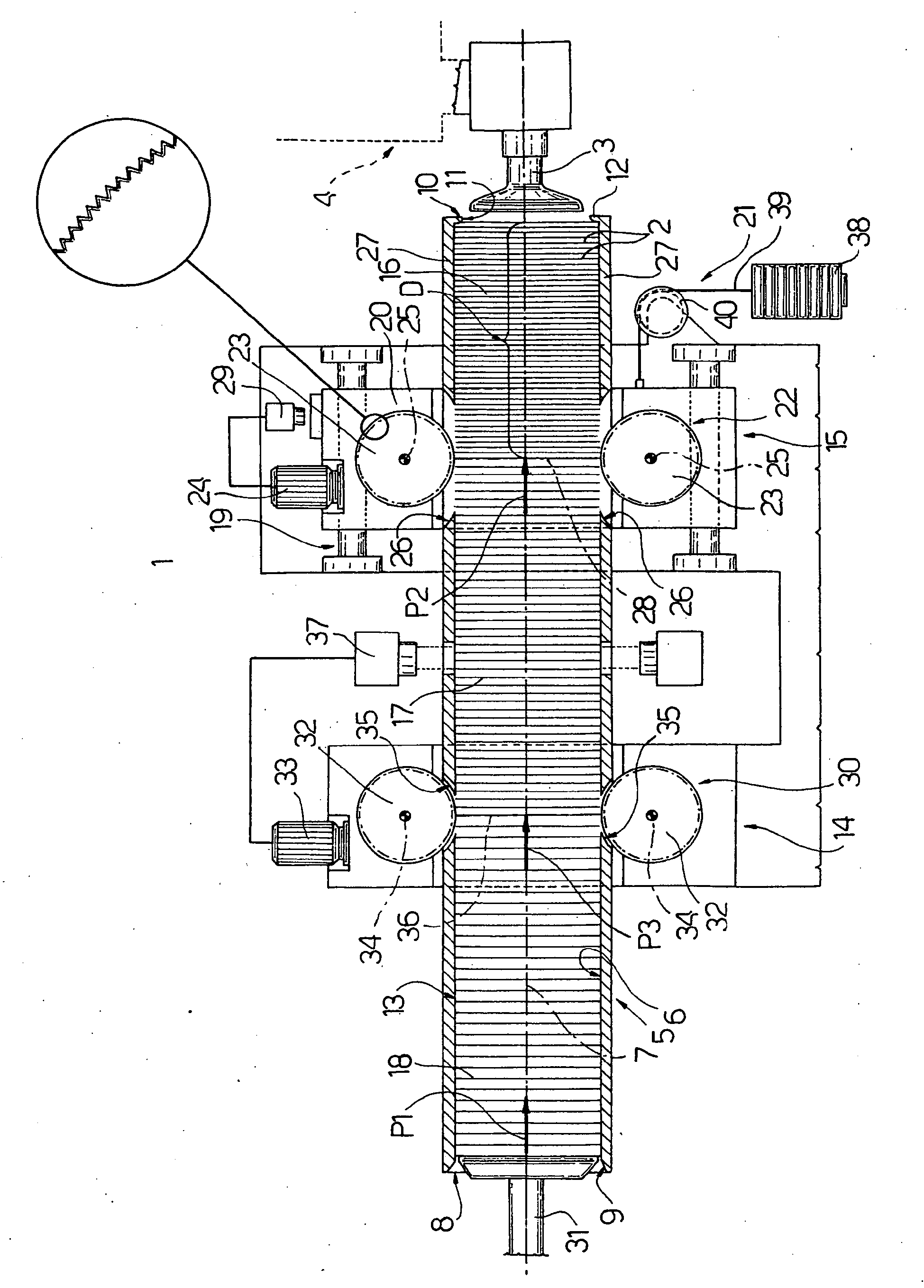
| (22) |
Date of filing: 13.02.2007 |
|
| (51) |
International Patent Classification (IPC):
|
|
| (54) |
Method and device for feeding sheets in a stack to a singulator
Verfahren und Vorrichtung zum Zuführen von Blättern in einem Stapel zu einem Vereinzeler
Procédé et dispositif pour l'alimentation de feuilles dans une pile vers un dispositif
de séparation de feuilles
|
| (84) |
Designated Contracting States: |
|
CH DE GB LI |
| (30) |
Priority: |
14.02.2006 IT BO20060112
|
| (43) |
Date of publication of application: |
|
15.08.2007 Bulletin 2007/33 |
| (73) |
Proprietor: G.D SOCIETÀ PER AZIONI |
|
40133 Bologna (IT) |
|
| (72) |
Inventor: |
|
- Spatafora, Mario
40057 Granarolo (IT)
|
| (74) |
Representative: Jorio, Paolo et al |
|
STUDIO TORTA
Via Viotti 9
10121 Torino
10121 Torino (IT) |
| (56) |
References cited: :
FR-A1- 2 692 874
|
US-A- 3 995 851
|
|
| |
|
|
|
|
| |
|
| Note: Within nine months from the publication of the mention of the grant of the European
patent, any person may give notice to the European Patent Office of opposition to
the European patent
granted. Notice of opposition shall be filed in a written reasoned statement. It shall
not be deemed to
have been filed until the opposition fee has been paid. (Art. 99(1) European Patent
Convention).
|
[0001] The present invention relates to a method and device for feeding sheets to a user
machine.
[0002] More specifically, the present invention relates to feeding relatively thin, small
sheets to a user machine, and may be used to advantage for feeding revenue stamps
or similar to a cigarette packing machine, to which the following description refers
purely by way of example.
[0003] In cigarette packing, stamps are fed successively to a pickup member of a packing
machine by a feed device, in which the stamps are stacked inside a substantially horizontal
channel having an outlet bounded laterally by shoulders and facing the pickup member.
[0004] In feed devices of this sort, a given thrust is exerted on the stack to compress
it against the shoulders of the outlet and so ensure correct engagement of the stack
by the pickup member.
[0005] Tests show that withdrawal of the stamps one by one, as opposed to groups of two
or more at a time, is substantially only ensured when the stamps at the end of the
stack facing the outlet are subjected to substantially constant pressure over and
above a given value, and that this constant pressure cannot be achieved by simply
exerting constant thrust on the stack in the direction of the outlet. The stack, in
fact, when compressed, is deformed elastically, with an elastic response which, for
a given material and thickness of the stamps, depends on the length of the stack,
so that the pressure with which the stack adheres to the shoulders of the outlet varies
as the stack is used up, even if the stack is.subjected to constant thrust.
[0006] It has been proposed to eliminate this drawback by continuously determining the contact
pressure of the stack on the lateral shoulders of the outlet, and applying thrust
by means of a variable-thrust pressure member feedback-controlled to keep the contact
pressure equal to a given reference value.
[0007] Unfortunately, this solution, too, has not been altogether successful. The stack,
in fact, when compressed, behaves like an elastic block with a relatively high degree
of hysteresis varying with the length of the stack, and feedback thrust control causes
the contact pressure to assume a mean value substantially equal to the reference value,
but to oscillate continually and uncontrollably about the reference value, thus preventing
withdrawal of the stamps one by one.
[0008] FR2692874A1 discloses a feeding mechanism for a rapid unstacking device. The feeding mechanism
presents the front end of a pile of thin objects, each resting vertically on a conveyor,
to an unstacking device; the conveyor leads the pile in the direction of a support
face. A motorised roller, holding the pile of thin objects, raises the conveyor onto
a support element on the unstacking device; the roller has a surface with a high coefficient
of friction.
[0009] It is an object of the present invention to provide a feed method and device designed
to at least partly eliminate the aforementioned drawbacks, and which, at the same
time, are cheap and easy to implement.
[0010] According to the present invention, there are provided a method and device as claimed
in the respective accompanying independent Claims and preferably in any one of the
Claims depending directly or indirectly on the independent Claims.
[0011] The present invention will be described with reference to the attached drawing, which
shows a schematic view of a non-limiting embodiment.
[0012] Number 1 in the attached drawing indicates as a whole a device for feeding stamps
2, in particular, revenue stamps, to a known pickup member 3 of a packing machine
4, in particular, a cigarette packing machine.
[0013] Device 1 comprises a conduit 5 defining, internally, a channel 6 having a substantially
horizontal longitudinal axis 7 and comprising an input end 8 having an inlet 9; and
an output end 10 having an outlet 11 bounded laterally by two lateral shoulders 12
and facing pickup member 3.
[0014] Channel 6 houses a stack 13 of stamps 2 positioned crosswise to longitudinal axis
7, and device 1 comprises two stop devices 14 and 15, which are located along conduit
5, with stop device 15 interposed between stop device 14 and outlet 11, and cooperate
laterally with stack 13 to divide it, in use, into an output portion 16 extending
between stop device 15 and outlet 11, an intermediate portion 17 extending between
stop devices 14 and 15, and an input portion 18 extending between stop device 14 and
inlet 9.
[0015] Stop device 15 comprises a rail 19 extending along channel 6, parallel to longitudinal
axis 7; and a carriage 20, which is mounted on and runs idly along rail 19, is connected
to a thrust device 21 for exerting constant thrust on carriage 20 towards outlet 11,
and supports an engaging device 22 for laterally engaging stack 13 to separate output
portion 16 from intermediate portion 17, and for transmitting said constant thrust
to output portion 16 in the direction of lateral shoulders 12.
[0016] Engaging device 22 comprises two rollers 23, which are located on opposite sides
of channel 6, are supported by carriage 20, are powered by a motor 24 to rotate in
opposite directions about respective axes 25 perpendicular to longitudinal axis 7,
and engage respective longitudinal openings 26 in respective lateral walls 27 of conduit
5, so as to be positioned, in use, laterally contacting stack 13 along a partition
plane 28 perpendicular to longitudinal axis 7 and separating output portion 16 from
intermediate portion 17.
[0017] In actual use, partition plane 28 moves with carriage 20 along rail 19, and motor
24 is feedback-controlled by a sensor 29, for determining the distance between partition
plane 28 and lateral shoulders 12 and, therefore, the length of output portion 16,
so as to roll rollers 23 along stack 13 and draw carriage 20 along rail 19 to keep
the length of output portion 16 substantially equal to a given value.
[0018] To ensure positive engagement of stack 13 by rollers 23, rollers 23 are made of any
material but knurled on the outside, or, in a variation not shown, are smooth but
made of elastomeric material.
[0019] Stop device 14 is located in a fixed position along channel 6, and comprises a powered
engaging device 30 for laterally engaging stack 13 to separate input portion 18 from
intermediate portion 17, and for absorbing a given axial thrust exerted on input portion
18 by a pressure member 31 acting on stack 13 through inlet 9.
[0020] Engaging device 30 comprises two rollers 32, which are located on opposite sides
of channel 6, are powered by a motor 33 to rotate in opposite directions about respective
axes 34 perpendicular to longitudinal axis 7, and engage respective openings 35 in
respective lateral walls 27 of conduit 5, so as to be positioned, in use, laterally
contacting stack 13 along a partition plane 36 perpendicular to longitudinal axis
7 and separating input portion 18 from intermediate portion 17.
[0021] In actual use, partition plane 36 is fixed, and motor 33 is feedback-controlled by
a sensor 37, for determining the density of stamps 2 along intermediate portion 17,
so as to roll rollers 32 in opposite directions about respective axes 34 to riffle
stack 13, and transfer stamps 2 through partition plane 36 from input portion 18 to
intermediate portion 17 to keep the density of stamps 2 along intermediate portion
17 substantially equal to a given value.
[0022] In this case, too, to ensure positive engagement of stack 13 by rollers 32, rollers
32 are made of any material but knurled on the outside, or, in a variation not shown,
are smooth but made of elastomeric material.
[0023] In actual use, pressure member 31 subjects input portion 18 to a relatively high
pressure P1, which is entirely absorbed by rollers 32 and not transmitted to intermediate
portion 17 through partition plane 36. At the same time, thrust device 21 - shown
schematically as a weight 38 connected to carriage 20 by a cable 39 wound about a
pulley 40 - subjects output portion 16, by means of rollers 23 engaging stack 13,
to a constant pressure P2 normally, though not necessarily, lower than P1; whereas
intermediate portion 17 is subjected to no direct pressure. Therefore, the pressure,
indicated P3, on stamps 2 in intermediate portion 17 may be assumed to be relatively
low and substantially zero, and in any case lower than both P1 and P2.
[0024] In these conditions, which may be assumed starting conditions, partition plane 28
is separated from shoulders 12 by a distance D substantially equal to a reference
value.
[0025] When pickup member 3 begins withdrawing individual stamps 2 successively in known
manner from output portion 16 of stack 13 through outlet 11, output portion 16 gets
shorter, so that carriage 20 moves towards shoulders 12. This movement is immediately
detected by sensor 29, which activates motor 24 and rotation of rollers 23, which
roll along stack 13 to restore distance D to the reference value. As they roll along,
rollers 23 riffle stack 13 to transfer a certain number of stamps 2 from intermediate
portion 17 to output portion 16 and so reduce the density of stamps 2 along intermediate
portion 17. This change in density is detected by sensor 37 and immediately compensated
by activation of motor 33, which rotates rollers 32, which riffle stack 13 to transfer
a certain number of stamps 2 from input portion 18 to intermediate portion 17. When
the length of input portion 18 falls below a given value, further stamps 2 are loaded
through inlet 9 by removing pressure member 31, and without disturbing the distribution
of stamps 2 along intermediate portion 17 and input portion 16, and with no variation
in distance D.
[0026] As stamps 2 are fed to packing machine 4, it is therefore possible to maintain a
constant distance D, a constant pressure P1, and, therefore, constant withdrawal conditions
of stamps 2 through outlet 11.
1. A method of feeding sheets to a user machine, the sheets (2) being arranged in a stack
(13) along a channel (6) having a substantially horizontal longitudinal axis (7),
an input end (8), and an output end (10), and having, at the output end (10), an outlet
(11) facing a single-sheet (2) pickup member (3); the method comprising the steps
of:
- dividing the stack 13) in the longitudinal direction at a first partition plane
(28) to define an output portion (16) terminating at the outlet (11) and an input
portion (18) in the direction of the input end (8);
- compressing the output portion (16) at a given constant first pressure (P2) towards
the outlet (11); and
- moving the first partition plane (28) relative to the stack (13) towards the input
end and against the first pressure (P2) to compensate for the sheets (2) withdrawn
through the outlet (11) by the pickup member (3), and keep a length (D) of the output
portion (16) substantially constant and equal to a first given value.
2. A method as claimed in Claim 1, and comprising the further steps of:
- dividing the stack (13), not only at the first partition plane (28), but also at
a second partition plane (36) to define, along the stack (13), in addition to the
output portion (16), also an intermediate portion (17) and the input portion (18);
- compressing the input portion (18) at a given second pressure (P1); and
- transferring sheets (2) from the input portion (18.) to the intermediate portion
(17) to keep a density of the sheets (2) along the intermediate portion (17) substantially
constant and equal to a given second value.
3. A method as claimed in Claim 2, wherein the value of the density of the sheets (2)
along the intermediate portion (17) is chosen so that the sheets (2) along the intermediate
portion (17) are subjected to a third pressure (P3) lower at all times than the first
pressure (P2).
4. A method as claimed in Claim 2 or 3, wherein the value of the density of the sheets
(2) along the intermediate portion (17) is chosen so that the sheets (2) along the
intermediate portion (17) are subjected to a third pressure (P3) lower at all times
than the second pressure (P1).
5. A method as claimed in any one of Claims 1 to 4, wherein the first pressure (P2) is
applied by a first device (15), which defines the first partition plane (28), is movable
to move the first partition plane (28) along the channel (6), is subjected to constant
thrust towards the outlet (11), and cooperates with the stack (13) to apply the first
pressure (P2) to the output portion (16).
6. A method as claimed in any one of Claims 2 to 5, wherein the second pressure (P1)
is applied by pushing the input portion (18) against a second device (14) cooperating
with the stack (13) at the second partition plane (36).
7. A method as claimed in Claim 6, wherein the second partition plane (36) is located
in a fixed position along the channel (6).
8. A method as claimed in Claim 6 or 7, wherein the sheets (2) are transferred from the
input portion (18) to the intermediate portion (17) by the second device (14) moving
the sheets (2), located instant by instant in said fixed position along the channel
(6), towards the outlet (11), in response to detection of a density of the sheets
(2) below the second value along the intermediate portion (17).
9. A device (1) for feeding sheets, arranged in a stack (13), to a single-sheet pickup
member (3) of a user machine (4), the device comprising a conduit (5) defining a channel
(6), which houses the stack (13), wherein the channel (6) has a substantially horizontal
longitudinal axis (7), an input end (8), and an output end (10), and comprises, at
the output end (10), a narrow-section outlet (11) positioned facing the single-sheet
pickup member (3) and defined laterally by at least one shoulder (12) supporting the
stack (13);
the device (1) being characterized by comprising a first device (15) cooperating with the stack (13) to define, along the
stack (13) and at a first partition plane (28), an output portion (16) terminating
at the outlet (11);
the first device (15) being mounted to be moveable along the channel (6), and comprising
thrust means (21) for applying constant thrust to the first device (15) towards the
outlet (11), and powered first engaging means (22) which engage the stack (13) to
define the first partition plane (28), to apply a constant first pressure (P2) to
the output portion (16) as a function of said thrust; and
wherein the powered first engaging means (22) is feedback-controlled by first sensor
means (29) for determining the length (D) of the output portion (16) to compensate
for the sheets (2) withdrawn through the outlet (11) by the pickup member (3) and
to keep a length (D) of the output portion (16) substantially constant and equal to
a given first value.
10. A device (1) as claimed in Claim 9, and also comprising a second device (14) located
in a fixed position along the channel (6) and cooperating with the stack (13) to define,
along the stack (13) and at a second partition plane (36), an input portion (18),
and an intermediate portion (17) interposed between the input portion (18) and the
output portion (16); the second device (14) comprising powered second engaging means
(30), which engage the stack (13) to define the second partition plane (36), and to
transfer sheets (2) from the input portion (18) to the intermediate portion (17) to
keep a density of the sheets (2) along the intermediate portion (17) substantially
constant and equal to a given second value.
11. A device (1) as claimed in Claim 10, and also comprising pressure means (31) for compressing
the input portion (18) at a given second pressure (P1) against the second device (14).
12. A device (1) as claimed in any one of Claims 9 to 11, wherein the first device (15)
comprises a rail (19) extending along the channel (6), parallel to the longitudinal
axis (7); and a carriage (20) fitted to the rail (19) to run idly along the rail (19);
the carriage (20) supporting the first engaging means (22), and being connected to
the thrust means (21).
13. A device (1) as claimed in Claim 10, wherein the first device (15) comprises the first
sensor means (29) for determining the length (D) of the output portion (16); and the
powered first engaging means (22) comprise two powered first rollers (23), which are
located on opposite sides of the channel (6), are fitted to the carriage (20) to rotate
in opposite directions about respective first axes (25) perpendicular to the longitudinal
axis (7), and are positioned contacting the stack (13) along the first partition plane
(28), which moves with the carriage (20) along the rail (19); the first rollers (23)
being feedback-controlled by the first sensor means (29) to roll along the stack (13)
and draw the carriage (20) along the rail (19) to keep the length (D) of the output
portion (16) substantially equal to the given first value.
14. A device (1) as claimed in Claim 13, wherein the two first rollers (23) are knurled
rollers.
15. A device (1) as claimed in Claim 13 or 14, wherein the two first rollers (23) are
made of elastomeric material.
16. A device (1) as claimed in any one of Claims 13 to 15, wherein, for each first roller
(23), the conduit (5) has a lateral longitudinal opening (26) allowing the first roller
(23) into the channel (6).
17. A device (1) as claimed in any one of Claims 10 to 16, wherein the second device (14)
comprises second sensor means (37) for determining the density of the sheets (2) along
the intermediate portion (17); and the powered second engaging means (30) comprise
two powered second rollers (32), which are located on opposite sides of the channel
(6) to rotate in opposite directions about respective fixed second axes (34) perpendicular
to the longitudinal axis (7), are positioned contacting the stack (13) along the second
partition plane (36), and are feedback-controlled by the second sensor means (37)
to riffle the stack (13) and keep the density of the sheets (2) along the intermediate
portion (17) substantially constant and equal to the given second value.
18. A device (1) as claimed in Claim 17, wherein the two second rollers (32) are knurled
rollers.
19. A device (1) as claimed in Claim 17 or 18, wherein the two second rollers (32) are
made of elastomeric material.
20. A device (1) as claimed in any one of Claims 17 to 19, wherein, for each second roller
(32), the conduit (5) has a lateral opening (35) allowing the second roller (32) into
the channel (6).
1. Verfahren zum Zuführen von Blättern an ein Benutzergerät, wobei die Blätter (2) in
einem Stapel (13) entlang eines Kanals (6) angeordnet sind, mit einer im Wesentlichen
horizontalen Längsachse (7), einem Eingabe bzw. Eingangsende (8) und einem Ausgabe-
bzw. Ausgangsende (10), und der an dem Ausgangsende (10) einen Austritt (11) hat,
der einem Einzelblatt- (2) Aufnahmeelement (3) zugewandt ist; wobei das Verfahren
die folgenden Schritte umfasst:
- Teilen des Stapels (13) in der Längsrichtung an einer ersten Trennebene (28), um
einen Ausgangsabschnitt (16), der an dem Austritt (11) endet, und einen Eingangsabschnitt
(18) in der Richtung des Eingangsendes (8) zu definieren bzw. zu begrenzen;
- Zusammendrücken des Ausgangsabschnitts (16) mit einem vorgegebenen konstanten ersten
Druck (P2) in Richtung des Austritts (11); und
- Verschieben der ersten Trennebene (28) relativ zu dem Stapel (13) in Richtung des
Eingangsendes und gegen den ersten Druck (P2), um die Blätter (2) auszugleichen, die
von dem Aufnahmeelement (3) durch den Austritt (11) abgezogen bzw. entnommen wurden,
und im Wesentlichen Konstantalten einer Länge (D) des Ausgangsabschnitts (16) gleich
einem ersten vorgegebenen Wert.
2. Verfahren nach Anspruch 1, das die folgenden weiteren Schritte umfasst:
- Teilen des Stapels (13) nicht nur an der ersten Trennebene (28), sondern auch an
einer zweiten Trennebene (36), um entlang des Stapels (13) neben dem Ausgangsabschnitt
(16) auch einen Zwischenabschnitt (17) und den Eingangsabschnitt (18) zu definieren;
- Zusammendrücken des Eingangsabschnitts (18) mit einem vorgegebenen zweiten Druck
(P1); und
- Überführen der Blätter (2) von dem Eingangsabschnitt (18) an den Zwischenabschnitt
(17), um eine Dichte der Blätter (2) entlang des Zwischenabschnitts (17) im Wesentlichen
konstant und gleich einem vorgegebenen zweiten Wert zu halten.
3. Verfahren nach Anspruch 2, wobei der Wert der Dichte der Blätter (2) entlang des Zwischenabschnitts
(17) derart gewählt wird, dass die Blätter (2) entlang des Zwischenabschnitts (17)
einem dritten Druck (P3) unterworfen werden, der zu jeder Zeit niedriger als der erste
Druck (P2) ist.
4. Verfahren nach Anspruch 2 oder 3, wobei der Wert der Dichte der Blätter (2) entlang
des Zwischenabschnitts (17) derart gewählt wird, dass die Blätter (2) entlang des
Zwischenabschnitts (17) einem dritten Druck (P3) unterworfen werden, der zu jeder
Zeit niedriger als der zweite Druck (P1) ist.
5. Verfahren nach einem der Ansprüche 1 bis 4, wobei der erste Druck (P2) von einer ersten
Vorrichtung (15) angewendet wird, welche die erste Trennebene (28) definiert und verschiebbar
ist, um die erste Trennebene (28) entlang des Kanals (6) zu verschieben, die einem
konstanten Längsdruck in Richtung des Austritts (11) unterworfen wird und mit dem
Stapel (13) zusammenwirkt, um den ersten Druck (P2) auf den Ausgangsabschnitt (16)
anzuwenden.
6. Verfahren nach einem der Ansprüche 2 bis 5, wobei der zweite Druck (P1) durch Drücken
des Eingangsabschnitts (18) gegen eine zweite Vorrichtung (14) angewendet wird, welche
mit dem Stapel (13) an der zweiten Trennebene (36) zusammenwirkt.
7. Verfahren nach Anspruch 6, wobei die zweite Trennebene (36) an einer festen Position
entlang des Kanals (6) angeordnet ist.
8. Verfahren nach Anspruch 6 oder 7, wobei die Blätter (2) von dem Eingangsabschnitt
(18) an den Zwischenabschnitt (17) überführt werden, indem die zweite Vorrichtung
(14) die Blätter (2) ansprechend auf die Erfassung einer Dichte der Blätter (2), die
entlang des Zwischenabschnitts (17) unter dem zweiten Wert liegt, verschiebt und Augenblick
für Augenblick an der festen Position entlang des Kanals (6) in Richtung des Austritts
(11) angeordnet wird.
9. Vorrichtung (1) zum Zuführen von Blättern, die in einem Stapel (13) angeordnet sind,
an ein Einzelblatt-Aufnahmeelement (3) eines Benutzergeräts (4), wobei die Vorrichtung
eine Leitung (5) umfasst, die einen Kanal (6) definiert, der den Stapel (13) aufnimmt,
wobei der Kanal (6) eine im Wesentlichen horizontale Längsachse (7), ein Eingangsende
(8) und ein Ausgangsende (10) hat und an dem Ausgangsende (10) einen Austritt (11)
mit schmalem Schnitt hat, der dem Einzelblatt-Aufnahmeelement (3) zugewandt angeordnet
ist und seitlich durch wenigstens einen Absatz (12) definiert ist, der den Stapel
(13) hält;
wobei die Vorrichtung (1) dadurch gekennzeichnet ist, dass sie eine erste Vorrichtung (15), die mit dem Stapel (13) zusammenwirkt, um entlang
des Stapels (13) und an einer ersten Trennebene (28) einen an dem Austritt (11) endenden
Ausgangsabschnitt (16) zu definieren;
die erste Vorrichtung (15) derart montiert ist, dass sie entlang des Kanals (6) verschiebbar
ist und Längsdruckmittel (21) zum Anwenden eines konstanten Längsdrucks auf die erste
Vorrichtung (15) in Richtung des Austritts (11) umfasst, die von ersten Eingreifmitteln
(22) angetrieben wird, welche an dem Stapel (13) angreifen, um die erste Trennebene
(28) zu definieren, um einen konstanten ersten Druck (P2) an den Ausgangsabschnitt
(16) als eine Funktion des Längsdrucks anzuwenden; und
wobei das angetriebene erste Eingreifmittel (22) von dem ersten Sensormittel (29)
rückkopplungsgeregelt wird, um die Länge (D) des Ausgangsabschnitts (16) zu bestimmen,
um die Blätter (2) auszugleichen, die von dem Aufnahmeelement (3) durch den Austritt
(11) entnommen werden und um eine Länge (D) des Ausgangsabschnitts (16) im Wesentlichen
konstant und gleich einem vorgegebenen ersten Wert zu halten.
10. Vorrichtung (1) nach Anspruch 9, die auch eine zweite Vorrichtung (14) umfasst, die
an einer festen Position entlang des Kanals (6) angeordnet ist und mit dem Stapel
(13) zusammenwirkt, um entlang des Stapels (13) und an einer zweiten Trennebene (36)
einen Eingangsabschnitt (18) und einen zwischen den Eingangsabschnitt (18) und den
Ausgangsabschnitt (16) eingefügten Zwischenabschnitt (17) zu definieren; wobei die
zweite Vorrichtung (14) angetriebene zweite Eingreifmittel (30) umfasst, die an dem
Stapel (13) angreifen, um die zweite Trennebene (36) zu definieren und Blätter (2)
von dem Eingangsabschnitt (18) an den Zwischenabschnitt (17) zu überführen, um eine
Dichte der Blätter (2) entlang des Zwischenabschnitts (17) im Wesentlichen konstant
und gleich einem gegebenen zweiten Wert zu halten.
11. Vorrichtung (1) nach Anspruch 10, das auch Druckmittel (31) zum Zusammendrücken des
Eingangsabschnitts (18) mit einem vorgegebenen zweiten Druck (P1) gegen die zweite
Vorrichtung (14) umfasst.
12. Vorrichtung (1) nach einem der Ansprüche 9 bis 11, wobei die erste Vorrichtung (15)
umfasst: eine Schiene (19), die sich entlang des Kanals (6) parallel zu der Längsachse
(7) erstreckt; und einen Wagen (20), der auf die Schiene (19) aufgesetzt ist, um leer
entlang der Schiene (19) zu laufen; wobei der Wagen (20) das erste Eingreifmittel
(22) hält und mit dem Längsdruckmittel (22) verbunden ist.
13. Vorrichtung (1) nach Anspruch 10, wobei die erste Vorrichtung (15) das erste Sensormittel
(29) umfasst, um die Länge (D) des Ausgangsabschnitts (16) zu bestimmen; und das angetriebene
erste Eingreifmittel (22) erste angetriebene Rollen (23) umfasst, die auf entgegengesetzten
Seiten des Kanals angeordnet sind, auf dem Wagen (22) eingebaut sind, so dass sie
sich in entgegengesetzte Richtungen um jeweilige erste Achsen (25) senkrecht zu der
Längsachse (7) drehen und derart angeordnet sind, dass sie den Stapel (13) entlang
der ersten Trennebene (28), die sich mit dem Wagen (20) entlang der Schiene (19) bewegt,
berühren; wobei die ersten Rollen (23) von dem ersten Sensormittel (29) rückkopplungsgeregelt
werden, so dass sie entlang des Stapels (13) rollen und den Wangen (20) entlang der
Schiene (19) ziehen, um die Länge (D) des Ausgangsabschnitts (16) im Wesentlichen
gleich dem vorgegebene ersten Wert halten.
14. Vorrichtung (1) nach Anspruch 13, wobei die zwei ersten Rollen Rändelrollen sind.
15. Vorrichtung (1) nach Anspruch 13 oder 14, wobei die zwei ersten Rollen (23) aus elastomerem
Material gefertigt sind.
16. Vorrichtung (1) nach einem der Ansprüche 13 bis 15, wobei die Leitung (5) eine seitliche
Längsöffnung (26) für jede erste Rolle (23) hat, welche die erste Rolle (23) in den
Kanal (6) einlässt.
17. Vorrichtung (1) nach einem der Ansprüche 10 bis 16, wobei die zweite Vorrichtung (14)
zweite Sensormittel (37) zum Bestimmen der Dichte der Blätter (2) entlang des Zwischenabschnitts
(17) umfasst; und die angetriebenen zweiten Eingreifmittel (30) zwei angetriebene
zweite Rollen (32) umfassen, die auf entgegengesetzten Seiten des Kanals (6) angeordnet
sind, so dass sie sich in entgegengesetzte Richtungen um jeweilige feste zweite Achsen
(34) senkrecht zu der Längesachse (7) drehen, die so angeordnet sind, dass sie den
Stapel (13) entlang der zweiten Trennebene (36) berühren, und von dem zweiten Sensormittel
(37) rückkopplungsgeregelt werden, um den Stapel (13) zu riffeln und die Dichte der
Blätter (2) entlang des Zwischenabschnitts (17) im Wesentlichen konstant und gleich
dem vorgegebenen zweiten Wert zu halten.
18. Vorrichtung (1) nach Anspruch 17, wobei die zweiten Rollen (32) Rändelrollen sind.
19. Vorrichtung (1) nach Anspruch 17 oder 18, wobei die zwei zweiten Rollen (32) aus elastomerem
Material gefertigt sind.
20. Vorrichtung (1) nach einem der Ansprüche 17 bis 19, wobei die Leitung (5) für jede
zweite Rolle (32) eine seitliche Öffnung (35) hat, welche die zweite Rolle (32) in
den Kanal (6) einlässt.
1. Procédé d'alimentation en feuilles d'une machine utilisatrice, les feuilles (2) étant
disposées en une pile (13) le long d'un canal (6) ayant un axe longitudinal sensiblement
horizontal (7), une extrémité d'entrée (8) et une extrémité de sortie (10) et qui
comporte, à l'extrémité de sortie (10), une sortie (11) qui fait face à un organe
de préhension (3) de feuilles individuelles (2), le procédé comprenant les étapes
de :
- division de la pile (13) dans la direction longitudinale au droit d'un premier plan
de division (28) pour définir une portion de sortie (16) qui se termine à la sortie
(11) et une portion d'entrée (18) dirigée vers l'extrémité d'entrée (8) ;
- compression de la portion de sortie (16) à une première pression constante donnée
(P2) vers la sortie (11) ; et
- déplacement du premier plan de division (28) par rapport à la pile (13) vers l'extrémité
d'entrée et à l'encontre de la première pression (P2) pour compenser les feuilles
(2) qui sont extraites à travers la sortie (11) par l'organe de préhension (3) et
pour maintenir une longueur (D) de la portion de sortie (16) sensiblement constante
et égale à une première valeur donnée.
2. Procédé tel que revendiqué dans la revendication 1 et comprenant les étapes supplémentaires
de :
- division de la pile (13) non seulement au droit du premier plan de division (28)
mais aussi au droit d'un second plan de division (36) pour définir aussi, le long
de la pile (13), en plus de la portion de sortie (16), une portion intermédiaire (17)
et la portion d'entrée (18) ;
- compression de la portion d'entrée (18) à une deuxième pression donnée (P1) ; et
- transfert des feuilles (2) de la portion d'entrée (18) à la portion intermédiaire
(17) pour maintenir une densité des feuilles (2) le long de la portion intermédiaire
(17) sensiblement constante et égale à une seconde valeur donnée.
3. Procédé tel que revendiqué dans la revendication 2, dans lequel la valeur de la densité
des feuilles (2) le long de la portion intermédiaire (17) est choisie de manière que
les feuilles (2) situées le long de la portion intermédiaire (17) soient soumises
à une troisième pression (P3) inférieure à tout moment à la première pression (P2).
4. Procédé tel que revendiqué dans la revendication 2 ou 3, dans lequel la valeur de
la densité des feuilles (2) le long de la portion intermédiaire (17) est choisie de
manière que les feuilles (2) situées le long de la portion intermédiaire (17) soient
soumises à une troisième pression (P3) inférieure à tout moment à la deuxième pression
(P1).
5. Procédé tel que revendiqué dans l'une quelconque des revendications 1 à 4, dans lequel
la première pression (P2) est appliquée par un premier dispositif (15) qui définit
le premier plan de division (28), est mobile pour déplacer le premier plan de division
(28) le long du canal (6), est soumis à une poussée constante vers la sortie (11)
et coopère avec la pile (13) pour appliquer la première pression (P2) à la portion
de sortie (16).
6. Procédé tel que revendiqué dans l'une quelconque des revendications 2 à 5. dans lequel
la deuxième pression (P1) est appliquée en poussant la portion d'entrée (18) contre
un second dispositif (14) qui coopère avec la pile (13) au droit du second plan de
division (36).
7. Procédé tel que revendiqué dans la revendication 6, dans lequel le second plan de
division (36) est placé dans une position fixe le long du canal (6).
8. Procédé tel que revendiqué dans la revendication 6 ou 7, dans lequel les feuilles
(2) sont transférées de la portion d'entrée (18) à la portion intermédiaire (17) par
le second dispositif (14) qui entraîne les feuilles (2), qui est placé instant après
instant dans ladite position fixe le long du canal (6), vers la sortie (11), en réponse
à la détection d'une densité des feuilles (2) inférieure à la seconde valeur le long
de la portion intermédiaire (17).
9. Dispositif (1) pour l'alimentation en feuilles, disposées en une pile (13) à un organe
de préhension de feuilles individuelles (3) d'une machine utilisatrice (4), le dispositif
comprenant un conduit (5) définissant un canal (6), qui contient la pile (13), dans
lequel le canal (6) a un axe longitudinal sensiblement horizontal (7), une extrémité
d'entrée (8) et une extrémité de sortie (10), et comprend, à l'extrémité de sortie
(10) une sortie (11) à section étroite positionnée face à l'organe de préhension de
feuilles individuelles (3), et définie latéralement par au moins un épaulement (12)
qui supporte la pile (13) ;
le dispositif (1) étant caractérisé en ce qu'il comprend un premier dispositif (15) qui coopère avec la pile (13) pour définir
le long de la pile (13) et au droit d'un premier plan de division (28), une portion
de sortie (16) qui se termine à la sortie (11);
le premier dispositif (15) étant monté pour pouvoir se déplacer le long du canal (6)
et comprenant des moyens de poussée (21) destinés à appliquer une poussée constante
au premier dispositif (15) en direction de la sortie (11), et des premiers moyens
d'attaque motorisés (22) qui attaquent la pile (13) pour définir le premier plan de
division (28), afin d'appliquer une première pression constante (P2) à la portion
de sortie (16) en fonction de ladite poussée ; et
dans lequel les premiers moyens d'attaque motorisés (22) sont asservis par des premiers
moyens de détection (29) destinés à déterminer la longueur (D) de la portion de sortie
(16) pour compenser les feuilles (2) qui sont extraites à travers la sortie (11) par
l'organe de préhension (3) et pour maintenir une longueur (D) de la portion de sortie
(16) sensiblement constante et égale à une première valeur donnée.
10. Dispositif (1) tel que revendiqué dans la revendication 9, et comprenant aussi un
second dispositif (14) disposé dans une position fixe le long du canal (6) et coopérant
avec la pile (13) pour définir, le long de la pile (13) et au droit d'un second plan
de division (36), une portion d'entrée (18) et une portion intermédiaire (17) interposée
entre la portion d'entrée (18) et la portion de sortie (16) ; le second dispositif
(14) comprenant des seconds moyens d'attaque motorisés (30) qui attaquent la pile
(13) pour définir le second plan de division (36) et pour transférer des feuilles
(2) de la portion d'entrée (18) à la portion intermédiaire (17) afin de maintenir
une densité des feuilles (2) le long de la portion intermédiaire (17) sensiblement
constante et égale à une seconde valeur donnée.
11. Dispositif (1) tel que revendiqué dans la revendication 10, et comprenant aussi des
moyens de pression (31) destinés à comprimer la portion d'entrée (18) à une deuxième
pression donnée (P1) contre le second dispositif (14).
12. Dispositif (1) tel que revendiqué dans l'une quelconque des revendications 9 à 11,
dans lequel le premier dispositif (15) comprend un rail (19) s'étendant le long du
canal (6), parallèlement à l'axe longitudinal (7) ; et un chariot (20) monté sur le
rail (19) pour courir librement le long du rail (19) ; le chariot (20) supportant
les premiers moyens d'attaque (22) et étant relié aux moyens de poussée (21).
13. Dispositif (1) tel que revendiqué dans la revendication 10, dans lequel le premier
dispositif (15) comprend les premiers moyens de détection (29) destinés à déterminer
la longueur (D) de la portion de sortie (16) ; et les premiers moyens d'attaque motorisés
(22) comprennent deux premiers rouleaux motorisés (23) qui sont disposés sur des côtés
opposés du canal (6), sont attachés au chariot (20) pour tourner dans des sens opposés
autour de premiers axes respectifs (25) perpendiculaires à l'axe longitudinal (7),
et sont positionnés en contact avec la pile (13) le long du premier plan de division
(28), lequel se déplace avec le chariot (20) le long du rail (19) ; les premiers rouleaux
(23) étant asservis par les premiers moyens de détection (29) pour rouler le long
de la pile (13) et tirer le chariot (20) le long du rail (19) afin de maintenir la
longueur (D) de la portion de sortie (16) sensiblement égale à la première valeur
donnée.
14. Dispositif (1) tel que revendiqué dans la revendication 13, dans lequel les deux premiers
rouleaux (23) sont des rouleaux moletés.
15. Dispositif (1) tel que revendiqué dans la revendication 13 ou 14, dans lequel les
deux premiers rouleaux (23) sont faits en une matière élastomère.
16. Dispositif (1) tel que revendiqué dans l'une quelconque des revendications 13 à 15,
dans lequel, pour chaque premier rouleau (23), le conduit (5) comporte une ouverture
longitudinale latérale (26) qui permet au premier rouleau (23) de pénétrer dans le
canal (6).
17. Dispositif (1) tel que revendiqué dans l'une quelconque des revendications 10 à 16,
dans lequel le second dispositif (14) comprend des seconds moyens de détection (37)
destinés à déterminer la densité des feuilles (2) le long de la portion intermédiaire
(17) ; et les seconds moyens d'attaque motorisés (30) comprennent deux seconds rouleaux
motorisés (32) qui sont placés sur des côtés opposés du canal (6) pour tourner dans
des sens opposés autour de seconds axes fixes respectifs (34) perpendiculaires à l'axe
longitudinal (7), sont positionnés en contact avec la pile (13) le long du second
plan de division (36), et sont asservis par les seconds moyens de détection (37) pour
racler la pile (13) et maintenir la densité des feuilles (2) le long de la portion
intermédiaire (17) sensiblement constante et égale à la seconde valeur donnée.
18. Dispositif (1) tel que revendiqué dans la revendication 17, dans lequel les deux seconds
rouleaux (32) sont des rouleaux moletés.
19. Dispositif (1) tel que revendiqué dans la revendication 17 ou 18, dans lequel les
deux seconds rouleaux (32) sont faits en une matière élastomère.
20. Dispositif (1) tel que revendiqué dans l'une quelconque des revendications 17 à 19,
dans lequel, pour chaque second rouleau (32), le conduit (5) comporte une ouverture
latérale (35) permettant au deuxième rouleau (32) de pénétrer dans le canal (6).
REFERENCES CITED IN THE DESCRIPTION
This list of references cited by the applicant is for the reader's convenience only.
It does not form part of the European patent document. Even though great care has
been taken in compiling the references, errors or omissions cannot be excluded and
the EPO disclaims all liability in this regard.
Patent documents cited in the description