|
(11) | EP 1 842 853 A1 |

| (12) | EUROPEAN PATENT APPLICATION |
| published in accordance with Art. 158(3) EPC |
|
|
|
|
|||||||||||||||||||
| (54) | METHOD FOR SYNTHESIZING IONIC COMPLEX |
| (57) In order to synthesize an ionic metal complex having a chemical structural formula
represented by the formula (1), at least one of a compound represented by the formula
(2) and a compound represented by the formula (3) is reacted with a halogen-containing
compound represented by the formula (4) or formula (5), in an organic solvent, in
the presence of a compound containing an element of group 1, group 2, group 13 or
group 14 of the periodic table as a reaction aid.
|
TECHNICAL FIELD
[0001] The present invention relates to a method for synthesizing an ionic complex, which is used as a supporting salt or additive for electrochemical devices, such as lithium cell, lithium ion cell and electric double layer capacitor, a polymerization catalyst of polyolefin and the like, or a catalyst for organic syntheses.
[0002] Hitherto, ionic complexes, such as PF6-, BF4- and AsF6-, in which Lewis acid and F ion are combined, have been used for uses, such as supporting salt for electrochemical devices, polymerization catalyst of polyolefin and the like, or catalyst for organic syntheses, and the like, due to their characteristics of solubility, ionic dissociation property and high activity against reactions.
[0003] Under a situation that the application range has become multiple and diverse, the optimum ionic complex for each use has been searched. As its properties, there is a demand for heat resistance, hydrolysis resistance, low toxicity, recyclability, and the like. Under such situation, there have been found many complexes of a conventional manner of a simple bonding to central element. There are many synthesis methods. For example, it is possible to cite a demineralization reaction of a halide of an element corresponding to the central element and a ligand having high dissociation property, such as alkali metal, and the like. Depending on the combination of the ligand and the central element, however, the reactivity is low in some cases. There are also many cases in which a free obtainment of complex as designed is difficult (Patent Publication 1, Patent Publication 2 and Patent Publication 3).
Patent Publication 1: Japanese Patent Laid-open Publication 2002-519352
Patent Publication 2: Japanese Patent Laid-open Publication 2001-106694
Patent Publication 3: Japanese Patent Laid-open Publication 2001-354681
SUMMARY OF THE INVENTION
[0004] In view of such prior art problems, the present inventors have conducted an eager examination. As a result, we have found a method for synthesizing a novel complex, in which a reaction is conducted in organic solvent using a ligand and a halogen-containing compound as raw materials in the presence of a compound containing an element of group 1, group 2, group 13, or group 14 of the periodic table, thereby reaching the present invention.
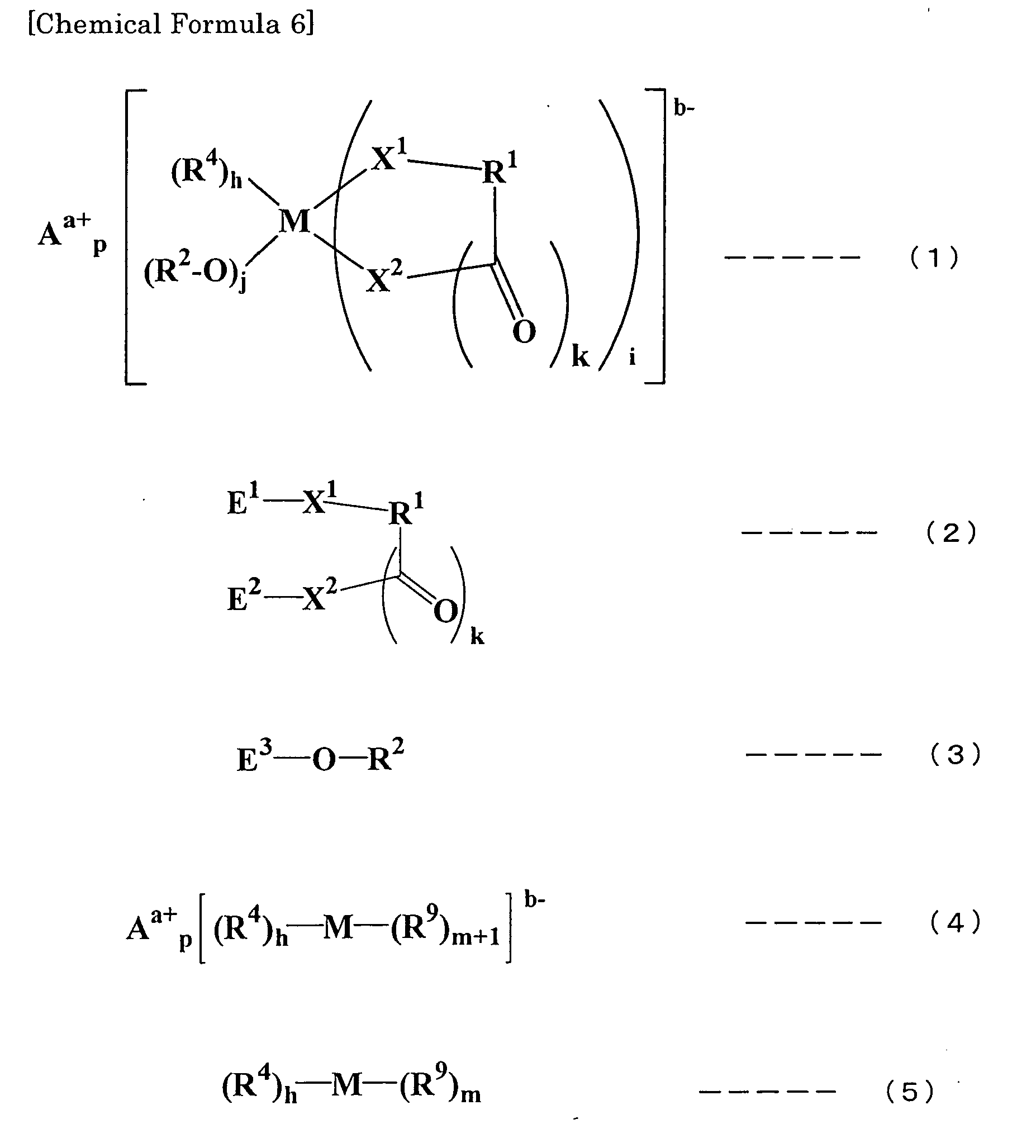
[0005] The present invention provides a method for synthesizing an ionic metal complex having a chemical structural formula represented by the formula (1), comprising reacting at least one of a compound represented by the formula (2) and a compound represented by the formula (3) with a halogen-containing compound represented by the formula (4) or formula (5), in an organic solvent, in the presence of a compound containing an element of group 1, group 2, group 13 or group 14 of the periodic table as a reaction aid.
[0007] M represents a transition metal or an element of group 13, group 14 or group 15 of the periodic table.
Aa+ represents a metal ion, hydrogen ion, or onium ion.
a represents 1-3, b represents 1-3, p represents b/a, h represents 1-5, i represents 0-2, j represents 0-5, k represents 0 or 1, and m represents 0-4.
The total of h, i and j is 3-6. At least one of i and j must necessarily be 1 or greater.
[0008] R1 represents a C1-C10 alkylene, C1-C10 halogenated alkylene, C3-C10 cycloalkylene, C3-C10 halogenated cycloalkylene, C6-C20 arylene, or C6-C20 halogenated arylene, wherein these alkylenes and arylenes may have substituents and hetero atoms in their structures, and R1 existing by a number of may bond to each other.
[0009] R2 represents a C1-C10 alkyl, C1-C10 halogenated alkyl, C6-C20 aryl, C6-C20 halogenated aryl, or -C(=O)R3, wherein these alkyls and aryls may have substituents and hetero atoms in their structures, and R2 existing by a number of j may bond to adjacent molecules to be in a polymer form.
[0010] R3 represents a halogen, C1-C10 alkyl, C1-C10 halogenated alkyl, C6-C20 aryl, or C6-C20 halogenated aryl, wherein these alkyls and aryls may have substituents and hetero atoms in their structures, and R3 existing by a number of j may bond to adjacent molecules to be in a polymer form.
[0011] R4 represents a halogen, C1-C10 alkyl, C1-C10 halogenated alkyl, C6-C20 aryl, C6-C20 halogenated aryl, or X3R5, wherein these alkyls and aryls may have substituents and hetero atoms in their structures, and R4 existing by a number of h may bond to each other to form a ring or may bond to adjacent molecules to be in a polymer form. '
[0012] X1 represents O, S, SO3, or NR6; X2 represents O, S, or NR7; X3 represents O, S, SO3, CO2, or NR8.
[0013] Each of R5, R6, R7 and R8 independently represents a hydrogen, C1-C10 alkyl, C1-C10 halogenated alkyl, C6-C20 aryl, or C6-C20 halogenated aryl, wherein these alkyls and aryls may have substituents and hetero atoms in their structures, and R5, R6, R7 and R8 existing in a plural number may bond to each other through single bond or multiple bond to form a ring or may bond to adjacent molecules to be in a polymer form.
[0014] Each of E1, E2 and E3 independently represents a hydrogen or alkali metal. Each of R9 represents a halogen.
[0015] The alkyls, halogenated alkyls, aryls, and halogenated aryls used in the present invention include ones having branches and other functional groups such as hydroxy groups and ether bonds.
DETAILED DESCRIPTION
[0016] The present invention has made it possible to easily and efficiently synthesize an ionic complex, which is used as a supporting salt or additive for electrochemical devices, such as lithium cell, lithium ion cell and electric double layer capacitor, a polymerization catalyst of polyolefin and the like, or a catalyst for organic syntheses.
[0018] Herein, it suffices that an ionic complex to be synthesized, which is the target of the present invention, is one having a structure in which inorganic and organic-series ligands are bonded to the central element, and it is preferably one having a structure represented by the formula (1).
[0019] M in the formula is one selected from transition metals and elements of group 13, group 14 or group 15 of the periodic table. It is preferably Al, B, V, Ti, Si, Zr, Ge, Sn, Cu, Y, Zn, Ga, Nb, Ta, Bi, P, As, Sc, Hf, and Sb. It is more preferably Al, B or P. It is possible to use various elements as M of the center. In the case of Al, B, V, Ti, Si, Zr, Ge, Sn, Cu, Y, Zn, Ga, Nb, Ta, Sc, or Hf, the synthesis is relatively easy, too. Furthermore, in the case of Al, B or P, it has superior characteristics in terms of all aspects of low toxicity, stability and cost, as well as easiness of synthesis.
[0020] Aa+ is a metal ion, hydrogen ion, or onium ion, preferably a lithium ion, sodium ion, potassium ion, quaternary alkylammonium ion, or hydrogen ion. Specific citations of Aa+ are lithium ion, sodium ion, potassium ion, magnesium ion, calcium ion, barium ion, cesium ion, silver ion, zinc ion, copper ion, cobalt ion, iron ion, nickel ion, manganese ion, titanium ion, lead ion, chromium ion, vanadium ion, ruthenium ion, yttrium ion, lanthanoid ions, actinoid ions, tetrabutylammonium ion, tetraethylammonium ion, tetramethylammonium ion, triethylmethylammonium ion, trimethylammonium ion, triethylammonium ion, pyridinium ion, imidazolium ion, 1,3-ethylmethylimidazolium, hydrogen ion, tetraethylphosphonium ion, tetramethylphosphonium ion, tetraphenylphosphonium ion, triphenylsulfonium ion, triethylsulfonium ion, triphenylmethyl ion, and the like. In particular, in the case of the consideration of the uses of electrochemical devices and the like, lithium ion, sodium ion, potassium ion, tetraalkylammonium ions, alkyl-substituted imidazolium ions, and hydrogen ion are preferable.
[0021] The valence a of the cation Aa+ is preferably 1 to 3. If it is greater than 3, the crystal lattice energy becomes large. Therefore, there occurs a problem that dissolution in solvent becomes difficult. Therefore, it is more preferably 1 in case that high solubility is necessary. Similarly, the valence b of the anion is preferably 1 to 3, particularly more preferably 1. The constant p showing the ratio of the cation and the anion is necessarily fixed by the valence ratio b/a of both.
[0022] Next, we explain a portion of the ligand that becomes a characteristic of the ionic complex synthesized in the present invention. In the following, an organic or inorganic portion bonded to M is called a ligand.
[0023] R1 in the formula (1) is one selected from a C1-C10 alkylene, C1-C10 halogenated alkylene, C3-C10 cycloalkylene, C3-C10 halogenated cycloalkylene, C6-C20 arylene, or C6-C20 halogenated arylene.
[0024] These alkylenes and arylenes may have substituents and hetero atoms in their structures. In particular, when a chelate ring is formed in conjunction with M of the center, one that forms a 5 to 10-membered ring is preferable. Being larger than 10-membered ring is not preferable, since the chelate effect becomes small.
[0025] In case that R1 has hydroxy group and carboxyl group in the structure, it is also possible that this portion further bonds to M of the center. Specifically, it is possible to mention structures and the like in which, in place of hydrogen on the alkylene and the arylene, halogen, chain or ring alkyl group, halogenated alkyl group, aryl group, halogenated aryl group, alkenyl group, halogenated alkenyl group, alkoxy group, halogenated alkoxy group, aryloxy group, halogenated aryloxy group, sulfonyl group, amino group, cyano group, carbonyl group, acyl group, amide group, and hydroxy group have been introduced; and structures and the like in which, in place of carbon on the alkylene and the arylene, nitrogen, sulfur and oxygen have been introduced.
[0026] R1 existing in a plural number may bond to each other. For example, it is possible to mention polyvalent ligands such as catechol, salicylic acid, and ethylenediaminetetraacetic acid. In the case of a polyvalent ligand, a chelate structure is formed in conjunction with M. Due to this chelate effect, this compound improves in heat resistance, chemical stability, and hydrolysis resistance. These ligand portions are preferably ones of electron attractive property. In particular, ones containing halogen in their structures are suitable. Ones containing fluorine are preferable.
[0027] R2 is one selected from a C1-C10 alkyl, C1-C10 halogenated alkyl, C6-C20 aryl, C6-C20 halogenated aryl, or -C(=O)R3. Similar to R1, these alkyls and aryls may have substituents and hetero atoms in their structures, and R2 existing by a number of j may bond to adjacent molecules to be in a polymer form.
[0028] R3 is one selected from a halogen, C1-C10 alkyl, C1-C10 halogenated alkyl, C6-C20 aryl, or C6-C20 halogenated aryl. These alkyls and aryls may have substituents and hetero atoms in their structures, and R3 existing by a plural number may bond to adjacent molecules to be in a polymer form.
[0029] R4 is one selected from a halogen, C1-C10 alkyl, C1-C10 halogenated alkyl, C6-C20 aryl, C6-C20 halogenated aryl, or X3R5. These alkyls and aryls may have substituents and hetero atoms in their structures. R4 existing by a number of h may bond to each other to form a ring or may bond to adjacent molecules to be in a polymer form. It is preferably an electron attractive group, particularly preferably fluorine. In case that R4 is fluorine, ionic conductivity becomes very high when used as an electrolyte, due to the effects of the improvement of degree of dissociation of the ionic complex by its strong electron attractive property and of the improvement of mobility by that the size becomes small.
[0030] X1 is O, S, SO3, or NR6. X2 is O, S, or NR7. X3 represents O, S, SO3, CO2, or NR8. The ligand is bonded to M through these hetero atoms. Herein, a bonding with ones other than O, S and N is not impossible, but it becomes very complicated in terms of synthesis. In case that these ligands exist by a number of 1 or greater, these ligands and M form a chelate structure, since there are bonds by X1 and X2 in the same ligand as a characteristic of this compound. This compound is improved by this chelate effect in heat resistance, chemical stability and hydrolysis resistance. In particular, in case that this chelate ring is a five-membered ring structure, the chelate effect is the most strongly exhibited to increase stability. Therefore, it is preferable.
[0031] R5, R6, R7 and R8 are ones selected from a hydrogen, C1-C10 alkyl, C1-C10 halogenated alkyl, C6-C20 aryl, or C6-C20 halogenated aryl. These alkyls and aryls may have substituents and hetero atoms in their structures. R5, R6, R7 and R8 existing in a plural number may bond to each other through single bond or multiple bond to form a ring.
[0032] The constants h, i, j and k relating to the number of the ligands explained hereinbefore depend on the type of M of the center. It is preferable that h is 1 to 5, i is 0 to 2, j is 0 to 5, and k is 0 or 1.
[0034] The method of the present invention for synthesizing the above complexes is explained. This method is characterized in that a ligand and a halogen-containing compound that becomes a supply source of the central element of the complex are reacted as raw materials in organic solvent in the presence of reaction aid.
[0035] The ligand is preferably one having an active hydrogen, alkali metal or alkali earth metal in order to bond to the halogen possessed by the halogen-containing compound, which becomes a supply source of the central element, and to eliminate it. Specifically, it is possible to mention alcohols, their metal alkoxides, carboxylic acids, their carboxylates, sulfonic acids, their sulfonates, sulfinic acids, their sulfinates, and the like. More preferably, this compound is a compound having a structure shown by the formula (2) or formula (3).
[0036] In the formulas (2) and (3), the symbols other than E1, E2 and E3 are the same as those of the formula (1).
[0037] Next, the halogen-containing compound, which becomes a supply source of the central element, has a transition metal or group 13, group 14 or group 15 of the periodic table as the central element. It is one in which at least one halogen is bonded to this central element. It may be one in which only halogen is bonded, or one in which other substituents are also bonded. Preferably, this halogen-containing compound is a compound having a structure shown by the formula (4) or formula (5).
[0038] In the formulas (4) and (5), the symbols other than R9 are the same as those of the formula (1). Herein, R9 represents a halogen, preferably a fluorine. As specific examples, it is possible to mention LiPF6, LiBF4, LiAlCl4, LiPF3(CF3)3, LiBF3(Ph), BF3, PF5, and the like. Ph represents a phenyl group.
[0039] In the present invention, the reaction aid is a compound containing a group 1, group 2, group 13 or group 14 element of the periodic table. Preferably, it is a compound containing Al, B, Si, alkali metal or alkali earth metal. A strong bond between these elements and the halogen aids in the progress of the target reaction in the present invention. Specifically, it is one selected from chlorides, bromides, iodides, alkoxy compounds and carboxy compounds of the above-mentioned elements. More preferably, it is one selected from AlCl3, BCl3, and SiCl4. E1R9, E2R9 or E3R9, which is generated in a small amount when the compound of the formula (2) or formula (3) and the compound of the formula (4) or the formula (5) have been mixed together, is removed by utilizing the reaction using this reaction aid. With this, the equilibrium shift in the direction of the target complex, resulting in the progress of the target reaction. It is desirable to select the ligand, the halogen-containing compound, and the reaction aid such that by-products are easily removed outside of the system as a precipitate or high-vapor-pressure component.
[0040] The quantitative ratio for conducting the reaction is not particularly limited. The ligand is reacted by 1 to 8 moles relative to 1 mole of the halogen-containing compound that becomes a supply source of the central element. The reaction aid is reacted by 0.1 to 10 times moles of the halogen-containing compound that becomes a supply source of the central element.
[0041] Although solvent used in the above-mentioned synthesis method depends on the structure of the compound, it is suitable to use one that dissolves even an extremely small amount of the compounds that become the raw materials and that does not react with the compounds in the system. It is preferably one having a relative dielectric constant of 2 or greater. Herein, in the case of using a solvent that has no dissolving power at all, the reaction becomes very slow. Therefore, it is not preferable. As long as it has even a slight solubility, the reaction proceeds rapidly since the target ionic complex has a high solubility. For example, it is possible to use carbonates, esters, ethers, lactones, nitriles, amides, sulfones, alcohols, aromatics, and the like. Besides a single solvent, it may be a mixed solvent of at least two kinds.
[0042] As specific examples of the solvent, it is possible to mention propylene carbonate, ethylene carbonate, diethyl carbonate, dimethyl carbonate, ethyl methyl carbonate, dimethoxyethane, acetonitrile, propionitrile, tetrahydrofuran, 2-methyltetrahydrofuran, dioxane, nitromethane, N,N-dimethylformamide, dimethylsulfoxide, sulfolane, γ-butyrolactone, toluene, ethanol, methanol, and the like.
[0043] Regarding the reaction temperature, -80°C to 100°C, preferably 0°C to 80°C, is used. If the temperature is lower than -80°C, the reaction may not proceed sufficiently. If the temperature is higher than 100°C, the solvent and the raw materials may be decomposed. The range of 0°C to 80°C is optimum in order to get a sufficient reaction rate and to generate no decomposition.
[0044] Since many of the raw materials used in the present invention have a hydrolytic property, it is desirable to conduct the synthesis in an atmosphere of a low-water-content air, nitrogen, argon, or the like.
[0045] It is also possible to purify the ionic complex, which has been obtained by the above-mentioned method, by a recrystallization method in which the solution is concentrated to precipitate crystals or a reprecipitation method in which a large amount of a poor solvent is added to the solution to precipitate them, followed by a method in which the obtained solid matter is washed, and the like.
[0046] In the following, the present invention is specifically explained by examples, but the present invention is not limited by such examples.
EXAMPLE 1
[0047] In a glove box of a dew point of -60°C, there were mixed together and dissolved 2.10g of catechol, 1.90g of lithium tetrafluoroborate (LiBF4), and 8mL of ethyl methyl carbonate. Next, 1.60g of silicon tetrachloride as the reaction aid were slowly added to this mixed liquid at room temperature with stirring. Concurrently with the start of the addition, gas was generated vigorously. After termination of the addition, stirring was continued for 2 hr. The obtained reaction liquid was subjected to 45°C and a reduced pressure condition of 133Pa to remove ethyl methyl carbonate. With this, 2.60g (yield: 83%) of lithium difluoro(catecholato)borate were obtained.
EXAMPLE 2
[0048] In a glove box of a dew point of -60°C, there were mixed together and dissolved 5.52g of salicylic acid, 6.08g of lithium hexafluorophosphate (LiPF6), and 100mL of diethyl carbonate. Next, 3.40g of silicon tetrachloride as the reaction aid were slowly added to this mixed liquid at room temperature with stirring. Concurrently with the start of the addition, gas was generated vigorously. After termination of the addition, stirring was continued for 2 hr. The obtained reaction liquid was subjected to 45°C and a reduced pressure condition of 133Pa to remove diethyl carbonate. With this, 9.70g (yield: 97%) of lithium tetrafluoro(salicylato)phosphate were obtained.
EXAMPLE 3
[0049] In a glove box of a dew point of -60°C, there were mixed together and dissolved 3.02g of trifluoroacetic acid, 3.34g of lithium tetrafluoroborate (LiBF4), and 100mL of diethyl carbonate. Next, 3.02g of silicon tetrachloride as the reaction aid were slowly added to this mixed liquid at room temperature with stirring. Concurrently with the start of the addition, gas was generated vigorously. After termination of the addition, stirring was continued for 2 hr. The obtained reaction liquid was subjected to 45°C and a reduced pressure condition of 133Pa to remove diethyl carbonate. With this, 9.80g (yield: 98%) of lithium difluorobis(acetoxy)borate were obtained.
EXAMPLE 4
[0050] In a glove box of a dew point of -60°C, there were mixed together and dissolved 6.72g of catechol, 1.91g of lithium tetrafluoroborate (LiBF4), 1.05g of lithium fluoride, and 100mL of diethyl carbonate. Next, 4.76g of boron trichloride (BCl3) as the reaction aid were slowly added to this mixed liquid at room temperature with stirring. Concurrently with the start of the addition, gas was generated vigorously. After termination of the addition, stirring was continued for 2 hr. The obtained reaction liquid was subjected to 45°C and a reduced pressure condition of 133Pa to remove diethyl carbonate. With this, 9.49g (yield: 95%) of lithium difluoro(catecholato)borate were obtained.
EXAMPLE 5
[0051] In a glove box of a dew point of -60°C, there were mixed together and dissolved 2.10g of catechol, 2.10g of sodium tetrafluoroborate (NaBF4), and 10mL of dimethyl carbonate. Next, 1.61g of silicon tetrachloride as the reaction aid were slowly added to this mixed liquid at room temperature with stirring. Concurrently with the start of the addition, gas was generated vigorously. After termination of the addition, stirring was continued for 2 hr. The obtained reaction liquid was subjected to 45°C and a reduced pressure condition of 133Pa to remove dimethyl carbonate. With this, 3.30g (yield: 96%) of sodium difluoro(catecholato)borate were obtained.
EXAMPLE 6
[0052] In a glove box of a dew point of -60°C, there were mixed together and dissolved 2.10g of catechol, 3.51g of potassium hexafluorophosphate (KPF6), and 20mL of diethyl carbonate. Next, 1.61g of silicon tetrachloride as the reaction aid were slowly added to this mixed liquid at room temperature with stirring. Concurrently with the start of the addition, gas was generated vigorously. After termination of the addition, stirring was continued for 2 hr. The obtained reaction liquid was subjected to 45°C and a reduced pressure condition of 133Pa to remove diethyl carbonate. With this, 4.36g (yield: 90%) of potassium tetrafluoro(catecholato)phosphate were obtained.
EXAMPLE 7
[0053] In a glove box of a dew point of -60°C, there were mixed together 2.10g of catechol, 4.15g of tetaethylammonium tetrafluoroborate ((C2H5)4NBF4), and 10mL of dimethyl carbonate, thereby making a suspension condition. Next, 1.61g of silicon tetrachloride as the reaction aid were slowly added to this mixed liquid at room temperature with stirring. Concurrently with the start of the addition, gas was generated vigorously, and the suspension gradually became clear. After termination of the addition, stirring was continued for 2 hr. The obtained reaction liquid was subjected to 45°C and a reduced pressure condition of 133Pa to remove dimethyl carbonate. With this, 5.32g (yield: 97%) of tetaethylammonium difluoro(catecholato)borate were obtained.
1. A method for synthesizing an ionic metal complex having a chemical structural formula
represented by the formula (1), comprising reacting at least one of a compound represented
by the formula (2) and a compound represented by the formula (3) with a halogen-containing
compound represented by the formula (4) or formula (5), in an organic solvent, in
the presence of a compound containing an element of group 1, group 2, group 13 or
group 14 of the periodic table as a reaction aid,
wherein M represents a transition metal or an element of group 13, group 14 or group 15 of the periodic table,
Aa+ represents a metal ion, hydrogen ion, or onium ion,
a represents 1-3,
b represents 1-3, p represents b/a,
h represents 1-5,
i represents 0-2,
j represents 0-5,
k represents 0 or 1,
m represents 0-4,
the total of h, i and j is 3-6,
at least one of i and j must necessarily be 1 or greater,
R1 represents a C1-C10 alkylene, C1-C10 halogenated alkylene, C3-C10 cycloalkylene, C3-C10 halogenated cycloalkylene, C6-C20 arylene, or C6-C20 halogenated arylene, wherein these alkylenes and arylenes may have substituents and hetero atoms in their structures, and R1 existing by a number of i may bond to each other,
R2 represents a C1-C10 alkyl, C1-C10 halogenated alkyl, C6-C20 aryl, C6-C20 halogenated aryl, or -C(=O)R3, wherein these alkyls and aryls may have substituents and hetero atoms in their structures, and R2 existing by a number of j may bond to adjacent molecules to be in a polymer form,
R3 represents a halogen, C1-C10 alkyl, C1-C10 halogenated alkyl, C6-C20 aryl, or C6-C20 halogenated aryl, wherein these alkyls and aryls may have substituents and hetero atoms in their structures, and R3 existing by a number of j may bond to adjacent molecules to be in a polymer form,
R4 represents a halogen, C1-C10 alkyl, C1-C10 halogenated alkyl, C6-C20 aryl, C6-C20 halogenated aryl, or X3R5, wherein these alkyls and aryls may have substituents and hetero atoms in their structures, and R4 existing by a number of h may bond to each other to form a ring or may bond to adjacent molecules to be in a polymer form,
X1 represents O, S, SO3, or NR6; X2 represents O, S, or NR7; X3 represents O, S, SO3, CO2, or NR8,
each of R5, R6, R7 and R8 independently represents a hydrogen, C1-C10 alkyl, C1-C10 halogenated alkyl, C6-C20 aryl, or C6-C20 halogenated aryl, wherein these alkyls and aryls may have substituents and hetero atoms in their structures, and R5, R6, R7 and R8 existing in a plural number may bond to each other through single bond or multiple bond to form a ring or may bond to adjacent molecules to be in a polymer form,
each of E1, E2 and E3 independently represents a hydrogen or alkali metal, and
R9 represents a halogen.
wherein M represents a transition metal or an element of group 13, group 14 or group 15 of the periodic table,
Aa+ represents a metal ion, hydrogen ion, or onium ion,
a represents 1-3,
b represents 1-3, p represents b/a,
h represents 1-5,
i represents 0-2,
j represents 0-5,
k represents 0 or 1,
m represents 0-4,
the total of h, i and j is 3-6,
at least one of i and j must necessarily be 1 or greater,
R1 represents a C1-C10 alkylene, C1-C10 halogenated alkylene, C3-C10 cycloalkylene, C3-C10 halogenated cycloalkylene, C6-C20 arylene, or C6-C20 halogenated arylene, wherein these alkylenes and arylenes may have substituents and hetero atoms in their structures, and R1 existing by a number of i may bond to each other,
R2 represents a C1-C10 alkyl, C1-C10 halogenated alkyl, C6-C20 aryl, C6-C20 halogenated aryl, or -C(=O)R3, wherein these alkyls and aryls may have substituents and hetero atoms in their structures, and R2 existing by a number of j may bond to adjacent molecules to be in a polymer form,
R3 represents a halogen, C1-C10 alkyl, C1-C10 halogenated alkyl, C6-C20 aryl, or C6-C20 halogenated aryl, wherein these alkyls and aryls may have substituents and hetero atoms in their structures, and R3 existing by a number of j may bond to adjacent molecules to be in a polymer form,
R4 represents a halogen, C1-C10 alkyl, C1-C10 halogenated alkyl, C6-C20 aryl, C6-C20 halogenated aryl, or X3R5, wherein these alkyls and aryls may have substituents and hetero atoms in their structures, and R4 existing by a number of h may bond to each other to form a ring or may bond to adjacent molecules to be in a polymer form,
X1 represents O, S, SO3, or NR6; X2 represents O, S, or NR7; X3 represents O, S, SO3, CO2, or NR8,
each of R5, R6, R7 and R8 independently represents a hydrogen, C1-C10 alkyl, C1-C10 halogenated alkyl, C6-C20 aryl, or C6-C20 halogenated aryl, wherein these alkyls and aryls may have substituents and hetero atoms in their structures, and R5, R6, R7 and R8 existing in a plural number may bond to each other through single bond or multiple bond to form a ring or may bond to adjacent molecules to be in a polymer form,
each of E1, E2 and E3 independently represents a hydrogen or alkali metal, and
R9 represents a halogen.
2. A method for synthesizing an ionic complex according to claim 1, which is characterized in that the reaction aid is a compound of Al, B, Si, alkali metal or alkali earth metal.
3. A method for synthesizing an ionic complex according to claim 1, which is characterized in that the reaction aid is a chloride, bromide, iodide, alkoxy compound or carboxy compound
of Al, B, Si, alkali metal or alkali earth metal.
4. A method for synthesizing an ionic complex according to claim 1, which is characterized in that the reaction aid is AlCl3, BCl3, or SiCl4.
5. A method for synthesizing an ionic complex according to claim 1, which is characterized in that M is Al, B, V, Ti, Si, Zr, Ge, Sn, Cu, Y, Zn, Ga, Nb, Ta, Bi, P, As, Sc, Hf, or Sb.
6. A method for synthesizing an ionic complex according to claim 1, which is characterized in that Aa+ is a lithium ion, sodium ion, potassium ion, hydrogen ion, or quaternary alkylammonium
ion.
7. A method for synthesizing an ionic complex according to claim 1, which is characterized in that R9 is a fluorine.
REFERENCES CITED IN THE DESCRIPTION
This list of references cited by the applicant is for the reader's convenience only. It does not form part of the European patent document. Even though great care has been taken in compiling the references, errors or omissions cannot be excluded and the EPO disclaims all liability in this regard.
Patent documents cited in the description