|
(11) | EP 1 858 839 B1 |

| (12) | EUROPEAN PATENT SPECIFICATION |
|
|
| (54) |
REMOVAL OF RESIDUAL SULFUR DIOXIDE FROM DIMETHYL SULFATE ENTFERNUNG VON SCHWEFELDIOXIDRÜCKSTÄNDEN AUS DIMETHYLSULFAT ELIMINATION DU DIOXYDE DE SOUFRE RESIDUEL DU SULFATE DE DIMETHYLE |
|
|
|||||||||||||||||||||||||||||||
| Note: Within nine months from the publication of the mention of the grant of the European patent, any person may give notice to the European Patent Office of opposition to the European patent granted. Notice of opposition shall be filed in a written reasoned statement. It shall not be deemed to have been filed until the opposition fee has been paid. (Art. 99(1) European Patent Convention). |
Field of the Invention
[0001] The present invention generally relates to a process for the minimization and/or removal of sulfur dioxide from dimethyl sulfate.
Background of the Invention
[0002] Quaternized fatty acid triethanolamine ester salts are cationic surfactants that are excellent fabric softeners that have high ecotoxicological compatibility. Ester quats are typically produced in a two-stage process in which triethanolamine is first partly esterified with fatty acids and the reaction product is subsequently quaternized with an alkylating agent. Hypophosphorous acid and sodium hypophosphite are preferred catalysts for the esterification step. However, during working up, particularly at relatively high temperatures, certain by-products are formed, resulting in an adverse effect on the odor of the dimethyl sulfate (DMS) quaternized product. Many of these odor-related problems can be traced to sulfur dioxide contaminants in the dimethyl sulfate. Accordingly, it is desirable to minimize and/or remove all of the sulfur dioxide from dimethyl sulfate prior to quaternization.
[0003] It is noted that WO 2004/060854 discloses a hypophosphorous-catalyst based process to make odor-free dimethyl sulfate-quaternized amines by using a dimethyl sulfate containing less than 20 ppm SO2. In US 5670677 peroxide and alkali metal boranate are used to treat the ester before quaternization to improve color and odor of the quaternized material. Similarly, in US 4830771 the quaternized ammonium compounds are optionally bleached with H2O2 to improve the color.
[0005] Accordingly, the invention provides a process for the minimization and/or removal of sulfur dioxide from dimethyl sulfate. When used in the quaternization of amines made with hypophosphorous acid, dimethyl sulfate having little to no sulfur dioxide leads to the formation of a product substantially free of malodors.
Detailed Description of the Invention
[0006] The invention relates to a method of removing SO2 contaminants from DMS, to an SO2--free DMS and to odor-free products produced by said SO2-free DMS.
[0007] Quaternized fatty acid triethanolamine ester salts are cationic surfactants that are excellent fabric-softeners that have high ecotoxicological compatibility. Ester quats are typically produced in a two-stage process in which triethanolamine is first partly esterified with fatty acids, and the reaction product is subsequently quaternized with an alkylating agent. Hypophosphorous acid and sodium hypophosphite are preferred catalysts for the esterification step. However, during working up, particularly at relatively high temperatures, certain by-products are formed, resulting in an adverse effect on the odor of the dimethyl sulfate-quaternized product. Many of these odor-related problems can be traced to sulfur dioxide contaminants in the dimethyl sulfate. Sulfur dioxide is a contaminant in commercial dimethyl sulfate in quantities ranging from a few tens of ppm to about 1000 ppm, and it is believed that malodor is due to methylated sulfur compounds produced in complex chemistry involving residues of reactive ingredients interacting in the final quaternization step. Since the methylated sulfur compounds are detectable by smell in quantities down to about 1 ppb, prevention of their formation is the most practical way to insure that DMS-quaternized esterquats are free of objectionable odors.
[0008] The invention provides a process for the minimization and/or removal of sulfur dioxide contaminants from dimethyl sulfate. The method involves addition of one or more oxidizing agents to convert the SO2 contaminants in DMS effectively to SO3 (or sulfuric acid derivatives). More specifically, the present inventors have demonstrated that DMS containing high levels of SO2 produced high concentrations of methyl-S compounds as analyzed by GC. After treatment of the DMS by addition of one or more oxidizing agents such as t-butyl hydroperoxide and/or hydrogen peroxide in calculated quantities down to about an 18% excess, or less, in order to remove SO2 contaminants from DMS, the methyl-S compounds were no longer detectable by GC after quaternization.
[0009] The oxidizing agents employable in the process of the present invention include agents of the formula: ROOR where R = H or R'[O]m[CO]n-, wherein R'=alkyl or aryl and m and n = 0 or 1, with m = 0 if n = 0. Preferred oxidizing agents are peroxides, including hydrogen peroxide, hydroperoxides, peroxides, peresters, percarbonates and the like. Specific examples of preferred oxidizing agents include O2, O3, Cl2, KMnO4, K2Cr2O7, KClO3, NaClO2, HNO3, H2O2, t-butyl hydroperoxide, and the like.
[0010] The oxidizing agent(s) are added to the SO2-containing DMS in quantities of from 5 ppm to 1000 ppm; in most cases in an amount of from 10% to 100% molar excess versus the analyzed molar amount of SO2 will suffice. In another embodiment, an amount of from 10% to 100% molar excess versus the analyzed molar amount of SO2 is employed. This treatment step is typically performed at room temperature, and subsequent to adding the oxidizing agent to the DMS, the DMS is allowed to stand from a few minutes up to a few hours.
[0011] The present inventors have also discovered a process for the production of products free of malodors when prepared from the dimethyl sulfate quaternization of amines made with hypophosphorous acid. In such products the volatile organic sulfur by-products that lead to the formation of objectionable odors are minimized. In this regard the invention comprises quaternizing said amines with a dimethyl sulfate quaternization agent wherein said dimethyl sulfate has a sulfur dioxide content of less than 10 parts per million (ppm), preferably less than 8 ppm, and still more preferably less than 5 ppm. Minimizing the sulfur dioxide content in the dimethyl sulfate quaternization agent reduces or eliminates the formation of undesirable odor-causing by-products such as hydrogen sulfide, methyl mercaptan, dimethyl sulfide and dimethyl disulfide, resulting in a greatly improved odor profile of the final product. The present invention is not limited to processes for the preparation of ester quats but rather, is applicable to any dimethyl sulfate quaternization process of amines made with esterification catalyst/reductive bleaching agents.
[0012] The esterification catalyst/reductive bleaching agents employed in the context of the present invention are characterized in that they typically have a standard reduction potential of at least 0.5 volts. Nonlimiting examples of such esterification catalyst/reductive bleaching agents are hypophosphorous acid, sodium hypophosphite and mixtures thereof.
[0013] In another embodiment, the present invention relates to quaternary ammonium compounds having particularly good performance and stability profiles obtained by reaction of C12 - C22 fatty acids or the hydrogenation products thereof, or a mixture of such acids, with an alkanolamine in the presence of an acid catalyst, wherein the ratio of fatty acid to alkanolamine is from 1.40 -2.0. The resultant esteramine reaction products are subsequently quaternized to obtain the quaternary ammonium salts of the present invention.
[0014] The fatty acid is preferably a C12 - C22 acid containing a degree of unsaturation such that the iodine value ("IV") is in the range of from 0-140, preferably, from 3-90, more preferably in the range of 40-60 and still more preferably, in a range of from 45-55. Preferably, the fatty acid source is selected from C12-C22 fatty acids represented by the formula:
Rx-COOH,
wherein, Rx is a straight or branched chain C11-C21 alkyl group.
[0015] Preferred sources of C12-C22 fatty acids are selected from the group consisting of: lauric acid, tridecylic acid, myristic acid, pentadecylic acid, palmitic acid, margaric acid, stearic acid, arachidic acid, phytanic acid, behenic acid, anionic derivatives thereof, salts thereof, and combinations thereof.
[0016] Preferred sources of acid are C12-C22 fatty acids comprising a saturated alkyl group. Other preferred sources of acids are C12-C22 fatty acids comprising an unsaturated group, typically having an iodine value of from 15 to 25, preferably from 18 to 22.
[0017] The source of acid may be selected from the group consisting of palmitoleic acid, oleic acid, elaidic acid, vaccenic acid, linoleic acid, cis-eleostearic acid, trans-eleostearic acid, linolenic acid, arachidonic acid, anionic derivatives thereof, salts thereof, and combinations thereof.
[0018] Preferred sources of fatty acids are selected from the group consisting of coconut, soybean, tallow, palm, palm kernel, rapeseed, lard, sunflower, corn, safflower, canola, olive, peanut, and combinations thereof. A preferred source of acid is hard tallow fatty acid and/or partially hydrogenated tallow fatty acid.
[0019] Preferred fatty acids include but are not limited to oleic, palmitic, erucic, eicosanoic and mixtures thereof. Soy, tallow, palm, palm kernel, rape seed, lard, mixtures thereof and the like are typical sources for fatty acid which can be employed in the present invention. The fatty acid(s) employed in the present process optionally have a cis to trans isomer ratio of from about 80:20 to about 95:5. In another embodiment, the trans isomer content of said fatty acid(s) is less than about 10%. A typical trans-isomer content is between about 0.5 - 9.9%. A preferred fatty acid is a mixture of tallow/distilled tallow having a cis:trans isomer ratio of greater than 9:1. Partial or fully hydrogenated fatty acids can be employed in the process of the present invention.
[0020] The alkanolamines employable in the present invention generally correspond to the formula:
herein R, R1 and R2 are independently selected from C2 - C6 hydroxyalkyl groups or a group of the formula
where R3 is independently H or a C1 to C4 alkyl and z is 1 to 10.
[0022] Where R4 is a linear or branched, substituted or unsubstituted alkyl group, amidoalkyl group, etheralkyl group, or polyoxyalkylene group, n and m = 1-10, and R3 has the meanings defined above.
[0023] Examples of alkanolamines useful in the context of the present invention include, but are not limited to, triethanolamine, isopropanoldiethanolamine, ethanoldiisopropanolamine, triisopropanolamine, diethanolisopropanolamine, diethanolisobutanolamine, methyldiethanolamine and mixtures thereof.
[0024] The molar ratio of fatty acid to alkanolamine is generally in the range of from 1.4 to 2.0, preferably from 1.55 - 1.90, and more preferably, in the range of from 1.65-1.75. Best results are usually obtained when the molar ratio is between 1.68-1.72. The acid catalyst employable in the present process includes acid catalysts such as sulfuric acid, phosphorous acid, p-toluenesulfonic acid, methanesulfonic acid, oxalic acid, hypophosphorous acid or an acceptable Lewis acid in an amount of 500-3000 ppm based on the amount of fatty acid charge. A preferred acid catalyst is hypophosphorous acid. Typically, 0.02 - 0.2 % by weight, and more preferably 0.1 to 0.15 % by weight of acid catalyst, based on the weight of fatty acid, in employed in the present process.
[0025] The esterification of fatty acids with alkanolamines is carried out at a temperature of from 150° - 250°C until the reaction product has an acid value of below 5. After the esterification, the crude product is reacted with alkylating agents in order to obtain the quaternary ammonium product. The alkylating agent employed in the present invention is dimethyl sulfate having a sulfur dioxide content of less than 10 ppm. Typically, 0.7 to 1.0, preferably 0.75 to 0.98 mole of dimethyl sulfate per mole of esteramine is satisfactory in yielding the quaternized product.
[0026] The quaternization may be carried out in bulk or in solvent, at temperatures ranging from 60° - 120°C. If a solvent is employed, then the starting materials and/or product must be soluble in the solvent to the extent necessary for the reaction. Solvents of this type are generally known in the art. Suitable examples include polar solvents such as, for example, lower alcohols, i.e., C1 - C6 alcohols. Other solvents which can be employed include, but are not limited to mono-, di-, and tri-glycerides, fatty acids, glycols and mixtures thereof.
[0027] The products of the invention can beneficially be employed in textile softening and/or personal care compositions and in other applications typical for cationic surfactants.
Example 1
[0029] In small vials, 5 mL portions of commercial DMS were treated with 50 µL portions of either water or an oxidizing agent, stirred 30 min and then sampled.
[0030] The SO2 content was measured before and after treatment, as shown in the table.
DMS Treatments to Remove SO2
| Additive | Mol/mol SO2 | SO2 Conc. µg/mL |
| none | - | 445 |
| water | 80 | 310 |
| 30% H2O2 | 14 | <3 (ND) |
| 70% t-BuOOH | 5.9 | <3 (ND) |
| ND = not detected |
Example 2
[0031] 13.2 g of DMS containing roughly 2460 ppm SO2 (0.51 mmol) was treated with 26 µL (∼33 mg, 0.69 mmol, ∼35% excess) of 71.1% H2O2 (d 1.285). The colorless solution had no detectable remaining SO2.
Example 3
[0032] Hardened tallow triethanol ester methyl amine (HT TEEMA) was prepared using 1660 ppm (vs. fatty acid) of 50% hypophosphorous acid. Three 250-lb batches of hardened tallow triethanolamine ester quaternary (HT TEQ) were made by quaternization of the HT TEEMA with the following DMS feedstocks:
- 1. Commercial DMS containing -80 ppm of SO2.
- 2. Thirty-six pounds of DMS doped with 0.054 lb of sulfur dioxide to ∼1500 ppm of SO2.
- 3. Thirty-six pounds of DMS doped with -1500 ppm of SO2 and then treated with 0.086 lb, a 45-55% molar excess, of 50% hydrogen peroxide (∼2400 ppm) to reduce the SO2 to ∼1 ppm (as analyzed after 4.5 hr). The excess peroxide corresponds to stoichiometry for the reaction: H2O2 + SO2 → H2SO4.
[0033] The reactor was washed thoroughly between batches to avoid potential cross-contamination. All of the HT TEQ samples were kept in a freezer to preserve the odor characteristics of each of the batches until all of the runs were completed. The HT TEQ samples were then evaluated by a formal, 6-person odor panel.
[0034] Both HT TEQ batches 3256 and 3257, made from DMS with 80 ppm and 1500 ppm of SO2, respectively, had typical sulfur compound odors, with the latter batch having an exceptionally foul odor. The odor panel verified that the HT TEQ made from batch 3258 of treated DMS containing - 1 ppm SO2 did not have any detectable sulfur type odors.
Analysis of HT TEQ Made on 250-lb Scale
| Sample (Batch #) |
DMS Used | CH3SH | (CH3)2S | (CH3)2S2 | Unk.1 | |
| # | SO2 Conc. | Nanograms/gram or ppb | ||||
| 3256 | 1 | 80 ppm | 3 | <2 | <2 | 1 |
| 3257 | 2 | 1500 ppm | 29 | 32 | 1423 | 7 |
| 3258 | 3 | 1 ppm | <2 | <2 | <2 | <2 |
| 1 MW of 94, probably CH3OS[O]CH3 or CH3OSOCH3. |
1. A process for removing residual SO2 from dimethyl sulfate that comprises treating said dimethyl sulfate with an SO2-removing effective amount of at least one oxidizing agent for a time and at a temperature
effective to remove substantially all residual SO2 from the dimethyl sulfate.
2. The process of claim 1 wherein said oxidizing agent is represented by the formula:
ROOR where R = H or R'[O]m[CO]n-, wherein R'=alkyl or aryl and m and n = 0 or 1, with m = 0 if n = 0.
3. The process of claim 2 wherein said oxidizing agent is selected from the group consisting
of hydrogen peroxide, hydroperoxides, peroxides, peresters, percarbonates and mixtures
thereof.
4. The process of claim 1 wherein said oxidizing agent is selected from the group consisting
of O2, O3, Cl2, KMnO4, K2Cr2O7, KClO3, NaClO2, HNO3, H2O2, t-butyl hydroperoxide, and mixtures thereof.
5. The process of claim 1 wherein said oxidizing agent(s) are added to the SO2-containing DMS in quantities of from 5 ppm to 1000 ppm.
6. The process of claim 5 wherein said oxidizing agent is added to said SO2-containing DMS in an amount of from 10% to 100% molar excess versus the analyzed
molar amount of SO2.
7. The process of claim 1 wherein said treatment is conducted at ambient temperature.
8. The process of claim 1 wherein the amount of oxidizing agent and the reaction conditions
are selected such that the dimethyl sulfate contains less than 20 ppm sulfur dioxide
subsequent to said treatment.
9. The process of claim 8 wherein the amount of oxidizing agent and the reaction conditions
are selected such that the dimethyl sulfate contains less than 8 ppm sulfur dioxide
subsequent to said treatment.
10. The process of claim 9 wherein the amount of oxidizing agent and the reaction conditions
are selected such that the dimethyl sulfate contains less than 5 ppm sulfur dioxide
subsequent to said treatment.
11. A process for preparing a quaternized fatty acid triethanolamine ester having improved
odor profile that comprises esterifying an alkanolamine with fatty acid in the presence
of a esterification catalyst/reductive bleaching agent having a standard reduction
potential of at least 0.5 volts in order to form an esteramine and thereafter quatemizing
said esteramine with dimethyl sulfate, wherein said dimethyl sulfate is treated in
accordance with the process of claim 1.
12. The process of claim 11 wherein said esterification catalyst/reductive bleaching agent
is selected from the group consisting of hypophosphorous acid, sodium hypophosphite
and mixtures thereof.
13. The process of claim 12 wherein said fatty acid is a C12 - C22 acid containing a degree of unsaturation such that the iodine value ("IV") is in
the range of from 0-140.
14. The process of claim 13 wherein said fatty acid is selected from the group consisting
of oleic, palmitic, erucic, eicosanoic and mixtures thereof.
15. The process of claim 11 wherein said alkanolamine is of the formula:
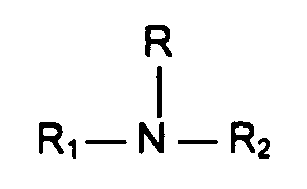
wherein R, R1 and R2 are independently selected from C2 - C6 hydroxyalkyl groups.
wherein R, R1 and R2 are independently selected from C2 - C6 hydroxyalkyl groups.
16. The process of claim 15 wherein said alkanolamine is selected from the group consisting
of triethanolamine, isopropanoldiethanolamine, ethanoldiisopropanolamine, triisopropanolamine,
diethanolisopropanolamine, diethanolisobutanolamine, methyldiethanolamine and mixtures
thereof.
17. The process of claim 11 wherein said dimethyl sulfate contains less than 8 ppm sulfur
dioxide.
18. The process of claim 17 wherein said dimethyl sulfate contains less than 5 ppm sulfur
dioxide.
1. Ein Verfahren zum Entfernen von SO2-Rückständen aus Dimethylsulfat, welches das Behandeln des Dimethylsulfats mit einer
zur Entfernung von SO2 wirksamen Menge von mindestens einem Oxidationsmittel über eine Zeit und bei einer
Temperatur, welche wirksam sind, um im Wesentlichen alle SO2-Rückstände aus dem Dimethylsulfat zu entfernen, umfasst.
2. Das Verfahren gemäß Anspruch 1, wobei das Oxidationsmittel durch die Formel ROOR dargestellt
wird, wobei R = H oder R'[O]m[CO]n- , wobei R' = Alkyl oder Aryl und m und n= 0 oder 1, wobei m = 0 wenn n = 0.
3. Das Verfahren gemäß Anspruch 2, wobei das Oxidationsmittel ausgewählt ist aus der
Gruppe bestehend aus Wasserstoffperoxid, Hydroperoxiden, Peroxiden, Perestern, Percarbonaten
und Gemischen davon.
4. Das Verfahren gemäß Anspruch 1, wobei das Oxidationsmittel ausgewählt ist aus der
Gruppe bestehend aus O2, O3, Cl2, KMnO4, K2Cr2O7, KClO3, NaClO2, HNO3, H2O2, t-Butylhydroperoxid und Gemischen davon.
5. Das Verfahren gemäß Anspruch 1, wobei das/die Oxidationsmittel in Mengen von 5 ppm
bis 1000 ppm zu dem SO2 enthaltenden DMS zugegeben werden.
6. Das Verfahren gemäß Anspruch 5, wobei das Oxidationsmittel in einer Menge von einem
10% bis 100% molaren Überschuss gegenüber der analysierten Molmenge von SO2 zu dem SO2 enthaltenden DMS zugegeben wird.
7. Das Verfahren gemäß Anspruch 1, wobei die Behandlung bei Raumtemperatur durchgeführt
wird.
8. Das Verfahren gemäß Anspruch 1, wobei die Menge des Oxidationsmittels und die Reaktionsbedingungen
derart ausgewählt sind, dass das Dimethylsulfat nach der Behandlung weniger als 20
ppm Schwefeldioxid enthält.
9. Das Verfahren gemäß Anspruch 8, wobei die Menge des Oxidationsmittels und die Reaktionsbedingungen
derart ausgewählt sind, dass das Dimethylsulfat nach der Behandlung weniger als 8
ppm Schwefeldioxid enthält.
10. Das Verfahren gemäß Anspruch 9, wobei die Menge des Oxidationsmittels und die Reaktionsbedingungen
derart ausgewählt sind, dass das Dimethylsulfat nach der Behandlung weniger als 5
ppm Schwefeldioxid enthält.
11. Ein Verfahren zur Herstellung eines quaternisierten Fettsäuretriethanolaminesters
mit verbessertem Geruchsprofil, welches die Veresterung eines Alkanolamins mit einer
Fettsäure in Gegenwart eines Veresterungskatalysators/reduktiven Bleichmittels mit
einem Standardreduktionspotential von mindestens 0,5 Volt umfasst, um ein Esteramin
zu bilden, und danach Quaternisierung des Esteramins mit Dimethylsulfat, wobei das
Dimethylsulfat gemäß dem Verfahren nach Anspruch 1 behandelt ist.
12. Das Verfahren gemäß Anspruch 11, wobei der Veresterungskatalysator/das reduktive Bleichmittel
ausgewählt ist aus der Gruppe bestehend aus hypophosphoriger Säure, Natriumhypophosphit
und Gemischen davon.
13. Das Verfahren gemäß Anspruch 12, wobei die Fettsäure eine C12-C22-Säure ist, welche einen Ungesättigtheitsgrad aufweist, so dass die Jodzahl (engl.
iodine value, "IV") im Bereich von 0 bis 140 liegt.
14. Das Verfahren gemäß Anspruch 13, wobei die Fettsäure ausgewählt ist aus der Gruppe
bestehend aus Oleinsäure, Palmitinsäure, Erucasäure, Eikosansäure und Gemischen davon.
15. Das Verfahren gemäß Anspruch 11, wobei das Alkanolamin die Formel
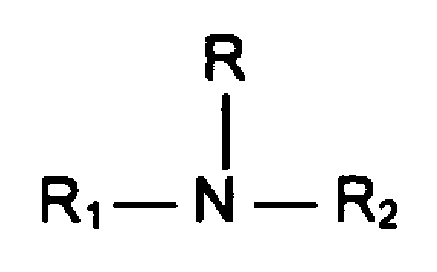
aufweist, wobei R, R1 und R2 unabhängig voneinander ausgewählt sind aus C2-C6-Hydroxyalkylresten.
aufweist, wobei R, R1 und R2 unabhängig voneinander ausgewählt sind aus C2-C6-Hydroxyalkylresten.
16. Das Verfahren gemäß Anspruch 15, wobei das Alkanolamin ausgewählt ist aus der Gruppe
bestehend aus Triethanolamin, Isopropanoldiethanolamin, Ethanoldüsopropanolamin, Triisopropanolamin,
Diethanolisopropanolamin, Diethanolisobutanolamin, Methyldiethanolamin und Gemischen
davon.
17. Das Verfahren gemäß Anspruch 11, wobei das Dimethylsulfat weniger als 8 ppm Schwefeldioxid
enthält.
18. Das Verfahren gemäß Anspruch 17, wobei das Dimethylsulfat weniger als 5 ppm Schwefeldioxid
enthält.
1. Procédé pour éliminer le SO2 résiduel du sulfate de diméthyle qui comprend le traitement dudit sulfate de diméthyle
avec une quantité efficace pour éliminer le SO2 d'au moins un agent oxydant pendant une durée et à une température efficaces pour
éliminer sensiblement tout le SO2 résiduel du sulfate de diméthyle.
2. Procédé selon la revendication 1, dans lequel ledit agent oxydant est représenté par
la formule : ROOR où R = H ou R'[O]m[CO]n-, dans lequel R' = un groupe alkyle ou un groupe aryle et m et n = 0 ou 1, avec m
= 0 si n = 0.
3. Procédé selon la revendication 2, dans lequel ledit agent oxydant est choisi dans
le groupe constitué par le peroxyde d'hydrogène, les hydroperoxydes, les peroxydes,
les peresters, les percarbonates et leurs mélanges.
4. Procédé selon la revendication 1, dans lequel ledit agent oxydant est choisi dans
le groupe constitué par O2, O3, Cl2, KMnO4, K2Cr2O7, KClO3, NaClO2, HNO3, H2O2, l'hydroperoxyde de t-butyle et leurs mélanges.
5. Procédé selon la revendication 1, dans lequel ledit ou lesdits agents oxydants sont
ajoutés au DMS contenant du SO2 dans des quantités de 5 ppm à 1 000 ppm.
6. Procédé selon la revendication 5, dans lequel ledit agent oxydant est ajouté audit
DMS contenant du SO2 dans une quantité de 10 % à 100 % en excès molaire par rapport à la quantité molaire
analysée de SO2.
7. Procédé selon la revendication 1, dans lequel ledit traitement est conduit à température
ambiante.
8. Procédé selon la revendication 1, dans lequel la quantité d'agent oxydant et les conditions
de réaction sont choisies de sorte que le sulfate de diméthyle contient moins de 20
ppm de dioxyde de soufre consécutivement audit traitement.
9. Procédé selon la revendication 8, dans lequel la quantité d'agent oxydant et les conditions
de réaction sont choisies de sorte que le sulfate de diméthyle contient moins de 8
ppm de dioxyde de soufre consécutivement audit traitement.
10. Procédé selon la revendication 9, dans lequel la quantité d'agent oxydant et les conditions
de réaction sont choisies de sorte que le sulfate de diméthyle contient moins de 5
ppm de dioxyde de soufre consécutivement audit traitement.
11. Procédé de préparation d'un ester de triéthanolamine d'acide gras quaternisé ayant
un profil d'odeur amélioré qui comprend l'estérification d'une alcanolamine avec un
acide gras en présence d'un catalyseur d'estérification/agent de blanchiment réducteur
ayant un potentiel de réduction type d'au moins 0,5 volt afin de former une esteramine,
puis la quaternisation de ladite esteramine avec du sulfate de diméthyle, dans lequel
ledit sulfate de diméthyle est traité conformément au procédé selon la revendication
1.
12. Procédé selon la revendication 11, dans lequel ledit catalyseur d'estérification/agent
de blanchiment réducteur est choisi dans le groupe constitué par l'acide hypophosphoreux,
l'hypophosphite de sodium et leurs mélanges.
13. Procédé selon la revendication 12, dans lequel ledit acide gras est un acide en C12 à C22 contenant un degré d'insaturation tel que l'indice d'iode (« IV ») est dans la plage
de 0 à 140.
14. Procédé selon la revendication 13, dans lequel ledit acide gras est choisi dans le
groupe constitué par l'oléique, le palmitique, l'érucique, l'éicosanoïque et leurs
mélanges.
15. Procédé selon la revendication 11, dans lequel ladite alcanolamine est de formule
:
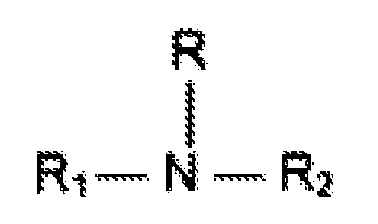
dans laquelle R, R1 et R2 sont indépendamment choisis parmi des groupes hydroxyalkyle en C2 à C6.
dans laquelle R, R1 et R2 sont indépendamment choisis parmi des groupes hydroxyalkyle en C2 à C6.
16. Procédé selon la revendication 15, dans lequel ladite alcanolamine est choisie dans
le groupe constitué par la triéthanolamine, l'isopropanoldiéthanolamine, l'éthanoldiisopropanolamine,
la triisopropanolamine, la diéthanolisopropanolamine, la diéthanolisobutanolamine,
la méthyldiéthanolamine et leurs mélanges.
17. Procédé selon la revendication 11, dans lequel ledit sulfate de diméthyle contient
moins de 8 ppm de dioxyde de soufre.
18. Procédé selon la revendication 17, dans lequel ledit sulfate de diméthyle contient
moins de 5 ppm de dioxyde de soufre.
REFERENCES CITED IN THE DESCRIPTION
This list of references cited by the applicant is for the reader's convenience only. It does not form part of the European patent document. Even though great care has been taken in compiling the references, errors or omissions cannot be excluded and the EPO disclaims all liability in this regard.
Patent documents cited in the description
- WO2004060854A [0003]
- US5670677A [0003]
- US4830771A [0003]
- GB119250A [0004]
- DE4121409 [0004]
- DE10132526 [0004]